
Vox clamantis in deserto




Beautiful beetle from Asia a killer of ash trees here

Emerald ash borer.
From ecoRI News (ecori.org)
The emerald ash borer, a destructive forest insect from Asia, has been found for the first time in Rhode Island, according to that state's Department of Environmental Management (DEM). The state has joined the federal quarantine covering much of the eastern United States to slow the spread of this alien invader.
Officials with the Animal and Plant Health and Inspection Service (APHIS) of the U.S. Department of Agriculture (USDA) have confirmed the identification of a beetle recently found in Washington County. The insect, which attacks only ash trees, was captured during annual monitoring surveys conducted jointly by DEM, the University of Rhode Island, and the USDA.
With many more traps collected from around Rhode Island now being examined, it’s highly likely that there will be more positive emerald ash borer identifications to be announced, according to DEM.
The emerald ash borer accidentally arrived in North America via wooden packing material exported from China and was first detected in Detroit in 2002. The invasive pest overwinters as larva under the bark of ash trees. As they grow, larvae feed and zigzag through tree tissue, leaving S-shaped tunnels that cut off the tree’s ability to transport water and nutrients. Once infested, ash trees rapidly decline and are killed in three to five years.
In Asia, emerald ash borers have co-evolved with native ash trees, so there are natural enemies and pathogens that keep their levels in check. That isn’t the case in North America, where there are very few if any known enemies and pathogens to control the insect.
Emerald ash borers has been detected in 35 states, including Connecticut, Massachusetts, and Rhode Island, and in three Canadian provinces. Since its discovery, the insect has killed tens of millions of ash trees and has cost municipalities, property owners, nursery operators, and forest products industries tens of millions of dollars, according to APHIS.
Although ash trees constitute only about 1 percent to 2 percent of Rhode Island’s forests, ash has been widely planted in urban public areas as landscape and shade trees on streets, campuses, parks, and urban woodlots. A compromised ash tree may represent a potential risk to health and safety because of the public use of these areas, according to DEM.
Emerald ash borers threaten all ash species in Rhode Island, including white ash, green ash, and black ash. There are no proven means to control these insects in forested areas, though repeated pesticide treatments can help protect individual trees, according to DEM.
Emerald ash borers don’t pose any human health risk.
DEM is finalizing an action plan aimed at slowing the spread and assisting Rhode Island landowners and municipalities in raising awareness of emerald ash borers and other invasive pests, identifying and inventorying ash trees, and reducing risks. DEM’s Division of Forest Environment is preparing a guidance document to help communities and homeowners develop response plans.
Slowing the spread of this insect is important, according to DEM. Adult emerald ash borers can fly only short distances, but people have accelerated their spread by moving infested material, particularly firewood. Larvae are easily moved in firewood, logs, and nursery stock, because they are hard to detect under bark.
Residents and visitors are reminded to protect Rhode Island’s forests by buying and burning local firewood. Wood dealers, loggers, and arborists should check state and federal restrictions prior to transporting ash out of Rhode Island. DEM has adopted the Don’t Move Firewood campaign developed by The Nature Conservancy.
Justin Vest: Standing up for immigrants -- in Alabama
Via OtherWords.org
This summer, people gathered in cities throughout the country to protest our government’s separation and incarceration of immigrant families. In Alabama, hundreds of local residents came together in Birmingham, Montgomery, and Dothan.
It was only the Huntsville rally that made national news — after an armed counter-protester attempted to disrupt the event. Whether explicitly stated or not, the narrative was the same: A white Trump supporter threatening violence came to epitomize Alabama’s stance on immigration.
It’s a convenient narrative that plays into the hands of anti-immigrant policymakers, who’ve been using Alabama to justify harsh immigration policies for years.
In 2011, Alabama passed the notorious HB 56, the harshest anti-immigrant law in the country. It required schools to determine the immigration status of students, barred undocumented immigrants from working or renting housing, gave local law enforcement authority to verify immigration status, and criminalized certain actions by individuals and charitable organizations — including transporting immigrants to the doctor or grocery store.
Some of these provisions were struck down following legal challenges, but many of the most egregious elements are finding new life at the federal level. Secretary of Education Betsy DeVos recently said schools should be able to decide whether to report undocumented students to ICE. And Jeff Sessions’ new “zero tolerance” policy and a series of procedural changes have taken the spirit of Alabama’s original HB 56 nationwide.
What gets ignored is the actual attitude of Alabamians toward immigrants. The majority of Alabamians aren’t uneducated racist bigots in lockstep with President Trump’s agenda.
Yes, Trump won 62 percent of the vote in Alabama, but 36 percent of eligible voters weren’t compelled by any candidate to turn out to vote. Taken together with those who voted against him, Trump only won 39 percent of the total Alabama electorate. Among those who voted for him, an even smaller margin supports his every move.
As a native of Alabama who grew up in small towns, this isn’t news to me, but the rest of the country needs to know as well.
The fact that hundreds of people attended numerous rallies across Alabama in support of immigrants should be evidence enough. The crowds may not have broken any records, but in a state that’s predominantly rural, it’s a big deal.
Volunteers with Hometown Action, a new group organizing a multiracial constituency of working class people in small towns and rural communities, have knocked on thousands of doors throughout Alabama. They’re asking about which issues matter most to local residents, and who they believe is responsible for their problems.
Even in some of the most conservative counties in the state, we found that most people don’t blame immigrants for their problems — even if politicians do.
Most people understand it’s the politicians and their wealthy corporate donors — industries that also exploit the resources of Latin American nations, the labor of immigrant workers, and profit off the incarceration of children and their families — who are responsible for their day-to-day struggles.
These are the same kinds of people who profit off the opioid crisis, replace good-paying jobs with precarious low-wage work, and who limit the opportunities of our children by underfunding our public schools.
I’m sick and tired of my people — working-class white people and small town Alabamians — being used by politicians as justification for these atrocities.
Alabamians are standing up for immigrants, and it’s time to change the narrative about who we are.
Justin Vest is the executive director of Hometown Action. He grew up in Alexander City, Ala.
Rock and artists in Rockport

Z. Jankowski, "Chunky Boats'', by Z Jankowski, at the "Third Summer Show'', at the Rockport Art Assoociation and Museum, through Aug. 20.
Rockport, at the tip of Cape Ann, is famous for summer people, fishing, granite quarries and artists. It has rocky beaches and seaside parks. It's also a rather affluent suburb of Boston.
A red fishing shack on Bradley Wharf in Rockport, known as "Motif #1,'' has for years been one of the most famous sites on Cape Ann. It's the subject of innumerable paintings and photographs, and is visited by artists and tourists alike from all over the world.
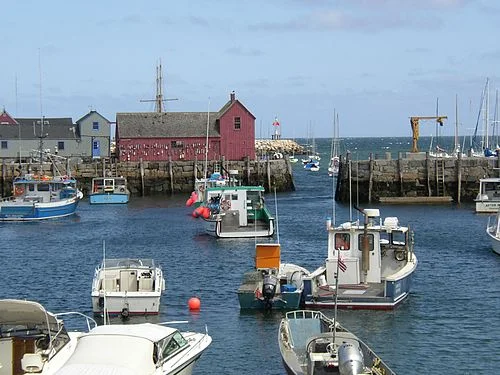
Rockport Harbor. The red building is "Motif #1''.
David Warsh: The fog of Trump in the trade wars

"Battle of Waterloo" (1815), by William Sadler.
Regulators in Berlin plan to block the Chinese acquisition of a German company under a tough new “critical infrastructure” law, according to the business magazine Wirtschaftswoche. The sale of Leifeld Metal Spinning, a Mittelstand machine tool manufacturer with customers in the aerospace and nuclear industries, would be the first transaction prevented under a measure passed after a Chinese appliance maker bought Germany’s largest maker of industrial robots, in 2016. The Financial Times picked up the news
Economic Principals has no way of knowing, but the guess here is that at least the timing of the decision was a consequence of the truce declared last week in Donald Trump’s trade war with the European Union.
From its start, broad bipartisan support in Washington for strong protectionist measures has been understood to be grounded in anxiety about China’s technological progress. Trump’s chief strategist is U.S. Trade Rep. Robert Lighthizer, a long-time critic of Chinese industrial policy. Xi Jinping’s “Made in China 2025” plan has touched off alarms in European capitals as well.
The issue has been obscured by President Trump’s unilateral decision to launch a two-front war, lashing out at European, Canadian and Japanese allies with steel and aluminum tariffs, and threatening new taxes on imported cars.
Like any global conflict, Trump’s trade blitzkrieg has been difficult to follow. I read four daily newspapers, and I gain much from each of them. I share The New York Times’s indignation at virtually every aspect of the Trump administration, so I enjoy their full-throated denunciations of the president and his team. On the other hand, I expect political divisions to continue after Trump leaves office, so I appreciate the level-headed mix of stories and their play in the first section of The Wall Street Journal (the editorial pages mostly get my dander up).
Most cunning in moving the broad story forward has been The Washington Post, even before adding two leading reporters to its staff, Devlin Barrett, formerly of the WSJ, and John Hudson, of Buzzfeed.
But on the topic of trade, the Financial Times beats the others hands down. It’s not just world trade editor Shawn Donnan, whose dispatches are regularly a day or two ahead of the rest. Here is his recent “Big Read” piece, part of an ongoing FT series about the competition between the U.S. and China over artificial intelligence. (The WSJ’s Greg Ip has a slightly different angle.) The FT’s columnists – Martin Wolf, Edward Luce, Philip Stephens, John Thornhill – are more closely attuned to trade policy as well.
The U.S. trade war with China is missing a widely-recognized casus belli. The Soviet Union’s success in launching its Sputnik satellite, in 1957, beating the U.S. into space, sparked a vigorous response. The creation of the National Aeronautics and Space Administration and the Defense Advanced Research Projects Agency were established within a year. In Education and Military Rivalry, Philippe Aghion and Torsten Persson studied expansions of mass education that tracked military threats in Europe in the nineteenth century and in a much larger sample of countries in the years after World War II. The National Defense Education Act of 1958 created thousands of PhDs in emerging fields.
Yet neither Trump nor the Republican-led Congress is proposing any such galvanic responses to Xi’s “Made in China 2025” program. Instead, the president has begun a trade war that so far has succeeded mainly in threatening to put big agriculture on the dole. The Republicans have passed a tax bill exacerbating already deep divisions between the states. Meanwhile Trump is waging a campaign not so much anti-intellectual as anti-fact. It keeps crowds coming to his rallies, but it is disastrous way to confront an external threat. Instead, try the careful review of the last quarter century of China policy by WSJ veteran Bob Davis for a start.
This much is coming clear. The fog of war is bad enough. The fog of Trump is worse.
David Warsh, a long-time columnist and an economic historian, is proprietor of Somerville, Mass.-based Economic Principals, where this column first ran.
'Faster than the black flies'

"A Maine fishing camp! The state that's given American culture the lumberman, the lobsterman, the Maine guide, has also given it this: the camp in the woods where the trout bite even faster than the black flies, the salmon leap into your canoe of their own volition, the griddle cakes come stuffed with blueberries, the loon calls at night, the moose bellows, and you sleep soundly under thick wool blankets even in July.''
-- From One River More, by W.D. Wetherell
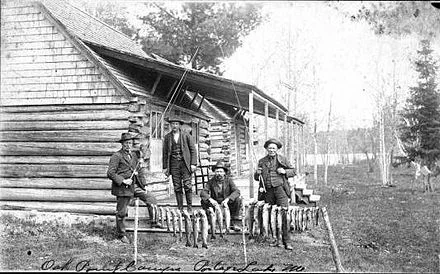
Successful fishermen at Oak Point Camps, Portage Lake, Maine, around 1900.
Going greener on the Isles of Shoals
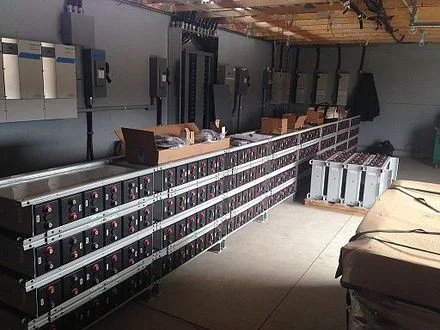
Sealed absorbed glass mat batteries for photovoltaic power collection at Shoals Marine Lab.
From Robert Whitcomb's "Digital Diary,'' in GoLocal24.com
Electricity ‘’microgrids’’ with small-scale solar-power and wind turbines, rather than big utility-scale facilities that spawn controversy, may become the big thing in green energy as technology and equipment make them more cost-efficient. There’s an example on tiny Appledore Island, in the Isles of Shoals, off New Hampshire.
There, amidst the screeching seagulls, reports The Concord Monitor, the Shoals Marine Lab, run by the University of New Hampshire and Cornell University, has mostly gotten off the diesel-powered generator it has long used and moved to solar energy, supplemented by a wind turbine. The electricity is stored in batteries, whose capacity has steadily improved in recent years even as they’ve become cheaper. The lab used to burn more than 10,000 gallons of diesel fuel a summer, Ross Hanson, the head engineer of the lab, told The Monitor, but “The last two summers that’s been about 1,500 gallons. We’re on track to probably cut that in half’’ with an upgraded solar system.
An ongoing challenge: Cleaning the bird poop off the solar panels: To read more, please hit this link:
https://www.concordmonitor.com/isles-of-shoals-microgrid-unitil-lab-18716311
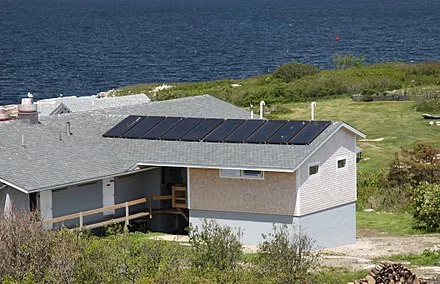
Solar hot water panels on the roof of the Shoals Marine Lab water- conservation building.
Rhode Island bravely tries truck tolls
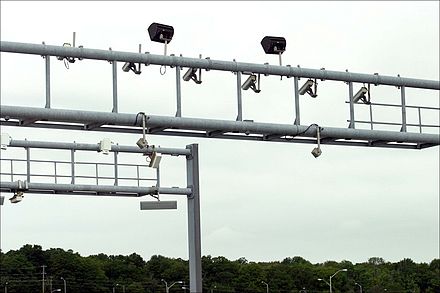
Toll gantrys.
Adapted from an item in Robert Whitcomb’s “Digital Diary,’’ in GoLocal24.com
The legal fight over the new truck-toll system that recently went into effect in Rhode Island is very interesting -- indeed it might end up in the U.S. Supreme Court. American Trucking Associations (sic) is suing to end the tolls, calling them unfair because the only class of vehicles whose owners must pay the tolls are large commercial tractor-trailers.
I hope that the state wins. These vehicles do the lion’s share of damage on Rhode Island’s roads and bridges.
The state says:
“The RhodeWorks bridge tolling program is a unique approach to repairing bridges by tolling only specific types of tractor trailers. The tolls collected at each location in Rhode Island will go to repair the bridge or bridge group associated with that toll location.’’
That the program is “unique’’ might be its legal Achilles heel. Singling out certain classes for taxation can be legally problematic. But I admire Governor Raimondo for being willing to take the heat in having Rhode Island finally seriously address its terrible transportation infrastructure problems, with the economic woes that accompany them.
Federal gasoline taxes (which pay for some of our highways) haven’t been raised since 1993, and America’s transportation infrastructure is falling apart. There seems to be little will in Washington to address this. Instead tax cuts tailored to please rich campaign contributors are prioritized. And so the states must come up with their own ways of financing the urgently needed repair of their roads, bridges and public transit.
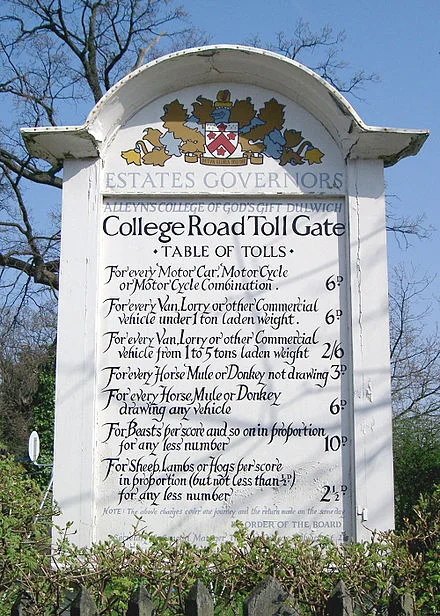
A quaint table of tolls in pre-decimal currency in Dulwich, England.
The fashion of recreation

"Weights" (circa 1850), shown in "Leisure Pursuits; The Fashion and Culture of Recreation,'' at Fruitlands Museum, Harvard, Mass., through March 24, 2019. "Weights'' is part of the collection of the William Cullen Bryant Homestead, in Cummington, Mass.
The museum says: "This exhibition looks at the way in which the people of Massachusetts have spent their leisure time interacting with Massachusetts Trustees of Reservations properties over the last 125 years. Visitors will see original antique and vintage dresses and personal accessories that were integrated into activities such as gardening, entertaining, fitness, water activities, equestrian pursuits, and travel at and to various properties.''

Gold and pink deco gown, circa 1930, silk brocade, rhinestones, metallic thread, Part of the Collection of the Stevens-Coolidge Place, in North Andover, Mass.
Looks like Maine

From Ole Brodersen's show "Trepassing: Photographs from Lyngor, Norway''. The Dedee Shattuck Gallery is in Westport, Mass.
The gallery says:
"Following 11 generations before him, Ole Brodersen (born 1981) grew up on the small island of Lyngør, Norway, with no cars and about 100 inhabitants. Ole's father is a sail maker, his grandfather a sailor. He has spent most of his life close to the ocean, in constant company of the elements.
"The series of photographs in 'Trespassing' explore of the landscape and the natural forces that animate it.''
Llewellyn King: With the Internet, cities are getting smarter
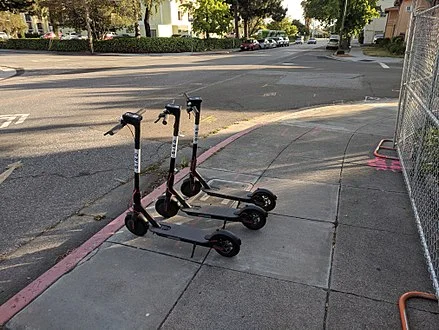
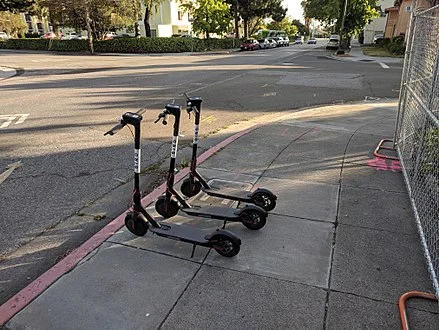
Bird electric scooters, being used in Providence and other cities.
Cities are getting smarter. It’s happening right now, and it isn’t much short of a revolution.
Whole cities are incorporating the Internet of Things (IoT) into their daily life, changing the way the cities and towns live and breathe. The idea is to improve the quality of life for the billions who now live in cities or will as the relentless urbanization of the world continues.
Some are more advanced than others, but the revolution is afoot across the globe. Experts can’t explicitly say which communities are leading the pack but, expectedly, Singapore and Dubai are in the front row, and so are New York and San Antonio.
The goal is to make cities, as old as civilization, more citizen-friendly and more efficient and to ready them for further electrification in transportation — and, one day, for autonomous vehicles.
Clint Vince, chairman of the U.S. Energy Practice of the world’s largest law firm, Dentons, tells me that the firm is so involved with smart cities and communities that it has established a not-for-profit think tank to work on smart city issues within it. He said the think tank has determined 14 “pillars” of the smart city, from obvious ones like transportation, water, electricity and sewage to less obvious city functions like health and recreation.
Vince has represented New Orleans and San Antonio for many years, but he now sounds more like a city visionary than a lawyer. “Take the electric grid: It has to go from a single-direction flow, taking electricity from the point of generation to the point of consumption, to a two-way flow,” he said. “Eventually, it has to have multi-directional flows.”
Vince is talking about the effect of microgrids and dispersed electric generation, such as rooftop solar. One day, this grid flexibility may lead to innovations such as electric cars “lending” electricity to the grid when prices are favorable.
Electricity and smart meters, which are the key to what is known as the smart grid, began the revolution. Now the surge is joined by telephony in connecting, managing and directing the smart city infrastructure, and in trouble shooting it.
Tony Giroti, chairman of the Energy Blockchain Consortium, says smart installations aren’t just for monitoring and metering electricity and water consumption, but also play a prime role in bridging the divide between the old infrastructure and the new information-driven one. Smart city sensors will advise before there is a problem with an old pipe or compressor, so that proactive intervention can avert breakdowns.
Cities such as New York and Washington have underground pipes and wires that are past their prime, but they needn’t pose the threats they used to: The cities can cry out electronically when their physical plant is hurting. The New York Power Authority, a state agency, is credited with a leading role in smart cities, but the rush is on across the country and around the world.
As the information-driven city takes hold, so do questions ranging, for example, from where will autonomous ride-share cars loiter when not booked to where will they park?
I was leaving an interview about the future of cities when I fell over it. Literally. One of those scooters that are now part of the urban transportation mix had been left on the sidewalk. Because of the use of Internet technology and GPS, riders can leave them anywhere when they get to their destinations. The scooters are picked up and recharged at night, signaling to the company where they are via GPS.
Creating new, more livable cities is exciting; dealing with the unexpected consequences, as always, is challenging. When no one is looking, I’m going to try one of these scooters. I may be in traction when I write my next column, but don’t worry — it’ll be delivered electronically.
On Twitter: @llewellynking2
Llewellyn King is executive producer and host of White House Chronicle, on PBS. He's based in Rhode Island.
The stone-wall industry

Stone wall near Hammersmith Farm, Newport, R.I.
--Photo by JG Klein
"Many New England stone fences built between 1700 and 1875 were laid by gangs of workers who piled stones at the rate of so much per rod. {Naturalist and writer) Edwin Way Teale says that in the latter years of the past (19th} century, before economic and social developments began obliterating some of the walls, there were a hundred thousand miles of stone fences in New England.''
-- William Least Heat Moon, in Blue Highways
'Africa in the ear!'

Gorillas at Franklin Park Zoo.
"A tree grew. Oh, remembering gorillas!
O Orpheus singt! Oh, Africa in the ear!
The recluse, Vip, came out. Gigi sat still
and wide-eyed, black face pressed against the bars.''
-- From "Live Jazz, Franklin Park Zoo,'' by Marilyn Nelson, a former poet laureate of Connecticut. Franklin Park is in Boston. The sub head of the poem: "Kubie {a gorilla} sobbed when a nearby jazz band stopped playing'' -- Christian Science Monitor, Aug. 27, 1996.
Chris Powell: So in Conn., who is really conservative?
Most candidates in the primaries for the Republican nominations for governor and lieutenant governor advertise themselves as "conservative," since the party is generally conservative and its primary voters are heavily so. But the advertising leaves "conservative" undefined, and the candidates seem to think that conservative Republicans need only to hear the word before responding reflexively with approval.
Conservatives may be more demanding than that. Are they really supposed to be persuaded by, for example, television commercials touting "conservative businessman Bob Stefanowski" for governor when the candidate has no record in public life and no one ever heard of him before he set out to buy the nomination?
The Hartford Courant quotes Darien First Selectwoman Jayme Stevenson, a candidate for the Republican nomination for lieutenant governor, as saying Connecticut needs consensus builders, "not people who stand on some kind of political ideology." Yet, though the Courant didn't report it, Stevenson's own advertising describes her as a "conservative Republican."
Of course after the primary most of this "conservative" stuff will disappear from Republican advertising since Connecticut's electorate is liberal or libertarian on social issues. But given state government's financial collapse, the electorate is also growing more skeptical if not quite yet conservative on financial issues. At least there is a case to be made for something different from the uncritical liberalism whose political correctness correlates heavily with financial collapse.
Will any candidates make that case well? If so, will they overcome the attacks of the state's politically correct news organizations?
Such an attack was placed on the front page of The Hartford Courant this week as the newspaper maliciously described as an extremist the lieutenant governor candidate endorsed by the Republican state convention, Southington state Sen. Joe Markley.
Unlike other candidates, Markley doesn't have to advertise himself as conservative, as he has a long record on issues that appalls the Courant. But it may not be as appalling as the Courant thinks.
Markley, The Courant notes, would require parental notification of abortions for minors. But most people in Connecticut probably would support changing abortion law that way to prevent concealment of child rape, of which the state has had some horrible cases the Courant has declined to report plainly.
Markley, The Courant continues, favors local option on fluoridation of public water supplies -- not because fluoridation is a communist plot but because it medicates people without their consent and because fluoride treatment is easily available otherwise. Preventing involuntary medication actually seems like a liberal position.
Markley, The Courant notes, was the only legislator to vote against a bill purporting to require formal consent for college students having sex. The proposal was politically correct but will accomplish little amid the usual conflicting testimony.
Markley, The Courant says, was a TEA Partier before the party started. TEA stands for "taxed enough already." Horrors! So which candidate for governor is airing commercials declaring that the middle class is overtaxed and "working families have paid enough"? That's no right-winger. It's liberal Democrat Ned Lamont.
Right or wrong, Markley may be the only candidate in the primaries who has a record on state issues and can explain it thoughtfully and cordially. At least in that respect he is very much out of place.
Chris Powell is a columnist for the Journal Inquirer, in Manchester, Conn.
Friends in the forest

"Untitled (Two Trees)'' (oil on canvas), by Hannah Stahl, at Atelier Newport gallery.
Break from the Great Depression

"Dad Blowing Up Green Turtle Tube" (1931, oil on canvas), by Leslie Thrasher, on the cover of the Sept. 5, 1931 Liberty Magazine. It can be seen at the National Museum of American Illustration, Newport.
c) 2018 National Museum of American Illustration, Newport, RI.
Images courtesy Archives of American Illustrators Gallery, New York, NY.
James P. Freeman: Those scary 'stans' of pop music

Eminem, who boosted the 'stan' sentiment with his song "Stan'' in 2000.
Gentle reader, are you consumed — in thought, word or deed — by your favorite actor, athlete or rock star? If yes, you’re considered a “stan.”
In today’s celebrity-obsessed culture, stan is a fitting portmanteau of stalker and fan (derived from fanatic or the Latin adjective, fanaticus). According to en.oxforddictionaries.com, it is defined as “an overzealous or obsessive fan of a particular celebrity.” And given modernity’s looseness with language and linguistics, the word may be used as a noun (i.e., “Kylie Jenner has millions of stans”) or a verb (i.e. “millions stan for Kendall Jenner”).
Many point to the song “Stan” by rapper Eminem (released as a single in 2000), about the warped idolatry of a disturbed fan of the Slim Shady himself, as giving popularity to the stan sentiment. Still others point to rapper Nas who, in 2001’s “Ether,” intentionally used the word for what became its popular connotation.
We’ve come a long way from the delirium of Frank Sinatra’s rabid 1940s “Bobby Soxers,” perhaps the earliest stans.
There was “Beatlemania” in the 1960s. Later, in the 1980s, young Madonna enthusiasts were known as “Wannabes.” Before the death of Jerry Garcia, in 1995, for decades legions of loyalists (“Deadheads”) lived a lifestyle synonymous with members of The Grateful Dead. Now we have “Sheerios” (Ed Sheeran), “Finaddicts” (for fans of the Jaws franchise), “Llamas” (Cowboy Junkies), and “Streepers” (Meryl Streep). And closer to home: “Red Sox Nation” (Boston Red Sox).
Social media — Facebook, YouTube, Twitter, Instagram, Tumblr, Pinterest, Reddit — have given rise to a weird mass intimacy (“like me” and “follow us;” “hearted”) between object (celebrity) and subject (stan). And vice versa.
This twisted relationship has spawned the professional fan. Part mystic. Part hysteric. Part parasitic.
And the new digital symbiosis practically requires that stans don the same clothes, drink the same Armand de Brignac, and download the deep-cut track. But don’t dare disagree or think differently. Or become a detractor. Just ask Wanna Thompson.
The New York Times recently reported that she incurred the wrath of the stans of Nicki Minaj (known as, appropriately, “Barbz”) and the artist herself (via a practice known as celebrity “clap back” — she has 20.2 million Twitter followers) when Thompson (a freelance writer with a mere 14,000 followers at the time) wondered if the singer would “put out mature content?” That simple question produced a hailstorm of scorn and derision toward Thompson.
It’s fun to imagine what stans’ reaction would be today if John Lennon posted on Snapchat that The Beatles were “more popular than Jesus now.”
James P. Freeman, a former banker, is a New England-based columnist. This piece first ran in Inside Sources.
James T. Brett: New England has benefited greatly from NAFTA
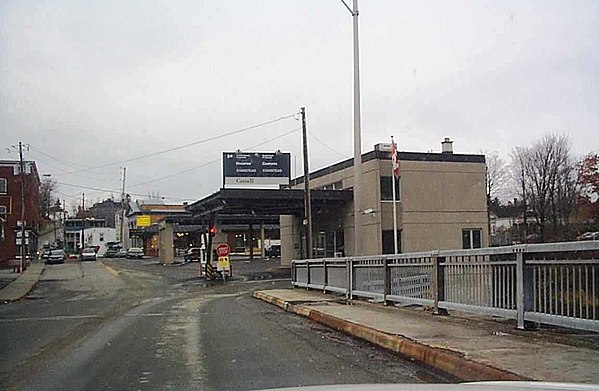
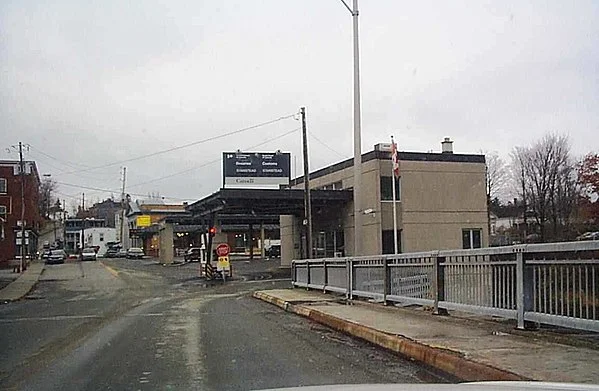
The Canada Border Inspection Station at Stanstead, Quebec, just across the border from Derby Line, Vt.
From The New England Council (newenglandcouncil.com)
Over the past 18 months, we have seen a marked shift in U.S. trade policy. Soon after taking office, President Trump made good on his campaign promise and announced that the U.S. would seek to renegotiate the North American Free Trade Agreement (NAFTA,) a multilateral agreement with Canada and Mexico that was put into effect in 1994. In more recent months—amid reports that NAFTA talks have grown contentious and that the U.S. is considering withdrawing altogether — the administration announced tariffs on certain imports that directly affect our neighbors to the immediate north and south.
Canada and Mexico are not only important allies, they are significant economic partners for the U.S., and for the New England states in particular. As the voice of the region’s business community, The New England Council believes it is of critical importance that the U.S. continue to work toward a modernized NAFTA, and that the administration should reconsider the tariffs against our partners in Canada and Mexico.
The impact of trade with Canada and Mexico on the New England economy cannot be understated. According to the U.S. Department of Commerce, Canada is the premier goods export market for businesses in five of the six New England states — in the sixth state, it is the second-largest market — representing more than $8.3 billion in exports in 2017 alone. Canada estimates that in 2017, service exports from our six states totaled nearly $3.3 billion. Mexico is also a top trade partner for our region, with three states counting our southern neighbor as their second- or third-ranking export market for goods. The region exported $4.4 billion worth of goods to Mexico in 2017, and remains a significant multibillion-dollar market for goods produced in Mexico. Data from the International Trade Administration indicates some 10.7 million American jobs are supported by goods and services exports, and it is doubtless that tens of thousands of New England jobs rely upon trade with Canada and Mexico.
The tariffs that President Trump has put into place are already having a significant impact here in New England. The U.S. Chamber of Commerce recently released a state-by-state analysis of the impact of the emerging trade war on U.S. exports. According to the report, as a result of the administration’s tariffs, $11 million in New Hampshire exports to Canada are targeted for retaliation, and close to $1 million in exports to Mexico are targeted for retaliation. Some of the hardest hit products include steel and aluminum products, lighting products, and certain foods. In total, nearly $2.7 billion in New England exports to Canada and Mexico face retaliation.
It is certainly appropriate to revisit and update major trade agreements. Some elements of our economy did not even exist at the time NAFTA was first negotiated, and we commend the administration for taking steps to modernize this historic agreement. At the same time, the President is right to be concerned about trade imbalances and to seek ways to minimize trade deficits. However, given the importance of trade with these two nations, it is gravely concerning that the administration would even suggest withdrawing from NAFTA. Further, the evidence laid out by the U.S. Chamber’s new report suggests that the tariffs are most certainly not serving our nation’s best interests, and could harm disparate and unrelated sectors of our economy.
It is understandable that partners and neighbors, on occasion, can have temporary disagreements over policy considerations, including on trade matters. However, The New England Council believes it is crucial that the playing field remain open for businesses, workers, and families across New England, so that they — through no fault of their own — are not disadvantaged by potential retaliatory trade measures or a defunct NAFTA.
James T. Brett is the president and CEO of the New England Council.
Martha Burk: A sad birthday for Medicare and Medicaid

Via OtherWords.org
July 30 marks a very important anniversary in our modern political history.
Fifty-three years ago in 1965, President Lyndon Johnson signed Medicare and Medicaid into law, creating two programs that would disproportionately improve the lives of older and low-income Americans — especially women.
Fast-forward to 2018, and both programs are very much under siege. Nowhere is the struggle starker than in the House Republican budget — titled “A Brighter American Future” — now on Capitol Hill.
The importance of Medicare as a source of women’s health coverage can’t be over-emphasized.
Older and disabled women make up more than half the total beneficiaries, and two-thirds of those 85 and over. This budget from hell takes a giant step toward privatizing the program by allowing insurance companies into the Medicare marketplace, which means benefits could be caught in a race to the bottom and become too paltry to cover all but the barest of medical needs.
Medicaid is the joint federal-state program that provides low-income people with health care. The proposed Republican budget repeals the Medicaid expansion that came with Obamacare, which will cause 14 million to 17 million people to lose coverage.
The Medicaid remnants that survive would be turned into block grants, allowing states to pick and choose who gets covered and what kind of benefits they get — no doubt with little or no federal oversight. That approach makes it easier to cut the program without saying how many people would be dropped, or how much benefits would be lowered.
Since poor women under retirement age and their children are the biggest group of beneficiaries, it stands to reason they’d also be the biggest losers.
But there’s more. Because women have more chronic health conditions like arthritis, hypertension, and osteoporosis, they’re more likely to need institutional care. Since Medicare generally doesn’t cover nursing home care, Medicaid provides such care for those with disabilities and/or very low incomes — and 60 percent of those folks are women.
What’s not in the budget? Long gone is the Obama-era effort close the Gingrich-Edwards tax loophole that allows some high-income individuals (possibly including Donald Trump) to avoid Medicare and Social Security payroll taxes altogether, resulting in billions of lost revenue for both programs.
The House Republican budget probably won’t pass in its present form. But with Republican majorities in both houses of Congress, even compromises are sure to favor more cuts.
“A Brighter American Future?” Hardly. This summer’s 53rd anniversary of Medicare and Medicaid looks like a less than happy one for those that depend on them most — namely women, but really anyone counting on growing older.
Martha Burk is the director of the Corporate Accountability Project for the National Council of Women’s Organizations (NCWO) and the author of the book Your Voice, Your Vote.
Muted infrastructure

From Jeff Weaver's show, "Works on Paper,'' at the North Shore Art Association, Gloucester, July 27-Aug. 18.
The PawSox mystery persists
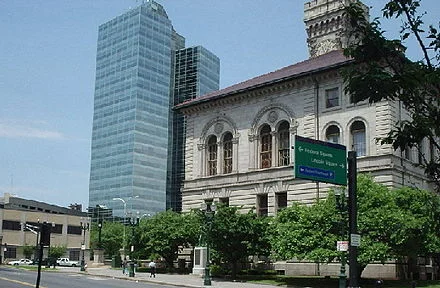
Downtown Worcester, with City Hall on the right.
From Robert Whitcomb's "Digital Diary,'' in GoLocal24.com
It remains surprising how little information has come out about Worcester’s pitch to lure the Pawtucket Red Sox to Massachusetts’s second-largest city, especially since Rhode Island Governor Raimondo signed a bill last month aimed at helping to finance a new stadium for the team at Pawtucket’s Apex site.
No one hereabouts seems to know what Worcester and the commonwealth have in mind, and how much information has been transmitted to the team owners.
At the same time, news reports point to the Kraft/Patriot family’s intensifying interest in building a major stadium for professional soccer (called variations of “football’’ in most of the world) in Boston for their New England Revolution team. Makes sense. Soccer has become ever more popular in America in the past few years. I was struck by how many bars and restaurants had World Cup games on their TVs in the recent competition, won by France. Within a couple of decades soccer stadiums may become more important sports venues here than stadiums for baseball and American football (concussions, anyone?)