
Vox clamantis in deserto


On crazy families

The administration building at McLean Hospital, in Belmont, Mass. It's New England's most famous mental hospital.
From the movie Casablanca:
German Major Strasser: “What is your nationality?’’
Rick Blaine: “I’m a drunkard.’’
French Captain Renault: “That makes Rick a citizen of the world.’’
To paraphrase Tolstoy’s famous line from Anna Karenina about “all unhappy families being unhappy in their own way”: All crazy families are crazy in their own way.
I’m referring to psychiatrist Edward M. Hallowell’s just-published memoir Because I Come From a Crazy Family. Hallowell, author of the best seller Driven to Distraction, about attention-deficit disorder, grew up in a family with a psychotic father, alcoholic mother, abusive stepfather, and two “learning disabilities’’ of his own. It’s a sometimes harrowing, sometimes funny and almost always engaging saga featuring what Dr. Hallowell calls the “WASP triad of alcoholism, mental illness and politeness.’’ Actually, of course, the WASPs aren’t the only ethnic group with that triad. Beyond Hallowell’s very personal tale, the book is a primer on what happens in the mental-health trade, from medical school on.
Most of the book takes place in New England, with colorful side trips to Charleston and New Orleans. GoLocal readers will see many familiar scenes.
Flower shop

"Homage 1010 (Black Rose)'' (digital collage), by Irene Mamiye, in her show at Lanoue Gallery, Boston, through July 29.
Marching fruit

"Kiwi Rhythm'' (oil on canvas), by Sherie Harkins, in the "Colorist'' group show at ArtProv Gallery, Providence, Aug. 8-Sept. 22.
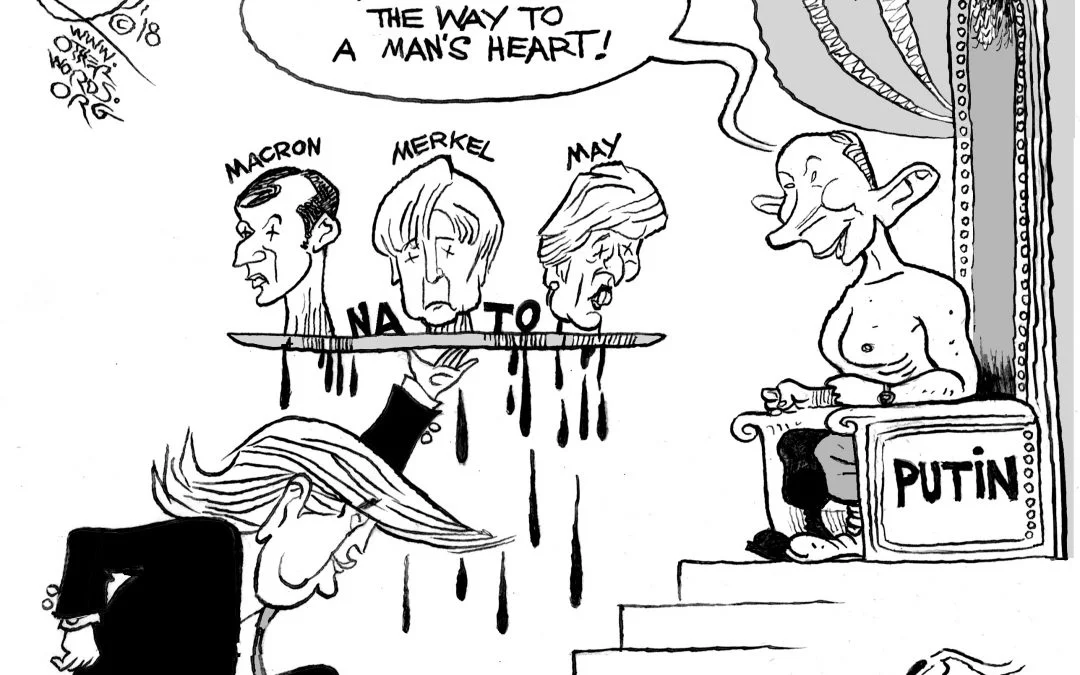
Chris Powell: The ambiguous charms of self-funding 'political outsiders'
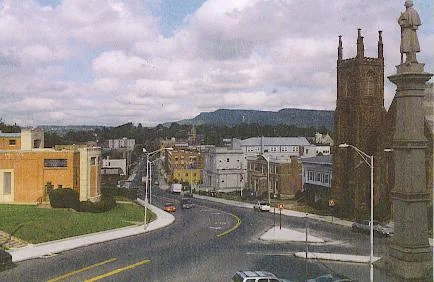
Meriden, Conn., a heavily Democratic city that just rejected a property-tax increase.
Connecticut doesn't know the two rich and self-funding candidates for the Republican nomination for governor, Bob Stefanowski and David Stemerman, who are called "pop-up" candidates by the candidate endorsed by the Republican state convention, Danbury Mayor Mark Boughton. So Stefanowski and Stemerman are impolitely introducing each other to Republican primary voters. It's not pretty but it's useful.
Last week Stemerman broadcast a television commercial noting that Stefanowski enrolled as a Republican only a few weeks before becoming a candidate, long had donated to Democratic candidates, and hasn't been voting Republican. (As it turned out, Stefanowski hasn't been voting Republican because he hasn't been voting at all for 16 years.)
Indeed, while Stefanowski seems to have been a Republican for a long time, he left the party and enrolled as a Democrat for less than a year before re-enrolling as a Republican again a year ago, apparently because he first considered running for governor as a Democrat.
So much for core beliefs.
Stefanowski concedes most of this, explaining weakly that he was working abroad and should have sought absentee ballots. He counters that Stemerman was once a Democrat, too, and donated to Barack Obama in 2007. But Stemerman left the Democratic Party 15 years ago and says his contribution to Obama was just the price of admission to a fundraiser sponsored by a friend and there were no additional donations.
Indeed, for corporate executives like Stefanowski and Stemerman, politics is often not a matter of core beliefs but just business that requires cozy relations with both sides of the street.
Stefanowski got his commercials on TV before the other Republican candidates and for a while was thought to have an advantage, but he may be badly damaged by exposure of his opportunism and dilettantism. Since Stemerman's connection with the other party is fairly remote, Republicans may take less offense from him.
The exchange between the self-funders is a reminder that the mantle of "political outsider," seemingly much desired by some candidates for governor, can also mean unknown, untested, uninformed, and full of last-minute, unpleasant surprises, as state Republicans might have learned from their awful habit of nominating self-funding political neophytes for governor and U.S. senator in recent years.
But there's nothing wrong with changing parties out of principle rather than opportunism, since people's views and parties evolve. Winston Churchill changed parties twice, from Conservative to Liberal and back again, because of policy differences before saving civilization from barbarism. Having gotten away with it all, he reflected: "Anyone can rat but it takes a certain amount of ingenuity to re-rat."
Stefanowski botched his "re-ratting," even as the next governor may need Churchillian ingenuity to save the state from parasitism.
At least there was a hopeful sign last week from Meriden, a heavily Democratic city that held a referendum on its City Council's proposed budget, which carried a property tax increase of 5 percent.
The budget was defeated by 5,999 to 260, a margin of 96 to 4 percent, and turnout was fairly representative — almost 6,300 voters.
If even a Democratic city has had enough of raising taxes, how will ordinary Democrats view a candidate of their party for governor who plans to raise taxes again to appease the government and welfare classes?
Chris Powell is a columnist for the Journal Inquirer, in Manchester, Conn.
Frank Carini: No need to chop down trees to address climate change
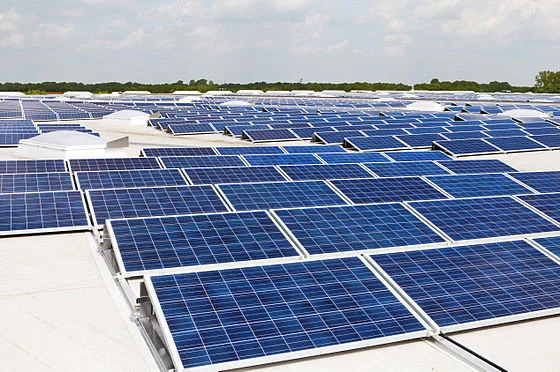
From ecoRI News (ecori.org)
We can split the atom, send people to the moon and land rovers on Mars, build weapons of mass destruction, drill for fossil fuels a mile beneath the ocean’s surface, take land via eminent domain to build a fence along the Mexican border, and develop technology that tracks our every move, but we can’t seem to increase solar-energy production without deforesting the landscape.
Modernizing the power grid to handle the 21st-Century needs of renewable energy and siting solar energy responsibly are always beyond our capabilities. Forests must be sacrificed to protect the environment from fossil fuels and climate change — except, of course, when forests need to be clear-cut to make room for more fossil fuels and more climate emissions (see Clear River Energy Center).
This obtuseness is on profound display in Rhode Island, where developers hack their way through green space to build monuments to corporate banking and blackjack. We leave already-developed, infrastructure-ready, paved-over disturbed places alone.
The siting of solar energy is a multilayered issue informed by many factors, the first and foremost of which is profit. After that comes the lure of tax revenue, the protection of property rights, and concerns about the high cost of interconnections and substation upgrades (see, profits). Last on the list of importance is environmental protections.
The future costs that come with degrading the environment by clear-cutting forest, much like filling in wetlands and drowning salt marshes to make way for more development, are largely ignored. The resulting problems caused by erosion, flooding, soil degradation, and various climate-change impacts, such as the deterioration of public health, are paid later by others who had no say in the shortsightedness.
If we truly wanted to, we could overcome the often-cited substation and interconnection excuses that are routinely noted when another tree is felled to make way for another solar panel. It’s really just a matter of whose money will be spent to improve the generation and distribution of renewable energy — an urgently needed must-do during this climate-changing time. Energy developers and utilities don’t want to pay for the needed upgrades. They want ratepayers to fund the work, even if it’s for fossil-fuel expansion.
Thus, forests are clear-cut and woodlands cleared, because it’s more profitable to bulldoze the environment than it is to repurpose already-developed areas, build carports, or transform brownfields and Superfund sites.
As of last month, London-based National Grid was ranked No. 249 on the Forbes list of the world’s largest public companies, with $18.4 billion in sales. The multinational corporation made $10.2 billion in profit in 2017.
National Grid recently filed a proposal with Rhode Island regulators that calls for a 19 percent increase in the bill for the typical residential user. Under the filing submitted to the Public Utilities Commission, starting Oct. 1 and running through March residential customers who use 500 kilowatt-hours a month would experience an increase in their monthly bill of nearly $19.
When it comes to the siren song of tax revenue and the accompanying allure of lower property taxes, which seldom manifest, the priceless value of green space can’t compete. The long-term costs of Rhode Island’s collective solar shortsightedness will be significantly more expensive than properly dealing with the siting issue now. It’s easier, however, to leave the tab for future generations to pick up.
The latest example in this recurring lack of leadership is the Exeter Town Council. Despite objections from both the Planning Board and town planner, and after three nights of public hearings where residents expressed strong opposition to a proposed zoning change, the Town Council recently voted to change the zoning ordinance as requested by a solar-energy developer.
Green Development LLC — the same North Kingstown-based company that tried buying votes in an attempt to get a bill approved that would have listed woody biomass as a renewable energy despite reams of information that say otherwise — won the zoning change that will allow it to build utility-scale solar installations on 15 properties in residential areas without having to seek special-use permits.
Property rights are important, but so too are the comprehensive plans that cities and towns are mandated to develop in order to, among other things, steer development to appropriate locations. However, the growing trend, especially in rural Rhode Island, is approving industrial-scale solar projects in neighborhoods zoned residential. The required comprehensive plans are routinely ignored.
Replace 60,000 solar panels with low-income housing or bike paths from Providence and Central Falls and the property-rights conversation will change.
A Rhode Island Office of Energy Resources (OER) stakeholders group met monthly for about a year. It helped craft a bill, the Rhode Island Energy Resources Act, that created siting standards for wind and solar projects within each municipality. The measure had the support of OER, the Rhode Island Department of Environmental Management, the Rhode Island Farm Bureau, the International Brotherhood of Electrical Workers, the Rhode Island Builders Association, the Northeast Clean Energy Council, the Conservation Law Foundation, The Nature Conservancy, and the Audubon Society of Rhode Island.
The House passed the bill, but the Senate never bothered to hold a hearing.
Now an advisory group, a subcommittee of the OER stakeholders group, is working to develop a solar-guidance-model ordinance for use by municipalities. Six more meetings are scheduled through mid-October. In the meantime, OER recently adopted a set of initiatives to encourage solar development on brownfields, rooftops, and carports. The initiatives, however, are short on specifics and funding.
These delay tactics need to be reversed. We should be creating task forces, ignoring bills, and holding public hearings that study the impacts of forest clear-cutting. It would be years before another tree was axed.
Frank Carini is the ecoRI News editor.
Conn. seems to be reviving
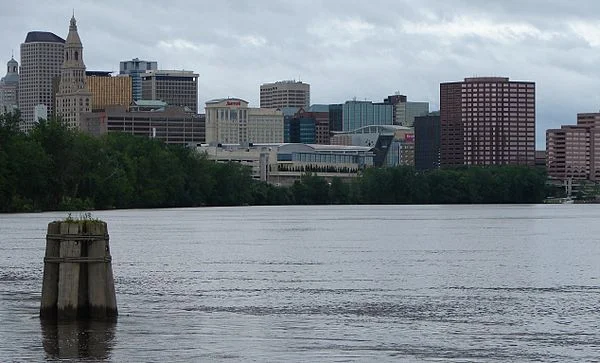
Looking across the Connecticut River at Hartford.
From Robert Whitcomb's "Digital Diary,'' in GoLocal24.com
Connecticut has been hammered by Republican politicians for years for its high taxes and sluggish economy. From the propaganda you’d never know that Connecticut remains the richest state on a per-capita basis, followed by Massachusetts.
In any event, things are finally looking up in the Nutmeg State. Among the good news, The Hartford Courant reports:
Seven Stars Cloud Group, a financial technology company, will spend $283 million to create a tech hub at the former University of Connecticut regional campus in West Hartford.
Infosys will create a regional tech and innovation hub in Hartford, which has been in a steep economic and social slide for years, and hire 1,000 people for its information-technology and consulting business.
Stanley Black & Decker will open an advanced-manufacturing center in downtown Hartford to develop its “smart factory’’ initiative.
CVS will keep the headquarters of Aetna, which it is buying, in Hartford.
EIP LLC is setting up banks of computer servers in an abandoned factory in New Britain, an old factory town, to process and store data for many businesses.
Despite its woes of the past few years, Connecticut’s large number of highly educated people and its location between the wealth-creating behemoths of Greater Boston and New York will continue to make it very attractive to sophisticated businesses – generally more so than the low-or-no-income-tax and low-public-services Sunbelt states. The Northeast will remain, after all these years, the richest part of the country.
Meanwhile, the financial-services complex in Fairfield County, and especially Stamford, closely linked to nearby Wall Street, will slowly shrink, as artificial intelligence and other technological change, as well as offshoring, reduce job counts. Finance has been the biggest wealth creator in Connecticut for a long time. It’s a healthy sign for the state that geographical and industry diversification, most of it involving high technology, is well underway.
By the way, I spent much of a recent Friday and Saturday driving around to see friends in Westport, Norwalk and Greenwich, all in rich Fairfield County. If taxes on the rich are so onerous in the Nutmeg State (where I lived for four years when in school) how come I saw so many new mansions and McMansions going up? It looked richer than ever!
Dark and light on Monhegan

""Monhegan (Manana)" (mixed media on canvas), by Tom Hall, in his Aug. 11-Sept. 8 show at the Corey Daniels Gallery, Wells, Maine. The "Monhegan" referenced is an island about 12 miles off the Maine Coast that's renowned as a art center and fishermen's harbor. For a, well, cheerier look at it, see the picture below.

.
Profit off multiple addictions!

From Robert Whitcomb's "Digital Diary,'' in GoLocal24.com
Let’s jack up the addiction rates!
Now that Massachusetts regulators have agreed to let the new MGM Springfield “casino resort’’ serve booze until 4 a.m. to grab more state revenue, officials of Connecticut’s huge Mohegan Sun and Foxwoods casinos, worried about more intense competition for the gambling and drinking communities, seek the same privileges, as the race to the bottom continues.
'Sluggish bubbles'
"Summer has salted
our neighborhood to thirst;
tar that patches the wounds of roofs
heats to sluggish bubbles;
sun obligates
paint on car hoods to blotch.''
-- From "40 Ounce,'' by Marcus Jackson
Mid-summer blues

"Tangled Up in Blue" (paper and colored pencil), by Jane Lincoln, in her show "Entangle,'' at the Kingston Gallery, Boston, through Aug. 12.
TEN Kingston Associate, Jane Lincoln, Tangled Up in Blue, BFK Rives paper and colored pencil, 14 x 16 inches, 2018
TEN Kingston Associates: Entangle
July 5⎻August 12, 2018

Jill Richardson: Food-stamp recipients probably to lose right to use the stamps at farmers markets

Via OtherWords.org
People on food stamps, officially known as the Supplemental Nutrition Assistance Program (SNAP), receive their benefits on a card that can be read like a credit card. Crucial to allowing recipients to use food stamps at farmers markets are card readers.
The U.S. Department of Agriculture just canceled its contract with the company that makes the card readers. As a result, food stamp recipients will likely lose the ability to use food stamps at farmers markets.
I was all set to write about this terrible mix-up. But then I realized it’s not the part I really care about.
Of course, food stamp recipients should be able to shop at farmers markets. But it’s a tiny part of a much bigger issue.
The diets of food stamp recipients lie at the intersection of two issues: our food system and economic inequality.
On one hand, you have a system of food that uses industrial methods to produce a cheap and abundant but often unhealthy food supply. Healthier foods tend to cost more, whereas junk food is cheap. And low-income neighborhoods often lack outlets that sell healthy food in the first place.
The answer to this isn’t to pay farmers less. Farmers are struggling — and if anything, higher prices paid to farmers for food and fiber would benefit rural communities in much needed ways.
The other way to help the diets of low-income people is to reduce poverty and inequality. Ideally, this will require large scale social change.
For example, schools in Detroit are so bad that students are suing the state because they weren’t taught to read. How is a kid who graduates from a school like that, even the smartest and most motivated kid, able to keep up with one who graduated from school that actually teaches its students?
In my perfect world, we’d find a way to ensure all Americans have an excellent education, affordable health care (including mental health care), affordable housing, and safe cities in which they don’t have to fear that calling the police will result in their own victimization. Workers will be able to organize to defend their rights as well.
In that world, fewer people would live in poverty, and more could afford good food.
One quick and efficient way to help reduce poverty is to raise the minimum wage. The 1968 minimum wage would be equivalent to $10.90 in 2015 dollars. The national minimum wage is only $7.25. Workers have lost ground over the last 50 years.
Meanwhile, since the early 1970s, as workers’ wages have stagnated or grown only slowly, productivity more than doubled.
Workers today do more than they did five decades ago but they make less money. The profits for the increased productivity go to the top 1 percent.
Accepting food stamps at a farmers market is nice. No doubt it’s more than nice for those on food stamps who shop at farmers markets. That contracting snafu should be fixed.
But to really help all Americans access fresh, healthy food, we need to either fix the food system or address economic inequality. Or, better yet, both.
Jill Richardson is the author of Recipe for America: Why Our Food System Is Broken and What We Can Do to Fix It.
'Most Pretentious People'
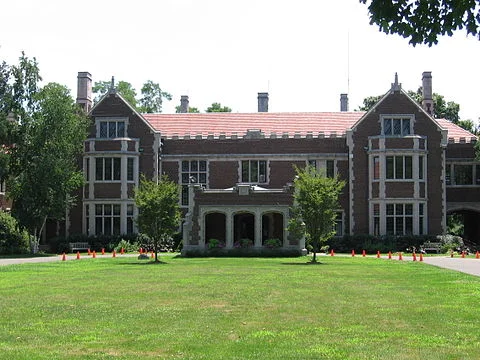
The Waveny Mansion, in New Canaan.
"I lived in a town called New Canaan, in Connecticut, where they are far too snobby to even mention celebrities. Many American towns are famous for things like, "See the World's Largest Ball of String!" I think my town's would probably have to be 'Most Pretentious People.'''
-- Katherine Heigl, Hollywood actress and producer
David Warsh: The two Putins

As shocking as anything that Donald Trump said in Helsinki last week was Vladimir Putin’s emphatic claim that “the Russian state has never interfered, and is not going to interfere, into internal American affairs, including election processes.”
Just as there are two NATOs, there are two Vladimir Putins. When U.S. policy didn’t change during his first eight years in office, Putin changed his own. Gradually he became an antagonist – and a demonstrable liar.
Much of what I know about the Russian president I owe to Steven Lee Myer’s biography, The New Tsar: The Rise and Reign of Vladimir Putin (Knopf, 2015), which, despite its tendentious title, is a first-rate book. During seven years in Moscow for The New York Times, Myers lost all sympathy with his subject, and, by the end of the book, regards him as a little more than a megalomaniac, returning to the presidency in 2012 “with no clear purpose other than the exercise of power for its own sake.” That much, I think, is pretty clearly mistaken. But the bulk of Myers’s sensitive and extensive reporting permits the reader to reach a conclusion independent of the author.
As an officer in the KGB in the 1980s, watching the Soviet Union begin to fall apart, Putin learned much about the virtues of credibility. He was, for instance, unusually candid in the campaign manifesto, “Russia at the Turn of the Millennium,” that he published on the eve of replacing Boris Yeltsin, at the end of 1999. Russia’s economy had shrunk by half in the 1990s, he wrote; it was a tenth the size of the United States, then a fifth the size of China. Fifteen years of robust growth would be required just to reach the level of Spain or Portugal.
Putin wrote:
"For the first time in the past two hundred [or] three hundred years, [Russia] is facing the real threat of slipping down into the second, and possibly even third rank of world states. We are running out of time to avoid this.''
Putin took office as a conciliator, eager for economic integration with the West. He was the first to offer assistance to the Bush administration after 9/11. He did not object to a US base in the former Soviet republic of Kyrgyzstan to support the invasion of Afghanistan. He journeyed to Texas to visit George W. Bush at his Crawford ranch.
A series of disappointments followed. NATO continued a second round of expansion, admitting seven nations, including Lithuania, Latvia and Estonia, former republics of the Soviet Union. Putin flew to Germany and France to join them in their opposition to the invasion of Iraq, without success. The U.S. quietly supported the Orange and Rose Revolutions – westernizing movements in Ukraine and Georgia, and bruited those nations eventual entry into NATO.
Perhaps the most decisive development came when Chechen hostage-taking left 400 dead in the north Caucasus city of Beslan in September 2004. Afterwards, Putin blamed the U.S. for failing to work closely with Russia in cracking down on Chechen rebels. All were terrorists in Moscow’s eyes; in Washington’s opinion, some were moderates with legitimate aspirations to independence.
Putin spoke out strongly in February 2007 in a speech to a security conference audience that included several American grandees. The New World Order with “one master, one sovereign,” was increasing tensions, not diminishing them. “Unilateral and frequently illegitimate actions” were causing more deaths than the bi-polar world that had existed before 1989, he said.
The next developments are familiar. A short war with Georgia in 2008 designed to emphasize its Finlandization in Moscow’s eyes. President Obama’s appointment of Hillary Clinton as secretary of state. The Arab Spring and NATO’s intervention to remove the Qaddafi regime in Libya. The beginnings of civil war in Syria. Putin’s decision to replace Dimitri Medvedev as president after the latter served a single term. Clinton’s support of election protests, and, above all, the events in Ukraine in 2014 that led to Russia’s annexation of the Crimean Peninsula.
Even then, Putin relied on the reputation he had built for candor, starting with “Russia at the Turn of the Millennium.” The emotionally charged speech to both houses of the Russian parliament announcing the annexation of the Crimean Peninsula was analyzed and annotated by the BBC. It stands up well as an act of persuasion to those who grant Moscow’s right to a Monroe Doctrine of its own. Even the pretense of the “little green men” who stage-managed the referendum by which Russia obtained the consent of the locals seems to fall within the penumbra of truth-telling. Nations aren’t expected to disclose orders of battle when going to war.
It was the downing of a Malaysian airliner by missile in eastern Ukraine that marked Putin’s departure from Western standards of credibility. The Russian government denied any role in the in incident, in which 298 persons perished, but investigators concluded that only a senior Russian military commander could have ordered the sophisticated anti-aircraft system deployed to Ukraine.
It was the same thing again last week, when Putin denied that the Kremlin had sponsored a massive campaign of digital theft and political tinkering with U.S. social media in 2016. The Washington Post reported July 21 that Clemson University researchers had discovered that Russian operatives had spun out 18,000 tweets, at the rate of a dozen a minute, on the eve of Wikileaks’ first disclosures of emails stolen from Clinton’s campaign manager.
It’s not that Russian interference changed the election. If any last-minute gambit was decisive, it was the incipient mutiny in the FBI’s New York office, for which former U.S. attorney and New York City Mayor Rudolph Giuliani served as the mouthpiece. It’s that the Russian invasion of digital discourse was a flagrant violation of previous norms. Presumably it arose from exasperation; undoubtedly it made matters worse. But there is no reason to think that it changed the result of the election. The fact remains that Trump won, 304 to 227 votes in the Electoral College. There will be another presidential election in little more than two years.
Apparently Trump hoped to return home from Helsinki with a written Russian promise that the government wouldn’t encourage or even allow such trespassing again, starting with the mid-term elections. “There was the idea that if Trump brought home such a guarantee, he would be seen as having scored a victory,” an unnamed Russian lawmaker told Demetri Sevastopulo and Kathrin Hille of the Financial Times. “But the proposed text amounted to an admission of guilt.”
Twenty-seven years after the end of the Soviet Union, Russia and the United States are once again foes. This time the valences are reversed. The U.S. is the expansionist power. It is Russia promulgating a doctrine of containment. Both nations are led by men who cannot be taken at their word. U.S. overreaching is not likely to continue indefinitely, any more than did Soviet behavior the last time around. But this much is already clear. Putin is a major figure in the history of his country. Trump is slowly being disowned by his.
David Warsh, a longtime columnist and an economic historian, is proprietor of economic principals.com. He's based in Somerville, Mass.
R.I. to encourage putting solar facilities on developed property
From ecoRI News (ecori.org)
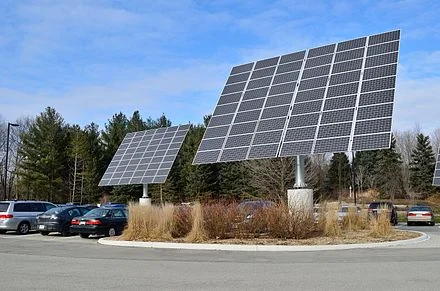
The Rhode Island Office of Energy Resources has adopted a set of initiatives to encourage solar development on brownfields, rooftops, and carports.
Rhode Island’s rush to site renewable energy on open space and clear-cut forest to make room has become a contentious issue, with Cranston, Exeter and Hopkinton among the places where resident pushback has been strong.
“Making renewable energy more affordable and accessible has been a top priority of this administration, and today’s announcement builds on the progress we have made,” Office of Energy Resources (OER) commissioner Carol Grant said. “There is so much underutilized space — from parking garages, to rooftops, to former industrial complexes. By retrofitting these spaces with new solar panels, we will continue to lower our carbon footprint and to meet the growing demand for [renewable] energy.”
The initiatives announced July 19 were developed during the past year with input from various stakeholders, including municipal planners, environmentalists, farmers, government agencies, businesses, developers, and concerned residents.
The new initiatives are as follows:
Brownfields. Former industrial or commercial sites where future use is affected by environmental contamination are often ideal locations for renewable-energy projects. Starting this fall, renewable-energy projects that are sited on brownfields will be eligible for financial incentives from the Renewable Energy Fund. A million dollars will be earmarked specifically for this initiative, according to OER.
Rooftops. The state agency, in coordination with the Distributed Generation Board, is proposing an increase in the number of megawatts of capacity available for rooftop solar under the 2019 Renewable Energy Growth Program. Under this proposal, the cap would be raised 27 percent to nearly 9 megawatts, allowing more homeowners across the state to access the program starting in the spring 2019. This proposal is subject to review by the Distributed Generation Board and Public Utilities Commission in late 2018, according to OER.
Carports. OER has proposed that solar arrays installed over parking areas be made available for the first time under the Renewable Energy Growth Program. The proposal is also subject to the same review and approval process as the small-scale solar proposal.
More bridges to nowhere

"The Beauty of Broken Bridges'' (encaustic painting), by Nancy Whitcomb
So whatever happened to Trump's promises to start rebuilding America's collapsing infrastructure, which is about the worst in the Developed World?
Small-town excitement
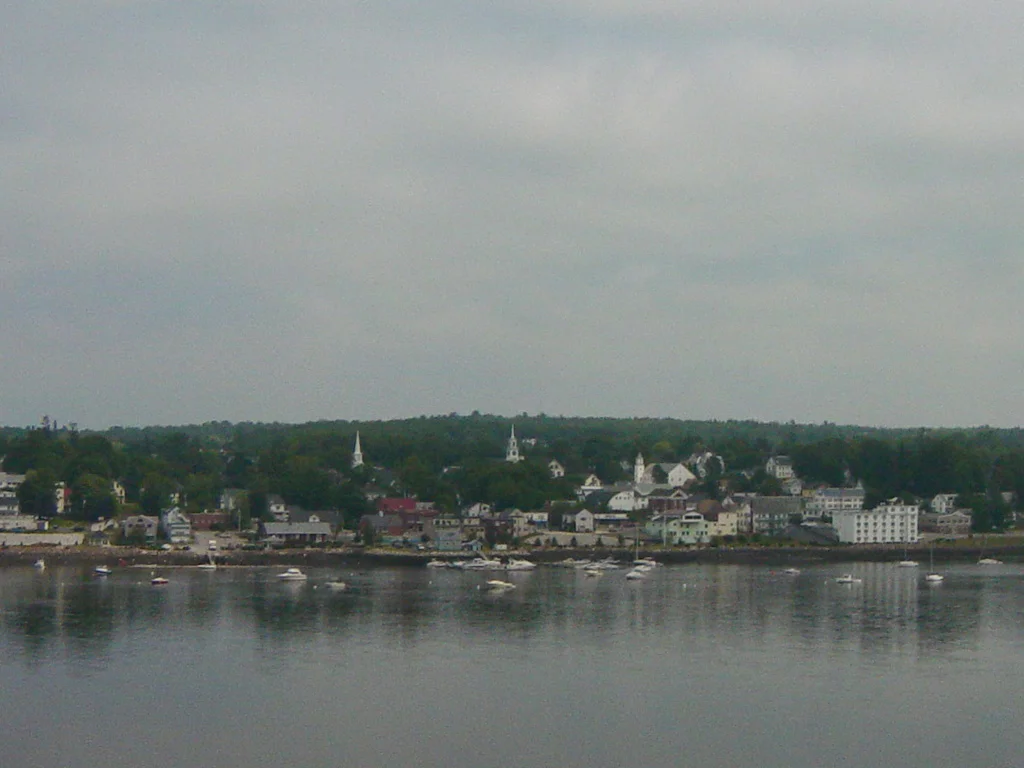
Bucksport, Maine.
"The Ecuadorian sailors arrive in Bucksport.
They stare at the American girls who stand
on the oil wharf in shorts and halters, eating
pistachio ice cream in the long Maine afternoons
as the sun drops behind the refinery....''
-- From "The Ecuadorian Sailors,'' by William Carpenter
A colorful guidebook -- and history -- about great New England houses and gardens
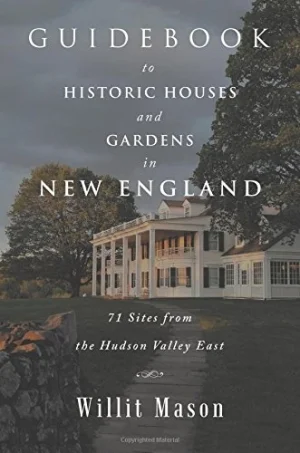
William (“Willit’’ ) Mason, M.D., has written has a delightful – and very handy -- book rich with photos and colorful anecdotes, called Guidebook to Historic Houses and Gardens in New England: 71 Sites from the Hudson Valley East (iUniverse, 240 pages. Paperback. $22.95). Oddly, given the cultural and historical richness of New England and the Hudson Valley, no one else has done a book quite like this before.
The blurb on the back of the book neatly summarizes his story.
“When Willit Mason retired in the summer of 2015, he and his wife decided to celebrate with a grand tour of the Berkshires and the Hudson Valley of New York.
While they intended to enjoy the area’s natural beauty, they also wanted to visit the numerous historic estates and gardens that lie along the Hudson River and the hills of the Berkshires.
But Mason could not find a guidebook highlighting the region’s houses and gardens, including their geographic context, strengths, and weaknesses. He had no way of knowing if one location offered a terrific horticultural experience with less historical value or vice versa.
Mason wrote this comprehensive guide of 71 historic New England houses and gardens to provide an overview of each site. Organized by region, it makes it easy to see as many historic houses and gardens in a limited time.
Filled with family histories, information on the architectural development of properties and overviews of gardens and their surroundings, this is a must-have guide for any New England traveler.’’
Dr. Mason noted of his tours: “Each visit has captured me in different ways, whether it be the scenic views, architecture of the houses, gardens and landscape architecture or collections of art. As we have learned from Downton Abbey, every house has its own personal story. And most of the original owners of the houses I visited in preparing the book have made significant contributions to American history.’’
To order a book, please go to www.willitmason.com
'Dimensional landscapes'
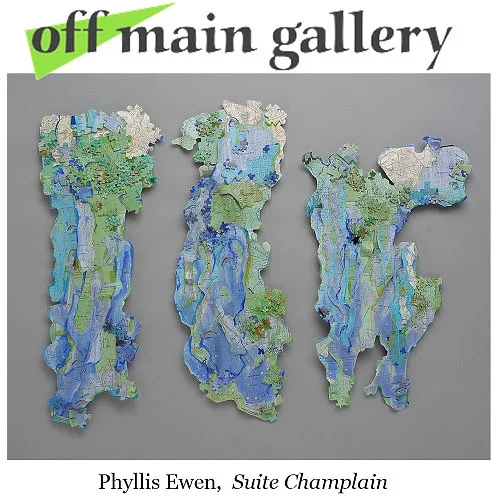
This image is from Ms. Ewen's "Flux & Flow'' show of "dimensional landscapes" on archival pigment prints at the Off Main Gallery, in Wellfleet, on the Lower Cape, through Aug. 9. The "Champlain'' is apparently a reference to Lake Champlain.
9
A poet finds grace on the Maine Coast

Cape Neddick Light (circa 1920), in York, Maine, where May Sarton lived in her last years, after moving from Nelson, N.H.
"As I think about it today in my 81st year, looking out at the sea from my desk, I realize that what I have found in Maine is more than courtesy and kindness. It is grace.''
-- The late poet May Sarton, in "I Was on my Way Home Anyway,'' in the March 1994 Yankee magazine.
York is a well-known summer resort town, with 18-hole golf clubs, four sandy beaches and Mount Agamenticus, a remarkably high hill (692 feet) considering its proximity to the sea. There's lots of "old money'' there, perhaps best seen at the exclusive York Harbor Reading Room club.

-- Photo by Fredlyfish
At the top of Mount Agamenticus, in York.

"York Harbor, Coast of Maine'' (1877), by Martin Johnson Heade.