
Vox clamantis in deserto







The fashion of recreation

"Weights" (circa 1850), shown in "Leisure Pursuits; The Fashion and Culture of Recreation,'' at Fruitlands Museum, Harvard, Mass., through March 24, 2019. "Weights'' is part of the collection of the William Cullen Bryant Homestead, in Cummington, Mass.
The museum says: "This exhibition looks at the way in which the people of Massachusetts have spent their leisure time interacting with Massachusetts Trustees of Reservations properties over the last 125 years. Visitors will see original antique and vintage dresses and personal accessories that were integrated into activities such as gardening, entertaining, fitness, water activities, equestrian pursuits, and travel at and to various properties.''

Gold and pink deco gown, circa 1930, silk brocade, rhinestones, metallic thread, Part of the Collection of the Stevens-Coolidge Place, in North Andover, Mass.
Looks like Maine

From Ole Brodersen's show "Trepassing: Photographs from Lyngor, Norway''. The Dedee Shattuck Gallery is in Westport, Mass.
The gallery says:
"Following 11 generations before him, Ole Brodersen (born 1981) grew up on the small island of Lyngør, Norway, with no cars and about 100 inhabitants. Ole's father is a sail maker, his grandfather a sailor. He has spent most of his life close to the ocean, in constant company of the elements.
"The series of photographs in 'Trespassing' explore of the landscape and the natural forces that animate it.''
Llewellyn King: With the Internet, cities are getting smarter
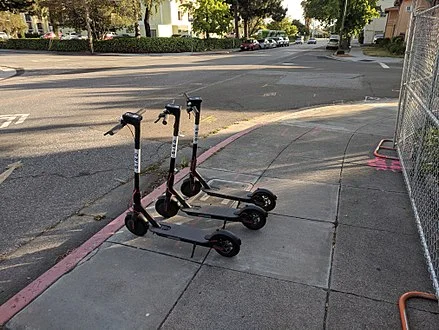
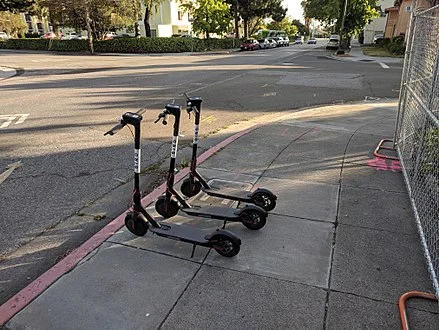
Bird electric scooters, being used in Providence and other cities.
Cities are getting smarter. It’s happening right now, and it isn’t much short of a revolution.
Whole cities are incorporating the Internet of Things (IoT) into their daily life, changing the way the cities and towns live and breathe. The idea is to improve the quality of life for the billions who now live in cities or will as the relentless urbanization of the world continues.
Some are more advanced than others, but the revolution is afoot across the globe. Experts can’t explicitly say which communities are leading the pack but, expectedly, Singapore and Dubai are in the front row, and so are New York and San Antonio.
The goal is to make cities, as old as civilization, more citizen-friendly and more efficient and to ready them for further electrification in transportation — and, one day, for autonomous vehicles.
Clint Vince, chairman of the U.S. Energy Practice of the world’s largest law firm, Dentons, tells me that the firm is so involved with smart cities and communities that it has established a not-for-profit think tank to work on smart city issues within it. He said the think tank has determined 14 “pillars” of the smart city, from obvious ones like transportation, water, electricity and sewage to less obvious city functions like health and recreation.
Vince has represented New Orleans and San Antonio for many years, but he now sounds more like a city visionary than a lawyer. “Take the electric grid: It has to go from a single-direction flow, taking electricity from the point of generation to the point of consumption, to a two-way flow,” he said. “Eventually, it has to have multi-directional flows.”
Vince is talking about the effect of microgrids and dispersed electric generation, such as rooftop solar. One day, this grid flexibility may lead to innovations such as electric cars “lending” electricity to the grid when prices are favorable.
Electricity and smart meters, which are the key to what is known as the smart grid, began the revolution. Now the surge is joined by telephony in connecting, managing and directing the smart city infrastructure, and in trouble shooting it.
Tony Giroti, chairman of the Energy Blockchain Consortium, says smart installations aren’t just for monitoring and metering electricity and water consumption, but also play a prime role in bridging the divide between the old infrastructure and the new information-driven one. Smart city sensors will advise before there is a problem with an old pipe or compressor, so that proactive intervention can avert breakdowns.
Cities such as New York and Washington have underground pipes and wires that are past their prime, but they needn’t pose the threats they used to: The cities can cry out electronically when their physical plant is hurting. The New York Power Authority, a state agency, is credited with a leading role in smart cities, but the rush is on across the country and around the world.
As the information-driven city takes hold, so do questions ranging, for example, from where will autonomous ride-share cars loiter when not booked to where will they park?
I was leaving an interview about the future of cities when I fell over it. Literally. One of those scooters that are now part of the urban transportation mix had been left on the sidewalk. Because of the use of Internet technology and GPS, riders can leave them anywhere when they get to their destinations. The scooters are picked up and recharged at night, signaling to the company where they are via GPS.
Creating new, more livable cities is exciting; dealing with the unexpected consequences, as always, is challenging. When no one is looking, I’m going to try one of these scooters. I may be in traction when I write my next column, but don’t worry — it’ll be delivered electronically.
On Twitter: @llewellynking2
Llewellyn King is executive producer and host of White House Chronicle, on PBS. He's based in Rhode Island.
The stone-wall industry

Stone wall near Hammersmith Farm, Newport, R.I.
--Photo by JG Klein
"Many New England stone fences built between 1700 and 1875 were laid by gangs of workers who piled stones at the rate of so much per rod. {Naturalist and writer) Edwin Way Teale says that in the latter years of the past (19th} century, before economic and social developments began obliterating some of the walls, there were a hundred thousand miles of stone fences in New England.''
-- William Least Heat Moon, in Blue Highways
'Africa in the ear!'

Gorillas at Franklin Park Zoo.
"A tree grew. Oh, remembering gorillas!
O Orpheus singt! Oh, Africa in the ear!
The recluse, Vip, came out. Gigi sat still
and wide-eyed, black face pressed against the bars.''
-- From "Live Jazz, Franklin Park Zoo,'' by Marilyn Nelson, a former poet laureate of Connecticut. Franklin Park is in Boston. The sub head of the poem: "Kubie {a gorilla} sobbed when a nearby jazz band stopped playing'' -- Christian Science Monitor, Aug. 27, 1996.
Chris Powell: So in Conn., who is really conservative?
Most candidates in the primaries for the Republican nominations for governor and lieutenant governor advertise themselves as "conservative," since the party is generally conservative and its primary voters are heavily so. But the advertising leaves "conservative" undefined, and the candidates seem to think that conservative Republicans need only to hear the word before responding reflexively with approval.
Conservatives may be more demanding than that. Are they really supposed to be persuaded by, for example, television commercials touting "conservative businessman Bob Stefanowski" for governor when the candidate has no record in public life and no one ever heard of him before he set out to buy the nomination?
The Hartford Courant quotes Darien First Selectwoman Jayme Stevenson, a candidate for the Republican nomination for lieutenant governor, as saying Connecticut needs consensus builders, "not people who stand on some kind of political ideology." Yet, though the Courant didn't report it, Stevenson's own advertising describes her as a "conservative Republican."
Of course after the primary most of this "conservative" stuff will disappear from Republican advertising since Connecticut's electorate is liberal or libertarian on social issues. But given state government's financial collapse, the electorate is also growing more skeptical if not quite yet conservative on financial issues. At least there is a case to be made for something different from the uncritical liberalism whose political correctness correlates heavily with financial collapse.
Will any candidates make that case well? If so, will they overcome the attacks of the state's politically correct news organizations?
Such an attack was placed on the front page of The Hartford Courant this week as the newspaper maliciously described as an extremist the lieutenant governor candidate endorsed by the Republican state convention, Southington state Sen. Joe Markley.
Unlike other candidates, Markley doesn't have to advertise himself as conservative, as he has a long record on issues that appalls the Courant. But it may not be as appalling as the Courant thinks.
Markley, The Courant notes, would require parental notification of abortions for minors. But most people in Connecticut probably would support changing abortion law that way to prevent concealment of child rape, of which the state has had some horrible cases the Courant has declined to report plainly.
Markley, The Courant continues, favors local option on fluoridation of public water supplies -- not because fluoridation is a communist plot but because it medicates people without their consent and because fluoride treatment is easily available otherwise. Preventing involuntary medication actually seems like a liberal position.
Markley, The Courant notes, was the only legislator to vote against a bill purporting to require formal consent for college students having sex. The proposal was politically correct but will accomplish little amid the usual conflicting testimony.
Markley, The Courant says, was a TEA Partier before the party started. TEA stands for "taxed enough already." Horrors! So which candidate for governor is airing commercials declaring that the middle class is overtaxed and "working families have paid enough"? That's no right-winger. It's liberal Democrat Ned Lamont.
Right or wrong, Markley may be the only candidate in the primaries who has a record on state issues and can explain it thoughtfully and cordially. At least in that respect he is very much out of place.
Chris Powell is a columnist for the Journal Inquirer, in Manchester, Conn.
Friends in the forest

"Untitled (Two Trees)'' (oil on canvas), by Hannah Stahl, at Atelier Newport gallery.
Break from the Great Depression

"Dad Blowing Up Green Turtle Tube" (1931, oil on canvas), by Leslie Thrasher, on the cover of the Sept. 5, 1931 Liberty Magazine. It can be seen at the National Museum of American Illustration, Newport.
c) 2018 National Museum of American Illustration, Newport, RI.
Images courtesy Archives of American Illustrators Gallery, New York, NY.
James P. Freeman: Those scary 'stans' of pop music

Eminem, who boosted the 'stan' sentiment with his song "Stan'' in 2000.
Gentle reader, are you consumed — in thought, word or deed — by your favorite actor, athlete or rock star? If yes, you’re considered a “stan.”
In today’s celebrity-obsessed culture, stan is a fitting portmanteau of stalker and fan (derived from fanatic or the Latin adjective, fanaticus). According to en.oxforddictionaries.com, it is defined as “an overzealous or obsessive fan of a particular celebrity.” And given modernity’s looseness with language and linguistics, the word may be used as a noun (i.e., “Kylie Jenner has millions of stans”) or a verb (i.e. “millions stan for Kendall Jenner”).
Many point to the song “Stan” by rapper Eminem (released as a single in 2000), about the warped idolatry of a disturbed fan of the Slim Shady himself, as giving popularity to the stan sentiment. Still others point to rapper Nas who, in 2001’s “Ether,” intentionally used the word for what became its popular connotation.
We’ve come a long way from the delirium of Frank Sinatra’s rabid 1940s “Bobby Soxers,” perhaps the earliest stans.
There was “Beatlemania” in the 1960s. Later, in the 1980s, young Madonna enthusiasts were known as “Wannabes.” Before the death of Jerry Garcia, in 1995, for decades legions of loyalists (“Deadheads”) lived a lifestyle synonymous with members of The Grateful Dead. Now we have “Sheerios” (Ed Sheeran), “Finaddicts” (for fans of the Jaws franchise), “Llamas” (Cowboy Junkies), and “Streepers” (Meryl Streep). And closer to home: “Red Sox Nation” (Boston Red Sox).
Social media — Facebook, YouTube, Twitter, Instagram, Tumblr, Pinterest, Reddit — have given rise to a weird mass intimacy (“like me” and “follow us;” “hearted”) between object (celebrity) and subject (stan). And vice versa.
This twisted relationship has spawned the professional fan. Part mystic. Part hysteric. Part parasitic.
And the new digital symbiosis practically requires that stans don the same clothes, drink the same Armand de Brignac, and download the deep-cut track. But don’t dare disagree or think differently. Or become a detractor. Just ask Wanna Thompson.
The New York Times recently reported that she incurred the wrath of the stans of Nicki Minaj (known as, appropriately, “Barbz”) and the artist herself (via a practice known as celebrity “clap back” — she has 20.2 million Twitter followers) when Thompson (a freelance writer with a mere 14,000 followers at the time) wondered if the singer would “put out mature content?” That simple question produced a hailstorm of scorn and derision toward Thompson.
It’s fun to imagine what stans’ reaction would be today if John Lennon posted on Snapchat that The Beatles were “more popular than Jesus now.”
James P. Freeman, a former banker, is a New England-based columnist. This piece first ran in Inside Sources.
James T. Brett: New England has benefited greatly from NAFTA
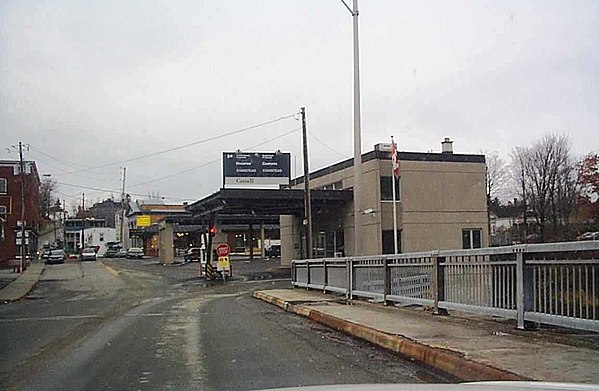
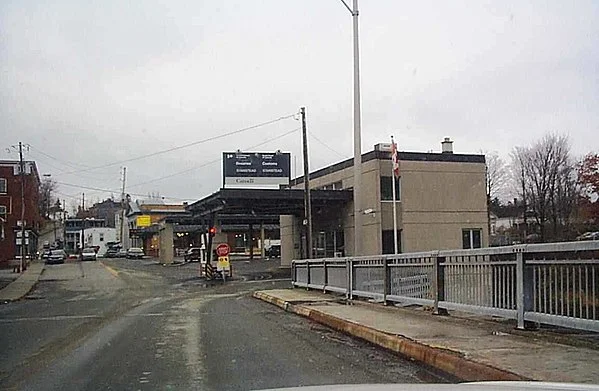
The Canada Border Inspection Station at Stanstead, Quebec, just across the border from Derby Line, Vt.
From The New England Council (newenglandcouncil.com)
Over the past 18 months, we have seen a marked shift in U.S. trade policy. Soon after taking office, President Trump made good on his campaign promise and announced that the U.S. would seek to renegotiate the North American Free Trade Agreement (NAFTA,) a multilateral agreement with Canada and Mexico that was put into effect in 1994. In more recent months—amid reports that NAFTA talks have grown contentious and that the U.S. is considering withdrawing altogether — the administration announced tariffs on certain imports that directly affect our neighbors to the immediate north and south.
Canada and Mexico are not only important allies, they are significant economic partners for the U.S., and for the New England states in particular. As the voice of the region’s business community, The New England Council believes it is of critical importance that the U.S. continue to work toward a modernized NAFTA, and that the administration should reconsider the tariffs against our partners in Canada and Mexico.
The impact of trade with Canada and Mexico on the New England economy cannot be understated. According to the U.S. Department of Commerce, Canada is the premier goods export market for businesses in five of the six New England states — in the sixth state, it is the second-largest market — representing more than $8.3 billion in exports in 2017 alone. Canada estimates that in 2017, service exports from our six states totaled nearly $3.3 billion. Mexico is also a top trade partner for our region, with three states counting our southern neighbor as their second- or third-ranking export market for goods. The region exported $4.4 billion worth of goods to Mexico in 2017, and remains a significant multibillion-dollar market for goods produced in Mexico. Data from the International Trade Administration indicates some 10.7 million American jobs are supported by goods and services exports, and it is doubtless that tens of thousands of New England jobs rely upon trade with Canada and Mexico.
The tariffs that President Trump has put into place are already having a significant impact here in New England. The U.S. Chamber of Commerce recently released a state-by-state analysis of the impact of the emerging trade war on U.S. exports. According to the report, as a result of the administration’s tariffs, $11 million in New Hampshire exports to Canada are targeted for retaliation, and close to $1 million in exports to Mexico are targeted for retaliation. Some of the hardest hit products include steel and aluminum products, lighting products, and certain foods. In total, nearly $2.7 billion in New England exports to Canada and Mexico face retaliation.
It is certainly appropriate to revisit and update major trade agreements. Some elements of our economy did not even exist at the time NAFTA was first negotiated, and we commend the administration for taking steps to modernize this historic agreement. At the same time, the President is right to be concerned about trade imbalances and to seek ways to minimize trade deficits. However, given the importance of trade with these two nations, it is gravely concerning that the administration would even suggest withdrawing from NAFTA. Further, the evidence laid out by the U.S. Chamber’s new report suggests that the tariffs are most certainly not serving our nation’s best interests, and could harm disparate and unrelated sectors of our economy.
It is understandable that partners and neighbors, on occasion, can have temporary disagreements over policy considerations, including on trade matters. However, The New England Council believes it is crucial that the playing field remain open for businesses, workers, and families across New England, so that they — through no fault of their own — are not disadvantaged by potential retaliatory trade measures or a defunct NAFTA.
James T. Brett is the president and CEO of the New England Council.
Martha Burk: A sad birthday for Medicare and Medicaid

Via OtherWords.org
July 30 marks a very important anniversary in our modern political history.
Fifty-three years ago in 1965, President Lyndon Johnson signed Medicare and Medicaid into law, creating two programs that would disproportionately improve the lives of older and low-income Americans — especially women.
Fast-forward to 2018, and both programs are very much under siege. Nowhere is the struggle starker than in the House Republican budget — titled “A Brighter American Future” — now on Capitol Hill.
The importance of Medicare as a source of women’s health coverage can’t be over-emphasized.
Older and disabled women make up more than half the total beneficiaries, and two-thirds of those 85 and over. This budget from hell takes a giant step toward privatizing the program by allowing insurance companies into the Medicare marketplace, which means benefits could be caught in a race to the bottom and become too paltry to cover all but the barest of medical needs.
Medicaid is the joint federal-state program that provides low-income people with health care. The proposed Republican budget repeals the Medicaid expansion that came with Obamacare, which will cause 14 million to 17 million people to lose coverage.
The Medicaid remnants that survive would be turned into block grants, allowing states to pick and choose who gets covered and what kind of benefits they get — no doubt with little or no federal oversight. That approach makes it easier to cut the program without saying how many people would be dropped, or how much benefits would be lowered.
Since poor women under retirement age and their children are the biggest group of beneficiaries, it stands to reason they’d also be the biggest losers.
But there’s more. Because women have more chronic health conditions like arthritis, hypertension, and osteoporosis, they’re more likely to need institutional care. Since Medicare generally doesn’t cover nursing home care, Medicaid provides such care for those with disabilities and/or very low incomes — and 60 percent of those folks are women.
What’s not in the budget? Long gone is the Obama-era effort close the Gingrich-Edwards tax loophole that allows some high-income individuals (possibly including Donald Trump) to avoid Medicare and Social Security payroll taxes altogether, resulting in billions of lost revenue for both programs.
The House Republican budget probably won’t pass in its present form. But with Republican majorities in both houses of Congress, even compromises are sure to favor more cuts.
“A Brighter American Future?” Hardly. This summer’s 53rd anniversary of Medicare and Medicaid looks like a less than happy one for those that depend on them most — namely women, but really anyone counting on growing older.
Martha Burk is the director of the Corporate Accountability Project for the National Council of Women’s Organizations (NCWO) and the author of the book Your Voice, Your Vote.
Muted infrastructure

From Jeff Weaver's show, "Works on Paper,'' at the North Shore Art Association, Gloucester, July 27-Aug. 18.
The PawSox mystery persists
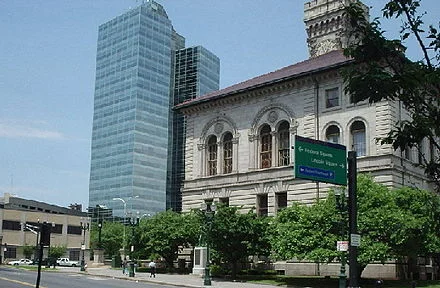
Downtown Worcester, with City Hall on the right.
From Robert Whitcomb's "Digital Diary,'' in GoLocal24.com
It remains surprising how little information has come out about Worcester’s pitch to lure the Pawtucket Red Sox to Massachusetts’s second-largest city, especially since Rhode Island Governor Raimondo signed a bill last month aimed at helping to finance a new stadium for the team at Pawtucket’s Apex site.
No one hereabouts seems to know what Worcester and the commonwealth have in mind, and how much information has been transmitted to the team owners.
At the same time, news reports point to the Kraft/Patriot family’s intensifying interest in building a major stadium for professional soccer (called variations of “football’’ in most of the world) in Boston for their New England Revolution team. Makes sense. Soccer has become ever more popular in America in the past few years. I was struck by how many bars and restaurants had World Cup games on their TVs in the recent competition, won by France. Within a couple of decades soccer stadiums may become more important sports venues here than stadiums for baseball and American football (concussions, anyone?)
On crazy families

The administration building at McLean Hospital, in Belmont, Mass. It's New England's most famous mental hospital.
From the movie Casablanca:
German Major Strasser: “What is your nationality?’’
Rick Blaine: “I’m a drunkard.’’
French Captain Renault: “That makes Rick a citizen of the world.’’
To paraphrase Tolstoy’s famous line from Anna Karenina about “all unhappy families being unhappy in their own way”: All crazy families are crazy in their own way.
I’m referring to psychiatrist Edward M. Hallowell’s just-published memoir Because I Come From a Crazy Family. Hallowell, author of the best seller Driven to Distraction, about attention-deficit disorder, grew up in a family with a psychotic father, alcoholic mother, abusive stepfather, and two “learning disabilities’’ of his own. It’s a sometimes harrowing, sometimes funny and almost always engaging saga featuring what Dr. Hallowell calls the “WASP triad of alcoholism, mental illness and politeness.’’ Actually, of course, the WASPs aren’t the only ethnic group with that triad. Beyond Hallowell’s very personal tale, the book is a primer on what happens in the mental-health trade, from medical school on.
Most of the book takes place in New England, with colorful side trips to Charleston and New Orleans. GoLocal readers will see many familiar scenes.
Flower shop

"Homage 1010 (Black Rose)'' (digital collage), by Irene Mamiye, in her show at Lanoue Gallery, Boston, through July 29.
Marching fruit

"Kiwi Rhythm'' (oil on canvas), by Sherie Harkins, in the "Colorist'' group show at ArtProv Gallery, Providence, Aug. 8-Sept. 22.
Chris Powell: The ambiguous charms of self-funding 'political outsiders'
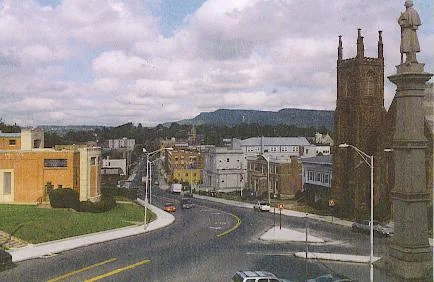
Meriden, Conn., a heavily Democratic city that just rejected a property-tax increase.
Connecticut doesn't know the two rich and self-funding candidates for the Republican nomination for governor, Bob Stefanowski and David Stemerman, who are called "pop-up" candidates by the candidate endorsed by the Republican state convention, Danbury Mayor Mark Boughton. So Stefanowski and Stemerman are impolitely introducing each other to Republican primary voters. It's not pretty but it's useful.
Last week Stemerman broadcast a television commercial noting that Stefanowski enrolled as a Republican only a few weeks before becoming a candidate, long had donated to Democratic candidates, and hasn't been voting Republican. (As it turned out, Stefanowski hasn't been voting Republican because he hasn't been voting at all for 16 years.)
Indeed, while Stefanowski seems to have been a Republican for a long time, he left the party and enrolled as a Democrat for less than a year before re-enrolling as a Republican again a year ago, apparently because he first considered running for governor as a Democrat.
So much for core beliefs.
Stefanowski concedes most of this, explaining weakly that he was working abroad and should have sought absentee ballots. He counters that Stemerman was once a Democrat, too, and donated to Barack Obama in 2007. But Stemerman left the Democratic Party 15 years ago and says his contribution to Obama was just the price of admission to a fundraiser sponsored by a friend and there were no additional donations.
Indeed, for corporate executives like Stefanowski and Stemerman, politics is often not a matter of core beliefs but just business that requires cozy relations with both sides of the street.
Stefanowski got his commercials on TV before the other Republican candidates and for a while was thought to have an advantage, but he may be badly damaged by exposure of his opportunism and dilettantism. Since Stemerman's connection with the other party is fairly remote, Republicans may take less offense from him.
The exchange between the self-funders is a reminder that the mantle of "political outsider," seemingly much desired by some candidates for governor, can also mean unknown, untested, uninformed, and full of last-minute, unpleasant surprises, as state Republicans might have learned from their awful habit of nominating self-funding political neophytes for governor and U.S. senator in recent years.
But there's nothing wrong with changing parties out of principle rather than opportunism, since people's views and parties evolve. Winston Churchill changed parties twice, from Conservative to Liberal and back again, because of policy differences before saving civilization from barbarism. Having gotten away with it all, he reflected: "Anyone can rat but it takes a certain amount of ingenuity to re-rat."
Stefanowski botched his "re-ratting," even as the next governor may need Churchillian ingenuity to save the state from parasitism.
At least there was a hopeful sign last week from Meriden, a heavily Democratic city that held a referendum on its City Council's proposed budget, which carried a property tax increase of 5 percent.
The budget was defeated by 5,999 to 260, a margin of 96 to 4 percent, and turnout was fairly representative — almost 6,300 voters.
If even a Democratic city has had enough of raising taxes, how will ordinary Democrats view a candidate of their party for governor who plans to raise taxes again to appease the government and welfare classes?
Chris Powell is a columnist for the Journal Inquirer, in Manchester, Conn.

Frank Carini: No need to chop down trees to address climate change

From ecoRI News (ecori.org)
We can split the atom, send people to the moon and land rovers on Mars, build weapons of mass destruction, drill for fossil fuels a mile beneath the ocean’s surface, take land via eminent domain to build a fence along the Mexican border, and develop technology that tracks our every move, but we can’t seem to increase solar-energy production without deforesting the landscape.
Modernizing the power grid to handle the 21st-Century needs of renewable energy and siting solar energy responsibly are always beyond our capabilities. Forests must be sacrificed to protect the environment from fossil fuels and climate change — except, of course, when forests need to be clear-cut to make room for more fossil fuels and more climate emissions (see Clear River Energy Center).
This obtuseness is on profound display in Rhode Island, where developers hack their way through green space to build monuments to corporate banking and blackjack. We leave already-developed, infrastructure-ready, paved-over disturbed places alone.
The siting of solar energy is a multilayered issue informed by many factors, the first and foremost of which is profit. After that comes the lure of tax revenue, the protection of property rights, and concerns about the high cost of interconnections and substation upgrades (see, profits). Last on the list of importance is environmental protections.
The future costs that come with degrading the environment by clear-cutting forest, much like filling in wetlands and drowning salt marshes to make way for more development, are largely ignored. The resulting problems caused by erosion, flooding, soil degradation, and various climate-change impacts, such as the deterioration of public health, are paid later by others who had no say in the shortsightedness.
If we truly wanted to, we could overcome the often-cited substation and interconnection excuses that are routinely noted when another tree is felled to make way for another solar panel. It’s really just a matter of whose money will be spent to improve the generation and distribution of renewable energy — an urgently needed must-do during this climate-changing time. Energy developers and utilities don’t want to pay for the needed upgrades. They want ratepayers to fund the work, even if it’s for fossil-fuel expansion.
Thus, forests are clear-cut and woodlands cleared, because it’s more profitable to bulldoze the environment than it is to repurpose already-developed areas, build carports, or transform brownfields and Superfund sites.
As of last month, London-based National Grid was ranked No. 249 on the Forbes list of the world’s largest public companies, with $18.4 billion in sales. The multinational corporation made $10.2 billion in profit in 2017.
National Grid recently filed a proposal with Rhode Island regulators that calls for a 19 percent increase in the bill for the typical residential user. Under the filing submitted to the Public Utilities Commission, starting Oct. 1 and running through March residential customers who use 500 kilowatt-hours a month would experience an increase in their monthly bill of nearly $19.
When it comes to the siren song of tax revenue and the accompanying allure of lower property taxes, which seldom manifest, the priceless value of green space can’t compete. The long-term costs of Rhode Island’s collective solar shortsightedness will be significantly more expensive than properly dealing with the siting issue now. It’s easier, however, to leave the tab for future generations to pick up.
The latest example in this recurring lack of leadership is the Exeter Town Council. Despite objections from both the Planning Board and town planner, and after three nights of public hearings where residents expressed strong opposition to a proposed zoning change, the Town Council recently voted to change the zoning ordinance as requested by a solar-energy developer.
Green Development LLC — the same North Kingstown-based company that tried buying votes in an attempt to get a bill approved that would have listed woody biomass as a renewable energy despite reams of information that say otherwise — won the zoning change that will allow it to build utility-scale solar installations on 15 properties in residential areas without having to seek special-use permits.
Property rights are important, but so too are the comprehensive plans that cities and towns are mandated to develop in order to, among other things, steer development to appropriate locations. However, the growing trend, especially in rural Rhode Island, is approving industrial-scale solar projects in neighborhoods zoned residential. The required comprehensive plans are routinely ignored.
Replace 60,000 solar panels with low-income housing or bike paths from Providence and Central Falls and the property-rights conversation will change.
A Rhode Island Office of Energy Resources (OER) stakeholders group met monthly for about a year. It helped craft a bill, the Rhode Island Energy Resources Act, that created siting standards for wind and solar projects within each municipality. The measure had the support of OER, the Rhode Island Department of Environmental Management, the Rhode Island Farm Bureau, the International Brotherhood of Electrical Workers, the Rhode Island Builders Association, the Northeast Clean Energy Council, the Conservation Law Foundation, The Nature Conservancy, and the Audubon Society of Rhode Island.
The House passed the bill, but the Senate never bothered to hold a hearing.
Now an advisory group, a subcommittee of the OER stakeholders group, is working to develop a solar-guidance-model ordinance for use by municipalities. Six more meetings are scheduled through mid-October. In the meantime, OER recently adopted a set of initiatives to encourage solar development on brownfields, rooftops, and carports. The initiatives, however, are short on specifics and funding.
These delay tactics need to be reversed. We should be creating task forces, ignoring bills, and holding public hearings that study the impacts of forest clear-cutting. It would be years before another tree was axed.
Frank Carini is the ecoRI News editor.
Conn. seems to be reviving

Looking across the Connecticut River at Hartford.
From Robert Whitcomb's "Digital Diary,'' in GoLocal24.com
Connecticut has been hammered by Republican politicians for years for its high taxes and sluggish economy. From the propaganda you’d never know that Connecticut remains the richest state on a per-capita basis, followed by Massachusetts.
In any event, things are finally looking up in the Nutmeg State. Among the good news, The Hartford Courant reports:
Seven Stars Cloud Group, a financial technology company, will spend $283 million to create a tech hub at the former University of Connecticut regional campus in West Hartford.
Infosys will create a regional tech and innovation hub in Hartford, which has been in a steep economic and social slide for years, and hire 1,000 people for its information-technology and consulting business.
Stanley Black & Decker will open an advanced-manufacturing center in downtown Hartford to develop its “smart factory’’ initiative.
CVS will keep the headquarters of Aetna, which it is buying, in Hartford.
EIP LLC is setting up banks of computer servers in an abandoned factory in New Britain, an old factory town, to process and store data for many businesses.
Despite its woes of the past few years, Connecticut’s large number of highly educated people and its location between the wealth-creating behemoths of Greater Boston and New York will continue to make it very attractive to sophisticated businesses – generally more so than the low-or-no-income-tax and low-public-services Sunbelt states. The Northeast will remain, after all these years, the richest part of the country.
Meanwhile, the financial-services complex in Fairfield County, and especially Stamford, closely linked to nearby Wall Street, will slowly shrink, as artificial intelligence and other technological change, as well as offshoring, reduce job counts. Finance has been the biggest wealth creator in Connecticut for a long time. It’s a healthy sign for the state that geographical and industry diversification, most of it involving high technology, is well underway.
By the way, I spent much of a recent Friday and Saturday driving around to see friends in Westport, Norwalk and Greenwich, all in rich Fairfield County. If taxes on the rich are so onerous in the Nutmeg State (where I lived for four years when in school) how come I saw so many new mansions and McMansions going up? It looked richer than ever!