
Vox clamantis in deserto




Weapon of choice

'I'm from Boston, and in Boston, you are born with a baseball bat in your hand. And actually, most of the bats in Massachusetts are used off the field instead of on the field, and we all had baseball bats in our cars in high school.''
-- Eli Roth, director, producer, writer and actor. He's actually from gentle Newton, not tough Boston.
Olivia Alperstein: Right-wing ideologue Kavanaugh threatens much more than Roe v. Wade
Via OtherWords.org
President Trump has nominated federal Appeals Judge Brett Kavanaugh to succeed Supreme Court Justice Anthony Kennedy. Why should you care? Because everything from reproductive rights to voting, education, and health care is now at stake.
Kavanaugh, a judicial ideologue committed to pulling the court further to the right, may also reverse decades of key rulings that uphold the constitutional right to personal liberty and autonomy.
All Americans say they value personal freedom, especially the right to make our own decisions about our private lives. Every day, we take that liberty for granted, from exercising our right to free speech to lighting up sparklers on the Fourth of July. Cherishing our liberties is as American as apple pie — but our right to exercise those liberties could be undone.
Nowhere is the issue more critical than on reproductive rights. Kavanaugh’s nomination will mean a major battle to undo key protections in Roe v. Wade, the landmark 1973 Supreme Court case that firmly established the right to access safe, legal abortion.
Striking down Roe would immediately outlaw abortion in states where pre-Roe anti-abortion laws are technically still on the books. As many as 22 states could be impacted over the course of two years.
That’s bad enough. But it’s also critical to remember the reasoning behind the historic 7-2 ruling: that people have a constitutional right to privacy.
Specifically, the Supreme Court upheld and enshrined the protections included in the First, Fourth, Ninth, and Fourteenth Amendments, holding that those protections applied to decisions a person might make about their own body.
Ultimately, that decision informed several other critical rulings, including cases that forbade bans on same-sex romantic relationships and affirmed the right to same-sex marriage. According to Roe, the right to make your own choices is one of the founding principles that govern this country.
If Roe is overturned, that could set off a chain reaction that upends this critical foundation behind other landmark cases — both those that came before and those that came after.
The constitutional right to privacy informed Loving v. Virginia, which struck down criminalization of interracial marriage, and Griswold v. Connecticut, which enabled the legalization of contraceptives. The constitutional right to privacy also played a key role in Carpenter v. United States, a recent ruling that prohibits warrantless collection of cellphone users’ data without reasonable cause.
Judicial precedent set by the Supreme Court has built a solid foundation for interpretation of the law — but all it takes is a stacked court to have that foundation tumble like a house of cards.
Supreme Court appointments are for life. The rulings these justices make affect the entire judicial system for decades, if not centuries, to come. Each year, dozens of critical cases come before the court that deeply impact people’s rights and daily lives.
While outgoing Justice Anthony Kennedy wasn’t perfect, he was committed to upholding the personal right to privacy as enshrined in U.S. law. Kavanaugh, however, could roll back our hard-won freedoms — and those of future generations.
The Senate will be voting soon on whether to confirm Kavanaugh. A lot more than just a vacant bench hangs in the balance.
Olivia Alperstein is the deputy director of communications and policy at the Congressional Progressive Caucus Center.
On 'Golden Pond'

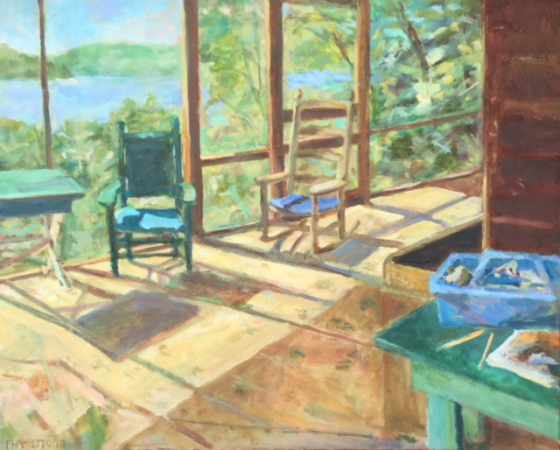
"Squam Series: Side Porch" (oil on canvas), by Frances Hamilton, at the Patricia Ladd Carega Gallery, Center Sandwich, N.H.

Overlooking Squam Lake.
Beautiful Squam Lake, long a much-loved summer vacation spot, is in the Lakes Region of central New Hampshire and just northwest of much larger Lake Winnipesaukee.
Native Americans called Squam Keeseenunknipee, which meant "the goose lake in the highlands". The white settlers that followed shortened it to "Casumpa," "Kusumpy" and/or "Kesumpe" around 1780. In the early 19th Century, the lake was given another Abenaki name, Asquam, which means "water". Finally, in the early 20th Century, Asquam was shortened to its present version.
The 1981 film On Golden Pond, with Jane Fonda, her father, Henry Fonda, and Katherine Hepburn, was filmed in Center Harbor, on Squam. Two tour-boat services are available on the lake, both based in Holderness (where there’s a prep school of the same name) -- Experience Squam, a private charter company, and the Squam Lakes Natural Science Center. Both show movie locations and items of natural and other significance.
Loons, eagles and great blue herons frequent Squam Lake.
Boston Children's Hospital again ranked first
This is from the New England Council (newenglandcouncil.com)
"Boston Children’s Hospital was recently ranked first for the fifth straight year in the U.S. News and Report’s 12th annual list of best children’s hospitals. The rankings are based on metrics like patient outcomes, patient safety, number of fellowship programs, nurse-to-patient ratio, and availability of specialists and advanced services.
Boston Children’s Hospital ranked first in three of the ten specialties: neurology/neurosurgery, nephrology, and orthopedics. Additionally, the hospital placed second in cardiology and heart surgery, diabetes and endocrinology, and gastroenterology (GI) and GI surgery.
Boston Children’s President and CEO Sandra L. Fenwick said, “In a time when health care is ever-changing, achieving the number one ranking reminds all of us at Boston Children’s what inspires us: it’s about caring for children, digging deeper research, and finding new ways to make our care even better.”
Paradise for predation

Eppur si muove

"The iris wavers as the fox trots by,
mornings in paradise, or what pretends
by any other name to smell of meat.''
-- From "Summer in the Ordinary,'' by William Logan
Offshore wind farm doesn't threaten squid fishery


Squid transformed into calamari.
From Robert Whitcomb's "Digital Diary,'' in GoLocal24.com
'Southern New England squid fishermen worry that Vineyard Wind’s plan to put up as many as 100 wind turbines in 250 square miles south of Martha’s Vineyard will hurt their business. It almost certainly will not. For one thing, most sea creatures thrive near wind turbines, whose supports act as reefs. The Europeans, which have massive offshore and coastal wind facilities, have shown how commercial fishing and such clean energy can co-exist.
And Vineyard Wind has contorted itself to make the big project easy for fishermen to live with, such as by promising to space the turbines eighth-tenths of a mile apart and to create special transit lanes for fishing boats.
With any project in public space as big as this, constituencies will sometimes engage in fierce debate. And ancient industries tend not to like change.
Fishing is an important sector in southeastern New England’s economy. But far more important than fishing for a single species is for the region to gain much more energy independence. It’s dangerous for New England to depend so much on fossil fuel from outside the region. And burning that fossil fuel causes massive pollution, global warming, and acidification of the oceans. The last is already killing some life in the ocean.
Better than October

"Orange Ridge'' (acrylic watermedia on aquaboard), by Randa Dubnick, in the show "Exploring in the Mountains of Color,'' at Galatea Fine Art, Boston, through July 29.
Stonehill College to open a business school via a $25 million bond issue
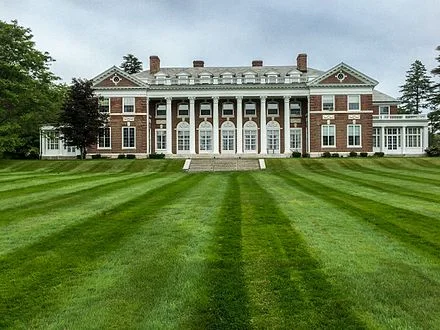
Most of the current Stonehill campus was purchased from Mrs. Frederick Lothrop Ames Jr. on Oct. 17, 1935. The initial purchase included 350 acres and the original Ames mansion, seen here; the Catholic college's remaining 190 acres were bought from Mrs. Ames two years later. Frederick Lothrop Ames Jr. was the great-grandson of Oliver Ames Sr., who came to Easton in 1803 and established the Ames Shovel Company.
From the New England Council (newenglandcouncil.com
"Stonehill College, in Easton, Mass., recently announced that it plans to open a business school using a $25 million bond issue from MassDevelopment, the state’s economic-development and finance agency. The new building will be called the Leo J. Meehan School of Business, named after W.B. Mason (office supplies) CEO and Stonehill alum Leo Meehan. The launch of the business school is part of a broader reorganization at the college, and the restructuring will consist of two main academic programs: The School of Arts & Sciences and the Meehan School of Business.
"Stonehill President John Denning said, 'This is a monumental boost for the college. It will elevate our standing regionally and nationally, allowing us to better compete for the best and brightest students and faculty.'''
Chris Powell: Political correctness can't transform boys into girls
ALICE: "One can't believe impossible things.''
THE WHITE QUEEN: "I daresay you haven't had much practice. When I was your age I always did it for half-an-hour a day. Why, sometimes I've believed as many as six impossible things before breakfast.''
-- From Through the Looking Glass, by Lewis Carroll.
Connecticut lately is getting plenty of practice trying to believe impossible things, not least because of high school sports contests that let boys compete as girls if they insist that they want to be girls. Two such boys, excellent athletes, recently have been finishing first and second in track meets for girls.
There has been some grousing that this is unfair, but on the whole it seems that those most directly aggrieved by the expropriation of the girls events are afraid of coming out as politically incorrect. They fear acknowledging the obvious -- that there are physiological differences between the sexes, starting with the male and female chromosomes, differences that in general give athletic advantages to males, advantages confirmed by the instant success of the boys competing in the girls track meets.
Connecticut law now presumes to deny this basic science by insisting on the right of people who reject their biological gender to use the bathrooms designated for the other gender. The ancient right of sexual privacy has been crushed under the heel of this political correctness.
Biology and science are being discarded in favor of mere individual desire, leaving society with no objective criteria for determining whether someone is male or female. People are to be only what they call themselves, though it used to be understood that, as Lincoln noted, just calling a tail a leg doesn't make it one.
If, as this trend presumes, there are really no differences between the sexes, there no longer will be any rationale for gender divisions in sports, from schools right up through professional leagues. As men who impersonate women begin competing that way, athletic opportunities and recognition for women will be reduced, as the success of the transgendered high school runners in Connecticut already has reduced them. Are women really going to sit quietly through this?
Requiring those runners to compete against their biological gender would deny them no opportunity. As this would remain a free country, the boys could still style and present themselves as girls. No one would have any power to interfere with their personal lives. There would be no need to review their medical histories, as is done elsewhere with claims of transgenderism, nor to psychoanalyze them. They could be themselves and their unconventionality would be no more publicized than it already is. No longer taking advantage of others, they would be less resented.
Indeed, in that case any honors they won might be considered not just more fairly but also more courageously won than honors they won by pretending to be girls.
Political correctness can intimidate people into silence but it can't control what they think, and honors received by able-bodied boys and men competing athletically against girls and women are not likely ever to be considered completely legitimate -- and they shouldn't be, no matter how much the White Queen enjoyed believing impossible things.
Chris Powell is a columnist for the Journal Inquirer, in Manchester, Conn.
Muted Cape color

"Race Point'' (oil on canvas), by Kathleen Jacobs, in her show "Paintings, Monotypes, Wellfleet, MA and Mayo Ireland,'' at Off Main Gallery, Wellfleet, Mass.
Charlie Baker waves the 'red flag'

From Robert Whitcomb's "Digital Diary,'' in GoLocal24.com
'Massachusetts Gov. Charlie Baker’s signing of a “red flag” gun law that will let household members seek a court order to take guns away from people posing a risk to themselves or others means that the Bay State’s gun-death rate, already the nation’s lowest, will probably get lower. Of course, the rate is low because the state has among America’s most restrictive gun laws.
The new law encourages family or household members to ask a judge for an order to remove guns from persons at risk of harming themselves or others and to ban them from having firearms for up to a year, when an extension could presumably be requested.
Massachusetts has become the sixth state to pass such a law, and Mr. Baker the fourth Republican governor to sign the bill into law since the Parkland shooting last winter. But the gun makers, and their lobbying organization, the National Rifle Association, own Congress – especially the House – so don’t expect any such action there anytime soon.
The states with the lowest gun-death rates are, in order, Massachusetts, Rhode Island, New York, Hawaii and Connecticut – all with restrictive (by American standards) gun laws. The NRA and its congressional servants say that “guns don’t kill people, people do.’’ Yeah, but it’s a hell of a lot easier with a gun….
Daniel Regan: Of power walks and other economical ways to improve higher education
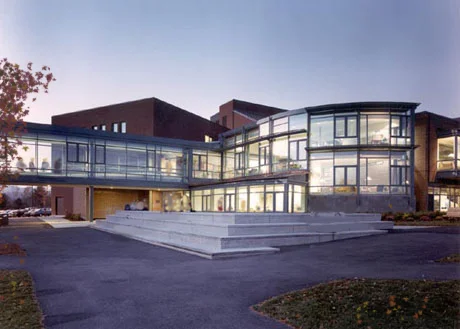
The library at Northern Vermont University -Johnson.
From the New England Board of Higher Education (nebhe.org)
I’ve grown tired of reading the literature on innovation in higher education, much less the offers for services, consulting, webinars and infrastructure that flood the inbox daily. So many of the recommended innovations are beyond the fiscal means of even the most venturesome administrators and their institutions. To this generalization, there are happy exceptions of course; but much of the literature and other communications convey the unmistakable sense that improvements in university functioning are more a capital-intensive, than a thought- or labor-intensive enterprise. That message is especially disheartening in these financially strapped times. It’s like being invited to a grand holiday toy exhibit, with a big “Don’t Touch” sign affixed to the shiniest wares. All other ideas, it seems, are relegated to the categories of mere “tips” or “strategies,” rather than the more muscular-sounding “innovations.” More syllables, more dollars, greater perceived value, I guess.
Who doesn’t pine for a gorgeous one-stop student success center or the expensive software to identify your “murky middle”? Don’t get me wrong: Administrators should continue ceaselessly their quest for the external funding, philanthropic gifts or institutional reallocations to fund these (and many other) valuable endeavors. In the meantime, however, a range of modest ideas, if implemented, have the potential to advance an institution’s educational mission. All manner of colleges and universities stand to benefit, but especially the higher educational “have-nots,”—including the small publics among them—which educate a substantial proportion of American students. For these institutions, restoring a sense of forward movement, despite their lack of resources to deal with fiscal adversity, can offer a sorely needed shot in the arm.
What you decide to do differently next year, or tomorrow, requires thought as well as a willingness to abide by the results.
Here are two examples:
Power (of a) walk (leadership and mission): This simple strategy can play a role in bringing a campus together around priorities that are shared widely and a leadership team that is broadly regarded as unified and legitimate. It’s an innovation that has a positive impact upon campus culture and, moreover, costs nothing to implement in either money or planning time.
Presidents, if possible, invite your provost, dean of academic affairs or whoever serves as chief academic officer to walk. That’s it. I don’t mean to or from a meeting, although that may have its virtues too; rather, for regular walks around campus, with a recommended duration of 30-60 minutes.
If your institution is anything like mine, staff and faculty often wonder among themselves whether the CEO and CAO are on the same wavelength. In this highly visible activity, they are—literally—together. If the two of you have difficulty eking out time to meet, this is your chance. All kinds of issues can be discussed, and in relative privacy. Paradoxically the public setting of a campus walk turns out to be more private than any office or conference room where “the walls have ears.” And if you are demonstrably engaged in discussion, you are less likely to be interrupted on the walkways than in the office.
Regular CEO/CAO walks can also shore up a president’s academic cache as well as help a CAO convey the sense that academic priorities have the president’s ear. And finally, with the grill lines in campus dining facilities generally longer than those for healthier dining options, modeling an accessible wellness activity for faculty, staff and students seems an appealing idea.
Although CEO/CAO walks may enjoy maximal effect on smaller campuses, they can also work elsewhere; and as seems desirable, another campus leader, besides the chief academic officer, may participate with the president.
Re-orienting orientation (student life and early success): Everyone seeks a strong start for beginning students, connecting them to one another and the campus as well as ensuring that they are poised for a good academic beginning. Freshman orientation, however, often has the flavor of a summer camp. The team-building and demonstrations of school spirit are all to the good; but they don’t necessarily prepare students for the first day of classes, which looms. A simple step—not no-cost but low-cost—is to create a session on your institution’s "common reading" as a centerpiece of the orientation schedule. Organizing a guided discussion of the common reading or book, in small groups if feasible, takes some effort and coordination, but is not expensive. As long as you’re at it, consider saving the de rigueur visit by the author for later in the semester, when students are better prepared to engage with, and be engaged by, him or her. And finally, also in service to a strong academic beginning, encourage—strongly—that first class meetings are substantive, rather than purely procedural. Too often students are first exposed to a course through a nuts and bolts discussion of syllabus matters, and then are dismissed. What does that convey about priorities? Instead, students should actually engage with some aspect of the course material and get a flavor for how the class will proceed. The “rules of the game” have their place; but we should also convey, and if possible have students get a taste of, the learning that we hope they will go on to experience.
Readers will have their own examples of no-cost or low-cost innovations. What we need is a clearinghouse for them. Entries could be organized by categories such as leadership and mission, planning, governance, academic programs, teaching and learning, student life and success, and financial management. The cumulative effect of modest innovations can make a real difference. Low cost doesn’t mean minimal thought, or low value.
Daniel Regan, a sociologist, is the accreditation officer and former dean of academic affairs at Northern Vermont University-Johnson.

Todd McLeish: There's a scarcity of local seafood in New England

From ecoRI News (ecori.org)
Those looking to buy local seafood at grocery stores and fish markets in New England may have a difficult time finding much, especially if you’re searching for something other than shellfish. Just 15 percent of the seafood available at markets in the region originated in New England, according to a pilot study by the Rhode Island-based nonprofit Eating with the Ecosystem.
“Unfortunately, the results weren’t super surprising to me,” said Kate Masury, the program director for Eating with the Ecosystem who coordinated the project with University of Rhode Island professor Hiro Uchida and student Christina Montello. “We’re a seafood-producing region, it’s a big part of our economy, but we’re not making it available to our own consumers.”
Rhode Island’s results were better than the regional average, though still not as high as one might expect. About 24 percent of the seafood in Ocean State markets was captured in New England waters, which compares favorably to Massachusetts and Connecticut, at 12 percent each, and New Hampshire and Vermont, at 5 percent. Only Maine, at 33 percent, had more local seafood available in the markets surveyed than those in Rhode Island.
The findings are the result of a citizen science project called Market Blitz that took place over a two-week period in March. Volunteers visited 45 supermarkets and seafood markets in all six New England states to identify what species were available and where they were captured.
While the percentage of locally caught species available for purchase was low, the total number of species for sale was unexpectedly high. Ninety-one species of fresh or frozen marine life could be bought during the survey period, including 45 species identified as being landed in the New England region and 85 species from outside the region or unidentified. (The overlap is due to some species being caught both locally and beyond the region.)
Again, Rhode Island was above average, with 50 species available at the 12 markets surveyed, far more than the other five states.
Despite the variety of species available, however, Masury said that New Englanders typically don’t eat a diverse diet of local seafood. Oysters, quahogs and lobsters dominate the markets, followed by four other varieties of shellfish. Farmed salmon is the most popular regional finfish, followed by wild flounder and haddock.
“We eat a lot of a few things, and it’s mostly shellfish,” she said. “When people go out to eat at a restaurant or go to a seafood market, they want traditional New England food. Shellfish is what people are demanding.”
Where does the rest of the New England seafood harvest go, if not to New England consumers? All over the globe.
“Two-thirds of the seafood caught in the U.S. is exported elsewhere, some species more so than others,” Masury said. “In Rhode Island, whiting, also called silver hake, is a fairly big fishery, but most people here have never heard of it. It mostly goes to New York and it’s distributed out of the region from there.”
In a report issued by Eating with the Ecosystem in late June, the authors wrote that the low availability of locally caught seafood “may not necessarily imply that the market is dominated by non-regional seafood. Rather, it may be in part because the markets did not bother to indicate — or advertise — that the seafood is from the region.”
The report also noted that many of the study’s results suggest that Maine and Rhode Island are different than the other New England states.
“Seafood is a bigger part of the economy in those states, they depend on fisheries more than other industries, and people who vacation in both areas want local seafood,” Masury said. “So part of the reason why those states had more availability of regional species is because there is more demand for local species.”
And that, she added, is the take home message of the Market Blitz. The region has plenty of room to improve, but consumers will have to demand it.
“For many businesses, it’s an economic decision,” she said. “If they don’t think people are going to buy it, they’re not going to offer it. So the biggest thing we can do is to show there is demand for local species. Buy the local instead of the imported. And if you don’t see local in your market, ask for it.”
The Market Blitz study will be conducted twice a year for the foreseeable future, to build up a database and demonstrate how seafood availability changes over time. In the next phase of the project, interviews will be conducted with fishermen, seafood dealers, processors, chefs, and consumers about the mismatch between what species are available in the ecosystem and what species are available in the marketplace.
“One of the things we talk about all the time with consumers is eating a diversity of local species in proportion to their natural abundance,” Masury said. “Species more abundant in the local area should be a larger part of our diet. We hear that species like dogfish and sea robin are abundant in local waters, for example, but you don’t realize that because that’s not what’s available in the local market. Our goal with the Market Blitz is to quantify what is available.”
Rhode Island resident and author Todd McLeish runs a wildlife blog.
'You'll be gone too'
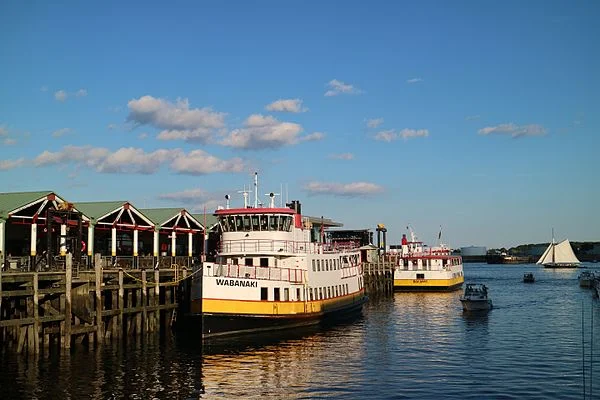
On the Portland waterfront.
"Wharves with their warehouses sagging
on wooden slats, windows steamed up
and beaded with rain -- it's a wonder
weather doesn't wash them away. In time,
they seem to say, you'll be gone too,
your belongings left on a quay for the taking....''
From "Here,'' by Betsy Sholl, who lives in Portland and is a former Maine poet laureate.
Midcentury modern
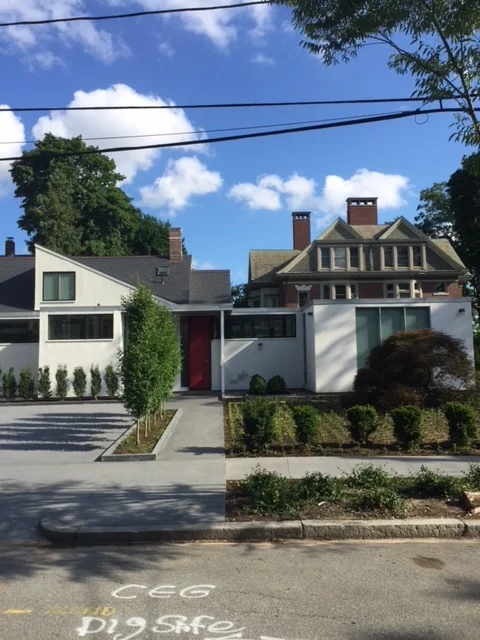
The Rakatansky House, in Providence.
From Robert Whitcomb's "Digital Diary,'' in GoLocal24.com
Ira Rakatansky (1919-2014) was a distinguished Modernist architect who studied under the famous Walter Gropius and Marcel Breuer at Harvard and set up shop in Rhode Island, where he designed many houses and commercial properties. One of the most beautiful was the one he had built for himself and wife, Lenore Gray, a gallery owner, in 1958 on the East Side of Providence. It’s an exhilarating, light-filled house, now in the last stages of being spiffed up by the new owners, who have also done spectacular new landscaping on the site; the Rakatanskys had a sort of Japanese-garden approach.
There something hopeful, confident and breezy about the best of these Mid-Century houses, especially when compared with so much of the hackneyed post-Modernist stuff going up. But many of the ‘50s ranch houses with garages that look bigger than the houses they’re next to are hideous.
Inspirational Maine

"Christina's World,'' Maine and Pennsylvania painter Andrew Wyeth's most famous painting. The building at the upper right is the Olson House, in Cushing, Maine.
's
"Maine likes to call itself 'America's Vacationland.' For many artists, though, it's the office. Since the 19th Century, painters from all over the country - including Edward Hopper, Alex Katz, John Marin, Fairfield Porter, Neil Welliver and Andrew Wyeth - have spent large chunks of time there''.
-- Terry Teachout, Wall Street Journal drama critic
The great Newport dorm dispute

Ochre Court, at Salve Regina University.
By Robert Whitcomb
This was written for GoLocal24.com
Town-gown battles are common. However, the current one in Newport, between Salve Regina University and some neighbors over the school’s plans to build two large undergraduate dormitories, is exotic because its campus is in a spectacular seaside area of mansions, beautiful landscaping and powerful, articulate and opinionated people. The proposed project would be on university-owned property bounded by Victoria, Shepard, Lawrence and Ruggles avenues – in the city’s famous Gilded Age mansion section.
The two dorms, one with 214 beds and the other with 196, would go in the National Historic Landmark District, Salve’s portion of which features 21 historic buildings, including Gilded Age mansions. The school lost 45 dorm beds last year when it sold Conley Hall, one of the reasons it cites for wanting to build the two new dorms. Junior and senior class students must now live off campus. The new dorms would house the juniors.
To move ahead to construction, the university needs, among other things, two special-use permits to build in such a district.
Salve is pushing to get the City Council to approve amendments to the city’s zoning ordinance very soon to allow this big project. Then the project could go on to the Planning Board this summer, and the Zoning Board and the city’s Historic District Commission in the fall. The project’s foes would probably have their best chance of killing it in the last body.
Bill Hall, the school’s CFO/vice president for administration, told me that Salve wants to build the dorms because, he says, “the on-campus presence of all three classes will create a more cohesive, vibrant campus community where {more} students interact with each other as they study, work, play and serve together…..Having all three classes (freshpersons, sophomores and juniors) will also include more out-of-class interaction between students, faculty and staff as well as greater mentoring of younger students by older students.’’
Where should Salve's students be housed?
Salve also asserts, in its sales pitch to the city, that the dorms would, in Mr. Hall’s words, “help minimize the costs of providing public services for this population {of students}’’ – particularly regarding police and fire -- because on-campus Salve security and other personnel would take care of much of that. And he said that reducing the number of commuting students would ease parking problems on local streets; the juniors would park their cars in the new lots to serve the two dorms.
He denied that the dorm rooms would be used as summer rentals, including Airbnb’s, in that high-rent season – and said that they’d only be provided for conference attendees in the summer. Still, Salve must be looking forward to gaining substantial new revenue from the new buildings in a time when many small colleges and universities have been struggling, forcing an increasing number to close every year.
But some (perhaps most) neighbors see red in this project, which they complain would irreparably damage the famous National Historic Landmark District. The fiercest foes are probably Judy and Laurence Cutler, who own the National Museum of American Illustration, which would abut one of the proposed dorms. Judy Cutler is one of the leading scholars and collectors of classic American illustrations and Laurence is an internationally known architect.
The Cutlers say the project would create a “hot-house environment’’ in the famous neighborhood because of the size of the dorms and the many additional on-campus cars -- and thus parking spaces – associated with the new-dorm residents. Indeed, foes say that the dorms would overwhelm the historic district.
As for Salve’s proposal to build them in something like the Shingle Style associated with Newport, she told me: “Simply adding wooden shingles and eaves doesn’t make a modern building fit into the existing historic neighborhood….The proposed designs appear incredibly artificial and look no different than standard low-cost housing projects and tenements’’. The neighborhood, “with open space, gardens and Gilded Age architecture, should not be sacrificed for profit-driven low-cost housing development.’’
Founders of the National American Illustration Museum oppose the Salve plan
Preserve Rhode Island also opposes the dorms. “The proposed buildings are much larger than adjacent historic buildings and so are out of scale with the surrounding historic area,” says a document signed by Valerie Talmadge, the organization’s executive director.
“The design and detailing of the new buildings is uniform and institutional, and therefore not characteristic of the district,” she wrote.
But Janet Robinson supports the “project as a resident within the historic district and as a taxpayer.” But then, she’s chairwoman of the Salve board of trustees! She’s also a former president and chief executive of The New York Times Co.
“The architectural design of the two residential buildings is outstanding and is very much in keeping with the current architecture represented in the area,” Robinson has asserted.
“The size, scale and mass of the buildings are all very appropriate’’ and “The landscaping that is proposed to complement these buildings will make an important contribution to the arboretum nature of the entire neighborhood.’’ The Cutlers, whose Newport property includes an arboretum designed by the famed Frederick Law Olmsted, take strenuous exception to that last assertion.
It seems obvious to me that many neighbors would be happy if Salve didn’t add any new buildings to its generally beautiful and highly eccentric campus anchored by nicely retrofitted old mansions. But as Mary Emerson, of Wetmore Avenue, told the Newport Historic District Commission: “If the dorms must be built, and Salve is determined to use that style {what she calls “mock-shingle’’}, then they must make the dorms smaller…Several smaller dorms, in lieu of the proposed prison-like structures….would be much fairer neighbors to nearby buildings.’’
However, Mr. Hall, while saying that the university is open to compromise, such as on building design and materials and laying down “porous’’ parking surfaces for the students’ cars in order to reduce water-runoff problems, the cost of putting up, say, four smaller dorms instead of two big ones would be prohibitive – four elevators instead of two and so on.
I’d guess that the Historic District Commission will turn down the dorms’ current size and that in the end something a bit smaller will go up. Meanwhile, look for a long, hot summer on the issue, despite the cooing ocean breezes.
Robert Whitcomb is editor of New England Diary.
Watch for jellyfish

"Beach Stroll'' (acrylic on paper), by Madeleine Lord, at the Patricia Ladd Carega Gallery, Center Sandwich, N.H.
In Conn., an NP in a residency program is part of growing trend
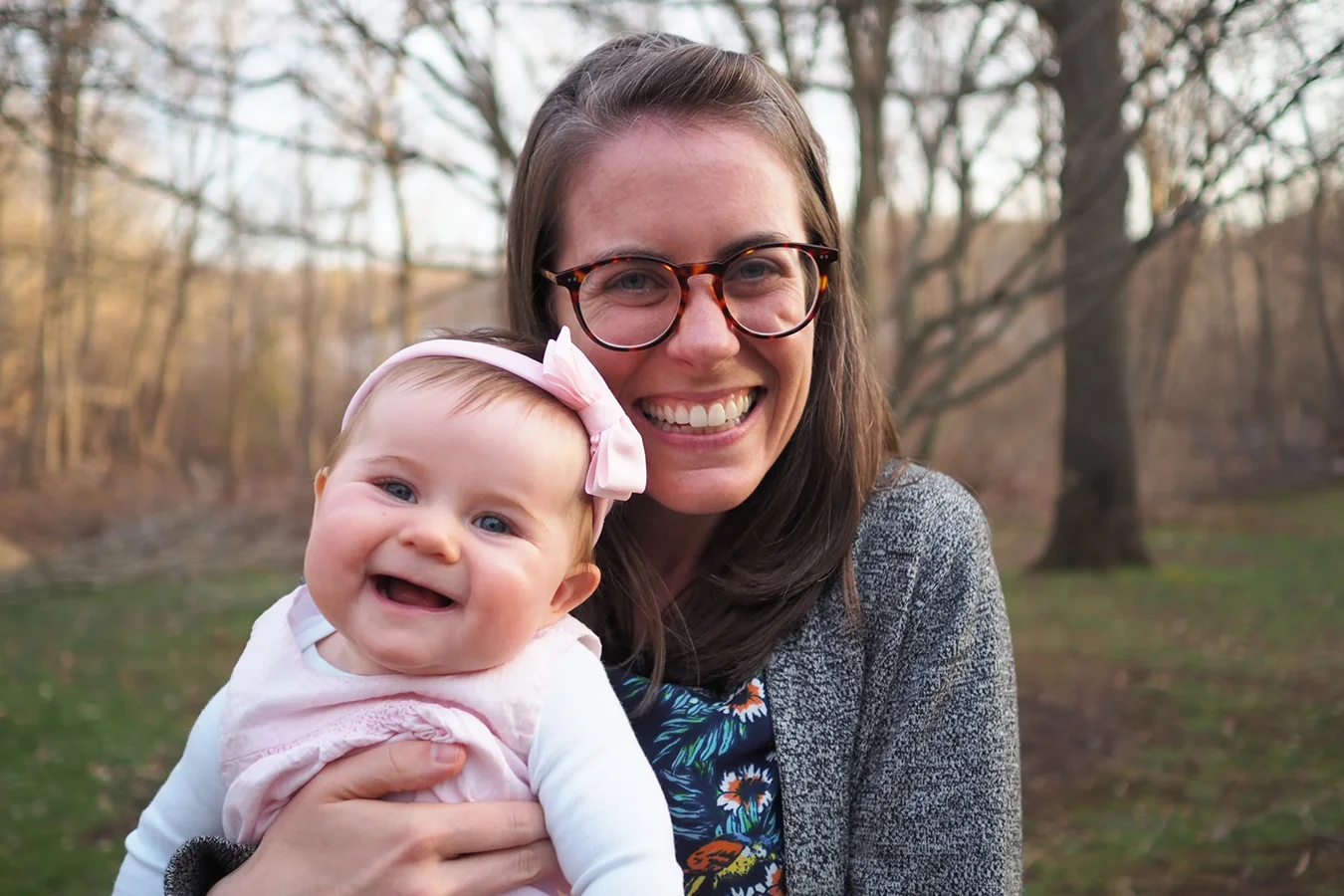
Nichole Mitchell, a nurse practitioner, holds her daughter, June. Mitchell says a residency program helped her develop a specialty in caring for patients with HIV and hepatitis C, as well as transgender care.
-- Photo courtesy of Nichole Mitchell
By MICHELLE ANDREWS
The patient at the clinic was in his 40s and had lost both his legs to Type 1 diabetes. He had mental health and substance abuse problems and was taking large amounts of opioids to manage pain. He was assigned to Nichole Mitchell, who in 2014 was a newly minted nurse practitioner in her first week of a one-year postgraduate residency program at the Community Health Center clinic in Middletown, Conn.
In a regular clinical appointment, “I would have been given 20 minutes with him, and would have been without the support or knowledge of how to treat pain or Type 1 diabetes,” she said.
But her residency program gives the nurse practitioners extra time to assess patients, allowing her to come up with a plan for the man’s care, she said, with a doctor at her side to whom she could put all her questions.
A few years later, Mitchell is still at that clinic and now mentors nurse practitioner residents. She has developed a specialty in caring for patients with HIV and hepatitis C, as well as transgender health care.
The residency program “gives you the space to explore things you’re interested in in family practice,” Mitchell said. “There’s no way I could have gotten that training without the residency.”
Mitchell is part of a growing cadre of nurse practitioners — typically, registered nurses who have completed a master’s degree in nursing — who tack on up to a year of clinical and other training, often in primary care.
Residencies may be at Federally Qualified Health Centers, Veterans Affairs medical centers or private practices and hospital systems. Patients run the gamut, but many are low-income and have complicated needs.
Proponents say the programs help prepare new nurse practitioners to deal with the growing number of patients with complex health issues. But detractors say that a standard training program already provides adequate preparation to handle patients with serious health care needs. Nurse practitioners who choose not to do a residency, as the vast majority of the 23,000 who graduate each year do not, are well qualified to provide good patient care, they say.
As many communities, especially rural ones, struggle to attract medical providers, it’s increasingly likely that patients will see a nurse practitioner rather than a medical doctor when they need care. In 2016, nurse practitioners made up a quarter of primary care providers in rural areas and 23 percent in non-rural areas, up from 17.6 and 15.9 percent, respectively, in 2008, according to a study in the June issue of Health Affairs.
Depending on the state, they may practice independently of physicians or with varying degrees of oversight. Research has shown that nurse practitioners generally provide care that’s comparable to that of doctors in terms of quality, safety and effectiveness.
But their training differs. Unlike the three-year residency programs that doctors must generally complete after medical school in order to practice medicine, nurse practitioner residency programs, sometimes called fellowships, are completely voluntary. Like medical school residents, though, the nurse practitioner residents work for a fraction of what they would make at a regular job, typically about half to three-quarters of a normal salary.
Advocates say it’s worth it.
“It’s a very difficult transition to go from excellent nurse practitioner training to full scope-of-practice provider,” said Margaret Flinter, a nurse practitioner who is senior vice president and clinical director of Community Health Center, a network of community health centers in Connecticut.
“My experience was that too often, too many junior NPs found it a difficult transition, and we lost people, maybe forever, based on the intensity and readiness for seeing people” at our centers.
Flinter started the first nurse practitioner residency program in 2007. There are now more than 50 postgraduate primary care residency programs nationwide, she said. Mentored clinical training is a key part of the programs, but they typically also include formal lectures and clinical rotations in other specialties.
Not everyone is as gung-ho about the need for nurse practitioner residency programs, though.
“There’s a lot of debate within the community,” said Joyce Knestrick, president of the American Association of Nurse Practitioners. Knestrick practices in Wheeling, W.Va., a rural area about an hour’s drive from Pittsburgh. She said that there could be a benefit if a nurse practitioner wanted to switch from primary care to work in a cardiology practice, for example. But otherwise she’s not sold on the idea.
A position statement from the Nurse Practitioner Roundtable, a group of professional organizations of which AANP is a member, offered this assessment: “Forty years of patient outcomes and clinical research demonstrates that nurse practitioners consistently provide high quality, competent care. Additional post-graduate preparation is not required or necessary for entry into practice.”
“We already have good outcomes to show that our current educational system has been effective,” Knestrick said. “So I’m not really sure what the benefit is for residencies.”
Deconstructing our divided culture

"Green Pole'' (oil on canvas), by David Barnes, in the group show "Divided Mind,'' through July 29 at Atelier Newport, Newport, R.I. The 23-artist show shows how they have explored the current deep divisions in our culture.