
Vox clamantis in deserto




Llewellyn King: Trump's 'Euro envy' threatens the Western Alliance

There is a strain of conservatism in the United States which suffers from what might be called “Euro envy.”
It is not mainstream, and it was not the conservatism of former presidents Ronald Reagan or either of the Bushes. It has evolved from a hatred of socialist manifestations in European economies.
Sadly, President Trump is the exemplar of this envy -- this need to deride Europe and all things European.
Euro envy has its equally foolish counterpoint across the Atlantic that might be called “disdain for the U.S.”
Neither would be of any consequence if it were not for the delicate international situation with the deteriorated relations between the United States and Europe, compounded by Europe’s own troubles.
Euro envy, at its purest, revolves around the successes of Europe: its public-health systems, its efficient rail system and its support of fine and performing arts. The belief is that Europe’s social approach cannot be better and somehow it must be found to be wanting.
Some things in Europe do work better, but at a price; a price in taxation and bureaucratic rigidities, which cost the Euro economies in lower growth and higher unemployment.
Anyone who has looked at European health systems knows that they work. Perhaps not perfectly, but well enough and at a lower gross price than their patchier American equivalent. Yet fables persist of people lining up in the streets of London for heart surgery and long waiting lists all over Europe for critical care. These are myths but potent ones.
For public transportation, health care and generous retirement, Europe pays. Recently in Sweden, a colleague who once worked in the White House press corps told me: “We pay half our wages in tax, but we get a lot for it.”
I would add to the downside of European life that it is very hard to fire anyone, that people retire too early and have too many government-guaranteed perks in the workplace like, in some countries, extended maternal leave for both parents.
The obverse, disdain for the U.S., features exaggerated emphasis on gun violence, prison conditions, no universal health care, job insecurity and two-week vacation times.
The European left has always denigrated conditions in America and has unfailingly given short shrift to Republican presidents. They are damned out of the blocks. “Cowboy” is the pejorative thrown at them. This is as unfair and untrue as is the Euro sneering.
Despite these streams of envy, even hatred, the Atlantic Alliance has been a thing of beauty in world history, a bulwark defending the cultures and freedoms that are the Western inheritance -- the inheritance that has made the liberal democracies such a magnet for the world’s less fortunate. Illegal immigration is the compliment that the hapless pay to the happy.
Trump has swallowed whole the Euro disdainers’ views -- they fit well with his nativistic views about the United States.
In one thing, though, and it has riled the right for decades, Trump is right: Europe pays too little for its own defense. This is the cudgel that he will wield at the NATO summit. Europe, for all its quality-of-life smugness, depends on the U.S. defense umbrella.
These things make the next two weeks critical in world affairs, and replete with terrible irony. Europe depends on the United States to defend itself against Russia, which has shown designs on all the European countries that were once Soviet vassal states. But the guarantor of European freedom, Trump, is out to trash the European alliance and cozy up to Russia.
The irony does not stop there. Trump wants more money from Europe when he is about to damage its economies with a trade war.
In the next two weeks, there is not much to envy in the European predicament: Pay up or face Russia alone. Trump will not have your back.
Llewellyn King (llewellynking1@gmail.com) is executive producer and host of White House Chronicle, on PBS. He is based in Rhode Island and Washington, D.C.

Don Pesci: Five lessons from the Capital Gazette shooting

Loading a 12-gauge shotgun, the type of weapon used by the Capital Gazette shooter.
Most left-of-center commentators lost interest in the Capital Gazette shooting in Annapolis, Md., on June 28 soon after it became obvious that there was little to no connection to Trumpian rhetoric slighting the “fake news” media.
For any number of good reasons, media face time procured by Connecticut's two U.S. senators, Dick Blumenthal and Chris Murphy, was minimal. Moments after the shooting, Murphy issued a dog-eared, often repeated refrain: “I’m sick and tired of this. My colleagues have accepted horrific mass violence and made the deliberate choice to do nothing about it. If politicians wanted to reduce gun violence, they would do their jobs and pass laws that we know would make a difference.” Demagoguery, in this case, is pointless though, as ever, politically useful. The weapon used in Annapolis by Jarrod Ramos was a 12-gauge shotgun, the kind of allowable self-defense rifle that former Vice President Joe Biden once recommended to frustrate mass murderers approaching from our driveways.
The Capital Gazette shooting was personal, not political. Ramos had sued the paper unsuccessfully for defamation, and the newspaper e-mail cache of was bulging with threatening comments. Disputes with papers usually are personal. Once the clouds of speculation parted, about two days after the shooting, we discovered that Ramos had been nursing a “longstanding dispute with the newspaper.”
Just before telling details began surfacing – the devil was in them – there was a short window of opportunity for free range speculation. For a moment there, it seemed as if a Trumpbot, armed perhaps with a “military-styled weapon” had turned his anger upon a “fake news” paper. But, sadly for some, this was not the case, although an account in The Baltimore Sun did manage to smuggle into its primary coverage, a day after the shooting, a Trumpian reference: “The shooting, which came amid months of unrelenting verbal and online attacks on the ‘fake news media’ from politicians and others from President Donald Trump on down …”
The Baltimore Sun and the Capital Gazette are sister publications. The shooter, a loner who found personal communication awkward but anonymous communication liberating – where have we seen this before? -- was animated by vengeance. The rife he used was not a “military-style weapon,” but a commonplace shotgun. The place of attack was what has been called “a soft target.” And, not unimportant, the response time of police and others was a brief 60 seconds; it does not get much better than that. Also, first responders did not linger on the periphery tremulously waiting for reinforcements; they raced into the firing.
Given all these givens, it becomes possible to ring from them some valuable lessons. Reporters and commentators -- always wary of being thought pedantic or, worse, moralistic -- call such lessons “takeaways.” But they are lessons containing invaluable bits of wisdom.
1) The premature ejaculations of passionate and ideologically committed “journalists” are nearly worthless, even when they may be right. It’s always a good idea to wait until the facts that shape the truth catch up to fanciful speculation before you press “send” on your column or report. Sometimes, this is a matter of hours; at the most, possibly a day. “A lie,” according to the old adage “can travel halfway around the world, while the truth is still getting its boots on.”
2) It may be nearly impossible to prevent mass shootings, but response time and other commonsense measures can mitigate disasters.
3) Soft targets – such as schools -- are hardened when the castle has a moat and the guards at the drawbridge are armed and dangerous to repel unwanted invaders.
4) It is possible, in schools especially, to involve the whole mini-polis in preventative measures, which necessarily would involve predictive profiling. Israel does a splendid job in this regard, without compromising the moral strictures of students and faculty – Connecticut, not so much.
Think for a moment before answering the following questions: Would high-school classes in the proper use of sporting rifles help or hurt efforts to reduce school shootings? Would trained, armed security personnel in schools, along with mechanical and technological speed bumps to easy entry, reduce crucial response time in the case of school shootings? Would efforts among students to include in their social embrace students who are “loners” dull the edge of murderous rage? To what extent are good manners, enforced by enlightened discipline, social prophylactics?
5) Finally, we all should reject tendentious arguments. The notion that the assault on the Capital Gazette by a man nursing a private, score-settling, vengeful but deliberative motive is causally connected to Trump’s intemperate and generalized attack on the public media is a textbook illustration of the post hoc ergo propter hoc (“after this, therefore because of this”) fallacy. Because one action is framed in a newspaper account along with another action, there need not be a causal relation between the two. Such planted axioms, we should all agree, do not point to a dispassionate and non-partisan search for the truth, which is what good journalism is all about.
Don Pesci (donpesci@att.net) is a Vernon, Conn.-based columnist.
Art from waiting

From Liz Shepherd's show "The Wait,'' at Boston Sculptors Gallery, through July 15. The gallery says:
"Shepherd explores the artist's search for meaning in the aftermath of long days attending a dying parent. The installation uses Shepherd's printmaking expertise as a springboard. Grids of small etchings recall the now absent figure; four large paintings on panel are in dialogue with the etchings on a facing wall. Painstakingly constructed silk-screened paper-mâché chairs hover and seem to evaporate into a silk-screened mural landscape. ''
Liz Shepherd says: "I wanted to flee but I also needed to see it through, to be a comfort and to fulfill a meaningful obligation. I wanted the end to come and the painful act of separation to be over all the while dreading it."
Hospitals becoming insurers

The main entrance of Massachusetts General Hospital, the flagship of Partners HealthCare.
In part of a trend, giant Partners HealthCare, Massachusetts’s largest hospital chain and largest employer, is moving insurance coverage from Blue Cross Blue Shield to Partners’ own insurance company, Neighborhood Health Plan. Its aim is to get a stronger handle on its employees’ medical costs, which continue to rise much faster than overall inflation. This attempt to curb expenses was also seen recently in the creation of a still unnamed health-care-cost-control enterprise by Berkshire Hathaway, JPMorgan Chase and Amazon, which have a total of about a million employees.
The curious thing about the Partners move is that the providers in its empire (which include world-famous Massachusetts General Hospital and Brigham & Women’s Hospital) are known for their very high prices, even by the standards of the world’s most expensive health-care system. That’s if you want to call America’s fragmented and grossly inefficient mess a “system’’. How does Partners plan to take money from one hand and put it in another, assuming that a substantial part of its employees’ medical costs are spent at the hospitals and physician offices of – Partners? I suppose it can save some money by cutting out such middle men as insurance brokers.
Anyway, look for more and more health providers to become insurers, especially in a rich health-care capital such as Greater Boston.

'Its deadly breath'
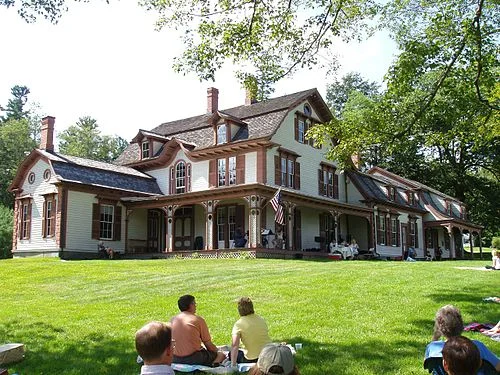
The William Cullen Bryant Homestead, in the western Massachusetts hill town of Cummington, is the boyhood home and later summer residence of William Cullen Bryant (1794–1878), the (once-famous) poet and New York newspaper editor. The 155-acre estate is at 205 Bryant Rd. and open to the public on weekends in summer and early fall. An admission fee is charged. Many of Bryant's poems were inspired by the New England countryside.

"Kindred Spirits'' by Asher Durand, depicts William Cullen Bryant with the painter Thomas Cole, in this quintessentially Hudson River School work.
"A power is on the earth and in the air,
From which the vital spirit shrinks afraid,
And shelters him in nooks of deepest shade,
From the hot steam and from the fiery glare.
Look forth upon the earth—her thousand plants
Are smitten; even the dark sun-loving maize
Faints in the field beneath the torrid blaze;
The herd beside the shaded fountain pants;
For life is driven from all the landscape brown;
The bird hath sought his tree, the snake his den,
The trout floats dead in the hot stream, and men
Drop by the sunstroke in the populous town:
As if the Day of Fire dawned, and sent
Its deadly breath into the firmament.''
-- ''Midsummer,'' by William Cullen Bryant (1794-1878
Higher McMansions on the beach?
From Robert Whitcomb's "Digital Diary,'' in GoLocal24.com
At this writing it was unknown whether Rhode Island Gov. Gina Raimondo would sign bad legislation, backed by builders, that would raise the maximum permissible height of houses along the coast to as high as 56 feet from 35 feet (plus five feet of freeboard) in the growing acreage defined as being in “flood-hazard zones’’. This legislation would encourage the construction and expansion of tall McMansions and continue the trend of the affluent sealing off the coast that’s been so obvious the past few decades. And the legislation would do it in areas that are increasingly vulnerable to flooding because of global warming. When the next big hurricanes arrive, taxpayers, through federal flood insurance, would have to help pay to clean up the mess. Most of these buildings should be moved farther away from the shore.
Charlestown Town Planner Jane Weidman told ecoRI News:
“It’s not good planning practice in general to build homes that block the shore and obstruct the view. We should be retreating or moving away, not promoting larger structures in flood zones. Why do we want to be massing up the most sensitive areas we have?”
To read the ecoRI News story on this, please hit this link.
Solitude departs in the summer


Craigville Beach, on Cape Cod.
“The yellow dunes squat in the sun, defending the white sands against aliens from the interior: Beach grass, sparse and straggling but sharp as knife, bristles on the frontier. But the sea glitters and calls, the invasion mounts, paths break through the dunes and the soft sands fall under human occupation. Thoreau saw the great beach of Cape Cod in its boundless innocence. ‘The solitude,’ he wrote, ‘was that of the ocean and the desert combined.’ Today, at least in the genial months, the beach more closely resembles Grand Central Station.’’i
-- From 'The Dash and Roar of Infinity,'' an essay by the late historian and presidential adviser Arthur M. Schlesinger Jr. in Arthur Griffin's New England: The Four Seasons.
He really wants to help you

"Sir David A(dam) Henborough (acrylic on canvas), by Brian Hart, in the show "Animals: Real and Imagined,'' at Brickbottom Artists Association, Somerville, Mass., July 12- Aug. 18.
David Warsh: Trump looks like a one-term president at this point
For a column that likes to look a little forward, the Trump presidency is a considerable roadblock. It won’t be possible to write with confidence about the American story until his administration is succeeded by the next. For that matter, Donald Trump himself can’t think very far ahead in these circumstances, and, while he improvises well, he is clearly not a man accustomed to planning well into the future.
So the intriguing question for the moment remains, what happens if the then 74-year-old Trump declares victory and doesn’t run again? What if he waits to announce, perhaps at the last possible moment, in July 2020, “I’ve accomplished what I was elected to do” and moves on to build his library? Sixty-year-old Vice President Mike Pence presumably would be more than ready to run.
It’s in this context that the latest developments should be understood – both his impending nomination of a second member to the Supreme Court and the planned trip to meet Vladimir Putin in Helsinki. Both seem to me to bolster the likelihood that, when the time comes, Trump will prefer to be a one-term president rather than take his chances trying to win a second term.
There’s no arguing with the fact that Trump has a chance to influence the Supreme Court for another 20 to 25 years. But the course that any particular justice’s influence might take on a nine-person court is very hard to predict. The Senate is narrowly divided and that will constrain the choice. The president met June 28 at the White House with Senate Judiciary Chairman Charles Grassley (R-Iowa) and the five senators whose votes will likely determine the fate of any nomination: Republicans Susan Collins, of Maine, and Lisa Murkowski, of Alaska; and Democrats Joe Donnelley, of Indiana, Heidi Heitkamp, of North Dakota, and Joe Manchin, of West Virginia,
As for the Helsinki meeting, Trump will talk to Putin about Syria and Iran, in hopes of finding some sort of mutual accommodation that might ratchet down the violence there. Some lifting of sanctions on trade will probably be part of the discussion. Putin may put back on the table the proposal for an across-the-board renormalization of relations that he privately transmitted through diplomatic channels last year. Trump may choose to talk instead of the joint measures against election-tampering that he broached, then backed away from, a year ago. He promised to “talk about everything” when the two meet. “Perhaps the world can de-escalate,” the president said. “We might be talking about some things President Obama lost.”
Obama’s foreign policy is not the issue. Even without Trump, American voters are probably returning to the realist, balance-of-power view of relations with Russia that dominated U.S. politics for the 45 years of the Cold War. The conviction that the United States is duty-bound to spread its values around the world, associated with Presidents Bill Clinton and George W. Bush and the candidacy of Hillary Clinton, has been losing force everywhere but the Atlantic Council.
In this view, foreign policy towards Russia is a sideshow that will largely take care of itself. The real story is Trump himself. What got him elected was his tough talk on immigration and trade. What sustains his popularity, as best I can tell, is the very considerable set of skills he acquired as a reality-TV performer on The Apprentice and Celebrity Apprentice. In this respect, Trump is like Ronald Reagan.
In every other respect, he is different. Reagan stressed alliances; Trump breaks them apart. Reagan was cheerful and friendly; Trump is a bully and a boor. Reagan made some bad appointments; Trump appointees have committed wholesale administrative vandalism. Reagan had confidence in the verdict of history; Trump makes war on it. The Iran-Contra hearings failed to seriously touch Reagan; the Mueller probe remains a dagger at the heart of Trump’s current term.
So see what happens in the November mid-term elections. Pay careful attention to polls next year. Much depends on who wins the Democratic primaries. Then there will be the 2020 congressional elections to consider – what if the Dems take back both houses? Where would be the fun in that? And, of course, keep an eye on the bond market, that harbinger of recession. It is always possible that Trump will run the table and, like Clinton, Bush, and Obama, settle into a second term more comfortable than the one before. I put the chances at one in three.
David Warsh, a Somerville, Mass.-based longtime columnist and economic historian, is proprietor of economicprincipals.com
Search for:
Jennifer Ware: 'The Trolley Problem' and robotics

From the New England Board of Higher Education (nebhe.org)
NEBHE's Commission on Higher Education & Employability has thought hard over the past year about the increasing role of artificial intelligence and robotics in the future of life and work.
Many others are also waking up to this landscape, which not so long ago seemed like science fiction. Waltham, Mass.-based MindEdge Learning, for example, plans to devote regular blog posts to ethical questions in a world in which humans coexist with sophisticated—even humanoid—robots.
The first blog post by Jennifer Ware, a MindEdge editor who teaches philosophy at CUNY, begins by asking: What happens when robots do immoral things? Whom do we hold responsible? How do we navigate the fact that our own biases and prejudices will inevitably make their way into programs for the machines we build? Should we construct sophisticated, humanoid machines simply because we can? Is it wrong to treat robots in certain ways, or fail to treat them in other ways? How might our relationships with robots color our relationships with other humans? What happens if robots take over parts of the workforce? How might robots give us insight into what it means to be human? She writes:
Programming Machines to Make Moral Decisions: The Trolley Problem
"Machines have changed our lives in many ways. But the technological tools we use on a day-to-day basis are still largely dependent on our direction. I can set the alarm on my phone to remind me to pick up my dry cleaning tomorrow, but as of now, I don’t have a robot that will keep track of my dry cleaning schedule and decide, on its own, when to run the errand for me.
As technology evolves, we can expect that robots will become increasingly independent in their operations. And with their independence will come concerns about their decision-making. When robots are making decisions for themselves, we can expect that they’ll eventually have to make decisions that have moral ramifications–the sort of decisions that, if a person had made them, we would consider blameworthy or praiseworthy.
Perhaps the most talked-about scenario illustrating this type of moral decision-making involves self-driving cars and the “Trolley Problem.” The Trolley Problem, introduced by Phillipa Foot in 1967, is a thought experiment that is intended to clarify the kinds of things that factor into our moral evaluations. Here’s the gist:
Imagine you’re driving a trolley, and ahead you see three people standing on the tracks. It’s too late to stop, and these people don’t see you coming and won’t have time to move. If you hit them, the impact will certainly kill them. But you do have the chance to save their lives! You can divert the trolley onto another track, but there’s one person in that path that will be killed if you chose to avoid the other three. What should you do?
Intuitions about what is right to do in this case tend to bring to light different moral considerations. For instance: Is doing something that causes harm (diverting the trolley) worse than doing nothing and allowing harm to happen (staying the course)? Folks who think you should divert the trolley, killing one person but saving three, tend to care more about minimizing bad consequences. By contrast, folks who say you shouldn’t divert the trolley tend to argue that you, as the trolley driver, shouldn’t get to decide who lives and dies.
The reality is that people usually don’t have time to deliberate when confronted with these kinds of decisions. But automated vehicles don’t panic, and they’ll do what we’ve told them to do. We get to decide, before the car ever faces such a situation, how it ought to respond. We can, for example, program the car to run onto the sidewalk if three people are standing in the crosswalk who would otherwise be hit–even if someone on the sidewalk is killed as a result.
This, it seems, is an advantage of automation. If we can articulate idealized moral rules and program them into a robot, then maybe we’ll all be better off. The machine, after all, will be more consistent than most people could ever hope to be.
But articulating a set of shared moral guidelines is not so easy. While there’s good reason to think most people are consequentialists–responding to these situations by minimizing pain and suffering–feelings about what should happen in Trolley cases are not unanimous. And additional factors can change or complicate people’s responses: What if the person who must be sacrificed is the driver? Or what if a child is involved? Making decisions about how to weigh people’s lives should make any ethically minded person feel uncomfortable. And programming those values into a machine that can act on them may itself be unethical, according to some moral theories.
Given the wide range of considerations that everyday people take into account when reaching moral judgments, how can a machine be programmed to act in ways that the average person would always see as moral? In cases where moral intuitions diverge, what would it mean to program a robot to be ethical? Which ethical code should it follow?
Finally, using the Trolley Problem to think about artificial intelligence assumes that the robots in question will recognize all the right factors in critical situations. After all, asking what an automated car should do in a Trolley Problem-like scenario is only meaningful if the automated car actually “sees” the pedestrians in the crosswalk. But at this early stage in the evolution of AI, these machines don’t always behave as expected. New technologies are being integrated into our lives before we can be sure that they’re foolproof, and that fact raises important moral questions about responsibility and risk.
As we push forward and discover all that we can do with technology, we must also include in our conversations questions about what we should do. Although those questions are undoubtedly complicated, they deserve careful consideration–because the stakes are so high.''
Ebony Slaughter-Johnson: Expanding poverty won't make America great

This summer, U.N. special rapporteur on extreme poverty Philip Alston presented his observations on the state of international poverty to the U.N. Human Rights Council.
The country at the center of his most recent report wasn’t a developing one — it was the United States. In one of the wealthiest countries. Alston found, many Americans live without access to water and public sewage services.
More alarmingly, at a time when 40 million Americans live in poverty — including over 5 million experiencing “developing world” levels of poverty — congressional Republicans and President Donald Trump are jeopardizing access to the social safety net for millions, the report concluded.
Exacerbating poverty won’t “Make America Great” for anyone.
For instance, health care, which is already prohibitively expensive, could become more so. A new rule allowing small businesses to buy plans without certain “essential health benefits” required by the Affordable Care Act (ACA) is expected to increase insurance costs for people who need those benefits.
Even now, ACA premiums are increasing thanks to the president’s decision to stop sharing costs with insurers.
Rising out-of-pocket costs and premiums could either push the poor out of the market or force them to contend with even higher medical expenses. And by encouraging people to opt out of pricier plans, that leaves those who remain insured confronting higher costs, and subsequent financial insecurity, themselves.
Lack of insurance either drives the uninsured into hospital emergency rooms, where they face more expensive treatment they have no hope of affording, or promises an amplified public health crisis. In a December report, Alston recalled encountering poor Americans who had lost all of their teeth because they lacked access to dental health care.
The social safety net, which plays a crucial role in reducing poverty among children, is also under threat.
The Supplemental Nutrition Assistance Program (SNAP) alone kept 3.8 million children and 2.1 million children out of poverty and “deep poverty,” respectively, in 2014. The Center for American Progress calculated that childhood poverty alone stunts economic output by $170 billion each year and deprives the economy of $500 billion each year.
More importantly, poverty is morally reprehensible, subjecting children to a lifetime of harm. It portends adverse health consequences, limited educational achievement, and lower rates of employment. Yet SNAP is on the chopping block for the House Farm Bill.
Poverty has also been shown to make communities fertile breeding grounds for abuse by law enforcement.
America’s homeless have been among those most vulnerable to this abuse. Instead of addressing homelessness with increased access to affordable housing, however, the Trump administration has suggested cuts to rental assistance programs. These cuts could push more Americans into homelessness — and then into the criminal justice system.
Across the country, homeless Americans are arrested and hit with an avalanche of fines and fees simply for trying to survive. The criminalization of homelessness deepens the poverty of the homeless and creates a criminal justice system that discriminates against the poor. No one benefits.
Fortunately, such hostility to the poor has been met with a wave of progressive activism.
Only a day after Alston presented his report, the Poor People’s Campaign rallied in front of the Capitol Building to cap six weeks of anti-poverty advocacy. Lawmakers are already following the campaign’s lead: Several influential senators and representatives recently heard testimony from struggling Americans.
Anti-poverty measures also featured prominently in the winning campaign of Alexandria Ocasio-Cortez, who is likely to become the next congresswoman for New York’s 14th District.
As Republicans pursue policies that make American poverty a global concern, at least some progressives are preparing to fight back.
Ebony Slaughter-Johnson is an associate fellow at the Institute for Policy Studies.
Frank Carini: Nitrogen from houses threatens coastal salt ponds

Mashchaug Pond, in Westerly, one of southern Rhode Island's salt ponds, also called lagoons.
From ecoRI News (ecori.org)
CHARLESTOWN, R.I. — People flock to live on and visit the coast here, but in the town’s most densely developed area, excess nitrogen from all those coastal dwellings is threatening the health of three salt ponds that connect to Block Island Sound and are the foundation of the local tourism industry.
This salt-ponds watershed makes up 33 percent of the town but contains 63 percent of all Charlestown dwellings. Dense development around the Ocean State’s coastal salt ponds isn’t limited to Charlestown.
The salt-pond region of southern Rhode Island extends from Maschaug Pond in Westerly to Point Judith Pond in Narragansett and forms the natural boundary between the Atlantic Ocean and a shallow freshwater aquifer. This watershed is so built up that vital ecosystems are under enormous pressure.
“A burgeoning population and increasing competition among activities threatens to overwhelm the capacity of the salt ponds to absorb wastes, provide shelter for boats and vessels, attract residents and tourists and underpin premium real estate values,” according to the Coastal Resources Management Council’s Salt Ponds Region Special Area Management Plan. “Large areas of the salt ponds are poorly flushed, which makes them valuable as fish and shellfish nurseries, but, also particularly susceptible to eutrophication and bacterial contamination.”
Studies and surveys by the Environmental Protection Agency (EPA) and by state agencies across the country have found that nonpoint source pollution, such as excess fertilizers, herbicides, and insecticides, oil, grease, and toxic chemicals from runoff, and bacteria and nutrients from faulty septic systems, causes the most harm to rivers, streams, lakes, estuaries, coastal waters, and wetlands.
In Rhode Island’s salt-pond region, cesspools and failing and substandard septic systems are the largest source of bacterial and nutrient contamination. In Charlestown, work done by the University of Rhode Island's Cooperative Extension and Nonpoint Education for Municipal Officials has found that 80 percent of groundwater nitrate is from onsite wastewater treatment systems.
In the town’s coastal-pond watershed sampling of private wells has found nitrogen concentrations that approach or exceed the EPA established maximum contaminant level of 10 milligrams per liter. The EPA action level is 5 mg/L. Charlestown relies exclusively on groundwater for drinking.
Besides contaminating drinking-water wells, this nitrogen-enriched groundwater also eventually flows into Charlestown’s three coastal salt ponds, where it causes eutrophication and increases the risk of hypoxia.
Since 1994, Green Hill Pond and eastern Ninigret Pond have been closed to shellfishing because of “significantly deteriorated water quality.”
The total average annual influx of nitrogen to Charlestown’s three coastal ponds is nearly 1.2 million pounds, according to the Rhode Island Department of Environmental Management (DEM). Here is the breakdown: Green Hill Pond, 46,903 pounds; Ninigret Pond, 44,794; Quonochontaug Pond, 24,579.
Matt Dowling, hired in 2008 as Charlestown’s first full-time onsite wastewater manager — only a handful of Rhode Island municipalities have a such a position — recently told ecoRI News that reducing nitrogen loading is a major priority from both a public-health and environmental-protection perspective.
Charlestown began addressing the problem in earnest four years before Dowling, an environmental scientist, was hired.
In the town’s coastal-pond watershed sampling of private wells has found nitrogen concentrations that approach or exceed EPA established maximum contaminant levels.
Filling in holes
In 2004, three years before a Rhode Island enacted a law to address a statewide problem, Charlestown officials took a bold step by requiring the elimination of all cesspools, which are merely holes in the ground that do nothing to treat human waste. These 55-gallon or so concrete- or stone-lined pits with holes in which sewage is flushed offer no treatment for pathogens, harmful bacteria, and nutrients, most notably nitrogen.
Cesspools and failing septic systems contaminate groundwater, the only source of drinking water in Charlestown. Conventional septic systems, meanwhile, do little to address the problem of nitrogen loading.
The town’s forward-thinking ordinance that required all cesspools be removed and replaced by 2009 was later modified. A zoned phase-out was implemented that mandated cesspools to be replaced by June 2014. Mission nearly accomplished.
Of the nearly 1,000 cesspools that once marked the local landscape, only 12 remain, according to Dowling.
The removal of the remaining cesspools is being managed through the town’s municipal court or by the Wastewater Management Commission’s waiver program that grants relief to property owners with financial hardships.
Statewide, DEM identified 1,084 cesspools subject to Rhode Island Cesspool Act of 2007 provisions requiring the replacement of those within 200 feet of a coastal shoreline feature, within 200 feet of a public drinking-water well, or within 200 feet of a public drinking-water reservoir, according to an agency spokeswoman.
She recently told ecoRI News that at last check 752 of those cesspools were replaced with a septic system and 147 were removed from service because the property connected to a sewer line, leaving 185 cesspools that haven’t yet come into compliance with the law.
“It is worth noting that these numbers are a snapshot,” she wrote in an e-mail. “There are sites working through the permitting process all the time so it is likely that more cesspools have been removed from service than are reported here.”
There are more than 3,000 onsite wastewater treatment systems in Charlestown’s salt ponds watershed and nearly 84 percent are within a ‘Lands Developed Beyond Carrying Capacity’ area.
Nutrient overload
Conventional septic systems typically have final effluent nitrogen concentrations of 44 milligrams per liter. For a three-bedroom home, this amounts to a nitrogen discharge of some 21 pounds annually.
In Charlestown, there are 3,008 onsite wastewater-treatment systems in the salt ponds watershed. Of those, nearly 84 percent, including 138 systems classified as unpermitted and/or substandard and installed before 1968, are within a Coastal Resources Management Council “Lands Developed Beyond Carrying Capacity” area, which frequently means one residential or commercial unit per one-eighth to half an acre.
In Charlestown, Dowling noted that the housing density is 8-10 dwellings per acre, and each lot has a septic system and well.
“Such intense development was the major source of contamination to groundwater and the salt ponds,” according to the Salt Ponds Region Special Area Management Plan. “High nutrient loadings and contaminated runoff waters were resulting in a high incidence of polluted wells and increasing evidence of eutrophic conditions and bacterial contamination in adjoining salt pond waters.”
Septic systems with nitrogen-reducing technology, however, are designed to lower nitrogen concentrations in wastewater by 50 percent. Dowling and the town are working with property owners to install this technology in the coastal ponds watershed. In the past eight years about 35 septic systems with this technology have been installed in Charlestown.
In 2016, Charlestown received an EPA grant to, among other things, help upgrade 15 substandard septic systems with nitrogen-reducing technology. The chosen homeowners will be compensated 75 percent of the total cost. The $674,201 grant also is funding a quarterly effluent sampling program for up to 50 property owners with denitrification systems.
To make sure that these expensive systems — $25,000 on average — are working properly and not underperforming, Dowling said data are needed to measure nitrogen output and to adjust the systems to meet their optimal nitrogen-reducing capacity. Barnstable County on Cape Cod is running a similar sampling program to help ensure a substantial decrease in nitrogen loading.
If the town were to be sewered — an expensive proposition that would require an agreement with South Kingstown — more property would be opened up to development, Dowling explained. Less nitrogen would be discharged to groundwater and the coastal ponds, but other development pressures would increase.
The four-year grant is also being used to help the town’s voluntary Recommended Landscaper Process partner with Save The Bay to install six demonstration rain gardens on public property, and partner with the Salt Ponds Coalition to establish two surface water sampling stations in Green Hill Pond to track nutrient impacts.
Modeling has demonstrated that fertilizer use contributes as much as 20 percent of the groundwater nitrogen in densely areas where high-maintenance lawns are clustered, according to Dowling.
Lawn chemicals aimed at killing pests, insect or plant, also take a toll on the ponds' health. During a recent visit to the area, two adjacent homes on Powaget Avenue had "Lawn Chemicals Applied" signs in their front yards.
Frank Carini is editor of ecoRI News.

Blake Farmer: The awfulness of highly adaptable poison ivy

Poison ivy on a roadside
--Photo by Jaknouse
From Nashville Public Radio, NPR and Kaiser Health News
It was a close encounter in 2012 that made microbiologist John Jelesko take an interest in poison ivy.
The Virginia Tech associate professor was cutting up a downed tree with an electric chainsaw. What he didn’t realize was that his power cable had been dragging through poison ivy. So, at the end of the day, as he coiled the cord around his palm and elbow, he inadvertently launched a career-bending science experiment.
“Within 48 hours, I had your classic case of poison ivy on my arm. And as a scientist, I said, ‘This is interesting, how bad can it be? I’ll just leave this untreated,'” he recalled, sheepishly. “In about two weeks, I had learned just how uncomfortable poison ivy rash could be.”
Uncomfortable sounds like an understatement. Jelesko said he barely slept while fighting the urge to “claw my itching flesh off.” Eventually, he went to his family doctor, who prescribed oral steroids.
The experience sparked years of research into a plant he calls a “familiar stranger.” He has studied the chemical, urushiol, that triggers that telltale rash and the plant’s biology overall.
The tricky thing about avoiding poison ivy, Jelesko said, is the plant is highly adaptable and can take many different forms in different environments.
“It’s remarkable,” he said, with a laugh. “There’s just an enormous amount of things with this plant that are currently unknown.”
Here, he offers insights into how to recognize Toxicodendron radicans, the scientific name of the plant, before you risk touching it — and what to do if it’s too late.
The axiom “leaves of three, let it be” is accurate, said Jelesko, but those leaves can come in many shapes, even on the same plant. You’re safe if the plant has thorns — poison ivy doesn’t — but it does sometimes have little white berries.
All of these are the same pesky, rash-inducing plant. Poison ivy leaves sometimes appear with jagged or lobed edges, and sometimes smooth.
Poison ivy can present as a vine or a shrub. When mature vines climb up a tree, their shape can even mimic that of the host tree. Simply pushing aside an innocent-seeming branch could make the passer-by pay a few days later, when a rash begins to well up.
Jelesko’s latest research, which is not yet published, finds that in cities poison ivy tends to grow as a climbing vine, whereas out in the forest, most of the plants are ground-creeping vines. And poison ivy is much more prevalent in “landscapes modified by humans” than out in the middle of the woods.
Some poison ivy vines can be downright awe-inspiring in their size, like the one in this video.
Poison ivy can take over a dead tree, like this one on the Virginia Tech golf course. From afar, it looks like it could be an evergreen. Up close, it becomes clear that this is a nightmare of nature. (Courtesy of John Jelesko)
What To Do When The Tricky Plant Wins …
If you think you’ve touched a plant, or unfortunately know you have, follow these tips to alleviate the problem. Of course, prevention is the best route. For John Jelesko, he now dons a protective Tyvek suit and two pairs of gloves when he wallows in poison ivy. Your last line of defense:
Wash with soap and water within a few hours. This tends to prevent an outbreak in most people.
Keep an eye out for a streaky, red rash in the first few days, especially if you’ve previously had a reaction to poison ivy. For poison ivy newbies, the rash could take a week to develop. Repeat customers can start breaking out in a day or two. Rather than building immunity, multiple exposures can make someone more sensitive, priming the immune system to produce a more “robust” response, Jelesko said.
When a rash appears, dermatologists recommend soothing it with anti-itch or corticosteroid cream.
And if it gets really bad, go to the doctor, especially if the rash involves sensitive areas like the mouth or genitals.
But steroids and anti-itch medicine doesn’t solve the whole problem. Aresearcher at Duke University found that part of the body’s response involves a protein known for inducing inflammation on the skin, “exciting” the nerve fibers in the skin and sending itchy signals to the brain. An antibody that counteracts the protein is currently in a clinical trial with humans to determine potential side effects.
If your pup came along with you on the outing that exposed you to poison ivy, never fear. Dogs are not allergic — but their fur can definitely hold the oil and transfer it to their owners, so pet your dog with caution after hiking past poison ivy. Scientists haven’t found many animals that break out like humans do, though lab mice seem to be allergic enough for research.
Executive challenge
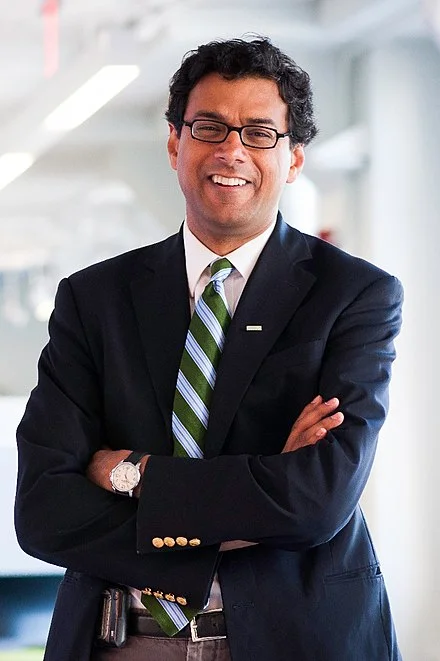
Atul Gawande, M.D.
From Robert Whitcomb's "Digital Diary,'' in GoLocal24.com
Atul Gawande, M.D., is a fine surgeon, writer, charming public speaker and teacher who became famous writing about the extreme inequities of health-care provision and cost in America. His main statistical tools were developed by the Dartmouth (College) Institute for Health Policy and Clinical Practice.
Now he has been tapped to be CEO of a still somewhat mysterious health-care venture formed by the far-too-big Amazon, giant conglomerate Berkshire Hathaway and JPMorgan, the behemoth bank. The companies haven’t yet presented a specific plan for the new nonprofit enterprise, which hasn’t even been named yet. But the main mission is to cut health-care costs for employers.
The good economic news for New England is that this outfit, which I suppose could become very big itself, will be based in Boston.
"I have devoted my public health career to building scalable solutions for better healthcare delivery that are saving lives, reducing suffering, and eliminating wasteful spending both in the U.S. and across the world. Now I have the backing of these remarkable organizations to pursue this mission with even greater impact for more than a million people {who work for the three companies}, and in doing so incubate better models of care for all. This work will take time but must be done. The system is broken, and better is possible," Gawande said.
The system is indeed broken, but can this rock star run a very large organization?
'Against house rules'

Indian Harbor Yacht Club, in Greenwich, Conn.
"I saw the black maid park the Cadillac
In the lot of the Indian Harbor Yacht Club.
When she hefted the first huge silver tray
of delicacies for that evening’s soiree
on her boss’s yacht, I offered to help.
No, she said, in her starched gray uniform
on orders from her employer. The launch man
In wrinkled khakis and a black cap with gold
braided on the bill, told her no, she couldn’t
ride the launch. Against Club rules.''
-- From “The Net,’’ by Peter Harris
The Millennials' Manhattan

From Robert Whitcomb's "Digital Diary,'' in GoLocal24.com
I was in Manhattan a couple of days the other week and seeing all those young adults (some are friends of mine) on the sunny streets brought back memories of when I lived in New York, in the ‘70s. Most of them seemed to be in their twenties, recently out of college and at least looked and sounded ambitious and not yet soured by the claustrophobia and stress that accompany life in the city and that ultimately drives out a lot of people when they enter their thirties. The sight of a bunch of young lawyers with the name of their corporate firm, “Davis Polk,’’ on their T-shirts and probably headed for an obligatory softball game in Central Park sort of crystallized my nostalgia as I gazed at the gleaming towers, too many now occupied by Russian oligarchs and other flight capitalists.
When I lived there, “The City,’’ as we still call it, was falling apart for various reasons, some affecting all large American cities, some unique to New York. Crime was high, the subways were a mess (and mostly un-air-conditioned), strikes were frequent and many big employers were fleeing the city for Fairfield County, Conn.
Still, because of demographic changes, huge Reagan-era incentives for Wall Street, stronger mayors and an unexpected increase in younger Americans’ appreciation of the joys of city life, New York came back and is a hell of a lot spiffier now than it was 40 years ago. But you can see a few signs that it’s sliding again – there’s more graffiti and more bums than just a few years ago, when Michael Bloomberg was mayor, and the current mayor, Bill DiBlasio does not, shall we say, have the reputation for competence and integrity that Bloomberg had and has.
The city’s Achilles heel is its over-dependence on finance. Artificial intelligence and big New York banks’ drive to lower costs by moving major operations to cheaper places threaten to shrink the city’s greatest wealth creator.
The most surprising thing I saw on a sidewalk: A bike whose frame was made of wood.
William Morgan: The Aldriches: Powerful politicians and architects
At the northeast corner of Providence's Swan Point Cemetery, overlooking the Seekonk River, is a tasteful necropolis holding the final resting places of several generations of what was once one of Rhode Island's richest and most influential families, indeed one with great national influence.
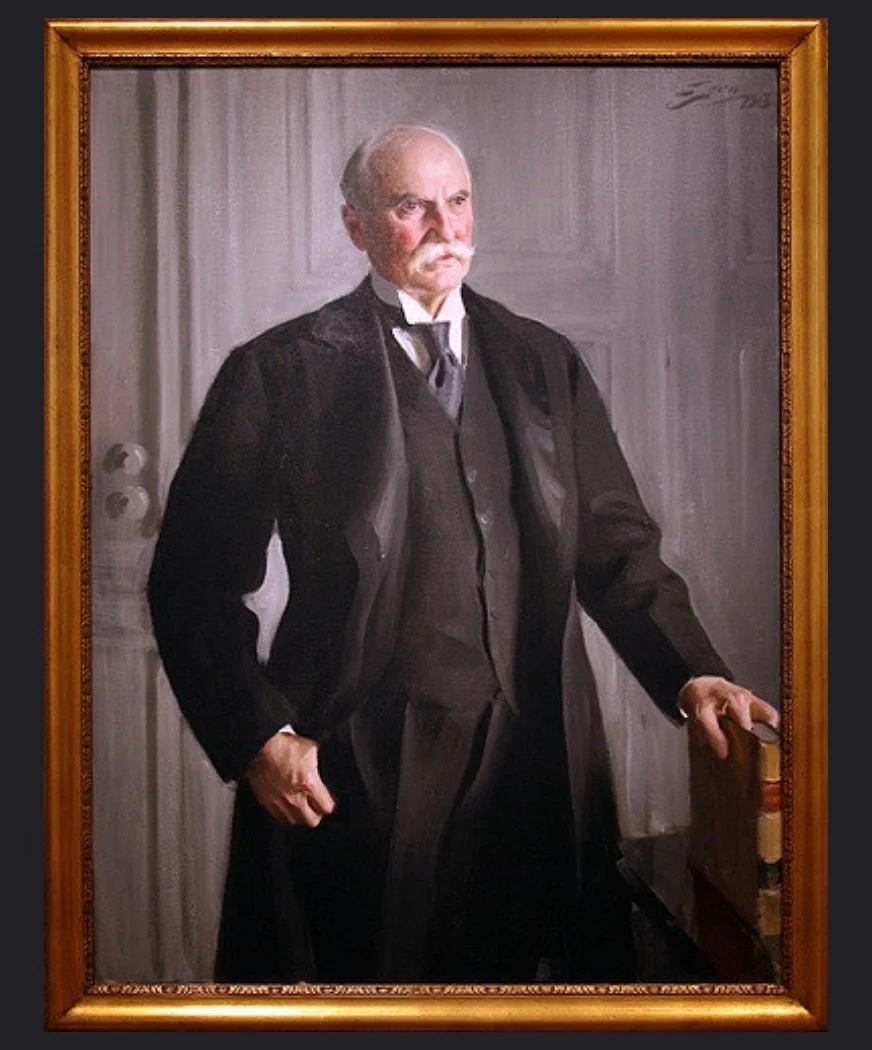
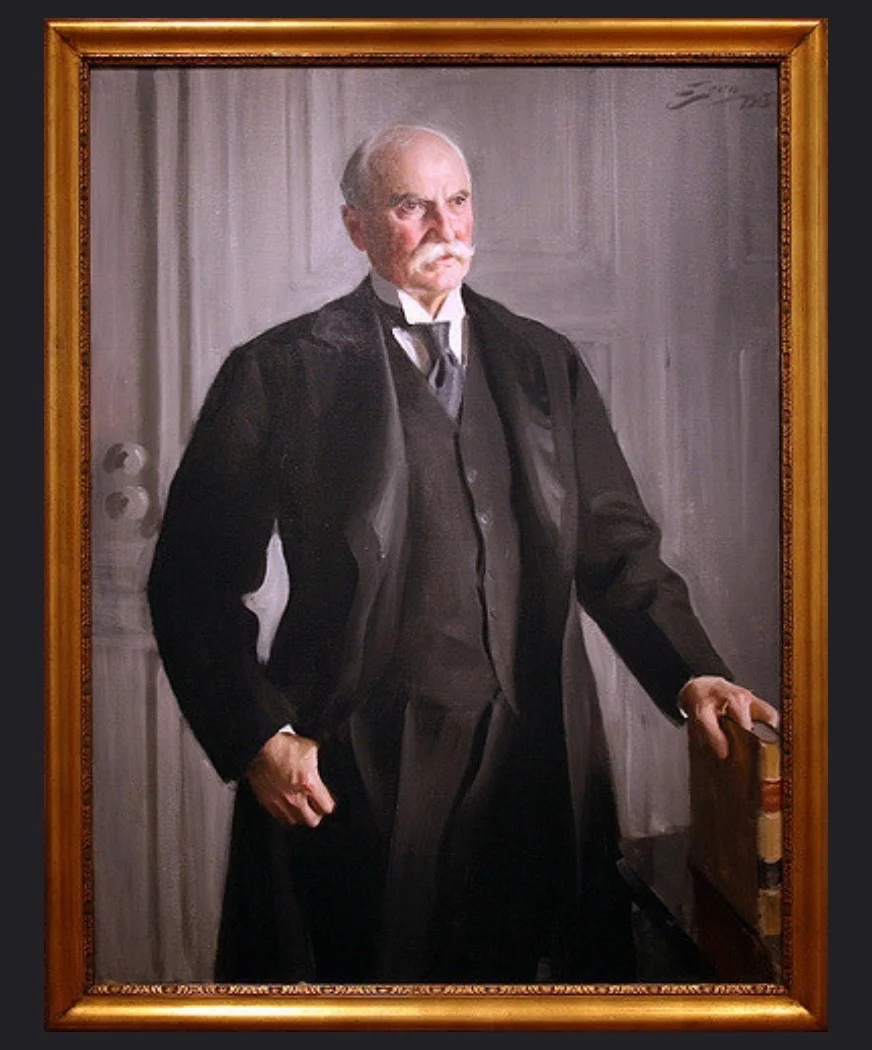
Nelson W. Aldrich, 1913, by Andres Zorn
-- Smithsonian, National Portrait Gallery
The patriarch was Nelson W. Aldrich, a very powerful U.S. senator who served from 1881-1911. Indeed, his nickname became the “general manager of the United States’’. This was back when Rhode Island itself was wealthy and powerful. This Republican Party chieftain extended his influence as the father-in-law of John D. Rockefeller Jr. and was thus the grandfather of Nelson Aldrich Rockefeller, the New York governor and vice president, and Nelson’s four brothers, all of whom were prominent public figures.
Amidst the politically connected Aldriches are two plain gravestones marking the resting place of the senator's son, William Truman Aldrich (1880-1966), and his grandson, Nelson Wilmarth Aldrich (1911-1986). These men were architects, successful designers who worked in different styles.
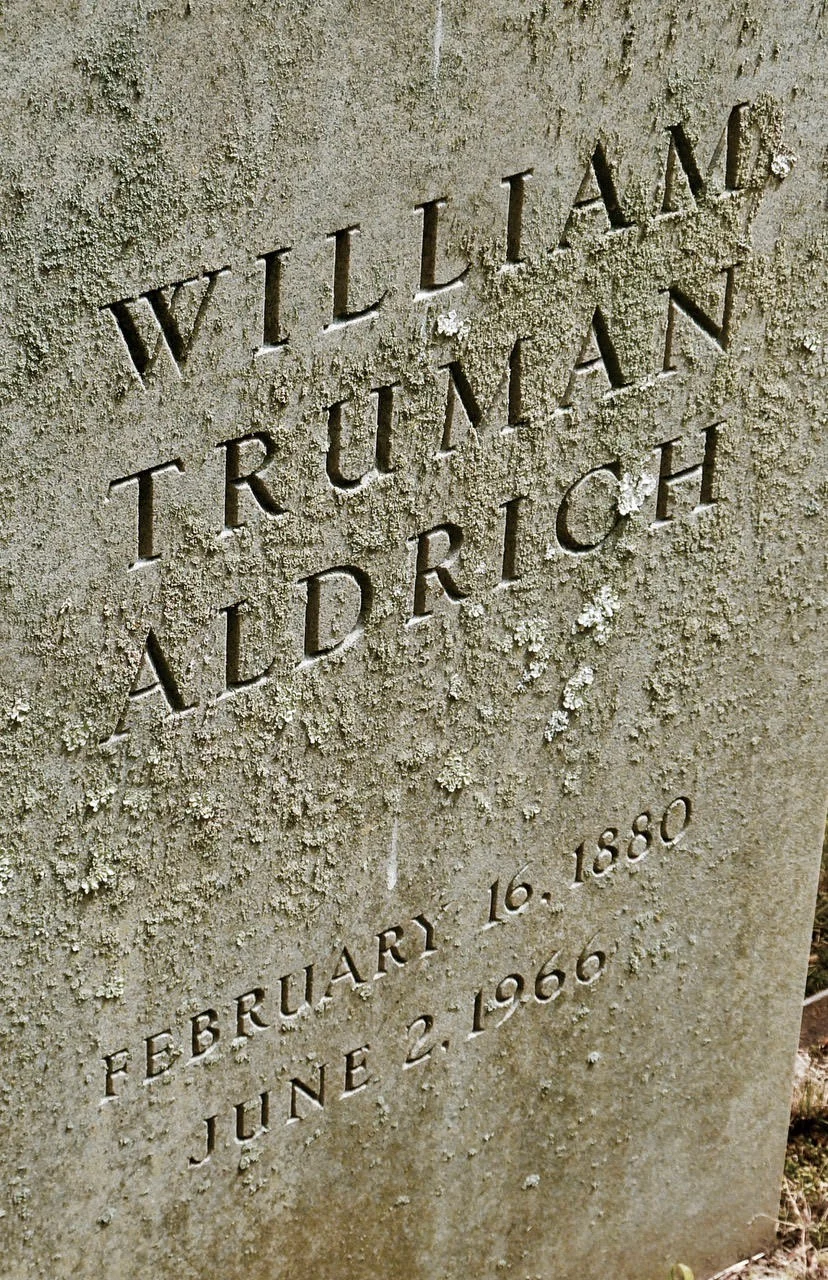
In its obituary, The New York Times described the MIT-trained William as "an architect and yachtsman." Even more important than his schooling at "Tech" were his studies at the École des Beaux-Arts, in Paris. Founded by Louis XIV, The École provided the ultimate education for classical architects; its name became synonymous for designers who could create public buildings worthy of a Roman emperor or a Renaissance palazzo for a Gilded Age plutocrat.
Before starting his own firm in Boston, William Aldrich worked for one of the leading Beaux-Arts firms, Carrère & Hastings, whose best-known monument in the style is the New York Public Library. Aldrich was something of a society architect (his connections to the Rockefellers no doubt helped him secure commissions), and he became a master of a restrained and historically informed interpretation of English Georgian. Typical of his pre-Depression compositions was the original museum for the Rhode Island School of Design and the Temple of Music at Roger Williams Park, both in Providence.
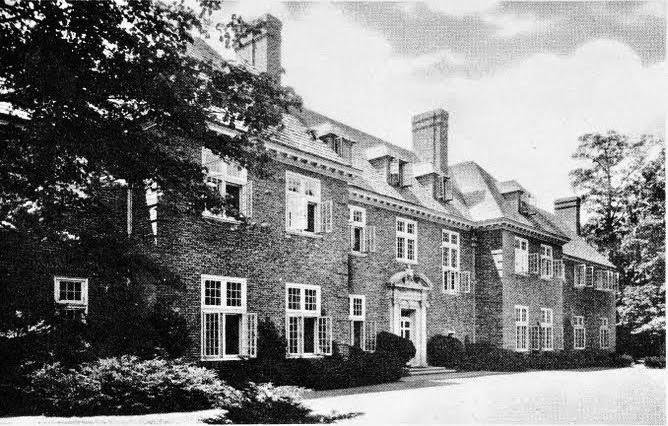
William T. Aldrich designed "Broadhollow," in Brookville, Long Island, c.1926. This was built for Winthrop William Aldrich, the head of the Chase Bank and ambassador to the Court of Saint James (i.e., to Britain).
The architectural landscape had changed considerably when William Aldrich's son Nelson established a practice in Boston following World War II. Nelson's program of study at Harvard was directed by Walter Gropius, who had earlier founded the revolutionary Bauhaus in Germany. Gropius announced his arrival at Harvard by taking a hammer to the plaster casts of classical sculpture that students were required to draw in earlier days. The very term Beaux-Arts became pejorative, synonymous with a supposedly stultifying, conservative aesthetic. (Frank Lloyd Wright coined the term Bozo to derisively refer to those trained at the École.)
Nelson Aldrich embraced the International style of the Bauhaus, with its flat roofs, industrial fenestration and lack of superfluous ornament. His firm, Campbell, Aldrich & Nulty, was in demand for academic buildings on such campuses as Amherst, Phillips Exeter Academy, and Dartmouth, his cousin Nelson Rockefeller's alma mater. The firm is perhaps best known for their part in the design of one of the most controversial modern buildings anywhere, the Boston City Hall.
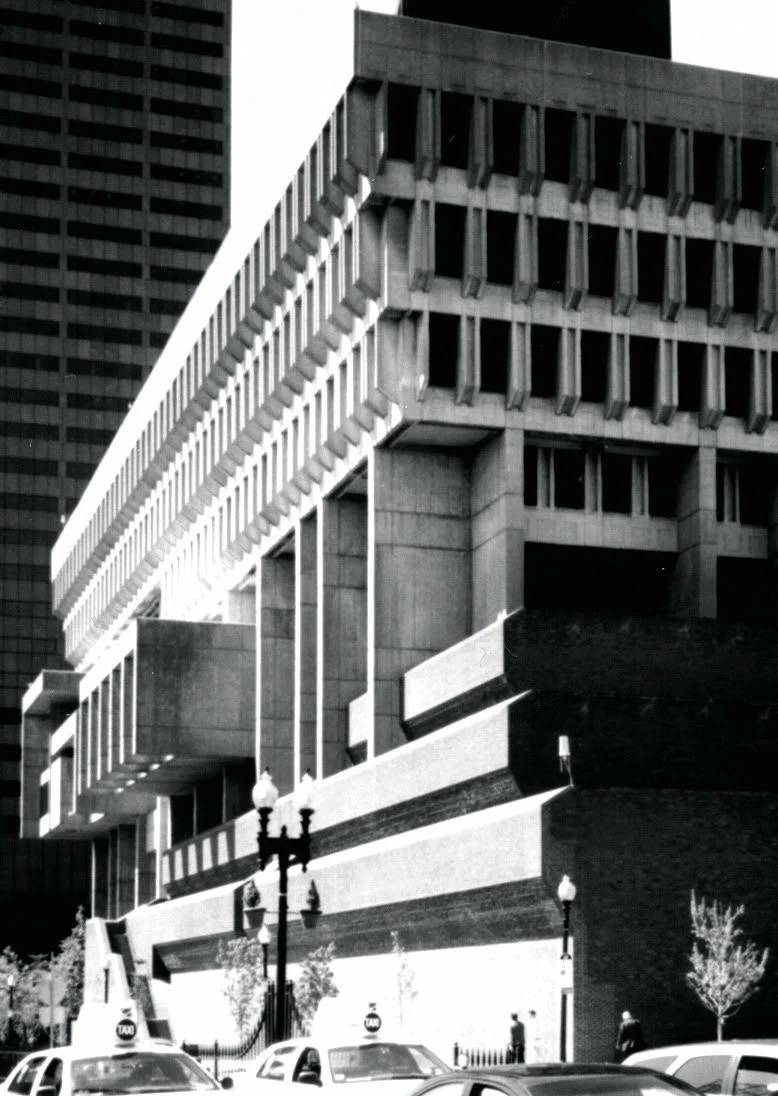
Boston City Hall, 1968, Kallmann, McKinnell & Knowles, with Campbell, Aldrich, and Nulty.

Campbell, Aldrich & Nulty, Weiss Science Tower, Rockefeller University, New York, 1974.
Nelson Aldrich's embrace of the raw concrete variant of modernism called Brutalism pretty much occurred after the death of his father, but their different architectural philosophies apparently caused much strain between the two. One suspects that there were other reasons for what the writer, son and namesake of the younger architect claims was a 30-year estrangement. Nevertheless, the two architects are now together for eternity.

William Morgan has taught the history of American architecture and is the author of the The Abrams Guide to American House Styles, among other books.
'Lives beyond all harm'
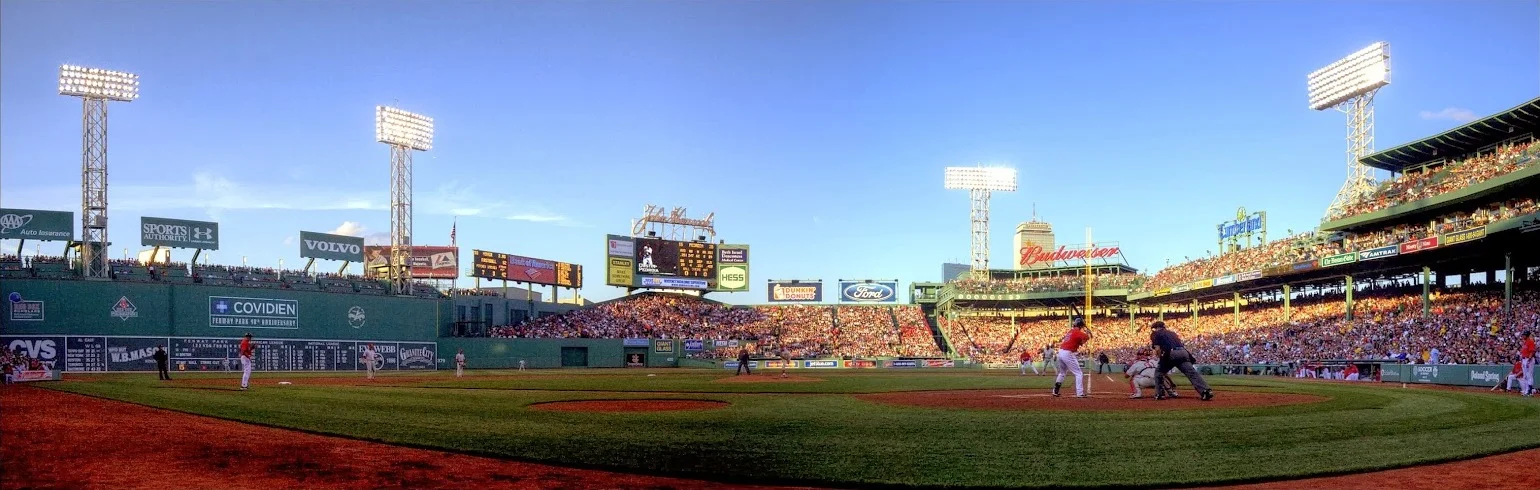
Fenway Park in the early evening.
"At Fenway. Pedro blew seven innings
of unhittable smoke. Nomar stretched
a triple into a home run. My son and I
ate dogs, almost caught a fly. His first
major league game. Repeatedly,
my son kissed my arm, his thanks
inningless, our lives beyond all harm.''
-- From "Body and Soul,'' by Peter Harris
'Squat New England woman'
"My shape reminds me a lot of my grandmother, whom I was really close to. She died when I was 13, and we have a really similar body type, the squat New England woman who can roll out dough and bring in your lawnmower. That's kind of the vibe of my body, and I'm into it."'
-- Lena Dunham
Deconstructing 'family of origin'

The gallery says:
"In therapy, the term 'family of origin' refers to the caretakers and siblings you grow up with, your first ever social group. In Merill Comeau's upcoming show at the Chandler Gallery (in Cambridge), the term, like the material she works with, is deconstructed and reimagined. Each piece is a representation of different familial experiences, and how those experiences intersect with one's sense of identity and community.''