
Vox clamantis in deserto


Executive challenge
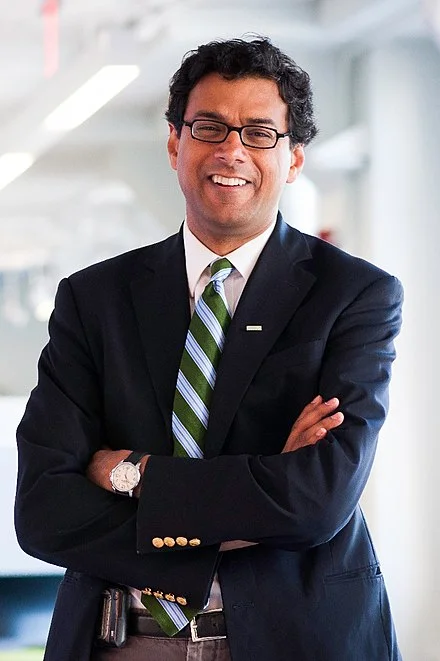
Atul Gawande, M.D.
From Robert Whitcomb's "Digital Diary,'' in GoLocal24.com
Atul Gawande, M.D., is a fine surgeon, writer, charming public speaker and teacher who became famous writing about the extreme inequities of health-care provision and cost in America. His main statistical tools were developed by the Dartmouth (College) Institute for Health Policy and Clinical Practice.
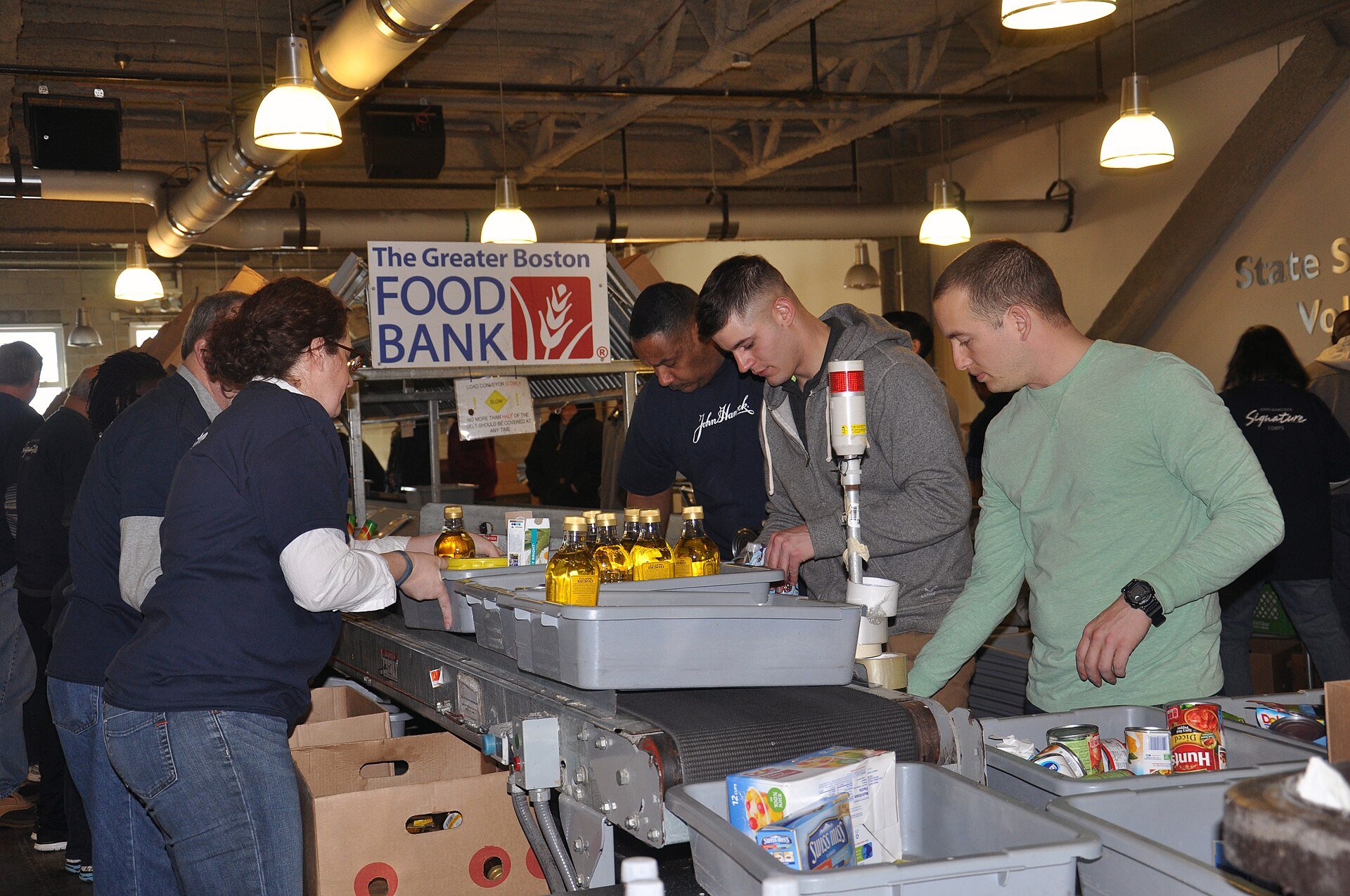
Now he has been tapped to be CEO of a still somewhat mysterious health-care venture formed by the far-too-big Amazon, giant conglomerate Berkshire Hathaway and JPMorgan, the behemoth bank. The companies haven’t yet presented a specific plan for the new nonprofit enterprise, which hasn’t even been named yet. But the main mission is to cut health-care costs for employers.
The good economic news for New England is that this outfit, which I suppose could become very big itself, will be based in Boston.
"I have devoted my public health career to building scalable solutions for better healthcare delivery that are saving lives, reducing suffering, and eliminating wasteful spending both in the U.S. and across the world. Now I have the backing of these remarkable organizations to pursue this mission with even greater impact for more than a million people {who work for the three companies}, and in doing so incubate better models of care for all. This work will take time but must be done. The system is broken, and better is possible," Gawande said.
The system is indeed broken, but can this rock star run a very large organization?
'Against house rules'

Indian Harbor Yacht Club, in Greenwich, Conn.
"I saw the black maid park the Cadillac
In the lot of the Indian Harbor Yacht Club.
When she hefted the first huge silver tray
of delicacies for that evening’s soiree
on her boss’s yacht, I offered to help.
No, she said, in her starched gray uniform
on orders from her employer. The launch man
In wrinkled khakis and a black cap with gold
braided on the bill, told her no, she couldn’t
ride the launch. Against Club rules.''
-- From “The Net,’’ by Peter Harris
The Millennials' Manhattan
From Robert Whitcomb's "Digital Diary,'' in GoLocal24.com
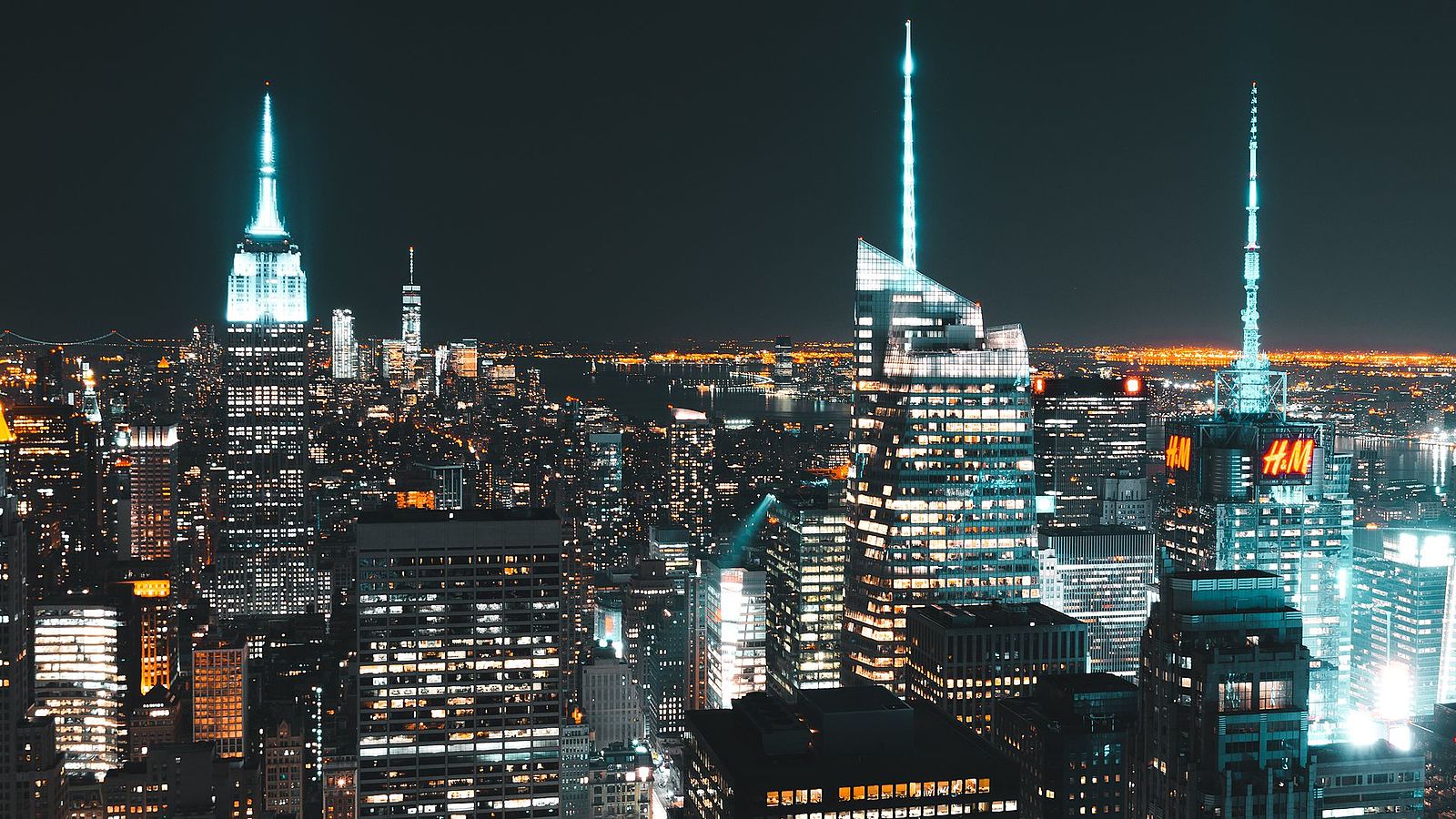
I was in Manhattan a couple of days the other week and seeing all those young adults (some are friends of mine) on the sunny streets brought back memories of when I lived in New York, in the ‘70s. Most of them seemed to be in their twenties, recently out of college and at least looked and sounded ambitious and not yet soured by the claustrophobia and stress that accompany life in the city and that ultimately drives out a lot of people when they enter their thirties. The sight of a bunch of young lawyers with the name of their corporate firm, “Davis Polk,’’ on their T-shirts and probably headed for an obligatory softball game in Central Park sort of crystallized my nostalgia as I gazed at the gleaming towers, too many now occupied by Russian oligarchs and other flight capitalists.
When I lived there, “The City,’’ as we still call it, was falling apart for various reasons, some affecting all large American cities, some unique to New York. Crime was high, the subways were a mess (and mostly un-air-conditioned), strikes were frequent and many big employers were fleeing the city for Fairfield County, Conn.
Still, because of demographic changes, huge Reagan-era incentives for Wall Street, stronger mayors and an unexpected increase in younger Americans’ appreciation of the joys of city life, New York came back and is a hell of a lot spiffier now than it was 40 years ago. But you can see a few signs that it’s sliding again – there’s more graffiti and more bums than just a few years ago, when Michael Bloomberg was mayor, and the current mayor, Bill DiBlasio does not, shall we say, have the reputation for competence and integrity that Bloomberg had and has.
The city’s Achilles heel is its over-dependence on finance. Artificial intelligence and big New York banks’ drive to lower costs by moving major operations to cheaper places threaten to shrink the city’s greatest wealth creator.
The most surprising thing I saw on a sidewalk: A bike whose frame was made of wood.
William Morgan: The Aldriches: Powerful politicians and architects
At the northeast corner of Providence's Swan Point Cemetery, overlooking the Seekonk River, is a tasteful necropolis holding the final resting places of several generations of what was once one of Rhode Island's richest and most influential families, indeed one with great national influence.
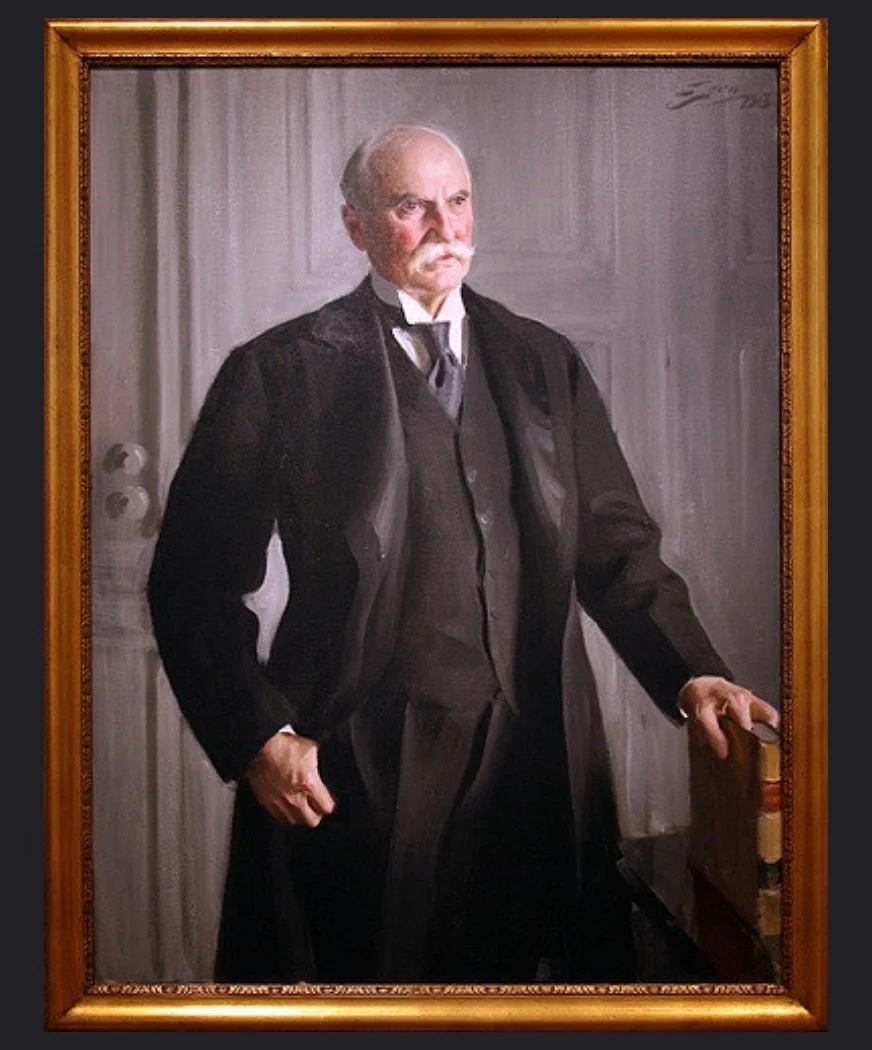
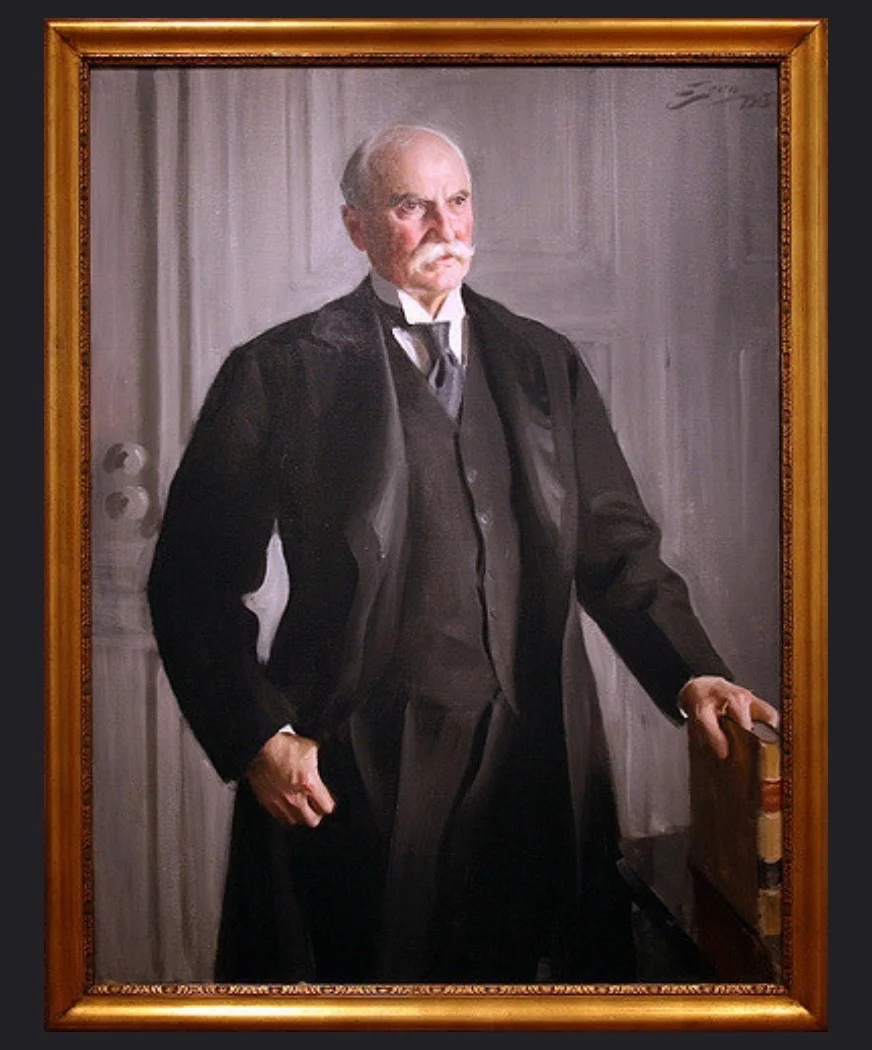
Nelson W. Aldrich, 1913, by Andres Zorn
-- Smithsonian, National Portrait Gallery
The patriarch was Nelson W. Aldrich, a very powerful U.S. senator who served from 1881-1911. Indeed, his nickname became the “general manager of the United States’’. This was back when Rhode Island itself was wealthy and powerful. This Republican Party chieftain extended his influence as the father-in-law of John D. Rockefeller Jr. and was thus the grandfather of Nelson Aldrich Rockefeller, the New York governor and vice president, and Nelson’s four brothers, all of whom were prominent public figures.
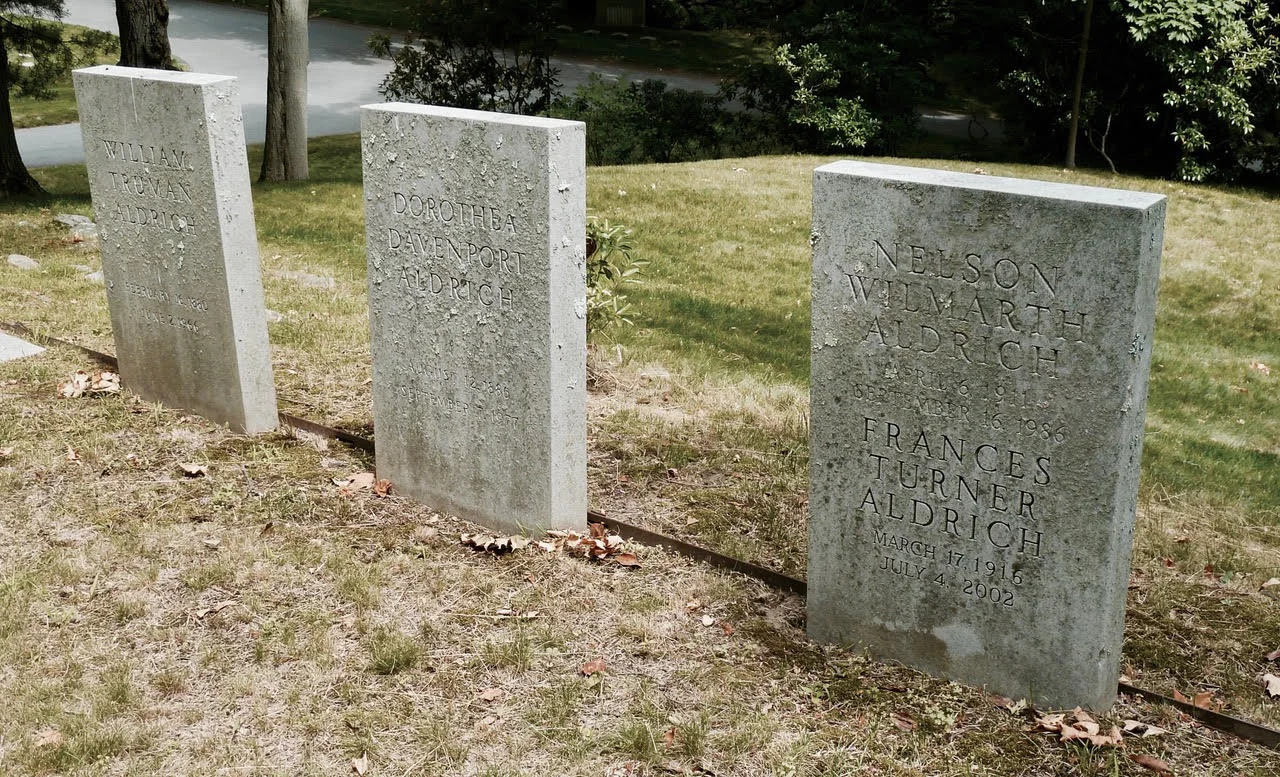
Amidst the politically connected Aldriches are two plain gravestones marking the resting place of the senator's son, William Truman Aldrich (1880-1966), and his grandson, Nelson Wilmarth Aldrich (1911-1986). These men were architects, successful designers who worked in different styles.
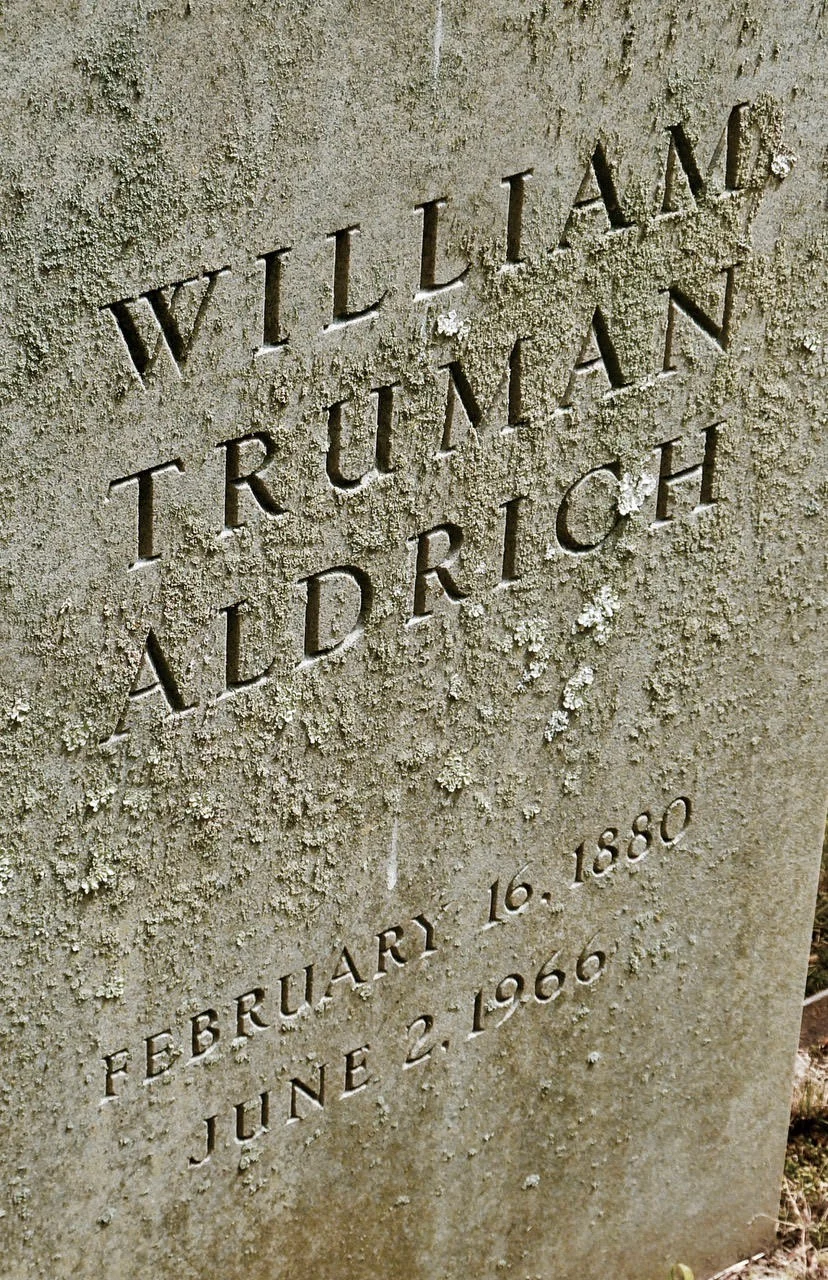
In its obituary, The New York Times described the MIT-trained William as "an architect and yachtsman." Even more important than his schooling at "Tech" were his studies at the École des Beaux-Arts, in Paris. Founded by Louis XIV, The École provided the ultimate education for classical architects; its name became synonymous for designers who could create public buildings worthy of a Roman emperor or a Renaissance palazzo for a Gilded Age plutocrat.
Before starting his own firm in Boston, William Aldrich worked for one of the leading Beaux-Arts firms, Carrère & Hastings, whose best-known monument in the style is the New York Public Library. Aldrich was something of a society architect (his connections to the Rockefellers no doubt helped him secure commissions), and he became a master of a restrained and historically informed interpretation of English Georgian. Typical of his pre-Depression compositions was the original museum for the Rhode Island School of Design and the Temple of Music at Roger Williams Park, both in Providence.
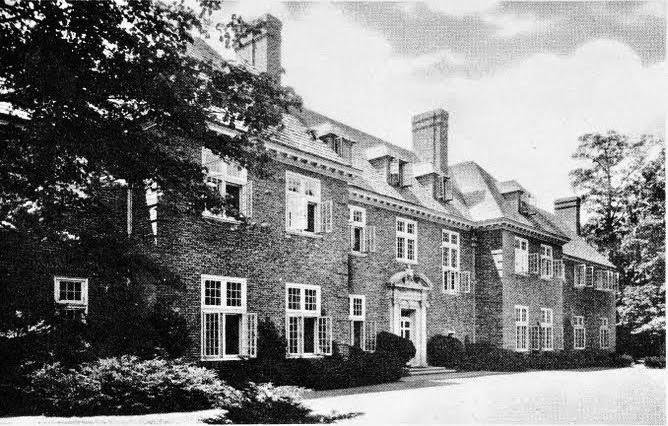
William T. Aldrich designed "Broadhollow," in Brookville, Long Island, c.1926. This was built for Winthrop William Aldrich, the head of the Chase Bank and ambassador to the Court of Saint James (i.e., to Britain).
The architectural landscape had changed considerably when William Aldrich's son Nelson established a practice in Boston following World War II. Nelson's program of study at Harvard was directed by Walter Gropius, who had earlier founded the revolutionary Bauhaus in Germany. Gropius announced his arrival at Harvard by taking a hammer to the plaster casts of classical sculpture that students were required to draw in earlier days. The very term Beaux-Arts became pejorative, synonymous with a supposedly stultifying, conservative aesthetic. (Frank Lloyd Wright coined the term Bozo to derisively refer to those trained at the École.)
Nelson Aldrich embraced the International style of the Bauhaus, with its flat roofs, industrial fenestration and lack of superfluous ornament. His firm, Campbell, Aldrich & Nulty, was in demand for academic buildings on such campuses as Amherst, Phillips Exeter Academy, and Dartmouth, his cousin Nelson Rockefeller's alma mater. The firm is perhaps best known for their part in the design of one of the most controversial modern buildings anywhere, the Boston City Hall.
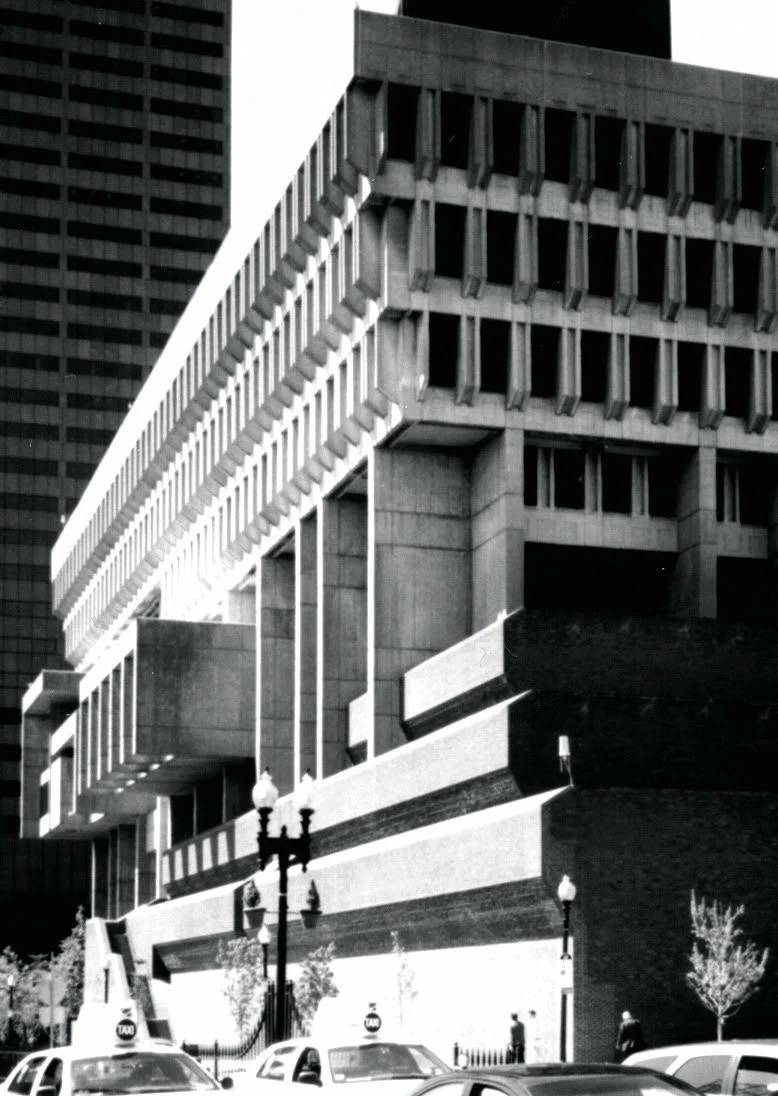
Boston City Hall, 1968, Kallmann, McKinnell & Knowles, with Campbell, Aldrich, and Nulty.
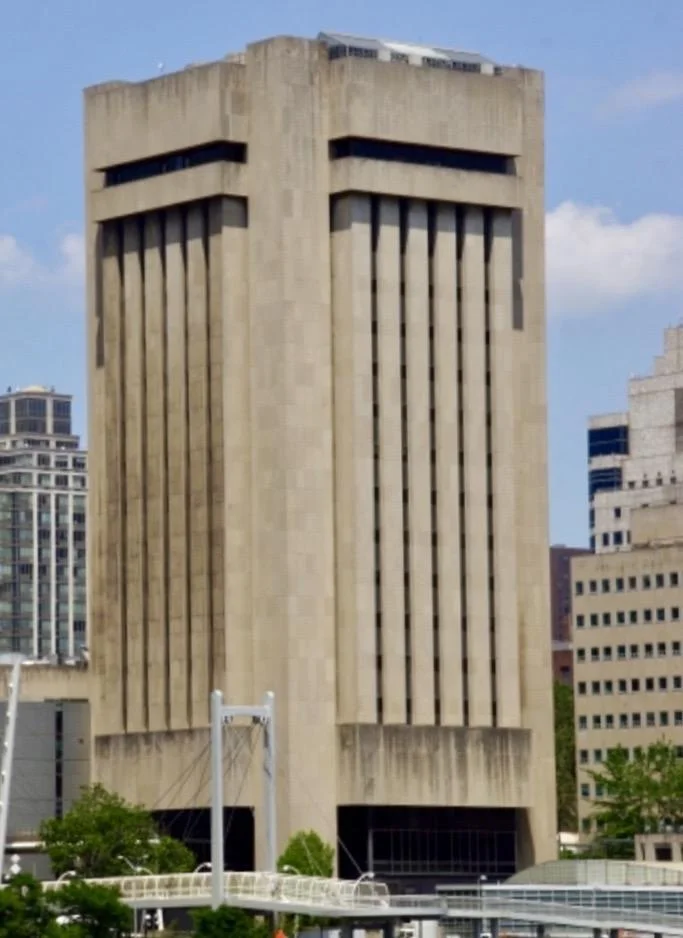
Campbell, Aldrich & Nulty, Weiss Science Tower, Rockefeller University, New York, 1974.
Nelson Aldrich's embrace of the raw concrete variant of modernism called Brutalism pretty much occurred after the death of his father, but their different architectural philosophies apparently caused much strain between the two. One suspects that there were other reasons for what the writer, son and namesake of the younger architect claims was a 30-year estrangement. Nevertheless, the two architects are now together for eternity.
William Morgan has taught the history of American architecture and is the author of the The Abrams Guide to American House Styles, among other books.
'Lives beyond all harm'
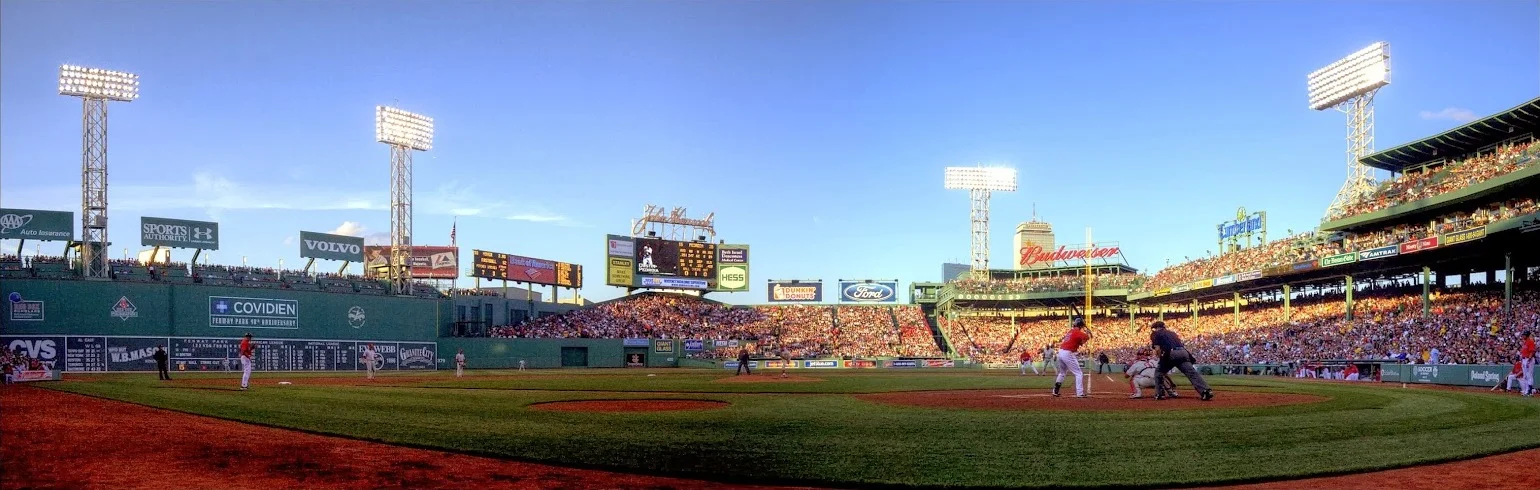
Fenway Park in the early evening.
"At Fenway. Pedro blew seven innings
of unhittable smoke. Nomar stretched
a triple into a home run. My son and I
ate dogs, almost caught a fly. His first
major league game. Repeatedly,
my son kissed my arm, his thanks
inningless, our lives beyond all harm.''
-- From "Body and Soul,'' by Peter Harris
'Squat New England woman'
"My shape reminds me a lot of my grandmother, whom I was really close to. She died when I was 13, and we have a really similar body type, the squat New England woman who can roll out dough and bring in your lawnmower. That's kind of the vibe of my body, and I'm into it."'
-- Lena Dunham
Deconstructing 'family of origin'

The gallery says:
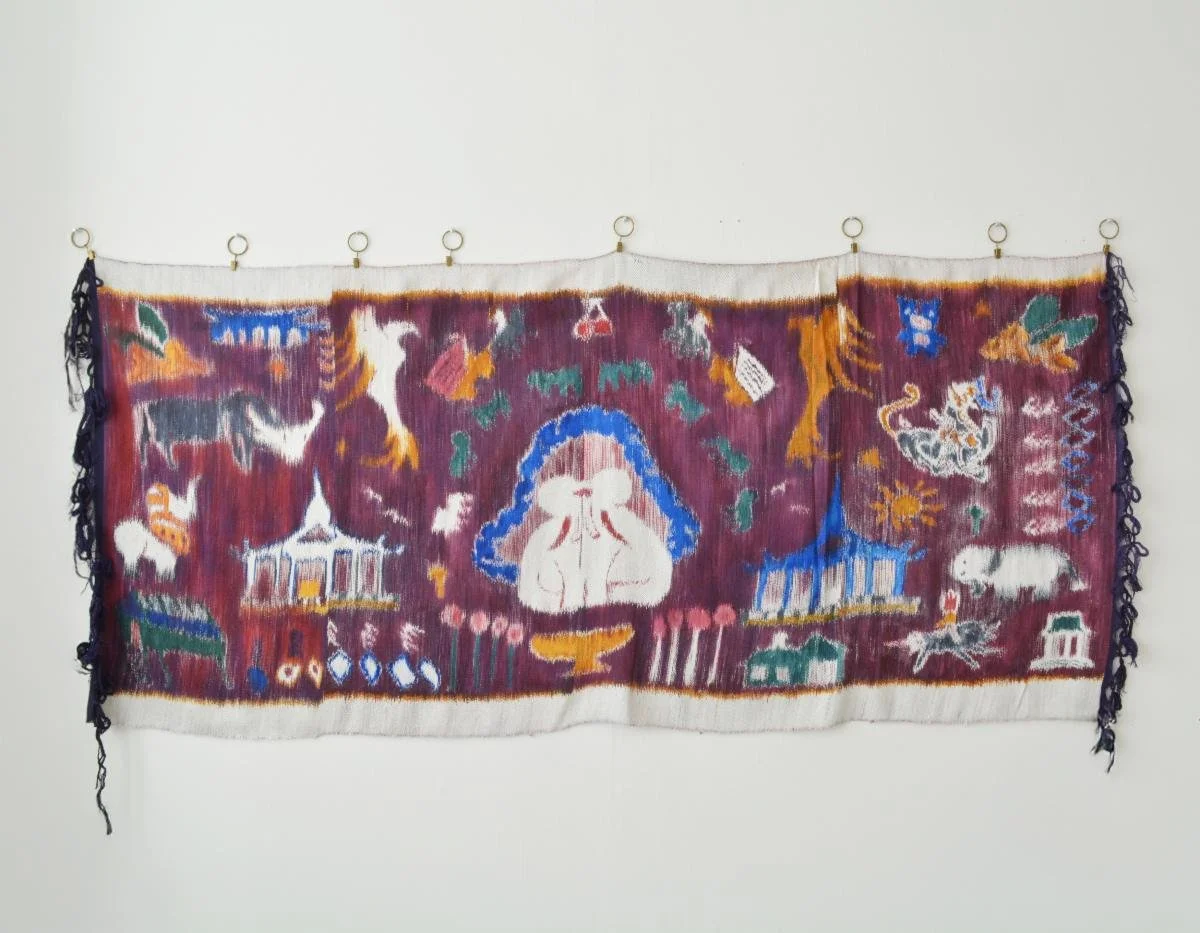
"In therapy, the term 'family of origin' refers to the caretakers and siblings you grow up with, your first ever social group. In Merill Comeau's upcoming show at the Chandler Gallery (in Cambridge), the term, like the material she works with, is deconstructed and reimagined. Each piece is a representation of different familial experiences, and how those experiences intersect with one's sense of identity and community.''
James P. Freeman: How America achieved a beautiful dream in a famously ugly year

"Earthrise'' photo, taken by Apollo 8 astronaut William Anders on Dec. 24, 1968.
As in most other years, there were wars, riots and assassinations in 1968. But here I write about something noble that happened that year. Three daring men circled the moon. In its way, Apollo 8 redeemed mankind and 1968.
The drama, discipline and derring-do of the mission is marvelously documented in two recent books: Apollo 8, by Jeff Kluger, and Rocket Men, by Robert Kurson.
Project Apollo was conceived in the waning days of President Dwight D. Eisenhower’s administration, in 1960, when Americans feared that they were losing the “space race” to the Soviets/Russians during the Cold War. But full commitment had to wait for President John F. Kennedy's grander embrace of the challenge, which he expressed at Rice University in September 1962. That speech galvanized the push for space exploration in general and a manned lunar landing in particular into a national calling. It was a superb expression of early 1960s idealism.
Kennedy said, “The growth of our science and education will be enriched by new knowledge of our universe and environment, by new techniques of learning and mapping and observation, by new tools and computers for industry, medicine, the home as well as the school.”
His celestial aspirations included “new hopes for knowledge and peace.” He also sought divine guidance: “As we set sail, we ask God’s blessing on the most hazardous and dangerous and greatest adventure on which man has ever embarked.”
Halfway through the decade, as America was bleeding in the Vietnam War, the National Aeronautics and Space Administration and many thousands of people (including many scientists and engineers in New England) were preparing to meet the challenge.
But by mid-1968, with only 18 months to achieve Kennedy’s goal of landing a man on the moon and returning him safely to the Earth by decade’s end, the objective was in jeopardy. No Apollo astronauts had flown in space since the Apollo 1 launch pad fire killed three astronauts in January 1967. And the lunar lander wouldn’t be ready for the flight until early 1969.
Fifty years ago this summer, NASA made a bold decision: Apollo 8 would circumnavigate the moon in December. Everyone understood the risks: unlike future missions, there was no lifeboat should catastrophic failure occur aboard the spacecraft.
The journey would test the nation’s best engineers in such areas as navigation, communication, computation and instrumentation. Not to mention rocketry. And nerves.
(Today’s iPhone has more processing power than the guidance computer on Apollo’s command module.)
Apollo 8 circled the Moon on Christmas Eve.
During a live global broadcast (the largest audience in history), the astronauts recited words worthy of the moment. As the gray surface of the Moon passed by, William Anders, Frank Borman and Jim Lovell each read from the Book of Genesis. “We close,” said Borman, “with good night, good luck, a Merry Christmas, and God bless all of you — all of you on the good Earth.”
Yet it was a simple but starkly beautiful photograph taken by Anders and published around the world on Dec. 30 that captured the legacy of what The New York Times described then as “the most fantastic voyage of all time.” Simply called “Earthrise,” it became an iconic image of 1968. And of all history.
Apollo 8 would mark several historical firsts: The first time that humans left the Earth’s gravitational field; the first time that men flew on top of the massive Saturn V rocket (nearly 60 feet taller than the Statue of Liberty; the most powerful machine ever built, it produced 160 million horsepower); and the first time that the dark side of the moon was seen by the naked eye. (The flight would also mark the fastest that people had moved; the astronauts re-entered the Earth’s atmosphere at 35,000 feet per second.) The crew became, rightly, international heroes.
Kennedy’s audacity was rewarded in July 1969 with the triumph of the Apollo 11 landing on the Moon. That could not have happened without the success of Apollo 8.
The national investment in Project Apollo cost $25.4 billion by its conclusion, in 1973 -- $206 billion in 2016 dollars. (America will spend $310 billion in debt service just in 2018.) Apollo may have been the last federal public-works program that would invest so much, and with such risk, to rise to a challenge of world-historical proportions.
James P. Freeman is a New England-based columnist and a former banker.
Good news for brick and mortar

Vacant mall in Arizona, emptied by Amazon.
From Robert Whitcomb's "Digital Diary,'' in GoLocal24.com
The U.S. Supreme Court’s ruling (South Dakota v. Wayfair) that Internet retailers be made to collect sales taxes in states where they have no physical presence is good news for what’s left of physical stores and downtowns in many places. Because of earlier legal actions, Rhode Island and Massachusetts are unlikely to be affected much by the ruling.
The Government Accountability Office says that states were already collecting about 75 percent of the potential taxes from online purchases. Still, the part not being taxed could be as much as $13 billion a year nationally.
It has been unfair that a god-awful 1992 ruling let online retailers based far away from most of their consumers avoid paying the local and state sales taxes needed to help pay for public services while stores that directly served local customers and employed local people have had to levy these taxes, of course making their prices less competitive.
Kudos to the 40 states and the Trump administration for suing to overturn a ruling that both violated states’ rights and made for a very unlevel playing field for retailers.
An Antebellum village

"Quenched'' (oil on canvas), by Gay Freeborn, at the Patricia Ladd Carega Gallery, Center Sandwich, N.H.
Center Sandwich is in the town of Sandwich. The village center and surrounding area are listed on the National Register of Historic Places as the Center Sandwich Historic District. It's just north of the Granite State's Lake District.
Center Sandwich began as the site of a gristmill, erected in 1768 by Daniel Beede, followed in 1780 by a sawmill, also on on the banks of the Red Hill River. Roads were then built to the area, and the village and surrounding rural parts of town grew from about 900 people in 1790 to over 2,000 in 1820.
Most of the village's development occurred in the decades before the Civil War, resulting in residential and civic buildings that are largely Federal and Greek Revival in style. Because no railroads were built to serve the area, Center Sandwich declined in importance after the Civil War. Only a few changes occurred in the appearance of village in the 20th Century. The oldest surviving building in the village is the 1792 Baptist church, originally Federal in style, but later given Greek Revival features.

The town hall in Center Sandwich.

Sarah Anderson: Things are bad but have been much worse for unions
The Knights of Labor seal.
From OtherWords.org
The U.S. Supreme Court has just dealt unions a bruising blow. In a 5-4 vote, the court ruled that public-sector employees who benefit from unions’ collective-bargaining services will no longer have to pay for them.
At least initially, this is expected to result in a steep drop in union resources and bargaining capacity, which will likely reduce employee pay. One Illinois university study, for example, predicts that public-school teacher salaries in that state will drop by an average of 5.4 percent.
But over the course of its turbulent history, the American labor movement has survived much worse. And it will find a way to get back on its feet.
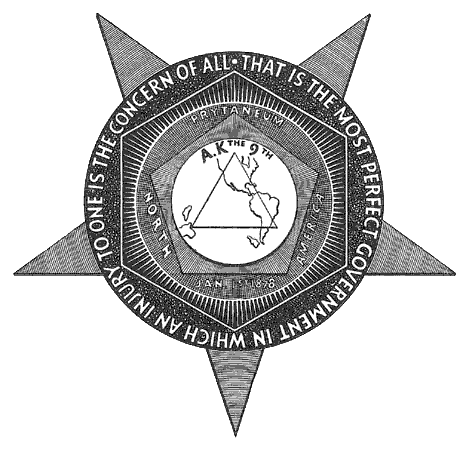
One of my ancestors was in the center of the drama during one of labor’s most roiling eras. Albert G. Denny, my great-grandmother’s brother, started out as a child laborer in a glass factory. He eventually became the national organizer for the Knights of Labor, the leading voice for U.S. workers in the 1880s.
Compared to the challenges Albert faced in the 19th Century, the new threat against organized labor still seems bad — but not as bad.
Teachers in several states have already been striking over low pay and school underfunding. In my great-uncle’s day, that could get you shot.
As a young glass blower in Pittsburgh in 1877, Albert witnessed one of the most violent attacks on labor in our nation’s history. When railroad workers there joined a nationwide strike, the governor sent in militia, who opened fire on the workers, killing 20. After more than a month of conflict, federal troops marched in and crushed the strike.
Within a few years of this tragedy, the labor movement began to rebound. Albert became secretary of a glassworkers union that effectively negotiated over wages, apprenticeships and other labor conditions. Later he became the lead organizer for the Knights of Labor, which grew rapidly to represent 20 percent of all U.S. workers by 1886.
The anti-union violence, however, didn’t end.
I have a copy of a telegram Albert sent the head of the Knights of Labor after learning that railroad baron Jay Gould’s goons had shot into a crowd of strikers in East St. Louis, killing six. “You should have Gould arrested and tried for accessory to murder,” Albert wrote.
Instead, the strike failed, Gould got richer, and the Knights of Labor began to implode. Membership plummeted from 800,000 in 1886 to 100,000 in 1890 — an even faster nosedive than the modern labor movement’s decline, from 17.7 million in 1983 to 14.8 million in 2017.
But out of the Knights’ ashes, new forms of organizing took shape. By the 1930s, the movement was powerful enough to push President Franklin Delano Roosevelt to enact landmark labor legislation that workers still benefit from today, including the minimum wage and the 40-hour week.
Once again, American workers will need to find new ways to build power against big money interests. Fortunately, this is already beginning.
In anticipation of the Supreme Court ruling, public-sector unions have been much more proactively reaching out to their members, hearing about their needs and concerns, and broadening the scope of their efforts beyond pay and benefits to immigrant rights, racial justice, and other social issues.
Traditionally non-unionized workers are also making some progress. Advocates for restaurant servers, for example, just won a Washington, D.C. ballot vote to eliminate the subminimum wage for tipped workers.
My great-uncle Albert Denny’s union hall is still standing in Pittsburgh’s South Side neighborhood, but it’s a deli/whiskey bar now. Some things change. But the need for working people to be able to come together to negotiate over conditions that affect their lives will not.
Sarah Anderson directs the Global Economy Project at the Institute for Policy Studies and co-edits Inequality.org. Follow her at @Anderson_IPS.
UMass Amherst surges to ninth in sustainability ranking
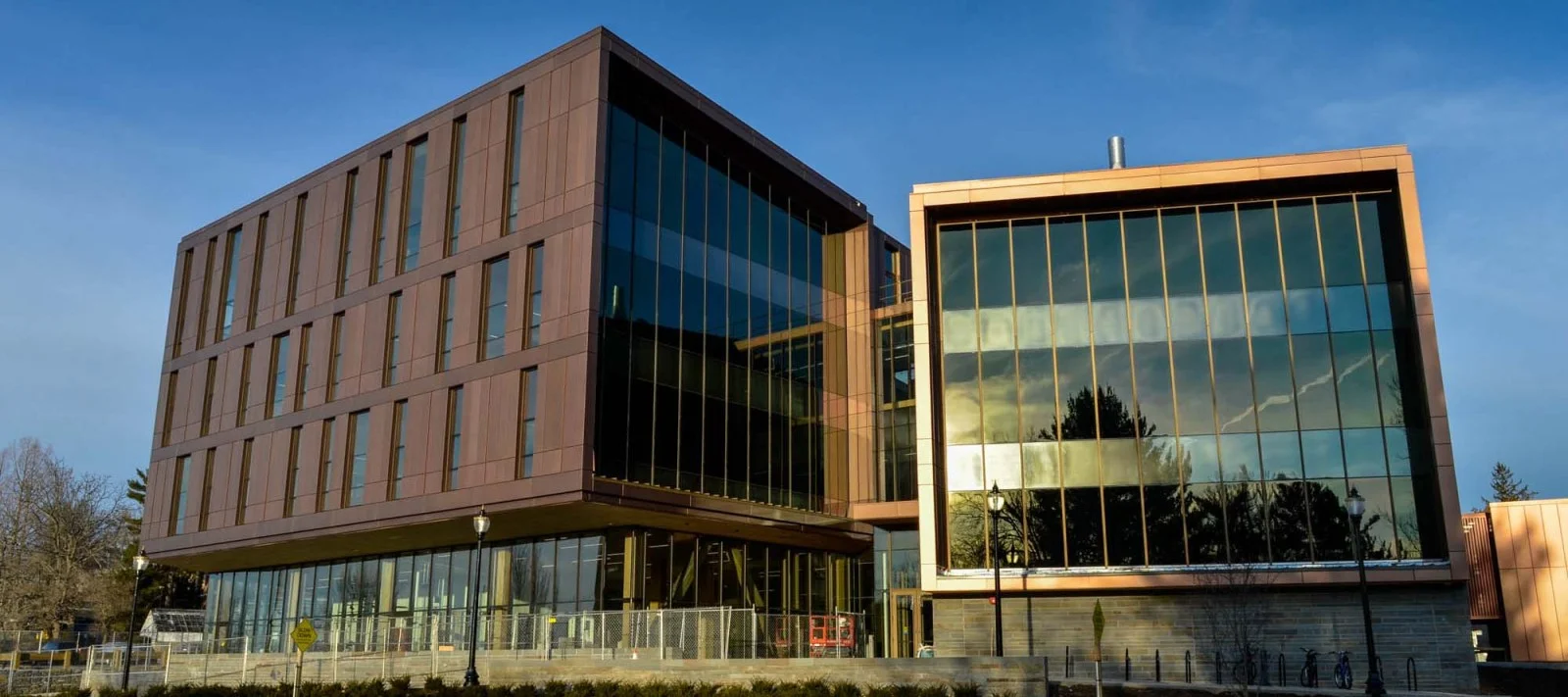
The John W. Olver Design Building, mostly made of wood, at UMass Amherst.
The New England Council reports:
"The University of Massachusetts at Amherst recently announced that it has been ranked ninth in the nation for Sustainable Universities by the Association for the Advancement of Sustainability in Higher Education’s (AASHE) Sustainability Tracking Assessment and Rating System (STARS). The STARS program recognizes sustainability accomplishments in areas such as academics, research, engagement, operations, and administration.
In 2015, the university was rated 29th in the STARS Campus Sustainability Index among U.S. doctorate-granting institutions. However, with the creation of the School of Earth and Sustainability, the design and construction of the John W. Olver Design Building -- the largest and most technologically advanced academic contemporary wood structure in the U.S. -- and the decision to be the first major public university to divest its endowment from direct holdings in fossil fuels, the university has significantly increased its STARS score from a 68.18 to a 75.77, resulting in a leap of 20 places from the previous 2015 rating.
Chancellor Kumble R. Subbaswamy said, “This new STARS score reflects the university’s continuing commitment to excellence in sustainability. UMass Amherst is a leader in best practices for energy efficient construction and sustainable food use, conducting world-class research and preparing a new generation of students to be inspired stewards of our planet.”
Read more on the UMass Amherst web site.
The long view
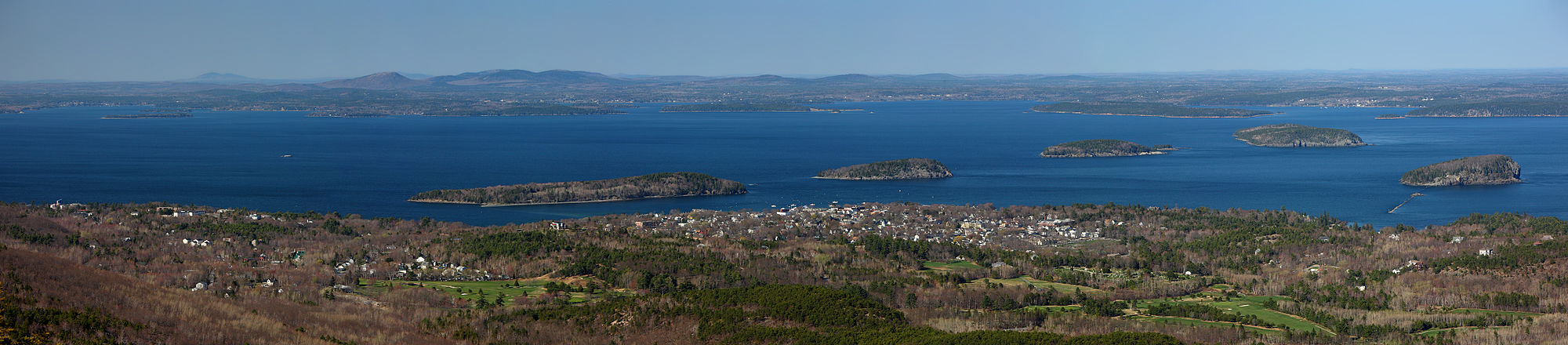
Frenchman's Bay, from the summit of Cadillac Mountain, in Acadia National Park, Maine. The town below is Bar Harbor, a major tourist center, cruising-ship port and the home of the College of the Atlantic. Cadillac Mountain is the highest point on the U.S. coast between Canada to Mexico.
"So might a Chinese sage have seen the world,
seen mist and humpbacked islands from a mountain,
with a hawk hanging in a silver sky.''
-- The start of Elizabeth Coatsworth's "From Cadillac Mountain''
'A legend of the dead'
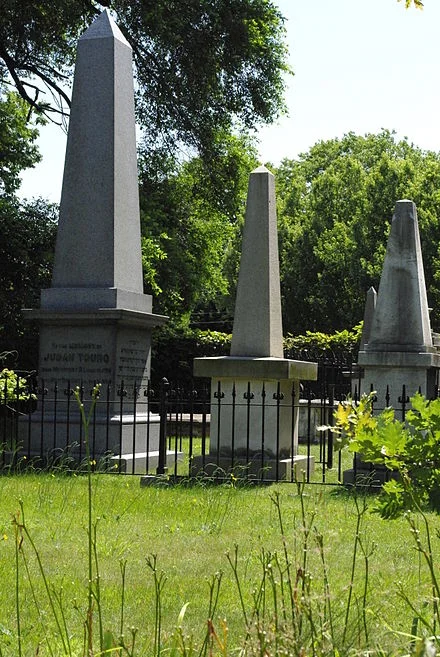
The Jewish Cemetery at Newport, dedicated in 1677 and also called the Touro Synagogue Cemetery. That synagogue, built in 1763, is the oldest surviving synagogue building in North America. It was built under the leadership of Cantor Isaac Touro.
"How strange it seems! These Hebrews in their graves,
Close by the street of this fair seaport town,
Silent beside the never-silent waves,
At rest in all this moving up and down!
The trees are white with dust, that o'er their sleep
Wave their broad curtains in the south-wind's breath,
While underneath these leafy tents they keep
The long, mysterious Exodus of Death.
And these sepulchral stones, so old and brown,
That pave with level flags their burial-place,
Seem like the tablets of the Law, thrown down
And broken by Moses at the mountain's base.
The very names recorded here are strange,
Of foreign accent, and of different climes;
Alvares and Rivera interchange
With Abraham and Jacob of old times.
"Blessed be God! for he created Death!"
The mourners said, "and Death is rest and peace;"
Then added, in the certainty of faith,
"And giveth Life that nevermore shall cease."
Closed are the portals of their Synagogue,
No Psalms of David now the silence break,
No Rabbi reads the ancient Decalogue
In the grand dialect the Prophets spake.
Gone are the living, but the dead remain,
And not neglected; for a hand unseen,
Scattering its bounty, like a summer rain,
Still keeps their graves and their remembrance green.
How came they here? What burst of Christian hate,
What persecution, merciless and blind,
Drove o'er the sea — that desert desolate —
These Ishmaels and Hagars of mankind?
They lived in narrow streets and lanes obscure,
Ghetto and Judenstrass, in mirk and mire;
Taught in the school of patience to endure
The life of anguish and the death of fire.
All their lives long, with the unleavened bread
And bitter herbs of exile and its fears,
The wasting famine of the heart they fed,
And slaked its thirst with marah of their tears.
Anathema maranatha! was the cry
That rang from town to town, from street to street;
At every gate the accursed Mordecai
Was mocked and jeered, and spurned by Christian feet.
Pride and humiliation hand in hand
Walked with them through the world where'er they went;
Trampled and beaten were they as the sand,
And yet unshaken as the continent.
For in the background figures vague and vast
Of patriarchs and of prophets rose sublime,
And all the great traditions of the Past
They saw reflected in the coming time.
And thus forever with reverted look
The mystic volume of the world they read,
Spelling it backward, like a Hebrew book,
Till life became a Legend of the Dead.
But ah! what once has been shall be no more!
The groaning earth in travail and in pain
Brings forth its races, but does not restore,
And the dead nations never rise again. ''
"The Jewish Cemetery at Newport, '' by Henry Wadsworth Longfellow (1807-1882)
Don Pesci: Supremes' union ruling pays homage to the First Amendment
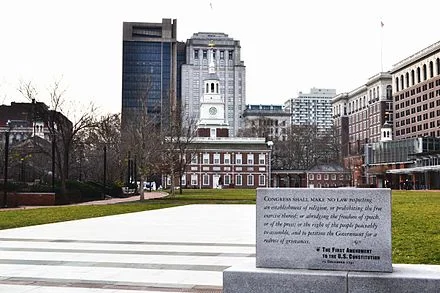
Inscription of the First Amendment in front of Independence Hall, in Philadelphia.
"To compel a man to furnish contributions of money for the propagation of opinions which he disbelieves, is sinful and tyrannical.''
-– Thomas Jefferson
The sentiment above is to be found in an Act for Establishing Religious Freedom, a bill drawn up by Thomas Jefferson as part of the Revised Code of Virginia laws, but the sentiment might easily apply to Janus vs. AFSCME, a decision presented this week by the U.S. Supreme Court.
In Janus, the high court reversed an earlier decision in Abood v. Detroit Board of Education. The court made a distinction in that case between forced payments used for political activities, which the court found violated First Amendment rights of free speech, and fees used for such conventional union work as collective bargaining, contract administration and the representation of workers in grievance processes which, the court declared, did not hurt First Amendment rights.
Justice Potter Stewart echoed Jefferson in the majority opinion: “To compel employees financially to support their collective-bargaining representative has an impact upon their First Amendment interests.” But, Potter argued, the forcible collection of dues from public workers used for “conventional union activity” is “constitutionally justified” to ensure “labor peace” and to thwart “free riders.”
Sardonically, Janus’s lawyers noted in their brief that Potter denominated “free riders” would be, were Abood to remain unchallenged, compelled free riders.
The Supreme Court had been inching towards a reversal of Abood in other cases. “Because a public-sector union takes many positions during collective bargaining that have powerful political and civic consequences, the compulsory fees constitute a form of compelled speech and association that imposes a significant impingement on First Amendment rights,” Justice Samuel A. Alito Jr., a Republican, wrote for the majority in a related case in 2012.
Alito, it must be admitted, had a point. In Connecticut, union contracts arranged between a union- friendly governor such as Dannel Malloy, a Democrat, and SEBAC, the union conglomerate that engorges itself on taxpayers' “contributions,” affect the whole body politic, not only the non-union member who may in some cases be forced, in Jefferson’s timeless formulation, to contribute “money for the propagation of opinions which he disbelieves.” In what sense, the Janus court queried, is collective bargaining and the creation of public employee contracts NOT political? Short answer: in NO case.
In Janus, the court threw out the dirty bathwater, the Abood decision with its tendentious distinctions, and saved the constitutional baby. When freedom of choice is mixed with the contributions of fees given freely by free men and free women, we get Jeffersonian freedom, in which the private wills of individuals are not throttled by unions in league with politicians and courts.
“A ruling against public unions,” The New York Times helpfully explains,” is unlikely to have a direct impact on unionized employees of private businesses, because the First Amendment restricts government action and not private conduct. But unions now represent only 6.5 percent of private sector employees, down from the upper teens in the early 1980s, and most of the labor movement’s strength these days is in the public sector.”
The Janus decision will likely reduce “contributions” muscled from state workers who do not wish to contribute to the ruin of state government. For all practical purposes, public-employee unions have become Connecticut’s fourth branch of government. In his most recent contract negotiations with SEBAC, Malloy stretched contractual agreements highly favorable to unions well beyond the end of his term in office to 2017; the contracts contain a provision that will not allow a future governor pursuing spending cuts to lay off workers until the contract has elapsed, and the contract provides automatic salary increases of 3 percent for public union workers after two years.
In addition to all these benefits, agreements between towns and municipal unions in Connecticut provide that town employees, some of whom are not unionized, should perform costly administrative work for unions.
A "Contractual Agreement, Between The Town of Manchester, Connecticut and Municipal Employees’ Union, Local 991, Council #4, AFSCME, AFL-CIO, July 1, 2016 - June 30, 2019” is typical. The agreement specifies that town government, not the unions, are responsible for deducting “membership dues, initiation fees, and reinstatement fees as may be fixed by the Union from the pay of those employees who, individually and in writing, authorize such deductions… Deductions shall be made each month and shall be remitted to the Financial Officer of the Union not later than the last day of said month. The monthly remittances to the Union will be accompanied with a list of names of employees from whose wages such deductions have been made and the amount deducted from each employee.”
Unions impassively, without expending labor or costs, simply receive payments from a municipal administrative apparatus whose salaries are paid by town taxpayers, thus reducing the administrative costs of unions. Not bad non-work if you can get it.
The court’s decision in Janus cuts to the constitutional quick. It declares in proper legal language that there is little difference between preventing free speech and compelling state employees to unwillingly finance union affairs costly to taxpayers – are we not constantly reminded by union propaganda that state workers are taxpayers too? -- and messaging with which they may disagree. Before Janus, state workers, forced unwillingly to pay for union operations, could opt-out of paying fees devoted to campaign funding only. Post Janus, state workers must willingly opt-in before union leaders may receive fees passed along to them by municipal employees who perform administrative work that should be done by unions.
Unions no doubt will experience a loss of revenue from some workers who previously were forced to contribute funds to powerful, politically connected unions. However, in a free society – i.e., one in which people are not compelled to “furnish contributions of money for the propagation of opinions” with which they disagree, we should choose to take our stand with Jefferson and First Amendment rights. Is it not an irony of ironies that the bill drawn up by Jefferson was specifically designed to prevent state government from collecting fees and taxes from non-preferred religious denominations to support a state established church?
Unions have become something of a religion for progressive politicians who favor particular worker sects. To all this nonsense, the Supreme Court has now said – “Thou shalt not.”
Don Pesci is a Vernon, Conn.-based columnist.
Llewellyn King: Even Sanders deserves privacy away from her job

Richard Burton as Mark Antony with Elizabeth Taylor as Cleopatra in the film epic Cleopatra (1963), the project in which they started their off-screen love affairs.
Public accommodations can be a thorny matter. Historically, Virginia has had its problems, as have other states and nations.
In Marshall, Va., a little greasy spoon became notorious and its owners served time in prison because they refused to serve people of color. Very soon, the only people who frequented the joint were journalists who hoped to catch the owners in the act of violating the state’s public accommodations law.
In a bar in Baltimore, I watched the owner lie to a black man who wanted service. “This is a private club, but I could sell you something to go,” the owner said. It wasn’t a club; it was racism at work.
At a roadside restaurant in South Africa, before the fall of Apartheid, my family and I and our black driver stopped for a bite. I was told that our driver couldn’t enter this humble establishment with me and my family and would have to eat in the car. We all ate in the car.
Obviously, there was no race dimension in the booting of White House Press Secretary Sarah Sanders from the Red Hen restaurant in Lexington, Va., but there was the owner’s anger, fury and protest. It was a comment on actions of the administration Sanders defends daily. Lexington, in the Shenandoah Valley, is a thoroughly Trump town – home to the Virginia Military Institute, Washington and Lee University, flag-bedecked houses, pickup trucks with NRA decals, and Fox on the box.
The restaurant owner, Stephanie Wilkinson, said that Sanders didn’t meet the restaurant’s standards of kindness, compassion and cooperation and that’s why she kicked out Sanders. Clearly Wilkinson was vexed, as many are these days, with the profound national division over the treatment of immigrant children at the border and the constant defense of mendacity by Sanders.
While political speech deserves defense, I think one deserves to eat one’s vittles without victimization. Chowing down shouldn’t be an opportunity for others to speak up.
Customers who meet reasonable standards of behavior and dress shouldn’t be denied service or yelled at while exercising their right to patronize public places. I think it was wrong for protesters to attack Department of Homeland Security Secretary Kirstjen Nielsen at a Mexican restaurant in Washington. Some privacy in public is an entitlement, even if the president behaves in outrageous ways with ad hominem attacks on allied leaders, schoolyard abuse of his detractors and a rabid-dog approach to public life.
There isn’t much for which I can claim the moral high ground, but when it comes to restaurants, I have credentials -- top-drawer bona fides, as it were.
Back in 1962, I was employed by one of the London newspapers, notorious for intruding on people's privacy. My assignment was to follow a couple of lovebirds around London. They were Elizabeth Taylor and Richard Burton and my job was to spend all day and much of the night at the famous Dorchester Hotel, where love was being committed.
Except that they never entered stage center.
Every day I made my way to the five-star hotel and sat around, had drinks (which the hotel provided free) and hoped to see them coming or leaving or, fond hope, kissing on the backstairs. No joy. Even hopes of asking the chambermaid about the bed were nobbled by hotel security.
Then one Sunday in Dulwich, a green and pleasant oasis in south London, my then-wife, a brilliant journalist, Doreen King, and I went for our Sunday lunch, an English tradition, at a very nice pub. And there they were, my prey: Taylor and Burton as large as life having lunch. Not just having lunch, but at the next table.
My wife whispered, “Are you going to call the office and get a photographer? What questions have you got ready?”
I looked at the lovers at the next table. Never have I seen two people so in love, so happy with each other. My wife and I agreed silently to leave them alone.
I’d like to be able to say that Burton winked, but he didn’t. He had eyes only for Taylor.
To my mind, the lovely (Taylor and Burton) and the less so (Nielsen and Sanders) should be able to enjoy a private meal in public. I missed a scoop on this belief.
Llewellyn King is executive producer and host of White House Chronicle on PBS. His e-mail is llewellynking1@gmail.com
Knowing when it's enough

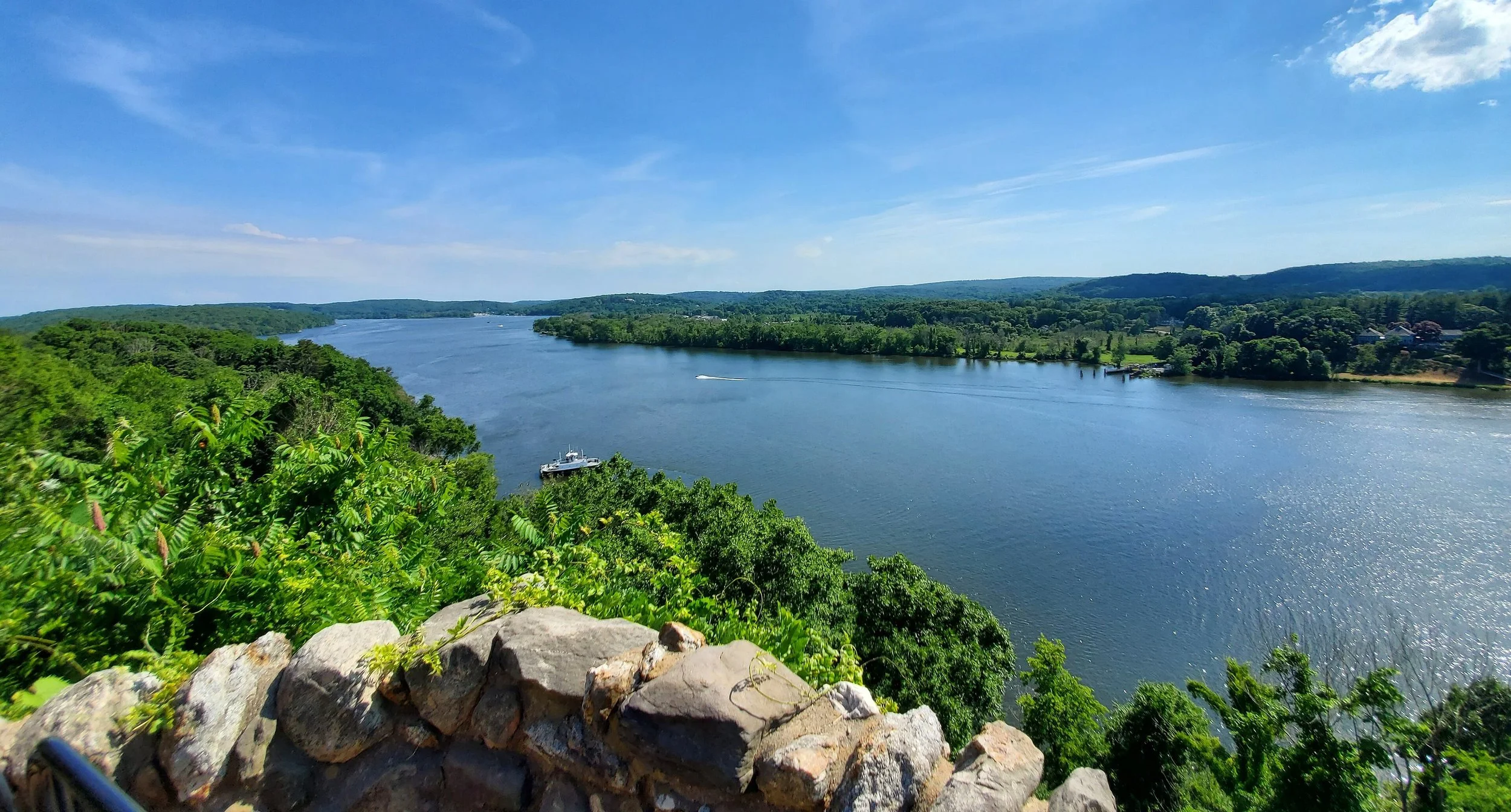
The Connecticut River, looking north from the French King Bridge at the Erving-Gill (Mass.) town line.

The Oxbow of the Connecticut River in Northampton, Mass., circa 1910.
"A farmer … has an enormous innate need to simply hold still, to keep what he’s got, to limit greed to what he can keep….What’s the use of owning more than you can plough, or hay, or cut into sawlogs or pulp or firewood in the wintertime, or drive spikes into to bleed out maple sap in sugar time? No use, at all. In the Connecticut Valley, this trait has saved a lot of beauty.''
-- Evan Hill, in The Connecticut River (1972)
They'll look less friendly soon

-- Photo by Joel Sartore/National Geographic Photo Ark
The Bruce Museum, in Greenwich, Conn., is hosting "National Geographic Photo Ark" through Sept. 2. "The National Geographic Photo Ark" is a multiyear project led by Photo Ark founder and National Geographic photographer Sartore.
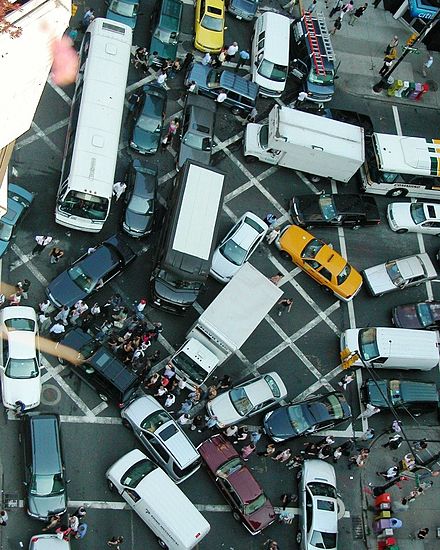
The freedom to be trapped in traffic
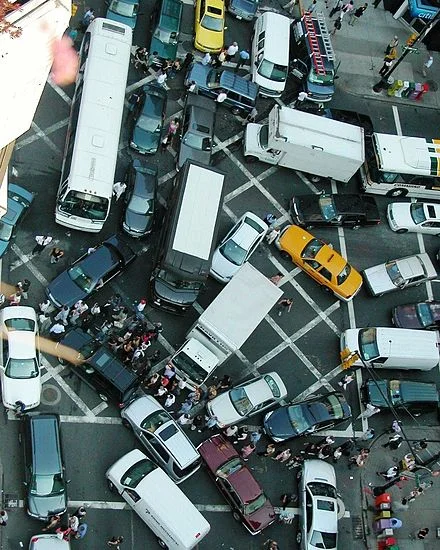
From Robert Whitcomb's "Digital Diary,'' in GoLocal24.com
"Politics: A strife of interests masquerading as a contest of principles. The conduct of public affairs for private advantage.''
-- Ambrose Bierce
That America is increasingly a plutocracy and not a democracy might be suggested by a story in The New York Times headlined “How the Koch Brothers Are Killing Public Transit Projects Around the Country.’’ The story details how the Koch lobbying group Americans for Prosperity has been working to block efforts around to address gridlock and air pollution. The Koches, who inherited their company, Koch Industries, from daddy use highly sophisticated data-analysis tools to sow fear, misunderstanding and confusion about projects they don’t like.
The Times story focuses on Nashville, whose voters, after an intense propaganda campaign by the Kochs, turned down a $5.4 billion public-transit program that polling before the Kochs arrived had been expected to easily win because the Music City is choking on car traffic and air pollution.
Good mass transit reduces traffic, boosts economic development and reduces air pollution. (I’d add warily it also helps to address man-made global warming but most Republicans don’t seem to believe in that. After all, what do 97 percent of scientists know?) It’s no accident that the richest U.S. cities – New York, Boston, etc., have dense (if far from perfect!) mass-transit systems.
Koch servant Tori Venable, who runs Americans for Prosperity, came up with an intriguing remark on why the car culture should continue dominant in crowded cities: “If someone has the freedom to go where they want, do what they want, they’re not going to choose to public transit.’’ Eh? Millions of people take mass transit every day because they want the freedom to nap, to read, to brood, and to avoid being hit by the idiot weaving in and out of lanes while texting.
Among the assorted inane things that Koch-connected people say about public transit came from Randal O’Toole, of the Cato Institute, who said “Why would anybody ride transit when they can get a ride at their door within a minute that will drop them off at the door where they want to go?’’
Well, how about those folks who don’t want to be trapped in traffic, which ride-hailing services such as Lyft and Uber are making much worse in many downtowns. Buses, trolleys and light rail take cars off the roads. And what about poor people who can’t afford to pay ride-hailing services (which jack up their prices substantially at job-commuting times)?
Rarely do the Koch Brothers act for any other reasons than economic self-interest, e.g.,- promoting wide-open immigration to keep wages low and tax cuts focused on the very rich. So consider that Koch Industries is a big producer of gasoline and asphalt and makes a variety of automotive parts. The more that people drive, the richer these billionaires become. To read The Times piece, please hit this link.
Of course, the Kochs can fly over the traffic in their helicopters.
A great but troubled patron of Modernism

Scofield Thayer.
Scofield Thayer, a rich man from Worcester, was a central figure in modern literature and visual art, as well as a fascinating case of mental illness. An exhibition of some of the legendary collection he left will be held at the Metropolitan Museum of Art, in New York, July 3-Oct. 7.
From the Met:
"An aesthete and scion of a wealthy family, Scofield Thayer (1889–1982) was co-owner and editor of the literary magazine the Dial from 1919 to 1926. In this avant-garde journal he introduced Americans to the writings of T. S. Eliot, Ezra Pound, D. H. Lawrence, Arthur Schnitzler, Thomas Mann, and Marcel Proust, among others. He frequently accompanied these writers' contributions with reproductions of modern art. Thayer assembled his large collection of some six hundred works—mostly works on paper—with staggering speed in London, Paris, Berlin, and Vienna between 1921 and 1923. While he was a patient of Sigmund Freud in Vienna, he acquired a large group of watercolors and drawings by Schiele and Klimt, artists who at that time were unknown in America.
"When a selection from his collection was shown at the Montross Gallery in New York in 1924—five years before the Museum of Modern Art opened—it won acclaim. It found no favor, however, in Thayer's native city, Worcester, Massachusetts, that same year when it was shown at the Worcester Art Museum. Incensed, Thayer drew up his will in 1925, leaving his collection to The Metropolitan Museum of Art. He withdrew from public life in the late 1920s and lived as a recluse on Martha's Vineyard and in Florida until his death in 1982.''
To read about the collection, please hit this link.