
Vox clamantis in deserto








Chris Powell: Why are Conn. and R.I. giving EB piles of money to do what it would do anyway?

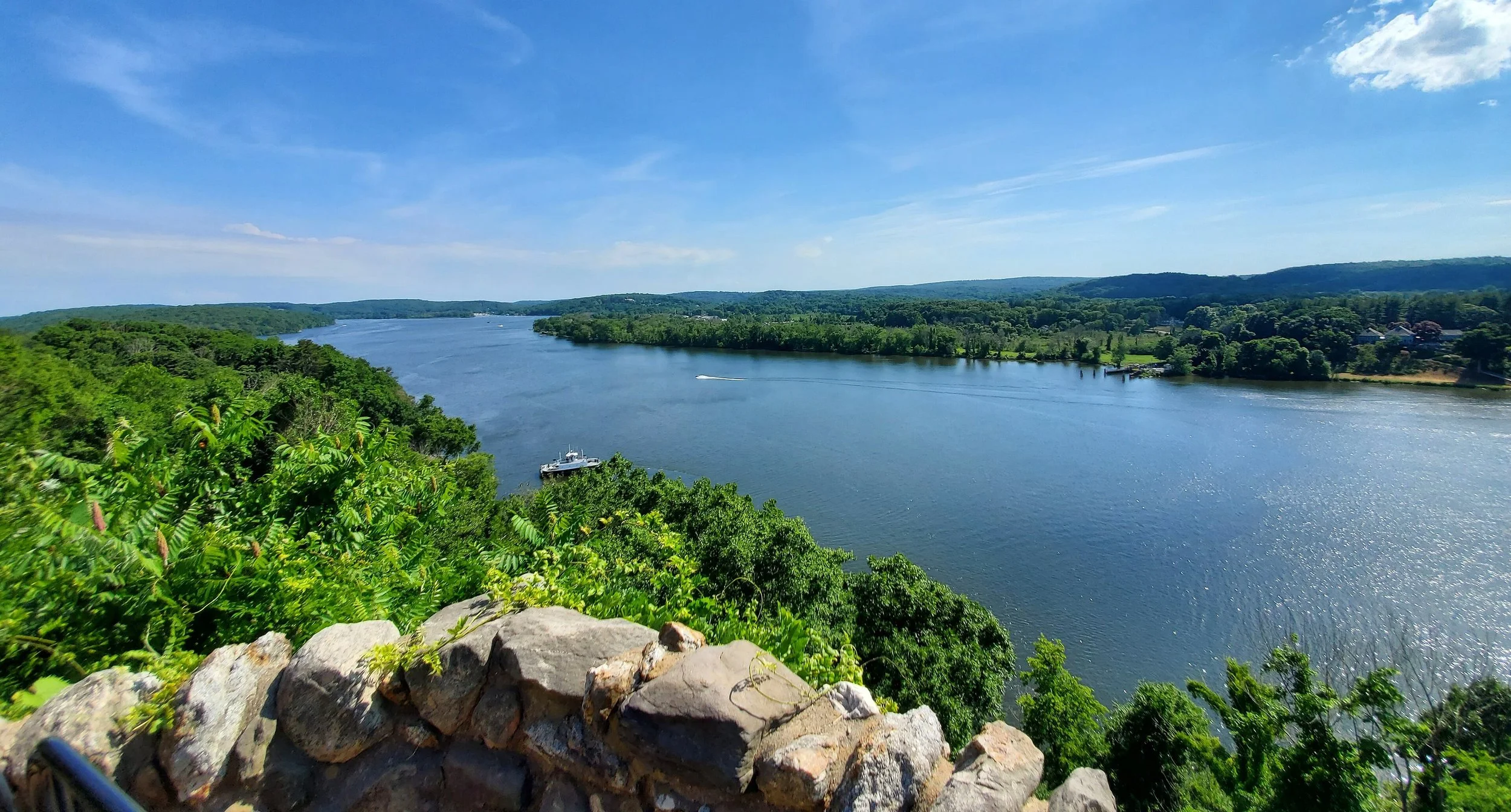
USS Nautilus moored in Groton at the Submarine Force Museum.
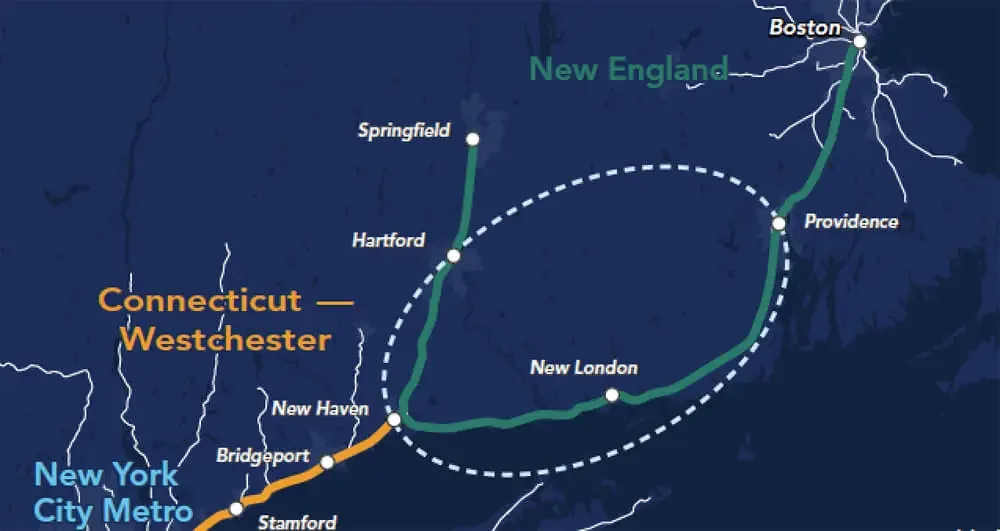
What was the necessity of Connecticut Gov. Dannel Malloy's award the other day of $80 million to the Electric Boat Division of General Dynamics in Groton? {Rhode Island is giving the very rich company $34 million in incentives to expand at Quonset Point.}
The governor said that in exchange for the money, the company will increase its local employment by 1,900 people over the next 16 years, a state subsidy of $42,000 per job. But the federal government already had given the company the extra submarine work that was requiring that expansion of its workforce.
That is, the Malloy administration is paying EB to do what it was doing anyway, and as a military contractor EB is already getting all its money from government.
So was the state's payment necessary to keep EB in Connecticut, to prevent the company from moving to another state? That seems improbable, given EB's huge facilities in southeastern Connecticut and Rhode Island. They would not easily be relocated. Further, any risk of relocation would not speak well of Connecticut's congressional delegation, whose agitation for more submarine construction is partly responsible for the extra work coming to EB. With the federal government spending billions more on submarines, EB probably would not have minded being required to stay put.
While the governor called the state's payment to EB a "partnership," it looks more like corporate welfare from an administration that senses that, with its constant increases in taxes and business regulations, it has crippled the state's economy and feels ever more vulnerable to extortion by major corporations.
And does the Navy really need the extra submarines? As long as military contracting is such big business in Connecticut, that issue will get no more serious inquiry from the state's political leaders than the war in Afghanistan, now in its 18th inconclusive year.
xxx
SUBVERTING THE CONSTITUTION: The General Assembly and Governor Malloy are moving to put Connecticut into the "national popular vote" system of determining the votes of the state's presidential electors and thus determining the election of the president. Under the proposal Connecticut's electors would be required to vote for the candidate who led the national presidential vote.
There are many problems with this plan, starting with its subversion of the Constitution by undoing the Electoral College without a constitutional amendment and it making a compact among states without the approval of Congress as required by the Constitution.
Advocates of the "national popular vote" system say it would ensure that every vote for president counts, but it wouldn't. For it would nullify the votes of states on the minority side and diminish the influence of Connecticut and other small states, whose electors now represent more voters than the national average. The proposed system would have canceled Connecticut's votes in the 2004 presidential election, when Democrat John Kerry carried the state but lost the national vote to Republican George W. Bush. Connecticut's advocates of the "national popular vote" system seem to think that this state can never be on the minority side nationally, but it has been.
And just how is the national popular vote to be officially counted and totaled? There are no such counts and totals. The secretaries of the 50 states count only their own state's votes and certify their electors
The Electoral College has its disadvantages but so does the "national popular vote" system. The proposal would allow political corruption in "sanctuary states," nullifiers of federal immigration law -- particularly California and New York -- to steal more than their allotted electoral votes and control presidential elections by facilitating voting by their millions of illegal immigrants.
Chris Powell is a columnist for the Journal Inquirer, in Manchester, Conn.
Think diffidence, not surliness
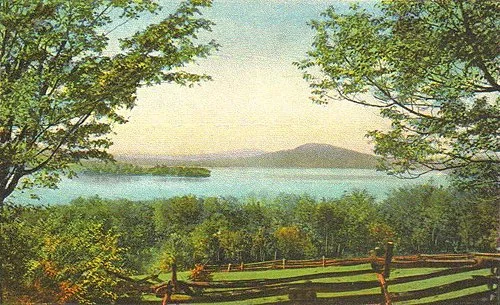
Rangeley Lake, Maine, on a postcard, circa 1920. Mrs. Rich's book, first published in 1942, about living with her family near the lake.
“In spite of all that is said, and more especially written, about the crabbed New Englander, New Englanders, like all ordinary people, are nice. Their manner of proffering a favor is sometimes on the crusty side, but that is much more often diffidence than surliness.”
― Louise Dickinson Rich, in We Took to the Woods
'When allowed to breathe'

"Ninth Avenue Quartet IV'' (oil on canvas), by Melissa Mayer, in her show "Melissa Meyer: Hitting the Right Notes,'' at Heather Guadio Fine Art, New Canaan, Conn., May 12-June 23.
The gallery says:
"Meyer's abstract paintings have a signature calligraphy and rhythmic curvilinear vernacular that are more complex than they initially seem. Like a good bottle of wine, her works open up when allowed to breathe and the more one looks, the more notes are savored. Her lengthy career stands as a testament to her authenticity, with forty-plus solo exhibitions, commissions, teaching and artist-in-residence positions here and abroad. ''
Taking it down
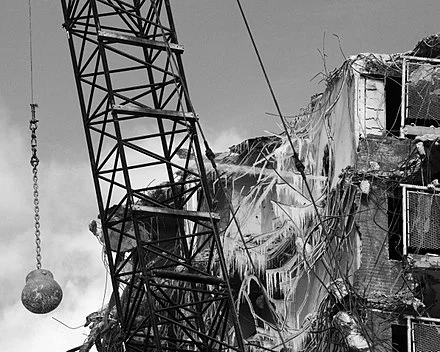
"The intact facade's now almost black
in the rain; all day they've torn at the back
of the building, 'the oldest concrete structure
in New England,' the newspaper said.
By afternoon,
when the backhoe claw appears above
three stories of columns and cornices,
the crowd beneath their massed umbrellas cheer.
Suddenly the stairs seem to climb down themselves,
atomized plaster billowing: dust of 1907's
rooming house, this year's bake shop and florist's,
the ghosts of their signs faint above the windows
lined, last week, with loaves and blooms.''
-- From "Demolition,'' by Mark Coty.

Dan Wallace: Making things better down in the boiler room
From the New England Board of Higher Education (nebhe.org)
DANBURY, Conn.
For many institutions in New England, the 2020 deadline to hit objectives for the Presidents' Climate Leadership Commitments that once seemed far away are now right around the corner. These ambitious plans were entered into in 2007 with the American College & University Presidents' Climate Commitment—in some cases, by now-departed presidents—and many higher education institutions (HEIs) across the region find themselves a bit behind schedule and in search of ideas for how to catch up.
In our region, where temperatures range from well below 0 to over 100 degrees, heating and cooling can present a major opportunity to improve sustainability stats of a campus. Overt changes such as improving windows come to mind, but recent advancements in boiler technology and strategies for working with the heat of the sun and the cool of the earth can provide powerful, if unsexy, means of reducing emissions quickly.
Advances in biofuels
A major source of New England HEIs’ fuel usage goes to the boilers that heat their buildings. Switching to a sustainable, renewable fuel in the burner system means huge reductions in carbon emissions and lowers dependence on fossil fuels, such as coal or natural gas. Most HEIs rule out this option because biofuels, such as wood chips or pellets, require a complete new boiler system and easily cost upwards of $10 million.
A new biofuel option has emerged in “liquid wood” or “bio-oil.” Liquid wood isn’t new to the market, but the technology to burn it efficiently and safely is. This liquid fuel, made from wood in a process called pyrolysis, behaves just like traditional fuel oils in the boiler, so existing boiler equipment can be retrofitted easily—for about one tenth the cost of converting to traditional biofuels. The fuel has existed for some time, but the technology to burn it has only recently been perfected.
Since the raw wood comes from tree farms, liquid wood fuel is a 100 percent renewable resource. It's also extremely carbon-efficient because the planting of new trees (to replace those harvested to create the oil) offsets much of the carbon emissions. When Bates College, in Maine, switched its heating system to liquid wood ahead of last winter, its carbon footprint was reduced by 83 percent in a single year.
Replace boiler components
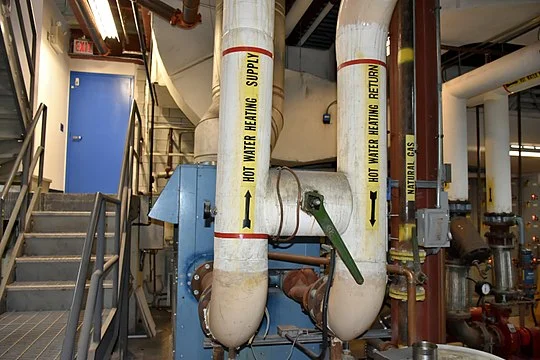
Boilers are incredibly durable. They often last decades—potentially even a century—without needing to be replaced. However, just because something isn’t broken, doesn’t mean it’s green. While many schools are still working to set up protocols to lower thermostats, they can also make use of technology that increases efficiency of the heating system automatically. For instance, boiler upgrades were part of how Bowdoin College reached its climate goal two years early.
The electrical efficiency of a boiler is determined by its ability to maintain an optimal ratio of air to fuel. Older burners set these ratios manually. Not only are they difficult to adjust, they slip over time. Upgrading the controller component of a boiler system is relatively inexpensive—most of the system can remain. With ratios dialed in by computer and maintained digitally, the sustainability gains can be huge. Installation costs can be as low as $5,000, and electrical usage can be reduced by as much as 75 percent.
Harness natural thermal energy
If your campus is climate-conscious, you’ve likely explored solar panels as a power source extensively, but there are other ways to capture the sun’s energy. Solar thermal walls are dark-colored metal plates that can be mounted on the southern side of buildings to capture the sun’s heat (even during the dead of winter) and pull warmed air into the building with fans. Heating fuel savings enable these fixtures to pay for themselves in one to eight years.
Controlling the temperature of your facility isn’t the only heating and cooling cost of a campus. Tremendous amounts of energy are expended changing the temperature of water. Geothermal wells use the Earth’s ambient temperature of about 55 degrees to give a head-start on heating water. While likely cost-prohibitive as a sustainability measure alone, campuses that may already be updating their water systems can look to make sustainability gains along the way, particularly rural campuses that rely on wells because they aren’t served by city water systems.
Merge environmental studies with engineering
The enthusiasm of students was a major driver for colleges and universities entering into climate leadership commitments in the last decade. In the years since 2007, "employability" has increasingly become a top issue on the minds of students and administrators. Campuses that connect these causes can both tap the intelligence and energy of their students while providing them with valuable workforce skills.
When updated with remote monitoring technology that tracks usage data, something as mundane as the campus boiler system can become a hands-on arena for research at the intersection of environmental studies and engineering. Colleges and universities in New England could follow the example of institutions like Maharishi University of Management in Iowa, where students get hands-on experience managing the campus’s sustainable living program, which includes sustainable heating and cooling elements. Several alumni have used skills developed in the program to enter the sustainability field or launch companies in the green energy space. At Mesalands Community College, in New Mexico—which has a 1.5-megawatt wind turbine that powers the campus and is maintained by instructors and students—graduates enter the workforce trained in wind turbine maintenance.
Rather than merely agitating for sustainability improvements on campus, institutions that create a collaborative environment for students to be part of the solutions give those students an edge as they enter the workforce. New England, where energy costs are high, winters are cold, and there’s widespread community support for climate initiatives, is an ideal place to train the next generation of building managers and engineers while preparing campuses for a sustainable future.
Dan Wallace is vice president and CEO of Preferred Utilities Manufacturing Corp.
Nathanson's journeys

"Cairo Airport'' (acrylic, 1970's), by Morris Nathanson, in the show "Morris Nathanson: Retrospective,'' at the Providence Art Club, May 12-June 1. The exhibition will include paintings, assemblages, works on paper and sculpture from throughout the career of the nationally known designer and artist.
Would Amazon help improve the MBTA?
In Boston's Seaport District, a candidate for Amazon's "Second Headquarters.''
From Robert Whitcomb's "Digital Diary,'' in GoLocal24.com
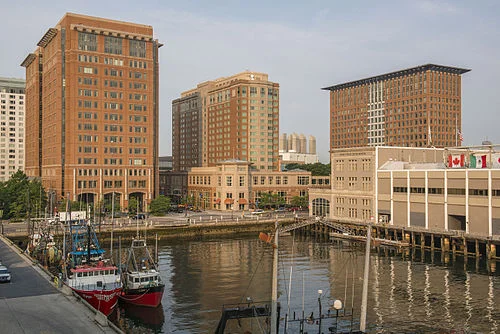
With the announcement that Amazon will hire at least 2,000 more people for its Boston operations – and maybe 50,000 more there if it chooses the city for its “Second Headquarters’’ – it’s nice to know that the online mega-retailer has been talking with people in candidate cities about affordable housing and traffic/transit issues that would be raised by so many new people.
In the case of Boston, have the city and company discussed, for example, Amazon helping to pay for the additional MBTA service needed if the company builds the Second Headquarters there, and helping to finance a lot of new housing to limit the rise in living costs in what is one of America’s most expensive places? Considering the huge tax incentives offered in order to lure the company, those questions are fair.
Todd McLeish: Endangered sparrow's survival depends on gender equality

Saltmarsh sparrow.
From ecoRI News (ecori.org)
Saltmarsh sparrows continue their struggle to survive. The formerly common bird that lives exclusively in East Coast coastal marshes is predicted to go extinct within the next 50 years, largely because of rising sea levels.
New research by scientists at the University of New Hampshire, however, has found that the birds are advocates of gender equality, a reproductive strategy that may benefit their populations but is probably too little too late to extend their time on Earth.
Female birds of many species, from songbirds and seabirds to parrots and raptors, can control whether they produce male or female offspring, according to UNH assistant professor Adrienne Kovach. It can sometimes be a beneficial strategy from an evolutionary perspective, because environmental circumstances or other factors may favor the success of males over females, or vice versa.
“Evolutionary theory suggests that if the potential benefits of raising one sex over the other vary in relation to environmental or maternal conditions,” Kovach said, “then females should favor the production of that sex. Typically, high-quality sons are more beneficial to mothers because they have the potential to produce far more grandchildren than daughters can, as males can mate many times but females are limited by how many eggs they can produce, incubate and raise to fledging.”
But there is a risk to producing more sons than daughters. Kovach said a male-biased population “may be especially troubling, as females are the ones who produce the eggs and offspring.” In addition, daughters often require fewer resources to reach maturity, and if they survive, they almost always reproduce. Males, on the other hand, can be “competitively inferior” and may not reproduce at all.
“With this in mind, one could logically say that producing daughters represents the safe bet,” said Kovach’s colleague Bri Benvenuti. “You might get a smaller payout in terms of numbers of offspring, but you know you’ll get something.”
The saltmarsh sparrows’ tenuous situation raised interesting questions for the researchers.
“We thought that the saltmarsh sparrow system provided a neat set of circumstances in which females might be expected to manipulate their offspring sex ratios,” Kovach said.
The species’ likely extinction is linked to its preference for nesting in marsh grasses just inches from the ground. The rising sea and increasingly severe storm surge floods their nests and often causes reproductive failure.
Since male offspring are larger and therefore may be more likely to survive a flooding event, Kovach and Benvenuti speculated that female saltmarsh sparrows might intentionally produce more sons. To find out, they collected nesting data from breeding sites in Maine, New Hampshire and Massachusetts and analyzed the DNA of chicks to determine the sex of the offspring. They also evaluated whether environmental conditions, maternal health or other factors influence the sex ratio.
The researchers were surprised to find an even sex ratio when averaged across the five years of the study. While they did find a pattern of yearly variation in sex ratio, it always corrected itself the following year.
“Females respond to higher frequencies of one sex by increasing production of the rarer sex, which would have a temporary fitness advantage,” Kovach said. “Our findings overall show support for balanced offspring sex ratios at a population level over time.”
Independent biologists Steve Reinert and Deirdre Robinson study saltmarsh sparrows at Jacob’s Point in Warren, R.I., and even though they captured 32 males and just 20 females last year, they believe the sex ratio of the population is 1-to-1.
“This probably relates to the way the males move in and out of our study site seeking copulations … while the females are nesting and staying put,” Reinert said. “It would be easy to get the wrong idea on sex ratios without intimate knowledge of the population.”
Although the birth of more males may give the species a better chance of survival, given the rising seas, Kovach and Benvenuti think a balanced sex ratio may have even greater benefits. They said that if the sex ratio leans too heavily in one direction or the other, it may not be good for the long-term trajectory of the population.
“If saltmarsh sparrows manipulated their offspring sex ratios in response to environmental conditions, then the consistent environmental changes predicted by rising sea levels could result in skewed population-wide sex ratios, which can be detrimental for declining species and small populations,” Kovach said. “Knowing that saltmarsh sparrow sex ratios will not be biased in response to these future changes is one bit of good news for this species that is already in trouble.”
Rhode Island resident and author Todd McLeish runs a wildlife blog.
Don't waste those scraps

"Chord 27,'' by Julie Graham, now being shown at Brookline (Mass.) Art Center.
'Irregular pile of architecture'
Fenway Park.
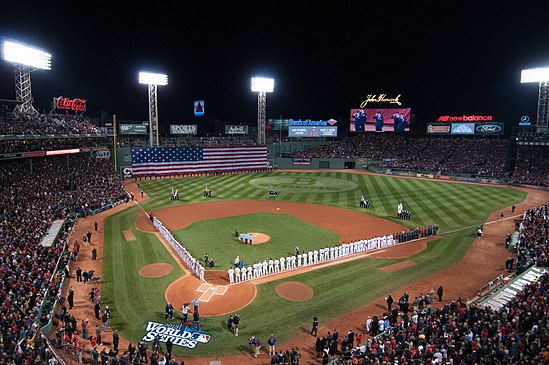
"The ballpark is the star. In the age of Tris Speaker and Babe Ruth, the era of Jimmie Foxx and Ted Williams, through the empty-seats epoch of Don Buddin and Willie Tasby and unto the decades of Carl Yastrzemski and Jim Rice, the ballpark {Fenway Park} is the star. A crazy-quilt violation of city planning principles, an irregular pile of architecture, a menace to marketing consultants, Fenway Park works. It works as a symbol of New England's pride, as a repository of evergreen hopes, as a tabernacle of lost innocence. It works as a place to watch baseball.''
-- Martin Nolan, writing in 1986 in The Boston Globe
Conservatives vs. big business?

1904 cartoon about the Standard Oil Trust (monopoly)
“C}onservatives are coming to see that Big Business can also threaten our liberties and the flourishing of civil society.’’
“What I am saying is we should not underestimate the importance of our immediate commercial environment to the forging of a sense of community, and that the shift from locally owned businesses to multinational corporations comes at a cost.’’
“As our attachments, and consequently obligations, to families, neighborhoods, small businesses and charities diminish, I fear that people cease to exercise civic responsibility and fill the empty societal space with whatever appears on their easily accessed screens: reality TV, strident talking heads on cable news, gossip on social media.’’
-- John A. Burtka IV, executive director of the American Conservative magazine, in “Conservatives Should Be Wary of Big Business,’’ in The Washington Post. To read his essay, please hit this link.
Hard and soft

Kent Falls State Park, in Kent, Conn.
“A waterfall means the coming together of something hard in Nature and something soft. Over the shelf of igneous rock, a stream descends to cut away the softer rock below. And, as is often true in the case of a hard edge joined to a softness and a movement, peculiar beauty comes of it.
“New England waterfalls like this one, with their white plumes spilling downward step by step, remind one of the age and gentleness of New England mountains, and, where they flow, they give the land a voice.’’
--Robie Macauley, in “New England Waterfall,’’ in Arthur Griffin’s New England: The Four Seasons
Chuck Collins: Learn a trade!

From OtherWords.org
BOSTON
In the classic 1960s movie The Graduate, a family friend offers the recent college graduate, the the character played by Dustin Hoffman, one word of advice in choosing a career: “plastics.”
My advice for today’s high school graduates: “Learn a trade.”
Unfortunately, there’s a historic stigma about “voc-ed,” the result of snobbery toward certain occupations.
Yes, there’s also the shameful practice of tracking low-income whites and people of color into blue-collar jobs while encouraging wealthier white students to attend college. But now there are millions of rewarding, high-paying trade jobs sitting empty.
Instead of training for those, tens of millions of high school graduates are on college autopilot, loading up an average of $37,000 in debt, and graduating without any practical skills.
Not only is our economy suffering for lack of skilled workers, but also a huge number of workers are unhappy and earning below their financial potential.
There are legions of depressed Dilberts out there in cubicle land, sitting in front of computer screens, wondering who will be laid off next. And there are millions of young people sitting in college classrooms dreaming of being somewhere else.
Put these same people in an apprenticeship with a skilled adult and they’ll thrive. Instead of wasting their intelligence in an office, they could deploy it in a bicycle or auto repair garage, woodworking shop, or on a farm or construction site.
Princeton economist Alan Blinder says the job market of the future won’t be divided between people with college degrees and those without, but between work that can be outsourced and work that can’t. “You can’t hammer a nail over the Internet,” he observed. “Nor can you fix a car transmission, rewire a house, install solar panels, or give a patient an injection.”
The value of a liberal arts college education is exposure to a wide range of ideas and knowledge, along with social networks. But college is certainly not the only path to such learning. And four-year residential college today has more in common with a party on a luxury cruise ship than a platform for learning a vocation.
True, today the lifelong earnings of college graduates exceed those who don’t attend college. But there’s no evidence this will be the case going forward. Have you paid an electrician or a plumber anytime lately? There’s a reason they’re hard to find and can command a high wage. It’s called scarcity.
Millions more “green collar” jobs are emerging in our transition to the renewable energy economy. And at some point, our nation will have to repair our aging bridges, roads, and transportation facilities and retrofit buildings to be more energy efficient.
According to the Bureau of Labor Statistics, one third of all new jobs through 2022 will be in construction, health care, and personal care. The fastest growing occupations are solar and wind energy technicians, followed by plumbers, machine tool programmers, HVAC mechanics, and iron and steel workers.
Changing attitudes about different occupations is part of the challenge.
Parents and guidance counselors can start by respectfully talking about the opportunities in trades. They can introduce students to people with satisfying careers in the trades and steer them to useful web resources on the path to trades.
Congress could help by making Pell grants available for short-term job training courses, not just college tuition. It could also restore funding for Tech-Prep, a neglected federal program that supports vocational education.
Let’s dump the old class-biased stereotypes. It takes all kinds of intelligence and advanced training to do a trade. And it can be financially rewarding and enormously satisfying.
Chuck Collins directs the Program on Inequality and the Common Good at the Institute for Policy Studies.

David Warsh: After the next recession
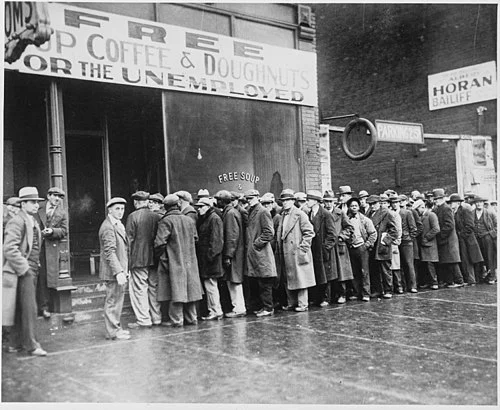
Unemployed men outside a soup kitchen opened in 1931 by mobster Al Capone in Depression-era Chicago.
SOMERVILLE, Mass.
The biggest problem facing the United States today is the inevitability of the business cycle. The unemployment rate in April reached its lowest rate in 17 years -- 3.9 percent. “Wages not keeping pace,” warned The New York Times. The “historically long jobs expansion… shows little evidence of slowing,” said The Wall Street Journal.
Alarm bells may not be ringing. The 2017 tax-cut stimulus is still working its way into the system. But with the jobless rate at 3.9 percent, wage growth will accelerate. Bottlenecks will form. Interest expenses will grow. Inflation rates will increase.
Sometime in the next two years or so, some combination of factors will force the Federal Reserve Board’s hand. Interest rates will rise more sharply than expected. A recession will begin, with all the usual adverse consequences for federal and state budgets. Then, as Warren Buffett, the Berkshire Hathaway CEO, likes to say, as the tide goes out, we will discover who's been swimming naked – politically, that is, not financially.
Donald Trump is not a factor here. One can’t be certain, but, after the stupendous difficulties of his years in the White House, it seems unlikely that he will choose to run for a second term in 2020. (This view is not yet widely shared.)
Nor are the 2018 midterm elections the issue. The economy won’t turn down before the autumn. Whatever happens to the leadership of Congress, if the Democrats are smart, there will be no surge to impeach the president. The institutions in place likely are sufficient to restrain Trump’s power and bring matters to their natural conclusion.
But at a certain point, before or perhaps just after the next presidential election, the economy will turn down. Then the failures of the last 20 years to come to terms with the imbalance of the federal budget will be sorely tested. Tax receipts will fall, expenditures increase; the budget deficit will swell. Even a mild contraction, such as that of March-December 2001, will test the stresses under which the U.S. has been operating for years.
Over four-fifths of the growth in nominal government spending over the next decade will be driven by Social Security, federal health programs and interest on the debt, according to the Congressional Budget Office. Revenue will fail to keep pace with growing spending, resulting in a deficit that will double in the next 10 years from the anticipated $800 billion at the end of fiscal 2018, according to the CBO’s most recent forecast.
Pessimism is rife. New York Times columnist David Brooks wrote recently that Republicans have become “an aging minority party” while moderate Democrats are “no longer a force.” There are “only two vibrant political tendencies in America right now,” wrote Brooks: “Trump-style populism and Bernie-Sanders/Elizabeth Warren-style progressivism.”
The leaders who exhibit these tendencies will turn out to have been the naked swimmers after the next recession. I have no idea what course the presidential election will look like, but I expect the more consensus-oriented politician will be the winner.
The current crisis of U.S. politics may turn out to resemble the angry mood of the late 1970s, when the tide finally turned against the New Deal consensus that had governed the country pretty much without interruption since 1932. That was nearly 40 years ago – about the length of time that such zig-zag reversals have taken historically. They have become a global phenomenon by now.
When things turn tough in the next recession, a center should form, much as it did in the early 1980s. Commissions will be empaneled, legislators will hold secret weekend negotiations, balanced reforms will be undertaken, some combination of benefit cuts and tax increases. Even now balance is still relatively easy to achieve in the case of Social Security. It is much more difficult to accomplish with respect to federal health programs.
Solvency is the biggest problem facing the United States today. And yet solvency is not just possible, it is likely, given the history of the last 75 years. The growth of interest on government debt will impose its own form of discipline. The alternative, the United States as Argentina or Venezuela, seems too remote for anything but column-fodder.
David Warsh, an economic historian and long-time columnist, is proprietor of economicprincipals.com, where this first ran.
New England's lilacs

"Lilacs, False Blue, White, Purple,
Colour of lilac,
Your great puffs of flowers
Are everywhere in this my New England ...
Lilacs in dooryards
Holding quiet conversation with an early moon;
Lilacs watching a deserted house; ...
Lilacs, wind-beaten, staggering under a lopsided shock of bloom,
You are everywhere.''
-- Amy Lowell
Health-care hurricane

From Robert Whitcomb's "Digital Diary,'' in GoLocal24.com
As insurers, drugstore chains, such as Rhode Island-based CVS, with its Minute Clinics, and the likes of Walmart team up to provide direct health care, independent physician groups face growing pressure. Many doctors have decided to throw in the towel and become hospital employees. Meanwhile, many physician groups (including the one I use) are extending their hours and making other changes to be more convenient for harried patients in order to better compete with the retail clinics.
The clinics are a response to America’s astronomically expensive, fragmented and inefficient health-care system. They offer a range of services for injuries and illnesses that can often be treated by a nurse, nurse practitioner or physician’s assistant at a cost considerably less than a physician would charge and much, much less than a hospital emergency room.
But will your local Minute Clinic get to know you, especially if you have a chronic illness, as well as your primary-care doctor, so as to be in a position to adjust your care over time? And what sort of relationships will develop between local physicians and retail clinics, considering that they’ll often be competitors? The retail health-care revolution is just getting going. The old model of American health care is falling apart; it’s economically unsustainable.
Stay as long as you want

"Empty'' (photo), by Rebecca Skinner, in the "Transient'' show at Fountain Street Gallery, Boston, through May 27.
Don Pesci: Transactional journalism and fake news

Frontispiece of Voltaire's Candide
Newspapers should have no friends
-- Joseph Pulitzer
Sometime in the past few years, nearly everyone in Connecticut, with the possible exception of the state’s ebullient left-leaning writers, became a cynic. And cynicism has increased in direct proportion to the inability or unwillingness of status quo progressives in the General Assembly to confront the state’s most pressing economic problems. “We've been sitting through the last days of the legislative session doing everything BUT paying attention to the state's economy and fiscal situation,” state Rep. Gail Lavielle notes on Facebook. Procrastination is the typical response of a do-nothing politician to a serious problem.
Given the state of the state – perilous – the unheeding joyful crowd may remind some people of Voltaire’s mercilessly flayed Candide, the eternal optimist who, despite rough treatment at the hands of an unforgiving world, continues to insist that, in spite of his manifold humiliations, this is still “the best of all possible worlds.”
Voltaire knew whereof he spoke. Hounded from country to country by his targets who sought to shove him into prison for the unpardonable crime of discomforting the comfortable, Voltaire had taken the measure of life’s cruelties and absurdities. To protect himself from lawyers waving defamation suits, the attorneys general of the day, he threw his cynicism into fiction that spared him prison time and disarmed the menacing optimists; had Voltaire been caught in their jaws, he would have suffered a fate not unlike that of Candide.
At almost exactly the same time in England, Alexander Pope, a hunch-backed Catholic, was creating a similar havoc among brethren belle lettrists. The art of journalism was still in swaddling clothes. Under Pope’s hand it grew up, very quickly. Pope threw his satires into poetry. His "Dunciad'' was a poetic torture chamber for those with whom he did polemical battle.
After much huffing and puffing, the two gave birth to modern journalism, the animating spirit of which is perfectly suggested by Pope’s boast:
"Am I not proud? Yes. Why should I not be,
When even men who do not fear God -- fear me?''
Moderns may be surprised to hear that it is only a hop, skip and jump from Voltaire and Pope to Joseph Pulitzer, after whom the much coveted Pulitzer Prize is named. Pulitzer’s vision of a press independent of political influence, one that lives or dies fiercely guarding its prerogatives, is at opposite ends from what Sharyl Attkisson has called, disdainfully, transactional journalism, which is at least as great a danger to journalism as fake news.
Pulitzer advised that good reporters should have no friends, and there were in the golden age of journalism reporters willing to confront, at great personal and professional costs, the considerable powers arrayed against them. Attkisson, who bailed out of CBS News two decades ago because she felt she would no longer be able to pursue stories inconvenient to the political friends of major news outlets, talks very sensibly about fake news.
There are two kinds of fake news. There is fake fake news and real fake news. Many politicians who find themselves on the receiving end of proper denunciation will denounce as “fake” news that is objectively true, although even objectively true news may be slanted. Real fake news cannot be true, but true news can be faked. And that is the boat that brings Attkisson to the shore of transactional journalism.
The transaction in transactional journalism is a business arrangement agreed to informally among politicians and friendly journalists, an arrangement possibly more damaging to good journalism than fake news because it cannot be as easily detected. Or rather, it can be detected and verified only by reporters in the field who have succumbed to the allure of powerful politicians, or by editors, publishers and owners of media outlets that have developed over the years a mutually supportive business relationship with politicians and their own valued sources upon which the prosperity of the media outlet in some sense depends. News depends upon sources and access; sources, whose primary loyalty is to the reigning powers, can dry up. Access can be denied.
There has been during the Malloy administration a great deal of objectively true evidence that Connecticut has entered an economic death spiral. The abandoning of the ship of state by those most responsible for Connecticut’s present economic condition – perilous – certainly suggests a flight from the past. The race for governor on the Democrat side has so far involved the party’s junior varsity politicians. Ned Lamont, said to be the leading Democrat gubernatorial contender, is no Ella Grasso or Abe Ribicoff. Indeed, Lamont is no Sen. Dick Blumenthal or Sen. Chris Murphy, both of whom appear to be content to remain in Washington, D.C. where they spend their days seeking to sink President Trump’s boat, at a time when the Democrat ship of state in Connecticut is sending up bubbles.
The cry of alarm coming from editorial boardrooms across the state is hardly ear-piercing. Where is the media hullabaloo? A thoroughgoing cynic may be forgiven for putting down the guarded optimism of political commentators in the state to Attkisson's transactional journalism.
Don Pesci is a Vernon, Conn.-based columnist.
'In an intenser calm'
"But not on a shell, she starts,
Archaic, for the sea.
But on the first-found weed
She scuds the glitters,
Noiselessly, like one more wave.
She too is discontent
And would have purple stuff upon her arms,
Tired of the salty harbors,
Eager for the brine and bellowing
Of the high interiors of the sea.
The wind speeds her on,
Blowing upon her hands
And watery back.
She touches the clouds, where she goes,
In the circle of her traverse of the sea.
Yet this is meagre play
In the scrurry and water-shine,
As her heels foam—
Not as when the goldener nude
Of a later day
Will go, like the center of sea-green pomp,
In an intenser calm,
Scullion of fate,
Across the spick torrent, ceaselessly,
Upon her irretrievable way.''
-- "Spring Voyage,'' by Wallace Stevens
Llewellyn King: Time to go back to basics at the White House Correspondents Dinner
The White House Correspondents’ Association dinner got just too celebrity ridden for its own good, as outfits who don’t know where the White House briefing room is lobbied for more and more tables.
It used to be an annual drunk for journalists to visit each other and see and be seen. It was a chance for the Fourth Estate men to wear tuxedos and women to wear evening gowns and to hit the parties in the hotel suites before and after the dinner — the tickets, it is hoped, paid for by the employers.
Then came Vanity Fair, People and Bloomberg and the annual excuse for excess for those engaged in journalism became the Oscars East and another excuse for excess by the excessive from the West Coast.
Journalists, who used to invite spouses and politicians they wanted to cultivate, were relegated to the D List as the aforementioned outfits and the networks demanded tickets for the Hollywood grandees. For years, as a member of the association, I was offered two tables and took one. But the celebrity cramming reduced my allocation to just two tickets; no chance to impress my potential sources or sponsors for my television program.
Along with celebrities from ZIP Code 20190 came small-time news executives, who leaned on their Washington correspondent for tickets for the publisher and spouse.
Ambassadors and lobbyists begged journalists for tickets. I was even offered money. More commonly, lobbyists would offer to pay for the poor scribbler’s ticket as well as their own. They were glad to let it be known that they’d pay for a table, if they could just get in themselves.
Many excluded hacks were soon showing up at the hotel in dinner dress to see and be seen in the hotel bar and in the corridors. Some hospitality tents on the lawn could be penetrated without a ticket: You could get a free drink and go home to watch the rest on TV. You saw your friends, you were seen, and you saved face along with money. Gradually, the hotel — the spacious if unexceptional Washington Hilton — increased security and pretending to be on the inside got harder.
A former Washington gossip columnist, Patrick Gavin, devoted much of a year to a documentary on the spring perennial, complete with interviews seeking to mine its social significance. It was craziness that had become fashionable, like the running of the bulls in Pamplona.
But the Gatsby-like madness couldn’t go on. The New York Times, always the first to take itself seriously, pulled out in 2011. Then, in 2013, the everyday corruption of Washington (the cozy press relations with politicians and lobbyists) was laid bare in “This Town: Two Parties and a Funeral — Plus, Plenty of Valet Parking — in America’s Gilded Capital.” The author, Timesman Mark Leibovich, fingered the White House correspondents’ dinner as a celebration of all that stank in Washington.
The respectability of the dinner was teetering before President Donald Trump launched his boycott. But there’s a back story. In 2011, President Barack Obama and “Saturday Night Live” comedian Seth Meyers ridiculed Trump for leading the “birther” movement and hosting a reality TV show. Some say that drubbing led Trump to run for president.
Picking a comedian for the dinner has always been dicey, and the association aims for diversity. He or she must be a political humorist and understand that the audience contains people who’ve been drinking and want to get back to it. Any dinner speaker knows a room full of drunks is tough.
This gig is made even more difficult by the presence of the president as patron and target. He should be roasted but left underdone, enjoying his time on the spit — as did Presidents Obama and George W. Bush, who also poked fun at themselves brilliantly.
Drew Carey, who was the comedian at the 2002 dinner, told me it was the most difficult room he had ever worked. Michelle Wolf turned the tables on April 28; she, with her vulgarity and rudeness, was the hardest comedian for the room to swallow.
Mercifully, it may go back to an orgy of journo camaraderie, fun and, yes, liquor — copious quantities of bipartisan spirit
On Twitter: @llewellynking2
Llewellyn King is executive producer and host of White House Chronicle, on PBS.