
Vox clamantis in deserto






'Seafarers' show in Newport

Atelier Newport will host a collaborative exhibition featuring works from The Donald Tofias Collection to run May 5-May 25, during the Volvo Ocean Race, with Newport being the only stopover in the United States.
The gallery says that the show, entitled "Seafarers,' will highlight Newport as the Sailing Capital of the World. It will feature the works by John Mecray and Michael Keane, along with contemporary nautical works by Heinke Bohnert, Antonia Ty Peeples, Jennifer Day and Sunny B. Wood, in addition to other artists. "The exhibition will celebrate the rich history of Newport through the painters' eyes, while moving to present contemporary work. Newport is steeped in marine work and 'Seafarers' presents an homage for two well-known marine painters of the 20th Century.''
Chris Powell: The 'victimhood' racket failed this time in Conn.

Announcing a few weeks ago his nomination of Connecticut state Supreme Court Justice Andrew J. McDonald for chief justice, Gov. Dannel Malloy celebrated the nominee's sexual orientation as if it was the highest qualification for the job. This suggestion was echoed by fellow Democrats in the General Assembly.
To hear them tell it now, McDonald's sexual orientation killed his nomination in the state Senate and almost killed it in the state House.
But if the governor and his allies really thought that prejudice against homosexuals was so pervasive in Connecticut, they would not have made such a big deal of McDonald's sexual orientation at the outset.
They did it in part to move discussion of the nomination away from the policy issues it raised: McDonald's record as a legislator, gubernatorial aide, and judge, and particularly his participation in the Supreme Court's ruling that capital punishment is unconstitutional.
But the governor and his allies also emphasized McDonald's sexual orientation because their party, the perpetrator of identity politics, knows that these days there is great political power in victimhood. They knew that the more they emphasized McDonald's sexual orientation, the more they could intimidate people out of criticism.
With Democrats today, anyone disputing a person of color or member of an ethnic minority risks being called a racist, anyone disputing a woman risks being called a misogynist, and anyone disputing someone in a same-sex relationship risks being called a "homophobe."
Of course "homophobia" was disproved by the bipartisan endorsement that McDonald received from the legislature five years ago when, his sexual orientation fully known, he was nominated as associate justice. What happened since then is no mystery. He developed a record on the court, Malloy's prestige collapsed, and his promotion of McDonald was seen as extreme cronyism.
McDonald's supporters were reluctant to debate his record. Their most relevant rejoinder was only that court decisions should not be questioned by the Great Unwashed, as if judges themselves don't question and reverse each other and as if McDonald's own supporters don't advocate reversing recent decisions of the U.S. Supreme Court.
The victimhood racket failed with McDonald, if partly for the wrong reasons -- a Democratic senator's personal conflict with him and another Democratic senator's weariness of the governor's political correctness and arrogance. But the governor is doubling down, making the bigotry charge against even the Democratic legislators who opposed McDonald, not just the Republicans. The governor says he would not vote for any legislator who voted against McDonald.
So maybe while frothing the governor will add that those Democratic legislators should be expelled from the party and driven into the Republican caucuses. While that would flip both chambers to Republican majorities, the governor would have cleansed his party of "homophobes."
The governor and Democratic legislators are expressing sympathy for McDonald on account of his supposed mistreatment. McDonald himself issued a maudlin statement emphasizing his sexual orientation. He said he didn't know what the future holds for him.
But for starters he retains his judgeship, his salary of $186,000, and great benefits, and after many years of employment in the legislature, governor's office, and judiciary, having risen to the top of Connecticut politics despite the supposed burden of his sexual orientation, he will be due a fat pension and gold-plated medical insurance for life. Oh, the oppression.
Chris Powell is a columnist for the Journal Inquirer, based in Manchester, Conn.
'Only you are gone'

Brook in the early spring in Southbury. Conn.
"April this year, not otherwise
Than April of a year ago,
Is full of whispers, full of sighs,
Of dazzling mud and dingy snow;
Hepaticas that pleased you so
Are here again, and butterflies.
There rings a hammering all day,
And shingles lie about the doors;
In orchards near and far away
The grey wood-pecker taps and bores;
The men are merry at their chores,
And children earnest at their play.
The larger streams run still and deep,
Noisy and swift the small brooks run
Among the mullein stalks the sheep
Go up the hillside in the sun,
Pensively —only you are gone,
You that alone I cared to keep.''
-- Song of a Second April, by Edna St. Vincent Millay (1892-1950). She grew up in several towns on the Maine Coast before heading to New York, where she became famous.
Trying to green out

"Above" *(oil on linen), by Lully Schwartz, at Alpers Fine Art, Andover, Mass.
Great idea, but don't put it near us

The near-island called Nahant -- very exposed to rising seas.
-- Photo by Svabo
Adapted from Robert Whitcomb's "Digital Diary,'' in GoLocal24.com
There’s an entertainingly ironic not-in-my-backyard battle under way in Nahant, Mass., on the northern side of Boston Harbor. The town, once perhaps best known for summer places of Boston Brahmins, has hosted, apparently without controversy, Northeastern University’s Marine Science Center since 1967.
Nahant, of course, is one of those coastal towns that faces the threat posed by rising sea levels and stronger storms caused by global warming.
But now Northeastern wants to build a 60,000-square-foot addition to the center in order to turn it into an internationally respected coastal sustainability institute. The structure would be built in a way to minimize its visual impact. The Boston Globe reports that two stories and a basement would go into the side and top of a concrete bunker that housed two anti-submarine guns in World War II. To read The Globe’s story, please hit this link:
http://www.bostonglobe.com/metro/2018/03/19/nahant-quiet-seaside-research-center-has-turned-into-bitter-battleground/mKkUCPnoKdriw4T1meezoO/story.html?p1=Article_Recommended_ReadMore_Pos4
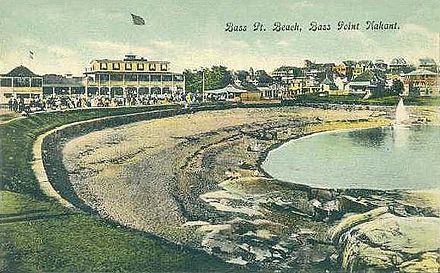
Postcard from around 1910, when Nahant was best known as a summer resort.
Maine as literary material

The Harriet Beecher Stowe House, in Brunswick, Maine. That's where she wrote Uncle Tom's Cabin, in 1850-52.
"In a way, I'm very interested in writing about Maine, because I think Maine represents its own kind of history. It's the oldest state {in average of residents}, and it's the whitest state.''
-- Elizabeth Strout, a novelist and native of Maine, whose culture is the basis of much of her writing. She now divides her time between New York City and Brunswick, Maine, best known as the site of Bowdoin College. Her best known book is Olive Kittredge, set in a small town in The Pine Tree State.
Check out nearby gorgeous Harpswell, on Casco Bay. The town includes a wonderful seafood restaurant called Cook's.

On Lookout Point, Harpswell.
A flower for Holy Week

Bleeding Heart.
“Abruptly it unblossoms
And disappears, though among
The first of the spring –
Tulips worn out with blooming
After only the second year, daffodils
Inexplicably nothing
But a vigor of leaves, a frailty
Of azaleas – among the first of the spring
The short-lived Bleeding Heart
Is certain, I can count on it.’’
-- From “Bleeding Heart,’’ by Mark Doty, a distinguished poet and former resident of Provincetown who now lives on Long Island.
Tackling despair in the Mass. addiction community

Mady Ohlman, who has now been sober for more than four years, says many drug users hit a point when the disease and the pursuit of illegal drugs crushes the will to live.
-- Photo by Jesse Costa/WBUR)
By MARTHA BEBINGER
For WBUR and Kaiser Health News
Mady Ohlma, of Massachusetts, was 22 on the evening some years ago when she stood in a friend’s bathroom looking down at the sink.
“I had set up a bunch of needles filled with heroin because I wanted to just do them back-to-back-to-back,” Ohlman recalled. She doesn’t remember how many she injected before collapsing, or how long she lay drugged-out on the floor.
“But I remember being pissed because I could still get up, you know?”
She wanted to be dead, she said, glancing down, a wisp of straight brown hair slipping from behind an ear across her thin face.
At that point, said Ohlman, she’d been addicted to opioids — controlled by the drugs — for more than three years.
“And doing all these things you don’t want to do that are horrible — you know, selling my body, stealing from my mom, sleeping in my car,” Ohlman said. “How could I not be suicidal?”
For this young woman, whose weight had dropped to about 90 pounds, who was shooting heroin just to avoid feeling violently ill, suicide seemed a painless way out.
“You realize getting clean would be a lot of work,” Ohlman said, her voice rising. “And you realize dying would be a lot less painful. You also feel like you’ll be doing everyone else a favor if you die.”
Ohlman, who has now been sober for more than four years, said many drug users hit the same point, when the disease and the pursuit of illegal drugs crushes their will to live. Ohlman is among at least 40 percent of active drug users who wrestle with depression, anxiety or another mental health issue that increases the risk of suicide.
Measuring Suicide Among Patients Addicted To Opioids
Massachusetts, where Ohlman lives, began formally recognizing in May 2017 that some opioid overdose deaths are suicides. The state confirmed only about 2 percent of all overdose deaths as suicides, but Dr. Monica Bharel, head of the Massachusetts Department of Public Health, said it’s difficult to determine a person’s true intent.
“For one thing, medical examiners use different criteria for whether suicide was involved or not,” Bharel said, and the “tremendous amount of stigma surrounding both overdose deaths and suicide sometimes makes it extremely challenging to piece everything together and figure out unintentional and intentional.”
Research on drug addiction and suicide suggests much higher numbers.
“[Based on the literature that’s available], it looks like it’s anywhere between 25 and 45 percent of deaths by overdose that may be actual suicides,” said Dr. Maria Oquendo, immediate past president of the American Psychiatric Association.
Oquendo pointed to one study of overdoses from prescription opioids that found nearly 54 percent were unintentional. The rest were either suicide attempts or undetermined.
Several large studies show an increased risk of suicide among drug users addicted to opioids, especially women. In a study of about 5 million veterans, women were eight times as likely as others to be at risk for suicide, while men faced a twofold risk.
The opioid epidemic is occurring at the same time suicides have hit a 30-year high, but Oquendo said few doctors look for a connection.
“They are not monitoring it,” said Oquendo, who chairs the department of psychiatry at the University of Pennsylvania. “They are probably not assessing it in the kinds of depths they would need to prevent some of the deaths.”
That’s starting to change. A few hospitals in Boston, for example, aim to ask every patient admitted about substance use, as well as about whether they’ve considered hurting themselves.
“No one has answered the chicken and egg [problem],” said Dr. Kiame Mahaniah, a family physician who runs the Lynn Community Health Center, in Lynn, Mass. Is it that patients “have mental health issues that lead to addiction, or did a life of addiction then trigger mental health problems?”
With so little data to go on, “it’s so important to provide treatment that covers all those bases,” Mahaniah said.
‘Deaths Of Despair’
When doctors do look deeper into the reasons patients addicted to opioids become suicidal, some economists predict they’ll find deep reservoirs of depression and pain.
In a seminal paper published in 2015, Princeton economists Angus Deaton and Anne Case tracked falling marriage rates, the loss of stable middle-class jobs and rising rates of self-reported pain. The authors say opioid overdoses, suicides and diseases related to alcoholism are all often “deaths of despair.”
“We think of opioids as something that’s thrown petrol on the flames and made things infinitely worse,” Deaton said, “but the underlying deep malaise would be there even without the opioids.”
Many economists agree on remedies for that deep malaise. Harvard economics Prof. David Cutler said solutions include a good education, a steady job that pays a decent wage, secure housing, food and health care.
“And also thinking about a sense of purpose in life,” Cutler said. “That is, even if one is doing well financially, is there a sense that one is contributing in a meaningful way?”
Tackling Despair In The Addiction Community
“I know firsthand the sense of hopelessness that people can feel in the throes of addiction,” said Michael Botticelli, executive director of the Grayken Center for Addiction at Boston Medical Center; he is in recovery for an addiction to alcohol.
Botticelli said recovery programs must help patients come out of isolation and create or recreate bonds with family and friends.
“The vast majority of people I know who are in recovery often talk about this profound sense of re-establishing — and sometimes establishing for the first time — a connection to a much larger community,” Botticelli said.
Ohlman said she isn’t sure why her attempted suicide, with multiple injections of heroin, didn’t work.
“I just got really lucky,” Ohlman said. “I don’t know how.”
A big part of her recovery strategy involves building a supportive community, she said.
“Meetings; 12-step; sponsorship and networking; being involved with people doing what I’m doing,” said Ohlman, ticking through a list of her priorities.
There’s a fatal overdose at least once a week within her Cape Cod community, she said. Some are accidental, others not. Ohlman said she’s convinced that telling her story, of losing and then finding hope, will help bring those numbers down.
The National Suicide Prevention Lifeline is 800-273-8255.
This story is part of a partnership that includes WBUR, NPR and Kaiser Health News.
Out of season, but....

Work by Christopher Frost, in his show "Winter,'' at Boston Sculptors Gallery April 4-May 6.
The gallery says: Chris Frost's new body of sculptural works consist of artworks observing perceptions of our natural environment. "The artist is interested in exploring a discrepancy between the groomed environment we encounter through media and commerce contrasted with the reality of our delicate and easily fractured physical spaces. These large floor and wall sculptures incorporate a variety of materials; painted fabric, resin, foam, wood and steel. Each of the artworks is anchored by natural forms (tree, boulder, stump) and is fabricated from white glazed ceramic.The white ceramic appears as a ghostly and fragile construct: an authentic environment. Winter reflects a passage of time, hibernation and dormancy, and even peril.''
Is the Granite State dangerously boring for potential drug abusers?

Boring? Lake Lake Winnipesauke and the Ossipee Mountains, in central New Hampshire.
From Robert Whitcomb's "Digital Diary,'' in GoLocal24.com
President Trump said in a New Hampshire speech that he wants drug dealers to get the death penalty. But in fact, laws already allow the death penalty for these people in certain circumstances. Far more effective in our “War on Drugs’’ redux would be, for example, going after physicians who over-prescribe opiates and punishing such despicable drug companies as Purdue Pharma, controlled by the social-climbing Sackler family, that obscured the perils of such prescription opiates as OxyContin. And Trump could take strong action to persuade Chinese dictator Xi Jinping to stop Chinese labs from mailing the hyper-dangerous synthetic opiate fentanyl to America.
Obviously much more treatment is needed, too. Trump was in New Hampshire in part because the Granite State has long had among the highest rates of drug use in the country. It also, according to a study done at Dartmouth, “has the lowest -per-capita spending for drug treatment in New England and the second-lowest in the nation.’’
Drug-abuse experts also cite the flip side of the Granite State's attractive rural and exurban qualities in the state's drug problems: Too many people are bored and feel that there are too few interesting things to do in the state, much of which is woodlands.
Would Trump’s wall on our Mexican border help? Maybe a little, but not much. Drugs, like money, are very fungible, and dispirited, anxious Americans have an insatiable thirst for them.
John O. Harney: The changing public perceptions of higher education
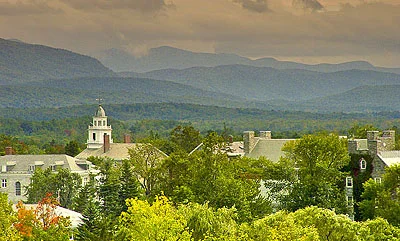
View of Middlebury College, in the quintessential college town of Middlebury, Vt., with the Green Mountains in the background.
Via the New England Board of Higher Education (nebhe.org)
American confidence in higher education began waning at just the time that more people began to see colleges as more concerned about their bottom lines than about education and making sure students have a good education experience, Public Agenda President Will Friedman told educators gathered in Boston on Monday at a NEBHE panel discussion on “The Changing Public Perceptions of the Value of Higher Education: Is It a Public Good?”
The discussion was moderated by Kirk Carapezza, managing editor at WGBH, a NEBHE partner. N.H state Rep. Terry Wolf, a NEBHE delegate, offered one state’s response.
The benefits of going to college and the importance of higher education institutions were once held to be a creed as American as apple pie. But recurring state budget challenges have constrained investment. Consistently rising tuitions—fueled by increasing college costs—have alarmed many. Politics and free-speech controversies have raised questions about college and universities’ openness and balance of perspectives. In short, times have changed.
Questions swirl:
How are public opinions toward higher education changing?
Why are higher education’s value propositions suspect in the eyes of some policymakers and citizens?
Does this division mirror party lines?
Has higher education been fairly—or falsely—tarred as inefficient?
Has the higher ed enterprise overcompensated for these perceptions by obsessing with business models and efficiency?
What has this apparent shift meant to egalitarian higher education concepts such as need-blind admissions, sabbaticals (ideally to pursue deep thinking), basic vs. applied research, and tenure (especially to protect academic freedom)?
What has it meant for the role of expert faculty informing civic policy outside academe and enriching discourse as “public scholars”?
What about the role of so-called “college towns” sustaining bookstores, theaters, cafes and other businesses favored by college students, budding entrepreneurs, faculty and visitors?
NEBHE was an “early adopter” of the higher education-economic development connection. What role can NEBHE play in balancing New England’s interest in advancing knowledge … and growing its knowledge economy?
Friedman said it wouldn’t be a tremendous shock if prospective students were beginning to question the value of higher ed. Every major institution except the military and libraries have lost major credibility, he said.
Most people still believe higher education is the key to the American dream. And indeed, a surfeit of data continues to show that the more higher education one has, the higher their salary. (Notably, Tom Mortenson, the longtime publisher of Postsecondary Education Opportunity, has also compiled trend data showing states with better-educated populations show better measures of economic, civic, physical and social health, ranging from higher citizen voting rates to lower infant mortality rates.)
But after years of going up, the percentage of people saying higher ed is necessary to success has begun to go down. One reason is student debt. Another is the decline in stable middle-class jobs.
Plus, there’s a partisan dynamic. Pew research shows that among Republicans specifically, the question of whether higher ed has a positive effect in the country fell off the cliff in 2015. In a 2017 survey from Civis Analytics, 46% of Republicans said they were concerned that colleges were pushing people toward a specific political view, compared with 5% of Democrats.
Carapezza recalled that when his WGBH crew visited schools in Germany, they learned that student debt was viewed there as shame (one audience member whispered that it's also seen that way in U.S. minority neighborhoods). Higher ed in Germany, Carapezza said, is seen as a public good, whereas here it is seen as a private gain.
Wolf conceded that some legislators would be happy to totally defund higher education. And negative perceptions spread quickly via social media. She urged leaders to change the way they talk about higher education. If you have a bachelor’s degree it means you can make a million dollars more over your career than someone with a high school diploma only. So why doesn’t an ad campaign promote the chance to make a million dollars?
Plus, a legislator, Wolf said she has to take care of senior citizens and tackle the opioid epidemic before helping college students who, she noted, could be aided less expensively though dual enrollment with high schools.
Some audience members lamented that we were educating too many social workers vs. carpenters (because you can see what they do)—somewhat reminiscent of a campaigning Marco Rubio’s concerns that we need more welders and fewer philosophers.
Of course, we need both.
John O. Harney is executive editor of The New England Journal of Higher Education, part of NEBHE.
Saudi crown prince visits Cambridge in search of investors
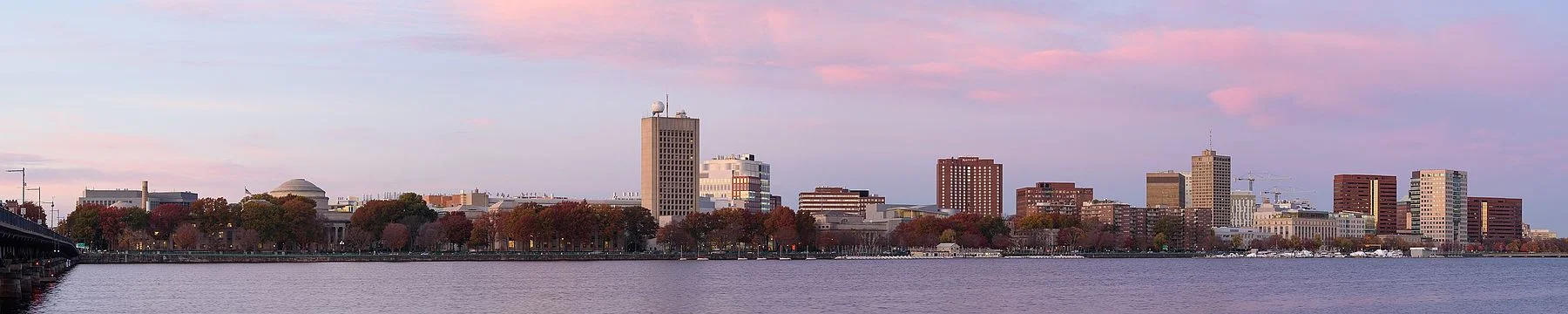
The Cambridge skyline from across the Charles River.
From the New England Council (newenglandcouncil.com)
"Saudi Arabian Crown Prince Mohammed bin Salman visited Harvard University, MIT, and IBM during a recent visit to Cambridge. The goal of the prince’s visit was to nurture ties between the private sector and academia between the two nations as well as to seek investors to support his economic and social reforms, changes aimed at reducing Saudi Arabia’s reliance on oil.
At Harvard, the prince participated in two private roundtable conversations. The first roundtable was with Harvard professors who focus on Saudi Arabia and the other with professors whose areas of study are pertinent to the reforms the prince outlined in his Saudi Vision 2030 document. The second meeting included presidents of local universities and colleges who discussed higher education and technology-related education. The prince also attended a MIT forum focused on science and technology, and visited IBM’s Cambridge facility to learn more about artificial intelligence.
“He’s very interested in the connection between research, entrepreneurship and innovation and how they fit together to fuel the economy,” said Harvard Vice Provost of International Affairs Mark C. Elliott. The prince is impressed by what he saw at Harvard and shares the concerns of some speakers about the need to prepare young people for jobs that do not yet exist. After the prince’s visits, Saudi officials announced new partnerships with MIT and Harvard with a focus on sustainable energy, fellowships for women, and research.''

Sergio Avila: Border wall on U.S.-Mexican border would imperil wildlife

Jaguar in Arizona.
Via OtherWords.org
Some Americans think of the U.S.-Mexico border as a wasteland. In fact, the mountains and deserts of our borderlands are teeming with wildlife.
Here you’ll find large cats such as the jaguar, the subject of my research.
Jaguar sightings have been reported in New Mexico and Arizona for over a century, even as far north as the Grand Canyon. Their presence is a stamp of approval — they mean healthy habitats, prey populations and the connection of critical wildlife corridors across the border.
Humans, after all, aren’t the only animals that cross the border. And they aren’t the only ones whose lives will be disrupted if a Trump administration border wall slices through cross-border wildlife corridors like Big Bend National Park in Texas and Organ Pipe Cactus National Monument in Arizona.
Unfortunately, a federal court recently approved waivers for dozens of environmental and health safeguards in these border regions — all so that wall can go up.
That means the border communities who oppose this wall and fear its destruction of the surrounding lands will have to swallow a wall with no public process. It means there will be no comment period, no baseline research on impact, and a lack of monitoring throughout the building process.
A wildlife preserve in Socorro County, New Mexico (Photo: Michael Littlejohn / Flickr)
And the worst part is, there will be no way to hold the government accountable.
It started when Congress passed the Real ID Act. Though it was billed as an immigration security measure, it gave the government the power to waive the National Environmental Policy Act, the Endangered Species Act, the Clean Water Act, the Wilderness Act, and even the Native American Graves Protection and Repatriation Act, among others.
Since then, miles of border infrastructure have been built along the California, Arizona, and Texas border despite a majority of people in those states opposing the wall. So far, the Trump administration alone has waived 37 laws in San Diego, 28 in Calexico, California, and 23 in Santa Teresa, New Mexico.
Protected areas on both sides of the border are the stepping stones for jaguars to move through and reach new territories. Without legal protection, the wall will destroy their habitat — forever risking their future in the region.
Human communities are at risk, too.
This waiver power resulted in extreme flooding that led to at least two deaths in Nogales, Arizona. According to Harvard researchers, the blockage of underground drainage and natural water routes through Arizona’s border created an effect like a burst dam after strong summer storms.
Other waivers threaten to pollute air and watersheds for hundreds of miles into the borderlands.
This is more than a red flag. It’s a human rights issue.
The Government Accountability Office has failed to provide any conclusions about the benefits of this mission to “protect” the border at all costs. But those of us who actually live in the borderlands have to live with its consequences.
It means the dangers of contaminated water sources, the destruction of our lands, the deaths of our brothers and sisters, and the evisceration of treasured local species like the jaguar.
We — and our public lands in Arizona, California, New Mexico and Texas — are the ones paying the highest price for this unchecked and unnecessary power.
Sergio Avila is an outdoors coordinator for the Sierra Club in the Southwest region. He’s studied the impacts of border infrastructure for over 14 years.

Don Pesci: Most Republicans are RINOS

With apologies to Shakespeare: “Spending’s the thing, wherein we’ll catch the conscience of the King.”
There is in Connecticut no truer Trumpian liege lord than Joe Visconti, a gubernatorial candidate who described himself in one of his campaign documents as “Trump without the millions.”
When Trumpians refer disdainfully to “the DC Swamp,” they have in mind the kind of uncontrolled spending that, during the Obama administration, doubled President George Bush’s $10 trillion deficit. The current deficit now has been boosted by the U.S. Congress, and it was Trump who signed – very reluctantly, to be sure – the “drain the swamp’s” death warrant.
After Trump had signed the budget, Visconti advised: “Still love & support Trump but MAGA [Make America Great Again] is dead. You can’t give huge tax breaks and then give away a trillion $$ in spending in the same year and not expect a $22 Trillion deficit. Build the wall is dead. Lock her [Hillary Clinton] up is dead. Nothing but empty slogans now. As for Republicans? Most are Democrats, always have been. The bill should never have been assembled by Ryan the RINO [Republican In Name Only] but it was. Nothing but betrayal. Here’s how it rolls out in 18, we lose the House because Trump supporters aren’t blind and won’t come out for RINOs, Trump isn’t on the ballot. Pelosi takes over and starts impeachment proceedings day 1.”
Laura Ingraham lamented that the omnibus bill was a huge boondoggle designed to fool most of the people most of the time. Connecticut has its own version of the national omnibus bill, a catch-all bill at the end of the legislative season that few exhausted legislators manage to read. Such massive bills are pokes designed to hide crony swamp dweller's legislation.
The national poke more than adequately finances a military that former President Obama seriously under-financed. It might be recalled that Trump, entering office and during his rambunctious campaign, presented himself as a Pat Buchanan anti-interventionist, after which he surrounded himself with generals. The world is a messy place for anti-interventionist presidents. The budget does not adequately finance the border wall upon which Trump campaigned, but Planned Parenthood, against which Trump campaigned, receives its pound of budget flesh.
Earlier in January, Senator from Planned Parenthood Dick Blumenthal and other extremist socially progressive Democrats beat back a bill that would have imposed a mild and painless restriction on those seeking abortions, the “Pain-Capable Unborn Child Protection Act.” The bill did not interfere with a woman’s right to procure an abortion; it simply restricted abortions to 20 weeks of a pregnancy, a period of time after which, science tells us, the fetus can feel pain. The bill also provided that women who defied the bill could not be prosecuted under the law, while those providing the abortion would be penalized.
Pro-abortion senators such as Blumenthal waved their old campaign placards against the bill. “It is shameful and disgraceful,” Blumenthal fumed, “that this measure should be before Congress. Hands off women’s health care.” The reader will note a tactical change in language: According to Blumenthal, the bill would not interfere with a woman’s “right to choose abortion,” merely hasten the choice. Abortion has little to do with health care and everything to do with abolishing parenthood. The regulation prone Blumenthal later would pronounce “immoral” those who defended a bill that regulated abortion on behalf of unborn children who feel the deadly pain of an abortionist’s knife. As Attorney General of Connecticut, Blumenthal consistently favored the regulation of businesses in his state, and he continues to do so in the Senate, bills affecting Planned Parenthood being a notable and glaring exception to his rule.
No, sorry. It is late-term abortion, the selling of baby parts and the inability of pro-abortionists to make relevant developmental distinctions in the stages of human life from conception to birth that is, by any stretch of the moral imagination, indecently immoral. In their campaigns, cowardly Republicans seem willing to cede the moral high-ground to the immoralists.
The imposition of the Trump tariffs has split Republicans, but Republicans and Trump were marching in tandem on the matter of immigration. That battle has been lost, largely owning to court decisions that have about them the stench of unconstitutionality. Here is Nancy Pelosi crowing her victory in assuring that the nation’s borders remain ungovernable and permeable: “Democrats won explicit language restricting border construction to the same see-through fencing that was already authorized under current law. The [omnibus spending] bill does not allow any increase in deportation officers or detention beds.”
So, the obscenely large spending bill is a win, win for progressive big spenders and a lose, lose for taxpayers. Democrats in Connecticut have offered Republicans the same plank that leads to the same shark-infested waters. Whether they will sleepwalk the plank to their appointed end remains very much an open question.
Don Pesci, a frequent contributor, is a Vernon, Conn.-based columnist.
'Be whole again'

From Robert Whitcomb's "Digital Diary,'' in GoLocal24.com
Amidst all the “crisis chatter’’ (the late novelist Saul Bellow’s phrase) about the news, we’d do well to read Robert Frost’s great haunting late poem “Directive,’’ about a walk in upland New England that turns into a reflection on eons of the natural world, humanity’s experience and, by implication, the poet’s own ordeals and transitory joys. It ends with a quasi-Christian statement. It puts life, especially a long one, into an ambiguous but still vivid perspective.
The poem is too long to run all of here, but here are some fragments:
Back out of all this now too much for us,
Back in a time made simple by the loss
Of detail, burned, dissolved, and broken off
Like graveyard marble sculpture in the weather,
There is a house that is no more a house
Upon a farm that is no more a farm
And in a town that is no more a town.
….
The height of the adventure is the height
Of country where two village cultures faded
Into each other. Both of them are lost.
And if you're lost enough to find yourself
By now, pull in your ladder road behind you
And put a sign up CLOSED to all but me.
…
First there's the children's house of make-believe,
Some shattered dishes underneath a pine,
The playthings in the playhouse of the children.
Weep for what little things could make them glad.
But the end of the poem:
Here are your waters and your watering place.
Drink and be whole again beyond confusion.
'Life between screens'

"Homage 4533" (dye sublimation print on aluminum), by Irene Mamiye, at Lanoue Gallery, Boston.
The gallery says:
"Influenced by her own personal history and artists as diverse as Laszlo Moholy Nagy and Gerhard Richter, Mamiye employs intricate and labor-intensive processes to challenge what is expected of the photographic medium. Culling photographs from social media, Mamiye transforms the plenitude of public images into richly layered works that hint at a life lived between screens. With a playful yet mordant humor, Mamiye creates pieces packed with art historical depth and pop cultural abundance.''
Her work uses photography, video and digital imaging techniques. "With light, color and movement, she blurs distinctions between physical and virtual reality.''
An obsession with the unconscious

The Wadsworth House, in Cambridge, Mass., where George Washington really did sleep in the summer of 1775. This photo was taken in the 1870s. The house is still there, and is used for the office of Harvard's University Marshal, commencement offices and offices of a few professors.
"It is a hoary New England tradition to keep track of where famous people slept instead of something they might have done while conscious.''
Andrew H. Malcolm, in U.S. 1: America's Original Main Street (1991)

This plaque in Hartford suggests that Washington slept around a lot in the Nutmeg State, too.
John O. Harney: Comings & goings in New England academia
Via The New England Board of Higher Education (nebhe.org)
Judy D. Olian, dean and John E. Anderson Chair in Management at the UCLA Anderson School of Management, was named the first woman president of Quinnipiac University, succeeding John L. Lahey.
University of Maine at Farmington President Kathryn A. “Kate” Foster was appointed the next president of The College of New Jersey, beginning July 1.
Mount Holyoke College appointed its first vice president for equity and inclusion and chief diversity officer: Kijua Sanders-McMurtry, who is currently vice president and dean for community diversity at Agnes Scott College in Georgia.
The University of Massachusetts at Dartmouth appointed Smith College Vice President for Alumnae Relations Jennifer Chrisler, formerly executive director of the nonprofit Family Equality Council, to be the university's vice chancellor for advancement.
The New England Aquarium named Vikki Spruill, currently leader of the Council on Foundations, to be the new president and CEO of the aquarium, which hosted 1.4 million visitors last year, but also closed several times recently due to coastal flooding at its Boston waterfront location.
John O. Harney is executive editor of the England Journal of Higher Education, part of the New England Board of Higher Education.
In Boston, long-term health care threatened by plan to end protected status for Haitians
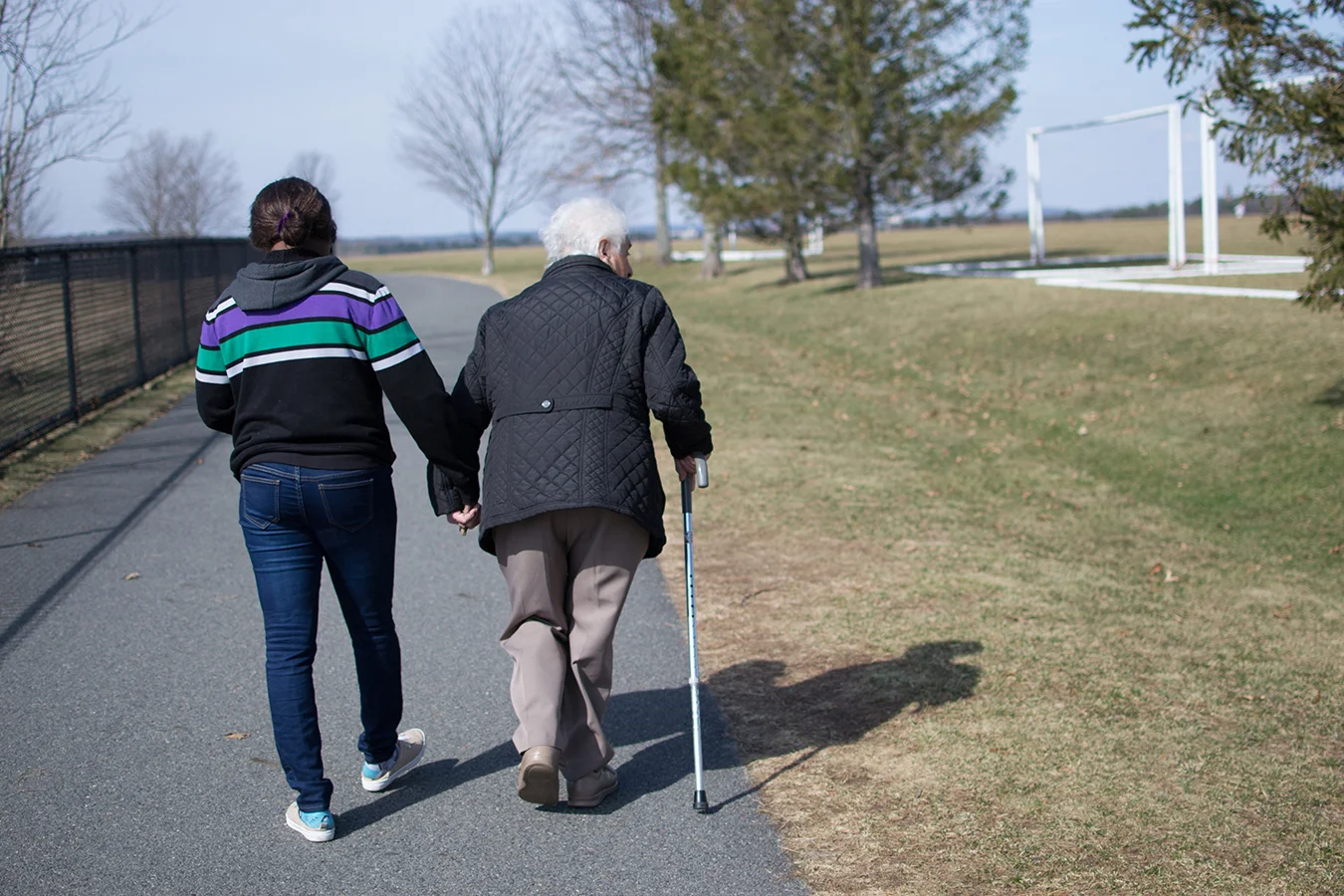
Nirva (left), a Haitian immigrant living in the U.S. under Temporary Protected Status, has helped care for 96-year-old Isolina Dicenso since 2011. Here they are in a windswept Millennium Park in Boston's rather suburb-like West Roxbury neighborhood.
-- Photo by Melissa Bailey for Kaiser Health News
By MELISSA BAILEY
BOSTON
After back-to-back, eight-hour shifts at a chiropractor’s office and a rehab center, Nirva arrived outside an elderly woman’s house just in time to help her up the front steps.
Nirva took the woman’s arm as she hoisted herself up, one step at a time, taking breaks to ease the pain in her hip. At the top, they stopped for a hug.
“Hello, bella,” Nirva said, using the word for “beautiful” in Italian.
“Hi, baby,” replied Isolina Dicenso, the 96-year-old woman she has helped care for for seven years.
The women each bear accents from their homelands: Nirva, who asked that her full name be withheld, fled here from Haiti after the 2010 earthquake. Dicenso moved here from Italy in 1949. Over the years, Nirva, 46, has helped her live independently, giving her showers, changing her clothes, washing her windows, taking her to her favorite parks and discount grocery stores.
Now Dicenso and other people living with disabilities, serious illness and the frailty of old age are bracing to lose caregivers like Nirva due to changes in federal immigration policy.
Nirva is one of about 59,000 Haitians living in the U.S. under Temporary Protected Status (TPS), a humanitarian program that gave them permission to work and live here after the January 2010 earthquake devastated their country. Many work in health care, often in grueling, low-wage jobs as nursing assistants or home health aides.
Now these workers’ days are numbered: The Trump administration decided to end TPS for Haitians, giving them until July 22, 2019, to leave the country or face deportation.
In Boston, the city with the nation’s third-highest Haitian population, the decision has prompted panic from TPS holders and pleas from health-care agencies that rely on their labor. The fallout offers a glimpse into how changes in immigration policy are affecting older Americans in communities around the country, especially in large cities.
Ending TPS for Haitians “will have a devastating impact on the ability of skilled nursing facilities to provide quality care to frail and disabled residents,” warned Tara Gregorio, president of the Massachusetts Senior Care Association, which represents 400 elder care facilities, in a letter published in The Boston Globe. Nursing facilities employ about 4,300 Haitians across the state, she said.
“We are very concerned about the threat of losing these dedicated, hardworking individuals, particularly at a time when we cannot afford to lose workers,” Gregorio said in a recent interview. In Massachusetts, 1 in 7 certified nursing assistant (CNA) positions are vacant, a shortage of 3,000 workers, she said.
Nationwide, 1 million immigrants work in direct care — as CNAs, personal-care attendants or home health aides — according to the Paraprofessional Healthcare Institute, a New York-based organization that studies the workforce. Immigrants make up 1 in 4 workers, said Robert Espinoza, PHI’s vice president of policy. Turnover is high, he said, because the work is difficult and wages are low. The median wage for personal-care attendants and home health aides is $10.66 per hour, and $12.78 per hour for CNAs. Workers often receive little training and leave when they find higher-paying jobs at retail counters or fast-food restaurants, he said.
The country faces a severe shortage in home health aides. With 10,000 baby boomers turning 65 each day, an even more serious shortfall lies ahead, according to Paul Osterman, a professor at Massachusetts Institute of Technology’s Sloan School of Management. He predicts a national shortfall of 151,000 direct-care workers by 2030, a gap that will grow to 355,000 by 2040. That shortage will escalate if immigrant workers lose work permits, or if other industries raise wages and lure away direct care workers, he said.
Nursing homes in Massachusetts are already losing immigrant workers who have left the country in fear, in response to the White House’s public remarksand immigration proposals, Gregorio said. Nationally, thousands of Haitians have fled the U.S. for Canada, some risking their lives trekking across the border through desolate prairies, after learning that TPS would likely end.
Employers are fighting to hold on to their staff: Late last year, 32 Massachusetts health-care providers and advocacy groups wrote to the Department of Homeland Security urging the acting secretary to extend TPS, protecting the state’s 4,724 Haitians with that special status.
“What people don’t seem to understand is that people from other countries really are the backbone of long-term care,” said Sister Jacquelyn McCarthy, CEO of Bethany Health Care Center in Framingham, Mass., which runs a nursing home with 170 patients. She has eight Haitian and Salvadoran workers with TPS, mostly certified nursing assistants. They show up reliably for 4:30 a.m. shifts and never call out sick, she said. Many of them have worked there for over five years. She said she already has six CNA vacancies and can’t afford to lose more.
“There aren’t people to replace them if they should all be deported,” McCarthy said.
Nirva works 70 hours a week taking care of elderly, sick and disabled patients. She started working as a CNA shortly after she arrived in Boston in March 2010 with her two sons.
She chose this work because of her harrowing experience in the earthquake, which destroyed her home and killed hundreds of thousands, including her cousin and nephew. After the disaster, she walked 15 miles with her sister, a nurse, to a Red Cross medical station to try to help survivors. When she got there, she recounted, the guards wouldn’t let her in because she wasn’t a nurse. Nirva spent an entire day waiting for her sister in the hot sun, without food or water, unable to help. It was “very frustrating,” she said.
“So, when I came here — I feel, people’s life is very important,” she said. “I have to be in the medical field, just to be able to help people.”
Caregiver Nirva and Isolina Dicenso have grown close, bonding in part over their Catholic faith. “Thank God I met this woman,” Dicenso, 96, says of Nirva.
The work of a CNA or home health aide — which includes dressing and changing patients and lifting them out of bed — was difficult, she found.
“At the beginning, it was very tough for me,” Nirva said, especially “when I have to clean their incontinence. … Some of them, they have dementia, they are fighting. They insult you. You have to be very compassionate to do this job.”
A few months ago, Nirva was injured while tending to a 285-pound patient who was lying on her side. Nirva said she was holding the patient up with one hand while she washed her with the other hand. The patient fell back on her, twisting Nirva’s wrist.
Injury rates for nursing assistants were more than triple the national average in 2016, federal labor statistics show. Common causes were falling, overexertion while lifting or lowering, and enduring violent attacks.
Nirva works with a soft voice, a bubbling laugh and disarming modesty, covering her face with both hands when receiving a compliment. She said her faith in God — and a need to pay the bills to support her two sons, now in high school and college — help her get through each week.
She started caring for Dicenso in her Boston home as the older woman was recovering from surgery in 2011. Like many older Americans, Dicenso doesn’t want to move out of her home, where she has lived for 63 years. She is able to keep living there, alone, with help from her daughter, Nirva and another in-home aide. She now sees Nirva once a week for walks, lunch outings and shopping runs. The two have grown close, bonding in part over their Catholic faith. Dicenso gushed as she described spending her 96th birthday with Nirva on a daylong adventure that included a Mass at a Haitian church. At home, Dicenso proudly displays a bedspread that Nirva gave her, emblazoned with the word LOVE.
On a recent sunny winter morning, Nirva drove Dicenso across town to a hilltop clearing called Millennium Park.
“What a beautiful day!” Dicenso declared five times, beholding the open sky and views of the Charles River. As she walked with a cane in one hand and Nirva’s hand firmly clasped in the other, Dicenso stopped several times due to pain in her hips.
“Thank God I have her on my arm,” Dicenso said. “Nirva, if I no have you on my arm, I go face-down. Thank God I met this woman.”
In addition to seeing Dicenso, Nirva works three shifts a week at a chiropractor’s office as a medical assistant. Five nights a week, she works the overnight shift, from 11 p.m. to 7 a.m., at a rehabilitation center in Boston run by Hebrew SeniorLife. CEO Louis Woolf said Hebrew SeniorLife has 40 workers with TPS, out of a total of 2,600.
It’s not clear how many direct care workers rely on TPS, but PHI calculates there are 34,600 who are non-U.S. citizens from Haiti, El Salvador, Nicaragua (for which TPS is ending next year) and Honduras, whose TPS designation expires in July. In addition, another 11,000 come from countries affected by Trump’s travel ban, primarily from Somalia and Iran, and about 69,800 are non-U.S. citizens from Mexico, PHI’s Espinoza said. Even immigrants with secure legal status may be affected when family members are deported, he noted. Under Trump, non-criminal immigration arrests have doubled.
The “totality of the anti-immigrant climate” threatens the stability of the workforce — and “the ability of older people and people with disabilities to access home health care,” Espinoza said.
Asked about the impact on the U.S. labor force, a DHS official said that “economic considerations are not legally permissible in TPS decisions.” By law, TPS designation hinges instead on whether the foreign country faces adverse conditions, such as war or environmental disaster, that make it unsafe for nationals to return to, the official said.
The biggest hit to the immigrant workforce that cares for older patients may come from another program — family reunification, said Robyn Stone, senior vice president of research at LeadingAge, an association of nonprofit groups that care for the elderly. Trump is seeking to scrap the program, which he calls “chain” migration, in favor of a “merit-based” policy.
Osterman, the MIT professor, said the sum of all of these immigration policy changes may have a serious impact. If demand for workers exceeds supply, he said, insurers may have to restrict the number of hours of care that people receive, and wages may rise, driving up costs.
“People aren’t going to be able to have quality care,” he said. “They’re not going to be able to stay at home.”
But since three-quarters of the nation’s direct care workers are U.S. citizens, then “these are clearly not ‘jobs that Americans won’t do,’” argued David Ray, spokesman for the Federation for American Immigration Reform, which supports more restrictive immigration policies. The U.S. has 6.7 million unemployed people, he noted. If the health care industry can’t find anyone to replace workers who lose TPS and DACA, he said, “then it needs to take a hard look at its recruiting practices and compensation packages. There are clearly plenty of workers here in the U.S. already who are ready and willing to do the work.”
Angelina Di Pietro, Dicenso’s daughter and primary caretaker, disagreed. “There’s not a lot of people in this country who would take care of the elderly,” she said. “Taking care of the elderly is a hard job.”
“Nirva, pray to God they let you stay,” said Dicenso, sitting back in her living-room armchair after a long walk and ravioli lunch. “What would I do without you?”