
Vox clamantis in deserto







Tim Faulkner: Mass. may get electricity from Hydro-Quebec another way

The spillway at Hydro-Quebec's Robert-Bourassa generating station can deal with a water flow twice as large as the Saint Lawrence River.
Via ecoRI News (ecori.org)
The Northern Pass power-line project may be on life support, but controversial Canadian hydropower might yet reach southern New England if Massachusetts Gov. Charlie Baker gets his way.
The New Hampshire Site Evaluation Committee rejected the 192-mil-long Northern Pass project on Feb. 1. While Eversource Energy has until March 27 to salvage its $1.6 billion transmission plan, Massachusetts has announced negotiations with a Maine utility for a backup plan to deliver imported hydropower to the Bay State.
The New England Clean Energy Connect, developed by the Central Maine Power Co., proposes a 145-mile power-line network to transmit 1,200 megawatts of hydropower from the Canadian border to Lewiston, Maine, where it will connect to the New England power grid. The $950 million cost for the project would be spilt by ratepayers and Hydro-Québec, an energy company run by the Canadian government.
Baker is banking on Canadian hydropower to fulfill his goal of 1,200 megawatts of new renewable energy under contract by April 1. The terms of the deal, as set by state law, have been criticized for excessively benefiting the utility, which in this case is Eversource or Central Maine Power. The terms for a hydropower-transmission project allows the utility to collect an annual payment, as well as receive a fully funded, high-voltage transmission system.
New Hampshire Republican Gov. Chris Sununu supports the Northern Pass proposal, but there was overwhelming opposition from local politicians, environmentalists and the public. In a unanimous vote, the state siting board ultimately rejected the proposal 7-0 because of concern that it would damage scenic areas, tourism and local businesses.
In Massachusetts, the bidding process has been accused of favoring the utilities, who make up a majority of the selection committee. Massachusetts Attorney General Maura Healey is reviewing the bidding process for any violations.
Less publicized is the threat hydropower inflicts on the environment and indigenous communities in Québec. Hydro dams require massive reservoirs that swamp dry land and low-lying wetlands while distressing fish and their habitat.
Indigenous groups such as the Pessamit Innu, Cree and Inuit claim that hydropower causes permanent damage to their land, food supply and the salmon population, one of the primary sources of revenue in the Betsiamites River. The Pessamit Innu tribe says exporting additional Hydro-Quebec electricity would cause greater changes in the water level of the reservoirs and further damage the environment.
The New Hampshire energy siting board denied the Pessamit Innu a request to intervene in the Northern Pass application review. The Pessamit grievances date back to the 1950s, when the first dams were built on their tribal land without approval, by Hydro-Quebec, which runs 62 hydro projects in the region. The company maintains that it has worked with the indigenous groups to protect and restore the salmon population while paying the Pessamit $80 million over 20 years. Hydro-Quebec notes that the company has signed 30 agreements with indigenous groups, known as first nations, since 1975.
Hydro-Quebec chasticed the Pessamit for partnering with Sierra Club to advance its opposition to exporting hydropower. The power company also criticized the environmental group for arguing that hydropower doesn't reduce greenhouse-gas emissions.
Yet, according to the Union of Concerned Scientists, large-scale hydropower contributes to global warming, as flooded land releases carbon dioxide and methane from decaying vegetation and erosion caused by runoff.
A 2016 study by Washington State University suggests that methane and CO2 emissions released as the water level fluctuates in hydropower reservoirs should be considered in the lifecycle emissions of an energy facility. A 2016 study published by PLOS One reaches a similar conclusion, but suggests that the emissions can be offset by generating biogas electricity and timely management of power generation.
Tim Faulkner is a reporter and writer for ecoRI News, where this article first appeared.
Chris Powell: Government employees above the law in Conn.
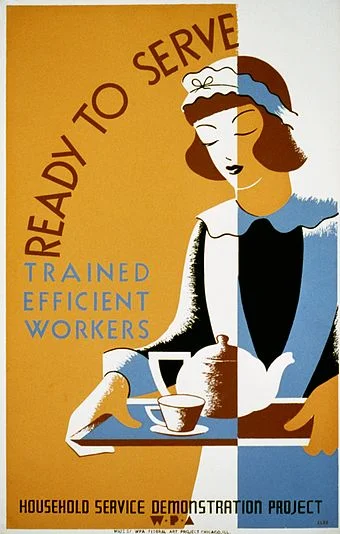
Not always? WPA poster from the Great Depression.
What happens when someone asserts that the compensation of members of state and municipal government employee unions, being the biggest expense of government in Connecticut, should be determined through the ordinary democratic process and not through secret negotiations between unions and politicians or by the decisions of unelected arbiters who answer to no one?
When that happens the unions shriek: You hate working people!
What happens when an academic study concludes that the compensation of Connecticut's state and municipal government employees is far more generous than that of most states because it is determined by a system that puts the government employee unions above the law?
The political allies of those unions, like state Senate's Democratic leader, Bob Duff of Norwalk, let loose the same shriek: You hate working people!
Such a study was published the other day by the Yankee Institute for Public Policy and Duff accused it of trying to "dismantle the middle class for the oligarchy" and to create an economy "where everyone works for a minimum wage."
Of course this shrieking fails to addresses the issues being raised. It aims to prevent those issues from being addressed. But thanks to the Yankee Institute study, at least those issues now are in the spotlight.
The study, "Above the Law," by Priya Abraham Brannick of the Pennsylvania-based Commonwealth Foundation for Public Policy Alternatives and F. Vincent Vernuccio of the Mackinac Center for Public Policy, in Michigan, is indisputable in its basic points:
-- Connecticut law subjects to collective bargaining more of the compensation and working conditions of state and municipal employees than most other states do.
-- Binding arbitration of state and municipal employee union contracts in Connecticut prevents elected officials from exercising much authority over the terms of government employment. Indeed, that is the very point of binding arbitration: to diminish the authority of elected officials.
-- Connecticut law even allows state and municipal employee union contracts to take precedence over state law. For example, while ordinarily the disciplinary records of government employees are public records, union contracts can nullify the public's right to know so misconduct and incompetence on the public payroll can be concealed.
Nobody should feel sorry for Connecticut's elected officials because of this. They don't want authority over the biggest costs of government. They don't want to get caught between taxpayers and the government employee unions. As employee compensation cannibalizes the government, Connecticut's elected officials want to be able to shrug and say they can't do anything about it, though this inability to control the costs of government employment is a primary driver of the state's disastrous decline.
Democratic elected officials especially don't want the government to regain control of its employment costs, because their party is dominated by the government employee unions.
But collective bargaining for government employees and binding arbitration of their union contracts should be repealed because they destroy democracy and their premise is that the only working people are those on government's payroll, that people who merely pay taxes are properly slaves.
So why do Connecticut's government employee unions hate taxpayers so?
Chris Powell is a columnist for the Journal Inquirer in Manchester, Conn., and a frequent contributor to New England Diary.

Images of reinvention in delightful Duxbury

"Henry'' (transparent watercolor), by Irena Roman, in her show "Second Wind: Journeys of Re-Invention,'' at the Art Complex Museum, Duxbury, Mass., through May 13.
Duxbury is a very affluent South Shore-of-Boston town with beautiful sandy beaches, oyster beds, cranberry bogs, piney woods and kettle ponds, along lots of 18th and 19th Century houses. Geologically, it's Cape Cod- like.
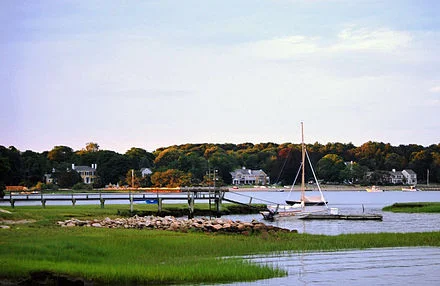
Inlet scene in Duxbury.

Duxbury has long been a summer place for the well-off, mostly from the Boston and Providence areas, but some from Greater New York, too, although the ocean water there is much colder than in Buzzards and Narragansett bays, to the south.

The John Alden House, built in 1653, when Duxbury was becoming a sort of suburb of still-small Plymouth.
Boycott Sinclair's WJAR
From Robert Whitcomb's "Digital Diary,'' in GoLocal24.com:
The TV station chain Sinclair Broadcast Group, which has polluted its stations with political propaganda, a few weeks ago gave each of its employees a highly publicized $1,000 bonus and thanked Trump for signing the tax law, which mostly benefits companies (which doesn’t bother me in itself) and rich folks. Now the company is pressuring its employees (including its journalists) to donate to the Sinclair Political Action Group, which supports Trump and other Republican politicians.
It used to be that news-media employees were discouraged from giving to politicians lest they appear to be overly biased. But in the much more corrupt political world following the Citizens United case, of 2010, such scruples are disappearing fast. It would be nice if viewers of, and advertisers on, Providence’s WJAR (Channel 10) boycotted the station, which used to be well-respected and still has some good people, though it’s hard to understand how any self-respecting journalist would want to work for such a sleazy company.
Back to Connecticut: Picking a place to live involves a lot more than economics and politics

The Black Horse Tavern, in Old Saybrook, Conn., built about 1712 by John Burrows. It is just west of the site of the historic Fort Saybrook, the major fortification of the 17th-Century Saybrook Colony. The building served as a tavern and inn until 1924. It's now a private house.
From Robert Whitcomb's "Digital Diary,'' in GoLocal24.com:
Jeff Larder wrote a charming piece in the Jan. 19 Hartford Courant headlined “Why I Came Back to Connecticut.’’ It could apply to any place with problems, which means any place. Mr. Larder, who lives in Old Saybrook, on Long Island Sound, had previously lived in Boston and Cape Cod. He moved back to the Nutmeg State in 2015.
There he has found plenty of things to complain about, including a “dysfunctional statehouse” (how many are highly functional?), “an exodus of jobs’’ and the “state full of suburbs flailing in a post-suburban world.’’ Further, the state’s “casinos are gross.’’ Yep, they are intrinsically gross.
Of course, some or even all of his complaints could be heard in many other states.
But economics isn’t everything. There are many reasons to live someplace.
He writes:
“....Connecticut more generally is at the happy middle of a diversity of experiences that comprise life at its best. In the span of a month, I had the best barbecue pork I've ever eaten in Hartford and the tastiest faux-chicken sandwich I've ever eaten at a vegetarian place in New Haven. Rolling farms, open space and hiking trails are minutes from downtown music venues and indie bookstores and record shops. The beaches aren't Malibu-caliber, obviously, but they're calm enough to teach your toddler to love the water….
“If Connecticut occasionally feels like an afterthought between two cities, remember that Manhattan is priced for wide-eyed optimists and pulseless corporate assassins, and the cranes in Boston seem hell-bent on building luxury apartments and the world's largest food court. Major metropolises are having trouble keeping around artists and creatives — the same people who make cities exciting places to live and can least afford the rent — and they've long been beyond the reach of middle-class families. Meanwhile, Connecticut's colleges, small and underutilized cities, and proximity to those same high-priced locales amount to an abundance of potential energy.’’
Sounds applicable to the cute little state to its east.
To read his essay, please hit this link:
Under attack from the inside

"Under Attack'' (encaustic relief over mixed media ), by Stephanie Roberts-Camello, in the group show "We the People,'' through March 14 at the James Library and Center for the Arts in Norwell, Mass. -- a suburb south of Boston on the North River.
Job is the measure

"Job,'' by Leon Bonnat.
"Wake when dog whimpers; Prick
Finger. Inject insulin.
Glue teeth in.
Smoke cigarette.
Shudder and fret.
Feed old dog. Revise syllabic
On self-pity. Get Boston Globe.
Drink coffee. Eat bagel. Read
At nervous speed.
Smoke cigarette.
Never forget to measure oneself against job.''
-- From "Death Work,'' by Donald Hall, former U.S. poet laureate and resident of Wilmot, N.H.

Scroll of the Book of Job.
Llewellyn King: My long but now failed love affair with guns

A Colt AR-15 semi-automatic rifle, the kind of weapon used in the Lakeland, Fla., attack that killed 17 people at a high school.
I have until now eschewed writing about guns. It’s personal. I like guns.
I grew up in what might be called a gun culture, but it was very different from today’s gun culture in the United States. It was in colonial Africa and guns were for hunting. They were also, as here today, just for having, works of art to be revered.
Many boys, at age 13 or 14, got a .22 rifle. Some got a combination rifle and shotgun: a .22 rifle on the top and a .410 shotgun on the bottom.
Handguns didn’t figure: They were illegal. The only man I knew who had one was always worried that he’d be discovered and prosecuted. Automatic weapons were still on the horizon where we were in a British colony -- what was then called Southern Rhodesia and is now called Zimbabwe
Military training, though sketchy, started early, when we were still in high school. We were issued British army, circa 1918, Lee Enfield .303 rifles — heavy, durable and lethal. We were told — as soldiers everywhere are — that our weapons were our best friends and would save our lives one day. We took the friendship part very seriously. People with guns do.
I still had some of that when I moved to the United States, in 1963. But my friendship with guns deteriorated in the era of the Saturday-night special.
Now in this era of the assault rifle, I believe that our gun tolerance is a fatal social disease. It’s a public-health issue right up there with the big killers and more terrible because so many of the victims, and most of the perpetrators, are children.
I was once the keynote speaker at a pro-gun group’s event. It was a seminal day, Nov. 5, 2008: the day after Barack Obama was elected president.
At that point, Obama had said nothing that I’d been able to find about guns. I told them that.
I told them about myself. I told them that members of my family, including my mother, had been professional hunters in the 1920s when felling large animals was acceptable, indeed regarded as a serious sport and as a way of harvesting nature’s bounty, even for ivory.
I didn’t tell them that I was leaning toward gun registration or my thoughts about the need to begin to turn the culture against guns, just as the culture had turned against homophobia and segregation. Just the facts. That’s what I tried to give them and what I had agreed with my speakers bureau. Yet when I sat down, the chairman said, “I think we have to read between the lines with journalists.”
The audience wasn’t what you might think of as gun extremists. They were serious, middle-class business people, mostly men; some were in the gun industry working for manufacturers. They believed that they were the victims of a vast left-wing conspiracy to destroy their businesses, their sport and their culture. They also believed, despite what I’d said, that I was the agent of that conspiracy.
So it is with my friends who are gun owners, from Florida to New Hampshire and across the country to Arizona. They vary from an erudite historian who has a collection of ancient and modern weapons in working order, to an electrician who believes he’s defending the people from the government by owning an AR-15, to a conservative economist who took to guns when he took to Republicanism.
Michael Gerson of The Washington Post has pointed out that the real child carnage, the senseless ghastly slaughter often over a gesture or an imagined slight, is in the inner cities. Tonight and tomorrow night, on and on, in the inner cities, children with guns will kill children, teenagers will kill teenagers. It’ll happen in Chicago and Baltimore and Detroit and across America to Oakland, Calif. Those who’ve been betrayed by their upbringing, by their absent fathers, and by their schools will be betrayed again. This time by the false security of their friend: the gun.
We have an estimated 300 million guns in America and 265 million passenger vehicles. The difference is we know the whereabouts of the vehicles: We register them. We also engineer them for safety, and we teach the drivers to drive. With guns we do just the opposite.
Wake up America and smell the cordite. It’s going off and killing someone near you right now.
On Twitter: @llewellynking2
Llewellyn King (llewellynking1@gmail.com) is executive producer and host of White House Chronicle, on PBS.
Little Compton's splendid Stone House

The Stone House.
Visit the uber-charming Stone House, in Little Compton, R.I., across from Newport and on bucolic Sakonnet Point. It's on the National Registry of Historical Places.
It's made to order for honeymoons.
For more information, please hit this link.
The air was too clear

Summer sailing off Acadia National Park, in Downeast Maine. Actually, pea soup fog is more common than blue sky in much of the summer on the Maine Coast.
"I taught up in Maine a couple of times and wasn't able to take a single picture. All that blue sky! Ugh. Sparkling clear air, just terrible. I couldn't do it.''
-- Controversial photographer Sally Mann

Don Pesci: Why does prison so rarely rehabilitate convicts?

Down the Rabbit Hole:
How the Culture of Corrections Encourages Crime
By Brent McCall & Michael Liebowitz
Available at Amazon
Price: $12.95/softcover, 337 pages
Down the Rabbit Hole, a penological eye-opener, was written by two Connecticut prisoners, Brent McCall and Michael Liebowitz. Their book is an analytical work, not merely a page-turner prison drama, and it provides serious answers to the question: Why is reoffending a more likely outcome than rehabilitation in the wake of a prison sentence?
The multiple answers to this central question are not at all obvious. Before picking up the book, the reader would be well advised to shed his preconceptions and also slough off the highly misleading claims of prison officials concerning the efficacy of programs developed by dusty old experts who have never had an honest discussion with a real convict. Some of the experts are more convincing cons than the cons, possibly because prisoners, many of them victims of programs that do not reduce recidivism rates, are not credentialed. Most people in prison are graduates of the school of hard knocks, not Harvard.
McCall and Liebowitz, serious criminals, are mechanics uniquely situated to answer the question: Why doesn’t rehabilitative imprisonment usually rehabilitate?
There are four criminological pillars to incarceration: incapacitation, punishment, deterrence, and rehabilitation. The authors find all four goals defensible, even desirable. However, the thesis of this book, very hard to dispute, is that only one engine, incapacitation, is pulling the train.
Punishment, in their view, does not rehabilitate because in most cases punishment is not viewed by prisoners as punishment: “We witness it every day. In a nutshell: prisons are often too comfortable; discipline is frequently too lax, inconsistent and arbitrary; and the staff generally doesn’t take rehabilitative programs any more seriously than the inmates do.”
The four goals of incarceration can only be met “… if there is proper implementation. When offenders are allowed to lay back in the relative comfort of an air conditioned cell watching color TV, listening to CD’s or playing video games, it can hardly be considered severe enough punishment to deter anything. Hell, that’s what most of the guys in prison enjoyed doing prior to their incarcerations. Couple this with the fact that inmates know that the vast majority of rule violations they commit will be ignored – even when committed in clear view and with the full knowledge of institutional staff members –and that effectively there are no performance expectations placed on them in either their job assignments or the programs they take – and you have a veritable recipe for failure.”
Young students confronting authority demands engage in what used to be called, before the collapse of public education, “reality-testing.” Will the authority figure apply his sanction equably? Will he apply it at all? If not, the efficacy of the sanction disappears. More destructively, the failure to apply sanctions will be interpreted as a failure of will and a sanctioning of illicit behavior. Sanctions unapplied or indifferently applied are, quite literally, dead.
The book finds that attempts to change rooted behavior in criminals fail for two principle reasons: 1) the content of the reform is wrong. You cannot teach dolphins to play pianos; better to teach them how to swim; 2) the messenger is wrong. Many of the messengers, and prison officials teach every day through example, are poorly instructed and fatally disengaged in what should be a primary mission -- changing the culture of prisons.
The authors note that the arc of penology, driven by perceptions of failure, has in the past moved between deceivingly opposite poles. “Every twenty years or so,” they write, “the pendulum swings from an ostensible focus on rehabilitation, with its apparent emphasis on prison programs, job training and compassion towards offenders, to get tough on crime policies, which supposedly means longer sentences and harsher prison conditions.”
This is a false either-or: “Firm condemnation of offenders and rehabilitative efforts can go hand in hand… punishment and reforms are not mutually exclusive objectives. In fact, punishment, or the threat of punishment is crucial to generating the motivation to change.” The culprit in prisoner reform – the authors assiduously avoid the word “rehabilitation” -- is an unjust and random implementation of both sanctions and reform efforts. As in the broader society, culture -- the real-time application of both punishments and reform efforts -- determines the success of penological programs.
Down the Rabbit Hole, suffused with hope, is remarkably free of bitterness. Still, an honest review of the tangle of unworkable prison reforms that do little to reduce the recidivism rate in Connecticut or other prisons -- "Statistics show that 67.8% of inmates released from prison nationwide are charged with at least one serious new crime within three years of their release" -- calls forth this sulfurous appraisal: “During the course of a single prison sentence, the offender can attend a series of programs that convey fundamentally different and often contradictory ideas about what the cause of his criminality is and what is required of him to correct it. In one program, he is told that he is the hapless victim of an inherently unfair societal power structure and that he simply needs to be open to the benevolent intervention of an inscrutable cosmic force. Another program teaches that he is the victim of a pernicious disease that robs him of the ability to choose and induces him to behave poorly. Still another program informs him that he is really just the victim of a cruel world that has mistreated him from birth and continues to fail to acknowledge his innate goodness, thus causing him to express himself through artificial sub-personalities he was forced to create in an effort to merely survive… And every once in a while, someone might mention that he needs to take responsibility and correct his thinking errors – though how exactly that is to be accomplished puzzles even those offering the admonition.”
The book offers constructive remedies. What is wanting in the confusing slop of pretend-reform programs is a conversion regimen that will purge the demons within that thrive on confusion, disorder and despair. There is life and hope at the end of the rabbit hole. The book, which pulls no punches and is what politicians might call a “frank and honest” discussion of life behind bars, is an easy read, free of suffocating academic jargon, though some destructive reform remedies do not survive the authors’ petri dish.
The audience targeted by the authors is the general public, and the book itself may best be appreciated as a message in a bottle sent to the wide world by Robinson Caruso, who is best able to provide the reader with the clearest understanding of Caruso’s island, which regularly ships island dwellers, hopefully reformed, to the mainland.
Don Pesci is a Vernon, Conn.-based columnist and frequent contributor to New England Diary.
Ethanol from the air
From Robert Whitcomb's "Digital Diary,'' in GoLocal24.com:
Sometimes what might turn out to be a big story is lurking nearby with little attention. Consider the tiny startup company in Fall River called Catalytic Innovations. There, scientist Stafford Sheehan and his team are developing a reactor system that uses air, water and sunlight (which turns into electricity in the company’s solar panels) to transform atmospheric carbon dioxide into clean-burning ethanol. Carbon dioxide has been ominously increasing with our burning of coal, oil and natural gas. Catalytic Innovations’ work might profoundly strengthen efforts to combat global warming while providing an abundant source of clean energy.
Reuters has a short video on this exciting company. (No, I do not own stock in it.) To see it, hit this link.
https://www.reuters.com/video/2018/02/12/catalyst-makes-alcohol-and-perfume-from?videoId=400622152&videoChannel=118065&channelName=Moments+of+Innovation
Bringing back the Rutgers tomato

Via OtherWords.org
Food corporations and their academic cohorts keep trying to “make” an industrial tomato to rival Mother Nature’s product. And they keep failing. They might consider this instead: the Rutgers 250. It’s a revived version of the classic hybrid tomato bred in 1934 by Rutgers University and Campbell Soup. The Rutgers tomato’s excellent flavor and texture made it the variety choice for years, eventually accounting for 60 percent of all tomatoes grown commercially in the United States.
But it fell out of favor in the 1960s, when big industrial growers in California and Florida switched to hard — and tasteless — tomatoes bred to withstand the crushing power of the harvesting machines they’d begun using.
That year — with the Good Food movement mushrooming and with consumers demanding that supermarkets sell truly flavorful tomatoes — plant breeders discovered that Campbell still had genetic material from the parent plants used 75 years earlier to develop the original Rutgers variety.
Since then, they’ve been working with it again, using cross-breeding techniques that go back to Latin America’s pre-Columbian natives. Slowly but surely, they brought back the Rutgers and its natural flavor, glowingly described as “the very taste of summer.”
The resurrected Rutgers tomato isn’t hard enough to be machine-harvested and shipped across country — which is one its major virtues. The fact that this tomato must be grown and marketed regionally is one step towards a decentralized, deindustrialized, and better food economy.
Instead of trying to squeeze nature into a high-tech, corporate model, this tomato represents an understanding that our food system can — and should — cooperate with nature and foster the growth of regional economies.
Jim Hightower is a radio commentator, writer, public speaker and editor of the populist newsletter.
Burgeoning print life

"Print Life: Neurogenesis, from Seed to Growth" (molded paper woodcut with wheat berry seeds, and flipbook), by Eric Avery, in the "2017 North American Print Biennial,'' at the Lunder Arts Center at the Lesley University of Art and Design, Cambridge, Mass., through March 4.
Health system needs surge protectors

U.S. Army field hospital.
Adapted from Robert Whitcomb's "Digital Diary,'' in GoLocal24.com:
Rhode Island and many other states have more hospital beds than they need most of the time. So here and elsewhere, some hospitals are being closed or being turned into entirely outpatient operations. Consider the recent closing of the inpatient part of Memorial Hospital, in Pawtucket, with considerable local anger.
But what happens when a big epidemic, such as the current flu outbreak, or a sudden disaster, such as the Station nightclub fire, strikes? That Rhode Island, and the rest of New England, has an older demographic than most of America and thus a higher percentage of people who could get very sick, makes us particularly exposed.
Where do you put all these very sick and/or injured people in times of widespread medical emergencies? Instant hospitals under tents, such as on battlefields?
Our health "system'' needs surge protectors.
Suggestions appreciated.
Well, yes, there's only one

The Housatonic River at Shelton, Conn.
"Housatonic, Quinnipiac and Connecticut,
Making their way to Long Island Sound.
Connecticut, what does it mean?
With its New Englanders of every race, color and creed.
A state of great beauty and a state of mind,
There is no other place that you will find ...
A State called Connecticut.''
-- From "A State Called Connecticut,'' by Camille Simone
Industry and high culture in Worcester

American Steel & Wire Company, circa 1905, in Worcester. At its height, the company employed thousands.
To many, Worcester may be best known as an old industrial city, with a particular focus on things made out of metal. Indeed, some people used to call it "The Pittsburgh of New England.''
Bu it also has such aesthetic and educational delights as many fine examples of Victorian-era mill architecture and Victorian mansions as well as such treasures as the American Antiquarian Society, the Worcester Art Museum, the Higgins Armory Museum, the Mechanics Hall concert venue, the EcoTarium and Clark University, where Freud gave his only lecture in America and from which came Robert Goddard, the pioneer of rocket technology. Then there's a leading Catholic institution, the College of the Holy Cross, up on a windy hill.
Many of the rich local industrialists were avid patrons of the arts and education even as some of them were happy to employ children in their factories.
And there's the Worcester Music Festival, allegedly the oldest music festival in the U.S., the Canal Festival (there are canals in Worcester dating back to Industrial Revolution days) and Rock and Shock

Beautful Mechanics Hall, in downtown Worcester.
Art against misogyny

"Bees with Honey'' (fiber), by Kimberly Becker, in the group show "A Woman's Place,'' at the Belmont Gallery of Art, Belmont, Mass., through March 10. Kimberly Becker, a painter and embroider who is also the curator of "A Woman's Place." Becker explains on her Web site, kimberlybecker.com; "My work speaks to current political and social issues that I believe need a loud voice. Women must tell their stories, and insist that the misogyny stop."
Chris Powell: Political sanctimony won't solve gun-violence challenge

An AR-15, which was easily bought by Nikolas Cruz at a gun store and then used to murder 17 people at a Florida school.
Estimates are that 300 million guns are in private possession in the United States, 55 million Americans own guns, and that at any particular moment about 20 percent of the population is suffering some form of mental illness.
So the remarkable thing may be not that the country has mass shootings every week but that there aren't several every hour and that anyone lives beyond age 40, especially as the political atmosphere has become stifling with sanctimony about guns.
The country sure does have a gun violence problem. But the rhetoric about it often lacks much relevance.
The bodies hadn't even been hauled away from the high school massacre in Florida last week before Connecticut U.S. Sen. Chris Murphy was pacing the Senate floor denouncing Congress for having done nothing about guns. Gov. Dannel Malloy, whose administration gave early release to convict Frankie "The Razor" Resto, who quickly went on to murder a store owner in Meriden, angrily accused Republican congressmen of having blood on their hands.
As is often the case, the problem with the quick denunciations arising from the Florida massacre is that none of the common prescriptions for diminishing gun violence would have made any difference.
More background checks? Desirable as they are, the perpetrator in Florida had no criminal record and his rifle was legally purchased at a gun shop. No "gun show sales loophole" was involved.
More mental-health appropriations? These would be helpful. But while many of the perpetrator's acquaintances regarded him as troubled and he had been expelled from high school because of misconduct, he rejected treatment.
Limit the capacity of gun magazines? This is trivial, since plenty of damage can be done whatever the magazine size and empty magazines are quickly replaced with loaded ones.
Outlaw "assault weapons"? This usually means any rifle that just looks scary. But the only thing that matters about a gun is not its appearance but its mode of firing, and there are only three kinds of guns.
There are fully automatic guns, semi-automatic guns and single-shot or double-shot guns The first kind reloads automatically and permits multiple rounds to be fired with a single squeeze of the trigger. The second kind also reloads automatically but requires individual trigger pulls for the discharge of each bullet. The third kind requires reloading for every one or two discharges.
Fully automatic guns are tightly regulated by the federal government and are not widely in public possession. Most modern guns are semi-automatic, as the Florida perpetrator's was. Outlawing them means outlawing most modern rifles and pistols -- that is, outlawing most of the guns held by the public -- and limiting public ownership to shotguns, bolt-loading guns, and derringers.
If outlawing most guns is what the advocates of more restrictions want, they should be honest about it -- and they will need luck with confiscation. After all, when guns are outlawed, only outlaws will have guns -- along with President Trump, that paragon of mental stability who also controls the country’s nuclear arsenal.
So unless the country chooses gun confiscation, it may be stuck with the public identification and preventive detention of the mentally ill and more armed security for its many soft targets like schools, theaters, and nightclubs.
Where 20 percent of the population is armed and another 20 percent is psychotic, inevitably there will be some overlap, against which the usual political sanctimony will be no defense.
Chris Powell is a columnist for the Journal Inquirer in Manchester, Conn., and a frequent contributor.
Study suggests benefits of 'home hospital' care for acutely ill

A study by researchers at Boston’s Brigham and Women’s Hospital suggests that a “home hospital” care model in which patients receive hospital-level acute care at home may cut costs without hurting quality, including patient safety.
Although many patients prefer to receive care at home, there are few “hospital at home” programs in America.
FierceHealthcare reports that gaps continue between hospitals and home-based care providers, which can pose patient-safety issues. “Home health workers are often provided incomplete or inaccurate information, and they often lack access to electronic health records to doublecheck patient information,” the news service reported.
The Brigham and Women’s Hospital’s small randomized control trial on its pilot home hospital program found that it cut healthcare costs by half.
The program included a daily visit from a physician and two daily visits from a home health nurse with patients also linking to physicians outside of those visits through video and/or texting.
“We haven’t dramatically changed the way we’ve taken care of acutely ill patients in this country for almost a century,” David Levine, M.D., a primary-care doctor at Brigham and the study’s lead author, said in an announcement about the study.
“There are a lot of unintended consequences of hospitalization. Being able to shift the site of care is a powerful way to change how we care for acutely ill patients and it hasn’t been studied in the U.S. with intense rigor,” Dr. Levine added.
He and his team plan to expand the study to include a larger number of patients.
To read the study, please hit this link.
To read FierceHealthcare’s take on this, please hit this link.