
Vox clamantis in deserto




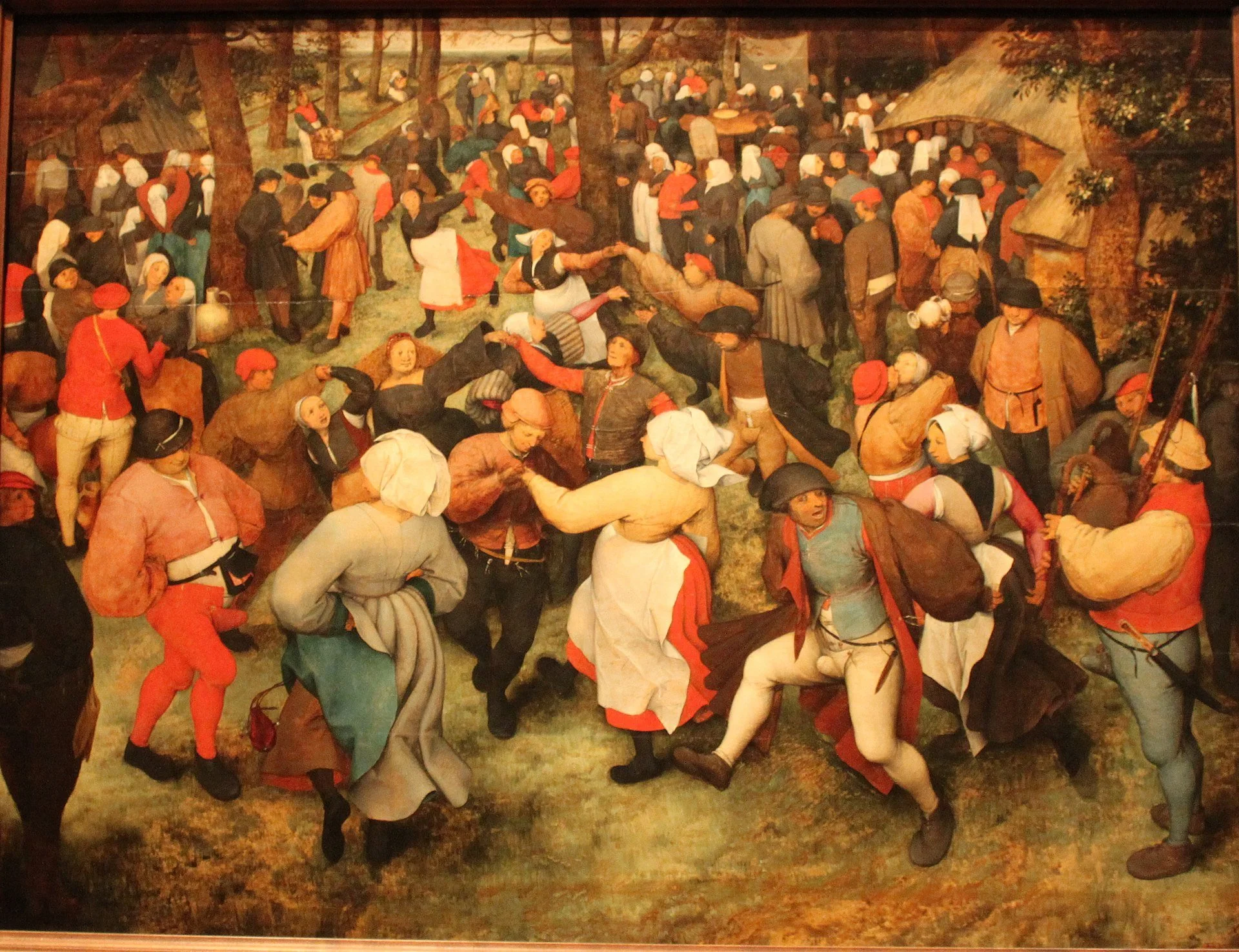



Siri knows all

"What Can Siri Answer?'' (epoxy clay. rhinestones, screw, nail, L-shaped key wrench and barrel nut!), by Heesun Shin, in the nine-woman show "Up-Root,'' at Periphery Space Gallery, Providence, through Nov. 18. The gallery says:
"Nine women artists speak to their individual cultural backgrounds. ...Many of the works are installations and even with nine artists the work is so tightly curated that they speak to each other. There is a strong narrative running through each artists body of work that speaks to traditions and belief systems one is brought up with or introduced to later. The show is very tactile ....'
Further, "Becoming American is often accompanied by a process of assimilation, particularly for second-generation immigrants, when a need to feel connected in a new community causes some to abandon ancestral traditions. At a time of cultural unrest and spiritual disconnection in America, this exhibition presents artists who embody, perpetuate and reclaim the cultures, ceremonies and rituals of their ancestors as a strategy for wholeness.''
Between haze and snow
"Besides the autumn poets sing,
A few prosaic days
A little this side of the snow
And that side of the haze.
A few incisive mornings,
A few ascetic eves, -
Gone Mr. Bryant's golden-rod,
And Mr. Thomson's sheaves."
-- Emily Dickinson, "Nature: XLIX''
Getting New Hampshire more on track
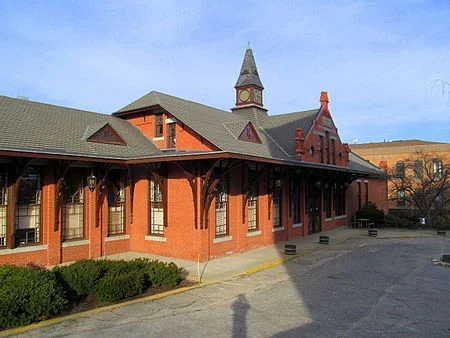
The old train station in Woonsocket, R.I., that's the headquarters of Boston Surface Railroad Co.
Adapted from Robert Whitcomb's "Digital Diary,'' in GoLocal24.com:
In further acceptance that southern New Hampshire is part of Greater Boston (as is northern the rather new Boston Surface Railroad Co. to provide commuter service from Nashua and Bedford, N.H., to Lowell, Mass., where passengers could link up with the MBTA. The only passenger rail service that the Granite State has now is Amtrak’s Downeaster, which connects Boston and Brunswick, Maine (via Portland), with stops at Dover, Durham and Exeter.
Mayor Donchess says the service would be a public-private partnership.
Some readers of past columns might remember that Boston Surface Railroad plans to open a commuter rail line connecting Providence and Worcester, with service now expected to start in the summer of 2019.
Great stuff!

Jim Hightower: Push back against arrogant Amazon

"Battle of the Amazons,'' by Peter Paul Rubens.
Via OtherWords.org
Isn’t it funny that right-wing politicians across America piously rant against giving a few bucks worth of jobless benefits to the needy — then turn around and shove billions of our tax dollars into corporate welfare for the greedy?
You’re right. It’s not funny. But here we go again.
We’re witnessing the most disgusting spectacle yet of the politico-corporate cabal extracting money from the people’s wallets to further enrich themselves.
Amazon.com, the $136-billion-a-year Internet colossus, has initiated a sleazy, self-serving public bidding war over where it will locate its new corporate headquarters. The city and state that offer the most bribe money to this private enterprise will be “the winner.” {Boston and Providence are among the bidders.}
Uber-rich Amazon doesn’t need — and certainly doesn’t deserve — any public handout. But officials in 238 cities have prostrated themselves in front of this Amazonian welfare queen in embarrassing bids to win her nod.
Amazon’s arrogant executives even sent out a list of basic benefits they expect every applicant to deliver, including a “business-friendly environment and tax structure,” free land, a subsidy to reduce its operational costs, tax breaks, relocation grants for executives and workforce, reduced utility bills, and — oh yeah, also give us first-rate schools and an educated labor pool.
As one analyst of Amazon’s bribery scheme noted, “These incentives aren’t free. There’s no fairy godmother paying for them.”
The typical result of corporate giveaways is that they cost the public more than we get back. By demanding such corporate spoils, Amazon brands itself a common thief, not only taking our money, but also stealing our trust in the fairness of the system and widening inequality in our society.
To help stop this corruption, go to GoodJobsFirst.org.
Jim Hightower is a radio commentator, writer and public speaker. He’s also the editor of the populist newsletter, The Hightower Lowdown.
You with the stars in your eyes
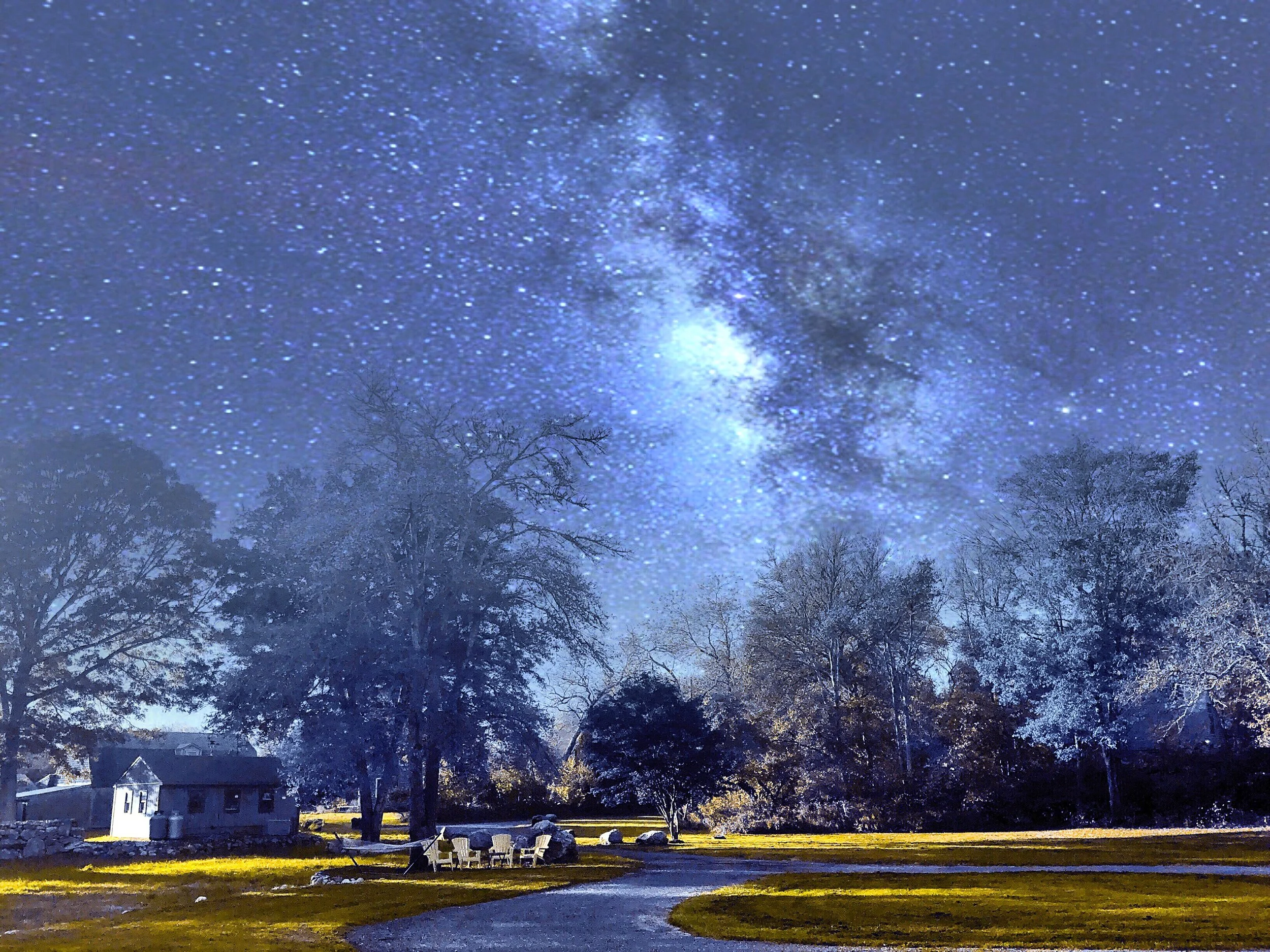
Staring into nuclear physics in Little Compton, R.I.
-- Photo by Lydia Davison Whitcomb
'Lightly hold' the beloved places
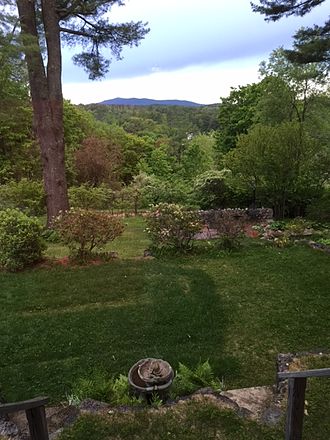
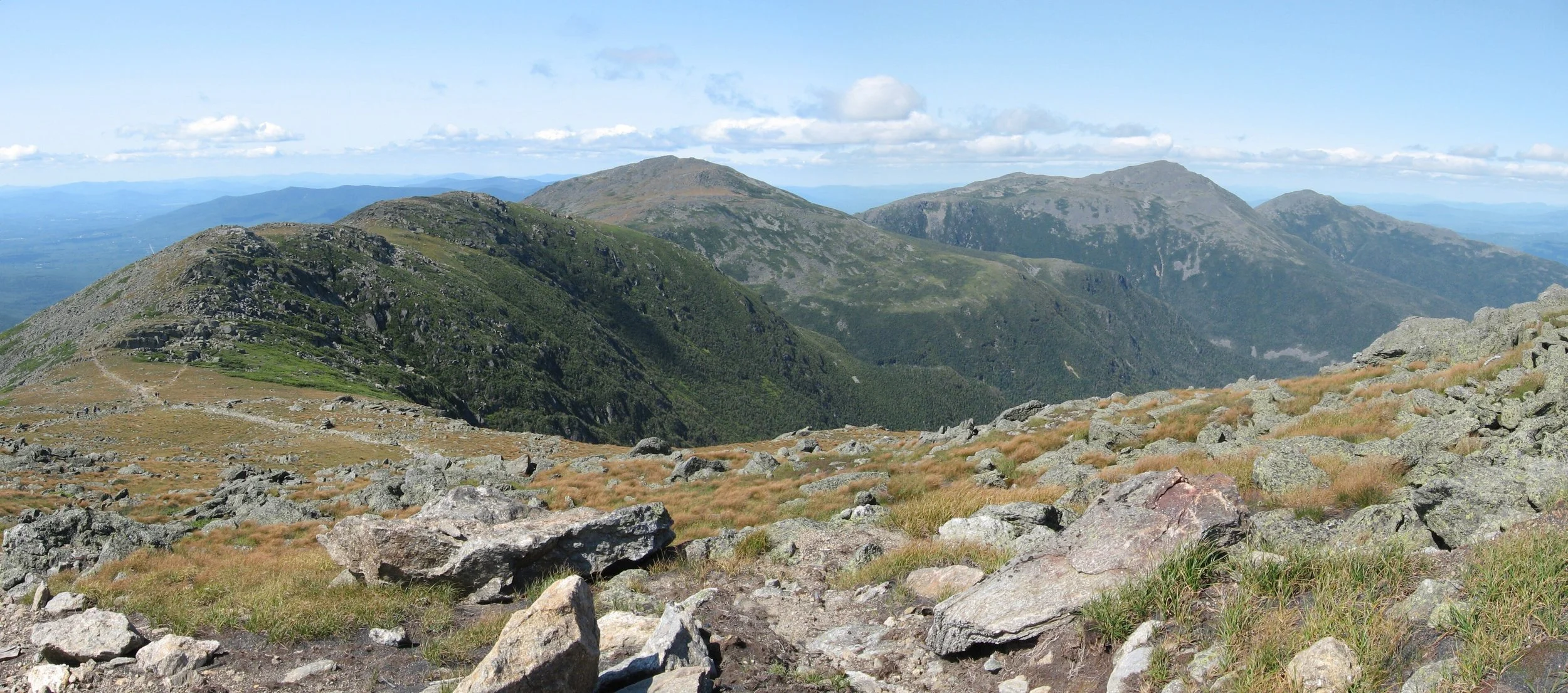
Mt. Monadnock, as seen from Peterboro, N.H.
"I don't wish for the red house back, not really, yet in a way, I wish for everything back that ever was, everything that once seemed like forever and yet has vanished . . . Standing here on an empty hilltop in New Hampshire, as a bulldozer slowly pushes the debris of a small red house into a neat pile, I allow, just for a moment, the past to push hard against the walls of my heart. Being alive, it seems, means learning to bear the weight of the passing of all things. It means finding a way to lightly hold all the places we've loved and left anyway, all the moments and days and years that have already been lived and lost to memory, even as we live on in the here and now, knowing full well that this moment, too, is already gone. It means, always, allowing for the hard truth of endings. It means, too, keeping faith in beginnings."
-- From Katrina Kenison, a Peterboro, N.H.-based writer. The famous MacDowell Colony artists' retreat is in Peterboro.
It's a tough cleanup job
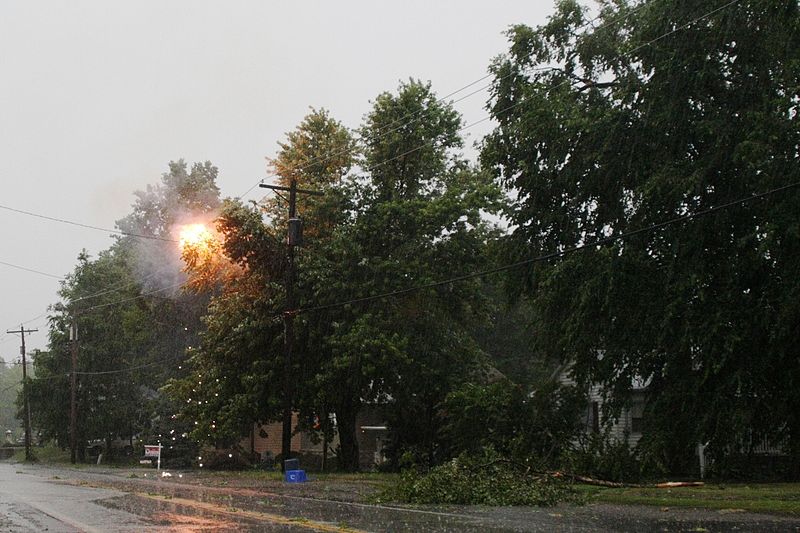
-- Photo by Robert Lawton
Adapted from Robert Whitcomb's "Digital Diary,'' in GoLocal24.com:
Regarding the rather tropical-style overnight storm we had on Oct. 29-30:
Do the radio talk-show and other complainants about lost electricity realize how difficult it is to clean up after any big storm, especially when summery (up to then) weather has left most leaves on the trees and so especially vulnerable to being blown over or losing big branches?
Unlike in much of the developed world, we in New England don’t usually bury our electric lines underground in heavily wooded areas. Further, in perhaps another sign of America’s crummy infrastructure maintenance, some electric utilities don’t do a very good job cutting back branches that could easily come down on wires even in relatively mild storms.
They should step up inspection and trimming operations, especially in the summer, before tropical storm and snowstorm/ice storm seasons. And state and municipal agencies could do more to monitor locations where trees pose the worst threats to lines, alert the utilities and in some cases do the trimming themselves. But in anti-tax America, how much are citizens willing to pay the added costs that this might entail? This takes more manpower.
Perhaps the storm will boost solar-panel installations. It should. There are several ways in which you can obtain electric autonomy from the likes of National Grid and Eversource by installing a photovoltaic system. The most reliable system is one connected to batteries, which will provide you electricity (for a while) even at night.
Please hit this link for pithy descriptions of your solar options to avoid what happened to so many people in New England as a result of the Oct 29-Oct. 30 tempest:
https://www.livestrong.com/article/149056-do-solar-panels-work-during-a-power-outage/
By the way, I heard a National Grid spokesman (a brutal job after a storm) say on the usual whineathon WPRO radio talk show that the storm was more intense than predicted. No, it wasn’t! The National Weather Service was remarkably accurate about the storm’s timing and intensity.
As for whether the cleanup was slower in Rhode Island than in Massachusetts and Connecticut: Maybe, but I heard the same sort of complaints from talk-show callers in those states about slow repair work there as I did from Rhode Islanders about power restoration in the Ocean State. This storm hit a very wide area. It would be nice to get some solid state-by-state comparisons of repair-work speed. Anyway, when you’re cold, your appliances don’t work and you can’t recharge your cellphone (“I have a cellphone, therefore I am’’) patience fades fast.
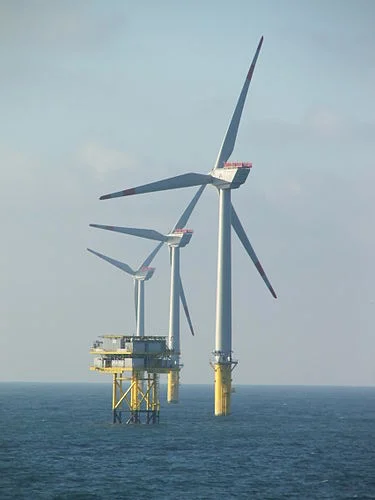
Tim Faulkner: Future looks bright for New England offshore windpower
Via ecoRI.org
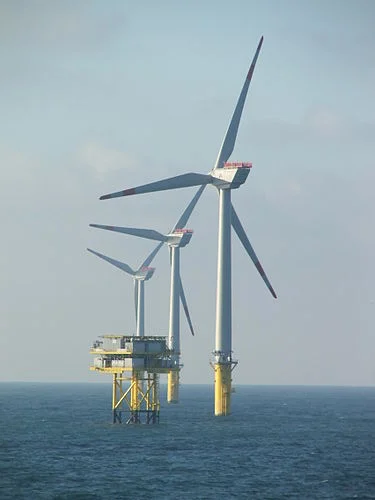
The future looks promising for the local and regional offshore wind business. Three recent reports project up to 36,000 new jobs and 8,000 megawatts of offshore wind power between New Jersey and Maine by 2030.
Released by the Clean Energy States Alliance, a coalition of state energy agencies, the reports examine and aggregate information about offshore locations, state policies, interconnection infrastructure, and job potential.
The main findings identify 109 different occupations and electricity output for nearly 4 million homes. By comparison, Rhode Island has 462,000 housing units and Massachusetts 2.7 million.
Of the the seven states in the reports, Massachusetts has the greatest resources for offshore wind energy, with 82,704 megawatts of potential power. Maine is next with 56,503 megawatts, but currently has no wind projects proposed. Rhode Island has 8,364 megawatts of wind potential. Rhode Island and Massachusetts share a federally designated wind-lease area south of Martha’s Vineyard.
The reports are part of a regional effort to promote renewable-energy planning called A Roadmap for Multi-State Cooperation on Offshore Wind Development. They were partially funded by a U.S Department of Energy grant of $592,683 given to the New York State Energy Research Development Authority. The reports were also done for the Massachusetts Clean Energy Center, Massachusetts Department of Energy Resources, and the Rhode Island Office of Energy Resources (OER).
“As host to the nation's very first offshore wind farm, currently generating 30 megawatts off the southern coast of Block Island, we see these reports as key to laying the foundation for this growing industry,” OER administrator Carol Grant said. “The states in the region have individually taken important steps to advance offshore wind. The release of the new reports exemplifies how the states are also working together to advance offshore wind deployment and supply-chain development.”
Report one, the Northeast Offshore Wind Regional Market Characterization, looks at federal lease opportunities, state policies, regional energy needs, existing electricity generation and planned retirements, and transmission capacity through 2030.
Report two, U.S. Job Creation in Offshore Wind, looks at job potential. The majority of jobs are in project development and management, supply and installation of electrical substations and subsea cable, wind farm operation and maintenance, and possibly some in manufacturing.
Report three, U.S. Jones Act Compliant Offshore Wind Turbine Installation Vessel Study, examines the federal rule that requires all vessels transporting cargo between domestic ports to be built in the United States. The report concludes that the budding offshore wind industry would need a turbine installation vessel and a feeder barge. Shipyards have already been sent information on cost estimates. The installation vessel would cost about $222 million and some $87 million for the feeder barge.
Webinars on the reports are scheduled to held Nov. 20 and Dec. 7.
Tim Faulkner is on the staff of ecoRI News (ecori.org).
Peter Certo: On tax 'reform,' GOP in Congress reports to campaign donors, not the general public
Via OtherWords.org
Sometimes I have to remind myself that people in “real America” with “real jobs” don’t while away their mortal hours reading about politics. But God help me, if you’ve suffered through any coverage of the Republican tax plan, you’ve probably heard three things.
First, it’ll dramatically slash taxes on corporations and billionaires, raise them for nearly a third of us in the middle class, and blow a $1.5 trillion hole in the deficit.
Second, it’s unpopular. Less than a third of Americans support it, Reuters reports. That’s worse than Trump’s own approval rating, which remains mired in the 30s.
And third, the Republicans who control Congress believe it simply must pass.
In fact, this third point sets the tenor for the entire debate. “Republicans are desperate to rack up a legislative win after a series of embarrassing failures,” TIME observes. “If tax reform doesn’t pass, many in the party fear an all-out revolt in 2018.”
“All of us realize that if we fail on taxes, that’s the end of the Republican Party’s governing majority in 2018,” South Carolina Republican Sen. Lindsey Graham told Fox News recently. In fact, “that’s probably the end of the Republican Party as we know it.”
If the tax giveaway doesn’t pass, adds Utah Republican Sen. Mike Lee, “We might as well pack up our tent and go home.”
The thing is, that doesn’t make any sense. Gallup polls have shown over and over that most Americans think rich people and corporations should pay more, not less. Even a majority of Republican voters worry about what this wealth grab will do to the deficit.
If they were looking for a win, then, Republicans would be running against their own plan. So what gives?
Well, New Jersey Republican Congressman Chris Collins recently offered a clue: “My donors are basically saying, ‘Get it done or don’t ever call me again.'” Ah!
Many voters in Collins’ high-tax district will likely pay more, since the GOP wants to end federal deductions for state and local taxes. But it doesn’t have a lick to do with voters. It has everything to do with the affluent donors who bankroll GOP campaigns.
A similar dynamic played out in the healthcare debate. GOP leaders trotted out plan after plan that would eliminate coverage for anywhere from 20 to 24 million Americans — plans that never topped the low 20s in public support.
But those plans would have reduced taxes on the wealthy. So they had to pass.
“Senator Charles E. Grassley of Iowa, who has been deeply involved in health policy for years, told reporters back home that he could count 10 reasons the new health proposal should not reach the floor,” the New York Times reported back in September, “but that Republicans needed to press ahead regardless.”
When those bills met their righteous demise, elite GOP fundraising took a huge dive. Senate Republicans lost $2 million in planned contributions alone, The Hill noted this summer. Fundraising in those months fell some $5 million below where it had been in the spring.
So there it is, team: Follow the money. It’s no wonder Princeton researchers found a few years ago that rich people matter to Congress, but ordinary folks generally don’t. That’s probably why many of us prefer to tune it out entirely.
It’s also exactly why we do have to pay attention. Especially in those rare moments when members admit exactly what’s going on.
Peter Certo is the editorial manager of the Institute for Policy Studies and the editor of OtherWords.org.
Pocasset plant life

"Grass in Little Bay, Pocasset, Cape Cod'' (limited edition aluminarte metal print), by Bobby Baker.
-- Copyright Bobby Baker Fine Art Photography
'Friendly in the dark chill'

A Leonid meteor.
"The sky is streaked with them
burning hole in black space --
like fireworks, someone says
all friendly in the dark chill
of Newcomb Hollow in November,
friends known only by voices.''
-- From "Leonids Over Us,'' by Marge Piercy, who is referring to the Leonids meteor shower. Newcomb Hollow is in Wellfleet, on Outer Cape Cod.
Is it time to tear down some expressways, or bury them?

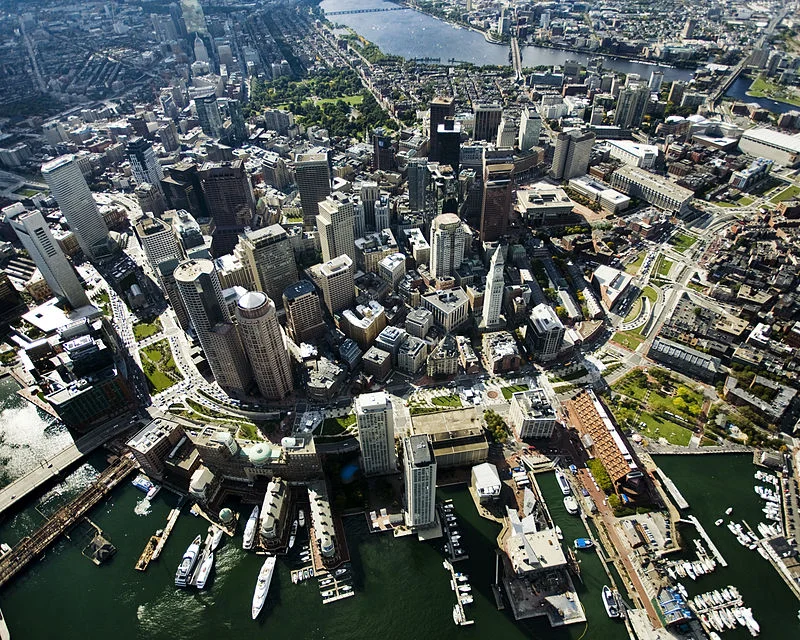
Boston's Rose Fitzgerald Kennedy Greenway (near the water in the foreground) now covers what had been the infamous surface version of the Central Artery, aka "The Distressway.''
-- Photo by Hellogreenway
A recent Sunday New York Times Style section (why the Style section?!) ran a story headlined “Exit the Expressway” (the headline has since been updated) about cities looking at tearing down some of those huge highways that were plowed through cities and parks in the construction heyday of the Interstate Highway System and states’ new-road projects.
In many towns and cities these highways rent the urban fabric, cutting off neighborhoods from each other even as they encouraged suburban sprawl. The Times’s story focuses on the Scajaquada (!) Expressway, aka New York State Route 198, in Buffalo. Its construction in the early ‘60s tore the lovely Delaware Park in half. Similar stuff happened in other cities during the orgasmic phase of the Automobile Age.
Now there’s a plan to convert at least part of the expressway into a lower-speed boulevard. It recalls proposals to turn the infamous 6/10 Connector in Providence into a boulevard.
Removing expressways has worked elsewhere, perhaps most successfully with downtown San Francisco’s Embarcadero Freeway, whose removal helped reenergize the city’s waterfront and led to a real-estate boom in the area.
Of course, another way to help repair the damage done to cities, and especially downtowns, by expressways is to put them underground, as was done with Boston’s infamous Central Artery in the Big Dig. The Central Artery’s roof is now a park. Unfortunately there’s far from enough money to a do a similar project with Route 95 in Providence, which creates a fearsome barrier through the middle of the city. But we can dream….
But what does seem likely is that changes in lifestyles, economics and environmental considerations will prevent a recurrence of the expressway- building boom of the ‘50s through the ‘70s. For one thing, we have a much stronger appreciation now of the need to preserve neighborhoods and to reduce our dependence on cars. Further, young people especially (say 35 and under) drive less than their parents and many of them much prefer cityscapes to suburbia; indeed they're turning parts of suburbia into places that look like walkable cities.
To read The Times’s article, please hit this link:
https://www.nytimes.com/2017/10/21/style/the-end-of-freeways.html
First light

"York Harbor, Coast of Maine'' (1877), by Martin Johnson Heade.
"Later, as I was getting dressed, I'd watch the early sunlight white-washing the houses across the harbor; America's first light falls on Maine each morning, and a clear and lovely light it is.''
-- The late Charles Kuralt, the CBS News journalist.
Invasive species and surveillance
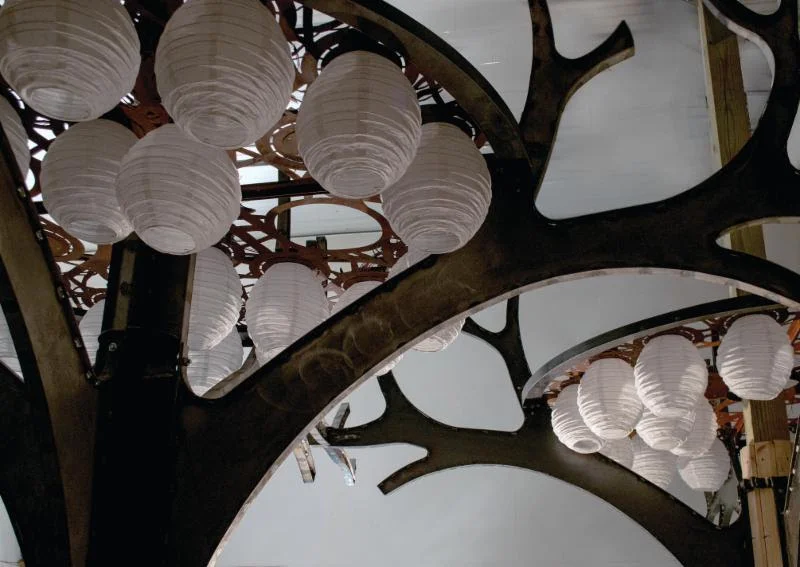
From Ed Andrews's show "Invasive Species,'' at Boston Sculptors Gallery, Nov. 8 through Nov. 10. The gallery says: "Monumental arboreal structures support rice paper cocoons that seem to breathe in and out, while small bug-like drones buzz overhead, appearing to monitor the movement of unsuspecting viewers. The effect is at once visually seductive, poetic and deeply disconcerting.''
The gallery says that Andrews's family lost 12 American Elms that shaded their home because of the invasive Dutch Elm disease, which came from Europe. "Today he manages 35 acres of woodland {in Glocester, R.I.} --an extension of his studio and a laboratory for his art practice--where he does his best to contain non-native plants and insects that threaten the eco-system, including an ongoing personal battle with the invasive European Gypsy Moth. These experiences inform Andrews's work, paired with his expressive commentary on the spread of the security and surveillance industry, which like invasive species, can potentially damage the environment, and pose a threat to our shared human economy and well-being.''
"Like a crisp oak leaf'
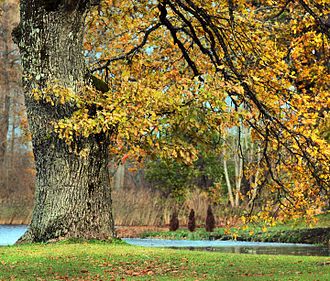
“'Sweater weather,”' you said.
And I am swept like a crisp oak leaf
into a duvet and down dream,
where the pillows do not speak
of the warm, the moments large and small
when I nestle near you,
demanding that arms dress me
to close kept comfort.''
— from “Sweater Weather” by Lisa Shields
Chris Powell: Immigration exceeds assimilation
According to the Center for Immigration Studies, 20 percent of this country's population now speaks at home a language other than English, up 34 percent since 1990. This indicates that immigration is exceeding the country's ability to assimilate immigrants into its culture.
Another indication was the recent terrorist attack in New York, where an immigrant from Uzbekistan is reported to have shouted “God is great” in Arabic after driving a truck over a score of people, killing eight and injuring many more.
A recent rally in Hartford in support of an illegal immigrant whose deportation order is close to being enforced also suggested that immigration is out of control. That's because the crowd chanted, "Undocumented! Unafraid!"
Of course, illegal immigrants are afraid. But to pretend that they are not afraid is to suggest that no immigration law should be enforced and that the country should have no borders. That would be the end of the country, and if illegal immigrants want that to seem to be their objective, they will encourage more deportations.
xxx
Bridgeport, most of whose students graduate from high school without ever mastering English and math, many of them getting diplomas though they are functionally illiterate, has decided to make them take a course in African-American studies, Caribbean and Latin American studies, or "Perspectives on Race."
"It is going to make a great deal of difference to our children and families," the vice chairwoman of the city's Board of Education, Sauda Baraka, told the Connecticut Post. "It will really help us with the learning process. Cultural competency has been shown to change the direction of young people and make them more interested in learning."
Connecticut can only hope so, since if anything done in public schools substantially improves the motivation of the disadvantaged, neglected and fatherless children of the cities, it does not seem to have been attempted yet.
Of course, to some extent the new courses represent political pandering, since Bridgeport's students and their parents are overwhelmingly from racial and ethnic minorities, about half Hispanic and a third black. But political tampering in education isn't peculiar to the city. A couple of decades ago a law was passed to require the state Education Department to prepare and offer to local schools curriculums in not just African-American and Puerto Rican history but also the Irish potato famine, since some politically influential people of Irish descent still carried a grudge about it.
The sad thing is that if the education of poor city kids was ever likely, and if education elsewhere in Connecticut was ever more serious (student performance in most towns isn't so much better than in Bridgeport), the histories of the country's minority groups would be crucial additions for students of all backgrounds. (The Asians should be included too, even though they don't whine as much politically.)
For inevitably the teaching of history has been skewed toward the ethnic majority, even though what most redeems the country is its heroic if uneven trudge toward democracy, equality and inclusion.
Will Bridgeport teach the history of racial and ethnic minorities as more cause for perpetual grievance, resentment, and dependence -- that is, teach it as mere political pandering?
Or will this history be taught as cause for inspiration, achievement, and respect for those whose sacrifice and persistence amid adversity made the country better not just for their own groups but for everyone else too -- made it, indeed, the hope of the world?
xxx
The state's biggest teacher union, the Connecticut Education Association, is back on television with a 30-second commercial asserting that "well-resourced public schools and dedicated teachers unlock our children's potential."
This treacle may invite viewers to recall the engraving on the statue of college founder Emil Faber in the movie Animal House: "Knowledge is good."
But apparently the CEA wants viewers to construe it to mean that even as Connecticut's economic and demographic decline worsens and sacrifices begin to be extracted throughout government, including sacrifices from the most innocent needy, teacher unions should be given whatever they want -- for the sake of the children, of course.
Yes, teachers and knowledge are good, but their price has to be weighed like everything else and it's possible even for them to cost too much, no matter how much political influence the union exerts in every town and how much advertising it can afford.
Chris Powell is managing editor of the Journal Inquirer. in Manchester, Conn.
Wild swings

Acrylic painting from the show "Calm/Chaos: Work by Aja Johnson,'' at Chandler Gallery, Cambridge, Mass., through Dec. 1. Ms. Johnson says her works convey a "desire for communication, catharsis or release.''
Passing ghosts
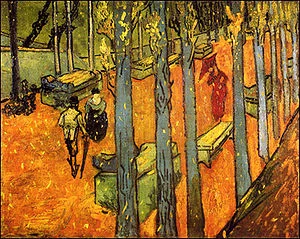
''Falling Autumn Leaves'' (oil), by Vincent van Gogh.
Listen. . .
With faint dry sound,
Like steps of passing ghosts,
The leaves, frost-crisp'd, break from the trees
And fall.
-- "November Night,'' by Adelaide Crapsey
Misreading 'The Last Hurrah'?
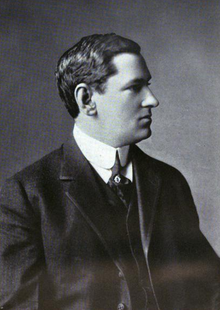
James Michael Curley in 1922, during his second term as mayor.
"The misreading of The Last Hurrah (Edwin O'Connor's novel loosely based on the career of the late Boston Mayor James Michael Curley (1874-1958)-- "The Rascal King''} came with certain costs. The book's acceptance as an authentic account of Boston's political culture helped steer attention away from critical aspects of the city's history....{T}he eagerness with which so many Americans embraced The Last Hurrah as a celebration of machine politics helped obscure the range of civic activism that circulated in ethnic America. Working-class immigrants and the politicians who represented them developed their own reform visions, often in opposition to party bosses...We risk dehumanizing ethnics when we assume that their politics amounted to little more than an exchange of votes for services, however personal the help may have been.''
-- James J. Connolly, in his article "The Last Hurrah and Pluralist Vision of American Politics,'' in the book Boston's Histories: Essays in Honor of {historian} Thomas H. O'Connor.
Editor's Note: Curley, however corrupt, had superb political talents, including a capacious memory. My paternal grandfather, who helped run a shoe company in Brockton, met and chatted with Curley at an event in the late '20s. He next ran into the pol in 1952. Curley greeted him by name (Henry) and asked him how Margaret, my grandmother, was.
-- Robert Whitcomb
I miss magazines

-- Photo by Rudiger Muller
Adapted from Robert Whitcomb's "Digital Diary,'' in GoLocal24.com:
I love print magazines. The way you turn the pages like a book. That the quality national magazines have fine contextual writing, superb photography and other illustration and spiffy design. (Indeed, the position of art director is very important in most magazines.) The way that they’re much more portable and neater than a broadsheet newspaper. And that you look at them with reflected light makes it easier to read long articles in them than reading such text on a screen. Like a book.
The four-color photography, strong design and expensive slick paper have been particularly important in maintaining the popularity of upscale specialty magazines such as for fashion and travel – the major reason that some of those magazines continue to thrive. Ads look their best in such formats.
As a kid I used to look forward to the arrival late each week of a slew of magazines --- Life, Look, Time, Newsweek, The Saturday Evening Post, Business Week, the National Geographic and even for a few years the Illustrated London News (which still ran black and white photos showing the damage done by Nazi bombers in London). These magazines were a joy to peruse.
New England has had more than a few regional magazines, such as the still prosperous Yankee and Down East magazines, but many have folded, such as the very interesting and attractive New England Monthly magazine published in 1984-1990.
When working in New York as an editor at The Wall Street Journal, I wrote for various magazines, usually travel stories but also how-to pieces and spot news, for extra money. While the monthly magazines understandably have relatively leisurely, if far from stress-free production schedules, the weeklies, particularly such news magazines as Life, Look, Time, Newsweek and Business Week, had high-pressure and even bizarre schedules. The first two days of the week were rather relaxed in their high-rise, high-tension headquarters, but the pressure built as the late-Friday deadlines approached. Editors and writers would put in 12-hour-days or more on Thursdays and Fridays.
Once the magazine was “put to bed,’’ after many cigarettes and much coffee had been consumed, there was a very unhealthy, if joyous habit of descending on midtown Manhattan bars to get hammered.
My late friend Harry Anderson, a high-level editor at Newsweek, used to tell me that the staff there did about 75 percent of the week’s work in the last 12 hours before the magazine (or “book’’ as the magazine staffs call it). He died in his forties of a heart attack.
Of course, magazines are fading fast. Google, Facebook, et al., gobble much of the advertising revenue; news can be published instantly on the Internet, and media publishers decide that they don’t want to spend money on paper and physical distribution of their products. So the number of national magazines is falling and virtually all of the surviving ones are much thinner than they used to be.
Some are becoming just Web sites and famous editors, such as the famed Vanity Fair editor Graydon Carter as well as the editors of Time, Elle, and Glamour, have recently been leaving their jobs, not wanting to preside over their publications’ accelerated decline. And Jann Wenner will sell his controlling stake in the often interesting if often irresponsible Rolling Stone.:
Still, it’s hard to think of a more pleasant reading experience than that offered by a good magazine. Let us hope that some of the best will survive, like recreational sailboats after steam ships and the internal-combustion machine came in. But magazines will increasingly be boutique operations and they’ll be harder to find, as I discovered the other week at Books on the Square, in Providence, which has taken away its magazine rack. Very sad.
To read a recent New York Times article on the fading away of magazines, please hit this link:
https://www.nytimes.com/2017/09/23/business/media/the-not-so-glossy-future-of-magazines.html