
Vox clamantis in deserto






Blended gasoline and milk

"Barn with Cow'' (ink and watercolor), by Tom Pirozzoli, at the Patricia Ladd Carega Gallery, Center Sandwich, N.H.

Will Amazon spawn old-fashioned Main Street retailing?

"View of Manchester, Vermont, '' by DeWitt Clinton Boutelle (1870)
From Robert Whitcomb's "Digital Diary,'' in GoLocal24.com:
What will become of cities as more and more work is done on the Internet and more and more stuffis delivered by mail (and drones?). At first glance you might think that these changes will hollow out the cities.
But people seek respite from screens and, for that matter, much paid work will continue to be done off screen. Consider that big growth areas for future jobs include such trades as electricians, plumbers, roofers, linemen, etc.
Seeing people in the flesh, not just virtually, will become more attractive as we become sated with screen life. Indeed, it’s essential for good health. And important decisions will continue to be best completed, and new ideas most cogently expressed, in real encounters. That’s one reason that Manhattan still thrives, in spite of its high costs. You can’t do a merger deal online. You have to meet in person.
Young adults, especially those with children, will continue to move to, or stay in, the suburbs, but future suburbs will look different from ‘50s- and ‘60s-style subdivisions. For one thing, they will have dense, very walkable centers for shopping, distribution and entertainment, and, especially, meeting people, with many smaller specialty stores in place of the vast malls and even vaster windswept parking lots around them. There will be fewer ugly big-box stores because so much of their brand-name stuff will be shipped directly to customers via Amazon, etc.
Highly specialized stores, many with unique items – some of them locally made ---can do well in these suburbs-becoming-mini-cities within broader metro areas. They’ll be staffed by salespeoplevery knowledgeable about their products and services and with long-term relationships with customers.
The Boston Globe reports: “Credit Suisse has predicted that upwards of a quarter of the 1,200 malls in America will close in the next five years.’’
“Today, if you know what you need, you go to Amazon and buy it,’’ Pam Danziger, president of the Pennsylvania-based Unity Marketing, told The Globe. “Where you’re going to find interest is on Main Street and not in these homogeneous same-old, same-old outlet stores. Main Street — where people really know you — that’s where the future of retail is.’’
Read the highly instructive case of toney Manchester, Vt., suffering from the decline in shopping at its many national chain outlets and so now looking to go more local. Please hit this link:
https://www.bostonglobe.com/metro/2017/09/15/there-app-for-this-retail-town-suffers-age-commerce/uArZDDp6UX5lzQlB0nsciP/story.html
Meanwhile, the car culture, even in the suburbs, will probably continue to fade with further proliferation of such ride-sharing services as Lyft and Uber and the expansion and diversification of mass transit associated with our aging population and environmental concerns.
Some suburbs are starting to look like center cities. Consider Tysons Corner, in suburban Fairfax County, Va., outside of Washington. Tysons looms like a mini-Manhattan, with office and residential towers. And then there are the small old cities within broader metro areas, of which there are many in New England – think Concord, N.H. and Portland, Maine. I think that they’ll grow as people seek the conveniences of more than traditional suburban density but without the costs of living in such big cities as Boston and New York, whose centers are increasingly for the rich.
Relatively new suburban places such as Tysons are called“edge cities’’ . But we’ve got what are small old “edge cities’’ around here, such as Pawtucket, R.I., which might have the urban bones to become more lively and prosperous.
Then there are the mid-size cities, such as Providence, Worcester and New Haven. They’ll draw people with their commercial and cultural attractions but won’t have the critical mass to become big cities. Rather, they’ll be ancillaries that will perform some of the services provided in nearby big cities -- e.g., Boston and New York. They’ll continue to lure folks who want to live in real cities but want/need somewhat less density and considerably lower costs than in Boston and New York.
Even Hartford, now an urban disaster area, ought to be able to eventually turn itself around and market its assets (especially its riverfront) as well as, say, Providence has done with its advantages.
Then there will be new mini-metro areas far away from big cities. One is the Lebanon, N.H.-Hanover, N.H.-White River Junction in the Upper Connecticut River Valley. There, the intersection of two major Interstate highways – Routes 89 and 91 -- along with the presence of a well-known university (Dartmouth College) and associated large medical center has for several decades been creating a kind of city – still sprawling but gradually being pulled together by, among other things, public transportation (encouraged by the proliferation of facilities, many of them high-end, for the elderly in areas with major colleges and medical centers).
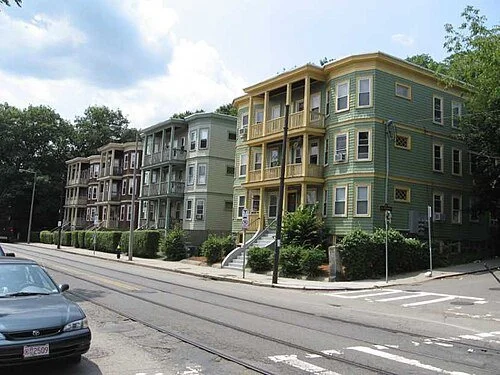
New England, with its many still well functioning towns and small cities with an almost European settlement pattern, would seem well placed to benefit from the technological and behavioral changes roiling the country, the sprawling , utterly car-dependent metro areas of much of the Sunbelt and Middle West less so. People will continue to seek community. At leastin New England that will be easier to find and/or rebuild than in most of the country.
'Old earth smiles'

-- Photo by Diego Delso
"Oh, good gigantic smile o’ the brown old earth,
This autumn morning! How he sets his bones
To bask i’ the sun, and thrusts out knees and feet
For the ripple to run over in its mirth;
Listening the while, where on the heap of stones
The white breast of the sea-lark twitters sweet.
That is the doctrine, simple, ancient, true;
Such is life’s trial, as old earth smiles and knows.
If you loved only what were worth your love,
Love were clear gain, and wholly well for you:
Make the low nature better by your throes!
Give earth yourself, go up for gain above!''
-- "Among the Rocks,'' by Robert Browning
Terry Hartle: Seeking transparency in college sexual-assault cases
Via The New England Board of Higher Education (nebhe.org)
When U.S. Education Secretary Betsy DeVos announced on Sept. 7 that her department would revisit how Title IX rules are enforced with respect to campus sexual assault, she said the first step would be a “transparent notice and comment process” to replace the 2011 “guidance” (and follow up 2014 guidance) that has been criticized for its one-size-fits-all presumption and lack of flexibility for campuses.
The U.S. Department of Education announced more details last week about how that process will work.
On Friday, Sept. 22, the department issued a “Dear Colleague” letter and Q&A documenton Title IX and sexual assault. The Dear Colleague letter rescinds the 2011 and 2014 guidance and states that the department will develop a policy that “responds to the concerns of stakeholders and that aligns with the purpose of Title IX to achieve fair access to educational benefits” through a rulemaking process. The schedule for this process is unclear.
In the interim, the department will rely on the “Q&A on Campus Sexual Misconduct,” developed using the 2001 “Revised Sexual Harassment Guide.” In some areas—such as letting colleges choose whether to use the “preponderance of evidence” or the “clear and convincing” evidentiary standard—the Trump administration is clearly making a change from current practice. In other areas, the new Q&A requires the same thing as the existing guidance. For example, the 2011 guidance and the Trump administration’s Q&A both require schools to have a title IX coordinator.
It should go without saying that schools should be very careful about altering current practices and only do so after close examination of the Q&A. And keep in mind that any changes may be temporary. The regulatory process the department intends to pursue is very likely to result in further changes in federal requirements.
But as the process for updating the Title IX campus sexual assault enforcement rules gets underway, let us not forget how notable it is that this is happening in the first place.
At one level, a regulatory process is not a big deal. The Education Department does it all the time on many issues.
Just since 2000, hundreds of higher education rules have been modified, created or eliminated.
However, the department rarely uses the regulatory process for Title IX. Indeed, OCR has gone through the formal rulemaking process just three times since initial Title IX regulations went into effect in 1975. Only two of these affected higher education. The first time involved revoking the prohibition on discrimination in the application of the codes of personal appearance in 1982. In 2000, OCR altered Title IX regulations to implement the Civil Rights Restoration Act of 1987, the so-called “Grove City” law that overturned a 1984 U.S. Supreme Court ruling that held that Title IX applied only to student financial aid, not other parts of the college that received federal dollars. The Civil Rights Restoration Act ensured that Title IV student financial aid triggered Title IX exposure for the entire school.
OCR has been more inclined to simply issue “guidance” that interprets Title IX regulations pertaining to campus sexual assault rather than pursue a formal rulemaking process. For example, the 2011 Dear Colleague Letter was developed “in house” without any suggestions from affected parties.
It is significant that the Trump administration is attaching a great deal of importance to getting the serious and complicated issue of campus sexual assault enforcement right. Promulgating regulations affecting Title IX is infrequent, hard and important. It is always a good idea to give all the parties involved an opportunity to comment and give their views on public policy.
Institutions, in responding to claims of sexual assault, have a responsibility to support the victim and to be fair to both parties. Figuring out exactly how to do that, when there may be different stories about what happened, no witnesses, and substance abuse may have been involved, can be extraordinarily difficult.
What we have had is a set of requirements, some of which are legally mandatory, others of which may or may not be mandatory. For colleges and universities the result has been uncertainty and complexity with no way to be sure in advance if they are doing the right thing. In this environment, it’s hardly surprising that schools have run afoul of OCR.
In the short run, any tweaking of campus policies or proceedings is likely to be at the margins. It is unlikely that colleges and universities will immediately change policies that they spent the last six years writing—and sometimes rewriting. And no institution will back off the commitment to prevent sexual assaults from occurring in the first place and handling cases that do occur with compassion for the survivor and fairness to both parties.
But replacing legally binding but unclear guidance with legally binding and clearregulations, and soliciting input from all sides in doing so, is a very good idea that will result in clearer regulations and, we hope, greater protections for all students.
Terry Hartle is senior vice president of government and public affairs at the American Council on Education.
Hierarchies perpetuating injustices

From Brian Gaither's show "Allegory of Justice,'' through Sept. 29 at the University of Massachusetts at Amherst's Augusta Savage Gallery. Mr. Gaither's paintings look at how hierarchies uphold social relations and perpetuate injustices.
Greg Gerritt: Menhaden -- foundational species

Atlantic menhaden.
Via ecoRI News (ecori.org)
PROVIDENCE
I went for a walk on a recent morning in one of my favorite places, on the very old path along the Seekonk River at the edge of Swan Point Cemetery, on the East Side of Providence. I have been walking there for 21 years, ever since I moved to the city. It’s called a river, but it’s really the northernmost extension of Narragansett Bay, with a dredged channel for boats heading up to Pawtucket, and a wide mudflat on the Providence side of the water.
The East Providence side is dominated by a sewage-treatment plant and an old landfill. The Providence side is one of the most majestic forests in New England, a mile along the river of steep bluff filled with 170-year-old hardwoods. Even cooler is that when the old trees fall down, they leave them there. I often sit on a log that likely fell into the water just before I moved here. It’s seriously decaying, lost all its branches a decade ago, but the trunk leaning down from the stone wall protecting the path from high tide, except in big storms, into the sea will still support me when I sit on it, on dry days. Like today.
The spring after I moved here, I saw my first Rhode Island osprey from that fallen tree, and I have even seen a small flatfish swim under me once. Later that same year, I saw my first menhaden and was amazed. For nine months I had been looking into the water every day as I walked the river and saw little life in it, but come August I saw endless streams of 3-inch fish swimming by, almost rivers of fish. I eventually learned what they were. I also started seeing menhaden in August and September downtown in the Providence, Woonasquatucket and Moshassuck rivers.
I started Friends of the Moshassuck shortly after that, as that little river surely needed friends after its 300-plus-year industrial history. I walk by almost every day. Eventually, Friends of the Moshassuck developed a video project on urban wildlife in the watershed. The focus is mostly on breeding toads and the restoration of breeding habitat a ways upstream, but come August and September, I walk along the Canal Street and South Water Street waterfront with video camera in hand, because menhaden continue to fascinate and are the one giant flash of wildlife we see each year in the city.
But I want to return us to the Seekonk River waterfront. On the morning I write of, it was 60 degrees, sunny, calm and the tide was in, lapping the stone wall. And walking along the path for the half-mile I covered, almost everywhere were very young menhaden. From 1.5 to 3 inches, with of course the majority, the great majority, being the smallest size class. A few times I saw menhaden jumping offshore, larger ones from the size of the splashes, which means they are being hunted from below. And below an osprey’s favorite perch, there were the quite stinky remnants of adult menhaden all over the place.
Between the stinky adults, the jumpers offshore, and the rivers of tiny ones below, I could only think of what else happens during menhaden season along the Seekonk River. The osprey have a nest on a platform at the Bucklin Point sewage-treatment plant. This year, for the second straight, they seem to have three youngsters, as I occasionally catch glimpses of five hunting at one time. All summer we have been seeing one or two, but come August, when the flow of menhaden is at its peak, its time to fledge the osprey chicks, and teach them to hunt. And menhaden is what they learn on, in numbers that even a beginning hunter can make a living on.
But is is not just the osprey. Cormorants are seen year-round, but during this time of year they are found in flotillas. Blue heron numbers multiply in August and September, and one seldom sees egrets except in late summer. Kingfishers are darting everywhere. Even the gulls are fishing. Gulls are not really designed to hunt mobile prey like menhaden; they scavenge and pick up stranded crabs. But this time of year you see gulls sitting on the water trying to catch little fish in the water. I have never seen a gull catch a fish, but clearly it must be a worthwhile source of food as the behavior persists, and one can only think that it works because it is directed at a prey so numerous that even a clumsy gull can catch its fill of prey that swims just below the surface eating plankton.
It was that eating of plankton that drew me to an analogy. I went to Yellowstone a few years ago, and there is one place in Yellowstone in which it is easy to see bison, the Madison River Valley. You look over the valley and there are bison everywhere. Bison need to drink pretty regularly, so they need to stay close to rivers. And then you realize that at one time, 200 years ago, there were herds of bison along almost every river in the grasslands of North America. And now there is one river valley that has a free-ranging herd and you remember what we have lost when you see what we still have.
Menhaden are the keystone species of the coastal estuaries in eastern North America. Osprey have returned since we stopped using DDT, but their continued recovery depends very much on menhaden. Eagles eat many as well, and the return of bald eagles to Rhode Island is an ongoing wonder. Three kinds of herons, egrets and kingfishers all rely upon menhaden to build up a little fat before the hard times of winter.
Seals have returned to Rhode Island, and stripped bass and bluefish make fishermen happy; they all depend upon schools of menhaden. One way you know this is true is because the schools of little ones always vastly outnumber the schools of big ones. Many die to keep the circle of life flowing.
Straying a bit from the bison analogy, we can’t afford to have menhaden in just a few places, and even more than bison, menhaden need the whole sea to do their work, to be food for all things great and small. No park could contain a school. What we have to do is protect the entire species, make sure that when people take some for our needs, that we leave enough for everything else. We must manage menhaden based on ecosystems needs, not human greed.
I strongly urge you to support menhaden management based on leaving enough in the sea for the circle of life to flow abundantly along our coasts.
Greg Gerritt is the founder/watershed steward for the Providence-based Friends of the Moshassuck.

The Seekonk River.
Don't pick me yet!

Tomato flower.
"The whiskey stink of rot has settled
in the garden, and a burst of fruit flies rises
when I touch the dying tomato plants.
Still, the claws of tiny yellow blossoms
flail in the air as I pull the vines up by the roots
and toss them in the compost.''
-- From "September Tomatoes,'' by Karina Borowicz
Don Pesci: Ah, those political friendships....
Political friendships, as we all know, are not usually long-lived. They usually end when the political clock runs out and the favored politician, putting active politics behind him or herself, enters into history.
Hillary Clinton's time as an active politician – one who may run for public office again – is over; so at least she says. Her political friends, attentive while she was an active politician – a first lady, a senator from New York, a secretary of state in the Obama administration -- will now recede into the background.
Political friendships are temporary at best. Those politicians who prefer public adulation to the adulation of their wives and children, are trading permanent friendships for part-time working relationships; for that is what a successful marriage is – a permanent friendship, more reliable and steadfast than the affections of lobbyists or partisan political comrades.
There is a quip obliquely attributed to President Harry Truman: “If you want a friend in Washington, get a dog.” Active politicians do not find it necessary to keep up friendships with politicians who have left the public stage. The political sandbox in Washington is forever changing. In DC, politicians come and go, speaking of Michelangelo. They write their memoirs, take up hobbies and, if they are former presidents, busy themselves with their libraries and try their best not to be underfoot. As has-beens, they become politically invisible.
When one-term former Connecticut Gov. Lowell Weicker retired from politics, after having hung an income tax, like a hangman’s noose, around Connecticut’s neck, there were no knocks on his door, and his phone didn’t ring. Occasionally, a journalist would call to ask a pointed political question, usually about budgets, deficits, or politically active Republicans. On this last point, all Republicans fell short in Weicker’s estimation, pock-marked as they were by conservativism. In any case, the redundantly rich Weicker was out of the stream, loitering on a far bank, perhaps reading the poetry of Hilaire Belloc, whose advice to the rich was: “Get to know something about the internal combustion engine, and remember – soon, you will die,” a dollop of humility that few active politicians are willing to swallow.
Die at some point we all will. But politicians die twice: once when they leave active politics behind them, and again when they shuck off their mortal coil.
The most certain indication that Hillary Clinton, permanently retired from active politics, has lost political luster is U.S. Sen. Dick Blumenthal’s sharp, cold-shoulder swipe.
Due to appear at two venues in Connecticut to peddle her newest book, What Happened. Blumenthal, a fast friend of the Clinton’s since their days together at Yale Law School, commented, “The majority of Connecticut voters supported her,” including, it should be noted, Blumenthal, whose support at the time seemed warm and genuine.
Would Blumenthal then attend the book signing? The response to this question had icicles hanging from its eves. According to an account in the Connecticut Post, "Blumenthal said he hasn’t read Clinton’s book and doesn’t have plans to attend either signing, however. ‘I’m not her agent,’ he said.” Here we glimpse the flower cast by an active politician on the soon to be buried casket of a dearly departed former friend.
Since Hillary Clinton lost the presidential election to Donald Trump, Blumenthal has pledged his troth to socialist Bernie Sanders of the People’s Republic of Vermont. Supporting universal health care – AKA socialized medicine – however devastating government supported health care might be to insurance jobs in Connecticut, once known as the insurance capital of the world, Blumenthal announced dramatically which side his progressive bread was buttered on, and he meant to brashly announce his solidarity with the progressive wing of the Democratic Party. What better way to do it than by trumpeting socialized medicine?
Socializing healthcare in the United States would involve moving from the private market to a government run market about 18 percent of the country’s gross domestic product (GDP). The transference would devastate the private health insurance employment market in Connecticut, because insurance companies would no longer be able to compete on “a level playing field” – an expression often employed by Blumenthal in different contexts – with monopolistic, ta -supported, socialized medicine.
In essence, the former private health-insurance market would become a boutique enterprise, much reduced, selling more expensive and more comprehensive plans to a limited market comprised of rich people such as Blumenthal. U. S. senators wisely avail themselves of federal retirement plans and Thrift Saving Plans that together offer far superior benefits than their constituents enjoy in a private marketplace; and of course they much prefer private insurance to Obamacare, viewed by many as a baby step on the way to a universal healthcare system. Rarely do congressmen include themselves as beneficiaries of the redistribution schemes that pour off their drawing boards.
The last thing that federal legislators such as Blumenthal want is a level playing field that would put them in the same game as the constituents they intend to help. When the authors of The Federalist Papers assured their countrymen that legislators in a functioning republic would not likely pass laws that would adversely affect themselves, they were yet unaware of the socialistic strategies of the Machiavellian legislators of our day.
Don Pesci is a veteran Vernon, Conn.-based columnist.
A town on 'uncouth' ledges
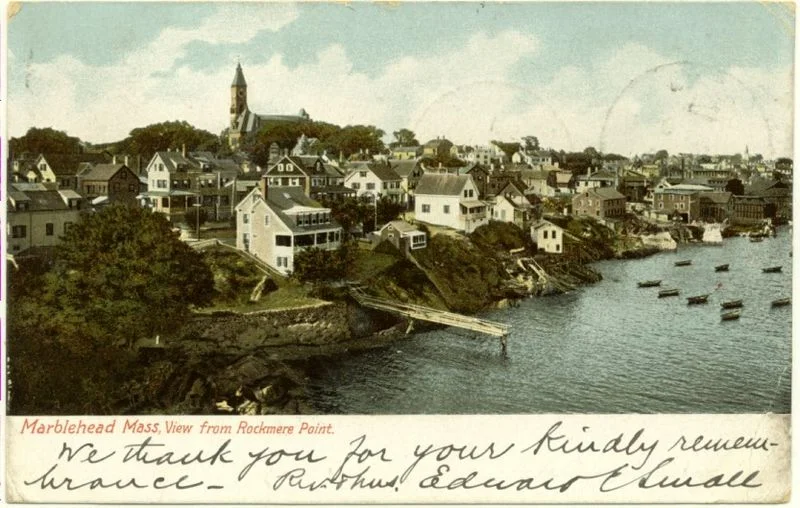
Marblehead in a 1905 postcard.
"They have covered a bare and uncouth cluster of gray ledges with houses, and called it Marblehead {Mass.} These ledges stick out everywhere; there is not enough soil to cover them decently. The original gullies intersecting these ledges were turned into thoroughfares, which meander about after a most lawless and inscrutable fashion...We expect to see sailors in pigtails, citizens in periwigs. and women in kerchiefs and hobnail shoes, all speaking in an unintelligible jargon.''
-- Samuel Drake, writing in A Book of New England Legends and Folk Lore (1872)
A big museum in a little town

The American Heritage Museum, in Stow, Mass.
The Worcester Business Journal reports that the Collings Foundation has been buildingits 65,000-square-foot American Heritage Museum, in tiny, rich, exurban Stow, Mass. (The neighbors in the residential neighborhood are not particularly pleased.)
The museum will have exhibits from America’s wars. These are said to include 12 warplanes; the largest U.S. private collection of military vehicles – 115 of them -- a life-size replica of a World War I trench and special effects that “re-create sights, sounds, and smells of war (i.e. ‘trench stench’)’’; a theater; classrooms; interactive exhibits, and such other artifacts as a Revolutionary War cannon, a 1917 American tank and a Scud-B missile from Desert Storm. Yikes! But no nuclear bombs yet.
It’s been increasingly said that there are too many museums competing for too many visitors. Perhaps this one will prosper, especially if it can partner with enough news media, documentary filmmakers and school, although the associated crowds won’t please the residents of mostly tranquil Stow. People enjoy entertainments based on wars, if not wanting to actually be in one.
There’s an International Museum of World War II in Natick, Mass., by the way.
To read the Worcester Business Journal article, please hit this link.
The maid will clean up this
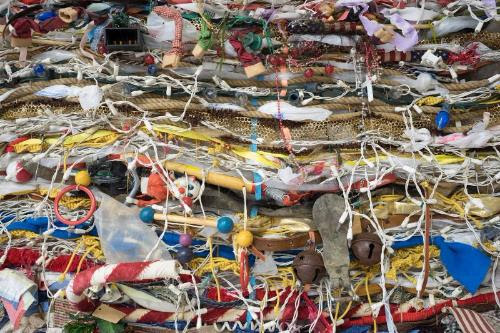
Work by Woomin KIm in her show "Urban Nest: Work by Woomin KIm,'' at Maud Morgan Arts Chandler Gallery. Cambridge, Mass., through Oct 27. Her work, recalling the old line that "one man's trash is another's treasure,'' uses a wide range of materials, including glass from broken bottles, assorted fibers and hair extensions.
The old Garden's challenges

The old Boston Garden.
"The old Boston Garden seats, some of which were placed here, were, as we remembered not much fun to sit in. The museum displays a sense of humor, by placing one seat behind a pole, symbolizing the 1,895 such seats.''
-- Jim Sullivan, writing on the Sports Museum of New England ,in the April 11, 2002 Boston Globe.
'I miss me too'
When people say they miss me,
I think how much I miss me too,
Me, the old me, the great me,
Lover of three women in one day,
Modest me, the best me, friend
To waiters and bartenders, hearty
Laugher and name rememberer,
Proud me, handsome and hirsute
In soccer shoes and shorts
On the ball fields behind MIT,
-- From "Days of Me,'' by Stuart Dischell
I'm feeling confused

By Don Doe, from the group show "Saints, Sinners and the Collective Unconscious,'' at the University of Massachusetts at Amherst Fine Arts/Center/Hampden Gallery.
Past time for go after sleazy Equifax, et al.
From Robert Whitcomb's "Digital Diary,'' on GoLocal24.com:
Credit-rating companies’ neglect of adequate cybersecurity obligations is well known. Thus the catastrophic hacking into the personal data of 150 million Americans at Equifax – including, God help us, Social Security numbers! – wasn’t a total surprise, as outrageous as it was. Taking the expensive actions necessary to improve security at least enough to prevent a hack of this magnitude might cut the companies’ quarterly earnings and stock price. That would be unacceptable to their grossly overpaid senior executives. Now, of course, the future of this far too powerful and arrogant enterprise may be in doubt.
Energetic lobbying by these companies has ensured that they pay a small price for presiding over an environment in which their customers’ economic lives can be ruined. Proposed regulations mandating much tougher cybersecurity provisions and punishment for breaches have been blocked.
And laws must be changed to hold data-product companies, such as Equifax, liable, via lawsuits, for the damage that their negligence (and worse) does to the public, just as are companies that sell physical things. At the same time, GOP efforts to kill the Consumer Financial Protection Bureau should be stopped. With too-powerful credit-rating agencies and corrupt banks such as Well Fargo, consumers need all the champions they can find.
Of course, we know that everything is hackable. There is no final security in cyberspace, and it’s an increasingly nasty place, in which we’re trapped. But many American companies make hacking remarkably easy because they don’t want to spend the money to reduce it.
In any event, “Everything is going to be hacked eventually. That’s just the way it goes,” Russell Vines, a cybersecurity expert at Consumers Union, told The Washington Post. “So everyone has to make provisions for what happens after.”
That means, of course, such measures as changing passwords and combing through credit-card bill and bank statements – for as long as you live.
The convenience of online activities and companies’ relentless campaigns to make you put as much of your life as technologically possible in cyberspace so that the firms can lay off more employees has left us all in swamps teeming with criminals. But you can cut your chances of being hacked and stolen from by reducing your online financial activities as much as possible. For example, online banking is a menace. Keep it to minimum. Stick to paper as much as you can.
Meanwhile, the Feds and businesses need to come up with ways to reduce the very dangerous reliance on Social Security numbers as primary identification. Consider that these numbers are connected to jobs, taxes, loans, government benefits and security clearances. We need alternate forms of identification. It’s getting urgent.
Equifax isa truly sleazy operation. (Try calling them, by the way.) They discovered the hack on July 29 but didn’t deign to tell the world until Sept. 8. Why? Well, it’s interesting to learn that three Equifax execs sold $2 million of Equifax stock right after the company discovered the breach in July. The execs denied that they knew about the breach.
Given the high-level of the execs that’s very hard to believe. The officers are:
Chief financial officer John Gamble; president of U.S. information solutions Joseph Loughran, and president of workforce solutions Rodolfo Plode.
Llewellyn King: TV talking heads rarely include the main human subjects of the shows
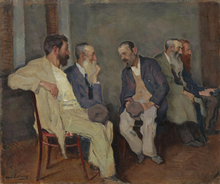
"The Conversation,'' by Arnold Lakhovsky (circa 1935).
Guess you’ve noticed: There are no politicians on the politics-obsessed cable news channels. Instead, there are journalists talking about politicians and politics; rafts of journalists organized into “panels” to comment, in seconds, on events.
Twenty years ago, it was different. So much so that I started a television program with the avowed intention of letting the public see who was writing the political news in the newspapers. We are still on the air, but with fewer journalists commenting.
In that seemingly distant time (which was, in reality, not very long ago), the principal political talk shows were The McLaughlin Group, under the pioneering John McLaughlin; Inside Washington, formerly Agronsky & Company, with Gordon Peterson, and the long-lived Washington Week in Review, with Ken Bode.
They were weekly, half-hour programs and mine, White House Chronicle, joined the roster as a distant “also ran.” We aimed at introducing print journalists to a TV audience. Other programs had set round tables that included Tribune Media’s Clarence Page, because he was a delight to work with — as we found on our program — and because he was informed and entertaining.
Women were fewer and they were led by Elizabeth Drew, of The New Yorker, Eleanor Clift,of Newsweek, Cokie Roberts of NPR, and syndicated columnist Georgie Anne Geyer.
Cable news meant CNN, then still trying to be magisterial.
Fast forward and television is chock-full of journalists talking about the news in what is now a staple of cable television; and rather than occupying half an hour a week these “panels,” as the hosts call them, are on pretty well 24/7.
The New York Times publishes under the slogan “All the News That’s Fit to Print.” On television, it’s all the news that can be talked about — and they do, endlessly. I think that is pretty entertaining and most of the talking heads seem to have really good sources; they are on the news — all the politics that can be talked about. It is the fat and sugar diet of TV.
What is missing are the subjects. Few members of Congress, with the exception of the leaders, are seen or talked about by name on television. They have been cleared from the television politics smorgasbord. Even the talking heads do not name them. The ubiquitous panelists talk about “my sources” or “a conservative congressman” or “a Democratic member.” No names. No faces.
There are reasons aplenty for this. One, now that there is more party discipline, except for a few people such as Sen. John McCain ( R-Ariz.), it is known what the party line will be: It is there in the talking points — and that makes for little news and boring television.
Another is that while journalists go for instant analysis, a cable television staple, politicians are scared of “stepping in it.” Search technology is so fearsome now that almost anything any politician says can be retrieved and put on the screen. That is fodder for future “gotcha” moments. The late Tim Russert, of Meet the Press, was a master of this. “In 2003, you said” and there it was, right on the screen, the politico making a regrettable remark.
Also, there is always the question of what the public wants (ratings to the TV industry). The public appears to be more interested in journalists debunking political leaders than the nuts and bolts of legislation or even what is happening in, say, science or the rest of the world. Salt and fat gets the eyeballs.
The late Arnaud de Borchgrave lamented that in his day, aspiring reporters longed to be foreign correspondents, now they yearn to cover Capitol Hill and the White House. Ralph Nader — who was once a prized “get” in the parlance of television bookers — has just issued a paper regretting the dominance of political chatter in the news space. Maybe he will be asked to talk about it on television, but it is unlikely.
On the upside, there are some awesome new talents, and more women in the Washington journalistic firmament — even if some of us like it when journalists, in the words of radio veteran Dan Raviv, just set out to “find out what’s happening and tell people.” No salt, no fat, just the facts.
Llewellyn King (llewellynking1@gmail.com), a veteran publisher, columnist and international business consultant, is host of White House Chronicle, on PBS. This piece first ran in Inside Sources.
Chris Powell: In Conn., another self-funding rich Republican ignoramus running for governor
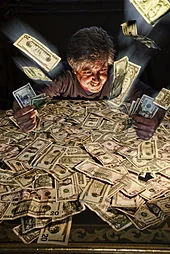
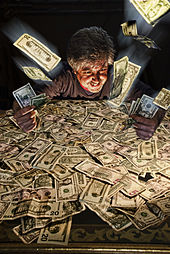
"Avarice,' by Jesus Solana.
David Stemerman, 48, of Greenwich, a successful investment fund manager, announced the other day that he is closing his fund and planning to become a candidate for the Republican nomination for governor of Connecticut.
Those who hope for change in state government's direction may be forgiven for thinking: not again. For Connecticut's minority party has an unfortunate habit of giving major nominations to candidates whose main qualification seems to be just their having enough money to finance their own campaigns.
Now that Connecticut's program of government financing of campaigns for state office is in doubt because of the state budget mess, a candidate's ability to finance his own campaign may seem more important to Republicans, especially since their legislators, considering it an extravagance, are the ones who want to do away with the Citizens' Election Program. But from multimillionaire Brook Johnson's campaign for U.S. senator in 1992 to multimillionaire Linda McMahon's campaigns for U.S. senator in 2010 and 2012 to multimillionaire Tom Foley's campaigns for governor in 2010 and 2014, Connecticut's Republican Party has failed, even when political circumstances were highly favorable.
As it turned out, campaign money wasn't nearly enough. Candidates also need a record in Connecticut's public life and some knowledge of the state and its government, and those self-funding Republican candidates didn't have it. Worse, they didn't care to learn, and it showed embarrassingly.
In a letter to his fund's investors disclosing his political ambition, Stemerman tried to take the edge off his wealth. "I am deeply concerned that a small number of people in our state are thriving while many are struggling to make ends meet," he wrote. He also tried to make a virtue of his political inexperience: "I do not claim to have all the answers, but as an outsider with a fresh perspective, I believe that I can bring a different approach."
"All" the answers? Even one might be nice.
Of course, someone without a record in the state's public life has as much right as anyone else to run for governor and may have valuable insights. But since Stemerman has no record, only a lot of money, Republicans and others who want political change in Connecticut should be concerned about what may be discovered about him by the opposition shortly before the election. That sort of thing badly damaged the candidacies of McMahon and Foley.
The Republicans already have a few potential candidates for governor who, while possessing no special wealth, at least have records and an idea of the state's problems. Whether they have the courage to speak about these problems as the state's sad circumstances require remains to be seen, but in any case the worst disaster that could befall Connecticut next year would be another self-funding ignoramus.
xxx
PUERTO RICANS LONG HAVE BEEN CITIZENS: Since many Connecticut residents are from Puerto Rico or have family there, the damage done to the island by the recent terrible hurricanes has been big news here. But it would be nice if journalists interviewing local Puerto Ricans stopped saying that so-and-so "came to the United States from the island," as if today's Puerto Ricans are or ever were foreigners.
They're not. They're Americans. The United States seized Puerto Rico during the Spanish-American War and federal law conferred citizenship on Puerto Ricans in 1917, if only because Congress wanted to make more men eligible for the military draft in World War I.
Chris Powell is managing editor of the Journal Inquirer in Manchester, Conn.
Coming up at the PCFR: War with China? Refugees on Lesbos; Selling out U.S. tech
Coming up at the Providence Committee on Foreign Relations (thepcfr.org; pcfremail@gmail.com):
On Wednesday, Oct. 11, comes Graham Allison, who will talk about, among other things, Chinese expansionism in the South China Sea. He'll discuss his new book Destined for War: Can America and China Escape Thucydides's Trap?
Graham Allison was director of Harvard's Belfer Center for Science and International Affairs from 1995 until July 2017. Allison is a leading analyst of U.S. national security and defense policy, with a special interest in nuclear weapons, terrorism and decision-making.
On Wednesday Nov. 15, comes prize-winning journalist Maria Karagianis, who will talk about the refugee crisis on the Greek island of Lesbos.
In May 2015, she traveled to Lesbos, which is within sight of Turkey. At that time, hundreds of thousands of refugees were spilling onto the beaches in leaky boats, many of them dying, trying to find freedom from war-torn Syria. The Greek people of the island, who have been nominated for a Nobel Peace Prize for their generosity, are now facing an economic catastrophe with tourism, their main source of income, which is now destroyed. She is currently a Woodrow Wilson visiting fellow and has traveled across the United States speaking at colleges and universities. She is a former guest editor and award-winning writer on the editorial board of The Boston Globe..
On Wednesday, Jan. 27, comes Victoria Bruce, who will talk about China's near monopoly of rare-earth elements.
She is the author of Sellout: How Washington Gave Away America's Technological Soul, and One Man's Fight to Bring It Home. This is about, among other things, China’s monopolization of rare earths, which are essential in electronics.
Victoria Bruce holds a master's degree in geology from the University of California, Riverside, where she researched the chemistry of volcanic hazards on Mount Rainer in Washington State. She has directed and produced four documentary films, earning the Alfred I. duPont-Columbia University Award for excellence in broadcast journalism for her film, The Kidnapping of Ingrid Betancourt. She also received the Duke University Human Rights Book Award for Hostage Nation.
On Wednesday, Feb. 21, comes Dan Strechay, who will talk about the environmental and socio-economical effects of the vast palm-oil agribusiness.
He is the U.S. representative for outreach and engagement at the Roundtable on Sustainable Palm Oil (RSPO). He'll discuss, among other things, the massive deforestation associated with producing palm oil in the Developing World and what to do about it. Prior to joining the RSPO, he was the senior manager for Sustainability Communications for PepsiCo.
Mass. creates a wilderness
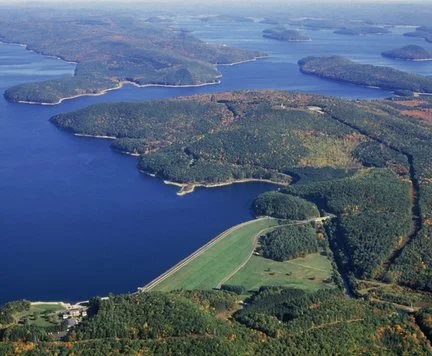
The Quabbin Reservoir.
"In front of me stretched the water of the Quabbin (Reservoir}. It was for this water that the Swift River Valley {of central Massachusetts} was flooded. It was because of this water that the wilderness, with its eagles and its extensive woodlands and abandoned cellar holes, exists in the Quabbin region.''
-- From Quabbin: The Accidental Wilderness, by Thomas Conuel
Come into my catacomb

A photo from the show "Recent Photography by Ron Rosenstock,'' at the Hopkinton Center for the Arts, Hopkinton, Mass., through Ot. 26.The show's photographs, all black and white, are of complex forms, large in scope and rich in detail, both natural and manmade. The gallery says that the images, although disorienting in their large scale, are also beautiful and peaceful.