
Vox clamantis in deserto





Sam Pizzigati: Retailers connive to tighten screws on public-school budgets

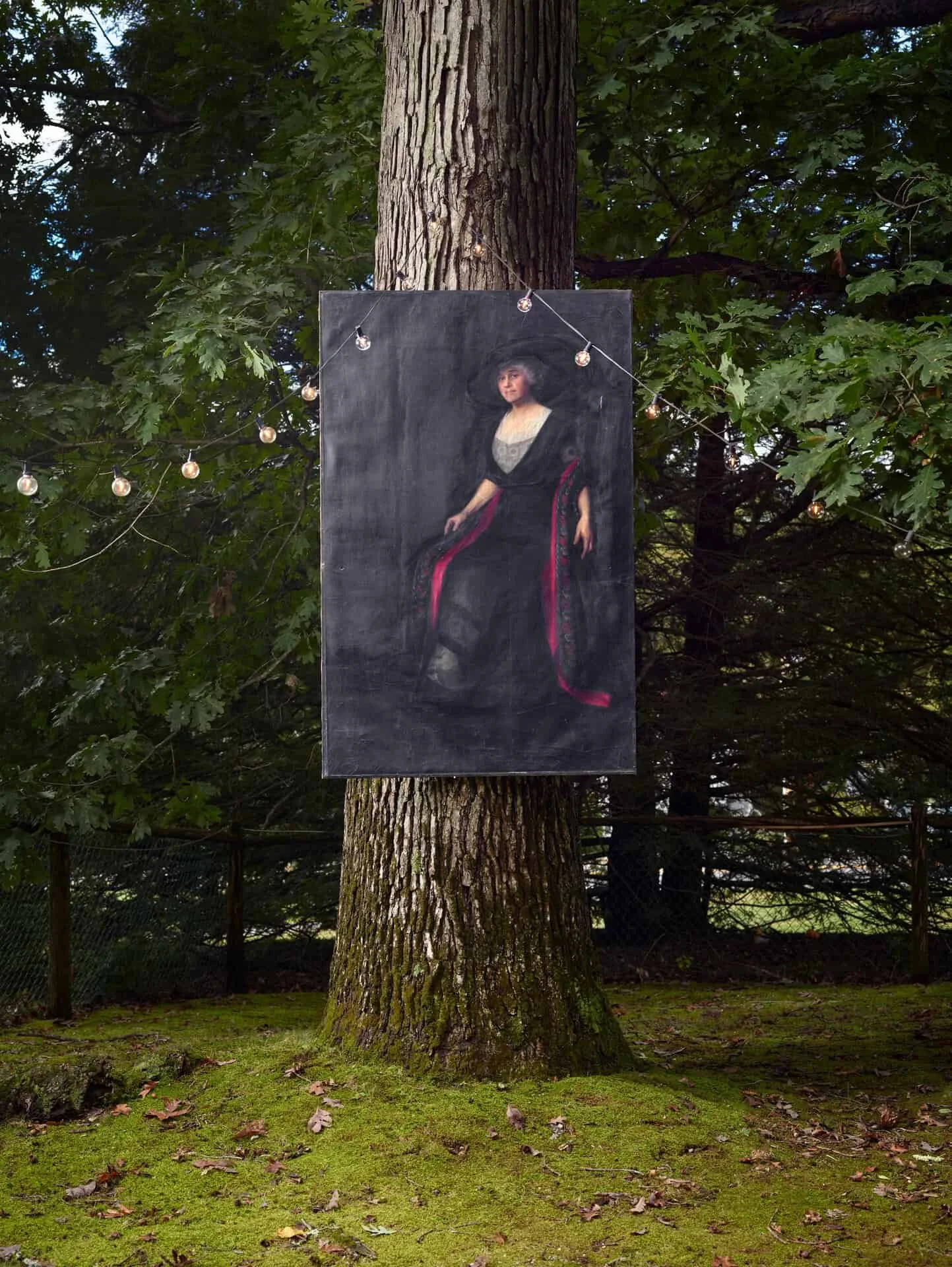
"The Old Beggar,'' by Lewis Dewis.
Via OtherWords.org
Back to school! These three simple words used to leave America’s public-school teachers giddy with anticipation. Now they leave them opening up their wallets and worrying.
The problem? Teachers have been spending out of their own pockets for generations to decorate their classrooms and the like. Now many have to spend their own money for basic school supplies — everything from pens and pencils to cleaning supplies.
One national study last year by Scholastic and YouGov found teachers spending an average of $530 a year on classroom supplies. The number of teachers who spend over $1,000 out of pocket, adds a National School Supply and Equipment Association report, has doubled.
In Oklahoma, third grade teacher Teresa Danks has been spending $2,000 annually of her own money. Earlier this summer, with her school district facing a $10 million budget cut, Danks actually started panhandling. She took to a busy street corner with a simple hand-made sign: “Teacher Needs School Supplies! Anything Helps.”)
Many passers-by did help. But the fiscal squeeze on America’s public-school budgets and teacher wallets is now threatening to get even worse.
That’s because big-box retail giants — the very stores where many teachers go to buy school supplies — have unleashed a fierce lawsuit offensive to significantly lower their local property- tax bills.
Property taxes remain, in most of the country, the single most pivotal source of local public school funding. If corporate retail powers like Home Depot and Target succeed in their new greed grab, the state comptroller in Texas recently warned, local public schools in his state alone would lose $1.2 billion annually, with another $703 million in school funding lost from the state level.
Our top big-boxers are flourishing: Home Depot profits last year jumped nearly 14 percent to $8 billion. And Home Depot CEO Craig Menear took home $11.5 million.
So on what grounds should the big-box boys be taxed less? Retail CEOs, Education Week reports, are having their lawyers make the astonishingly audacious argument that “the massive stores they operate ought to be appraised as if they were vacant.”
This ridiculous “dark store theory” has been winning lawsuits in Michigan, Indiana and Wisconsin, and school districts in the Midwest have already lost millions of dollars in revenue. In some cases, court rulings have actually forced local governments to reimburse big-box retailers for the higher property taxes they’ve already paid.
The new attack on local public-school funding isn’t just coming from brick-and-mortar retailers. Amazon, the online retail king, is taking new steps to avoid taxes, too.
Amazon now collects sales taxes on the goods consumers buy online in states that impose them.But Amazon is only collecting taxes on about half the goods that people who click onto Amazon itself buy. The half of sales that go through the third-party vendors that the Amazon site spotlights go untaxed.d.
The State of South Carolina is demanding that Amazon end this tax avoidance. Amazon is disputing the South Carolina claim, and the case is going to the courts. All the big online retailers will be watching closely. A South Carolina victory could mean higher tax revenue nationwide from big online retailers.
All these big-time retailers can afford to pay higher taxes. Our biggest retail empires, after all, have already made their emperors into some of the world’s richest people. The chief executive of Amazon, Jeff Bezos, now holds the third-largest individual fortune in the world.
Panhandling Oklahoma teacher Teresa Danks says she’s “tired of not having enough funding for our classrooms but being expected to always make it happen.”
The super rich who run retail in America could ease that fatigue. They could start paying their taxes.
Sam Pizzigati, an Institute for Policy Studies associate fellow, co-edits inequality.org.

'Out-of-body transformation'

Work by Anne Lilly, in her joint show "Stillness,'' with Phyllis Berman, at Room 83 Spring, Watertown, Mass., Sept. 9-Oct. 28.
The gallery says: "Kinetic sculptor Anne Lilly uses carefully engineered motion to shift and manipulate our perceptions of time, space and energy. Her steel sculptures move you. Sit across from someone with the tall mirrors ... moving slowly back and forth between you, and experience an out-of-body transformation as you morph into the other person and back into yourself. Anne’s work crosses the line between art and science.''
Put parking garages underwater?
From Robert Whitcomb's "Digital Diary,'' in GoLocal24.com
Building underwater parking garages might be a partial answer to the parking problems of coastal cities, such as Boston and Providence. An Aug. 22 Boston Globe story, “Could underwater garages solve Boston’s parking shortage?’’ noted that underwater parking garages “have been built, or are in the midst of being built, in at least three cities: Amsterdam, Copenhagen, and Geneva.’’
The Globe went on: “In a city like Boston, where the most parking-starved areas are surrounded by water, the payoff could be significant: helping to reduce the pollution and traffic caused by drivers circling the block hunting for spots, making parking more affordable, and freeing up more street-level space for other uses.’’
Much of tight little downtown Providence is virtually at sea level and would seem a good candidate for such garages. It might seem an eccentric idea, but so did moving the rivers and Route 195 when those huge projects were first proposed.
'Into the apparitions of the sky'

"I saw the spiders marching through the air,
Swimming from tree to tree that mildewed day
In latter August when the hay
Came creaking to the barn. But where
The wind is westerly,
Where gnarled November makes the spiders fly
Into the apparitions of the sky,
They purpose nothing but their ease and die''
-- From"Mr. Edwards and the Spider,'' by Robert Lowell

Don Pesci: Connecticut's confused moralists
Lincoln quoting Jefferson: “I tremble for my country when I remember that God is just!'’
During his political career, which spans four decades, Connecticut U.S. Sen. Dick Blumenthal has been storming moral mounts and shaking his fists at the gods. At some point, the gods of Western morality may respond.
Blumenthal’s reaction to American Nazis in Charlottesville was commendable and necessary; in any denunciation of Nazism, there must be no ambiguity – no moral confusion. There are indeed degrees of evil in the world. The bank robber who murders a teller commits a greater evil than the bank robber who simply robs a bank.
However, using the greater evil to excuse the lesser cannot be defended on moral grounds. The Antifa movement, like the American Nazi movement and the KKK, uses violence as a means of moral suasion. The Nazis and the members of the KKK who hijacked a protest over an attempt to remove a statute of Robert E. Lee from a park in Charlottesville should have been unreservedly condemned for who they are by all people whose moral sense is not impaired by political considerations.
These two groups have been with us a long time; we know them, and we should not pretend to forget or forgive the unrepented sins of their dark past. Both groups have bathed in blood up to their knees. The anti-black, anti-Semite, anti-Catholic KKK used to hang or terrorize its victims; these days, they are content to defame and rouse public opinion against them. German Nazis persecuted and murdered Jews; these days, American Nazis accuse Jews, who they falsely believe are animated by anti-patriotic globalist pretensions, of capitalist greed. The shadow of Buchenwald falls over all of this, and although David Duke is not Himmler – because there are differences in moral degrees of evil -- the seeds of the greater evil are sown in the ground of the lesser evil.
The Antifa movement – so called anti-fascists who have adopted the Stormtrooper tactics of Fascists -- should be roundly denounced for who they are by those who regularly storm moral mounts and shake their fists at the gods whenever television cameras are rolling. The Antifa movement has long been infiltrated by anarchists; in the anarchist dystopia, such senators as Blumenthal would be unnecessary excrescences.
Even for those who agree there is a moral order of greater and lesser evils, Blumenthal’s too ardent support of the more indefensible practices of Planned Parenthood is difficult to justify on moral grounds. Blumenthal's position on late term abortions, Orthodox Jews would say, is morally indefensible. Even a Reform Jew like Blumenthal may be uncomfortable with the killing of nearly born babies and the selling of their body parts to doctors, a process, some may think, that comes uncomfortably close to morally noxious Nazi practices?
The moral position on abortion – most especially partial birth abortion -- of 3rd District Congresswoman Rosa DeLauro also is confusing, which is why, she laments in her recent book, “The Least Among Us: Waging the Battle for the Vulnerable,” her bishop removed her as a trustee of her Catholic High School. Scandal in the Catholic Church is synonymous with sowing moral discord in the minds of Catholics. And Catholics who are public figures, so long as they remain in the faith, have a moral duty to maintain Catholic religious convictions in a morally confused universe. If they break with their Church on important matters of doctrine, a devil word in the modern period, they cannot maintain communion with the believing church, lay or clerical.
Of course, DeLauro has little use for bishops and little understanding of the historic opposition of her Church to the grave sin of abortion. She believes as a professing Catholic -- “My faith has always been important to me…” – that abortion has, within her Church, completely taken over “the conversation on faith in politics.” And she is inching toward a wholly indefensible moral position that important moral issues should be decided by the state, not bishops or rabbis.
DeLauro seems unaware that Catholic opposition to abortion and infanticide during Imperial Rome was the lever that freed women from a crushing paternalism in which the paterfamilias of a Roman family exercised complete dominion over the life and death of his unborn and born children. Abortion, infanticide and euthanasia, not uncommon in the Roman Empire, are becoming more common in the Western world as Christian perceptions are replaced by a morally neutral secularism, both in Europe and America.
The modern notion of human equality, unknown in the Roman Republic, descends from Biblical doctrine: “There is neither Jew nor Gentile, neither slave nor free, nor is there male and female, for you are all one in Christ Jesus (Galatians 3:28).” And the highly romantic notion of the love of children also has its roots in Christian faith, “But Jesus said, suffer little children, and forbid them not, to come unto me: for of such is the kingdom of heaven (Matthew 19:14).”
In Heaven, one hopes, abortion is frowned upon, as it is among bishops in DeLauro’s church. There, one hopes, Nazism, Klu-Kluxery, Antifa fascism and anarchism will not gain a foothold. Here below, the usual strife continues. Flawed moralists continue to belch fire from their secular pulpits. Medical practitioners, unbound by the Hippocratic oath – noxamvero et maleficium propulsabo: “I will utterly reject harm and mischief”— perform partial birth abortions, after which dismembered baby parts are auctioned off, while politicians, wrapping themselves in moral mantels, wink behind the curtain.
Not a church going man, Abraham Lincoln, quoted from Thomas Jefferson, not a church going man, in his Columbus, Ohio, debate with Steven Douglas: “… there was once in this country a man by the name of Thomas Jefferson, supposed to be a Democrat -- a man whose principles and policy are not very prevalent amongst Democrats today, it is true; but that man did not take exactly this view of the insignificance of the element of slavery which our friend Judge Douglas does. In contemplation of this thing, we all know he was led to exclaim, 'I tremble for my country when I remember that God is just!' … He supposed there was a question of God's eternal justice wrapped up in the enslaving of any race of men, or any man, and that those who did so braved the arm of Jehovah -- that when a nation thus dared the Almighty every friend of that nation had cause to dread His wrath. Choose ye between Jefferson and Douglas as to what is the true view of this element among us.”
Lincoln’s audience applauded this sentiment of a frail man leaning for support upon the crutch of an eternal truth. How often, we should ask, do the political heirs of Lincoln and Jefferson tremble when they consider that God is just?
Don Pesci is a Vernon, Conn.-based essayist.
Endless challenge

"Red Cross Serving the Children of the World'' (oil on canvas, 1942), by Frederick Sands Brunner, at the National Museum of American Illustration, Newport. Image courtesy, American Illustrator's Gallery Archives.
William Morgan: R.I. celebrates the tacky

Rhode Island's newest specialty license plate is yet another instance of the state's inability to put forth a decorous image. No wonder that Rhode Island keeps faltering at trying to sell itself as a tourist destination and a place to do business.
Perhaps the parade in Bristol is America's oldest Fourth of July celebration. So what? (This silly plate reminds me of one of my favorite instances of pathetic local boosterism. As you enter Mitchell, Ind., a sign declares: "Welcome to Mitchell. Home of the Mitchell Bees. State Basketball Championship Runner-ups 1948''. Or to echo the 1969 Peggy Lee ballad, "Is That All There Is?'')
American independence is, however, something to celebrate. Despite ongoing unhappiness with Thomas Jefferson because was a slaveholder, the Declaration of Independence, of which he was the chief author, changed the world positively forever. Why not remember that document and the events it spawned as the zenith of the Enlightenment? Instead, Rhode Island commemorates a parade in only one of its 39 towns.
Could we have come up with a license plate that did not look like the cheapest sort of political bumper sticker, another "patriotic" pimping of Old Glory?
As a design, the plate is as silly as it is illegible. Why add the impossibly small drum with crossed flags (the simple graphic clarity of the Rhode Island Regiment's flag might have served as a template for the overall design)?

The waving field of stars and stripes is simply a distracting mess, while what are presumably fireworks explosions seems to have been borrowed from Maryland's equally dreadful War of 1812 commemorative plate. Never mind that a disastrous, unnecessary war that we lost (Fort McHenry did not fall, but Washington was burned) is the object of identifying motor vehicles boggles the mind. What’s next: a Vietnam War plate? (Its motto might be the legend I saw on a soldier's jacket in 1968: When I die I am going to heaven, because I have already been to hell: Vietnam.)

Official Rhode Island needs to stop trying so hard. With license plates, as with most aspects of our image, simple is best.
William Morgan is an architectural historian, based in Providence. He has written about license plate design for such publications as the Hartford Courant and Slate.
Lost in the goldenrod

Oak Grove Cemetery, in Falmouth, Mass., where Katherine Lee Bates is buried.
Beside the country road with truant grace
Wild carrot lifts its circles of white lace.
From vines whose interwoven branches drape
The old stone walls, come pungent scents of grape.
The sumach torches burn; the hardhack glows;
From off the pines a healing fragrance blows;
The pallid Indian pipe of ghostly kin
Listens in vain for stealthy moccasin.
In pensive mood a faded robin sings;
A butterfly with dusky, gold-flecked wings
Holds court for plumy dandelion seed
And thistledown, on throne of fireweed.
The road goes loitering on, till it hath missed
Its way in goldenrod, to keep a tryst,
Beyond the mosses and the ferns that veil
The last faint lines of its forgotten trail,
With Lonely Lake, so crystal clear that one
May see its bottom sparkling in the sun
With many-colored stones. The only stir
On its green banks is of the kingfisher
Dipping for prey, but oft, these haunted nights,
That mirror shivers into dazzling lights,
Cleft by a falling star, a messenger
From some bright battle lost, Excalibur.
-- "In August,'' by Katherine Lee Bates, a native of Falmouth, Mass., who also wrote the lyrics for "America the Beautiful.''
Tim Faulkner: A confusing set of energy proposals for Somerset, Mass.
Via ecoRI News (ecori.org)
SOMERSET, Mass.
A massive new energy project is being proposed for the former coal-burning Brayton Point Power Station and the Montaup Power Plant, a long-shuttered coal facility along the west bank of the Taunton River. Both facilities are in Somerset.
During a muddled and at times rambling presentation on Aug. 23, a collection of energy developers outlined solar, biomass, fuel-cell and natural-gas projects with the potential to generate more than 2 gigawatts of electricity from the two locations. By contrast, recently closed Brayton Point had 1,611 megawatts of energy capacity.
The overall project, proposed by GSXI International Group, of Houston, is far from approved. The only agreement, so far, is a long-term contract to buy wood pellets from central Texas to fuel a biomass plant. The pellets would be shipped from Texas to Somerset via cargo ship. The town Economic Development Committee hosted the meeting as a public-information event.
The proposals presented conflicting data, but gave a rough outline of the scope of each project, which would be built in three phases. The biomass plant generated the most scrutiny, and about 20 protestors and several local environmental groups rallied outside the public library before the meeting.
Dubbed the Freedom Green Energy Biomass Project, the wood-fired plant is projected to generate between 400 and 1,000 megawatts by using the moth-balled coal boilers at Brayton Point. In a surprise twist, the power facility wouldn't burn the Texas wood pellets, but instead decompose the pellets and burn the emitted gases.
Skeptical residents wanted to know about pollution from emissions. Nilan Pillia, an engineer with GSXI, repeatedly promised that the energy process would generate no harmful pollutants. He couldn't cite any research, nor name a “syn-gas” facility that is already operating. Pillia could only say he’d worked on similar projects in Canada and Australia.
“There is no environmental risks. I can send you the reports,” Pillia said. “It is cleaner than natural gas, it is cleaner than coal.”
According to one of Pillia's charts, the biomass plant would also burn food scrap, animal waste and leaf and yard waste.
As the audience tried to grasp the unconventional power concept, the meeting shifted to a presentation on solar energy. Details were again sparse, but Seth Mansur, of Intelligen Energy of Worcester, described a 5-to-10-megawatt project comprised of solar carports and rooftop arrays combined with a residential discount program.
The presentation then pivoted to the hydrogen fuel-cell proposal. The audience expected to hear about hydroelectric power. However, Edgar Caballero, of Carter Energy Solutions, outlined a fuel-cell system that runs on hydrogen and raw sewage or seawater. The project would likely draw water from Mount Hope Bay, according to Caballero. Only carbon dioxide and drinkable water are the byproducts, he said. Although there are several companies developing full-cell energy, there are no industrial-scale power plants.
Caballero disputed the financial payout of residential solar power and touted the subsidy-free benefits of fuel cells. The costs to produce the energy from fuel cells is similar to the cost of generating power from natural gas, he said.
“It’s absolutely perfect, meaning zero emissions,” Caballero said, without addressing the amount of carbon dioxide emissions.
Caballaro explained that the competing hydrogen fuel cells are too expensive to turn a profit, but Carter is using a new, cost-effective 250-megawatt systems from German-based Langenburg Technologies.
In all, the combination of power projects promises 300 to 400 local jobs and $20 million in tax revenue. GSXI said it hopes to buy the Brayton Point site from Dynegy for $15 million. The projects would be built in three phases and cost $800 million.
After the meeting, Sylvia Broude, executive director of the Boston-based Toxics Action Center, said the presentation was shoddy and left her with more questions than answers.
"I continue to be very skeptical that they have a plan that could become a reality for Somerset," she said.
The Brayton Point Power Station operated for 54 years before ceasing operations on May 31. At the time, it was the largest and highest polluting power plant in New England.
The Montaup Power Plant closed Jan. 1, 2010. The 38-acre site has been considered for a number of industrial and commercial uses since its retirement.
Tim Faulkner writes for ecoRI News.
The perfect hiding place

"Passed a truck hauling portable johns.
20 bundled in plastic light blue.
Had a thought, they're perfect smuggling cons:
Who'd inspect? They're bound to pass through.''
- -"Rt. 95 Tales: Smugglers,'' by Allan C. Klepper
Do big tax breaks to lure developers make sense?
From Robert Whitcomb's Digital Diary, in GoLocal24.com
For years, Providence has used the offer of big tax-stabilization plans to try to lure big developers and other enterprises to the city, with occasional success. But at the same time, Providence commercial real-estate-tax rates remain among the highest in America. GoLocalProv.com has reported that the Lincoln Institute ranks the cities with the highest commercial rates as Detroit, New York, Chicago, Providence and Bridgeport, Conn., with “effective tax rates that are at least two-thirds higher than the average’’ of the 53 cities it surveyed.
Meanwhile, Boston ranks at 28th. Not exactly a competitive situation for Little Rhody!
Basically, like many jurisdictions around America, Providence (and Rhode Island) do a lot of economic development by deal rather than by broad-based policies that treat all property owners equitably.
Thus in Providence, as GoLocalProv.com noted, “new projects are the ‘haves’ -- new, modern and heavily subsidized,’’ while businesses that have been in Providence without these “bribes’’ are in older, less energy- or otherwise efficient buildings and have to pay the very high commercial real-estate taxes.
Thus over time they have a big incentive to leave the city. These usually small enterprises don’t get the political PR of a sexy national company moving some employees into Providence but there are a lot of them, and the city suffers when they leave, usually quietly and with no news stories. This emphasis on preferential tax deals for “sexy,’’ high-profile tax deals at the expense of the much larger number of unfavored enterprises continues to destabilize the city’s fiscal condition.
And remember how often companies that get preferential tax deals decide to leave town with little warning.
It’s past time that the city and state implement major commercial property-tax reform. As my friend Gary Sasse noted in GoLocalProv: “Unfortunately, state policy appears to be directed at providing real estate developers with preferential tax deals while totally ignoring structural property tax reforms needed to make Providence truly competitive.’’
WPI is setting up an operation in Boston's burgeoning Seaport District
This is from the New England Council
"New England Council member Worcester Polytechnic Institute (WPI) recently announced that it will launch an Innovation and Collaboration Space in Boston’s Seaport District this fall to improve access to industry partners and other agencies for students and faculty.
"WPI has signed a seven-year lease for a 6,400 square-foot space that is within walking distance of major innovation sector leaders such as GE, Vertex, Amazon and Red Hat. The new space will create and strengthen strategic partnerships, professional development, and research opportunities in addition to advancing the university’s position in the state’s innovation economy. The new space will be home to WPI’s Boston Project Center, where students have analyzed and tried to solve real-world problems in the community over the past few years. The space is expected to open in October.
“'The Seaport District is playing a critical role in what has been dubbed Mass Miracle 2.0., and WPI will use this new space for industry-centric meetings, classes, projects, and events that are tailored to the interests and needs of our neighbors who are working in areas such as healthcare technology, robotics, cybersecurity, and big data,' said Stephen Flavin, Vice President and Dean of Academic and Corporate Engagement.
“It will be a top priority to better serve these businesses and organizations by providing them with more convenient access to our high-caliber programs, and to connect them to our students and alumni.”
Easier than a bow tie

"Southwest Cravat'' (fabric), by Tanya Crane, in the show "Artists Awards,'' at the Society of Arts and Crafts, Boston, through Oct. 20. The gallery says:. "Her pieces are large in both size and meaning, exploring concepts like racial identity, industry and labor.''
Her pieces are large in both size and meaning, exploring concepts like racial identity, industry, and labor
A kind of love

-- Photo by William Morgan
Photo taken near the site of the now closed Sandy Hook Elementary School, in Newtown, Conn., where, on Dec. 14, 2012, Adam Lanza, after fatally shooting his mother at home, went to the school and shot to death 20 kids, six school employees and then himself.
Llewellyn King: Elon Musk and the power of celebrity
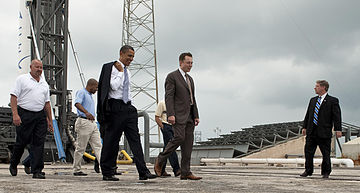
Elon Musk and then President Obama at the Falcon 9 launch site in 2010.
Agents of change are not always welcome. Seldom, in fact. Take Elon Musk, unquestionably an agent of change and not universally celebrated by his peers.
The public loves Musk, who has promised them pollution-free solar power, electric cars, space travel and an underground, intercity transport system called “Hyperloop,” in which they will be whisked in vacuum tubes on magnetic cushions at more than 800 miles an hour. He has hired Boeing to build the tunnels for the system.
More, Musk has attacked artificial intelligence and its use in weaponry as a threat to humanity. In this, he has fed into the general unease about artificial intelligence.
Recently, the chairman and chief executive officer of one of the largest electric-utility holding companies unloaded on me about Musk, accusing the inventor of being “dishonest,” “lying” and using fraudulent data in pushing SolarCity, his rooftop solar company. Also recently, a nuclear scientist with creative credentials denounced Musk to me as a showman, a media darling, a hoax and someone who had used too much government money, particularly at SpaceX, his reusable- rocket company.
The automobile industry wishes that Musk had stayed in his native South Africa rather than beginning a student odyssey, which saw him studying in Canada and at Stanford University before making his first fortune with PayPal.
It is true that Musk has used some debatable numbers. Three years ago, he told the Edison Electric Institute annual meeting that more electricity from solar panels could be generated from a nuclear power plant site than from the solar plant. That was a huge blooper: the equivalent of saying the economy of Liechtenstein is larger than that of the United States.
One expects people whose whole life is tied up in math, from rockets to electric cars, to get their sums right. Yet Musk glides on, like some blithe spirit, changing things as he goes. Changing them in fundamental ways.
And we should applaud his progress.
The arguments over Musk's creations end up as a battle between technological incrementalists and a disruptor. His critics are incrementalists, moving forward slowly and steadily.
Incremental change is the compound interest of technology. Look no further than today’s automobile to see how it has improved and changed incrementally over the years.
Then look to Musk and his Tesla: It is standing the automobile industry on its ear. So much so, The Economist magazine has heralded the death of the internal-combustion engine.
Change agents can be unsung heroes. James Watt was when he was creating the condenser that made steam power viable, and Bill Gates when he was helping to write the original Windows operating system, and Mark Zuckerberg when he was playing around with Facebook.
But by and large, hero inventors get the job done faster and with more ease. All the cited inventors found hero status later, but they might have gotten there faster with the public cheering them on — and loosening the financial strings — if they were known names with which to to begin.
Wall Street is cool to unsung inventors and cannot control itself when a name inventor goes to market. That is why Tesla has a larger market cap than General Motors, why Apple is the largest company in the world by some measures, and why Elon Musk and other celebrity inventors will shape our future faster and more dramatically than a lot of quiet evolvements.
Woe betide the technology-based industry that lacks a celebrity, a Pied Piper, to conquer the public imagination. Exhibit A might be the nuclear industry, which has achieved incredible things in making clean electricity through high science, but languishes today. Its last hero was Adm. Hyman Rickover, in the 1950s.
The book on celebrity invention could be said to have been written by one of the greatest American inventors: Thomas Edison.
He knew the power of a headline. His rival Nikola Tesla, less so.
Llewellyn King is executive producer and host of White House Chronicle, on PBS. His e-mail is llewellynking1@gmail.com. This first appeared in Inside Sources..
James P. Freedom: Free speech took a huge hit in Boston on Aug. 19
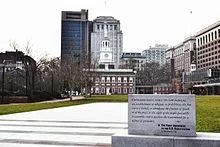
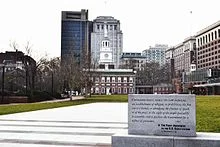
Monument to the First Amendment outside Independence Hall, in Philadelphia.
“If there is any principle of the Constitution that more imperatively calls for attachment than any other it is the principle of free thought — not free thought for those who agree with us but freedom for the thought that we hate.”
— The late Oliver Wendell Holmes Jr., U.S. Supreme Court justice
“We are so concerned to flatter the majority that we lose sight of how very often it is necessary, in order to preserve freedom for the minority, let alone for the individual, to face that majority down.”
— William F. Buckley Jr., founder of National Review magazine
Out in the grape-growing town of Delano, Calif., during a famous exchange captured on grainy color film at a public hearing in 1966, Sen. Robert F. Kennedy questioned Kern County Sheriff Leroy Galyen about labor strife affecting migrant farm workers and the arrests of 44 strikers and priests. Kennedy asked the sheriff: “How can you go arrest somebody if they haven’t violated the law?” Galyen responded: They’re ready to violate the law.”
Likewise, Boston public officials in advance of and during the Aug. 19's “Free Speech Rally” suppressed freedom of speech because speakers were ready to say something insensitive, perhaps even hateful. And local media condoned it.
Rally organizers were not ready to violate the law. In fact, all they intended was to exercise and express their constitutionally protected freedoms. Such as free speech.
Those freedoms, however, were ultimately too much too bear for Boston Mayor Marty Walsh, Boston Police Commissioner William Evans, and 40,000 so-called counter-protestors. (With impossible irony, they protested 40 “free-speech” advocates, barricaded like animals, on a bandstand on Boston Common.)
Before the free-speech rally Mayor Walsh stoked the counter-protest and condemned the group that was wrongly — and loudly — reported by media as being sympathizers with white supremacists. Among those guilty-by-false-association was John Medlar, who held the permit for Boston Free Speech Coalition, and is its spokesman.
Medlar, visually and vocally harmless, appeared on the WGBH program Morning Edition a day before the rally, dispelling what he called “misinformation about what we actually stand for.” He said, “If people are bringing overtly white supremacist symbols like swastikas or KKK flags or using the Nazi salute, we will disassociate ourselves from them.” Days in advance of the event the Boston Coalition rejected violence. It wrote on its Facebook page that the group was strictly about free speech: “We denounce the politics of supremacy and violence.” (The Boston rally was planned well in advance of the Charlottesville, Va., protests.) But these assurances mattered little to Boston officials.
America is itself supposed to be a free-speech zone but the free-speech advocates nonetheless had to obtain a permit for free speech, which was granted by the city with severe restrictions. A maximum of 100 people would be permitted entry (with no backpacks). Mayor Walsh went to the safe harbor of MSNBC four days before the rally and further articulated the restrictions (“no signs” and “no sound”). He also said he was “concerned with the message.”
Boston is subjective and selective when granting permits. Conservative-tinged groups such as the Tea Party and Boston Free Speech must obtain them but progressive-affiliated groups like Occupy Boston and counter-free speech groups are, interestingly, exempt from Boston’s high-minded indignation and moral preening. An example of Boston’s non-neutral public neutrality.
Mayor Walsh urged the public to stay away from the rally — lest they be offended — and he consulted with Southern Poverty Law Center for guidance on how to handle events involving white supremacists. He claimed it would be frustrating that vendors would lose business just “for five people to be able to spew hate.” And one commentator on Boston television reminded viewers, “there is no freedom of speech to incite violence.”
So what hateful speech (“the message”) was spoken on Saturday to incite violence?
No one knew.
Not only did Boston city officials suppress the expression of free speech but they also silenced dissemination of the content of that speech.
A Boston police directive, issued a couple of days before the event, read: “NO media personnel will be allowed inside the barricaded area around the Bandstand.” Additionally, media members were expected to “remain mobile and refrain from long term stationary reporting which may incite and attract participants.” What happened to that other vital First Amendment freedom? Like freedom of the press?
Boston media had to follow the official directive like obedient puppies, bowing to the fear-driven direction of their master, Mayor Walsh, who surely must have approved the police order. He therefore effectively imposed a journalistic blackout. And journalists accepted it.
Only in Boston can a hyper-progressive administration suppress a mostly progressive media into such pathetic submission. The order should have been vigorously challenged. Where was the outrage by media executives? How could Boston media accurately report a local event making national headlines without finding out the truth behind it? Instead, on Saturday, no mainstream Boston media could seek the whole truth.
That did not prevent wall-to-wall coverage — fake news? — of the unofficially sanctioned, media-ready counter-rallies. The mayor actually walked with counter protesters, who were unfettered by free-speech restrictions Many interviews with counter-protestors were broadcast (involving, at times, offensive background free speech, hateful signs, and backpacks). But the media were prevented from engaging with the free-speech participants. One television commentator on Boston’s Fox 25, wrongly declared the station was there to “cover every angle.” Except one critical angle: What the free-speech speakers were saying and doing. (No wonder conservatives rightly sense a left-leaning media bias.)
As a consequence, the public had to rely upon a YouTube video posted by a participant, recorded on the bandstand. That video showed no hateful speech (even if there were, that is constitutionally protected speech). And among their terrifying signs: “Black Lives Do Matter.”
The mayor, acting as if he had victoriously evacuated from Dunkirk, tweeted out: “Boston stood for peace and love, not bigotry and hate.” Except for several counter-protester bullies who harassed journalists, taunted and assaulted police (“Stupid black bitch, you’re supposed to be on our side”), and abused a woman holding an American flag. And responding to charges that some speakers were denied admittance, Commissioner Evans said at the post-rally press conference, “That’s a good thing because their message isn’t what we want to hear.” This is their close-minded, homogeneously-diverse, yet happy and harmonious, progressive Boston.
A post-mortem editorial in The Boston Globe, two days after the rallies, finally asked, “Why was media restricted from the bandstand?” Sarah Betancourt, writing for Columbia Journalism Review, raised important First Amendment concerns. She concluded that Boston officials “failed at protecting the media’s right to cover a newsworthy event.” She added that, “Journalists were blocked from witnessing and reporting on the very reason for the massive crowds.”
In 1860, nearly a hundred years before Bobby Kennedy’s questioning of Sheriff Galyen, Frederick Douglass, the eminent African-American human-rights leader, delivered “A Plea for Free Speech in Boston.” Douglass thought that the principle of free speech was “an accomplished fact.” He said, “There can be no right of speech where any man, however lifted up, or however humble, however young, or however old, is overawed by force, and compelled to suppress his honest sentiments. Equally clear is the right to hear. To suppress free speech is a double wrong.”
But the “mortifying and disgraceful fact,” Douglass stingingly observed then, “stares us in the face, that though Faneuil Hall and Bunker Hill Monument stand, freedom of expression is struck down. No lengthy detail of facts is needed.” The same must be said of Boston in 2017.
James P. Freeman, an occasional contributor to New England Diary, is a New England-based writer, former columnist with The Cape Cod Times and former banker. This piece first appeared in the New Boston Post. His work has also appeared in The Providence Journal and nationalreview.com.
Call the EPA
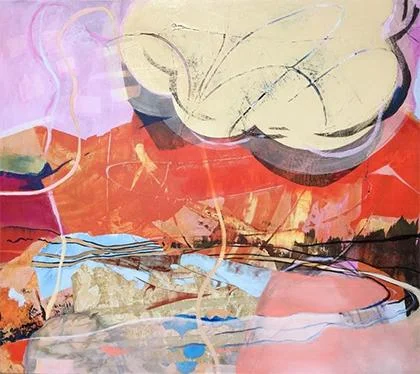
"Yellow Cloud'' (oil and collage on panel), by Jackie Reeves, in the group show "Speak My Language,'' at the Brickbottom Artists Association, Sept. 8-Oct. 14.
An old library's 'creature comfort'
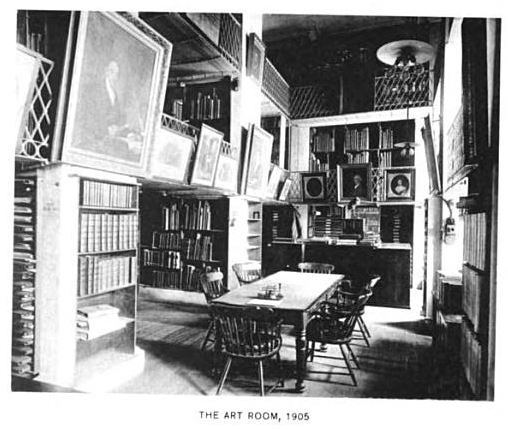
Inside the Boston Athenaeum.
"The high-ceilinged rooms, the little balconies, alcoves, nooks and angles all suggest sanctuary, escape, creature comfort. The reader, the scholar, the browser, the borrower is king.''
-- David McCord, about the Boston Athenaeum