
Vox clamantis in deserto


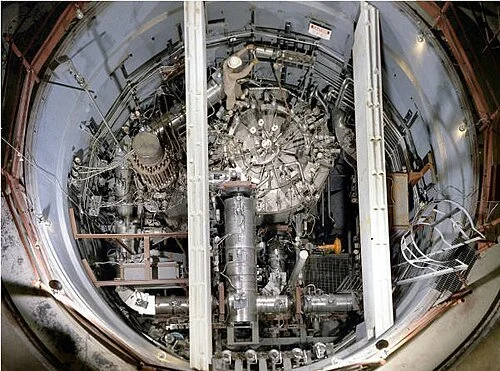




Hub hospital tries to stop 'tailgating'
Brigham and Women's Hospital, in Boston, tries to stop dangerous 'tailgating.'' Read about it by hitting this link.
Hosting a Chinese propaganda agency

Hassenfield Common and the Unistucture & Globe Dome at Bryant University, in Smithfield, R.I. Bryant has a unit of China's controversial Confucius Institute on its remarkably attractive modernistic campus.
Adapted from Robert Whitcomb's "Digital Diary,'' in GoLocal24.com
As the United States withdraws from speaking out for human rights and democracy, the Chinese dictatorship moves in with piles of money. That money is already having sad effects.
Consider that Greece has vetoed a European Union statement denouncing Chinese human-rights abuses in the wake of Greece recently getting billions of dollars in infrastructure investments from Beijing. Croatia and Hungary (the latter run by a semi-fascist president), also the beneficiary of massive Chinese spending, have also blocked E.U. statements on Chinese actions, including China’s attempt to take over the entire South China Sea. Each E.U. nation has veto power over statements meant to be the official E.U. position.
Here at home we have the Confucius Institute problem. The Institute is affiliated with China’s Education Ministry and hasthe official aim to promote Chinese language and culture. But it is really a propaganda and intelligence office, a handy base for industrial and other espionageand a sturdy platform for the increasingly aggressive and expansionist dictatorship to keep in line Chinese students studying abroad. Their very presence tends to constrain intellectual freedom regarding things Chinese.
Some U.S. colleges and universities, such as Rhode Island’s Bryant University, have partnered with the Institutesatellites for the money and business connections they provide after they set up shop on American campuses. These Confucius Institute operations provide free (to the colleges) teachers and textbooks and cover operating costs. Some administrators and faculty members like them because they help bring in full-tuition-paying Chinese students and provide freeand luxurious junkets to China to some administrators and faculty members. Such operations are inappropriate on American college campuses.
Rachelle Peterson, director of research at the National Association of Scholars, a conservative group, has accurately complained: “Confucius Institutes export the fear of speaking freely around the world. They permit a foreign government to have intimate influence over college classrooms. It’s time to kick them off campus.’’ Ms. Peterson quoted former Chinese Communist Party propaganda chief Li Changchun as calling the on-campus Confucius Institute satellites “an important part of China’s overseas propaganda efforts.’’
Less is more

"This simple summer day
Of not too much to do
May be the one
We look back on
When years have swirled away
And days like these are few.''
-- From ''One Day,'' by Alfred Nicol

The vanity of human constructions

-- Photo by Charles Pinning
One of my father’s ways of showing his love for his family was to build things of quality and permanence, things that he had had precious little of growing up.
The swing set in our backyard didn’t lift or shift, no matter how hard you swung, because my father built it himself out of iron pipe, sinking all four posts into the ground and encasing them in cement. He did the same to support the roof he built over the patio, and when he decided to erect a flagpole in the front yard, iron, steel and cement were materials of choice.
I don’t recall any discussion about putting in the flagpole, rather that it just started going up one day. Some of our neighbors had flagpole holders affixed on the front of their houses, but we were the only ones on our street with an actual flagpole in the front yard.
I felt embarrassed when I saw what my father was up to. Even as a 10-year old, I thought it over-the-top to have something that would be more at home in front of the White House than standing in front of our modest Cape Cod-style dwelling.
I do remember my father being very ingenious about how he engineered the project. He set the four-foot-high I-beam steel base in cement. He let me write my name with a twig in the cement. The next day he took his white-painted (carefully primed and then covered with three coats of enamel) steel pole with the gold ball on top—the thing had to have been 20 feet tall—and he attached it to the base, running two thick bolts through the base and pole, and then he hoisted the thing vertical with the block and tackle that you use to run up the flag, tightened the bolts, and voila!—we had Newport’s most imposing residential flagpole.
For awhile, the flag was run up and down daily, but that finally sputtered out because my father insisted that the rules of raising, lowering and folding it be adhered to, and Good Lord, even though he was in the military, his wife and children weren’t.
My older brother was a Boy Scout and got into the whole flag bit for a while, but even he eventually tired of it. The whole thing humiliated me. I recognized that this was just too much of a display of patriotism. Wasn’t it enough to live in the United States and be a good citizen? Did you really have to have this huge flagpole in front of your house?
Nonetheless, the durability of the setup was not lost on me, like the swing set and the patio roof. I admired my father’s diligent workmanship, but unfortunately, it over-influenced my adult life.
Early in my first marriage, there was the badminton net I was going to put up on the front lawn of my in-law’s house. I went to the lumber yard and bought two really beefy wooden posts, big enough to support a heavy fence, and using a post-hole digger, sunk them into the front yard. When my mother-in-law set eyes upon them she rightly said that they had to come out.
Can you imagine? Preparing a badminton court that would survive all but an aerial bombing! And then there was the exterior door I salvaged off the street to put in the doorway to the study of my New York apartment. The thing weighed at least a hundred pounds. What was I thinking?
I recently drove back to Newport and pulled up in front of my boyhood home. The flagpole was gone, but damned if that I-beam base wasn’t still there. The current owners had a bird bath mounted on top of the base.
Feeling around the bottom of it, I pulled back some grass and found the cement and my etched name. My fingertips grazing lovingly over this ruin of ancient Newport revealed all that is ever permanent about the past -- the intent of what we build. (See photo above.)
Charles Pinning is a Providence-based writer.
A sustainable fire hazard
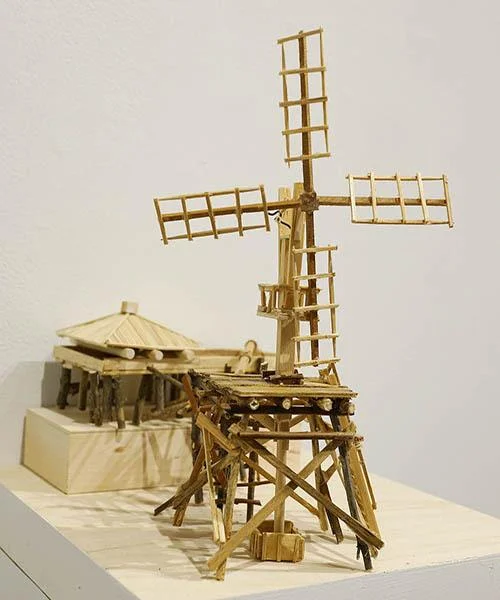
"Corporation Beach'' (toothpicks and wood scraps), by Jennifer Day, in her show "Small Business,'' at Bromfield Gallery, Boston July 5-30. Using wood, she creates dioramas of machinery and vehicles to show the application of medieval technology to modern sustainable energy.
David Warsh: Disillusionment in America and the former Soviet Union
The economics and politics of disillusionment in two nations
Elaine Scarry, an essayist and literature professor, long ago suggested that, in counterpart to the ingenious system of government framed by the Declaration of Independence and the Constitution, the United States also possessed a material constitution, consisting of the technological systems of the nation and no less remarkable than the political structure for being evolved in practice rather than written down.
Riffing on Scarry’s conception, historian of technology Thomas Hughes noted the tendency to take the latter for granted. The intellectual historian Perry Miller had already observed, in The American Scholar, how casually Americans “flung themselves into the technological torrent, how they shouted with glee in the midst of the cataract, and cried to each other as they went headlong down the chute, that here was their destiny….”
Now, Hughes wrote, with technological momentum accelerating, Americans needed to learn to see themselves as a nation of system builders as well as practitioners of their subtle arrangements of political democracy and free enterprise. American Genesis: A Century of Invention and Technological Enthusiasm (Viking, 1990), Hughes’s classic study of the engineering of the key inventions of the century after 1870 – incandescent light, the telephone, the radio, the airplane, the automobile, electric power – was motivated by a concern for the overlooked burdens that technological enthusiasm frequently imposed. Forty years after the development of modern financial markets for corporate control, containerization, microprocessors, personal computers and the Internet, Hughes’s attentiveness to the sudden eruption of a culture of critique, seems especially prescient: “the organic instead of the mechanical; small and beautiful technology, not centralized systems; spontaneity instead of order; and compassion, not efficiency.”
For the last six months, I have been dipping into the burgeoning literature of disillusionment, trying to understand the Trump election: Evicted: Poverty and Profit in the American City, by Matthew Desmond; Hillbilly Elegy: A Memoir of a Family and Culture in Crisis, by J. D Vance; Janesville: An American Story, by Amy Goldstein; Strangers in Their Own Land: Anger and Mourning on the American Right, by Arlie Russell Hochschild, and Doctored: The Disillusionment of an American Physician, by Sandeep Jauhar. The book I read all the way through was Glass House: The 1% Economy and the Shattering of an American Town (St. Martin’s, 2017), by Brian Alexander.
Glass House is about Lancaster, Ohio, and the Anchor Hocking Glass Co., upon which the city’s fortunes were built – and then eventually dissipated by rich New Yorkers – over the course of the 20th Century. At a little more than 300 pages, you might think that Glass House is more than you want to know about a little city on the Hocking River, southwest of Columbus, in the foothills of the Allegheny Mountains. But Alexander grew up in Lancaster in the 1970s, has stayed in touch (he lives in California now) and, as a highly capable magazine writer, he moves the story along with the force of a novel, interweaving the saga of the business itself with the lives of four friends.
It helps that his tale has plenty of colorful signposts along the way: the Ku Klux Klan in Lancaster in the 1920s; Malcolm Forbes in the early 1940s (his father bought him a newspaper there as a Princeton graduation present); Carl Icahn, (a key Donald Trump adviser today) who in 1983 put Anchor in play; Newell Corp., the vagabond manufacturing firm that in the 1980s rolled up Anchor into a giant conglomerate on the strength of a loan from an Arizona savings andloan association; Cerberus, the private-equity firm organized by Stephen Feinberg (another close Trump adviser today) that bankrupted Anchor; Sam Solomon, the African-American scion of North Carolina farmhands, who, as newly appointed CEO, seeks to save Anchor, now branded as EveryWare Global (Anchor survives, barely, Solomon is fired but becomes the hero of the book).
The leitmotif: at each step along the way, Alexander describes the succession of new drug products that began to plague Lancaster, starting in the 1970s: marijuana, cocaine, heroin, methamphetamine, Percocet, OxyContin, and Xanax. The greatest charm of Glass House is that its trajectory since the 1980s resembles that of almost any other Middle American manufacturing city you can think of.
Between times, I have been reading Secondhand Time: The Last Days of the Soviets, An Oral History (Random House, 2016), by Svetlana Alexievich, the 69-year-old Belorussian author who was recognized with the Nobel Prize for Literature in 2015. The book is not easy reading. Like four other “documentary novels” that Alexievich has written over 30 years, chronicling the lives of ordinary citizens of the former Soviet Union since World War II, it consists of a series of collages composed of interviews (“snatches of street noise and kitchen conversations”) with hundreds of characters, some of whom appear and reappear as in any good Russian novel.
The differences between Secondhand Time and Glass House are instructive, the differences between literature and journalism. Secondhand Times begins with a timeline, six pages briefly describing events from the death of Josef Stalin, in 1953 to the Maidan protests, in Kiev, in 2014. Then for 350 pages, consciousness swirls. Alexievich writes:
“The Soviet civilization…. I’m rushing to make impression of its traces, its familiar faces. …The myriad sundry details of a vanished way of life. It’s the only way to chase the catastrophe into the contours of the ordinary and try to tell a story.’’
The triumph of Secondhand Time is to make more understandable how many present-day Russians and others living in former Soviet jurisdictions can feel affection for a system that produced so much misery and permitted so little of the freedom that the Westerners take for granted. Consider the top-down coup that was the Bolshevik Revolution, the Russian Civil War, the murderous collectivization of agriculture, famine, the purges, the Gulag and then the gradual discovery of the awful history that had been hidden.
“Despite the poverty, life was freer” in some respects under communism, Alexievich told Guy Chazan of the Financial Times over dinner last month in Berlin. “Friends would gather at each other’s houses, play the guitar, sing, talk, read poetry.” When democracy came, she said, they expected that everyone would read Solzhenitsyn. Sure enough, with glasnost, Solzhenitsyn’s works were all published in the former Soviet Union, but no one any longer had time to read them. “Everyone just ran past them and headed for twenty different kinds of biscuits and ten varieties of sausage.” The book is about disillusionment plus – how great was the loss of the Great Idea.
I can’t read Alexievich, or any other source on Russian history, without experiencing an overwhelming sense of gratitude for having been born a citizen of the United States. But, as I read Johnson’s Russia List, the indispensable almost-daily chronicle of what the Russians are saying about themselves, it is clear that Russians are gradually coming to grips with their history (Alexievich being a prime example).
There’s no doubt that the government of Russia unwisely sought to underhandedly tamper with the machinery of American democracy in the 2016 election. They didn’t succeed. The Constitution of the United States, both the familiar version enshrined in law and the less-familiar material version, assure that America, for all its sorrows, continues to insure domestic tranquility – more reliably, perhaps, than you think.
David Warsh, a veteran economic historian and columnist on financial, political and historical affairs, is proprietor of economicprincipals.com, where this first ran.

As it speeds by

"Study in Time'' (photo collage), by Jamie Cascio, in the group show ''TIME: Brickbottom Artists Association Members' Exhibition,'' July 13-Aug. 19. Its gallery is in Somerville, Mass.
The curator writes:
"Time's Up, Time Out, Time Warp, Timeless -
"Time presents itself in drama, music, photography, philosophy, science...and life. It's connected to change, growth, mortality and decay. We mark it, track it, keep it, bend it, save it, lose it and waste it. It passes, drags, floats, and flies, but what is time? This summer, the Brickbottom Gallery members' explore this elusive concept.''
FRA's Md. railroad bridge ruling upsets Amtrak bypass-route foes
By ecoRI News staff (ecori.org)
HAMDEN, Conn.
A June 26 announcement by the Federal Railroad Administration (FRA) that the $1.1 billion Susquehanna River Rail Bridge Project on the Northeast Corridor in Maryland poses “no significant impact,” drew sharp rebuke from Daniel Mackay, executive director of the Connecticut Trust for Historic Preservation, who warned that such a decision could set an unacceptably low bar for mitigating historic, cultural and environmental resource impacts from future high-speed rail projects in Connecticut.
The proposed rail bridge replacement project bisects the National Register-listed Havre de Grace Historic District in Maryland, comprised of some 1,000 historic structures, many from the 18th Century, on the banks of the Susquehanna River, according to a recent story in The Baltimore Sun.
“FRA determined that the most comprehensive level of environmental review was not needed for this $1.1 billion dollar rail project in the midst of a historic coastal community in Maryland,” Mackay wrote in a recent press release. “Connecticut and Rhode Island communities caught in the cross-hairs of FRA’s bypass proposals should be concerned for the signal sent by this Maryland project — the process ahead may not yield the protections that communities want for themselves.”
Since the FRA released draft plans on Nov. 15, 2015 to expand new high-speed railroad corridorsacross coastal Connecticut and Rhode Island, under a federal planning process called NEC Future, the Connecticut Trust and its grassroots partner, SECoast, have led a campaign to counter FRA’s “insensitive approach to transportation planning for the Northeast Corridor routes through Connecticut.”
“FRA’s plan represents a once-in-a-generation decision that will fundamentally shape the communities, economies and ecology of coastal southern New England,” according to Gregory Stroud, director of special projects at the Connecticut Trust and co-founder of SECoast. “The only sure way to protect our communities from these types of impacts is to fully remove these projects from the Record of Decision.”
The FRA is expected to announce a long-delayed record of decision for NEC Future this summer, finalizing a blueprint for the Northeast Corridor that will shape infrastructure decisions and investment through 2040, or later.
The current blueprint has been in place since a similar process was completed in 1978. The Northeast Corridor, which connects cities between Washington, D.C., and Boston, is the nation’s busiest rail corridor.
Summer drinking

Sailor from USS Nitze competes in the cod race during Fourth of July celebration in Eastport, Maine in 2011.
'"O high New England summer, warm
and fortified against the storm
by nightly nips you once adored,
though never going overboard....''
-- From "Fourth of July in Maine,'' by Robert Lowell
Chris Powell: Connecticut's state government helps create urban poverty
For many years state government has been obsessed with making taxes and spending add up without much regard to what government actually produces.
Few in authority have noticed that despite the desperate efforts with arithmetic, Connecticut has been declining steadily. While the state auditors of public accounts often expose the ordinary management failures of particular agencies, no one in authority has tried to audit Connecticut on a comprehensive scale.
But a few months ago a scholar with the Manhattan Institute, Stephen D. Eide, working with the Yankee Institute, Connecticut's foremost public-policy research organization, produced a few lines of data that may be all the audit Connecticut needs.
For a study titled "Connecticut's Broken Cities," Eide took U.S. Census Bureau figures for Connecticut's four largest cities -- Hartford, New Haven, Bridgeport and Waterbury -- to calculate the changes in the poverty of their populations from 1970 to 2014.
Eide found that poverty had exploded. Hartford's population fell 21 percent but its number of poor people rose by 56 percent. New Haven's population fell 5 percent but the number of its poor rose 41 percent. Bridgeport's population fell 6 percent but the number of its poor rose 86 percent.. Waterbury's population rose marginally, by 1.7 percent, but its poor rose by an extraordinary 154 percent.
That is, during the last five decades Connecticut's cities have been turned into poverty factories. Government policy has only increased poverty and social disintegration in the cities, not reduced it.
Ordinarily such policy might be considered a catastrophic failure. But since these results have been produced for so long without causing any change in policy or even reconsideration, another possibility must be acknowledged: that Connecticut intends to create poverty. After all, poverty creates dependence on government; dependence on government creates political power; and administering poverty creates lucrative business for government and its agents in what are called social services and criminal justice.
Eliminating poverty would destroy that political power and lucrative business. Of course poverty has many destructive and unattractive effects, and if the people whose taxes pay for poverty policy saw those effects up close, they might raise questions.
So with exclusionary zoning, dressed up with noble-sounding terms like open space and farmland preservation, and with the concentration of rent subsidies, Connecticut has confined most of its poverty to the cities, largely out of sight.
But now the poverty business -- welfare, child protection, rent subsidies, Medicaid, criminal justice, remedial education and so forth -- along with government employee pensions, are cannibalizing the rest of state government, and the General Assembly and the governor lately have not been able to enact a budget.
Taxpayers are noticing. So the managers of the poverty business are raising distractions, trying to deter questions. When the state Education Department's program supplying free meals to schoolchildren during the summer reopened the other day, its executive director said the program is needed because many employers fail to pay a "living wage."
That is, Ronald McDonald, the Burger King and Wendy the Hamburger Girl have induced people to have children they were never prepared to support after they graduated from high school without mastering high school work, confident that government would provide. Kids have to be fed but government itself is making more of their parents unfit to feed them.
Chris Powell is managing editor of the Journal Inquirer, in Manchester, Conn.
Do Canto recognized for helping restore Grand Banks schooner
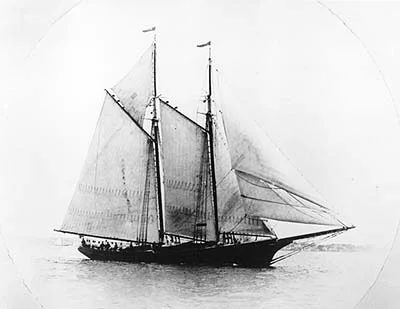
The Ernestina-Morrissey in its heyday. It was launched in 1894.
From the New England Council (https://newenglandcouncil.com/)
"Licy Do Canto, founder and president of NEC member the Do Canto Group, was recently recognized for his work leading the restoration of the Ernestina-Morrissey, the oldest surviving Grand Banks fishing schooner.
"Licy Do Canto serves as Chairman of Massachusetts’ Schooner Ernestina Commission, which is in charge of overseeing the $6.3 million historical preservation of the Schooner Ernestina-Morrissey. The Ernestina- Morrissey serves as the flagship vessel of the state of Massachusetts and Department of Conservation and Recreation (DCR). Officials at the DCR are looking into the possibility of utilizing the ship for educational opportunities for students, including those at the Massachusetts Maritime Academy, once the restoration project is complete. Do Canto hopes to highlight the schooner’s history of carrying immigrants to the United States, such as his own grandmother who emigrated to the United States abroad the Ernestina-Morrissey. The Ernestina-Morrissey was the last sailing ship to have regular service carrying immigrants to the United States, largely from Cape Verde.
“'The state has this opportunity to embrace this vessel for what it is, and the rich culture and history it reflects,' said Do Canto.
"The New England Council thanks Do Canto for his work towards preserving an important piece of history for New England. '' For more information, hit this link.
Fusing tourism and town life
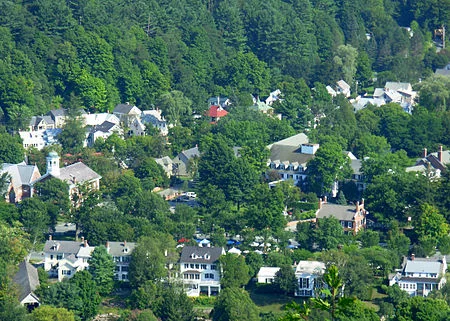
Woodstock, Vt.
''It looked like the set for an Andy Hardy movie - things quaint in the manner of Norman Rockwell...Maybe the town wasn't the prettiest village in America, but if the townspeople wanted to make the claim, I wouldn't have disputed them. It was Woodstock, Vermont.
"....the village lived by the tourist - the well heeled tourist. But few places in the country fused tourism and town life so well. In Woodstock, they were parts of the whole.
"If the village had a fault, it lay in both a hubris about its picturesqueness and in its visitors with new money and new facades...."
-- From William Least Heat-Moon's Blue Highways
Sculpture from space in the Berkshires

"Crystal'' (wood and zinc-coated copper), by Thomas Schutte, in his show "Crystal at the the Clark,'' at the Clark Art Institute, Williamstown, Mass., through Oct 31.
Mr. Schutte is best known for large-scale sculptures of figures that reimagine the role of statuary and monuments. This installation is in a meadow near the top of Stone Hill, close to the edge of woodland. He got the idea for the unusual asymmetrical shape by thinking of a small piece of crystal scaled up to architectural proportions. He seems to have sought to create a sense that space aliens had landed in the Berkshires.
Upon having our swelter quota
"Our fear of death is like our fear that summer will be short, but when we have had our swing of pleasure, our fill of fruit, and our swelter of heat, we say we have had our day."
-- Ralph Waldo Emerson
July a foggy month along the coast
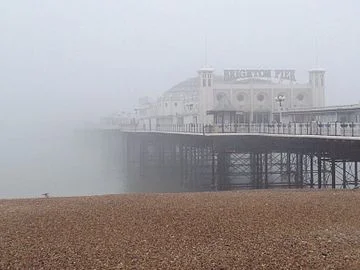
''July can be the foggiest time of the year, as residents of the New England coastal areas know well. Many summer vacationers, attracted by the refreshing coolness of the ocean breezes, complain when sea fog obscures the sun and spoils a beach day for sun-bathing and swimming. {That's because} in July the greatest contrasts exists between the relatively cool ocean waters and the hot air masses from the continent.''
From The Country Journal New England Weather Book, by David Ludlum

Llewellyn King: Trump's staggering ignorance about the energy sector

Two things are reverberating around the energy world. One is President Trump’s announcement that it is U.S. policy to seek energy “dominance,” and the other a projection by Lisa Wood of the Institute for Electric Innovation at the Edison Foundation that by 2025 there will be 7 million electric vehicles on the road.
Let us take them sequentially. In talking about energy dominance the president is acting like a man in a gorilla suit, thumping his chest and making strange noises that can only be understood by other men in gorilla suits.
The goal of every president, from Nixon on, has been to make the United States energy self-sufficient, as it was at the end of World War II — a time when Texas was the Saudi Arabia of fossil fuel and world oil consumption was modest. Now world consumption hovers around 95 million barrels a day and U.S. consumption around 20 million barrels a day.
The government-imposed fleet-mile standards have done much to improve mileage and curb U.S. energy appetite. With that program nixed by Trump and low prices, U.S. consumption might for a while edge up slightly.
The big change has been hugely increased production of oil and gas from shale in the United States through hydraulic fracturing, called “fracking,” of very tight formations.
It is this that allows Trump and Secretary of Energy Rick Perry to talk of “dominance,” undiplomatic and even offensive as such language must seem. It is as though Trump policy is to kick sand in the face of anyone who might be a customer in the future or who bailed us out in the past. In the lexicon of ill-considered words in relations with allies and customers, “dominance” must be right up there.
Oil and natural-gas abundance has changed everything where hydrocarbons are concerned and has even affected nuclear power. Natural gas is cheap, so cheap that it is cheaper than coal or nuclear for electric generation. The president might love coal and coal miners, but even relaxing environmental rules will not save coal domestically though exports will continue.
India and China, which burn vast quantities of coal and may have to burn more, would like to get off it. Their cities are choking on bad air and the health of their people is being harmed. That is why they are the new hope for nuclear generation.
The market is against coal as is public opinion. King Coal is due to abdicate and the men in the gorilla suits cannot save his throne.
Enter the electric car as another game-changer, slowly at first, then very fast.
The projection by the Edison Foundation’s innovation arm that electric-car deployment would reach 7 million vehicles by 2025 should encourage a new interest in the utility sector because it is the electric car that looks likely to change domestic demand for oil, freeing more of it for export. If charging stations can be deployed quickly enough, the 7 million figure may seem modest.
Natural gas is already an export commodity with 16 permits for terminals issued under the Obama administration.
If Trump and Perry want the United States to continue to be out in front in energy, they might think hard about how the fracking miracle came about. Call it the 40-year cycle: It took about 40 years of trial and error to unleash the bounty of close-formation gas and oil. It also took a lot science, a lot of government-backed geology and one brave entrepreneur, George Mitchell of Mitchell Energy & Development Corp. to bring it off. The government poured the science in everything from new design drill bits to 3-D seismic and GPS mapping; oil-field know-how came from Mitchell.
Likewise, with wind and solar technology, the wind turbines and solar panels being deployed today were first investigated, again with a lot of taxpayer money, back in the 1970s at such government laboratories as Sandia in New Mexico. I know: I covered the first faltering steps.
The point here is that to lead or, if you prefer, to dominate in energy you need patience, science and funding endurance. Trump and Perry are starting their quest to world “dominance” by slashing the research budget of the Department of Energy and doing away with ARPA-E, the super-reach arm of the agency.
It is not a strategy for staying out front, for dominating for very long.
Llewellyn King (llewellynking1@gmail.com) is host of White House Chronicle, on PBS, and a veteran publisher, editor. columnist and international business consultant, mostly specializing in energy-related matters. He's based in Washington, D.C., and Rhode Island. This piece first ran in Inside Sources.
Video: Partners CEO discusses impact of GOP insurance legislation
Video: See this New England Council interview with David Torchiana, M.D., president and CEO of Partners HealthCare, the biggest hospital system in New England, on the possible impact of Republican health-insurance legislation on, among other things, the Bay State. To see the video, please hit this link.
Amazon's Whole Foods takeover: Automation will be the job killer

A Whole Foods store in Boston.
From Robert Whitcomb's "Digital Diary,'' in GoLocal24.com:
Amazon’s plan to buy Whole Foods has elicited a lot of heavy breathing and assertions that Amazon will wipe out a lot of grocery stores. I thinkthat these forecasts are exaggerated. Groceries – stuff that can rot – are not the same things as books and clothes. The distribution challenges are very different.
Most people will continue to drive or walk to a regular (not high-end, expensive “organic”) supermarket or small grocery store for the foreseeable future. Inflation-adjusted wages have been falling for most people. The market for expensive (and some would say pretentious) food is unlikely tovastly expand. For all its alleged glamour, most people don’t shop at the expensive likes of Whole Foods – and never will.
An Amazon-Whole Foods mating might work very well in densely populated affluent areas with a close enough proximity to warehouses to ensure that the stuff can be delivered unspoiled to Amazon-Whole Foods supermarkets or to your home. But it wouldn’t work well in thinly populated areas.
Finally, even in this plutocratic age, it’s possible that the Federal Trade Commission and the U.S. Justice Department will awake from their all-too-frequent torpor and press monopoly charges against the company if it tries to take over a big hunk of the grocery business.
Anyway, I’m more worried about the effects on employment and wages of the automation of cashier and other jobs now underway in many kinds of stores than about Amazon specifically (I always use cashiers, not those machines, in a tiny effort to help preserve jobs.) And I worry about the effects on local tax revenue and jobs from so many stores of all kinds closing because of the online revolution.
'Only different grown'
Once more on the fallow hillside, as of old, I lie at rest
For an hour, while the sunshine trembles through the walnut-tree to the west,—
Shakes on the rocks and fragrant ferns, and the berry-bushes around;
And I watch, as of old, the cattle graze in the lower pasture-ground.
"Of the Saxon months of blossom, when the merle and mavis sing,
And a dust of gold falls everywhere from the soft midsummer's wing,
I only know from my poets, or from pictures that hither come,
Sweet with the smile of the hawthorn-hedge and the scent of the harvest-home.
"But July in our own New England—I bask myself in its prime,
As one in the light of a face he loves, and has not seen for a time!
Again the perfect blue of the sky; the fresh green woods; the call
Of the crested jay; the tangled vines that cover the frost-thrown wall:
"Sounds and shadows remembered well! the ground-bee's droning hum;
The distant musical tree-tops; the locust beating his drum;
And the ripened July warmth, that seems akin to a fire which stole,
Long summers since, through the thews of youth, to soften and harden my soul.
"Here it was that I loved her—as only a stripling can,
Who dotes on a girl that others know no mate for the future man;
It was well, perhaps, that at last my pride and honor outgrew her art,
That there came an hour, when from broken chains I fled—with a broken heart.
"'T was well: but the fire would still flash up in sharp, heat-lightning gleams,
And ever at night the false, fair face shone into passionate dreams;
The false, fair form, through many a year, was somewhere close at my side,
And crept, as by right, to my very arms and the place of my patient bride.
"Bride and vision have passed away, and I am again alone;
Changed by years; not wiser, I think, but only different grown:
Not so much nearer wisdom is a man than a boy, forsooth,
Though, in scorn of what has come and gone, he hates the ways of his youth.
"In seven years, I have heard it said, a soul shall change its frame;
Atom for atom, the man shall be the same, yet not the same;
The last of the ancient ichor shall pass away from his veins,
And a new-born light shall fill the eyes whose earlier lustre wanes.
"In seven years, it is written, a man shall shift his mood;
Good shall seem what was evil, and evil the thing that was good:
Ye that welcome the coming and speed the parting guest,
Tell me, O winds of summer! am I not half-confest?
"For along the tide of this mellow month new fancies guide my helm,
Another form has entered my heart as rightful queen of the realm;
From under their long black lashes new eyes—half-blue, half-gray—
Pierce through my soul, to drive the ghost of the old love quite away.
"Shadow of years! at last it sinks in the sepulchre of the past,—
A gentle image and fair to see; but was my passion so vast?
"For you," I said, "be you false or true, are ever life of my life!"
Was it myself or another who spoke, and asked her to be his wife?
"For here, on the dear old hillside, I lie at rest again,
And think with a quiet self-content of all the passion and pain,
Of the strong resolve and the after-strife; but the vistas round me seem
So little changed that I hardly know if the past is not a dream.
"Can I have sailed, for seven years, far out in the open world;
Have tacked and drifted here and there, by eddying currents whirled;
Have gained and lost, and found again; and now, for a respite, come
Once more to the happy scenes of old, and the haven I voyaged from?
"Blended, infinite murmurs of True Love's earliest song,
Where are you slumbering out of the heart that gave you echoes so long?
But chords that have ceased to vibrate the swell of an ancient strain
May thrill with a soulful music when rightly touched again.
"Rock and forest and meadow,—landscape perfect and true!
O, if ourselves were tender and all unchangeful as you,
I should not now be dreaming of seven years that have been,
Nor bidding old love good-by forever, and letting the new love in!''
-- "The Old Love and the New,'' by Edmund Clarence Stedman