
Vox clamantis in deserto







Sunny-side up

"Jessie's Diner'' (oil on linen), by Andrew Stevovich, at Adelson Galleries, Boston.
Tim Faulkner: Southern New England gas-pipeline project suspended
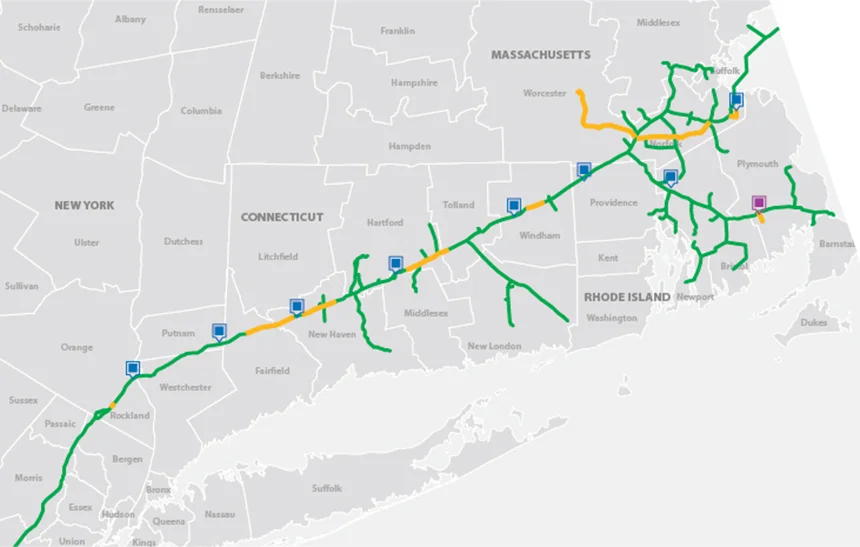
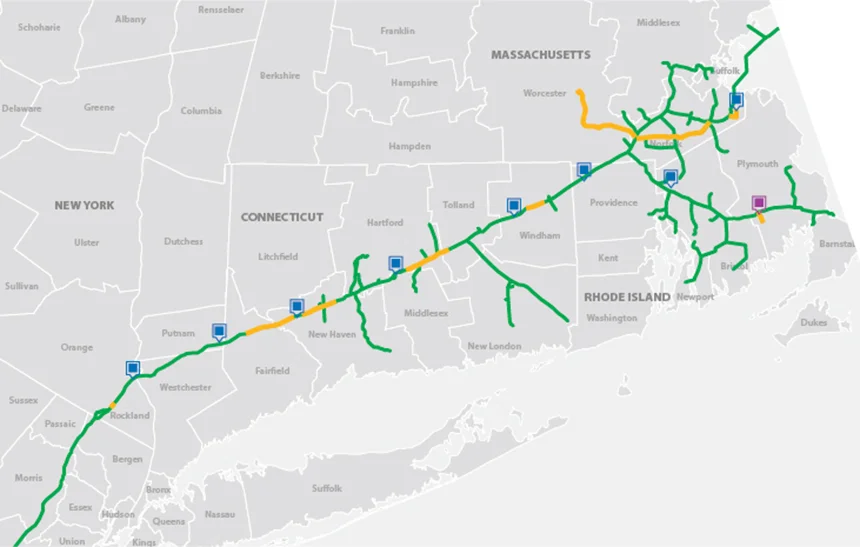
The Access Northeast project
-- Map by Access Northeast
Via ecoRI News (ecori.org)
A natural-gas-infrastructure project slated for southern New England came to a screeching halt June 29, when Houston-based Spectra Energy Partners announced it is suspending the controversial Access Northeast project.
The buildout of the Algonquin natural-gas pipeline centered on a series of extensions and nine compressor station projects between New York and Massachusetts, including a new compressor station in Rehoboth, Mass., and the expansion of a compressor station in Burrillville, R.I.
The 10,320-horsepower Rehoboth compressor station was proposed for a privately owned 120-acre site close to Attleboro and Seekonk, Mass., and Pawtucket, R.I., and about 10 miles from downtown Providence.
Access Northeast was a shared effort by Spectra, National Grid and Eversource. The project was one of several that resulted from a December 2013 agreement between all six New England governors that allowed the states to share the costs of regional energy projects. The effort hit a snag in late 2016, when the Massachusetts Supreme Judicial Court rejected a plan by the three companies to charge electric ratepayers for the natural-gas projects. The demise of the so-called “pipeline tax" put the Access Northeast and other proposed pipeline upgrades in limbo and prompted other New England states to suspend or reject similar funding schemes.
The Access Northeast project provoked stiff local criticism and the formation of opposition groups such as Citizens Against the Rehoboth Compressor Station (CARCS), The FANG Collective and Burrillville Against Spectra Energy.
Opponents united over heath, safety and environmental risks such as air and water pollution, fires and explosions, noise, climate-change impacts, and the notion that the projects helped the export of natural gas from hydraulic fracturing fields in Pennsylvania and Ohio to coastal terminals in or near New England.
News of the canceled project was announced via an e-mail to municipalities hosting projects. The opposition groups were quick to responded to the announcement that Spectra withdraw the Access Northeast application.
“This victory is owed to all of the frontline communities who have been resisting Spectra across the Northeast, and to those who have put their bodies on the line as part of direct actions to stop Spectra," said Nick Katkevich of The FANG Collective, a Providence-based environmental activist group that was founded in reaction to a previous expansion of the Burrillville compressor station.
Katkevich and other activists say there are still many more southern New England projects to oppose, such as Spectra’s Atlantic Bridge project, which includes a bitterly contested compressor station in Weymouth, Mass.
“We must remain ever vigilant since Rehoboth hosts miles of transmission lines which makes us particularly vulnerable,” said Tracy Manzella of CARCS. “We agree and support the messaging from all the other anti-pipeline groups."
Manzella sees bigger forces to reckon with, such as fossil-fuel-friendly policies advanced by the operator of the New England power grid, ISO New England, and Massachusetts Gov. Charlie Baker.
“CARCS will not rest in its resistance to pipeline expansion here or anywhere, not until we have safely made the transition to clean renewable energy and the window of opportunity for these greedy companies to use us for their profit taking is past," she said.
Access Northeast is the second canceled pipeline project. In March 2016, fossil-fuel developer and pipeline owner Kinder Morgan scrapped its proposed $3 billion, 188-mile Northeast Direct pipeline planned for the northern edge of Massachusetts.
“Spectra recognized that their deep pockets were no match for grassroots power," said Craig Altemose, executive director for 350 Massachusetts for a Better Future. "It’s only a matter of time before other fossil-fuel companies come to the same realization. We look forward to Spectra similarly abandoning their plans for the similarly offensive and unnecessary Atlantic Bridge project.”
Tim Faulkner writes frequently for eco RI News.
Job openings at Boston's biggest weekly
Boston’s largest-circulation weekly newspaper is looking for one or more hard-news reporters with experience in complex urban issues (development, zoning, transportation, etc.)
Must have a minimum of one year’s experience beyond college and already live in Boston or a contiguous city.
Please email resume and three hard news clips to:djacobs@thebostonguardian.com
Compensation is commensurate with experience.
David Jacobs
Publisher/Editor
The Boston Guardian
And it used to be frozen

"Bay Odyssey'' (watercolor), by Stoney Conley, at the Patricia Lloyd Carega Gallery, Center Sandwich, N.H.
Felines are finer

Do your friends want to reform you?
Do they try to mend your ways?
Do they prod you to get moving:
Jog, recycle, fill your days,
Start your own organic garden,
Eat more carrots, eat less fat?
Well, there’s always my solution --
Blow them off, and get a cat.
''Better Company,'' by Felicia Nimue Ackerman
'Relax and just recover'

"Seaweed,'' (photo) by Bobby Baker (copyright Bobby Baker Fine Art).
"On the seawall walking,
As the seagulls squawk.
I'm tossing rocks in the water,
But the birds think it's fish that I feed!
"On the sand I see a crab,
Digging deeper with its pinchers...
Moving tiny bits of pebbles,
As the sunset falls with a breeze.
"Cape Cod invites these scenes,
In New England in the Summer.
It's not odd but quite easy...
To spot two strolling lovers!
"In New England in the Summer.
Loving up like nothing other.
This kind of weather to discover!
Release, relax and just recover. ''
"In New England in the Summer,'' by Lawrence S. Pertillar

Sorry to leave you hanging

"Drive'' (oil on canvas), by Christopher Pendergast, in the group show "+wanderlust,'' at Atelier Newport, in Newport, R.I., July 1-30. The gallery say the show "reflects an urge for self-development by experiencing the unknown, confronting unforeseen challenges, getting to know unfamiliar cultures, ways of life and behaviors driven by the desire to escape. The exhibition will feature objects, sculpture and painting by sixteen artists who explore this concept or the idea of desire.''
Don Pesci: Connecticut awaits a Bismarck

Otto von Bismarck, who unified the German states in the 19th Century.
The usual gubernatorial campaign in Connecticut begins with brave platitudes and ends, once office has been achieve, with whimpering platitudes.
We recall a triumphant Gov. Lowell Weicker warning during his gubernatorial campaign that instituting an income tax in the midst of a recession would be like “pouring gas on a fire,” then, having achieved office, hiring as his Office of Policy Management Director Bill Cibes, who ran an honest but losing Democratic primary campaign by agitating for an income tax. Before you could say, “Let’s pour gas on the fire,” Connecticut had its income tax. State businesses have taken note of the ungovernable growth in spending and now have their eyes fixed on the exit signs.
Republican Gov. John Rowland was wafted into office on a pledge to repeal Weicker’s incendiary income tax; once in office, the pledge was quickly moved to Rowland’s back burner, where it expired from lack of air.
Gov. Jodi Rell, who replaced Rowland when he was sent to jail for the first time for corrupt activity, proved to be an imperfect “firewall” preventing progressive Democrats in the General Assembly from piling up debt through reckless spending. Having declined to run for a third term, Rell passed the gubernatorial reins to then Stamford Mayor Dannel Malloy and retired to Florida, far from the hurly burly of tax increases and spending binges.
Enter Governor Malloy, who imposed on Connecticut the largest and second largest tax increases in state history, having hinted in his own campaign that the weight of debt in Connecticut would be more or less evenly distributed between state employee unions and taxpayers.
One political commentator in Connecticut, weary with all the folderol, has now declared war on platitudes and artfully misleading campaigns. Other journalists committed to telling it like it is may follow suit.
“There may be many differences between Republican and Democratic candidates,” Kevin Rennie tells us. “One unhappy trait, however, unites them. They all want to be governor and no one wants to say how they would solve the state's most pressing problems. With the state facing a $5 billion budget deficit this is the ideal moment to unveil detailed, serious solutions before an engaged public. Let a thousand ideas bloom. If they possess the talent to be a successful governor, tell us what you would do right now, in a forbidding hour for Connecticut.”
Prussian and then German Chancellor Otto von Bismarck put such misgivings more succinctly: “A statesman cannot create anything himself. He must wait and listen until he hears the steps of God sounding through events; then leap up and grasp the hem of His garment.”
In progressive Connecticut, belief in God waxes and wanes in proportion to the trust that one places in blind fate and cowardly politicians; today, public faith in Connecticut politicians is at its lowest ebb. We pray to politicians when times are good and to God when politicians are bad, which is often. Bismarck again: “People never lie so much as after a hunt, during a war or before an election.”
And Bismarck again: “Never believe anything in politics until it has been officially denied.” Official denials are rarely convincing, such as: “Just as he said during the 2014 campaign ‘there is no deficit, there will be no deficit,’ the governor has no clothes,” said House Minority Leader Themis Klarides in October, 2016. The state’s present biennial deficit, as Rennie notes, is hovering around $5 billion.
The elections in 2018 promise to be somewhat different for a series of reasons: 1) progressivism – the notion that if government is good, bigger government is better – has been a conspicuous failure; 2) mindful of Napoleon’s advice – when your enemy is making mistakes, don’t interfere – leading Republicans in Connecticut are fully prepared to exploit in a general election the opposing party’s tactical and strategic errors on tax increases; 3) in the long run, Republicans are committed to substantial reform, including wresting political power from unions entrenched within a solicitous administrative state, while the Democratic Party has been for a half century defenders of the status quo; 4) it is true that there is no Bismarck in the Republican Party gubernatorial line-up for governor so far, but the Democratic Party's gubernatorial roster screams “more of the same,” and its program for the future promises to be chock full of Bismarckian “official denials” that many political watchers will regard as desperate, despicable and laughably untrue.
Don Pesci is a Vernon, Conn.-based columnist whose essays often appear in New England Diary.
General Electric's impact on Massachusetts

This from the New England Council (newenglandcouncil.com):
"New England Council member General Electric (GE) recently released an economic impact analysis (EIA) of the company’s operations in Massachusetts.
"The report, 'General Electric’s Impact on the Commonwealth of Massachusetts’s Economy,' was conducted by Frost & Sullivan, a business economic intelligence and research company, and breaks down GE’s impact into five categories: total economic impact, employment, labor compensation, charitable impact, and investment. GE contributed $6.31 billion to the Massachusetts economy in 2016 through the company’s total production output in the state. GE’s operations in Massachusetts support 17,829 jobs; 4,750 of which come from GE, 4,921 come from supply chain partners, and 8,158 supported by the spending by GE employee households. These direct, indirect, and induced jobs generated $2.352 billion in labor compensation in 2016 due to GE’s presence in Massachusetts. The analysis also found that GE donated $13.26 million in charitable contributions while GE employees volunteered over 6,650 hours to charities in Massachusetts. The total impacts also do not include investments GE has made in the state for future operations, including the company’s headquarters relocation to Boston and the opening of GE Healthcare’s new Life Science headquarters in Marlborough.
"The New England Council thanks GE for its continued investment in Massachusetts and the entire New England region, which contributes to the strengthening of the region’s economy and provides jobs to thousands of New England residents.''
Chuck Collins: America's crumbling infrastructure and the very rich

Via OtherWords.org
If you find yourself traveling this summer, take a closer look at America’s deteriorating infrastructure — our crumbling roads, sidewalks, public parks and train and bus stations.
Government officials will tell us “there’s no money” to repair or properly maintain our tired infrastructure. Nor do we want to raise taxes, they say.
But what if billions of dollars in tax revenue have gone missing?
New research suggests that the super-rich are hiding their money at alarming rates. A study by economists Annette Alstadsaeter, Niels Johannesen, and Gabriel Zucman reports that households with wealth over $40 million evade 25 to 30 percent of personal income and wealth taxes.
These stunning numbers have two troubling implications.
First, we’re missing billions in taxes each year. That’s partly why our roads and transit systems are falling apart.
Second, wealth inequality may be even worse than we thought. Economic surveys estimate that roughly 85 percent of income and wealth gains in the last decade have gone to the wealthiest one-tenth of the top 1 percent.
That’s bad enough. But what if the concentration is even greater?
Visualize the nation’s wealth as an expansive and deep reservoir of fresh water. A small portion of this water provides sustenance to fields and villages downstream, in the form of tax dollars for public services.
In recent years, the water level has declined to a trickle, and the villages below are suffering from water shortages. Everyone is told to tighten their belts and make sacrifices.
Deep below the water surface, however, is a hidden pipe, siphoning vast amounts of water — as much as a third of the whole reservoir — off to a secret pool in the forest.
The rich are swimming while the villagers go thirsty and the fields dry up.
Yes, there are vast pools of privately owned wealth, mostly held by a small segment of super-rich Americans. The wealthiest 400 billionaires have at least as much wealth as 62 percent of the U.S. population — that’s nearly 200 million of us.
Don’t taxpayers of all incomes under-report their incomes? Maybe here and there.
But these aren’t folks making a few dollars “under the table.” These are billionaires stashing away trillions of the world’s wealth. The latest study underscores that tax evasion by the super-rich is at least 10 times greater — and in some nations 250 times more likely — than by everyone else.
How is that possible? After all, most of us have our taxes taken out of our paychecks and pay sales taxes at the register. Homeowners get their house assessed and pay a property tax.
But the wealthy have the resources to hire the services of what’s called the “wealth defense industry.” These aren’t your “mom and pop” financial advisers that sell life insurance or help folks plan for retirement.
The wealth defenders of the super-rich — including tax lawyers, estate planners, accountants, and other financial professionals — are accomplices in the heist. They drive the getaway cars, by designing complex trusts, shell companies, and offshore accounts to hide money.
These managers help the private jet set avoid paying their fair share of taxes, even as they disproportionately benefit from living in a country with the rule of law, property rights protections, and public infrastructure the rest of us pay for.
Not all wealthy are tax dodgers. A group called the Patriotic Millionaires advocates for eliminating loopholes and building a fair and transparent tax system. They’re pressing Congress to crack down on tax evasion by the superrich.
Their message: Bring the wealth home! Stop hiding the wealth in offshore accounts and complicated trusts. Pay your fair share to the support the public services and protections that we all enjoy.
Chuck Collins is a senior scholar at the Institute for Policy Studies and a co-editor of Inequality.org. He’s the author of the recent book Born on Third Base.
Information and pictures, please, on the Stone House
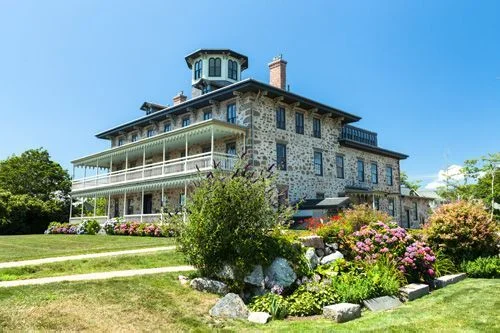
The Stone House, in Little Compton, R.I.
We're doing some historical research on the Stone House, an old inn in Little Compton, R.I. We'd appreciate any information from readers about their own weddings and/or wedding receptions held at the Stone House or such events involving their friends and/or relatives. Dates of the events -- and pictures! -- would be most appreciated. We'd guess that there have been weddings and/or wedding receptions there going back to the late Twenties, when there was a speakeasy in this lovely structure, built in 1854 as a private home.
Please email such information to:
rwhitcomb4@cox.net
Maine's rural health systems should align values
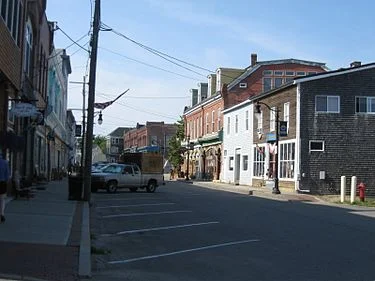
Not exactly wild downtown Eastport, Maine.
Video: Michelle Hood, president and CEO of Eastern Maine Healthcare Systems, discusses why rural healthcare organizations must align their values before become partners or doing an outright merger.
To watch the video, please hit this link.
Seasoned with other seasons
Each season has fragments of others. Consider this morning in southern New England, where the freshness and temperature of the air, and the light, recalled late September.
Pooja Patel: N.E. institutional leadership for illegal-alien students aided by DACA
Via the New England Board of Higher Education (nebhe.org)
A Massachusetts resident, Faustina began working on her college applications last August. In the beginning, the process was going well. However, as she began receiving acceptance letters and financial aid award letters, things became difficult. As an undocumented student, Faustina did not have a permanent residency card, which most colleges need in order to provide financial aid. Unwavering in her efforts to pursue a higher education, Faustina hoped to receive financial support from private institutions but, often, they could not meet her need.
As a Deferred Action for Childhood Arrivals (DACA) beneficiary, Faustina was ineligible for federal financial aid and, in most cases, state financial aid. Signed under the Obama administration, DACA grants a working permit to those who entered the U.S. before age 16, allowing students to enroll at institutions of higher education and join the military. This month, the secretary of the Department of Homeland Security, John Kelly, said that the DACA program would remain in effect, however, the long-term viability of the program remains unknown. While DACA allowed students like Faustina to come out of the shadows and apply to college, there is a long way to go to ensure that all academically qualified students have access to a quality and affordable higher education.
Undocumented students are ineligible for federal financial aid programs such as the Pell Grant, work study and government loans. As a result, these students rely almost exclusively on state support. Twenty states offer some form of financial aid to undocumented students, and most extend in-state tuition to undocumented students.
Nationally, six states provide both in-state tuition and state financial aid. In New England, only two states offer financial support. Connecticut and Rhode Island extend in-state tuition to undocumented students if they meet certain criteria such as having attended a state high school for two or more years and graduated. Connecticut State Colleges and Universities President Mark Ojakian has taken a personal interest in the matter. “We support all students’ educational goals and dreams, not only because it is the right thing to do, but because investing in all our students improves the sustainability of our communities and the economic competitiveness of our state.”
Legislative action in New England
In Connecticut, the Higher Education and Employment Advancement committee, chaired by state Rep. Gregg Haddad (D.-Mansfield), has introduced An Act Equalizing Access To Student-Generated Financial Aid, HB 7000. The bill allows students to have equal access to institutional financial aid regardless of immigration status. “Institutional financial aid” includes tuition waivers, tuition remissions, grants for educational expenses and student employment.
“The dreamers [undocumented students] themselves have been pushing this [legislation],” according to Haddad. Members of the CT Students for the Dream—an organization devoted to advocating for the rights of undocumented student—have played a crucial role in propelling the legislation, Haddad said. “They’re here, they have study-ins in the capital. They lobby extensively. They are unbelievably unafraid to identify themselves as undocumented residents.”
In addition to the students, “institutions in Connecticut have reacted so differently than institutions elsewhere” reported Haddad. For instance, in fall 2016, Eastern Connecticut State University admitted the first cohort of Opportunity Scholars. These scholars come from seven “locked-out” states—states that deny in-state tuition and, in some cases, bar undocumented students from enrolling—as well as 13 different countries. According to Eastern President Elsa Núñez, “no public funds are being used to support Eastern’s Dreamers, and no in-state students are being denied admission because of the program.” Instead, the 42 scholars in the cohort, in addition to five DACA students from Connecticut, are being funded by the Dream.US Scholarship program. In regard to continuing the program, “applications are already being accepted for fall 2017, and Eastern will likely enroll another 75 Opportunity Scholars,” according to Núñez.
There is a moral and an economic imperative to Connecticut’s support of undocumented students. The state faces a major budget deficit and struggles with the lack of an urban center that draws young people, putting the state’s vitality at risk. Therefore, Connecticut hopes to attract young people of all backgrounds.
While the leadership of the Connecticut State Colleges and Universities, and Eastern in particular, is admirable, more needs to be done at the legislative level to ensure that undocumented students have access to affordable education. HB 7000 is a step in the right direction but its future remains uncertain. The bill did not come to a vote during the 2017 legislative session but Haddad hopes to bring the bill back when the Legislature reconvenes. As Haddad continues to persist, Massachusetts state Sen. Sonia Chang-Diaz (D-2nd Suffolk District) hopes to pave new ground in her state.
Massachusetts has the highest number of DACA beneficiaries in New England region, with 7,258 individuals benefiting from the executive action. Still, Massachusetts has not passed legislation extending in-state tuition. Aiming to change the status quo, Chang-Diaz introduced An Act Providing Access To Higher Education For High School Graduates In The Commonwealth, S. 669.
The bill extends in-state tuition and eligibility for state-funded financial assistance to any person who has attended high school in the Commonwealth for three or more years and has graduated from high school or has a General Equivalency Diploma (GED), with stipulations such as providing an individual taxpayer identification number (ITIN) in lieu of a social security number and signing an affidavit stating that the person has applied or will apply for citizenship or legal permanent residence within 120 days of eligibility. If passed, this bill would remove a major financial barrier to higher education for undocumented students, allowing them to enroll at a Massachusetts public institution with a more affordable price tag.
Survey results
To better understand undocumented students’ access to affordable higher education in the region, the New England Board of Higher Education (NEBHE) conducted a survey of undergraduate institutions in Connecticut, Massachusetts and Rhode Island. Out of 144 bachelor's-degree granting institutions in these three states, 50 institutions responded to the survey. The majority of the survey respondents were 4-year private, nonprofit institutions followed by 2-year public and 4-year public institutions, respectively.
Of the institutions that responded, 72 percent reported admitting undocumented students in the 2015-16 admission cycle. Although because of the response rate, the results overall have no statistical significance, the responses reveal a broad range of attitudes toward undocumented students.
Three 2-year public institutions admitted between 1-9 undocumented students in the 2015-16 admission cycle with one institution admitting more than 20 undocumented students. Given the financial challenges facing this group of students, this trend is not altogether surprising. Undocumented students tend to come from lower socioeconomic backgrounds and 2-year public institutions often provide a more affordable education than other alternatives. Comparatively, 11 4-year nonprofit private institutions admitted between 1-9 students and one reported admitting 10-19 students. Again, given the financial constraints facing this particular group of students, a 4-year nonprofit is more likely to offer them the financial support they need than a 4-year public institution.
Of the institutions that responded to the survey, the majority do not identify or track undocumented students (Figure 2). For institutions that do identify these students, they use a wide array of classifications ranging from “domestic student” to “non-eligible non-citizen” to being designated as a part of a “cohort.” One institution tracks these students as “DACA eligible” for in-state tuition purposes.
Forty-six percent of the institutions that answered the survey said that they provide resources specifically designated for undocumented students such as legal aid, student organizations focused on immigration and staff members whose mission is to support undocumented students. One institution formed an “Undocumented Student Task Force” focused on identifying barriers and developing solutions. Another—a private institution located in Massachusetts—created a list of alumni who are willing to offer legal and social service support to undocumented students and their immediate family members.
This institution also fully covered undocumented students’ health insurance. Due to strong institutional support, the net cost of yearly attendance for the undocumented students was between $1 and $4,999. However, not all institutions have the resources to be able to serve undocumented students in this capacity. For instance, another private institution in Massachusetts reported admitting undocumented students and providing financial aid of $35,000 or more but the net cost for the student was still $20,000 or higher.
Of the responding institutions that admitted undocumented students, 52 percent reported providing financial aid. Financial aid in this case includes in-state tuition, grants or scholarship. A majority of colleges and universities offer institutional grants and scholarships, with some in Connecticut and Rhode Island relying on in-state tuition. Both responding Rhode Island public institutions provided financial aid in the form of in-state tuition. Of two Connecticut public institutions that provide financial aid, one offered in-state tuition while the other provided foundation-funded scholarships such as TheDream.US aid program. Conversely, no public institutions in Massachusetts provided financial assistance to these students.
Overall, the survey results shed light on the powerful impact of institutional leadership. Absent affirmative legislation or state policy in Massachusetts, individual institutions have taken it upon themselves to provide support for undocumented students. A subsection of Tufts University’s admissions page is specifically geared towards undocumented students, stating that “undocumented students, with or without DACA, who apply to Tufts are treated identically to any other U.S. citizen or permanent resident.”
Recognizing that undocumented students are ineligible for federal financial aid, Tufts provides institutional financial aid, meeting 100 percent of the demonstrated student need. While not all institutions make information available online, often, private nonprofit institutions do assist undocumented students by providing institutional aid and connecting them with private scholarships. While this is admirable, not every institution has the financial means to support undocumented students. Given such disparities, legislation plays a crucial role in bridging the gap to ensure all qualified students have access to quality higher education.
The face of DACA
Faustina was fortunate to have the support of her school counselor. “She was determined to send me to college … you are going to college.” she said. She gave me hope which was something that I needed most at the moment.” Faustina’s school counselor was unwavering in her support—contacting everyone from her personal friends to people in the mayor’s office. Fortunately, Faustina was able to receive support from Clark University and plans on enrolling in fall 2017. Even with a college acceptance in hand, Faustina's concerns about affordability are far from over. “Now that I am about to attend Clark, my only concern is finding a co-signer for my loans. I am still waiting to hear back from scholarships but so far I have a gap of $12,510 per year which is not bad considering my circumstances.”
“I am not embarrassed to tell people my immigration status because at the end of the day, I know that it does not determine my future or who I am. There is always going to be another way to reach my goal and get a higher education.” Faustina hopes to pursue actuarial science or computer science, at Clark. “I am just grateful to get the support that I needed from people who wanted to help [and] give me a chance at life and higher education.”
Faustina’s story is that of resilience and hope. Students like Faustina are the future of New England —we need to continue doing our part in making the higher education dream a reality for all students. While institutional leadership will continue to play a large role in enrolling, retaining and graduating undocumented students, state policy or legislative action is crucial to laying the foundation for extending financial support to these students.
Pooja Patel was a policy research intern at the New England Board of Higher Education (nebbe.org) during academic year 2016-17 while she pursed her master's degree in education from Boston College.

Trying to control unhealthy self-medication

Adapted from Robert Whitcomb's "Digital Diary,'' in GoLocal24.com
The new ordinance banning smoking outdoors in part of downtown Providence reflects the confusions and hypocrisies of American policies regarding tobacco and some other drugs (such as alcohol). On the one hand we say that smoking is very unhealthy and leads to many thousands of deaths a year and vast health expenses, on the other hand, tobacco products are legal and pull in billions of dollars a year in tax money. (Some argue that smoking, by causing early and often fast deaths, actually saves on overall national health costs: Fewer of those too-expensive old folks who take so long to expire.)
I think that the new ordinance isn’t a bad idea. It may extend a few lives, including of those people who must breathe in second-hand smoke in situations such as waiting for buses at Kennedy Plaza. And there will be fewer cigarette butts and other smoking-related litter on the streets and sidewalks.
Smoking is self-medication for many mentally ill people, many, perhaps most of whom suffer from intense anxiety. Thus, assuming that the Providence police are willing and able to enforce the smoking ban, you might find fewer insane people hanging around downtown scaring some “normal people’’. That, presumably, would be good for most retail and other businesses. But in our unfortunate era of deinstitutionalization, where will the mentally ill go? I’d guess that many will simply move to the edge ofdowntown, to join the ones below my window at the corner of Orms and Charles streets.
Now back to the scarier substance-abuse problem – opiate addiction and lethal overdoses.
'Then summer ended' in PTown
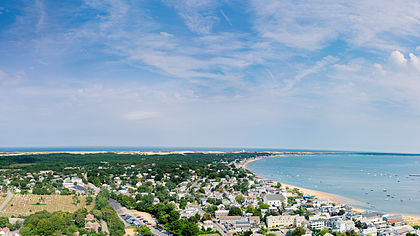
Provincetown in high summer.
"Decade after decade, artists came to paint the light of Provincetown, and comparisons were made to the lagoons of Venice and the marshes of Holland, but then the summer ended and most of the painters left, and the long dingy undergarment of the gray New England winter, gray as the spirit of my mood, came down to visit.
-- Norman Mailer, in "Tough Guys Don't Dance''
Shopping at the fish market

"Noddies Above the Waves'' (woodblock print on Stonehenge paper), by Margaret Barnaby, at the Patricia Ladd Carega Gallery, Center Sandwich, N.H.
Robert Whitcomb: The amazing rise of Singapore

The gigantic container port of Singapore.
Singapore
Unlikely Power
by John Curtis Perry
Oxford, 329 pp., $29.95
This review first appeared in The Weekly Standard.
Central to the rise of the island of Singapore as one of the world’s most important cities are its location on one of the planet’s most important waterways and crossroads and its potent mix of the behavioral values of two cultures – British and Overseas Chinese.
There’s no other city like Singapore, which goes back hundreds of years to a once-prosperous city called Temasek that essentially disappeared. Singapore’s long colonial status started in 1819, when it was founded by Sir Stamford Raffles as a British trading post, and ended in 1963, when Singapore briefly merged with Malaya only to anxiously turn into an independent city-state in 1965, when it became clear that a Malay marriage with a city dominated by Overseas Chinese was doomed.
But then, Singapore has always been a site of grand reinventions, some gradual and some fast. Mr. Perry, an emeritus professor of history at the Fletcher School of Law and Diplomacy at Tufts, provides a usually engaging history of this complicated place. Most importantly for us, of course, he explains cogently why it has become so successful. And he works in some glamour and romance, too, about a place that people of a certain age still see as “exotic,’’ like something from a Somerset Maugham story.
Being part of the mostly well-governed British Empire, which was held together by the Royal Navy and British commerce (based on free trade), was essential to Singapore’s 19th Century development. It wove Singapore into an international system that swiftly made it into a major entrepot and gave the rapidly growing city stable, competent and relatively fair government that promoted prosperity. “Thanks to its strategic location between India and China, and a commitment to free flows of goods and people, the settlement …proved an instant success asa gateway and place of exchange,’’ Mr. Perry writes.
It was, he notes, very profitably linked to two powerful networks – “regional in the case of the Chinese, global in the case of the British….Trade linked the small world of Anglo-Chinese Singapore to the globe.’’
“How pleased he (Raffles) would have been to see contemporary Singapore’s embrace of much of British tradition {especially civility, order and a commitment to fairness},’’ Mr. Perry writes. Indeed, Raffles is still revered in Singapore, where a large statue of him stands in front of the city’s Victoria Memorial Hall and many streets retain their English names from colonial days.
But Chinese entrepreneurialism, which has always included large doses of risk-taking leavened, like traditional British culture, with self-discipline, including the willingness to delay gratification in order to save and invest, was also crucial. “British dominion over the seas provided the foundation but upon this foundation stood the sturdy Chinese middleman, with Straits-born Babas {a term for the so-called Straits Chinese} leading the way with their knowledge of English and their ability to connect with other Asians.’
A lot of Singapore’s revenue was once derived from opium, although the place has been rigorously, sometimes even frighteningly anti-drug since independence. While once having the (much exaggerated) reputation amongst Westerners as a den of iniquity, Singapore has long since been famously puritanical about some behavior, perhaps most famously expressed in its ban on chewing gun and its use of caning to punish such crimes as vandalism.
The helmsman of Singapore’s progress from relative poverty to great wealth was Lee Kuan Yew (1923-2015), the most important person in Singapore from before independence from Britain, through the city’s unhappy marriage with Malaysia and then in its gutsy decision to try to survive and then prosper as a maritime-based city-state (recalling medieval Venice and Genoa). Mr. Perry provides an engrossing analysis of what drove this intensely ambitious, brilliant, ascetic and authoritarian ruler and his colleagues as they made Singapore into a major world city, first primarily as a port/supply center, then also as a manufacturing hub and now as a technological dynamo, too.
As he led his crowded jurisdiction as prime minister, from 1965 to 1990, and then continuing as the dominant figure until his death, he kept driving his people to work hard, be clean, be honest, restrain their desires and plan for decades ahead. Don't get soft in this dangerous world, he warned. Be anxious! It all recalls the Puritan Ethic.
I know quite a few people who worked in Singapore, a couple of them who wrote for me when I was the finance editor of the International Herald Tribune, which had a bureau and printed in Singapore and was sometimes censored there; they either loved its cleanliness and order or hated the Big Brotherism that promoted those qualities. A cousin of mine -- a merchant banker -- couldn’t wait to move out of ‘’boring’’ and “stifling’’ Singapore and move to the messy, manic, raucous and sometimes seamy life in Hong Kong, its big rival at the time in the ‘80s.
Singapore’s leaders worry a lot. For example, they fear that the island could lose much business if, as has long been proposed, a canal is built across narrow southern Thailand, diverting much ship traffic from the Straits of Malacca. They worry that an oil pipeline might be laid across the Malayan Peninsula, undermining Singapore’s status as a huge petro port and refining center, and that new technologies will leave them behind.
And as officials of an implausibly tiny, very vulnerable state, they’re hyper-alert about political, social and economic conditions in their often unstable neighbors Malaysia (on which they depend for much of their fresh water) and Indonesia. Mr. Perry amusingly quotes historian Ian Burama (via architect Rem Koolhaas) on Singapore’s existential tenseness (a tenseness that reminds me of another small place – Israel): “It corresponds to a deep primordial fear of being swallowed up by the {nearby} jungle, a fate that can only be avoided by being ever more perfect, ever more disciplined, always the best.’’
Well, more accurate is Mr. Perry’s point that leaders of the new nation, “anxious to build a sense of identity, seized upon a notion of shared values, articulating and organizing them into a collective ethos, formally approved by Parliament.’’ The ethos says that citizens “must defer to the needs of the community….with consensus {maybe more like obedience to authority) taking precedence over contention…and individualism … disparaged as selfishness…..The prescribed ethic lauds hard work, frugality, and social discipline, with emphasis on the practical and the specific….Discipline is equated with being civilized.’’
Mr. Lee went to university in England and loved English poetry and appreciated the fragility of human achievements. He liked to quote the gorgeous last lines of Kipling’s poem “Recessional,’’ written at the apogee of British power, in 1897.
Far-called, our navies melt away;
On dune and headland sinks the fire:
Lo, all our pomp of yesterday
Is one with Nineveh and Tyre!
Judge of the Nations, spare us yet,
Lest we forget—lest we forget!
Mr. Lee believed that Singapore could never afford to rest on its laurels.
He pushed and pushed. Consider how the prime minister drove Singapore to quickly become one of the world’s first great container ports, helping to transform it into the world’s most important maritime center. Mr. Lee and his associates and successors kept looking ahead, making the island not onlya major manufacturing city but also a hub for research and technology and awide range of sophisticated business services.
His people have mostly accepted the rigorous and mostly very honest autocracy/technocracy that has run Singapore for more than 50 years because it has created such widely shared prosperity. And, after all, Mr. Perry writes, the Singaporean government “is not tyrannous. Instead it is clearly dedicated to the ideal of popular welfare.’’ So far.
Still, Singapore’s recent move into the knowledge industry raises questions about how long this new endeavor can flourish in an authoritarian state, especially one longer led by the giant figure of Lee Kuan Yew. In any event, he and his associates have left Singapore – and us – edifying reminders of certain “old-fashioned’’ civic values that we could use much more of in the West.
Sir Stamford Raffles would have approved Mr. Perry’s remark that a marriage of convenience between “shrewd Chinese entrepreneurship and stable British colonial governance spawned Singapore’s vitality {and} continues to nourish it today.’’ And, I would add, this city-state provides strong lessons to other governments on how to maximize the welfare of their citizens. That’s as long as you don’t care much about real democracy.
Which raises the question of whether Singapore’s future leaders, assuming that they’ll also be autocratic, will be as honest, competent and public-spirited as Lee Kuan Yew or his son Lee Hsien Loong, prime minister since 2004. If not, then Singaporeans may finally demand major political change. Things may get messy in this hyper-orderly place.
Robert Whitcomb, a former finance editor of the International Herald Tribune, is a partner in a healthcare-sector consultancy and editor of NewEnglandDiary.com.

Statute in Singapore of Sir Stamford Raffles, considered modern Singapore's founder.
Wait till it gets really big

"The Source'' (oil paint, stitchery and gold leaf), by Judith Skoogfors-Prip, in her current show with Joan DeRugeris entitled "Twists and Turns,'' at the Providence Art Club.
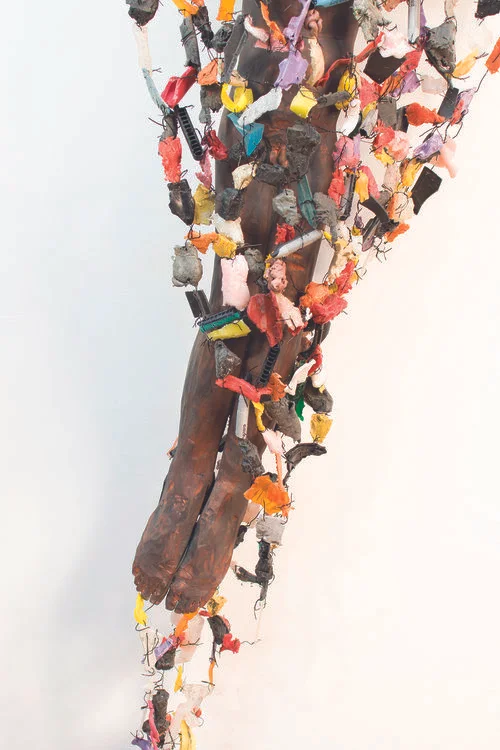
Embracing impermanence
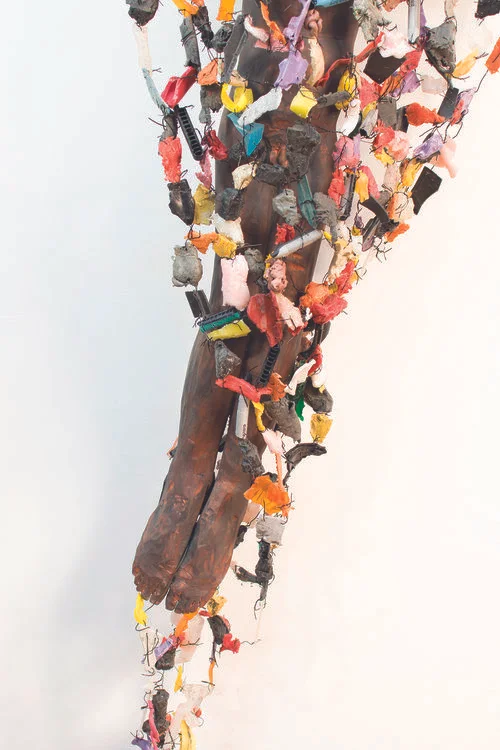
From John Christian Anderson's show "My Inheritance,'' at Boston Sculptors Gallery, through July 23. He used scavenged materials and handcrafted elements. The resulting sculptures, says the gallery, "present themselves as facsimiles and simultaneously evoke an ominous dark element along with a humorous sensibility.''
His work embraces "impermanence, imperfection, and incompleteness as a way to express personal narratives while also reflecting a world that is becoming more ephemeral and out of balance.''