
Vox clamantis in deserto





Felicia Nimue Ackerman: So lucky to be here
My daughter keeps telling me I am so lucky to be here.
She means instead of in her five-bedroom home,
Which always has space for another child
But not for a grandmother in a wheelchair.
I am so lucky to be here.
My room is yellow as the sun,
Which warms my face
When I roll out onto the porch
And endure people I have nothing in common with
Except age and abandonment.
For so long I dreaded being shut away from the world.
But I am so lucky to be here,
The best nursing home in Rhode Island,
Instead of where I would be if people knew
That what killed my unfaithful husband
Was not an accident.
-- Felicia Nimue Ackerman
Information (including pictures), please, on Stone House weddings, receptions
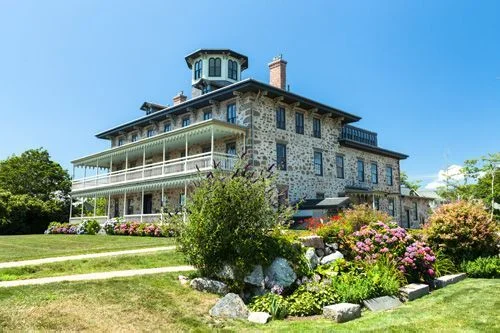
The Stone House, in Little Compton, R.I.
We're doing some historical research on the Stone House, an old inn in Little Compton, R.I. We'd appreciate any information from readers about their own weddings and/or wedding receptions held at the Stone House or such events involving their friends and/or relatives. Dates of the events -- and pictures! -- would be most appreciated. We'd guess that there have been weddings and/or wedding receptions there going back to the late Twenties, when there was a speakeasy in this lovely structure, built in 1854 as a private home.
Please email such information to:
rwhitcomb4@cox.net
For Grandma Moses to shear

"Sheep'' (acrylic on antique board), by Warren Kimble,'' in his show "Warren KImble: Folk Art 2017,'' at Brandon Artists Guild, Brandon, Vt. June 30-Aug. 29. The gallery says the show "shows Kimble in a current mood of nostalgia, creating his famous animal, barn and homestead scenes on antique wooden boards and other found objects.''
'Their no-longer houses'
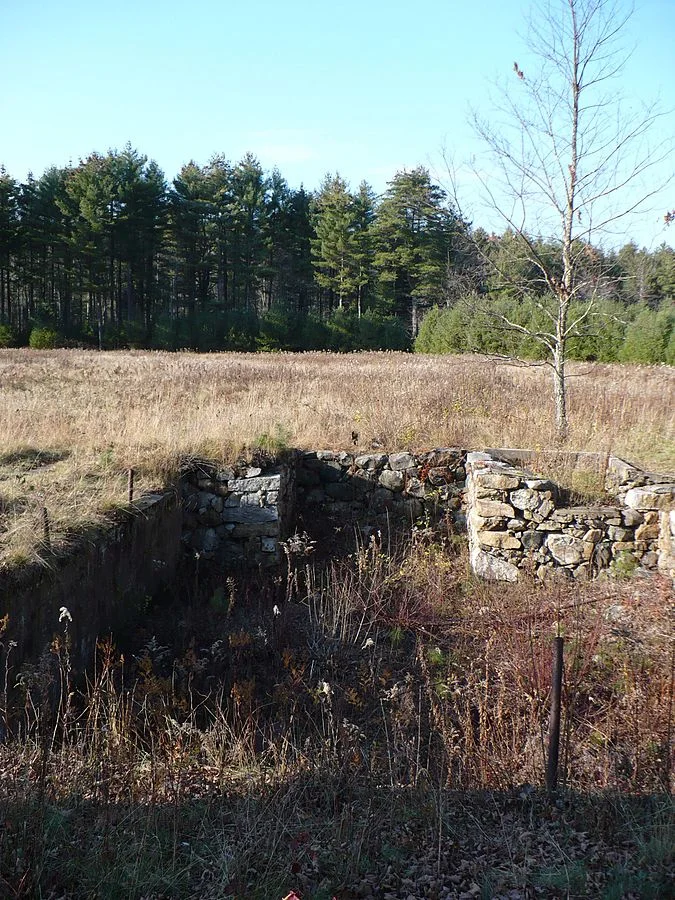
"Toss in some wavy lines, an equal sign, and a squiggle,
then a lilac log, boulders with faces, a few phrases
like rock walls, twin marks from wagon wheels on granite.
The tell-tale lilacs give away the cellar hole:
magnetic lilacs, like nineteenth-century girls
in pinafores and blossom sprays, stationed
beside their no-longer houses. They look about to sing.''
-
-- From "Deconstructing New England, by Alexandria Peary
'The town has you'
"The town is an accumulation of three parts which, in sum, are greater than the sections. The town is the people who live there, the buildings which they have erected to den or do business in, and it is the land. The people are Scotch-English and French. There are others, of course - a smattering, like a fistful of pepper thrown in a pot of salt, but not many. This melting point never melted very much. The buildings are nearly all constructed of honest wood. Many of the older houses are saltboxes and most of the stores are false-fronted, although no one could have said why. ''
''.... The land is granite-bodied and covered with a thin, easily ruptured skin of topsoil. Farming it is a thankless, sweaty, miserable, crazy business. The harrow turns up great chunks of the granite underlayer and breaks on them. In May you take out your truck as soon as the ground is dry enough to support it, and you and your boys fill it up with rocks perhaps a dozen times before harrowing and dump them in the great weed-choked pile where you have dumped them since 1955, when you first took this tiger by the balls. And when you have picked them until the dirt won't come out from under your nails when you wash and your fingers feel huge and numb and oddly large-pored, you hitch your harow to your tractor and before you've broken two rows you bust one of the blades on a rock you missed....''
"....The land has got you, locked up solid got you, and the house, and the woman you fell in love with when you started high school (only she was a girl then, and you didn't know for shit about girls except you got one and hung on to her and she wrote your name all over her book covers and first you broke her in and then she broke you in and then neither one of you had to worry about that anymore), and the kids have got you, the kids that were started in the creaky double bed with the splintered headboard. You and she made the kids after the darkness fell - six kids, or seven, or ten. The bank has you, and the car dealership, and the Sears store in Lewiston, and John Deere in Brunswick. But most of all the town has you because you know it the way you know the shape of your wife's breast.''
-- Maine novelist Stephen King
Ban TV ads for prescription drugs

Adapted from Robert Whitcomb's "Digital Diary,'' in GoLocal24.com
As we seek to control healthcare costs, one place to look is on TV. There, especially on shows that appeal to an older demographic, such as the evening network news, you can see a Niagara of ads for new and expensive brand-name drugs that purport to be better than the meds that are on the market already – mostly much cheaper generics. Often the new pills are no better (or actually worse, with dangerous side-effects) than the current ones, although their ad copy is sexy.
People see these ads and then ask their overworked physicians for a prescription for these pricey pills. Some physicians cave in and write a script to move the patients out of their offices ASAP. Keep ‘em happy! We all get the bill in higher insurance premiums, and surging Medicaid and Medicare costs.
It has been a financial disaster except for the drug companies. And few consumers are competent to understand all the workings of these drugs hyped on the tube. Too often we confuse “new’’ with “better’’ – a confusion that the drug companies are pleased to promote.
Up to about 20 years ago, advertising on TV of prescription drugs was banned. That ban should be restored ASAP for the nation's physical and fiscal health.
Meanwhile, sometimes the old, cheap out-of-patent drugs may prevent or treat ailments they weren’t invented for. Consider trazadone, used to treat anxiety and depression, and often given to older people as a sleep aid. It turns out it may help prevent or slow dementia. If trials work out, this could turn out to be a huge benefit to America’s surging population of old folks and their families. And save vast sums of money.
Chris Powell: Sharia Law not an issue in Conn., so leave Muslims alone; state helps the hoaxers
Everybody knows that Islam is having a civil war between murderous totalitarians and people who just want to live and let live. Civilization's urgent agenda must be to help the good guys. But as Connecticut saw last weekend, some people are determined to insult and intimidate the good guys by suggesting that all followers of Islam are bad, which can only discourage the good guys and strengthen the bad guys.
Last weekend's demonstration of this came in Waterbury, where a group called ACT for America held a rally, purportedly to warn about sharia law, an Islamic religious code that is contrary to democracy in many respects. Waterbury seems to have been selected because it has a large Muslim community.
But no one in Connecticut is advocating replacing civil law with Sharia Law. In Connecticut Sharia is not an issue and is no more a threat to democracy than Christian or Jewish religious law, both of which also differ substantially from civil law but are not acknowledged by ACT for America as being just as incompatible with democracy as sharia is.
Nor does ACT for America acknowledge that Christianity and (much less so) Judaism had their own civil wars that devastated Europe and the Middle East for centuries before the live-and-let-live factions triumphed. Even in Connecticut, as late as the 1950s Protestants and Catholics nearly came to blows over whether civil law should provide public school bus transportation to Catholic schools.
Being 2,000 years younger than Judaism and six centuries younger than Christianity, Islam isn't done with its civil war yet. So Islam's good guys need support, not bullying and shunning. ACT for America says it wants religious freedom for all, but the group's harping on sharia law where there is no attempt to induce government to impose it smells like bigotry and hate.
State government helps the hoaxers
Former Fox News journalist Megyn Kelly, now running a news program on NBC, is catching criticism for planning an interview with radio talk show host Alex Jones, who is renowned for asserting that the Newtown school massacre in 2012 was a hoax. Maybe Kelly's questioning will undermine Jones as a hoaxer himself, or maybe it will just glorify him among the growing segment of the population that is inclined to consider everything official to be a lie.
But if government wants to help squelch hoaxes, it should reconsider what it has done to encourage them, as the General Assembly and Gov. Dannel Malloy did in response to the Newtown school massacre. That is, at the urging of the families of the murdered, legislators and the governor hurriedly enacted an exemption to Connecticut's Freedom of Information Act to obstruct disclosure of police photographs and videos depicting victims of homicide. Such images remain essential to refuting deniers of all sorts of atrocities, from the Holocaust to the Armenian genocide to the Rape of Nanking.
If applied nationally, Connecticut's law would conceal the Zapruder film of the assassination of President John F. Kennedy as well as the photographs taken during his autopsy, even as the circumstances of the president's murder remain very much in question. After the Newtown massacre Connecticut's black and Hispanic state legislators insisted on making the photo and video exemption apply to all homicide victims rather than limit it to the Newtown case.
Now those legislators are lamenting that, because Bridgeport police are not equipped with dashboard and body cameras, there are no photos or video of the fatal shooting by officers of a 15-year-old boy a month ago. But even if there were such images, the law those legislators insisted on enacting would obstruct any release to the public.
Chris Powell is managing editor of the Journal Inquirer, in Manchester, Conn.

We've a lot of common

"We Two Together'' (bronze resin), by Michael Alfano, in the "20th Annual Outdoor Sculpture Exhibit,'' at the Mill Brook Gallery & Sculpture Garden, Concord, N.H., Sept. 24-Oct. 27.
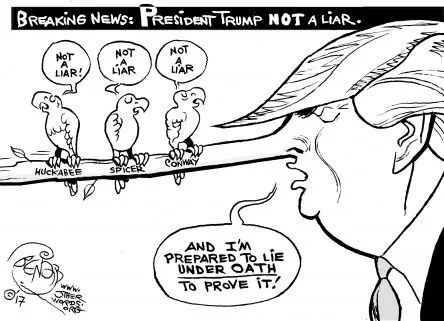
Jim Hightower: Donald Trump's relentless Twitter attacks on --- our allies
Via OtherWords.org
Donald Trump missed his opportunity to become a General Patton-style military commander and glorious war hero back in the Vietnam era. He surely would’ve been the greatest in history, to hear him tell it.
But, alas, he says some unspecified foot problem (or something or other) kept him from the privilege of actually getting to go fight in that war. Bad luck, I’m sure. But now that The Donald is the commander-in-chief for real, his inner warrior has been given a second chance to bloom, and this time he’s fully enlisted.
In recent weeks, President Trump has (1) escalated a running war of words against Chancellor Angela Merkel of Germany, (2) bombed the European leaders of NATO with explosive charges that they’re unworthy of his support, (3) launched a fierce new barrage of tough rhetoric in his extralegal offensive to ban all travel to the U.S. by anyone from six Muslim nations, and (4) opened an entirely new battlefront by attacking the mayor of London with one of his Twitter missiles.
In last year’s presidential campaign, Trump declared with typical modesty that “No one is bigger or better at the military than I am.”
Well, I’m certainly no expert on war, but if a president is going to pick a mess of foreign fights, wouldn’t it be better, strategically speaking, to pick on actual enemies, rather than on America’s allies? After all, there might come a time when we need friends to stand with us.
In a twist of historic irony, it looks like Boss Trump and his military team might need those European allies sooner than they figured. His national security chief and the Pentagon are pushing a new strategy for America’s long, horribly messy war in Afghanistan — but it depends on our NATO allies sending some of their troops into the fight.
Oops, how awkward for the impetuous tweeter-in-chief.
Jim Hightower is a radio commentator, writer, and public speaker. He’s also the editor of the populist newsletter, The Hightower Lowdown.
.

The decline of the summer job

Adapted from Robert Whitcomb's "Digital Diary,'' in GoLocal24.com
Getting a summer job used to be almost mandatory for teens as a way to build starter bank accounts and, sometimes, character. In my case, these jobs included such activities as mowing lawns, delivering newspapers, cutting back shrubs, painting fences, processing bills of lading at a trucking company on the Boston waterfront, working as a counselor at a camp for inner-city kids, waiting on tables and other, usually tedious, activities.
Things have changed a lot: The U.S. Bureau of Labor Statistics has reported that in July 2016 only 43 percent of those 16 to 19 were working or trying to get a job. In the late ‘80s the rate was nearly 70 percent. (I suspect that it was even higher than that in my time as summer worker – ’62-’69.)
But the refusal of successive Republican Congresses to raise the minimum wage, the arrival of illegal aliens to perform many jobs, especially yard work, house painting and other very physical labor, has discouraged many young people from even trying to get a job. And the days when you could pay for college with summer earnings alone are long gone.
At the same time, affluent parents now tend to encourage their teens to accumulate assorted extracurricular experiences, including travel, and to take summer courses to promote themselves in order to get into a “good college’’ rather than get a job. It used to be that well-off and even many rich parents would push their offspring to get summer jobs as a useful introduction to the world of work, where they’d learn how to deal with bosses and colleagues and to manage money.
You don’t hear much about character-building anymore. The results of its absence are all around and extend from the White House to your neighborhood.
A yard's geometry
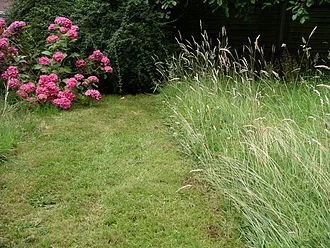
"Sleepy and suburban at dusk,
I learn again the yard’s
geometry, edging around the garden
and the weedy knots of flowers, circling
trees and shrubs, giving
a wide berth to the berry patch,
heavy and sprawled out of its bounds.
Shoving such a machine
around a fairway of dandelions,
it is easy to feel absurd.
The average lawn, left alone
one hundred years, could become
a hardwood forest. An admirable project.''
-- From "Mowing,'' by Robert Wrigley
'Light Traces' at the Plumbing Museum

''Undersea Garden'' (archival pigment print), by Jenn Wood, in her joint show with Ian MacLellan entitled "Light Traces,'' at the Plumbing Museum, Watertown, Mass., June 22-Aug. 7. The Plumbing Museum is so named because of its origins with Charles Manoog, who collected such antiques as old bathtubs and rustic sinks.
Facebook vs. America's sense of community
Adapted from Robert Whitcomb's "Digital Diary'' in GoLocal24.com
Harvard College has withdrawn the acceptances of at least 10 young people because of their nasty postings on Facebook. As in so many ways, the Internet has made life worse, not better. Some civil libertarians, such as writer and Harvard Law Emeritus Prof. Alan Dershowitz, have criticized Harvard’s actions on the grounds of free speech. But Harvard is a private institution that has every right to let in whomever it wants into its community. In this case, it doesn’t want a bunch of young people who are crude and cruel or at least act as if they are.
These kids, smart and generally affluent, if lacking judgment, can apply elsewhere – assuming they can remove most traces of their comments, though that may be difficult, or get colleges to chalk it all up to youthful exuberance. Stuff on the Internet is as enduring as a manmade monster can be. Everything about us that anyone has ever entered on the Internet is there in some crevasse.
If only more people of all ages would spend much less time on social media and more time, well, outdoors, for example, or reading a book onpaper and thus while doing so not being constantly distracted by the gyrations of the Internet and especially of social media, which are engineered to be addictive.
Facebook CEO Mark Zuckerberg, the famous Harvard billionaire dropout, has done far more harm than good for civil society and democracy by creating echo chambers where people see and hear things mostly according to their long-held biases and their insular interests. Facebook is helping to destroy a broader sense of American community and the duties of civic engagement..
But the genie is out of the bottle!
'You talk like a professor'
Lancaster bore him—such a little town,
Such a great man. It doesn’t see him often
Of late years, though he keeps the old homestead
And sends the children down there with their mother
To run wild in the summer—a little wild.
Sometimes he joins them for a day or two
And sees old friends he somehow can’t get near.
They meet him in the general store at night,
Pre-occupied with formidable mail,
They seem afraid. He wouldn’t have it so:
Though a great scholar, he’s a democrat,
If not at heart, at least on principle.
Lately when coming up to Lancaster
His train being late he missed another train
And had four hours to wait at Woodsville Junction
After eleven o’clock at night. Too tired
To think of sitting such an ordeal out,
He turned to the hotel to find a bed.
“No room,” the night clerk said. “Unless——”
Woodsville’s a place of shrieks and wandering lamps
And cars that shook and rattle—and one hotel.
“You say ‘unless.’“
“Unless you wouldn’t mind
Sharing a room with someone else.”
“Who is it?”
“A man.”
“So I should hope. What kind of man?”
“I know him: he’s all right. A man’s a man.
Separate beds of course you understand.”
The night clerk blinked his eyes and dared him on.
“Who’s that man sleeping in the office chair?
Has he had the refusal of my chance?”
“He was afraid of being robbed or murdered.
What do you say?”
“I’ll have to have a bed.”
The night clerk led him up three flights of stairs
And down a narrow passage full of doors,
At the last one of which he knocked and entered.
“Lafe, here’s a fellow wants to share your room.”
“Show him this way. I’m not afraid of him.
I’m not so drunk I can’t take care of myself.”
The night clerk clapped a bedstead on the foot.
“This will be yours. Good-night,” he said, and went.
“Lafe was the name, I think?”
“Yes, Layfayette.
You got it the first time. And yours?”
“Magoon.
Doctor Magoon.”
“A Doctor?”
“Well, a teacher.”
“Professor Square-the-circle-till-you’re-tired?
Hold on, there’s something I don’t think of now
That I had on my mind to ask the first
Man that knew anything I happened in with.
I’ll ask you later—don’t let me forget it.”
The Doctor looked at Lafe and looked away.
A man? A brute. Naked above the waist,
He sat there creased and shining in the light,
Fumbling the buttons in a well-starched shirt.
“I’m moving into a size-larger shirt.
I’ve felt mean lately; mean’s no name for it.
I just found what the matter was to-night:
I’ve been a-choking like a nursery tree
When it outgrows the wire band of its name tag. 65
I blamed it on the hot spell we’ve been having.
’Twas nothing but my foolish hanging back,
Not liking to own up I’d grown a size.
Number eighteen this is. What size do you wear?”
The Doctor caught his throat convulsively.
“Oh—ah—fourteen—fourteen.”
“Fourteen! You say so!
I can remember when I wore fourteen.
And come to think I must have back at home
More than a hundred collars, size fourteen.
Too bad to waste them all. You ought to have them.
They’re yours and welcome; let me send them to you.
What makes you stand there on one leg like that?
You’re not much furtherer than where Kike left you.
You act as if you wished you hadn’t come. 80
Sit down or lie down, friend; you make me nervous.”
The Doctor made a subdued dash for it,
And propped himself at bay against a pillow.
“Not that way, with your shoes on Kike’s white bed.
You can’t rest that way. Let me pull your shoes off.”
“Don’t touch me, please—I say, don’t touch me, please.
I’ll not be put to bed by you, my man.”
“Just as you say. Have it your own way then.
‘My man’ is it? You talk like a professor.
Speaking of who’s afraid of who, however,
I’m thinking I have more to lose than you
If anything should happen to be wrong.
Who wants to cut your number fourteen throat!
Let’s have a show down as an evidence
Of good faith. There is ninety dollars.
Come, if you’re not afraid.”
“I’m not afraid.
There’s five: that’s all I carry.”
“I can search you?
Where are you moving over to? Stay still.
You’d better tuck your money under you
And sleep on it the way I always do
When I’m with people I don’t trust at night.”
“Will you believe me if I put it there
Right on the counterpane—that I do trust you?” 105
“You’d say so, Mister Man.—I’m a collector.
My ninety isn’t mine—you won’t think that.
I pick it up a dollar at a time
All round the country for the Weekly News,
Published in Bow. You know the Weekly News?” 110
“Known it since I was young.”
“Then you know me.
Now we are getting on together—talking.
I’m sort of Something for it at the front.
My business is to find what people want:
They pay for it, and so they ought to have it.
Fairbanks, he says to me—he’s editor—
Feel out the public sentiment—he says.
A good deal comes on me when all is said.
The only trouble is we disagree 120
In politics: I’m Vermont Democrat—
You know what that is, sort of double-dyed;
The News has always been Republican.
Fairbanks, he says to me, ‘Help us this year,’
Meaning by us their ticket. ‘No,’ I says, 125
‘I can’t and won’t. You’ve been in long enough:
It’s time you turned around and boosted us.
You’ll have to pay me more than ten a week
If I’m expected to elect Bill Taft.
I doubt if I could do it anyway.’“
“You seem to shape the paper’s policy.”
“You see I’m in with everybody, know ’em all.
I almost know their farms as well as they do.”
“You drive around? It must be pleasant work.”
“It’s business, but I can’t say it’s not fun.
What I like best’s the lay of different farms,
Coming out on them from a stretch of woods,
Or over a hill or round a sudden corner.
I like to find folks getting out in spring,
Raking the dooryard, working near the house.
Later they get out further in the fields.
Everything’s shut sometimes except the barn;
The family’s all away in some back meadow.
There’s a hay load a-coming—when it comes.
And later still they all get driven in:
The fields are stripped to lawn, the garden patches
Stripped to bare ground, the apple trees
To whips and poles. There’s nobody about.
The chimney, though, keeps up a good brisk smoking.
And I lie back and ride. I take the reins
Only when someone’s coming, and the mare
Stops when she likes: I tell her when to go.
I’ve spoiled Jemima in more ways than one.
She’s got so she turns in at every house
As if she had some sort of curvature,
No matter if I have no errand there.
She thinks I’m sociable. I maybe am.
It’s seldom I get down except for meals, though.
Folks entertain me from the kitchen doorstep,
All in a family row down to the youngest.”
“One would suppose they might not be as glad
To see you as you are to see them.”
“Oh,
Because I want their dollar. I don’t want
Anything they’ve not got. I never dun.
I’m there, and they can pay me if they like.
I go nowhere on purpose: I happen by.
Sorry there is no cup to give you a drink.
I drink out of the bottle—not your style.
Mayn’t I offer you——?”
“No, no, no, thank you.”
“Just as you say. Here’s looking at you then.—
And now I’m leaving you a little while.
You’ll rest easier when I’m gone, perhaps—
Lie down—let yourself go and get some sleep.
But first—let’s see—what was I going to ask you?
Those collars—who shall I address them to,
Suppose you aren’t awake when I come back?”
“Really, friend, I can’t let you. You—may need them.”
“Not till I shrink, when they’ll be out of style.”
“But really I—I have so many collars.”
“I don’t know who I rather would have have them.
They’re only turning yellow where they are.
But you’re the doctor as the saying is.
I’ll put the light out. Don’t you wait for me:
I’ve just begun the night. You get some sleep.
I’ll knock so-fashion and peep round the door
When I come back so you’ll know who it is.
There’s nothing I’m afraid of like scared people.
I don’t want you should shoot me in the head.
What am I doing carrying off this bottle?
There now, you get some sleep.”
He shut the door.
The Doctor slid a little down the pillow.
-- "A Hundred Collars,'' by Robert Frost
Peter Montgomery: U.S. right-wing terrorism on rise in the Trump era
Harassment, intimidation, and physical violence against religious and ethnic minorities is on the rise. And some experts worry that the Trump administration is making things worse.
The attack on a Portland, Ore., commuter train by a knife-wielding white nationalist who was screaming anti-Muslim insults overshadowed other recent crimes apparently motivated by bigotry — including a machete attack against a black man in California and the killing of a Native American man by the driver of a pickup truck who was terrorizing a group of picnicking friends.
Just outside Washington, D.C., recently, an African-American student on the verge of graduating from college was murdered by a white student who was reportedly a member of an online “alt-Reich” {neo-Nazi} group. Nooses have been placed in a number of prominent locations, including the National Museum of African American History and Culture.
The Southern Poverty Law Center documented almost 900 reports of harassment and intimidation in the immediate aftermath of the 2016 election. “Many harassers invoked Trump’s name during assaults,” the SPLC reported, “making it clear that the outbreak of hate stemmed in large part from his electoral success.”
Similarly, the Anti-Defamation League reported that anti-Semitic incidents in the U.S. jumped 86 percent in the first quarter of 2017. There’s also been a surge in violent attacks on Indian Americans and Sikhs, sometimes by people mistakenly identifying them as Muslims or Arabs.
What’s going on?
Violence motivated by bigotry obviously didn’t begin with Trump. But there’s no question that Trump’s rise has inflamed racial resentments and unleashed something dangerous. His campaign excited white nationalists, beginning with his first speech vilifying Mexican immigrants and continuing with his call for a ban on Muslims entering the country.
Trump’s suggestion that the Indiana-born Judge Gonzalo Curiel couldn’t rule fairly because of his family’s Mexican origins sent a signal: Real, trustworthy Americans are white. Trump’s close alliance with some conservative Christian leaders sends another signal: Real Americans are Christians.
Some hateful people take these signals as permission to openly express and act on bigotries that were previously understood to be unacceptable.
Indeed, by putting Steve Bannon in senior campaign and White House positions, Trump made it clear that promoting bigotry is no bar to service in his administration. Bannon’s leadership of a right-wing website was praised by a prominent neo-Nazi leader for making the site “hardcore.”
These signals were amplified by the appointment of Jeff Sessions, a Voting Rights Act critic and promoter of anti-immigrant policies, to be U.S. attorney general.
In the face of a growing bipartisan consensus on criminal justice reform, Sessions is trying to take the country in the opposite direction, pushing aggressively for mass incarceration and undermining previous Justice Department efforts to hold police accountable for racially motivated violence.
Arlie Perliger, a Massachusetts professor who works with West Point’s Combating Terrorism Center, argues that right-wing violence grounded in white supremacist ideology should be treated as domestic terrorism.
But the Trump budget proposal released in May zeroes out funding for a Department of Homeland Security program that gives grants to communities to counter violent extremism. Reuters reported that the administration has also frozen $10 million in grants that had already been allocated.
Generations of Americans have struggled and continue to struggle to make liberty and justice for all a reality in our increasingly diverse society. But with Trump as their leader, opponents of pluralism are demanding a return to some undefined period when America was “great.”
They’re at war with what America has been becoming. And while the Trump administration may give proof to the axiom that truth is the first casualty of war, it’s sadly not the last.
Peter Montgomery is a senior fellow at People For the American Way.
Skinny dipping for art
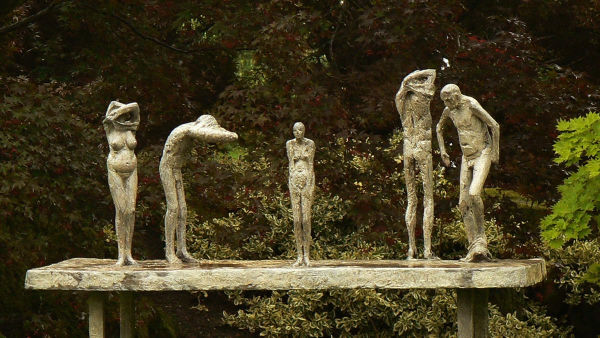
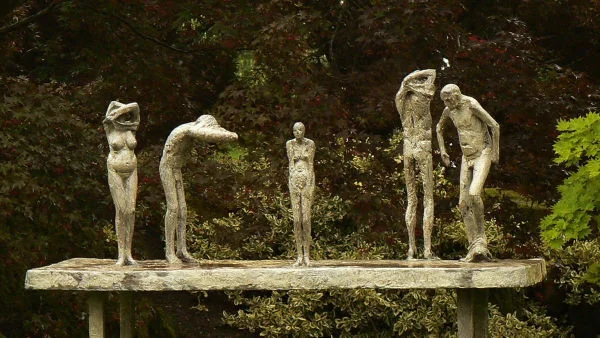
"Table 1, 2008'' (bronze) by Penelope Jenckes, at the Berta Walker Gallery's Wellfleet, Mass., exhibition space at the Wicked Oyster Restaurant.
Penelope Jenckes
Berta Walker
Wicked Oyster Gallery

Don Pesci: Pointless rhetoric after Alexandria shootings

From the hand-written copy of the proposed Bill of Rights, 1789, cropped to just show the text that would later be edited and ratified as the Second Amendment.
It took Hartford Courant editorial writers 10 plump paragraphs to reach their predictable corporate conclusion: “… Somehow this country must protect the fundamental right to assemble in peace, whether to talk politics or play ball or sit in school. The way to do that is to limit the weapons that shatter the peace, not to silence the debate.”
There is little doubt that weapons may be used to shatter peace. That is the operative principle of all terrorists and anarchists. The weapons, as we have seen in recent days, may be various: suicide vests, trucks and knives – all assault weapons, an assault weapon being any instrument of death uses in an assault on human life, including, the editors of The Courant may be surprised to learn, an abortionist’s scalpel.
The attempted murderer who took up arms against Republican members of Congress at an Alexandria, Va., ballpark was obviously no respecter of the First Amendment, which includes the provision affirming a right of assembly. The right of assembly, prosecutors will tell you, is subject to some restrictions. Terrorists have no right to assemble to destroy, say, the Twin Towers in New York City. Republican and Democratic congressmen do have a right to assemble to commit legislation or to play baseball with each other in a false show of patriotic unity.
The victims who assembled to play ball in Washington were a) unarmed, and b) enclosed within a fence that made them easy prey for the shooter, who was shot dead by Capitol Police officers on assignment to protect only one of the congressmen in the ballpark. Had the congressman not been there, the police would have been absent, and the other Republican congressmen in the ballpark and their aides doubtless would have been systematically slaughtered.
It was the presence of armed police on the scene, good guns in the hands of the good guys, that prevented a mass slaughter. No one – liberal, progressive or Trumpian – would argue that a) the police should not have been armed, b) there is no moral difference between the shooter and Capitol Police, or c) rights of assembly or rights of free speech should be curtailed because, in an age of terrorism, the exercise of such rights provides killing opportunities for criminals and potential criminals. Indeed, Courant editors argue that Second Amendment rights should be curtailed to ensure a robust expression of First Amendment rights; though, of course, exceptions should be made in the case of professional defenders of the peace. Thank God that armed officers were present at the ballpark!
Very well then. The question arises: Will gun control that falls short of the abolition of the Second Amendment and universal disarmament get the job done? Will even such an extreme measure get the job done?
And the answer, booming in everyone’s ears, is – no, it will not get the job done. “The job” is to leave non-violent gun owners unmolested while preventing criminal access to assault weapons, an assault weapon being any weapon used in an assault; think for a moment of the average kitchen or car garage as an assault weapon armory.
The latest two terrorist assaults in London involved mass murder by vans, readily available for rent everywhere gun laws have been promulgated. London is a gun-restricted town. So is Chicago, whose gun laws are more restrictive than Connecticut’s.
A couple of months ago, Connecticut was deemed the murder capital of New England, and Connecticut’s gun laws in the post-Sandy Hook period are among the most restrictive in the nation. We have in our state gun-control laws that do not prevent gun crimes committed by criminals or potential criminals. Hartford and other of Connecticut’s large cities are shooting galleries in which the shooters are armed with weapons easily obtained by criminals and gangbangers, all of whom have slipped the gun-control snares fashioned by easily conned politicians.
So, then, the kinds of gun restrictions being peddled by Connecticut’s two U.S. senators, Chris Murphy and Dick Blumenthal, are at best half-measures that will not and cannot prevent gun violence practiced by the average terrorist, anarchist or homegrown professional criminal. The protections offered by Connecticut's congressmen, are violence-prophylactics with holes in them.
Only the abolition of the Second Amendment, the confiscation of all guns in the United States, and an inescapable death penalty attached to all crimes committed with weapons might – might -- reduce gun crimes in the United States. Nothing short of such extreme measures might get the job done.
However, a disarmed general population elsewhere in Europe, enjoying themselves in cafes and rock concerts, has not fared well against terrorists with bombs strapped to their chests or armed with knives and murderous vans. Disarmed congressmen corralled behind a fence have not fared well against an enraged Bernie Sanders supporter who had expressed his violent distaste of a Republican president and Congress.
Connecticut’s restrictive gun laws have not brought the peace of lawful assembly to poor victims in Hartford who have barricaded themselves in their houses against gang and gun violence. Only armed and violent gangbangers and criminals are free to roam streets unmolested in Hartford, the most dangerous city in Connecticut.
Such extreme measures as have been mentioned here are not on the tables of Blumenthal and Murphy – just safe, pointless, vote-getting measures that touch only the lives of lawful gun owners.
Don Pesci is a Vernon, Conn.-based columnist.
'A different reality'

"After the Rain'' (oil on panel), in Martha Stone's show "Memories and Musings,'' at Galatea Fine Art, Boston, through June 30.
She says: "In these turbulent times art can offer us a different reality, which can sustain and strengthen us. As I paint I find a challenging yet comfortable place to live for a while.''