
Vox clamantis in deserto







Our big river
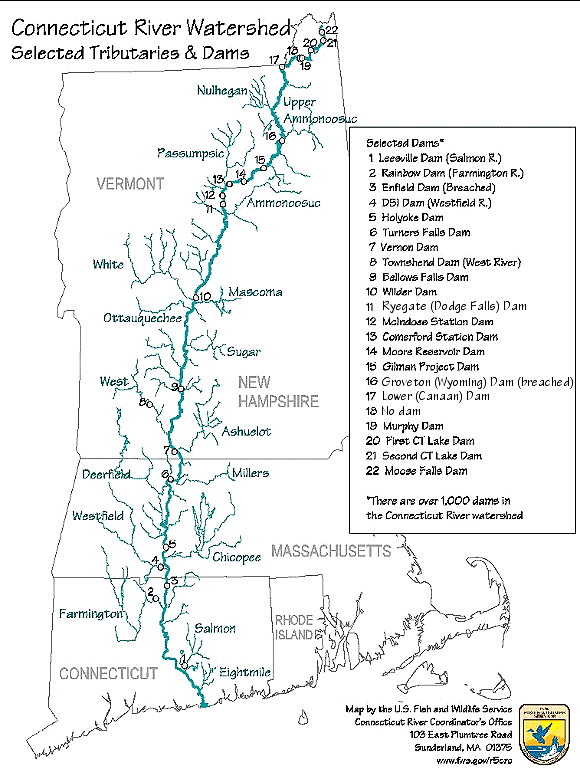
'There is a great river this side of Stygia
Before one comes to the first black cataracts
And trees that lack the intelligence of trees.
'In that river, far this side of Stygia,
The mere flowing of the water is a gayety,
Flashing and flashing in the sun. On its banks,
'No shadow walks. The river is fateful,
Like the last one. But there is no ferryman.
He could not bend against its propelling force.''
-- From "The River of Rivers in Connecticut,'' by Wallace Stevens.
Put panhandlers to work
Adapted from Robert Whitcomb's "Digital Diary,'' in GoLocal24.com
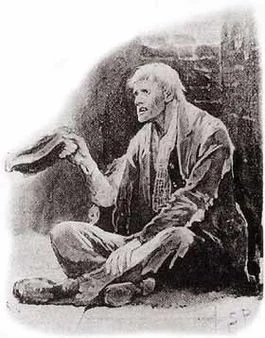
I type this, I see panhandlers on the street below, right before a traffic intersection. Too often cars stop without warning in order to give the panhandlers money. From their behavior, I’d guess that most are mentally ill and/or have substance-abuse problems.
There have been reports that in some cities syndicates place the panhandlers at certain corners and then take some of the revenue, sort of like pimps.
In many places (such as Rhode Island) the local chapters of the ACLU have made it too difficult to force these people to stop their “work,’’ or whatever you want to call it. So they continue to create litter (lots of cigarette butts) and threaten car crashes. In some (more conservative?) places, however, municipalities have managed to make bans on panhandling stick. Indeed, the National Law Center on Homelessness and Poverty reports that the number of communities that bar all panhandling has risen 40 percent in the past decade and more than 60 percent now prohibit the practice in some public places.
But some cities are being more creative. As a story by Maine Public Radio’s Ed Morin reports, Portland officials have hired some beggars to do such public chores as cleaning parks, focusing on picking up trash (which panhandlers, who are often homeless, help litter), generally at the local minimum wage. Private donations have also been used in some places to support these initiatives. To see Mr. Morin’s story, hit: https://nenc.news/portland-program-puts-panhandlers-productive-paying-public-projects/
It recalls the WPA of New Deal days.
As Mr. Morin reports, some other cities are taking the same approach, including Albuquerque, Denver and Chicago. I applaud this effort to financially support people to help prevent their homelessness, to give more structure, meaning and self-respect to their dysfunctional lives and to clean up communities, especially in public places. Let’s not let municipal labor unions get in the way.
John O. Harney/James Martin/James E. Samels: Consolidating New England's excessive number of colleges and universities
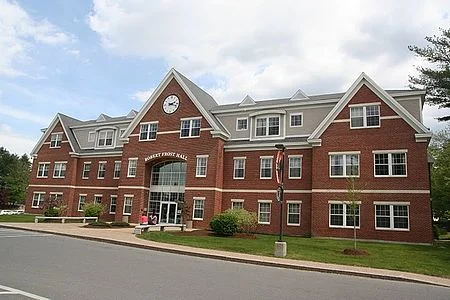
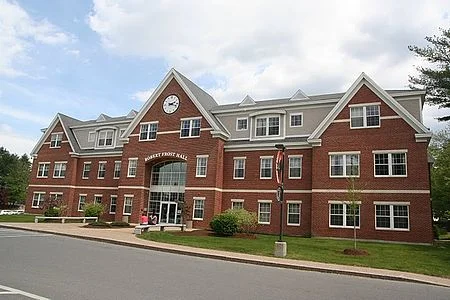
Robert Frost Hall at Southern New Hampshire University's main campus in Manchester. The poet himself attended Dartmouth College and Harvard University but didn't graduate from either. He lived in New Hampshire for much of his life.
Via the New England Board of Higher Education (nebhe.org)
NEBHE has been deeply interested in how New England higher education institutions can collaborate with one another and with other leaders to confront threats to their economic sustainability. These threats stem partly from shifts in academic content and delivery, student demography and institutional finances—all set against the background of both rising expectations and eroding public perceptions of higher education. Through its Higher Education Innovation Challenge, NEBHE engaged institutional leaders in addressing head-on the critical issues of cost and economic sustainability, while developing analytical tools and convenings to help campuses survive and thrive.
Notably, NEBHE President and CEO Michael K. Thomas’s monograph "Between Collaboration and Merger: Expanding Alliance Strategies in Higher Education," explains how higher education leaders can apply lessons from strategic alliances in other industries to enhance college and university’s financial sustainability and competitive positioning—responding to the public demand to educate more students at lower cost without sacrificing quality. Thomas explores models of strategic alliances that find a “sweet spot” between common higher education consortia and full institutional mergers.
Here, James Martin and James E. Samels, explain their latest book, Consolidating Colleges and Merging Universities: New Strategies for Higher Education Leaders, published by Johns Hopkins University Press earlier this year.
In the following Q&A with John O. Harney, executive editor of NEBHE's New England Journal of Higher Education, the authors share their findings and explore some of the key reasons that more New England colleges and universities are now considering partnerships, co-ventures, and even mergers as strategic options.
Harney: Why do you believe now is the right time for this book?
Martin and Samels: "Simply said, it is increasingly difficult to ignore the many news flashes, press releases and higher ed conversations focused on institutional partnerships, mergers and closures. Here in New England with some of our states offering, per-capita, the largest number of colleges and universities in the nation, there are too many colleges for too few students. We believe that this region will continue to see a rising number of schools beginning to work formally toward partnerships that leverage their resources and combine their curricula, personnel and infrastructure. Some institutions will enter into strategic alliances, and some will move straight to considerations of merger. Others will decide to close.''
Harney: "Even with, as you say 'too many' higher education institutions in New England, many students still appear not to find access or success in higher education. Do you see a way to address this conundrum?''
Martin and Samels: "Yes, our book looked at this issue, and while Consolidating Colleges and Merging Universities focuses principally on the leadership decisions involved in developing and sustaining new and familiar models of partnership and merger, we also explored a number of the reasons driving, even forcing, some schools to collaborate. The impact of collaborations on current and future students was also considered, as well as how faculty and administrative leaders can support student needs more effectively.''
"One recommendation would be to develop Early College programs that more effectively align students' career interests and aptitude levels with available curricula. Strategic programming in this area can help undergraduates avoid becoming lost during the critical first-year experience.
"Another suggestion would be to emphasize the value of vocational career opportunities. Massachusetts Secretary of Education James Peyser, for example, has spoken persuasively about the value of vocational-technical, and agricultural, programs, and he is candid about the need for higher education to find new ways to support vocational career paths.''
Harney: "New England is also shifting in terms of its demography. The region is aging, and it’s welcoming populations that have been underserved by higher ed historically? How could higher education partnerships, strategic alliances or even mergers effectively engage these groups that have not participated fully in higher ed?''
Martin and Samels: "As a start, public and private colleges could jointly dedicate more time and resources to defining their audiences and developing new programs, degree and otherwise, to address their needs.
"As one example, New England is currently experiencing a surge in the growth of the number of Latino students, and this trend is not likely to reverse itself anytime soon. In response, public, private and even for-profit institutions could formally partner, where requested or needed, with clusters of community colleges to create collaborative programs that form bridges to facilitate academic achievement.''
Harney: "Another key market is adult students. What do you think of Purdue’s acquisition of Kaplan with its generally older student body?''
Martin and Samels: "No matter what concerns one may have about this concept, we believe that it will occur in other regions, including our own, with greater frequency. Clearly, there are numerous issues that will need to be addressed, but management agreements of multiple types will begin to emerge as, for one example, a for-profit partner might allocate expanded resources to enrollment and marketing while a traditional public or independent partner could provide a larger share of the curricula and teaching faculty.
"As noted, there are complexities to work through, but entrepreneurial institutions will work through them if broader goals of mission enhancement, market share and sustainability can be achieved.''
Harney: "We are hearing more about regional 'clusters' of colleges and universities that cross state lines. What is your view of the feasibility of partnerships involving institutions in two or even three different states?''
Martin and Samels: "It appears that state lines may not be meaningful in terms of partnership and merger planning going forward. Rather, colleges and universities that share a will to innovate, a complementary—rather than simply similar—structure, and compatible student market-shares, no matter where they reside, will have the best chances to prosper. We believe that groups of institutions across the region, perhaps without realizing they are motioning closer together, are going to identify specific areas in which to partner and share resources over the coming 24 to 36 months.''
Harney: "What is the future for partnerships of any kind between public and private colleges and universities … and even for-profits in the case of Kaplan? How might they work and why?''
Martin and Samels: "In the book, we write about institutional asset transfers that can serve as "mergers without merging," so to speak. These can readily cross traditional public-private lines if planners are committed to shared goals. Colleges and universities that, at least initially, view full merger as out of the question may still develop agreements to share marketing resources, faculty teaching expertise, and classroom and library facilities, as examples.'
"The recent history of Daniel Webster College, in New Hampshire, is in some ways reflective of the drive to partner and create larger, stronger institutions. In the span of just a few years, Daniel Webster went from being a freestanding private college to part of the ITT Educational Services Inc. for-profit enterprise and now to part of Southern New Hampshire University (SNHU) via a 'Teach-Out and Program Articulation Agreement.' Under this agreement, as of the end of the 2016-17 academic year, 'SNHU will accept all Daniel Webster students who meet the minimum admission requirements for all subsequent coursework offered through SNHU, 'has outlined on the SNHU Web site.''
Harney: "As you know, we have reported on institutional closings over the years, in part through our Higher Education Innovation Challenge. Which kinds of New England colleges are most vulnerable? How can they avert closing?''
Martin and Samels: "New England colleges and universities most vulnerable to closure typically:
"Are small—with 2,500 students or fewer
"Are more than 85 percent tuition-dependent
"Have aging campus infrastructure with continuing signs of deferred maintenance
"Have rising student default rates
"Show excessive family tuition debt burden
"Have spiraling tuition discount rate
"Are religiously affiliated.
''We would also add that not all institutions in the region with one or several of these signifiers is headed toward closure. Rather, institutional leaders now studying this list and acknowledging that it describes their college or university, perhaps accurately, can undertake numerous plans for success. Our research suggests that one of the most effective is to develop a strategic alliance and co-venturing plan with a willing partner institution. As someone recently described it, 'Pick a dance partner before the music ends."'
'The familiar becomes foreign'

From "Holding Remnants,'' Farnir Adamites's show at the Boston Sculptors Gallery, June 14-July 23.
His show features large paper sculptures that act as monuments and reminders of past objects, people and actions. The gallery says: "Influenced by the concept that traits and traumas can be imprinted on our DNA and passed down to future generations, Adamites's work embraces the physical and psychic state of repetition. Dowsing pendulums, disfigured orbs and husk-like forms are common visual themes employed by the artist to highlight the state of disorder at the point when memories become new experiences, and the familiar becomes foreign. ''
'Everything had ripened at once'
"Remember the days of our first happiness,
how strong we were, how dazed by passion,
lying all day, then all night in the narrow bed,
sleeping there, eating there too: it was summer,
it seemed everything had ripened
at once. And so hot we lay completely uncovered.
Sometimes the wind rose; a willow brushed the window.''
From "Summer,'' by Louise Gluck
Hiding inside from Lyme disease
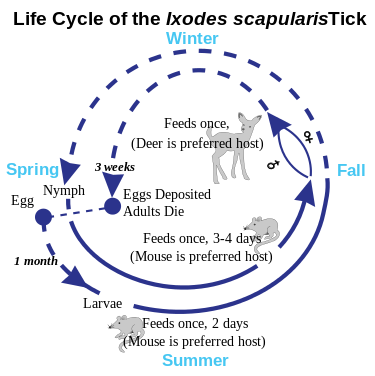
Lyme disease-causing tick.
Adapted from Robert Whitcomb's "Digital Diary'' in GoLocal24.com
Here’s a weird report from the Connecticut Post: A new study at the Yale University School of Forestry and other institutions asserts that fear of Lyme disease (named after the Connecticut town) costs, in the paper’s words, “$2.8 billion to $5 billion per year in activities pursued instead of enjoying the outdoors.’’ Strains credulity.
“People are giving up trips, and it's not just hiking and camping in the woods,’’ University of Alaska scholar Kevin Berry, the report’s lead author, said: “It’s trips to the park, soccer games or walks and bike rides in places where there are stands of trees and all grasses …a wide variety of activities pretty much anywhere in this part of the Northeast that’s outdoors.’’
Really? Can’t people just put on bug repellent and wear long pants?
Short-term loan
"Summer is a promissory note signed in June, its long days spent and gone before you know it, and due to be repaid next January."
-- Hal Borland

David Warsh: Understanding Russia's fascination with Vladimir Putin

The friendly -- or cold?-- face of the Russian president.
Chicago Tribune editor Jack Fuller used to speak of the mainstream news business as being among the “truth disciplines,” its aim being “at most a provisional kind of truth, the best that can be said quickly.” Science was older, slower, more firmly grounded. There were many related fields. As a newsman himself, Fuller didn’t spend over much time on the nature of truth, but most people know what he meant.
He was concerned with matters on which all those who took pains to inform themselves could agree. These were names, addresses, ages, places, details, to start; then assertions of all sorts, carefully attributed, not piled on willy-nilly but carefully connected in logical chains, accumulating in hopes of producing the goal, impossible in all but the simplest matters (was he alive or dead?), of consensus.
An interesting example of just how unsatisfying routine news can be could be heard last week in an imaginative and ambitious venture undertaken by National Public Radio, a member-supported media network enabled by the Public Broadcasting Act of 1967. NPR’s’s Morning Edition host David Greene traveled to Moscow to report live on Friday, June 9, and, as scheduled, Monday, June 12 – at the very moment that testimony of former FBI Director James Comey was dominating the news in Washington and New York. His dispatches were supplemented by reports from NPR national security correspondent Mary Louise Kelly and Moscow correspondent Lucian Kim.
In one segment, Greene interviewed Russia Today editor-in-chief Margarita Simonyan. Government-funded RT insists that it is a global news network much like the BBC or France 24 or Al Jazeera, offering news and opinion from a distinctive Russian point of view in both Russian and English. Many Western governments (and news organizations) regard RT as “the slickly produced heart of a broad, often covert disinformation campaign designed to sow doubt about democratic institutions and destabilize the West,” as Steven Erlanger recently put it in The New York Times.
Simonyan, 37, is well suited to her task. She spent a year in high school in Bristol, N.H., in 1996, and traveled widely afterwards as a Russian journalist. Greene asked about the telephone on which she is said to take orders from the Kremlin. “Yeah, it’s right here,” she said, laughing. “I use it whenever I have to discuss something [for which I need] a secure line…. Just today I talked to the Russian central bank, discussing some issues of RT finances that probably shouldn’t be discussed on an open line.”
Greene asked if she had an opinion about Putin and his policies.
“I have tons of opinions….To understand Russia’s fascination about Putin – and I think this is something that is completely not being understood in the West and in the mainstream media. And the reason why it’s not being understood is because people didn’t live here through the ’90s.
“In a town like mine, I probably, at that time, wouldn’t name a single person whom I personally knew who wanted to stay in Russia. Can you imagine that? All of the people I knew wanted to leave because we saw our country as something horrible, falling apart, that will only continue to fall apart. There were numerous wars going on. And then came Putin, and he stops all that. And we saw it in our lives. People around started – first of all, they stopped being hungry. Then they stopped having one pair of shoes for both my sister and me, you know, and wearing them in a row – and my mom. So for three of us [laughter], one pair of normal shoes – that all stopped. It all seemed magic….
“Not just mine – it’s everybody I know. And when I’m saying – I want to underline this. It would be an extremely difficult task to find a single person who lived worse before Putin than now, very difficult.’’
Careening along to stay within the bounds of his allotted time, Greene asked the next question: “If investigations revealed things about Vladimir Putin that could ultimately lead to him leaving office, would you be ready to carry out an investigation like that to its fullest here?”
SIMONYAN: “If I really sincerely thought that what Putin is doing is harmful for my country and for my people and it needs to be stopped, I wouldn’t hesitate to do that.’’
GREENE: “This – that’s not – I think you recognize this. That’s not your image or RT’s image on the outside.’’
SIMONYAN: “I understand that. I understand that. What are you going to do, you know, when the mainstream media, again and again and again, publish stories about us that are completely false? You know, that’s the image [they have of us]. Why do they do that? You tell me. I don’t know.’’
I don’t spend much time with RT itself. I scan the email version of the compendium of English-language news about Russia published nearly every day as Johnson’s Russia List, by independent journalist David Johnson. I skim most of what U.S. and British newspapers are saying, and a fair amount of RT content as well.
I am occasionally startled by what the Russian network is reporting that the Western papers are not, as was the case last week, when RT published Putin’s remarks at a session of the St. Petersburg International Economic Forum. Megyn Kelly, of NBC, was serving as his interlocutor, to good effect. It was at a sidebar news conference that Putin suggested that “patriotically minded” Russian hackers might have meddled in U.S. politics. JRL, I find, is a far better guide to developments in Russia than the coverage of any single newspaper.
As for the point that Simoyan sought to make on NPR about Putin’s popularity in Russian public opinion polls, it was made at much greater length and depth, in Second Hand Time: The Last of the Soviets (2013), by Belarusian journalist Svetlana Alexievich. The author’s earlier works include Chernobyl: The Oral History of a Nuclear Disaster (1997); Zinky’s Boys: Soviet Voices from the Afghanistan War (1992); The Last Witnesses (1985), recollections ofRussians who were children during World War II, and War’s Unwomanly Face (1982), about the experiences afterward of Russian women who fought in World War II.
Alexievich, 69, was recognized in 2015 with the Nobel Prize for Literature – an award that, like many other distinguished prizes, is among the truth disciplines that Fuller had in mind. Seeking to explain Putin’s popularity, Alexievich last year told Rachel Donadio, of The New York Times, “In the West, people demonize Putin. They do not understand that there is a collective Putin, consisting of some millions of people who do not want to be humiliated by the West. There is a little piece of Putin in everyone.”
What, then, about Putin’s repeated denials that his government backed various attempts to interfere with U.S. elections in 2016? In Washington last week, that still seemed a question worth asking. Sen. Angus King (I-Maine) asked former FBI director Comey, “Was the Russian activity in the 2016 election a one-off proposition, or is this part of a long-term strategy? Will they be back?”
“Oh, it’s a long-term practice of theirs,” Comey responded. “It stepped up a notch in a significant way in ’16. They’ll be back. There should be no fuzz on this whatsoever,” Comey said. “The Russians interfered in our election during the 2016 cycle. They did it with purpose. They did it with sophistication. They did it with overwhelming technical efforts.” Later, he returned to the topic:
“The reason this is such a big deal. We have this big messy wonderful country where we fight with each other all the time. But nobody tells us what to think, what to fight about, what to vote for except other Americans. And that’s wonderful and often painful. But we’re talking about a foreign government that, using technical intrusion, lots of other methods tried to shape the way we think, we vote, we act. That is a big deal. And people need to recognize it. It’s not about Republicans or Democrats. They’re coming after America, which I hope we all love equally. They want to undermine our credibility in the face of the world. They think that this great experiment of ours is a threat to them. So they’re going to try to run it down and dirty it up as much as possible. That’s what this is about and they will be back. Because we remain — as difficult as we can be with each other, we remain that shining city on the hill. And they don’t like it.’’
Special prosecutor Robert Mueller’s report on all aspects of Russian interference in the U.S. elections will go about as far as can be hoped in resolving doubts on this particular issue – diminishing the “fuzz” and confusion surrounding it. Clarity with respect to Russian hacking is one thing. Determining its effect on the 2016 election will be difficult, probably impossible, to resolve.
As for that cherished image of a shining city on a hill? As my friend Richard Pitkin says, there is a little city-on-a-hill in all Americans. It is a complicated sort of truth about which even Russian journalists and scholars may have a say.
David Warsh, an economic historian and veteran journalist reporting and commenting on economic, political and media matters, is proprietor of economicprincipals.com.
On the Silk Road to the PCFR

June 12, 2017
To members and friends of the Providence Committee on Foreign Relations (pcfremail@gmail.com; thepcfr.org):
Our last speaker of the season comes on Wednesday, June 14, with Laura Freid. Until recently she served as the founding chief executive of Silkroad, also known as the Silk Road Project, the global arts organization founded by Yo-Yo Ma, the famed cellist, in 1998 to promote international understanding and collaboration through the arts. The Silk Road, of course, was an ancient network of trade routes that were for centuries central to cultural interaction across much of Eurasia connecting the East and West.
Ms. Freid was recently named the president of the Maine College of Art.
She’ll talk about her experiences with Silk Road Project and the present and future ofthe arts as a force for international peace and mutual understanding.
She is calling her talk “What Happens When Strangers Meet? Lessons from the Road.’’ There will be film clips.
Many members may remember Ms. Freid's tenures as executive vice president for public affairs and university relations at Brown University and chief communications Officer at Harvard University, where she was publisher of Harvard Magazine.
Our summer hiatus starts after the June 14 dinner but we'll be sending out our traditional "Summer Letter'' soon thereafter with news about PCFR programs and internal improvements to come.
Llewellyn King's journal: Sad story about the seas; a movie mystery; D.C. lawyers' cold marble

Beach in the Cape Cod National Seashore.
I have not yet been to the beach this year and with the arrival of hot weather, a dip is in order. But the fact is that the beach is not what it used to be for me. Ever since I started making television programs on the oceans, I have stared out to the waves with a different mindset -- foreboding tinged with sorrow.
Like most of us I thought of the oceans as the last refuge of untrammeled nature, a place where man’s predations could not defeat nature; the last safe place for the world as it was. Then I started doing television interviews about the state of the oceans and found how wrong I was.
The first interview was with Mark Spalding of The Ocean Foundation; the second with Colin Woodard of The Portland Press Herald; the third was with Sen. Sheldon Whitehouse (D-R.I.), who is my senator; the fourth with University of Rhode Island oceanographer Sunshine Menezes; and the fifth was another detailed discussion of the state of the oceans with Whitehouse in his office on Capitol Hill.
Whitehouse is a passionate advocate for the oceans and an articulate voice about their deplorable condition, due to acidification, infestation with plastic, overfishing, and the relentless rise in temperature and sea level -- up there with acidification, and likely in the future to wipe out coastal communities.
It is grim stuff: a horror story of our own making and one that is sometimes lost among other stories of environmental disaster. But this is one that will get us all in some way.
They say Algernon Charles Swinburne, the 19th Century English poet, would not only write poetry about the ocean, but also would shout his verses into the waves. This summer as we flock to enjoy the beaches in New England and elsewhere, maybe we should shout “sorry” into the sick waves, because they are sick of a disease that can be arrested if we just have the mind to start.
Movie mystery: What gets the distributors' nod?
To me, part of the mystery of the movie business is as much in the distribution as in how particular movies come to be made. I say this because an exceptional film -- one of the few of recent releases -- has got short shrift from the distributors in Rhode Island. I cannot speak for the rest of New England or the country as a whole.
The movie is Norman,, starring Richard Gere -- and starring is the operative word because he is seldom off-screen. It has all of the ingredients which make a movie great to my mind – and for what it is worth, I once reviewed movies for newspapers. The story is, briefly, the tale of a somewhat sleazy New York fixer who ingratiates himself with an Israeli politician who rises to become prime minister of that nation. They become durable friends.
The movie, written and directed by Joseph Cedar, an Israeli film director, is taut, dodges heavy sentimentality and yet has flashes of sentimentality. It nails the banal cruelty of politics, the mischief of gatekeepers and the pain of outsidedness. The craft of filmmaking is on display here at its best. Gere is great and the rest of the cast is also exceptional. I am sure that it will be studied for its technical skill for years to come in film schools.
So why, I ask, was it not on general release in Rhode Island? On Saturday, June 10, it only had an 11:30 a.m. showing in one of the malls. My wife, Linda, and I ended up seeing it at Cable Car Cinema, a venerable but tiny art house in Providence, where it had a number of showings.
Why such limited release? The film was lavishly reviewed in the press, here and abroad. Curious business, movies – a joy when you see a great one where it was meant to be seen, in my view, in a cinema. and not on a TV screen.
Washington's marble lobbies: Cold, slippery and awful
Back to Washington last week for another speech and some visits.
Washington’s law firms set the pace for office decoration and two things dominate: marble and glass. One thing is eschewed: anywhere to sit.
Building after building, housing the myriad law firms, most of which are lobbying shops as well, have ridiculously obstructive security with rent-a-cops running little fiefs, and acres of cold, people-rejecting marble.
When you get upstairs, everything that can be glass is glass. One lobbyist makes sure that you are escorted at all times because of the number of people who have been hurt walking onto glass walls and doors.
Glass and marble: What does it all mean? What happened to wood and warmth and places to sit in lobbies? Heaven knows, human knees have not been converted to stone and glass.
Llewellyn King (llewellynking1@gmail.com) is executive producer and host of White House Chronicle, on PBS, and a frequent contributor to New England Diary.
'A ton of monarch'

"The world is warming and lightening
and mist on the pond
dissolves into bundles and ribbons.
At the end of my dock there comes clear,
bared by the gentle burning,
a monstrous hulk with thorny head,
up to his chest in the water,
mist wreathing round him.
Grander and grander grows the sun
until he gleams, his brown coat
glistens, the great rack,
five feet wide, throws sparks
of light. A ton of monarch,
munching, he stands spotlit.
Then slowly, gravely, the great neck lowers
head and forty pounds of horn
to sip the lake.''
From "Moose in the Morning, Northern Maine,'' by Mona Van Duyn
-
Such sweet pain
"Ah, summer, what power you have to make us suffer and like it."
-- Russell Baker
Can you predict a new stadium's psychological effects on its market?
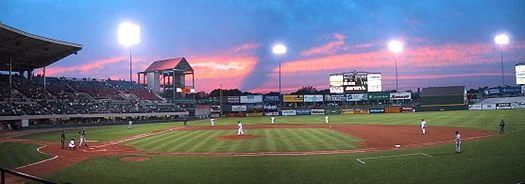
Remarkably romantic-looking McCoy Stadium, current home of the Pawtucket Red Sox.
Adapted from Robert Whitcomb's "Digital Diary,'' in GoLocal24.com
Larry Lucchino, chairman of the Pawtucket Red Sox, sent me an article from MLB.com the other week in response to my skepticism that baseball will continue to be popular enough to financially justify the public’s investment in a new baseball stadium in Pawtucket over the next 30 years. The first part of the article, which you can read by hitting this link, http://m.mlb.com/news/article/230956600/baseball-softball-most-participated-team-sport/:
“NEW YORK -- Baseball and softball had nearly 25 million combined participants last year, more than any team sport in the United States, Major League Baseball announced during its quarterly Owners Meetings on Thursday {May 18}.
“The finding came from an annual report produced by the Sports & Fitness Industry Association (SFIA), which also showed a notable increase in participation for youth baseball and softball.
“’Those numbers are really good news for us,’ Commissioner Rob Manfred said after the meetings adjourned. ‘We feel they're related to the investment baseball has been making through the Play Ball initiative. And, in fairness, even before that, in terms of the Major League Academies and the RBI (Reviving Baseball in the Inner Cities) that began under Commissioner Bud Selig, improvements in youth participation in baseball are unique among team sports.
"It's not a trend that we're seeing with other team sports."
That reminds me of a central question in considering whether to put taxpayer money into stadiums to be used by for-profit sports teams owned by very rich people: Does having such a facility substantially boost the energy and optimism – the “animal spirits’’ – of a region and in doing so make it more economically and socially dynamic? Has gritty, high-crime Baltimore, for example, become a lot better with the Orioles’ beautiful Camden Yards stadium?
And if the Pawtucket Red Sox organization doesn't get the financial deal it wants from the State of Rhode Island, where else could it go in New England?

Chris Powell: Conn. GOP gets serious, Democrats wallow in trivia

The Connecticut Capitol, in nearly bankrupt Hartford.
While this year's regular session of the Connecticut General Assembly has little to show for itself but more gambling -- another casino and more off-track betting -- it was positive in one respect: the recognition by Gov. Dannel Malloy and the unusually large Republican minority that structural changes in spending policies are necessary to save the Nutmeg State.
The governor has extracted substantial if inadequate concessions from the state employee unions, but he proposed to close the budget deficit by shifting to municipalities $400 million in teacher pension costs. Instead he might have proposed reducing teacher pension benefits, since those benefits, unlike state employee pension benefits, are set by state law rather than union contract. But having dozens if not hundreds of members and their dependents in every town, the teacher unions are far more influential than even the state employee unions, so no one dares to economize there.
The Republicans united behind a budget proposal that avoided tax increases by cutting more from state employee compensation. They essentially proposed to remove salaries and benefits from collective bargaining for the time being. Thus the Republicans realized at last that they gain nothing by being nice to the state employee unions. Since the Democrats are the party of those unions and retain narrow majorities in both houses of the legislature, this Republican effort to restore democratic control of public expense will have no chance of passing until Republican majorities are elected. But standing for something important may distinguish the Republicans favorably in next year's election.
The legislature failed to produce a budget for two reasons.
First, the Democrats could not hold their majority together. Most Democratic legislators are liberals and will always prefer raising taxes. But enough Democrats either agree with the governor that raising taxes now would hurt the state more than it would help or they fear for their re-election if taxes are raised again, since the public is realizing that living conditions have only worsened as taxes have been raised during the Malloy administration.
Second, the Republicans seem to have decided that any compromise with the Democrats on the budget will have to raise taxes and spending somewhat and that sharing responsibility for that isn't worthwhile politically, especially since, in the forthcoming special session of the legislature, the Democrats probably will compromise among themselves to reach such an outcome anyway. The Republicans may figure that the Democrats might as well own the whole thing and be obliged to defend it in the election next year, when the public will be looking for change.
Both parties bear responsibility for the expansion of gambling, policy that is disgraceful, contrary to Democratic pretenses of protecting the poor and opposing concentration of wealth and Republican pretenses of advocating responsible living. But at least the Republicans aren't celebrating the legislative session as the Democrats are.
Democratic state headquarters this week issued a statement lauding the legislature for banning therapy aimed at trying to convert homosexuals into heterosexuals, though there was no evidence of its use in Connecticut; for increasing penalties for hate crimes, as if they were not already seriously punishable; for reducing bail for minor offenses, as if this affects many people; and for approving a state constitutional amendment for a transportation fund “lockbox,” as if money still won't be fungible and government won't always find a way to divert it.
Failing to produce a budget, the legislative session was all trivia.
Chris Powell is managing editor of the Journal Inquirer, in Manchester, Conn.
-
'Protect the Oceans'

"Cod Larvae'' (encaustic on panel), by Pamela Dorris DeJong, in the group "Protect the Oceans: An exhibit of artists interested in protecting our oceans and shoreline habitats,'' at Highfield Hall, Falmouth, Mass., through June 18.
Summer loss
"The season’s ill—
we’ve lost our summer millionaire,
who seemed to leap from an L. L. Bean
catalogue. His nine-knot yawl
was auctioned off to lobstermen.
A red fox stain covers Blue Hill.''
-- From "Skunk Hour,'' by Robert Lowell.
(Blue Hill refers to Blue Hill, Maine)
'Hate to be made literate'
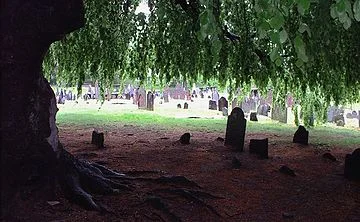
Ye Antientist Burial Ground,, in New London, Conn., is one of the earliest graveyards in New England and the oldest colonial cemetery in New London County. The hillside lot of 1.5 acres adjoins the original site of the settlement’s first “meeting house’’ (church). There’s a broad view to the east of the Thames River and, on the far shore, the heights of Groton.
The lot was reserved for a burying ground and recorded as such in the summer of 1645 with the first decedent "of mature age" interred there in 1652. An ordinance of June 6, 1653 set the place apart, declaring: "It shall ever bee for a Common Buriall place, and never be impropriated by any."
"Somehow the blocks of slate and marble hate
to be cut and carved to the dimensions
of Mary Monday’s age and her virtues.
At heart they hurt to be made literate
and they are rebelling, fast as they can,
shedding an edge, a letter, as they go
—a year, a part of a skull, a bone—
it hurts them to stand so long for this
kind of death not theirs. Fast as they can
they are leaning away from their duty
and look down longing for the warm sod.''
From "New England Graveyard, '' by Stephen Sandy
Joyous racist murderers
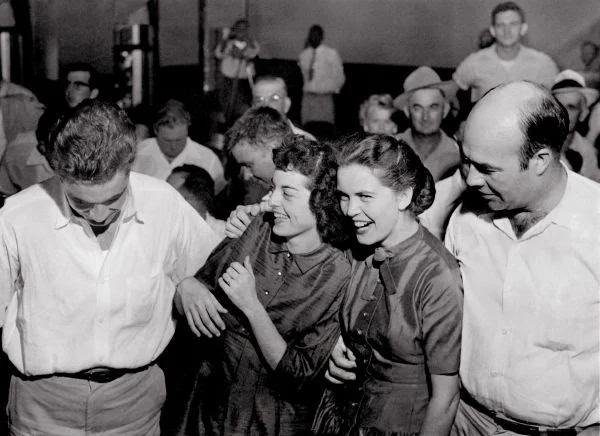
Photo from the show "Black & Brown People/ White Problems,'' at the Samson Projects gallery, Boston, through Aug, 19. In this picture, from left to right: Roy Bryant, Carolyn Bryant, Juanita Milam, and J. W. Milam embrace after the men's acquittal by an all-white male jury of the charge of having kidnapped, beaten and murdered Emmett Till, a 14 year-old black boy in 1955 – a crime that the two men confessed to in an interview in 1956, paid for by Look magazine, and in which they showed no remorse. Photo by Associated Press; individual photographer not identified.
Use it up, wear it out
''In Maine, there is a deeply ingrained sense that you can always get a little more use out of something.''
-- Tim Sample
Spreading out the casino scam
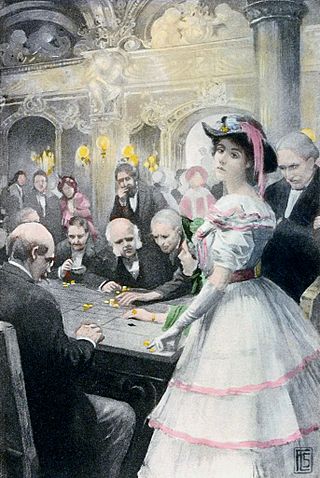
"Gwendolen at the roulette table" – 1910 illustration with George Eliot's Daniel Deronda.
Adapted from Robert Whitcomb's "Digital Diary,'' in GoLocal245.com
After failing to improve the standard of living (well, loan sharks have done well) in southeastern Connecticut (a state whose government is swimming in red ink) with their vast casinos, the MashantucketPequot and Mohegan tribes are pushing to build a “satellite’’ casino in East Windsor, Conn., making the pitch that this will reduce the flow of revenue to Springfield, Mass., where another casino based on wishful macroeconomic thinking is going up.
Let the cannibalization of casino suckers continue! Surf a new wave of embezzlements and personal bankruptcies in Greater Hartford! Of course, the tribes are getting support from their local state legislators, who look to campaign contributions before the next election.
The plan is for the Pequots’ Foxwoods and the Mohegans’ Sun to pay 25 percent of their gross slot-machine revenues at the new facility to the state so long as no other enterprise is allowed to have a casino in Connecticut. So much for the free market!