
Vox clamantis in deserto









Jim Hightower: Nuns take on Wells Fargo
Via OtherWords.org
In an insightful song about outlaws, Woody Guthrie wrote this verse: “As through this world I travel / I see lots of funny men / Some’ll rob you with a 6-gun / Some with a fountain pen.”
The fountain pens are doing the serious stealing these days.
For example, while you’d get hard time in prison for robbing a bank at gunpoint, bankers who rob customers with a flick of their fountain pens (or a click of their computer mouse) get multimillion-dollar payouts.
They usually escape their crimes unpunished — but not unscathed. After all, it’s their constant, egregious, gluttonous thievery that’s made “banker” a four-letter word in America, synonymous with immoral, self-serving behavior.
For example, Wells Fargo, our country’s biggest consumer bank, has gotten away with paying some fines for stealing millions of dollars from customers in its notorious “fake accounts” scheme.
But it hasn’t escaped the wrath of the Sisters of St. Francis of Philadelphia.
This feisty order of nuns, which holds a block of Wells Fargo stock, is infuriated by the rank immorality of its bank’s executives. The sisters are pushing a shareholders’ proposal demanding a full accounting of the “root causes” of the malicious fraud perpetuated on vulnerable depositors.
Unsurprisingly, the bank’s aloof and arrogant board of directors, which had silently presided over the fraud for years, opposes any such meaningful probe. Such recalcitrance only intensifies the public’s outrage and cynicism toward out-of-control banksters.
But the giant worries less about its public image than it does about the reality an in-depth investigation would expose — namely, that our nation’s dominant banks have not only become too big to fail and too big to jail, but too big to manage and control.
To stop that thievery, they must be broken up.
Jim Hightower is a columnist for OtherWords columnist and the editor of the populist newsletter, The Hightower Lowdown.
Trump Tower in a few hundred years

"Corfe Castle, Dorset'' (oil), by Inigo Richards, in the show "Art in Focus: The British Castle -- a Symbol in Stone,'' at the Yale Center for British Art, New Haven., through Aug. 6.
Wonderful but tough

Top of Mt. Katahdin, in Maine, the northern terminus of the Appalachian Trail.
''Maine is wonderful. It can be very hard. I mean, if you look at the profile maps it doesn't look it, but somehow when you get out there it's really steep and hard.''
-- Bill Bryson, author of A Walk in the Woods, about his bizarre hike along the Appalachian Trail.
Boston in the shadows
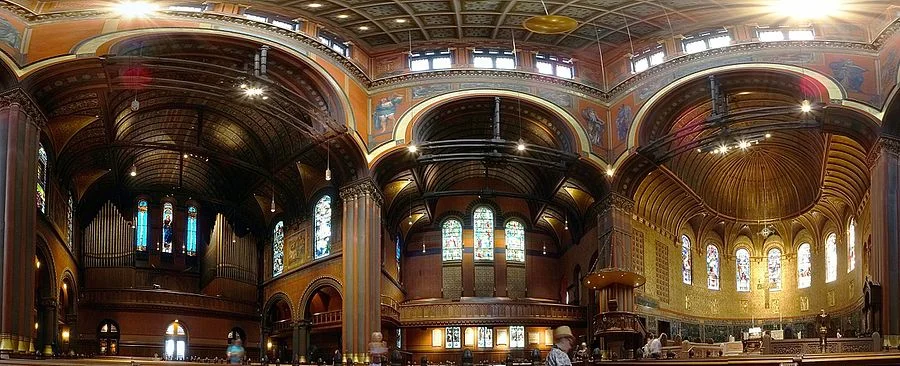
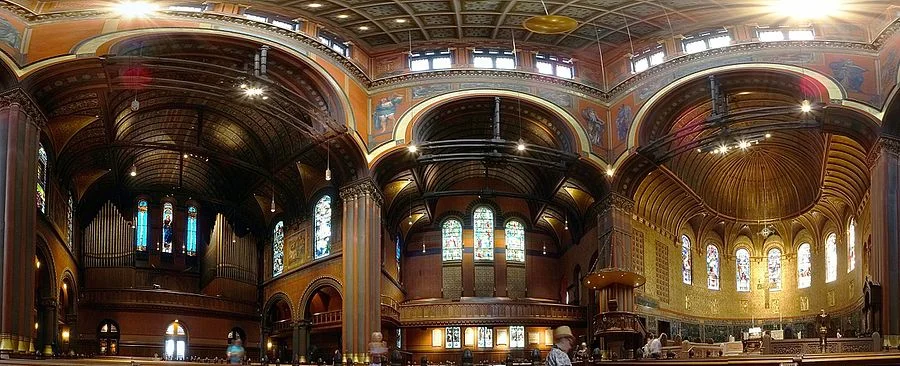
Panorama of the inside of Trinity Church, Boston, built in 1872-77. The shadows from new nearby towers threaten to sometimes reduce the beauty of the stained glass windows.
Adapted from an item in Robert Whitcomb's "Digital Diary'' in GoLocal25.com
I like skyscrapers for the exuberance (or confidence or arrogance?) they express about a city. I wish we had more in Providence. So the Manhattanization of much of downtown Boston per se doesn’t bother me. Seeing those towers from Boston Harbor and the shores of the Charles River can be exhilarating. But they don't work everywhere.
Consider that two glorious old churches – Trinity Church, on Copley Square, and nearby Old South Church -- would all too often be put into shadows by a pair of towers (376 and 298 feet tall) planned for atop the soon-to-be-expanded Back Bay train and subway station.
I realize that the taller the buildings the more money the developer can make. But extreme building height can also undermine the very qualities that make a city attractive. Consider that the famous stained glass windows of the aforementioned churches would sometimes be put into the dark on sunny days by the shadow.
Then there’s the 750-foot tower that Millennium Partners wants to build downtown on Winthrop Square (where I worked one summer at the old Boston Record American) — which will put some of the Boston Common in the shade.
Boston, like all old cities, needs to find a better balance between dramatic height and human scale and between piles of new money and aesthetics. In Houston it doesn’t matter. I suspect that Bostonians would prefer that their old city continue to look more like London than Houston.
Shadows cast by skyscrapers are not bad in themselves. It depends on what’s being put in the shadows.
Film: How 2 boys survived a Guatemalan massacre
This was sent to New England Diary on April 24
"We are reaching out with an opportunity to see a special advance screening of Finding Oscar, a new documentary about two boys who survived a massacre during the Guatemalan Civil War and help bring justice to those responsible.
"This is a one-time only event in Providence and a unique opportunity to hear from the film's subject, Oscar Ramírez Castañeda, who will be at the theater for a post-screening conversation. It is sure to be a powerful event and we hope you can join us.
"In a forgotten massacre during Guatemala’s decades-long civil war, a young boy was spared, only to be raised by one of the very soldiers who killed his family. Nearly 30 years after the tragedy, it will take a dedicated team – from a forensic scientist to a young Guatemalan prosecutor – to uncover the truth and bring justice to those responsible…by finding the missing boy named Oscar.''
Advance Screening of Finding Oscar
1 p.m., Sunday, May 7, 2017
Avon Cinema
260 Thayer St.
Providence, RI 02906
Followed by a Q&A with Oscar Ramírez Castañeda
See trailer:
http://findingoscar.com/
Purchase tickets. See:
http://avoncinema.com/coming-soon.php
Education and employability in New England
Via the New England Board of Higher Education (nebge.org).
The {New England} Commission on Higher Education and Employability held its opening event at the Rhode Island State House on Wednesday, April 12. The commission is a collaboration of the New England Board of Higher Education (NEBHE) and Gov. Gina M. Raimondo of Rhode Island, who is serving as chair. The Commission membership includes business leaders, college presidents, chancellors, state legislators, secretaries of labor and workforce development and students.
The commission will identify and recommend high-impact practices and institutional and state policies to improve the career readiness and employability of recent college graduates in New England.
NEBHE’s president and CEO, Michael K. Thomas, cited a 2014 Gallup report, which found that the urgency of this work can be attributed to the polarization between employers and college academic leaders. While 96 percent of college representatives felt confident in their institution’s ability to prepare students for the workforce, only 11 percent of business leaders agree that today’s college graduates have the skills and competencies that business needs.” According to the Federal Reserve Board, more than 30 percent of young adults do not receive information about jobs and careers in college.”
Governor Raimondo spoke about the rapid pace of technological change and the advancement of industrial robots, artificial intelligence and data analytics. The governor said, "Companies that get it right in the face of change will survive and grow, while the impact of acceleration could mean that well-paid jobs for blue-collar workers, such as trucking, will likely be obsolete in 15 years." Moreover, she noted, Rhode Island has undergone difficult economic times the last 20 years and that this conversation is a game changer – everyday, employers tell her that they could grow faster if more skilled employees were available.
Providing testimony were Andreas Schleicher, director for the Directorate of Education and Skills at the Organization for Economic Development and Cooperation OECD), and Brandon Busteed, executive director, education and workforce development, for Gallup.
Schleicher cautioned that while the older generation of U.S. adults’ literacy levels is amongst the highest in the world, the younger generation falls short. A Japanese high school graduate, for instance, has the same level of literacy as a U.S. college graduate. Busteed shared what skills employers were seeking in recent college graduates.
Rising to number one amongst employers is the need for recent graduates to have some type of internship or work experience. Elsa Núñez, president of Eastern Connecticut State University, responded in agreement and added that the quality of the internship matters, too. Busteed spoke about the critical role that career services plays in helping students to develop employability skills and the fact that more students were taking advantage of these services. Unfortunately, though, Gallup has found that many graduates reported that their career services office was not very helpful.
One common refrain heard from commission members who are employers was that their states and the region are suffering from a skilled worker shortage. Judith West, senior vice president of human resources at the Maine Medical Center, called the situation a perfect storm. West pointed out, "In Maine, there are more deaths than babies being born and the incoming workforce lacks fundamental skills and needs retraining – contributing to the increasing growth in the cost of health care costs."
Ross Gittell, commissioner of the New Hampshire Community College System, reminded the commission to focus more on its strength in acting as a region and that we can leverage our collective efforts given New England’s highly skilled workers and high-value added industries are highly mobile.
In order to help the Commission develop its report and accompanying recommendations, the membership is divided into three working groups, each focusing on two topics: Effective Use of Labor Market Data & Intelligence & Planning, Advising and Career Services; Work-Integrated Cooperative and Internship-based Learning & Targeted Higher Education/Industry Partnerships; Innovation, Technology and New Economy Skill Bundles & Emerging Credentialing Systems.
The commission will reconvene in Providence the end of June.
Cape light

"Hopper's House'' (oil on canvas), by Jim Holland, in the show "Up Close and Personal: 2017 Season,'' at the Heritage Museum and Gardens, Sandwich, Mass., through Oct. 9. The title is an obvious reference to the late long-time Cape Cod summer resident and New York-based painter Edward Hopper.

David Warsh: Thank Utah as well as Mass. for movement toward universal health insurance

The Mormon Tabernacle on Salt Lake City.
SOMERVILLE, Mass.
There is no better example of the use of the memory hole in the service of doublethink than Republican opposition to the individual mandate that is at the heart of Obamacare. Requiring all individuals, even young and healthy ones, to buy health insurance through markets was a Republican idea, advanced in the early 1990s in opposition to a single-payer health system. It was a thoroughly sensible approach to the problem of steadily rising health-care costs, and, as it turned out, the only practicable way to proceed.
I wrote about these beginnings last month. The news that the Republican leadership in the House plans a second attempt to “repeal and replace” – apparently in the shadow of the president’s tax-reform plans – got me thinking about the subject again.
A couple of summers ago, I spent a pleasant day reading American Crucifixion: The Murder of Joseph Smith and the Fate of the Mormon Church (Public Affairs, 2014), by Alex Beam. Aside from the manuscript of the Book of Mormon, confided to him, in 1843, by an angel named Moroni, Smith left relatively little behind when he died, at age 38, besides a museum containing the mummies of “the Old King Pharaoh himself of the Exodus, with his wife and daughter.”
Otherwise, Joe Smith possessed “pretty much all the weaknesses a man could have,” in the words of the church elder who succeeded him. These included an enthusiasm for plural marriage so robust that it eventually included the wife of one powerful backer and the daughter of another – extensions that ultimately proved fatal. Smith was shot to death by members of a mob in in Carthage, Ill., in 1844.
Instead of dispersing, most of the members of the Church of Jesus Christ of Latter-day Saints fled Illinois and moved some 1,300 miles through Indian country to the Great Basin of Utah, in a series of epic journeys. There they produced a community of faith that for more than 165 years has successfully preached a powerful gospel at home and abroad. How did the Mormon Church fare so well?
The answer, I knew, was Brigham Young. I knew this mainly from reading the chapter on Young in The Vital Few: The Entrepreneur & American Economic Progress (Oxford, 1986), by Jonathan Hughes, of Purdue and, later, Northwestern University. The chapter on Young follows one on another religiously inspired founder of an American state, the Quaker William Penn. Other chapters portray the lives and works of Eli Whitney, Thomas Edison, Andrew Carnegie, Henry Ford, E.H. Harriman and J. Pierpont Morgan; as well as social entrepreneurs Mary Switzer (federal disability services) and Marriner Eccles (the Federal Reserve Board).
If Smith was the church’s greatest talent, Young was the first Mormon mandarin (following the tripartite schema of Nicholas Lemann). Young was 30 when he first he read the Mormon testament. He was 45 when he took over leadership of the church. In the great Mormon migration, on foot and by wagon, he produced, Hughes wrote, “a singular masterpiece of organization” –- and a political culture that proved durable. For an elaboration of this remarkable achievement, the exertions and the foresight it required, see Hughes's book.
In summary, Hughes wrote:
"In the trek, as in the early settlements, the 'ideological system' was a mixture of private enterprise tempered by cooperation wherever private means did not provide the ends sought by the church leaders. This view of economic organization never left the Mormons. It now pervades the United States….Conservatives, they preside over a most extensive welfare enterprise…. both 'free enterprise' and 'collectivist.'''
That in turn led me to read American Universities and the Birth of Modern Mormonism: 1867-1940 (University of North Carolina, 2016), by Thomas Simpson It turns out that once things settled down in the Utah Territory– after the “Utah war” of 1857-58, in which the U.S. sent a 5,000-man expeditionary force to pacify the unruly polygamists, and after the four-year U.S. Civil War – Brigham Young authorized the beginnings of a reverse migration of Mormon students to Eastern universities.
This was the same sort of strategy pursued during the same years by separatist Japan under the charter of the Meiji Restoration. Japan sent many students to universities abroad in the late 19th Century and it produced similar results – a controlled modernization that nevertheless eroded the ecclesiastical insularity that it was designed to serve. Much the same process unfolded in China after 1978 – the Great Leap Outward, as it was known.
Which brings me to my subject, Mitt Romney, governor of Massachusetts, 2003-07, and among the most prominent Mormons in American politics. It was Romney’s administration that took advantage of fortuitous fiscal circumstances to enact a universal health-care system with an individual mandate. The measure was aimed about equally at citizens who were unable to obtain insurance because of pre-existing conditions and poor people who habitually obtained their health care in emergency rooms.
The measure proved a considerable success. The Obama administration saw the opportunity, seized it, and, with Democratic majorities in both houses of Congress, passed it into law in 2010. A furious backlash ensued that summer. The Tea Party midterm election produced a Republican majority in the House. Positions hardened and the logic of the individual mandate was obscured.
Romney sought the Republican presidential nomination in 2008 on the basis of his success in Massachusetts, but lost out to Sen. John McCain (R.-Ariz.). He tried again in 2012 and this time obtained the nomination, but only at the cost of disavowing the general applicability of his signature reform. Romney promised that were he elected, he would immediately grant waivers to Obamacare to any state that wanted one, and said he would then set out to repeal the law. He lost the election by a substantial margin. Had he bided his time, might Romney might have made a strong run for the Republican nomination in 2016? (He turned 70 earlier this year.) Who knows? Time-biding isn’t easy in politics.
Recently Romney has been encouraged to consider running for the U.S. Senate in Utah, should 83-year-old Republican Orrin Hatch decide to retire. If that happens, Romney might once again become an influential voice for the individual mandate; he could serve two good terms on the national stage. The Utah electorate is apparently becoming a source of surging support for Obamacare in the face of attempted repeal – as might be expected of Brigham Young’s Utah.
Meanwhile, Rep. Jason Chaffetz, who represents Provo and the state’s Third Congressional District, announced last week without explanation that he wouldn’t stand for re-election in 2018, perhaps even resigning his seat – and thus the chairmanship of the powerful Government Oversight Committee – before then. Perhaps Chaffetz hopes to run for governor in 2020. The Trump loyalist would not be a be a shoe-in. Recent Utah governors have included two figures of national stature, Mike Leavitt and Jon Huntsman Jr., and the Mormon Establishment that produced them remains a potent source of fresh talent. Less reflexively Red than you think, Utah has suddenly become another of those laboratories of democracy to closely watch.
David Warsh, a veteran business writer and economic historian, is proprietor of economicprincipals.com, where this first ran.
Very scientific Boston Common
BOSTON
The Boston Common hosted not one, but two of the 600 March for Science rallies held around the world on Earth Day, April 22. In addition to the featured rally, a separate Kids' March drew about 1,000 youngsters and adults. The children’s event hosted science experiments and activities, and its own list of speakers at the park's historic bandstand.
On the main stage, Gina McCarthy, director of the Environmental Protection Agency (EPA) under President Obama, spoke briefly about President Trump’s efforts to block billions of dollar in funding for climate-change research and science-related programs.
“Actions so far in Washington have made clear that not only are they intent on denying inconvenient science, they are out to stop doing science. Period and full-stop,” McCarthy said.
The April 22 science rally drew a crowd of at least 5,000, many wearing white lab coats. The crowd was a mix of college students, biotech employees and retirees, many of whom attended the Women’s March and other protests organized after Trump’s inauguration, which came on Jan. 20.
Even before he took office, Trump has been an unabashed opponent of research and climate-change science. He’s appointed members of the fossil-fuel industry to his cabinet and installed them to run federal agencies.
Of its many actions against science, the Trump administration removed the word “science” from the mission statement of the EPA’s Office of Science and Technology.
Protests against Trump's efforts to purge the government of scientific truths continues next Saturday, April 29. with the People’s Climate March in Washington, D.C., and around the world.
Spring boy

''Eligma Narcissus,'' by Allison Thiel, in the "Senior Concentration Seminar Exhibition 2017,'' at the Cantor Art Gallery, College of the Holy Cross, Worcester, April 27-May 26.

'Bustlings, strainings'

"It was that period in the vernal quarter when we may suppose the Dryads to be waking for the season. The vegetable world begins to move and swell and the saps to rise, till in the completest silence of lone gardens and trackless plantations, where everything seems helpless and still after the bond and slavery of frost, there are bustlings, strainings, united thrusts, and pulls-all-together, in comparison with which the powerful tugs of cranes and pulleys in a noisy city are but pigmy efforts."
-- Thomas Hardy
'The Art of Sound'

"Sentient Veil,'' by Philip Beesely (seen here), in the show "Listen Hear: The Art of Sound,'' at the Isabella Stewart Gardner Museum, Boston, through Sept. 5. This is a group show with seven sound installations inside the museum as well as two off-site pieces.
Llewellyn King: A compromise to address the ugliness of deportations
It is ugly today, it will be uglier tomorrow, and months from now it will be even uglier. The relentless rounding up of undocumented people living in the United States is the horror that can be ended, if there was a will to end it — and if it were not a source of political feedstock for unyielding positions so close to the Trump presidency.
Mind you, it was not all that pretty under the Obama administration. He signaled his heart was in the right place while the deportations continued. What Obama did was to protect, by executive order, the undocumented who were brought in by their parents while underage. Now there is a report of the first of these dreamers, Juan Manuel Montes, being arrested.
We get little snippets of how ugly the deportations are from time to time in the media: a child bawling her eyes out because ICE policemen have seized her mother. That poor woman is on her way to a country she left because there was little there for her when she committed the crime of settling without papers in the United States; when she availed herself of the opportunity that nearly all American settlers once did: to live and work in freedom and peace.
In writing about the inhumanity of deporting the undocumented, I know what I have opened myself up to a flood of abusive mail, denouncing me as a crypto-communist and much worse. Always the same theme and often the same words inform these communications: “What is it that they don’t understand about illegal?” That is crime enough for those who want mass deportations.
At present the threshold, we are told, is that the deportee should have at some time committed a felony. Under federal law, illegal residence here is not a felony but a misdemeanor. One such crime in some states is driving under the influence. A felony? Yup. By the way, it is a crime for which former President George W. Bush was convicted in 1976.
Things are going to go from ugly to hideous when the federal government brings its might against sanctuary cities. There is the raw combustible material of civil strife here — ugliness in the streets, which has not been seen since 1968.
When neither of two options is acceptable, it is time to seek a third way: a compromise.
I have been advocating a compromise that was developed by a quiet, former IRS tax inspector and California university system auditor who lives in Malibu, Calif. He is Mark Jason and his idea is simple: cool things down and get some benefit for local authorities in areas where the undocumented are concentrated.
Jason and his Immigrant Tax Inquiry Group, wholly funded by himself, would recognize the presence of the undocumented and give them a way to remain and live productive lives. His proposal is a 10-year work permit dependent on a tax of 5 percent to be paid by both the worker and the employer. Jason calculates a revenue bounty of $176 billion over 10 years. There would be no citizenship for the worker. This money, Jason says, ought to go to the localities where the undocumented live and to defray the costs of education, health care, policing and other essential services.
This third way, this 5 percent solution, would not satisfy the immigrant advocates who want a “path to citizenship” or those who want to throw the baggage out; the dreaded knock on the door, families shattered, dreams turned into nightmares.
I still think we must control immigration, prevent it at points of entry, not when a life has been established and families are at risk.
There is a horror greater than the illegality of an otherwise productive citizen. It is the supreme ugliness of the state sending its agents against the individual, whether it is the state seeking to bivouac troops in private homes, as the English did to the American colonists, or the agents of the state coming into a home to rip it asunder.
That is an ultimate ugliness, unspeakable, unbecoming and, dare I say, un-American.
Llewellyn King (llewellynking1@gmail.com) is host and executive producer of White House Chronicle, on PBS, and a veteran publisher, columnist, international business consultant and frequent contributor to New England Diary.
Don Pesci: Weicker back with more incoherence; Hartford's dilemma and opportunity
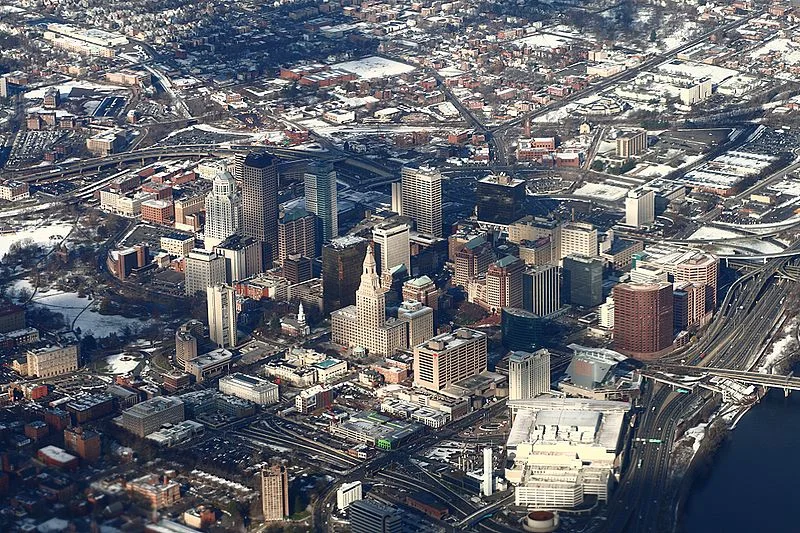
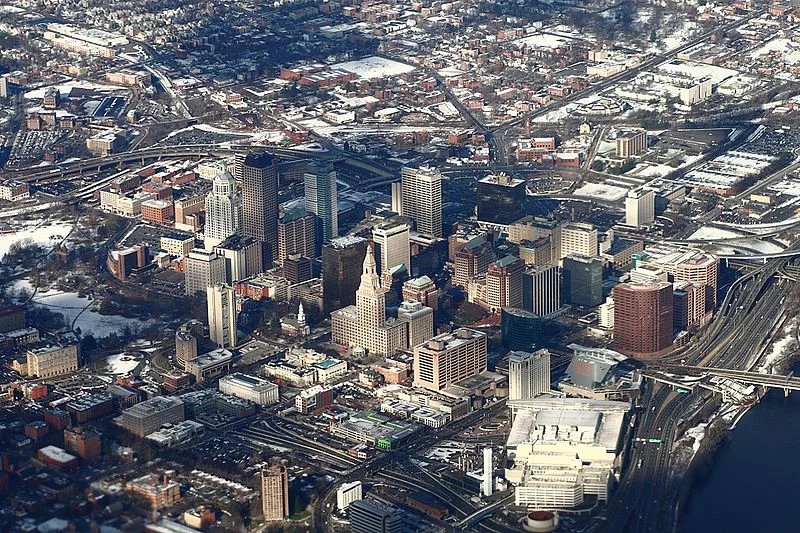
Downtown Hartford, once famed as the "Insurance Capital of the World.''
-- Photo by Sage Ross
Former Connecticut Gov. Lowell Weicker surfaced recently and both condemned, unwittingly, and complimented lame duck Gov. Dannel Malloy.
Every so often, Mr. Weicker, intent on working the dents out of his legacy, pokes his head above the fox hole, scans enemy territory for a friendly face, and spills some political beans. Ken Dixon of the Connecticut Post asked Mr. Weicker to comment on Mr. Malloy’s decision to pack it in, and he obliged. What Weicker said was, as usual, confusing and contradictory.
Mr. Malloy’s decision to withdraw his name for re-nomination, Mr. Weicker said, “unties Malloy’s hands.” Really? Malloy’s hands have not been tied during his entire term in office. All the heights of power in Connecticut’s government – the governor’s office, the General Assembly, the state’s constitutional offices, Connecticut’s U.S. Congressional Delegation, important courts appointments made by Mr. Malloy – have been in Democrats' hands since Mr. Malloy had first been elected governor. Indeed, so untied were Mr. Malloy’s hands that he felt comfortable denying Republican leaders in the General Assembly any voice in union contract negotiations with SEBAC, the union conglomerate authorized to fashion contracts with the governor; and when budget deliberations began during Malloy’s first term and second terms, he shooed Republicans out of the negotiation room and slammed the door in their faces.
One thinks of Cromwell marching into the British Parliament and shouting, “Gentlemen, go home!” There is not a hint of “tied hands” in any of this?
Mr. Weicker then added that, were he governor, “I would to the best of my ability deny the spending spree in the legislature. We’ve got to stop spending. That’s our huge problem. Every legislator has their pet project. We’re probably in the worst financial condition of any state in the union, and we’re known for that, rather than being the wealthiest.” He rounded out his thoughts, such as they were, by commending Mr. Malloy, whose approval rating in Connecticut is among the lowest in the nation, at about 28 percent: “Dan’s had two terms, which is heavy-duty in Connecticut. I would say he still wants to leave a positive legacy. I admire the man. I like him. He’s a good governor.”
So let’s see: in 20 months, Mr. Malloy will have been in office for two terms; he is the author of both the largest and second largest tax increases in Connecticut history, outperforming even Weicker on this score; the Connecticut legislature, dominated by Democrats for a half century or more, has, even by Weicker’s reckoning, spent the state into a hole; state deficits are about what they were during Weicker’s first term in office – which, everyone will recall, necessitated the imposition of an income tax; Connecticut is “in the worst financial condition of any state in the union” Mr. Weicker pronounces, adding, implausibly, “I admire the man. I like him. He’s a good governor.” What work, if any, does the word “good” do in that sentence?
In Mr. Weicker's mind -- not that anyone need bother too much with Mr. Weicker's mind -- spending is not a function of taxation, and taxation is not a function of spending. That is why Mr. Weicker can say, both and at the same time: a) spending is a problem; if I were governor, I would put a stop to spending, and b) Malloy, who has not done this, is, nevertheless, an admirable governor. Malloy and Weicker have increased spending because they increased taxes. These two operations being detached in Weicker's mind, Malloy is a “good governor.”
Mr. Malloy is a good governor for much the same reason Mr. Weicker was a good governor: facing deficits, both raised taxes permanently – inflicting permanent damage upon the state, while satisfying progressive legislators and unions. Mr. Weicker likes Mr. Malloy because Mr. Malloy is like Mr. Weicker.
Hartford Mayor Luke Bronin -- who, as chief counsel to Mr. Malloy, learned his politics at the feet of the master --is cut from the same progressive cloth as Mr. Weicker and Mr. Malloy. In fact, Connecticut’s capital city, is a microcosm of the state. Whatever is wrong in Hartford is wrong in the state; whatever is right in Hartford is right in the state.
Hartford has been a one-party town for more than 50 years. The presence of the Republican Party in the city as a political force is a whisper in the wind. Mr. Bronin replaced Hartford Mayor Pedro Segarra, who, before leaving office, gifted the incoming mayor with a financial mess and a new ballpark that will be losing millions of dollars two years out from opening day. The school system in Hartford, laboring under a court order that requires schools in the city to maintain an “equitable” ratio of 25 percent whites to 75 percent minorities, is in continuing crisis.
A charter school in Hartford that provides to African-Americans and Hispanics an education that does not require remedial courses for those of its students who graduate and go to college has been forced to turn away African-American and Hispanic students because it must preserve a 25-75 percent mixture of white and non-white students that a Connecticut court whimsically considers constitutional. No one in the city even blinks at this obvious example of court-ordered educational discrimination against minority mothers who want a better education for their children.
Hartford derives its revenue from property taxes, but there is a hitch: about fifty percent of the property in Hartford cannot be taxed. When the city wades into red ink, it makes an effort – only partly and temporarily successful much of the time – to reduce costs by reducing expenditures and begging state union workers for givebacks. In both the city and the state, union givebacks have been insufficient to balance budgets without additional revenue increases. Mr. Bronin’s present budget is running a deficit in part because savings from past “givebacks” have not been given back. The budget Mr. Bronin just presented relies on a generous gift from the state’s lame-duck governor than may not materialize. Both Hartford and state budgets are “balanced” by revenue projections that may never materialize.
Here is Mr. Bronin’s dilemma in a nutshell: He cannot increase taxes without incurring business flight and a consequent diminution of revenue, and he cannot – dare not – institute permanent cuts in spending by courageously confronting powerful unions. Yet spending continues to outpace revenue collections. For this reason, both he and Malloy find themselves in the same position as Mr. Micawber in Charles Dickens’s David Copperfield: “Annual income twenty pounds, annual expenditure nineteen pounds nineteen and six, result happiness. Annual income twenty pounds, annual expenditure twenty pounds nought and six, result misery."
Hartford has an insuperable advantage over the state. The city, as a default strategy, can and likely will declare bankruptcy, which will have the beneficial effect of forcing Mr. Bronin to do what he, Mr. Malloy and Mr. Weicker were loathed to do – cut spending by reducing contractual “fixed-cost” expenditures.
Don Pesci is a Vernon, Conn.-based political writer.
Happy birthday, Boston Guardian

Congratulations to the folks at The Boston Guardian, the best weekly newspaper in the Capital of New England, on the first birthday of the publication. Print on paper can still thrive, especially when it's combined with first-class journalism, as The Guardian has proven in the past year.
The Guardian's parent company is Guard Dog Media, whose mascot poses here.
Short on people

Schoolhouse in Sharon, N.H., the tiny town where P.J. O'Rourke lives.
"I live in rural New Hampshire, and we are, frankly, short on people who are black, gay, Jewish, and Hispanic. In fact, we're short on people. My town has a population of 301.''
--. P. J. O'Rourke
April soft, April cold
Praise the spells and bless the charms,
I found April in my arms.
April golden, April cloudy,
Gracious, cruel, tender, rowdy;
April soft in flowered languor,
April cold with sudden anger,
Ever changing, ever true --
I love April, I love you.
-- Odgen Nash, "Always Marry an April Girl''
Tools of art

From Jeff Grassie's show "Turning the Ordinary Into the Extraordinary,'' at Willow Spring Vineyards, Haverhill, Mass., April 27-28. Mr. Grassie's experimental art creations use electric saws, chisels and other tools to create art made from wood, stone, metal, glass and other media.
im

James P. Freeman: The ridiculous victimology in the student loan mess

It must be difficult for students today… constantly deflecting laser-like “micro-aggressions” from minor affronts, constantly seeking “safe spaces” from scary ideas, and constantly anticipating “trigger-warnings” from insensitive academia. No doubt, all victims of a culture of cruelty. And now students and relatives must be vigilant for the newest neighbor moving into the inclusive victimhood: student loans.
Tom Lindsay, contributor to forbes.com, makes the case in a piece titled, “The Latest — And Surprising — Victims of the Student-Loan Debt Crisis: Older Americans.” Lindsay cites a report recently issued by the Consumer Financial Protection Bureau. The report finds that the number of those aged 60 and older with student loan debt has “quadrupled over the last decade in the United States, and the average amount they owe has also dramatically increased.”
About 2.8 million of these borrowers owe a total of $66.7 billion in student loans. Unsurprisingly, “73 percent of student loan borrowers age 60 and older report that their student debt is owed for a child’s and/or grandchild’s education,” with the remaining 27 percent financing either their own or their spouse’s education.
This “increased burden,” writes Lindsay, has “caused” these older Americans to use savings originally intended to be used during their retirement years to pay for the loans. He also reasons that the financial damage “suffered” by older Americans as a result of “tuition hyperinflation demonstrates the enormity of the student-loan crisis.”
Of course, Lindsay’s thesis is preposterous. He ignores the simple fact that these older Americans chose to take out these loans, and that older Americans comprise the wealthiest demographic group in America, as measured by median net worth. And the amount of student loan debt owed by these Americans is a fraction of the total outstanding student loan debt. So today, victimhood status is conferred upon even the wealthiest among us.
Forbes is not alone, however, in identifying victims. Last December, cnbc.com issued warning flags with “The Next Victims of the Student Loan Crisis: Mom and Dad.” And in May 2014, huffingtonpost.com ran a piece, “How to Save the Victims of the Student Loan Crisis.” (Such stories diminish those with legitimate claims of intentional fraud and other legal violations.)
Consequently, millions of students today — whose parents or grandparents do not, will not, or cannot take out loans on their behalf — are being described as victims because they are supposedly coerced into borrowing huge sums by an unforgiving lending hegemony to pay for what should now be a low-cost entitlement, the education experience. Forget that a vast number of them made poor choices in the grim exercise of free will: choosing to attend far too expensive colleges and choosing to borrow far too much money to pay for them.
Outstanding student loan debt now exceeds outstanding credit-card debt. According to a recent analysis by the Consumer Federation of America (CFA), based upon data released by the U.S. Department of Education, 42.4 million Americans owe $1.3 trillion in federal student loans (excluding borrowing through private student loans, home equity loans, and credit cards as a means to finance education). As of December 31, 2016, a total of $137.4 billion in balances were in default, a 14 percent increase from 2015. There are 3,000 new student loan defaults each day; 1.1 million borrowers defaulted just in 2016. They join the ranks of 4.2 million now in default.
Rohit Chopra, Senior Fellow at the Consumer Federation of America, said, “Our broken system works well for the student loan industry, but is failing borrowers, taxpayers, and our economy.”
Chopra fails to disclose that the federal government essentially is the “student loan industry,” since it effectively nationalized the lending market seven years ago, and politicized it. (Much federal loan program funding is rolled up in the federal Affordable Care Act.) Prior to 2010, “vulnerable” student borrowers were victims-in-advance of unscrupulous bankers who dared profiting from the risks of lending. So, with gorgeous irony, The Huffington Post in 2013 reported: “Obama Student Loan Policy Reaping $51 Billion Profit.”
In his fine explanation of the “student loan mess,” Noah Smith, for Bloomberg.com, contends that “when the government owns student loans, it has every incentive not to fix the country’s student-debt problem.” But Smith peppers his commentary with the tone of victimhood. Millennials are “scarred” by the financial crisis of 2008-2009; they are that “unlucky generation”; their victim status is cemented by the “capricious power of the business cycle [leaving] them with fewer jobs and lower wages even as they were saddled with record amounts of debt. It’s no wonder that delinquency rates on student loans have soared.” So, students are excused for unbridling the reins of personal responsibility.
And there will surely be more victims now that the Trump Administration is rolling back protections for people in default on student loans. But changes are expected, according to usnews.com. These changes might include: capping or rolling back certain graduate loans, reforming income-driven repayment plans, and changing Public Service Loan Forgiveness.
On the WGBH program Greater Boston, in a segment about student loan debt, host Jim Braude asked his guests, “the government… they’re part of the problem sometimes, aren’t they… I mean the federal government?” Gabrielle King Morse, Massachusetts director of the non-profit UAspire, responded, “it is true that banks actually have more regulation… than the federal government… so you’re right.” The government even makes financial award letters difficult for “highly educated” people to understand.
Federally owned student debt rose from zero in the early 1990s, to $100 billion before The Great Recession, to about $850 billion in 2014, to $1.3 trillion today; student debt now comprises 45 percent of federally owned financial assets. This is another example of how massive progressive engineering (replacing market-driven private enterprise with cumbersome central public control) has made something undoubtedly worse and unduly complex. The real victims here are those still believing in the efficacy of progressive philosophy.
James P. Freeman is a New England-based writer and former columnist with The Cape Cod Times and occasional contributor to New England Diary. This piece first ran in the New Boston Post.