
Vox clamantis in deserto




Faith in the unseen
"Keep your faith in all beautiful things; in the sun when it is hidden, in the Spring when it is gone."
-- Roy R. Gilson

Whoosh!

Visualization of a Hyperloop train.
Adapted from an item in Robert Whitcomb's "Digital Diary'' in GoLocal24.com.
It’s sounds very sci-fi, but excitement is slowly growing about Hyperloop transportation systems, in which magnetically levitated trains carry passengers and freight inside a low-pressure tube at the speed of sound. One of the companies pushing for them is Hyperloop One, which has identified 11 routes across America where Hyperloops might be built.
By far the shortest and therefore the cheapest such route being proposed is Providence-Somerset- (to serve the Fall River area) -Boston – a 64-mile route that could take less than 10 minutes to travel. That this route is in a densely populated area whose residents are used to mass transit makes it more attractive. (By the way, Holly McNamara, aSomerset selectwoman, proposed the stop in that town.)
How much would it cost? No one really knows, but certainly several billion dollars.
Still, some engineers think that Hyperloops could be cheaper than regular high-speed rail to construct. The giant consultancy KMPG did a study that concluded that the per-mile cost of building a Hyperloop could be more than 25 percent less expensive than building California’s planned high-speed rail to link Los Angeles and San Francisco.
Of course it all seems surreal now, but as former U.S. Transportation Secretary Anthony Foxx said about the Hyperloop idea:
“The airplane was pie-in-the-sky, the car was pie-in-the-sky, virtually every mode of transportation we enjoy today was at one a point pie-in-the-sky idea. We have to accept that there’s a stretch here. But it’s a stretch that can yield pretty significant benefits. What surface transportation mode today can get 700 miles per hour? None. There’s a huge opportunity, we just have to be willing to do what it takes to get there.”
But, as he told Recode: “The technology, the science behind it, is very sound, but it’s one of those examples of, the technology may be there before the government is. Will it happen some place? Absolutely, I’m sure it will. Not even sure it’s going to happen first in the U.S. to be honest, but I think there’ll be some proof points out there to show that Hyperloop is a real thing.”
Obviously, federal rail regulations would have to be dramatically changed to include 700-mph trains! But if the Hyperloop happens, it could make Boston and Providence into one city.
Spring explodes

"A Breath of Spring'' by Kate Taylor, at the Copley Society of Art, Boston.

Jill Richardson: A push for urban chickens

Via OtherWords.org
If you live in Austin, Texas, the city will pay you to get chickens.
That’s right. Whereas in the past, cities often banned urban chickens, our nation has now crossed a threshold in which a city will pay residents to keep chickens.
The program is an effort to reduce waste in the city. And, while chickens will gladly eat your food scraps, weeds, bugs, and even mice or lizards if they can catch them, they don’t perform many waste-reduction duties that a good compost pile won’t do.
They’re just a lot cuter and friendlier than your average compost pile. And, of course, compost piles don’t lay eggs.
Unlike a large poultry operation with thousands of chickens in a confined space, backyard chickens don’t smell. A flock of five chickens in a tidy coop with ample bedding has no odor.
I just completed my master’s thesis about urban backyard chickens. Needless to say, I’ve visited many backyards and visited many flocks of urban chickens. In nearly all cases, the chickens were considered pets.
Unfortunately, none of the people I interviewed saved money by keeping chickens. Eggs are so cheap that saving money by raising them yourself is nearly impossible. But they all enjoyed having chickens, so they were getting benefits beyond just eggs.
Nearly all were gardeners, for example, and chickens produce an invaluable source of fertilizer: manure. Gardeners who aren’t fortunate enough to own chickens have to buy it by the bag at the store. Its effect on plants is practically magical.
One of the people I interviewed told me she got chickens after her husband joked that they should. She thought, “Chickens don’t belong in the city!” and began researching chickens online to show her husband what a ridiculous idea it was.
Only, the more she looked into it, the more she changed her mind.
Until the past decade, many city governments also thought chickens didn’t belong in the city. The laws have changed one by one, generally allowing residents to keep a small number of the animals.
Madison, Wisconsin, for example, allows only four. Seattle allows eight. San Diego allows five, unless residents can provide a sufficiently large enough space to keep more. And most cities ban roosters.
But Austin is unique in actually encouraging people to keep the birds.
Their stance makes sense. Taxpayers spend a lot of money disposing of waste in landfills. If it’s cheaper to taxpayers to incentivize families to keep chickens and divert their food waste from the landfill, then why not?
Perhaps Austin will take our country into a new era, one in which chickens are not just kept in the city by the quirky few. Imagine how much waste would stay out of the landfill if chickens became as common as dogs and cats. That day will not come soon, but I hope to see it in my lifetime.
OtherWords columnist Jill Richardson is the author of Recipe for America: Why Our Food System Is Broken and What We Can Do to Fix It.
R.I. hospital system wants Partners to acquire it
Rhode Island’s Care New England hospital system wants to be acquired by Greater Boston's Partners HealthCare, which includes such famed institutions as Massachusetts General Hospital and Brigham and Women's Hospital. CNE's plan is to sell off Memorial Hospital, in Pawtucket, R.I., as part of being acquired. Ohio-based Prime Healthcare would buy Memorial.
Because of Massachusetts state regulators' concerns about Partners' pricing power, that system has found it difficult to expand more in Greater Boston.
CNE's current units are:
Butler Hospital
Kent Hospital
Memorial Hospital
Women & Infants
VNA of Care New England
Care New England Wellness Center
“Today’s announcement represents the positive results of an extremely careful and deliberate process intended to ensure the best clinical, financial, and strategic direction forward for CNE,” said board Chairman Charles R. Reppucci, in a release. “While we are taking the first steps in this process, we do so with the utmost optimism and dedication to ensuring the successful completion of this affiliation with Partners which represents a unique and compelling opportunity in the advancement of Rhode Island healthcare delivery.”
Care New England has struggled financially in recent years and has long been wanting to merge with another entity.
The system had a $68.3 million operating loss in fiscal 2016 and a $1.8 million operating loss in fiscal 2015.
CNE has had a relationship with Partners since 2009 through a clinical affiliation with Brigham and Women’s Hospital. And McLean Hospital, also owned by Partners, has sometimes worked with Care New England’s Butler Hospital in behavioral health and research.
How such a merger would affect the Alpert Medical School at Brown University is unknown. Partners has very close links with the Harvard Medical School.
Presumably the acquisition would involve big golden parachutes for CNE executives.
Wave theory

"Wave 8'' (PVC pipe on Aspen wood), by Jessica Drenk, in the group show "Matters at Hand,'' at Heather Gaudio Fine Art, New Canaan, Conn., April 20-June 17. The gallery says: "This all-women exhibition explores an appreciation for the natural world, its beauty and ephemerality.''
''
Todd McLeish: Marine plastic trash imperils beaches and wildlife
By TODD McLEISH, for ecoRI News (ecori.org)
LITTLE COMPTON, R.I.
Geoff Dennis walks the local coastline with his black lab Koda almost daily, and he is disgusted by the quantity of trash that accumulates. So every day he picks up every bit of it he can find, and he records how many of each item he collects. He even saves much of it so he can document the annual accumulation with a photograph. He said the problem seems to be getting worse.
Last year, for instance, he picked up 2,380 plastic bottles, 1,330 mylar balloons and 395 drinking straws.
A quahogger for 30 years, Dennis said he “got a taste for trash” while monitoring piping plovers at Goosewing Beach here for The Nature Conservancy about a decade ago.
“It really bothers me. The first time I walked with the dog, I came back with over 100 mylar balloons,” he said. “If I can start a conversation with people about it, that’s great. But most people just don’t care.”
Dennis estimated that about half of the trash he finds was dropped recently by people using the beaches. The other half drifted in on ocean currents and could have come from anywhere. He sometimes finds items covered in gooseneck barnacles, a species not found locally that Dennis said probably drifted north on the Gulf Stream.
“Over a typical year, the largest volume of stuff I pick up is commercial fishing gear,” he said. “You get huge pieces of netting all over the place, little pieces of green twine, pieces of tires they use on the draggers.”
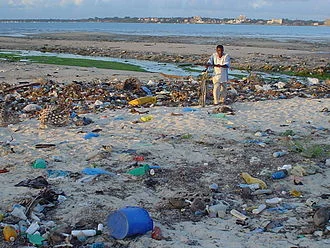
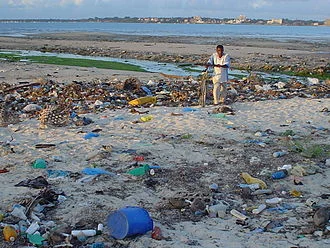
The problem of marine debris and beach trash is overwhelming. According to the documentary, “A Plastic Ocean,” about 8 million tons of plastic are dumped into the ocean annually. Much of it is still out there just waiting to be consumed by fish, sea turtles, albatrosses and other marine creatures. The plastic that isn’t consumed by wildlife eventually washes up on a beach.
July Lewis, who coordinates beach cleanups throughout the state for Save The Bay, said there are two aspects to the issue of marine debris: aesthetics and wildlife impacts.
“No one wants to come to a beach that’s covered in trash,” she said. “It makes a difference in how people can enjoy our beaches.”
From a wildlife perspective, however, it can be a life-or-death issue. Sea turtles consume plastic bags and latex balloons that they mistake for jellyfish; whales that feed on large quantities of plankton can’t separate out the microplastics from the edible microorganisms; and bits of plastic get caught in the gills of fish and the stomachs of birds.
“Even if it’s not fatal, it’s a burden on these animals,” Lewis said. “It’s hard to calculate exactly what that burden is and what the mortality may be from it, but it’s increasing because we know that the amount of plastics in our ocean is increasing. Most everything that lives in the ocean has some plastic in them.”
Lewis noted that monofilament fishing line is especially dangerous to marine life, because animals can easily become entangled in it.
“It’s meant to be invisible and unbreakable, so it’s a serious entanglement hazard to marine life,” she said.
Nearly 1,500 pieces of fishing line at least a yard long were picked up on Rhode Island beaches last September as part of the International Coastal Cleanup. In addition, Lewis said the event’s 2,205 volunteers removed about 46,000 cigarette butts, 7,500 plastic bottles, 4,800 glass bottles, 13,000 pieces of plastic, 10,500 food wrappers and 5,700 plastic bags from 65 miles of Ocean State shoreline.
Dave McLaughlin, executive director of Clean Ocean Access, a Middletown-based nonprofit that organizes dozens of beach cleanups on Aquidneck Island annually, said the problem of plastics in the ocean continues to increase.
“By 2050 there will be more plastic in the ocean than fish,” he said. “That’s a pretty scary statistic.”
In the past 10 years, his group has removed nearly 95,000 pounds of debris from Aquidneck Island beaches.
“We’re still finding debris left on the shoreline from the storm surge of Hurricane Bob and Hurricane Sandy, some of which has been out there for 20 years,” he said.
Clean Ocean Access has adopted a unique technology used at marinas on the West Coast to help address the problem. The group has installed a trash skimmer in Newport Harbor that uses a Dumpster-sized contraption with a motorized pump to suck floating debris — as well as oil and other pollutants — into the container for proper disposal. Between August and December of last year, it collected more than 6,000 pounds of debris. McLaughlin aims to install four more at other marinas around the state next year.
“It’s like watching paint dry,” he said. “It looks like it’s doing nothing, but when you come back eight hours later, it’s collected a lot of stuff.”
With Earth Day approaching, McLaughlin and Lewis encourage Rhode Islanders to join in some of the many local beach cleanups taking place this month. Save The Bay-sponsored cleanups can be found here, or join Clean Ocean Access at a cleanup of the Cliff Walk on April 22 from 10 a.m.-noon.
Clean Ocean Access is also sponsoring a screening of the film “A Plastic Ocean” at the Jane Pickens Theater in Newport on April 26 at 6:30 p.m.
“In the grand scheme of things, picking up someone else’s trash on the beach isn’t changing people’s habits,” Dennis said. “But in my little niche, it’s making a difference."
Todd McLeish runs a wildlife blog.
Upland New England's golden age

Thetford Academy, Thetford, Vt., as seen in a 19th Century woodblock.
‘’The fifty years between 1790 and 1840 were the upland {of New England} region’s golden age. The people who came to push the frontier out of the New England hills during this half-century brought the region its golden age of national importance in many fields, such as politics, invention, and intellectual thought. Most visible was the example it gave of pioneer determination, and what it could do in domesticating the wilderness.’’
“By the 1790s, the whole of New England’s upland region began to take on a homogeneous character. From the affluent hilltop town of Litchfield, in Connecticut, to the modest little communities in Maine and upper New Hampshire, there were solid homes, vistas of cleared land, white churches, and active mills….Academies sprouted up in very country seat: ornate buildings, whose impressive facades promised an Athenian future for our young nation. The academies shared the village center with churches of many denominations – Baptist, Methodist, and Episcopal – whose parishioners came north to escape taxes levied to support Congregationalism, then the state religion in Connecticut and Massachusetts.’’
-- From Upland New England: Life Past and Present, by William F. Robinson
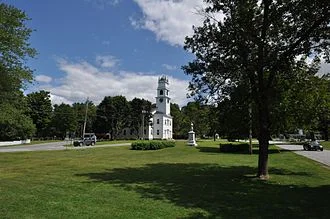
The green in Lyme, N.H.
Universities' administrative bloat and edifice complex
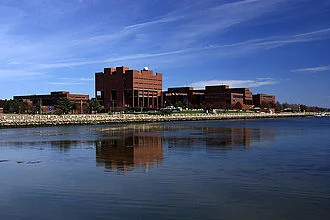
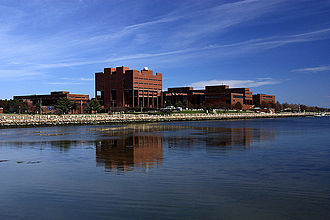
UMass - Boston.
Adapted from an item in Robert Whitcomb's "Digital Diary'' in GoLocal24.com.
The severe fiscal problems of the University of Massachusetts at Boston are pretty representative of those of much of higher education: Endless over-budget building as college presidents seek to erect monuments to themselves; the hiring of ever more overpaid administrators with vague and trendy titles even as tuitions surge, and ever higher percentages of faculties are “adjuncts’’ who barely earn minimum wage. Meanwhile, too many schools strive to be complicated research universities instead of focusing on teaching because “research’’ sounds much more glamorous.
What UMass Boston (and the state) needs isfor it to be a first-class local “commuter’’ school focused on teaching, and to leave the research to UMass’s flagship institution – UMass at Amherst and the state’s famous private research universities. UMass Boston will never win an arms race with UMass Amherst, let alone Harvard and MIT.
An example of the vacuous jobs being created at UMass Boston: Tom Sannicandro, a former state legislator from Ashland, Mass., just got the job of“director of the Institute for Community Inclusion’’ at a $165,000-a-year salary, along with juicy benefits. Keith Motley, the now ousted chancellor (basically president but chancellor sounds more royal) whose oversize ambitions and edifice complex at the institution helped put it into a deficit of tens of millions of dollars, will now go on sabbatical with a salary of $355,059. His salary last year was $422,000.
When that long vacation is over, Mr. Motley, a professional bureaucrat and former basketball coach, will return as a $240,000-a-year faculty member teaching…? Well, that hasn’t be disclosed.
What a scam.
The corruption that has produced obscene compensation for public company C-suites, regardless of how well they do their jobs, has long since infected public and private higher education, too.
Poultry problem

"Chicken Fight'' (oil on canvas), by Sarah D'Ambrosio, in the ''Master of Fine Arts Thesis Exhibition,'' at the Museum of Art of the University of New Hampshire, Durham, N.H., April 21-May 19.
Chris Powell: Conn. to replace Mass. gamblers with its own
MANCHESTER, Conn.
With their joint venture to put a casino in East Windsor, Conn., to intercept potential traffic to the resort casino being built just over the Massachusetts line, in Springfield, the Mashantucket Pequot and Mohegan Indian tribes say they aim to save jobs for Connecticut and gambling royalty revenue for state government.
This isn't quite accurate. The real objective of the interceptor casino is to replace gamblers from Massachusetts who have been patronizing the tribes' casinos in southeastern Connecticut and who are expected to start gambling in Springfield instead. The Massachusetts gamblers are to be replaced in East Windsor with gamblers from Connecticut itself.
This change in the source of gamblers and revenue should bear heavily on the General Assembly's decision whether to authorize the casino in East Windsor. For it is one thing to draw money from Massachusetts gamblers and send them home with the consequences of their excesses and addictions and their increased inclinations to rob and embezzle. At least then the money comes from out of state and the social burden is borne there.
It is something else to draw money from Connecticut gamblers and stick Connecticut with the consequences of excessive gambling. For if the casino revenue is to be drawn from Connecticut itself, it will come only from other commerce in the state, and the social burden of increased gambling will be borne here.
What then is the advantage of saving casino jobs in Connecticut if those jobs come at the expense of other commerce and jobs in the state? And gambling royalty revenue to state government cannot be fairly calculated without also calculating the expense of increased financial crime and broken homes and lives.
The casino racket is just about finished for state government. Connecticut has pushed its neighboring states into the business and now there's no one left to plunder but the state's own people. There's little profit in that except for the casino operators.
xxx
This is income tax week, and a new book by Vanessa Williamson of the Brookings Institution argues that Americans on the whole are "proud to pay taxes," considering it their civic duty to support their government. But on the national level, rather than the state and municipal levels, taxes are not really needed to support the government at all, since the national government has the inherent power of money creation and to finance its operations it does not need to borrow money or obtain gold or any other monetary commodity.
The purposes of taxation at the national level are quite different. In 1946 the president of the Federal Reserve Bank of New York, Beardsley Ruml, described them this way: "1. As an instrument of fiscal policy to help stabilize the purchasing power of the dollar. " 2. To express public policy in the distribution of wealth and income, as in the case of the progressive income and estate taxes. "3. To express public policy in subsidizing or penalizing various industries and economic groups. " 4. To isolate and assess directly the costs of certain national benefits, such as highways and Social Security."
That is, the purpose of federal taxation is to advance certain social and economic policies, to shape the people's behavior, and to allocate power in society. So while people justly can be proud of paying taxes on the state and municipal levels, where their taxes really do underwrite government, and while they can be proud of their country, on the national level their taxes are mainly the mechanism by which government controls them. On the whole those controls may be good ones but there's nothing particularly to be proud of in doing as one is told. Those controls are just the terms of the right to live in the country.
Chris Powell, a frequent contributor to New England Diary, is managing editor of the Journal Inquirer in Manchester, Conn.
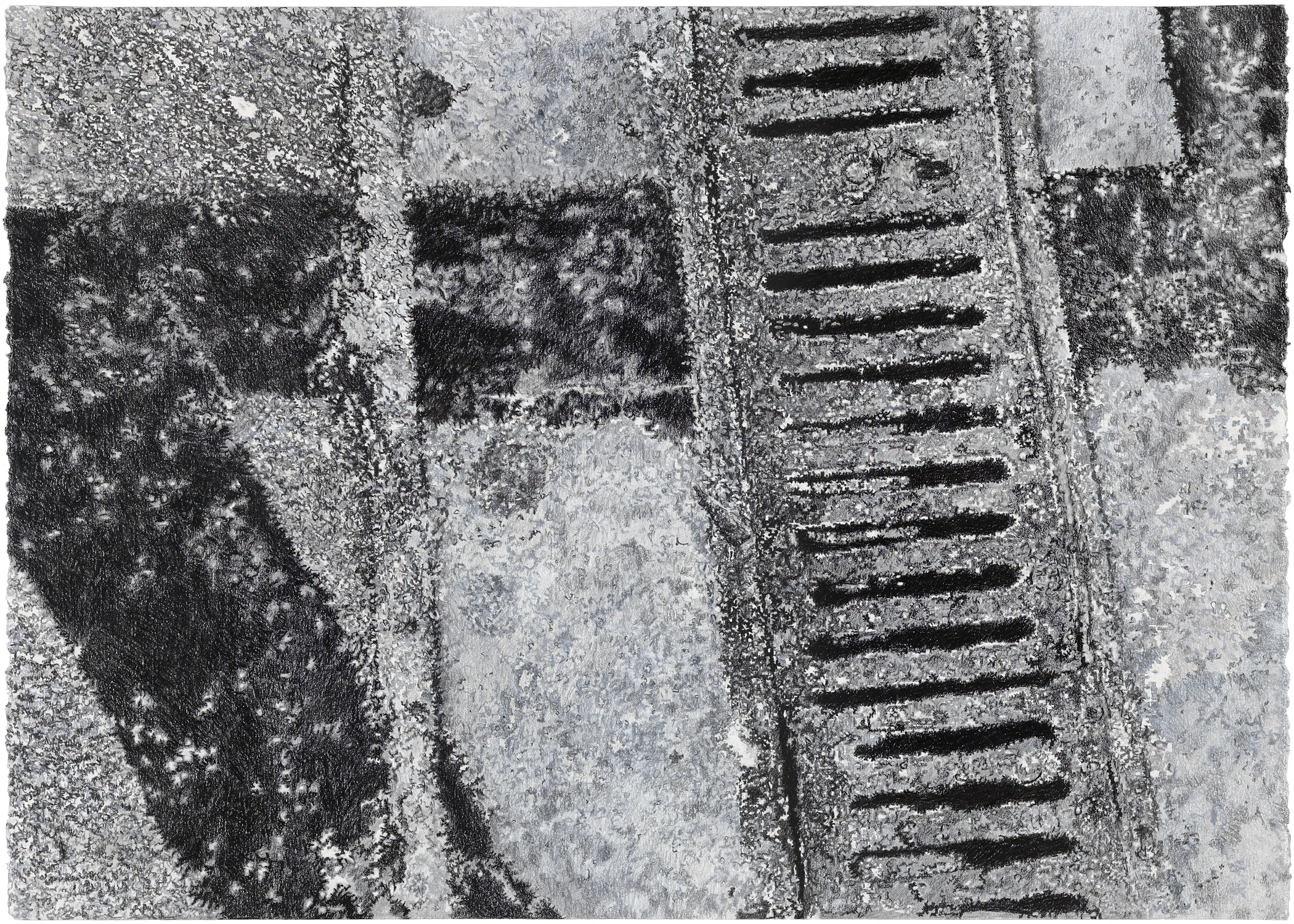
The more options the better

"Alternative Approach'' (charcoal and pastel), by Lesley Cohen, in her show 'Strata/Stratum,'' at the Bromfield Gallery, Boston, for the month of May.
David Warsh: Will the global rich prevent nuclear war?
After I asserted last week that “the stand-off with Russia is more dangerous than you think” – citing Graham Allison’s argument inThe Thucydides Trap and a new warning conveyed by the “doomsday clock” of the Bulletin of Atomic Scientists – a friend wrote,
“The main difference [between the current situation and Athens-Sparta rivalry in ancient Greece] is that Spartans didn’t send their children to school at Oxford, nor did they have trillions invested in the Turks and Caicos, London, and other hotspots where the Russians like to stash their loot (both human and financial). All these hillbillies with nukes would never risk having the global hooch stash both literally and figuratively blown up. It would interfere too much with the satisfaction of their gross Trumpian tastes.’’
That got me thinking. Twenty years ago, New York Times columnist Thomas Friedman observed that no two nations in which McDonald’s was operating fast-food restaurants had yet gone to war with one another. “When a country reaches a certain level of economic development, when it has a middle class big enough to support McDonald’s, it becomes a McDonald’s country, and people in McDonald’s countries don’t like to fight wars; they like to stand in line for burgers.”
It was the ’90s when Friedman wrote, remember, and Golden Arches doctrine quickly became a truism of The Fabulous Decade: Macroeconomic Lessons From the 1990s, by Alan Blinder and Janet Yellen; The End of History, by Francis Fukuyama, and what many called “The Great Moderation.’’
Perhaps it’s time to ask the same question about the upper classes. As huge fortunes become more concentrated in the hands of relatively few families in the United States, Russia, China and some other nations, does inequality begin to guard against the horrors of deliberate nuclear war? (Accidents, are always possible, of course,) It may be time to go beyond Golden Arches doctrine to consider the significance of global-asset allocation – not just of commodities, financial assets, and real estate but, as my friend noted, of the families of the rich.
Take Vladimir Putin. He is thought to have accumulated an enormous fortune, but more to the point are the fortunes of his two daughters. Maria Vladimirovna Faassen is said to be married to a Dutch citizen and oil industry executive; they lived for a time in the Netherlands. Katerina Tikhonova is a fundraiser for Moscow State University and competitive dancer. Both now live in Moscow. Prime Minister Dimitri Medvedev’s holdings are somewhat better understood, thanks to the 50-minute YouTube investigation by presidential aspirant Alexei Navalny that sent thousands of demonstrators into the streets in 80 cities across Russia last month. As Bloomberg columnist Leonid Bershidsky writes, there is no separating wealth and power in Russia. The overlap may be as great or greater in China.
Would the leaders of Russia, China and the United States be as quick to go to war as were, say, German, Russian and British commanders in 1914, despite the fact that the British, German, and Russian royal families were all blood relations. Only by miscalculation, or so I would like to think. For another key difference between the situation today and the 14 (of 16) episodes in The Thucydides Trap that ended in war — has to do with the technologies of war. Thermonuclear weapons delivered by missiles to population centers have a degree of finality that make a mockery of the concept of strategic aims, much less victory. True, nukes have become smaller, cleaner, and alliances still matter, but would China wage nuclear war to defend North Korea? Or the United States to defend Japan?
There is a counterargument of sorts, of course. It is spelled out in The Great Leveler: Violence and the History of Inequality (Princeton 2017), by Stanford University historian Walter Scheidel. He argues that only violent events have significantly lessened inequality measured in a certain way over time – wars, revolutions, plagues. Scheidel gives short shrift to the process we call economic growth, mostly having to do with the growth of knowledge. But if you despise inequality intensely enough, I suppose war is an answer. Isn’t that what films such as The Hunger Games and Mad Max are about?
Myself, I spent my spare time last week reading Robert Service's The End of the Cold War 1985-1991 (Public Affairs, 2015), about the remarkable events at the end of the 1980s contrived mostly by Ronald Reagan, George Shultz, Mikhail Gorbachev and Eduard Shevardnadze. “The impossible had turned into the probable and finally into the real,” Service writes. “The world of 1945, held in aspic by the chemistry of struggle between two superpowers, dissolved before everyone’s eyes.” The transformation of politics and economics they set in motion was a remarkable accomplishment, not to be squandered.
David Warsh is a veteran financial and political columnist and an economic historian. He’s the proprietor of economicprincipals.com, where this first commentary first ran.
April 19 PCFR: Global disease threats/responses

Soldiers from Fort Riley, Kansas, ill in the great influenza pandemic of 1918.
To members and friends of the Providence Committee on Foreign Relations (pcfremail@gmail.com; thepcfr.org).
Our next meeting comes on Wednesday, April 19, with Rand Stoneburner, M.D., the distinguished international epidemiologist. Dr. Stoneburner, who has done extensive work with the World Health Organization and other major public health organizations, will talk about Zika, Ebola and what he sees as the biggest global disease threat – an influenza pandemic. He’ll have some graphics.
Meanwhile, see:
https://www.washingtonpost.com/national/health-science/the-trump-administration-is-ill-prepared-for-a-global-pandemic/2017/04/08/59605bc6-1a49-11e7-9887-1a5314b56a08_story.html?utm_term=.45d46676dada&wpisrc=nl_rainbow&wpmm=1
And:
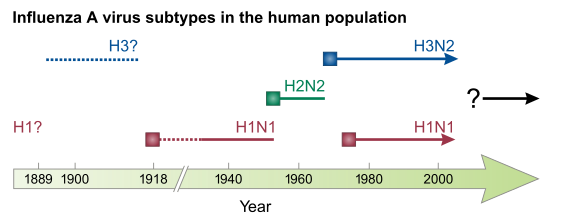
The main types of influenza viruses in humans. Solid squares show the appearance of a new strain, causing recurring influenza pandemics. Broken lines indicate uncertain strain identifications.
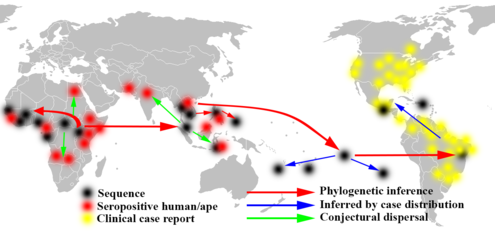
Zika transmission map.
'A new theory of comedy'
"Another spring,
late afternoon and driving back from Boston
just past the woods
where tree frogs were mating and chirping, neither sad nor glad,
a new theory of comedy
flew out of the blue, inaudibly making its way
through a sonic boom
and the routine blare of the car radio's everyday
box score of doom.''
-- Edwin Honig, from "Spring Two, #12''
Not available at Starbucks

Ceramic mug, by Mitch Shiles, at the Brookline (Mass.) Arts Center.
Crazy, hazy days coming

"Summer Blur'' (encaustic) by Nancy Whitcomb, in the group show "Four Explore,'' with Angel Dean, Mimo Gordon-Riley, Nancy Gaucher-Thomas and Priscilla Foley Blackman, at the Providence Art Club, April 23-May 12.

Keep it in the family

From Robert Whitcomb's "Digital Diary'' in GoLocal24.
America’s metro areas, most of which vote Democratic and many of which are very prosperous, subsidize the nation’s rural areas, which vote Republican and tend to have more poverty (except for some in such heavily government-subsidizedsectors as agribusiness) and health and social pathologies. Of course there’s massive hypocrisy in GOP attacks on “big government,’’ whose anti-poverty programs disproportionately favor Red States, not the “welfare queens’’ and illegal immigrants in such Blue State cities as New York and Los Angeles.
As the Trump administration, in its relentless efforts to further enrich its mostly very affluent senior members by cutting income and other taxes for the rich, tries to shrink locally popular programs to help the poor, concentrated in the Red States, it will be interesting to see what Trump’s fanatical fans in those states do.
Meanwhile, you have to be impressed by the confident brazenness of the Trump family and administration in seeking ways to make money off the fact that their leader, an outrageous crook, is in the White House. The administration is rife with egregious conflicts of interest, many connected with the Trump Organization. The taxpayers are now paying big money to help the Trump family and its associates make a killing off the fact that their leader is in the Oval Office.
Near the center are Mr. Trump’s daughter Ivanka and Jared Kushner, who learned the joys of self-dealing and nepotism from their fathers. Mr. Kushner’s father, like Donald Trump, is real estate man. But Charles Kushner is also a convicted felon. In 2005, he was convicted of illegal campaign contributions, tax evasion and witness tampering, and served time in federal prison. After his release he resumed his career in real estate.
But the elder Mr. Kushner has been a devoted father. Consider his $2.5 million donation to Harvard before his son was admitted, despite a not very impressive secondary-school record. Now young Jared is being asked by his father-in-law to, among other minor chores, “reinvent ‘’ government to make it more businesslike. (Whose business is the model?) For some sense of how this might work out, read Elizabeth Spiers’s piece about how Jared ran the New York Observer: https://www.washingtonpost.com/posteverything/wp/2017/03/30/i-worked-with-jared-kushner-hes-the-wrong-businessman-to-reinvent-government/?utm_term=.6322cc1d9211
Such families know how to get things done!
'Forgotten like the Druid's spell'

"Pythoness of ancient Lynn''.
How has New England’s romance fled,
Even as a vision of the morning!
Its rites foredone, its guardians dead,
Its priestesses, bereft of dread,
Waking the veriest urchin’s scorning!
Gone like the Indian wizard’s yell
And fire-dance round the magic rock,
Forgotten like the Druid’s spell
At moonrise by his holy oak!
No more along the shadowy glen
Glide the dim ghosts of murdered men;
No more the unquiet churchyard dead
Glimpse upward from their turfy bed,
Startling the traveller, late and lone;
As, on some night of starless weather,
They silently commune together,
Each sitting on his own head-stone!
The roofless house, decayed, deserted,
Its living tenants all departed,
No longer rings with midnight revel
Of witch, or ghost, or goblin evil;
No pale blue flame sends out its flashes
Through creviced roof and shattered sashes!
The witch-grass round the hazel spring
May sharply to the night-air sing,
But there no more shall withered hags
Refresh at ease their broomstick nags,
Or taste those hazel-shadowed waters
As beverage meet for Satan’s daughters;
No more their mimic tones be heard,
The mew of cat, the chirp of bird,
Shrill blending with the hoarser laughter
Of the fell demon following after!
The cautious goodman nails no more
A horseshoe on his outer door,
Lest some unseemly hag should fit
To his own mouth her bridle-bit;
The goodwife’s churn no more refuses
Its wonted culinary uses
Until, with heated needle burned,
The witch has to her place returned!
Our witches are no longer old
And wrinkled beldames, Satan-sold,
But young and gay and laughing creatures,
With the heart’s sunshine on their features;
Their sorcery—the light which dances
Where the raised lid unveils its glances;
Or that low-breathed and gentle tone,
The music of Love’s twilight hours,
Soft, dream-like, as a fairy’s moan 50
Sweeter than that which sighed of yore
Along the charmed Ausonian shore!
Even she, our own weird heroine,
Sole Pythoness of ancient Lynn
Sleeps calmly where the living laid her;
And the wide realm of sorcery,
Left by its latest mistress free,
Hath found no gray and skilled invader.
So perished Albion’s “glammarye,”
With him in Melrose Abbey sleeping,
His charmëd torch beside his knee,
That even the dead himself might see
The magic scroll within his keeping.
And now our modern Yankee sees
Nor omens, spells, nor mysteries;
And naught above, below, around,
Of life or death, of sight or sound,
Whate’er its nature, form, or look,
Excites his terror or surprise,—
All seeming to his knowing eyes
Familiar as his “catechise,”
Or “Webster’s Spelling-Book.”
From John Greenleaf Whittier's "New England Legend''
Note: The Pythoness of ancient Lynn was Moll Pitcher, who lived under the shadow of High Rock in that town, and was sought far and wide for her supposed powers of divination.
Conspicuous consumption
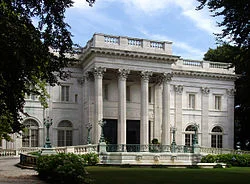
Marble House, Newport, R.I., built in 1888-92.
''One hundred years after the declaration that all men are created equal, there began to gather in Newport a colony of the rich, determined to show that some Americans were conspicuously more equal than others.”
--- The late Alistair Cooke, British-born journalist, television personality and broadcaster