
Vox clamantis in deserto



Llewellyn King: Remembering when airlines cared; mills better to live in than to work in
Notebook
One expects the weather in Chicago in winter to disrupt travel plans, if you have to go through the city or are destined to visit there. However, one doesn’t expect to be trapped in clear but windy weather in Chicago because New England is having a winter convulsion.
But that is just what happened to me last Thursday. You get that sinking feeling when you get to the airport and you are told your flight has been canceled. Expletives escape otherwise elegant mouths, like air out of a punctured tire.
It seems to be somewhat worse than it used to be because the airlines no longer feel responsible for you. If a flight had to be canceled in times past, the airline would find you an hotel; reschedule your flight, possibly on another carrier; and, well, treat you as though you were a valued customer.
Deregulation put paid to that. Not all at once, but bit by bit to the point where you are of no interest to the carrier.
You can huff, puff, tweet (it is part of huffing and puffing circa 2017), but you might as well rage at a Northeaster. It does what it does, and airlines do what they do. They have shifted the responsibility of force-majure cancellations on to you: To be the customer of any large organization is to be inconsequential.
Do what you have to do: suck it up.
Snow, Let It Snow
The snows of New England are one of the joys of New England to me.
My love affair, in the way of love affairs, came to me when I was a young man, just turned 20, who had moved from balmy, weather-unchallenged Southern Rhodesia, now Zimbabwe, keen to see all of the wonders of the British Isles – and snow. I had imagined it, but I had never seen the stuff.
As it was, my imagining had got it about right. So it is hard for me to understand why people would desert the wonders of the Northland for the heat of the flat, hot Southland – Florida, in particular.
For my first snow, when I should have been editing at the old United Press International in London, I was to be found glued to a window watching my snow fall. Man, that was living!
All these years later, snow still thrills. You might think I ski. No, I just like snow, good, honest, New England snow -- like its lobster rolls, its snow can’t be beat.
Nostalgia for Hard Times
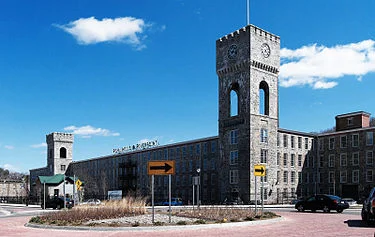
The Royal Mill, in West Warwick, R.I., home of Llewellyn King and his wife, Linda Gasparello, and where Fruit of the Loom fabric used to be made.
There is nostalgia loose in the land for the days when factories hummed, belching smoke and steam and, incidentally, other pollutants, and men and women clocked in three shifts a day.
If you ride the train south from Boston to Washington, D.C., you can see the debris of that time: deserted red brick factories with their broken windows, like tears, lamenting their fall; beautiful mill buildings, begging for a second chance to serve.
The nostalgia is for a time when the sign you see from the train in New Jersey -- “Trenton Makes, the World Takes” -- was incontrovertibly true.
I live in a converted mill in Rhode Island, once the proud home of one of the great names in garment manufactures -- Fruit of the Loom. The result of the grand days of mills is, converted, a grand place to live. High ceilings and big rooms over a river are the stuff of realtors’ brochures. Big windows let in scads of light and the workmanship, mostly by Italian stonemasons, is a reminder of how it was when craftsmen “built things to last.”
It also, like most of those mills and factories, those stone or red brick tombs stuffed with memories of another time, must have been a hellish place to work. Freezing, unheated in winter, broiling in summer, filled with noxious fumes from the dyes and fibers from the cotton, where men and women -- near slaves -- had traded the misery of agriculture for the misery of repetitive, ghastly labor.
A sense of the horror of the mills can be got by visiting the museum at the Slater Mill, which opened in Pawtucket in 1793. A little shop of horrors!
Work is good, but factory work less so. Automation is confining repetitive manual labor largely to the dust heap, and is doing so even in China.
Your correspondent would much rather live in a mill today than have worked in one back in the day. One hopes that new technologies and materials will make for new work, better work.
Car Experts: The Luxury Surprise
Sitting through a hearing in Washington on infrastructure revitalization, an area where I am a recognized bore, a surprising bit of news surfaces: the head of BMW North America, Ludwig Willisch, tells the House Committee on Transportation and Infrastructure that BMW, not Detroit’s American brands, is the largest exporter of cars from the United States.
Note that for future arguments about trade.
Llewellyn King (llewellynking1@gmail.com), a frequent New England Diary contributor, is host of White House Chronicle (whchronicle.com), on PBS. He is veteran broadcaster, publisher, columnist and international business consultant, especially in energy matters.
Bravo bottle bill, sort of
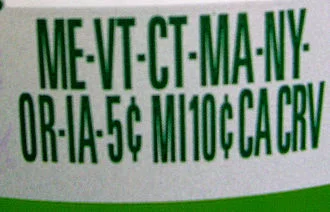
Deposit notice on a bottle sold in continental U.S. indicating the container's deposit value in various states; "CA CRV" means ''Cash Redemption Value.''
Adapted from Robert Whitcomb's "Digital Diary'' column in GoLocal24.com:
I was reading an article the other day about Connecticut’s ‘’bottle bill,’’ which mandates that when you buy a container of soda, water and beer, etc., you are charged 5 cents on top of the price of the container – a nickel that you get back when you return the container to a redemption center to be recycled. That’s a very effective law (which Rhode Island should have) because it helps reduces litter.
In the Nutmeg State, the bottle bill has become a bonanza for the state because there are so many too-busy or too-lazy people who just toss their containers in the trash or a recycling bin and don’t claim the nickel at redemption centers.
See this story from WNPR: http://wnpr.org/post/has-connecticuts-bottle-bill-changed-environmental-law-cash-cow
If you toss a can into your trash or recycling bin, instead of redeeming it for the 5- cent deposit -- your unclaimed nickel goes to the state with nothing to the private redemption centers that are charged with collecting the stuff in return for a slice of the nickel. That’s been happening more and more. Tough for these small businesses.
I have long wondered about the full environmental efficacy of recycling. How much of the value of recycling plastic, metal and plastic is offset by the energy and water (often hot) used to clean it up a bit before it goes into the recycling bin and to transport and process it? Still, again, recycling and bottle bills, discourage littering. Besides its demoralizing effects on the public, litter, especially the plastic stuff, kills some wildlife.
So bless bottle bills and recycling.
Get over it
"Wan February with weeping cheer,
Whose cold hand guides the youngling year
Down misty roads of mire and rime,
Before thy pale and fitful face
The shrill wind shifts the clouds apace
Through skies the morning scarce may climb.
Thine eyes are thick with heavy tears,
But lit with hopes that light the year's."
- Algernon Charles Swinburne, A Year's Carols: February
At this time of year, we might prefer green

''Mellow Yellow'' (oil on canvas), by Mia Cross, in the show "Yellow,'' in the annual
''core member'' exhibition at Fountain Street Fine Art, Framingham, Mass., through March 5.
Chris Powell: Complexity, hypocrisy, ambiguity in school-choice issue; sieg heil Trump?

-- Photo by David Shankbone
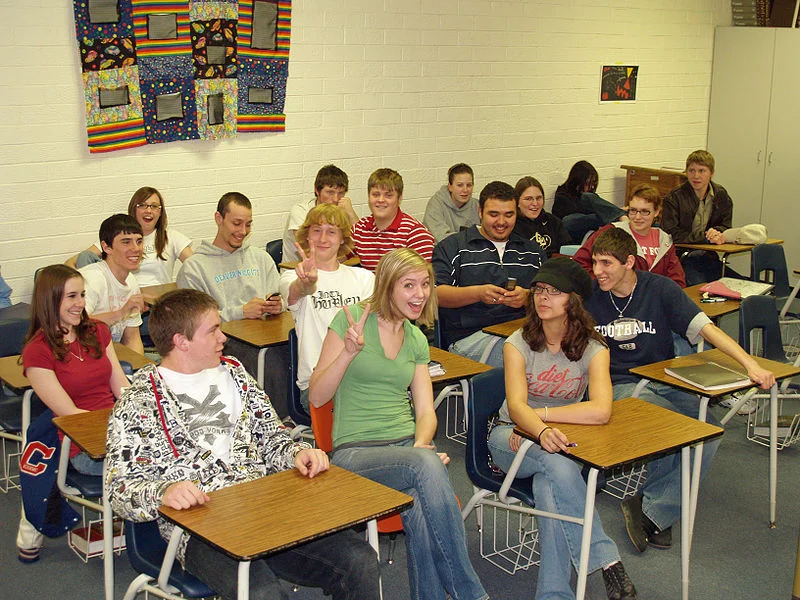
Public high school class in Colorado.
Democratic legislators are always most conscientious when they are playing stooges for the teacher unions, perhaps the most powerful component of the party's base. Hence the all-nighter that Democratic U.S. senators pulled on the Senate floor to posture against President Trump's nomination of Betsy DeVos for U.S. education secretary.
Yes, DeVos has no experience in administration of public education, but then no one who has ever tried to get a straight answer out of a school superintendent will hold that against her. The real objection to DeVos has been her advocacy of school choice -- that is, giving public schools some competition from charter schools and private schools. Speaking against DeVos during that all-nighter, Connecticut Sen. Chris Murphy said she had sought to "undermine" public schools.
School choice is a complicated issue. It can divert resources from the poor to the financially comfortable, who already have a large degree of choice through their ability to move away from urban poverty to the suburbs. But most advocacy of school choice aims to empower the poor, though even that can rob struggling schools of their best students.
In any case insofar as the U.S. Education Department long has represented the education establishment and particularly the teacher unions, the department could use an outsider's perspective, as could all of primary education in the country. For in many states, including Connecticut, two-thirds of high school students graduate without ever mastering high school work, most of public education in this country having collapsed into social promotion.
Further, a big problem with public education in Connecticut particularly is that it's not really public at all. For example, since 1984 teacher evaluations have been exempted from disclosure under Connecticut's freedom-of-information law, an amendment to the law having been demanded by the teacher unions in response to a finding by the Freedom ofInformation Commission that the law required disclosure. Among all state and municipal employees in Connecticut, only teachers enjoy this exemption.
A few weeks ago The Hartford Courant reported that about a third of Connecticut's school boards evaluate their superintendents only by discussion in private meetings to avoid generating any records that would become public. State law requires towns to elect school board members for staggered terms so that even if townspeople are unanimous in wanting to replace every school board member, this cannot be accomplished in fewer than three elections over six years.
Then there is Connecticut's "minimum expenditure requirement," the state law that forbids towns from reducing school spending even if student enrollment goes to zero. The law's purpose has been to ensure that all financial savings from declining enrollment go straight into teacher salaries and benefits, with taxpayers recovering not a cent.
None of these provisions serves the public any more than the Democratic senators, in opposing DeVos, served the public. These provisions serve only those employed in education, and the Democratic senators have been only verifying Ambrose Bierce's definition of politics: "A strife of interests masquerading as a contest of principles; the conduct of public affairs for private advantage."
xxx
IS PRESIDENT TRUMP A FASCIST? One swallow may not make a summer, but Trump's ugliest approach to fascism happened last week, when, at a meeting at the WhiteHouse with sheriffs from around the country, he was told of a state senator in Texas who has proposed legislation to prohibit police from seizing the assets of people who are only suspected but not convicted of crime.
The legislation would uphold ordinary due process of law. But Trump's response was: "We'll destroy his career." The sheriffs laughed. They should have shouted: "Sieg heil!"
Chris Powell is managing editor of the Journal Inquirer, on Manchester, Conn.
Feminine faces of art

"Bodies of Work'' (encaustic), by Angel Dean, featuring, among other things, images of Mary Cassatt, Georgia O'Keefe, Frida Kahlo and Kara Walker. It's part of a show called "Celebrating Women Artists: Making Our Mark,'' with 104 artworks by Exhibiting Artist Members of the Providence Art Club, to be on view through Feb. 24. This painting won the "Best in Show'' award for this exhibition.
'the landscape listens'
"There’s a certain slant of light,
On winter afternoons,
That oppresses, like the weight
Of cathedral tunes.
Heavenly hurt it gives us;
We can find no scar,
But internal difference
Where the meanings are.
None may teach it anything,
’T is the seal, despair,—
An imperial affliction
Sent us of the air.
When it comes, the landscape listens,
Shadows hold their breath;
When it goes, ’t is like the distance
On the look of death."
- Emily Dickinson, "#82''
Empathy with our threatened 'next of kin'

Photo of exhibit in "Next of Kin: Seeing Extinction through the Artist's Lens,'' by Christina Seely of the Canary Project, in a perspective on the biodiversity extinction crisis, at the Harvard {University} Museum of Natural History, in Cambridge, through June 4.
The museum says that "special photography techniques and rare specimens from Harvard's collections evoke empathy with our 'next of kin.'''
Llewellyn King: Transport infrastructure urgency brings some comity to Washington
By the current standards on Capitol Hill, there is astounding comity in the House Committee on Transportation and Infrastructure. The committee, which held its first hearing of the new Congress recently, exhibits a kind of good humor, of give and take, which largely ceased with the Gingrich Revolution of 1994.
What makes this committee different is that Republicans and Democrats are staring into the jaws of hell together, so to speak. Disparate as they are, from super-liberal Democrat Eleanor Holmes Norton, of the District of Columbia, to the committee’s conservative chairman, Bill Shuster, R-Pennsylvania, the members know that the nation’s infrastructure is in deplorable condition.
They know, too, that in the current Congress, with its GOP aversion to new taxes, there is not enough money to fix the deteriorating infrastructure. They know all too well the old saw about immovable objects and irresistible forces.
A panel of heavy infrastructure users, headed by business celebrity Fred Smith, founder and CEO of FedEx, laid out the choke points for his industry: air traffic control and the interstate highway systems.
One of Smith’s ideas for improving the nation’s highways, bridges and public transit systems is to raise the gasoline and diesel tax, which has languished since 1994. But he warned this might not be the whole answer when new forms of propulsion, like electricity and compressed natural gas are changing or threatening to change the transportation mix.
No one on the panel objected to the idea of taxes for infrastructure. The overriding concern was from committee members who wondered whether the money would be spent where it was planned or diverted to general revenue needs.
It interested me that it was Smith who recommended greater taxation. His panel colleagues, including Ludwig Willisch, CEO of BMW of North America, and David MacLennan, CEO of Cargill, did not demure. More important, Republican members of the committee swallowed the tax poison without visible physical effect. No retching, trembling or detectable palpitations.
The elephant in the room, of course, was the Trump administration. Candidate Trump promised a massive infrastructure leap forward.
No one seemed confident that spending hawks in the Congress would support such athletics. It is hard to be hopeful that President Trump will get all or any of the new money out of a Congress that is looking at escalating deficits.
Talking to people involved in infrastructure, one gets this picture: user fees are not enough and toll roads, favored in principle by many, do not raise enough money to attract and keep private investors. Philip White of the global law firm Dentons, points out that many of these have failed in Texas — ground zero for private enterprise — and have had to be taken over by government entities. Similar fates have befallen toll roads elsewhere.
The big initial boost for the infrastructure under Trump will not come from new money, but rather from authorizing previously delayed projects and easing regulations. There is also the current highway fund spending, which has risen somewhat.
But nobody, especially on the House committee, believes it is enough to reverse the relentless crumbling of roads and bridges. The real infrastructure funding need has been estimated to be as high as $6 trillion.
Back to FedEx’s Smith and what he thinks will work: a mileage tax, congestion pricing and high-access lanes on highways; a revised tax code, which would eliminate some of the anomalies that hamper strategic planning; privatizing air traffic control; and upgrading runways.
He pointed to Memphis, FedEx’s “SuperHub,” where there has been a huge gain in productivity with air traffic improvements financed by his company.
Cargill, for its part, sang the song of barges, shipping containers, trucks and railcars. “It is the interconnected nature of waterways, railways and highways — the three-legged stool of domestic transportation — that is important to keeping the United States competitive. When one mode of transportation is troubled, it affects the entire system,” MacLennan said.
All is not lost for infrastructure spending. Trump, it appears, is keen to say he has honored his campaign promises. And he promised big.
Get ready for taxes, fees and congestion charges. The need is great, the means slim and taxes, by another name, will come.
The House Transportation and Infrastructure Committee will need all of its evident camaraderie as it takes its shovel to the legislative tarmac.
Llewellyn King (llewellynking1@gmail.com), host of White House Chronicle on PBS, is a veteran publisher, columnist and international business consultant. He is also a frequent contributor to New England Diary. This piece first ran on Inside Sources.

Todd McLeish: List of endangered plants in Rhode Island is growing

Purple mikweed is one of the endangered species.
VIa ecoRI News (ecori.org)
The official list of Rhode Island’s rare and endangered plants has been updated for the first time in a decade, and the picture is somewhat grim. A total of 81 species were added to the Rhode Island Natural Heritage Database, bringing the total to 414, and 13 from the previous list were found to have disappeared from the state entirely.
Conversely, several species thought to have been extirpated were rediscovered, and a handful of others were found to be less rare than earlier surveys had indicated.
“Things are changing rapidly with the climate, and there is ongoing development pressure that affects plants,” said David Gregg, executive director of the Rhode Island Natural History Survey, which played a key role in updating the database. “New observations are being made all the time that change our opinion of the relative rarity of species.”
The Natural Heritage Database categorizes rare plants as either endangered, threatened or of special concern in the state, and a fourth category called “historic” indicates those species that once grew in the state but are no longer present.
Among the plants added to the database in the recent update are trumpet honeysuckle, a species common in the horticultural trade but which has declined in the wild; Canada dwarf-dogwood, also called bunch berry, which has struggled due to warming temperatures; and yellow blue-head lily, a northern species found more commonly on the mountain slopes of Vermont and New Hampshire.
Orchids are in especially dire straits in Rhode Island. Seven orchid species were added to the database, including yellow ladies’-tresses, large whorled pogonia, and north wind bog-orchid. Of the 36 species of orchids native to Rhode Island, 33 of them are now on the rare species list, and 10 of those are considered historic. The only orchids native to Rhode Island that are not on the list are the pink lady slipper and two kinds of rattlesnake plantain.
“Orchids are always rare on the landscape, but they’re also eaten by deer — they’re apparently really tasty — and they have very specific pollinator relationships and habitat specificity that make them at risk,” said Hope Leeson, a botanist for the Natural History Survey who participated in updating the database. “We’ve talked about adding the pink lady slipper, but it hasn’t made the list yet.”
Leeson said many of the changes to the database were the result of increased efforts by a large number of volunteer botanists such as Rick Enser, Doug McGrady and Francis Underwood spending time searching for particular species. A population of waxy-leaved meadow-rue was discovered by volunteers in Westerly, for instance, and purple milkweed was found in West Warwick and South Kingstown. Both species had been considered historic but have been moved to the endangered category.
Among the 10 species that volunteers were unable to find and, as a result, are now considered historic are lily-leaved wide-lipped orchid, dwarf burhead, three kinds of sedge, and budding pond weed, an aquatic plant that requires pristine water quality to survive.
Just three species were removed from the list because their population status in the state improved. Five others moved down the list from endangered to threatened or threatened to concern because they were found to be in less danger of extinction than previously believed. One of those, tall beaksedge, is considered a conservation success story because it benefitted from active monitoring efforts and habitat protection.
“We debated moving other species off the list entirely, but part of our reluctance was that even though we may have found more populations, they are still at risk from things that are going to continue happening in the future — climate change, habitat fragmentation, deer browse,” Leeson said. “Those are impacting rare species, and since rare species have such a specific habitat type that they have an affinity for, if you lose the habitat you lose the species.”
According to Gregg, the database is used in decisions by state and local environmental officials about land management and conservation, and by regulators and developers when properties are being considered for development. For instance, applications for permits to disturb wetlands must include a list of rare species found on the property.
Electric utilities often seeks information about rare species found on their transmission corridors as they make upgrades to power lines.
Many groups and individuals were involved in updating the list, including representatives from the Rhode Island Department of Environmental Management, U.S. Fish & Wildlife Service, Audubon Society of Rhode Island, Rhode Island Wild Plant Society and the New England Wildflower Society. The updated list was included in the state’s 2015 Wildlife Action Plan, which was reviewed by scientists and the public and approved by DEM in late 2016.
The database of rare animals in Rhode Island is being updated and should be completed by the end of the year.
Rhode Island resident and author Todd McLeish runs a wildlife blog
'This understated land'
New England Mind
My mind matches this understated land.
Outdoors the pencilled tree, the wind-carved drift,
Indoors the constant fire, the careful thrift
Are facts that I accept and understand.
I have brought in red berries and green boughs—
Berries of black alder, boughs of pine.
They and the sunlight on them, both are mine.
I need no florist flowers in my house.
Having lived here the years that are my best,
I call it home. I am content to stay.
I have no bird's desire to fly away.
I envy neither north, east, south, nor west.
My outer world and inner make a pair.
But would the two be always of a kind?
Another latitude, another mind?
Or would I be New England anywhere?
Robert Francis
Recognizing bad actors
Feb. 9, 2017
To members and friends of the Providence Committee on Foreign Relations (thepcfr.org; pcfremail@gmail.com).
Here’s our updated schedule through June. Please note that there might be a couple of additional speakers.
Our next speaker comes on Thursday, Feb. 23, with Carl Maccario, an expert on international security issues involving terrorists and other bad actors. He's an internationally known specialist in behavior recognition, evaluating truthfulness and detecting deception, and nonverbal communication.
He has provided behavior recognition training to virtually every part of The Department of Homeland Security and as well as to various branches of the Department of Defense entities and to foreign nations.
He’ll have some exciting visuals to show us.
From the ponds and streams to the slopes

Adapted from an item in Robert Whitcomb's "Digital Diary'' in GoLocal24com.
Wachusett Mountain Ski Area, in Princeton, Mass., has, so far in this puny winter, used more than 95 million of gallons of water to make snow! I can imagine how much the really big northern New England areas have used. The Wachusett president, Jeff Crowley, says that’s about the amount it usually uses in an entire season, reports the Worcester Business Journal. I wonder what effect putting so much water on a little mountain has on the area’s environment
Not only does snow-making equipment let ski areas get through poor real-snowfall seasons, but man-made snow is said to last longer than the natural stuff. I suppose that having all that slow-melting “snow’’ on the mountain late in the season might stretch out local streams’ spring run. But snow-making also causes erosion, which washes sediment into streams, which among other things hurts trout and other fishing. And running the machines uses a lot of energy.
Greenwich, Conn., is a very profitable place to be a hospital chief executive
From the Web site of Cambridge Management Group (cmg625.com)
Journalist Steven Brill found that Norman Roth of Greenwich (Conn.) Hospital, a part of the Yale New Haven Health System; Thomas Priselac, of Cedar Sinai Health, in Los Angeles, and Steven M. Safyer, of Montefiore Health System, in New York, were the highest-paid hospital CEOs based on a new metric that Mr. Brill has developed: patient days.
He used the new benchmark in a piece for Axios to determine, in the words of FierceHealthcare, “not only how much hospital CEOs earn, but how much it costs patients. Brill came up with his lists by merging American Hospital Directory data about hospital operations, including patient bed and total patient days, with IRS information filed by nonprofit hospitals about CEO compensation. He then came up with lists of reported annual payouts to CEOs divided by the annual number of patient days recorded at each hospital.”
“Mr. Brill’s piece was accurately headlined “Stay in a hospital, pay the CEO $56 a night.” That headline suggests one reason that the U.S. healthcare system is by far the most expensive in the world.
“Although the benchmark isn’t a perfect measure to compare CEOs, Brill said it is a good way to compare the relative scope of responsibilities for each CEO because it measures the number of patients each hospital serves and the extent of that service,” the news service reported.
Roth, the head of the southern Connecticut hospital for the last nine months of the fiscal year 2015, earned $56 for each patient night stay, based on his annual salary and bonus of $2.9 million and the 184 beds he supervised. Greenwich is one of America’s richest communities.
The next-highest earner was Thomas Priselac, who earned $13.99 per patient stay.
To read the Axios piece, see: https://www.axios.com/stay-in-a-hospital-pay-the-ceo-56-a-night-2242870721.html
To read the FierceHealthcare report, see: http://www.fiercehealthcare.com/finance/top-hospital-ceo-pay-broken-down-by-patient-overnight-stayvery
Seasonal 'Comforts, Cures, and Distractions'
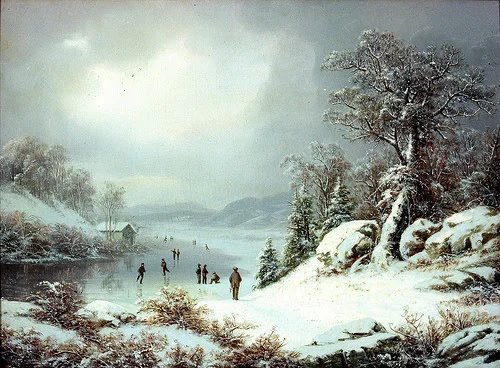
"Image from the "Comforts, Cures, and Distractions'' show at the Fruitlands Museum, in Harvard, Mass., through March 26.
The gallery writes:
"Featuring a wintry theme, the exhibition features a wide assortment of art, artifacts and landscape paintings from the museum's Transcendentalist, Shaker and Native American collections.
The gallery notes that Fruitlands curator Dumont Garr "doesn't forget that the season had been difficult for those without the luxuries of central heating and other modern aids and conveniences we so often take for granted. 'Comforts, Cures, and Distractions' provides insight on how communities comforted, cured and distracted themselves from the colder weather.
"Featuring hand made Shaker scarves and mittens; skates, sleds and snowshoes that date back to 1834; a Woodlands Native American water warmer or mokuk; and several 19th-Century paintings of ice skaters or individuals playing in the snow, the exhibition gives a realistic view into what this time would have looked like.
"Each piece tells its own story while being part of a bigger narrative. The several pairs of mittens that are included in the exhibition are both colorful and useful and bring images of children playing in the snow while a red blanket chest displays the talent and precision that individuals used in order to create practical and necessary pieces for their homes. Reminiscent of wintry weather, beautiful landscapes and childhood innocence, 'Comforts, Cures, and Distractions' is both educational and exciting''.

Josh Fitzhugh: The big question: When to tap our maples?
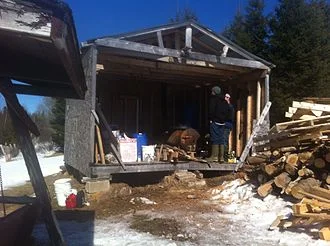
A "sugar shack,'' where maple sap is boiled off to make syrup.
Letter from Vermont 1
WEST BERLIN, Vt.
Snow is falling hard here in Central Vermont today, our first major snowfall of the year. Up until now we’ve had mostly freezing rain and slushy snow events and drivers have had to contend with icy rather than snowy roads.
The first couple of months of the year tend to be languid at most Vermont farms that aren’t dairies. The fall harvest is complete as is the Christmas sales season. Equipment has been put away. The days are short and the temperature generally cold. We get a succession of storms. Unless you log (taking down timber trees in anticipation of a log pickup before the roads turn muddy in spring), you spend the time thinking of the coming growing season; repairing structures or equipment; plowing and shoveling roads and roofs; catching up on sleep; and if you can, escaping to warmer climes for a week or two.
In recent years, sugarmakers (i.e., those who make maple syrup) have pondered another question that threatens some of this quietitude. When to tap?
Up until a generation ago, the question was pretty straightforward. You drilled (tapped) your maples just before the days began to climb into the 40’s after cold nights below freezing. That ranged from late February in Southern New England to early March in most of Vermont to late March in Northern New England, including Down East Maine.
The reason for this was that tap holes, once drilled in maple, would tend to dry out over time, and that would reduce the sap flow. In some cases, the dehydration would get so bad that sugarmakers would have to retap their trees, a big undertaking. In addition of course, delaying the tapping would lengthen the inactivity on the farm.
Now, however, the “tapping time” varies tremendously, for a couple of reasons. First, because most sugarmakers now use tubing rather than buckets to collect their sap, tap holes don’t tend to dry out as much as when they were exposed directly to the open air. Secondly, due to the size of some operations, tapping must begin in late November or December just to get all the taps in for the sugar season. (Even with tubing, trees must be retapped every year.)
Climate change also appears to be a factor. Sugarmakers find they can get a “run” of maple sap during the depths of winter when the temperature rises suddenly for a day or two, as it seems to be doing more frequently. If your main cash crop is maple syrup (as it still is for many farmers), you don’t like to miss the opportunity presented for additional production.
At our farm, we are traditionalists. Though we use tubing we don’t tap our trees late February. (Twenty years ago we waited until Town Meeting day, the first Tuesday in March.) It’s annoying when we get a nice spring day in January or February and we hear that some farmers are making syrup (or at least gathering sap) but we just don’t think it’s worth the hassle to gear up for a day here or a day there before the season starts in earnest in early March.
We figure that the trees need their quiet time, as do we.
Josh Fitzhugh, an occasional contributor, is a retired insurance executive, lawyer and journalist. His family operates Tether Loop Farm, in West Berlin. The farm sells maple syrup and hay.
Pages of memory

From the show “Legacy” at the South Shore Art Center’, Cohasset, Mass., Feb. 24-April 9.

Jim Hightower: These are great days for reading '1984'

Via OtherWords.org
Tromp-tromp-tromp — troops are marching to battles. Boom-boom-boom — bombs are blowing up communities. Whoooosh — poisonous gas is being released.
Forget Syria, Iraq, and Afghanistan — this is Trump’s War.
Our bellicose commander in chief is at war in the homeland, deploying his troops to attack everything from our public schools to the EPA, dropping executive order bombs on Muslim communities and the Mexican border.
He’s spewing poisonous tweets of bigotry and right-wing bile at the media, scientists, inner cities, “illegal voters,” Meryl Streep, diplomats, Democrats, and people who use real facts.
Basically, Trump is at war with everyone who doesn’t agree with him — in short, with the majority of Americans. And you thought that Nixon had a long enemies list!
Yet Trump’s most destructive assault so far hasn’t targeted any one group, but instead an essential and existential concept: truth. Bluntly put, he believes that truth is whatever he says it is, and that he can change it tomorrow.
Years ago, in a futuristic novel, the author wrote about the rise of a tyrannical regime that ruled by indoctrinating the masses to accept the perverse notion of capricious truth. It was George Orwell’s 1984, which depicted a dystopia he named Oceania.
There, the public had been inculcated to believe that reality is not “something objective, external, existing in its own right.” Rather, “whatever the Party holds to be truth is truth.”
Now, in 2017, we live in Trumplandia — with a delusional leader of a plutocratic party trying to redefine reality with “alternative facts,” fake news, and a blitzkrieg of Orwellian “Newspeak.”
But resistance to Trumpism is already surging. Not least, Orwell’s 70-year-old book has become a bestseller again — thanks to Trump resisters seeking… you know, the truth.
Jim Hightower is a radio commentator, writer, and public speaker. He’s also the editor of the populist newsletter, The Hightower Lowdown.
Chris Powell: Oh, no, not back to big-time hockey in Hartford!?
MANCHESTER, Conn.
What are Hartford's big problems? Connecticut Gov. Dannel Malloy suggests that they are the lack of a big-league hockey team and a deficient formula for state financial aid to the city's school system. But Connecticut has been there, done that, and gotten the bill if not the T-shirt. Proposing to spend $250 million to renovate what used to be the Hartford Civic Center arena -- now the XL Center, naming rights having been sold -- the governor is soliciting the New York Islanders to leave their arena in Brooklyn.
It's unclear why the Islanders would respond with anything except a laugh, since Hartford proved itself unable to support big-league hockey when the Whalers departed, in 1997. As state government began contemplating still another subsidy for the Whalers in 1996, the Journal Inquirer reported that the team had gotten at least $67 million from the state since 1992 and that this had equated to a subsidy of about $32 per Whalers ticket purchased over five years.
While it thought that it had plenty of money to subsidize hockey back then, state government was failing to put aside the money necessary to maintain the solvency of the state employee pension fund, whose unfunded liabilities now are cannibalizing the rest of state government. Still the governor imagines that the state has money to subsidize hockey in Hartford. As for state aid to municipal schools, the governor's proposal on the subject seems to be part of a scheme to balance the state budget by cutting aid to all but the most impoverished cities and towns.
This will force most towns either to raise property taxes or get concessions from their municipal employee unions, the largest of which represent teachers. What the governor proposes may be fairer taxation, but people being taxed more still will be right to resent it, because state government has been tinkering with its school aid formula since the state Supreme Court decision in Horton v. Meskill, in 1977 without any substantial improvement in educational results in the schools that were supposed to be helped. Connecticut's evidence of almost 40 years is that school financing has little bearing on student performance -- that student performance is mainly a matter of parenting, with most children in poor cities and towns being products of the welfare system and thus having no fathers and only incompetent mothers.
Almost four decades have passed since Connecticut began its school-aid formula approach to education. The only reason to continue that approach is to delay recognizing the social problem and welfare policy's responsibility for it.
BANKRUPTCY WON'T VAPORIZE HARTFORD
In an editorial the other day The Hartford Courant called on the rest of the state to rescue Hartford city government from its insolvency, as if state government isn't even more insolvent. The Courant gave the impression that if Hartford filed for bankruptcy, as Mayor Luke Bronin has said the city might have to, all the good things in the city would disappear, causing a lot of damage to the suburbs.
Of course, such suggestions are nonsense. Bankruptcy would leave Hartford with its hospitals, museums, and colleges -- would leave the city even with the incompetently built minor-league baseball stadium city that government decided to undertake at a cost of $50 million (now probably more than $70 million) shortly before discovering that city government was facing a budget deficit of equal size.
No, bankruptcy would merely restructure the city's debts, which are owed primarily to its employees and retired employees and bondholders -- the parties who long have enabled and profited from the financial irresponsibility of city government. In a bankruptcy they would have to return some of their profits -- that's all.
Chris Powell is managing editor of the Journal Inquirer, in Manchester, Conn.
David Warsh: An order of battle for the future of print in the Age of Google
The Trump administration having declared war on the media – three of the four most important newspapers, in particular – it is prudent to construct an order of battle for the newsprint press. It’s been 15 years since I worked for a newspaper. I no longer know much about what constitutes common knowledge in their pared-down newsrooms, much less combat readiness in their front offices. But Jack Shafer, who writes the "Fourth Estate Column'' for Politico, is a close and shrewd commentator on the scene.
So I sat upright when Shafer wrote in December, ''Don’t Blame Craigslist for the Decline of Newspapers''. The conviction that free online for-sale lists – “verticals,” in Web-speak – were a critical factor was widespread, Shafer wrote. For example, The Economist had written in 2006, “Craig Newmark has probably done more than anything to destroy newspapers’ income.” But blaming the innovative Newmark was unfair and ahistorical, Shafer continued.
"Newspapers themselves deserve a share of it. Where they gained monopoly power, which was in most U.S. cities, daily newspapers gouged their classified customers pitilessly; they lobbied Congress heavily to block the early migration of classifieds to electronic forms. And the big newspaper chains helped destroy their own business by investing in national online classified advertising verticals, which they ultimately sold.''
It was as I feared. Newsrooms still don’t understand what happened to their centuries-old semi-monopoly on advertising. It was search-based advertising, introduced in 2002 by Google, not Craigslist, which sent newspapers into a tailspin from which they haven’t yet fully leveled off. Regaining altitude depends critically on responding effectively to the entry of this new competitor in the market for attention.
Google didn’t invent search advertising. That honor belong to a serial entrepreneur named Bill Gross, who in February 1998 introduced the idea to an uncomprehending TED audience that a search term was inherently valuable – six months before Google incorporated. A Cal Tech graduate, Gross understood that, because it signaled intent, a search term could be priced and sold at auction to an advertiser. His GoTo.com, later known as Overture, didn’t make it big (unless you think that its eventual $1.63 billion sale to Yahoo was big), but Google did, when it introduced an improved version of the scheme it called AdWords four years later. At that point newspapers were still expecting a full recovery from the mild recession.
The significance of search advertising to newspapers was news to me when I started writing about it, in 2011, in "A Bare Knuckles Pricing Strategy for The New York Times'' and ''A Momentous Event, Not Yet Widely Understood''. I cobbled together my understanding from several books, the best of which remains The Search: How Google and Its Rival Rewrote the Rules of Business and Transformed Our Culture (Portfolio, 2005), by John Battelle, a founding editor of Wired. Columbia University professor Tim Wu gives the story a 10-page reprise in ''The Attention Merchants: The Epic Scramble to Get inside Our Heads'' (Knopf, 2016), though far too late in the book to be of much use to newspaper strategists.
I don’t want to go on rewriting old columns. My point here is that newspapers themselves haven’t covered the story. Among financial sophisticates, search advertising is old news to almost everyone but newspaper readers. Here’s how Bloomberg Businessweek last month described the enormous new market in a cover story on Google’s new CFO:
''Whereas traditional advertising companies had tried to target audiences based on demographic profile, Google’s search ads could be aimed at people already interested in a particular product. Its pioneering pay-for-click pricing scheme, AdWords, meant advertisers paid only for ads that worked. The result revolutionized media and advertising, and gave Google a revenue stream that seemed almost limitless. Googlers have a name for its ad business: 'the cash machine.'
The magazine cover was simplicity itself:
. Google Income Statement:
1. Revenue from online advertising
$76,062,000,000
2. Revenue from Google Glass, venture capital investments, Nest thermostats, smart contact lenses, building-size video screens, seawater-based fuel, broadband internet service, delivery drones, internet balloons, self-driving cars, quadrupedal all-terrain robots, Wi-fi kiosks, energy generating kites, the world’s most sophisticated artificial intelligence software, possible cure for death:
¯\_(ツ)_/¯
Facebook, Google’s closest search-advertising competitor, saw revenues climb to around $25 billion last year. In contrast, the four best papers probably didn’t sell $10 billion worth of advertising between them. But if deeply reported stories about the invention and significance of search-based advertising have appeared on newspapers’ front pages, I have missed them.
Five developments have been necessary to remove newspapers from the hands of travelers, wherever they happen to be: browsers, search engines, servers, auction technology and, of course, smart phones. But what about the body (and mind) at rest? Research is accumulating that a significant market remains for printed newspapers, delivered to homes and offices. As Jack Shafer wrote last summer, in ''Why Print Still Rules'':
"Print—particularly the newspaper—is an amazingly sophisticated technology for showing you what’s important, and showing you a lot of it. The newspaper has refined its user interface for more than two centuries. Incorporated into your daily newspaper’s architecture are the findings from field research conducted in thousands of newspapers over hundreds of millions of editions. Newspaper designers have created a universal grammar of headline size, typeface, place, letter spacing, white space, sections, photography, and illustration that gives readers subtle clues on what and how to read to satisfy their news needs.
''Web pages can’t convey this metadata because there’s not enough room on the screen to display it all. Even if you have two monitors on your desk, you still don’t have as much reading real estate that an open broadsheet newspaper offers. Computer fonts still lag behind their high-resolution newsprint cousins, and reading them drains mental energy. I’d argue that even the serendipity of reading in newsprint surpasses the serendipity of reading online, which was supposed to be one of the virtues of the digital world.''
And the other week, in ''Print Still Refuses to Surrender,'' Shafer concluded that English readers, at least, had spoken: “You can pry their newspapers from their cold dead hands.” A new study, by Neil Thurman, of the City University of London, had found that 88.5 percent of the total time readers devoted to 11 national U.K. newspapers was spent on the print edition, Shafer wrote, compared to 7.5 percent on smartphones, and 4 percent on PCs. Another study, by the audit and consulting firm Deloitte, revealed that 88 percent of newspaper revenues in France, Germany, Spain and the UK still come from print editions of newspapers. Everybody knows that printed editions are doing better in Europe than in the US, but here, too, advertisers pay far more for space in newspapers than they do for fleeting online impressions, even as print-advertising revenues continue to drop – last year precipitously, it turns out,.
Here is where the story gets interesting. Leave aside the FT, a truly global newspaper that was purchased in 2015 by the deep-pocketed Nikkei media group. (The Japanese are the ones who really love newspapers.) The three leading U.S. newspaper appear to be pursuing very different strategies with respect to print.
The New York Times publisher Arthur O. Sulzberger Jr. in 2012 hired as chief executive Mark Thompson, who oversaw the building of a highly successful Web site for the state-subsidized British Broadcasting Company. The Washington Post, is now owned by Jeffrey Bezos, the Amazon founder, who possesses an almost limitless sense of the power of the Web. Bezos’s executive editor, Martin Baron, told Madrid’s El Pais in an interview last month, “Print is not going to be around forever and it’s going to become a smaller and smaller part of what we do. I don’t know whether it’s five or ten years or something longer than that, but I do know it’s not going to be the future of our business… I wouldn’t even use the word newspaper anymore.”
That leaves The Wall Street Journal, privately owned by Rupert Murdoch’s News Corp. since 2007. The WSJ, like The Washington Post, no longer publishes its income statements, so it is hard – or at least expensive – to know how either enterprise is doing. But of the three, The Journal seems most deeply committed to its paper editions, given Murdoch’s deep, deep roots in print. It could turn out that the NYT and Washington Post become, as did the Christian Science Monitor in 2008, all-digital operations.
Suppose, for the sake of argument, that Shafer is right – that print is in fact a vital aspect of the future of the business. That could leave Murdoch’s WSJ, along with Gannett’s USA Today, with a shared monopoly on the national newspaper business. It’s one more thing to worry about in the time of Trump.
David Warsh is proprietor of economicprincipals.com