
Vox clamantis in deserto






Greenwich, Conn., is a very profitable place to be a hospital chief executive
From the Web site of Cambridge Management Group (cmg625.com)
Journalist Steven Brill found that Norman Roth of Greenwich (Conn.) Hospital, a part of the Yale New Haven Health System; Thomas Priselac, of Cedar Sinai Health, in Los Angeles, and Steven M. Safyer, of Montefiore Health System, in New York, were the highest-paid hospital CEOs based on a new metric that Mr. Brill has developed: patient days.
He used the new benchmark in a piece for Axios to determine, in the words of FierceHealthcare, “not only how much hospital CEOs earn, but how much it costs patients. Brill came up with his lists by merging American Hospital Directory data about hospital operations, including patient bed and total patient days, with IRS information filed by nonprofit hospitals about CEO compensation. He then came up with lists of reported annual payouts to CEOs divided by the annual number of patient days recorded at each hospital.”
“Mr. Brill’s piece was accurately headlined “Stay in a hospital, pay the CEO $56 a night.” That headline suggests one reason that the U.S. healthcare system is by far the most expensive in the world.
“Although the benchmark isn’t a perfect measure to compare CEOs, Brill said it is a good way to compare the relative scope of responsibilities for each CEO because it measures the number of patients each hospital serves and the extent of that service,” the news service reported.
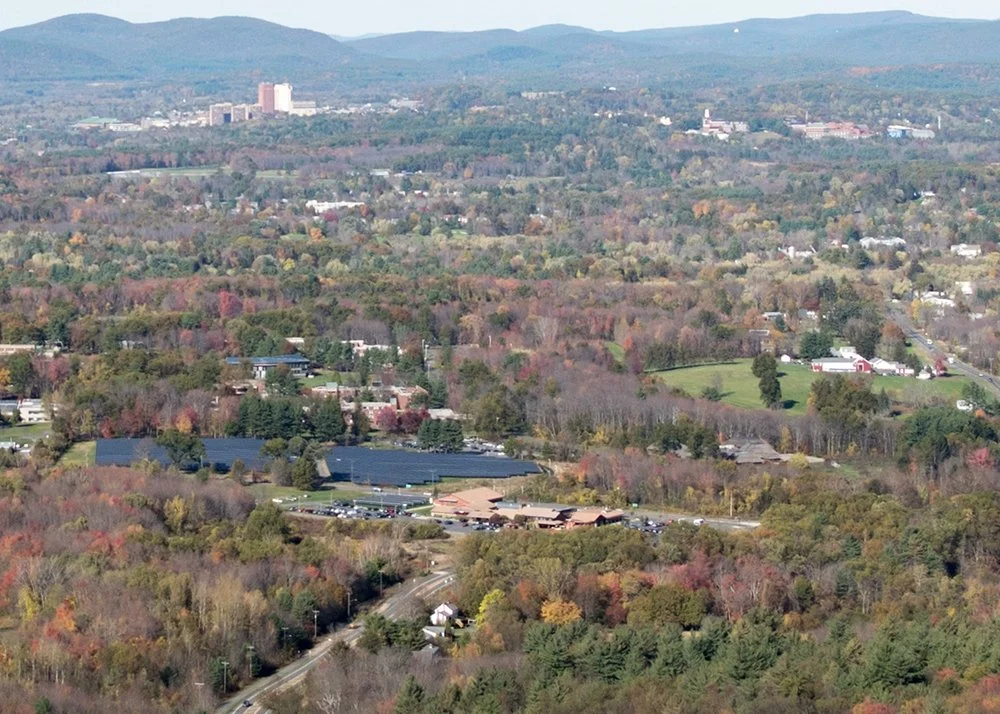
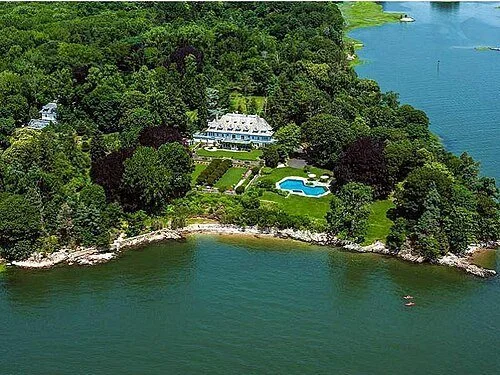
Roth, the head of the southern Connecticut hospital for the last nine months of the fiscal year 2015, earned $56 for each patient night stay, based on his annual salary and bonus of $2.9 million and the 184 beds he supervised. Greenwich is one of America’s richest communities.
The next-highest earner was Thomas Priselac, who earned $13.99 per patient stay.
To read the Axios piece, see: https://www.axios.com/stay-in-a-hospital-pay-the-ceo-56-a-night-2242870721.html
To read the FierceHealthcare report, see: http://www.fiercehealthcare.com/finance/top-hospital-ceo-pay-broken-down-by-patient-overnight-stayvery
Seasonal 'Comforts, Cures, and Distractions'
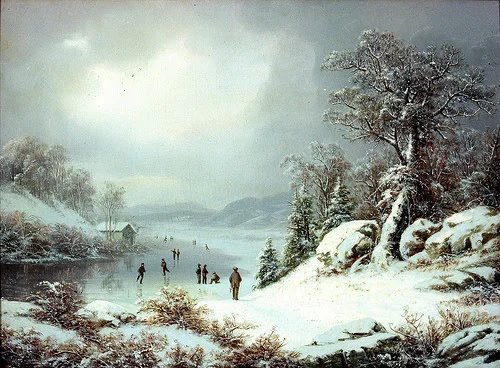
"Image from the "Comforts, Cures, and Distractions'' show at the Fruitlands Museum, in Harvard, Mass., through March 26.
The gallery writes:
"Featuring a wintry theme, the exhibition features a wide assortment of art, artifacts and landscape paintings from the museum's Transcendentalist, Shaker and Native American collections.
The gallery notes that Fruitlands curator Dumont Garr "doesn't forget that the season had been difficult for those without the luxuries of central heating and other modern aids and conveniences we so often take for granted. 'Comforts, Cures, and Distractions' provides insight on how communities comforted, cured and distracted themselves from the colder weather.
"Featuring hand made Shaker scarves and mittens; skates, sleds and snowshoes that date back to 1834; a Woodlands Native American water warmer or mokuk; and several 19th-Century paintings of ice skaters or individuals playing in the snow, the exhibition gives a realistic view into what this time would have looked like.
"Each piece tells its own story while being part of a bigger narrative. The several pairs of mittens that are included in the exhibition are both colorful and useful and bring images of children playing in the snow while a red blanket chest displays the talent and precision that individuals used in order to create practical and necessary pieces for their homes. Reminiscent of wintry weather, beautiful landscapes and childhood innocence, 'Comforts, Cures, and Distractions' is both educational and exciting''.

Josh Fitzhugh: The big question: When to tap our maples?
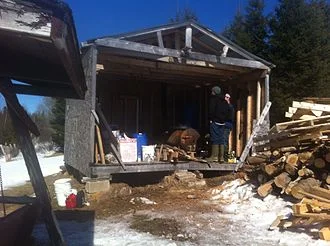
A "sugar shack,'' where maple sap is boiled off to make syrup.
Letter from Vermont 1
WEST BERLIN, Vt.
Snow is falling hard here in Central Vermont today, our first major snowfall of the year. Up until now we’ve had mostly freezing rain and slushy snow events and drivers have had to contend with icy rather than snowy roads.
The first couple of months of the year tend to be languid at most Vermont farms that aren’t dairies. The fall harvest is complete as is the Christmas sales season. Equipment has been put away. The days are short and the temperature generally cold. We get a succession of storms. Unless you log (taking down timber trees in anticipation of a log pickup before the roads turn muddy in spring), you spend the time thinking of the coming growing season; repairing structures or equipment; plowing and shoveling roads and roofs; catching up on sleep; and if you can, escaping to warmer climes for a week or two.
In recent years, sugarmakers (i.e., those who make maple syrup) have pondered another question that threatens some of this quietitude. When to tap?
Up until a generation ago, the question was pretty straightforward. You drilled (tapped) your maples just before the days began to climb into the 40’s after cold nights below freezing. That ranged from late February in Southern New England to early March in most of Vermont to late March in Northern New England, including Down East Maine.
The reason for this was that tap holes, once drilled in maple, would tend to dry out over time, and that would reduce the sap flow. In some cases, the dehydration would get so bad that sugarmakers would have to retap their trees, a big undertaking. In addition of course, delaying the tapping would lengthen the inactivity on the farm.
Now, however, the “tapping time” varies tremendously, for a couple of reasons. First, because most sugarmakers now use tubing rather than buckets to collect their sap, tap holes don’t tend to dry out as much as when they were exposed directly to the open air. Secondly, due to the size of some operations, tapping must begin in late November or December just to get all the taps in for the sugar season. (Even with tubing, trees must be retapped every year.)
Climate change also appears to be a factor. Sugarmakers find they can get a “run” of maple sap during the depths of winter when the temperature rises suddenly for a day or two, as it seems to be doing more frequently. If your main cash crop is maple syrup (as it still is for many farmers), you don’t like to miss the opportunity presented for additional production.
At our farm, we are traditionalists. Though we use tubing we don’t tap our trees late February. (Twenty years ago we waited until Town Meeting day, the first Tuesday in March.) It’s annoying when we get a nice spring day in January or February and we hear that some farmers are making syrup (or at least gathering sap) but we just don’t think it’s worth the hassle to gear up for a day here or a day there before the season starts in earnest in early March.
We figure that the trees need their quiet time, as do we.
Josh Fitzhugh, an occasional contributor, is a retired insurance executive, lawyer and journalist. His family operates Tether Loop Farm, in West Berlin. The farm sells maple syrup and hay.
Pages of memory

From the show “Legacy” at the South Shore Art Center’, Cohasset, Mass., Feb. 24-April 9.

Jim Hightower: These are great days for reading '1984'

Via OtherWords.org
Tromp-tromp-tromp — troops are marching to battles. Boom-boom-boom — bombs are blowing up communities. Whoooosh — poisonous gas is being released.
Forget Syria, Iraq, and Afghanistan — this is Trump’s War.
Our bellicose commander in chief is at war in the homeland, deploying his troops to attack everything from our public schools to the EPA, dropping executive order bombs on Muslim communities and the Mexican border.
He’s spewing poisonous tweets of bigotry and right-wing bile at the media, scientists, inner cities, “illegal voters,” Meryl Streep, diplomats, Democrats, and people who use real facts.
Basically, Trump is at war with everyone who doesn’t agree with him — in short, with the majority of Americans. And you thought that Nixon had a long enemies list!
Yet Trump’s most destructive assault so far hasn’t targeted any one group, but instead an essential and existential concept: truth. Bluntly put, he believes that truth is whatever he says it is, and that he can change it tomorrow.
Years ago, in a futuristic novel, the author wrote about the rise of a tyrannical regime that ruled by indoctrinating the masses to accept the perverse notion of capricious truth. It was George Orwell’s 1984, which depicted a dystopia he named Oceania.
There, the public had been inculcated to believe that reality is not “something objective, external, existing in its own right.” Rather, “whatever the Party holds to be truth is truth.”
Now, in 2017, we live in Trumplandia — with a delusional leader of a plutocratic party trying to redefine reality with “alternative facts,” fake news, and a blitzkrieg of Orwellian “Newspeak.”
But resistance to Trumpism is already surging. Not least, Orwell’s 70-year-old book has become a bestseller again — thanks to Trump resisters seeking… you know, the truth.
Jim Hightower is a radio commentator, writer, and public speaker. He’s also the editor of the populist newsletter, The Hightower Lowdown.
Chris Powell: Oh, no, not back to big-time hockey in Hartford!?
MANCHESTER, Conn.
What are Hartford's big problems? Connecticut Gov. Dannel Malloy suggests that they are the lack of a big-league hockey team and a deficient formula for state financial aid to the city's school system. But Connecticut has been there, done that, and gotten the bill if not the T-shirt. Proposing to spend $250 million to renovate what used to be the Hartford Civic Center arena -- now the XL Center, naming rights having been sold -- the governor is soliciting the New York Islanders to leave their arena in Brooklyn.
It's unclear why the Islanders would respond with anything except a laugh, since Hartford proved itself unable to support big-league hockey when the Whalers departed, in 1997. As state government began contemplating still another subsidy for the Whalers in 1996, the Journal Inquirer reported that the team had gotten at least $67 million from the state since 1992 and that this had equated to a subsidy of about $32 per Whalers ticket purchased over five years.
While it thought that it had plenty of money to subsidize hockey back then, state government was failing to put aside the money necessary to maintain the solvency of the state employee pension fund, whose unfunded liabilities now are cannibalizing the rest of state government. Still the governor imagines that the state has money to subsidize hockey in Hartford. As for state aid to municipal schools, the governor's proposal on the subject seems to be part of a scheme to balance the state budget by cutting aid to all but the most impoverished cities and towns.
This will force most towns either to raise property taxes or get concessions from their municipal employee unions, the largest of which represent teachers. What the governor proposes may be fairer taxation, but people being taxed more still will be right to resent it, because state government has been tinkering with its school aid formula since the state Supreme Court decision in Horton v. Meskill, in 1977 without any substantial improvement in educational results in the schools that were supposed to be helped. Connecticut's evidence of almost 40 years is that school financing has little bearing on student performance -- that student performance is mainly a matter of parenting, with most children in poor cities and towns being products of the welfare system and thus having no fathers and only incompetent mothers.
Almost four decades have passed since Connecticut began its school-aid formula approach to education. The only reason to continue that approach is to delay recognizing the social problem and welfare policy's responsibility for it.
BANKRUPTCY WON'T VAPORIZE HARTFORD
In an editorial the other day The Hartford Courant called on the rest of the state to rescue Hartford city government from its insolvency, as if state government isn't even more insolvent. The Courant gave the impression that if Hartford filed for bankruptcy, as Mayor Luke Bronin has said the city might have to, all the good things in the city would disappear, causing a lot of damage to the suburbs.
Of course, such suggestions are nonsense. Bankruptcy would leave Hartford with its hospitals, museums, and colleges -- would leave the city even with the incompetently built minor-league baseball stadium city that government decided to undertake at a cost of $50 million (now probably more than $70 million) shortly before discovering that city government was facing a budget deficit of equal size.
No, bankruptcy would merely restructure the city's debts, which are owed primarily to its employees and retired employees and bondholders -- the parties who long have enabled and profited from the financial irresponsibility of city government. In a bankruptcy they would have to return some of their profits -- that's all.
Chris Powell is managing editor of the Journal Inquirer, in Manchester, Conn.
David Warsh: An order of battle for the future of print in the Age of Google
The Trump administration having declared war on the media – three of the four most important newspapers, in particular – it is prudent to construct an order of battle for the newsprint press. It’s been 15 years since I worked for a newspaper. I no longer know much about what constitutes common knowledge in their pared-down newsrooms, much less combat readiness in their front offices. But Jack Shafer, who writes the "Fourth Estate Column'' for Politico, is a close and shrewd commentator on the scene.
So I sat upright when Shafer wrote in December, ''Don’t Blame Craigslist for the Decline of Newspapers''. The conviction that free online for-sale lists – “verticals,” in Web-speak – were a critical factor was widespread, Shafer wrote. For example, The Economist had written in 2006, “Craig Newmark has probably done more than anything to destroy newspapers’ income.” But blaming the innovative Newmark was unfair and ahistorical, Shafer continued.
"Newspapers themselves deserve a share of it. Where they gained monopoly power, which was in most U.S. cities, daily newspapers gouged their classified customers pitilessly; they lobbied Congress heavily to block the early migration of classifieds to electronic forms. And the big newspaper chains helped destroy their own business by investing in national online classified advertising verticals, which they ultimately sold.''
It was as I feared. Newsrooms still don’t understand what happened to their centuries-old semi-monopoly on advertising. It was search-based advertising, introduced in 2002 by Google, not Craigslist, which sent newspapers into a tailspin from which they haven’t yet fully leveled off. Regaining altitude depends critically on responding effectively to the entry of this new competitor in the market for attention.
Google didn’t invent search advertising. That honor belong to a serial entrepreneur named Bill Gross, who in February 1998 introduced the idea to an uncomprehending TED audience that a search term was inherently valuable – six months before Google incorporated. A Cal Tech graduate, Gross understood that, because it signaled intent, a search term could be priced and sold at auction to an advertiser. His GoTo.com, later known as Overture, didn’t make it big (unless you think that its eventual $1.63 billion sale to Yahoo was big), but Google did, when it introduced an improved version of the scheme it called AdWords four years later. At that point newspapers were still expecting a full recovery from the mild recession.
The significance of search advertising to newspapers was news to me when I started writing about it, in 2011, in "A Bare Knuckles Pricing Strategy for The New York Times'' and ''A Momentous Event, Not Yet Widely Understood''. I cobbled together my understanding from several books, the best of which remains The Search: How Google and Its Rival Rewrote the Rules of Business and Transformed Our Culture (Portfolio, 2005), by John Battelle, a founding editor of Wired. Columbia University professor Tim Wu gives the story a 10-page reprise in ''The Attention Merchants: The Epic Scramble to Get inside Our Heads'' (Knopf, 2016), though far too late in the book to be of much use to newspaper strategists.
I don’t want to go on rewriting old columns. My point here is that newspapers themselves haven’t covered the story. Among financial sophisticates, search advertising is old news to almost everyone but newspaper readers. Here’s how Bloomberg Businessweek last month described the enormous new market in a cover story on Google’s new CFO:
''Whereas traditional advertising companies had tried to target audiences based on demographic profile, Google’s search ads could be aimed at people already interested in a particular product. Its pioneering pay-for-click pricing scheme, AdWords, meant advertisers paid only for ads that worked. The result revolutionized media and advertising, and gave Google a revenue stream that seemed almost limitless. Googlers have a name for its ad business: 'the cash machine.'
The magazine cover was simplicity itself:
. Google Income Statement:
1. Revenue from online advertising
$76,062,000,000
2. Revenue from Google Glass, venture capital investments, Nest thermostats, smart contact lenses, building-size video screens, seawater-based fuel, broadband internet service, delivery drones, internet balloons, self-driving cars, quadrupedal all-terrain robots, Wi-fi kiosks, energy generating kites, the world’s most sophisticated artificial intelligence software, possible cure for death:
¯\_(ツ)_/¯
Facebook, Google’s closest search-advertising competitor, saw revenues climb to around $25 billion last year. In contrast, the four best papers probably didn’t sell $10 billion worth of advertising between them. But if deeply reported stories about the invention and significance of search-based advertising have appeared on newspapers’ front pages, I have missed them.
Five developments have been necessary to remove newspapers from the hands of travelers, wherever they happen to be: browsers, search engines, servers, auction technology and, of course, smart phones. But what about the body (and mind) at rest? Research is accumulating that a significant market remains for printed newspapers, delivered to homes and offices. As Jack Shafer wrote last summer, in ''Why Print Still Rules'':
"Print—particularly the newspaper—is an amazingly sophisticated technology for showing you what’s important, and showing you a lot of it. The newspaper has refined its user interface for more than two centuries. Incorporated into your daily newspaper’s architecture are the findings from field research conducted in thousands of newspapers over hundreds of millions of editions. Newspaper designers have created a universal grammar of headline size, typeface, place, letter spacing, white space, sections, photography, and illustration that gives readers subtle clues on what and how to read to satisfy their news needs.
''Web pages can’t convey this metadata because there’s not enough room on the screen to display it all. Even if you have two monitors on your desk, you still don’t have as much reading real estate that an open broadsheet newspaper offers. Computer fonts still lag behind their high-resolution newsprint cousins, and reading them drains mental energy. I’d argue that even the serendipity of reading in newsprint surpasses the serendipity of reading online, which was supposed to be one of the virtues of the digital world.''
And the other week, in ''Print Still Refuses to Surrender,'' Shafer concluded that English readers, at least, had spoken: “You can pry their newspapers from their cold dead hands.” A new study, by Neil Thurman, of the City University of London, had found that 88.5 percent of the total time readers devoted to 11 national U.K. newspapers was spent on the print edition, Shafer wrote, compared to 7.5 percent on smartphones, and 4 percent on PCs. Another study, by the audit and consulting firm Deloitte, revealed that 88 percent of newspaper revenues in France, Germany, Spain and the UK still come from print editions of newspapers. Everybody knows that printed editions are doing better in Europe than in the US, but here, too, advertisers pay far more for space in newspapers than they do for fleeting online impressions, even as print-advertising revenues continue to drop – last year precipitously, it turns out,.
Here is where the story gets interesting. Leave aside the FT, a truly global newspaper that was purchased in 2015 by the deep-pocketed Nikkei media group. (The Japanese are the ones who really love newspapers.) The three leading U.S. newspaper appear to be pursuing very different strategies with respect to print.
The New York Times publisher Arthur O. Sulzberger Jr. in 2012 hired as chief executive Mark Thompson, who oversaw the building of a highly successful Web site for the state-subsidized British Broadcasting Company. The Washington Post, is now owned by Jeffrey Bezos, the Amazon founder, who possesses an almost limitless sense of the power of the Web. Bezos’s executive editor, Martin Baron, told Madrid’s El Pais in an interview last month, “Print is not going to be around forever and it’s going to become a smaller and smaller part of what we do. I don’t know whether it’s five or ten years or something longer than that, but I do know it’s not going to be the future of our business… I wouldn’t even use the word newspaper anymore.”
That leaves The Wall Street Journal, privately owned by Rupert Murdoch’s News Corp. since 2007. The WSJ, like The Washington Post, no longer publishes its income statements, so it is hard – or at least expensive – to know how either enterprise is doing. But of the three, The Journal seems most deeply committed to its paper editions, given Murdoch’s deep, deep roots in print. It could turn out that the NYT and Washington Post become, as did the Christian Science Monitor in 2008, all-digital operations.
Suppose, for the sake of argument, that Shafer is right – that print is in fact a vital aspect of the future of the business. That could leave Murdoch’s WSJ, along with Gannett’s USA Today, with a shared monopoly on the national newspaper business. It’s one more thing to worry about in the time of Trump.
David Warsh is proprietor of economicprincipals.com
This island would be too exciting for picnicking

There’s been a bit of a rumpus about a proposal by Massachusetts conservation officials to introduce the endangered Timber Rattlesnake on Mount Zion Island in the Quabbin Reservoir. The island is closed to public access.
This is an animal native to the Bay State, in which there are only five surviving populations, spread out from the New York border in the southern Berkshires, east to the Blue Hills, just south of Boston. This species has had the greatest modern decline of any native reptile in the Bay State and is a high conservation priority species for the state Division of Fisheries and Wildlife (MassWildlife).
The Quabbin Reservoir is also the site of MassWildlife's nationally known and successful American Bald Eagle restoration project.
Mankind keeps destroying species. But all life is inter-connected. We destroy species to our long-term peril. Housing the rattlers on Mount Zion seems a responsible way of helping to save this species, which is beautiful in its way. And the presence of the rattlers on the island would definitely discourage humans from landing there and littering it. A slight whiff of terror would be good for the preservation of the wildlife of the island (the vast majority of which would not be bitten by the rattlers) and indeed the whole Quabbin eco-system.
Now to reintroduce mountain lions to Great Blue Hill, overlooking Boston? They like hilly places with caves. Just kidding, but they'd be prettier than the ski lift there.
'Brindled People'
A Field of Stubble, lying sere
Beneath the second Sun --
Its Toils to Brindled People thrust --
Its Triumphs -- to the Bin --
Accosted by a timid Bird
Irresolute of Alms --
Is often seen -- but seldom felt,
On our New England Farms
-- Emily Dickinson
Notebook: A theater may presage renewal of an old New England mill village; slow-train joys
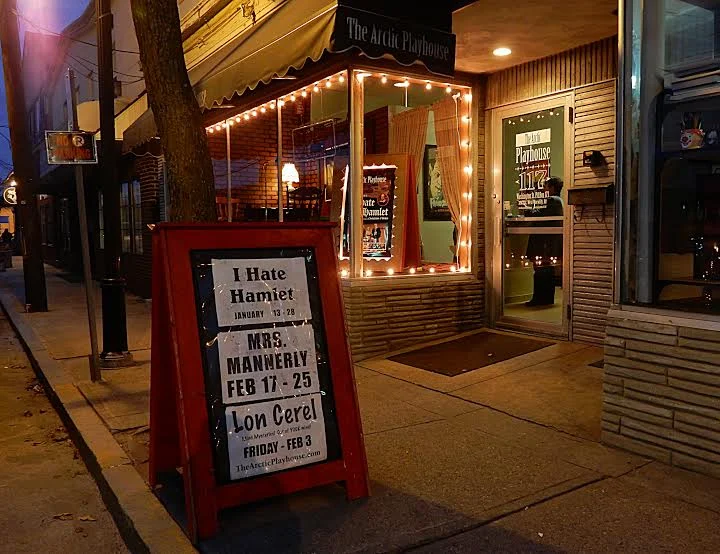
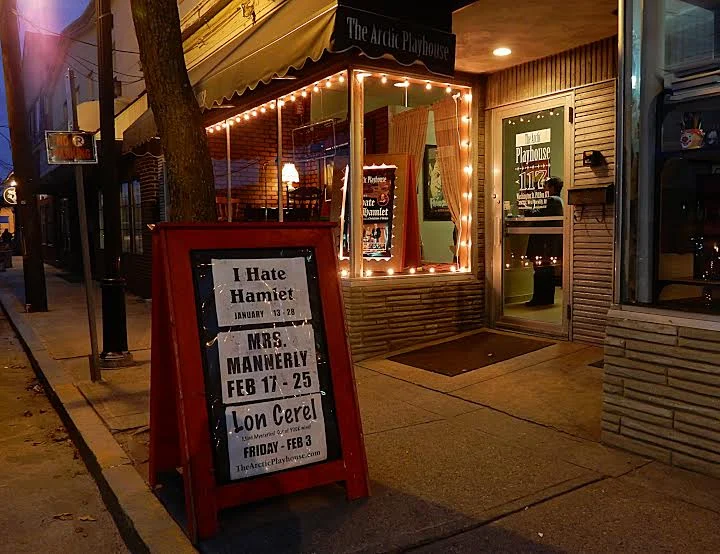
Outside The Arctic Playhouse, in West Warwick, R.I. See more pictures below. Photo: Photo: Linda Gasparello
It is the theater paradox: regional performances are often as good or better than those in big cities, even those in the hallowed locales of Broadway and the West End of London.
Away from the established talent and the marquee names, theater flourishes, sometimes in the most modest venues. Having been a theater critic in various places, including London and Washington, I can attest to the fact that theater is where you find it. I saw productions of Evita in London, New York and a dinner theater in Manassas, Va.
So I was delighted to find The Arctic Playhouse in Rhode Island, just a short distance from my home. The little theater– and I mean little -- is without pretensions. It is as modest as can be and, in its way, a little treasure.
Arctic, in its day, was a destination village in West Warwick, R.I.,: a place where professionals lived and shoppers came from afar. But the development of malls nearby doomed little Arctic. Now it is a sad place with an aged population: The senior center is a happening place for many of the residents.
Arctic is proud but poor, with businesses that have held on from better days; businesses like Rockway Tailoring and Dry Cleaners (still run by the family that opened its doors 132 years ago), Cayouette Shoe & Leather Repair and Rogers Paint Service Store.
For all of its boarded-up shops, Arctic is fighting back. The symbol of its fight is The Arctic Playhouse, in a former dog salon on the main street. It was founded by three Rhode Islanders, Jim Belanger, Lloyd Felix and David Vieira, who wanted to arrest the decay in the village.
Though lacking in many amenities, Arctic now has a live theater, which few villages can claim. It is small, seating just 90 people, and very “villagey,” adding to its charm. Audiences are local and pricing ($10 for many performances) is very reasonable. There is a cash bar, free popcorn in red-striped cups and cookies baked by volunteers.
The curtain metaphorically (there isn’t one) rises weekends to some rattling good productions, either the playhouse's own or those of New England amateur companies. The lights go up and the players are in front of you -- so close that you feel you are in the play yourself.
Whether I have seen a production in a full or half-empty house, I have sensed that the audience is part of the performance. One feels responsible for the players and the play.
My wife and I are regulars and have been enchanted. Next year, The Arctic Playhouse moves to a new home, still on the main street, still in a converted shop, but with better facilities and more seats.
The curtain is going up on renewal in Arctic, one show at a time.
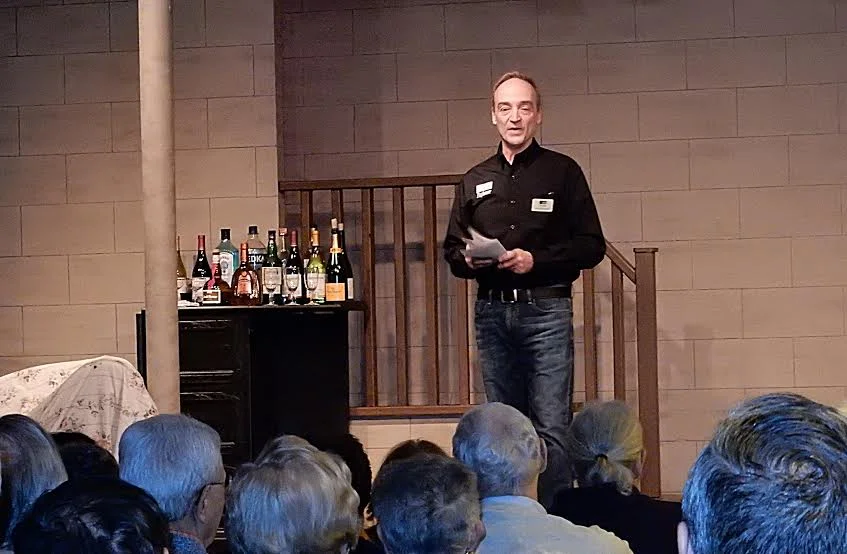
Jim Belanger introduces a play. Photo: Linda Gasparello
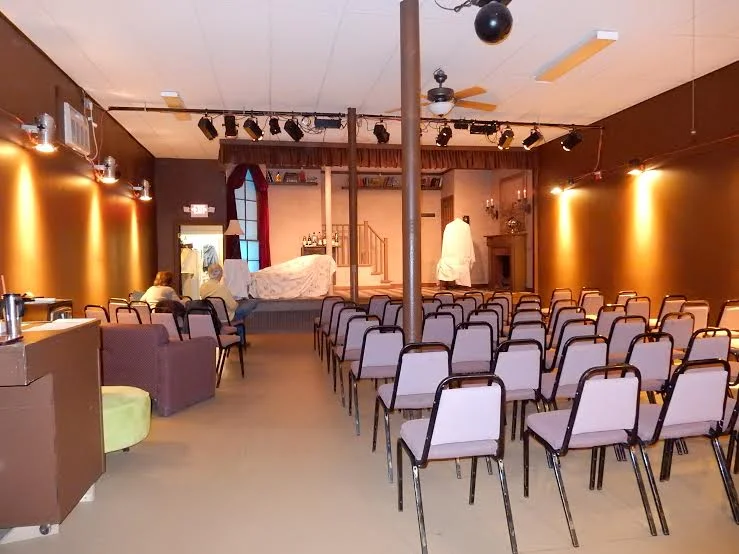
Before a performance. Photo: Linda Gasparello
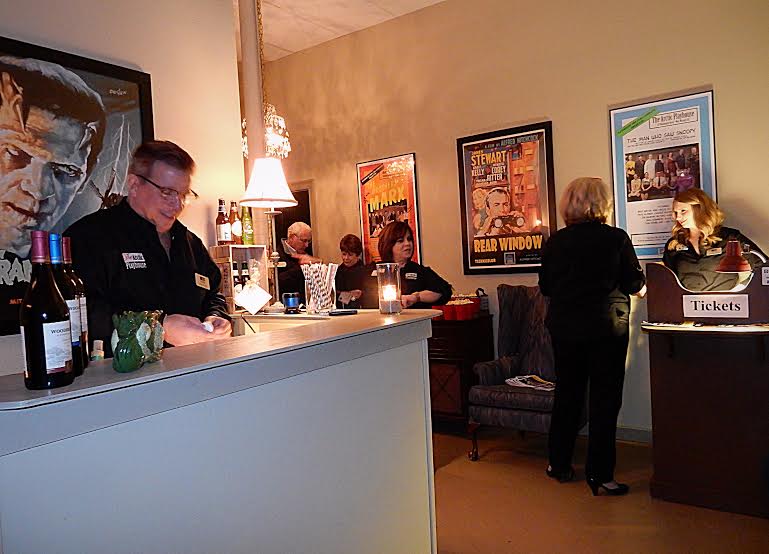
Theater co-founder Lloyd Felix mans the bar. Photo: Linda Gasparello
***
The joys of slow Northeast Corridor trains
Infrastructure is one of the things that President Trump has proposed to fix. In theory, the trains between Boston and Washington, D.C. – the famous Northeast Corridor -- could be sped up by at least 100 miles an hour.
Well, I have ridden the fast trains of Europe, swooped from Paris to Avignon, France, hurtled from Brussels to London under the English Channel. But I miss the old way of locomotion like France’s Mistral, which used to travel from Paris to Nice and on which you could eat memorable food, get your hair cut or visit a boutique.
On the cross-channel trains between Britain and the Continent, which were put on ferries and sailed overnight, it was dinner in England, breakfast in France and a divine sleep between.
If Amtrak ends up on steroids at some time in future, I shall miss the old, slow regional on which I travel to Washington, D.C., and back to Providence so often with time to read a book or get started on writing one. Forget the speed, Amtrak, but please fix the wifi.
Llewellyn King, a frequent contributor to New England Diary, is host and executive producer of White House Chronicle, on PBS, and a long-time publisher,, editor, columnist and international business consultant.
'Joy shivers in the corner'
New England
''Here where the wind is always north-north-east
And children learn to walk on frozen toes,
Wonder begets an envy of all those
Who boil elsewhere with such a lyric yeast
Of love that you will hear them at a feast
Where demons would appeal for some repose,
Still clamoring where the chalice overflows
And crying wildest who have drunk the least.
Passion is here a soilure of the wits,
We're told, and Love a cross for them to bear;
Joy shivers in the corner where she knits
And Conscience always has the rocking-chair,
Cheerful as when she tortured into fits
The first cat that was ever killed by Care.''
Edwin Arlington Robinson
Candace Williams: Number of new high-school grads in N.E. seen falling 14% by 2032
Marker commemorating the first location of the Boston Latin School, on School Street, founded in 1635 and the first public school in what would become the United States.
By 2032, the number of new high school graduates in New England is projected to decline by 22,000 to a total 140,273, according to the Western Interstate Commission for Higher Education’s (WICHE) most recent ''Knocking at the College Door'' report.
New England’s challenge with an aging population and falling birth rates has been well chronicled. With fresh projections and an ever-changing political climate, the number of high schoolers expected to graduate in the region – from a public or private high – warrants a much closer look. So does the changing demography of the graduating class, with the number of white high school graduates projected to fall by 25%, while the number of minority graduates rises significantly
Overall, the number of new high school graduates in New England is projected to decline by 14%. Within the region, Connecticut and New Hampshire face the greatest declines, with the number of new high school graduates in both states expected to decrease by 20% by 2032. The majority of graduates, currently 87%, of high schoolers in New England, attend a public high school. However, a greater share of students attends private school in this region than the rest of the nation. Whereas a projected 7% of students will graduate from a private secondary school nationally by 2032, nearly 12% of New Englanders will.
Fewer white students being born in the region can explain much of the decline in graduates in New England. During the period 2016-2032, the number of white high school graduates is projected to fall by 25%. Over that same tperiod, the number of minority graduates will increase significantly—by 46% among Hispanics, 7% among blacks , 2% among American Indian/Alaska Natives and a 37% among Asian/Pacific Islanders.
Nationally, for every 10 white graduates lost, eight minority graduates are gained. In New England, this is not the case. For every 10 white students lost, just four minority graduates are gained. Nonetheless, by 2032, 45% of high school graduates in the region will be minority.
The implication of fewer high school graduates pose real challenges to higher education institutions, both public and private, as well the regional economy. The region’s population decline has other implications including fewer congressional representatives, who have often been champions of public higher education.
Candace Williams isassociate director of policy & research for the New England Board of Higher Education, on whose Web site, nebhe.org, this piece first appeared.
'Tumultuous privacy'
"Announced by all the trumpets of the sky,
Arrives the snow, and, driving o'er the fields,
Seems nowhere to alight: the withered air
Hides hills and woods, the river, and the heaven,
And veils the farm-house at the garden's end.
The sled and traveler stopped, the courier's feet
Delayed, all friends shut out, and housemates sit
Around the radiant fireplace, enclosed
In a tumultuous privacy of storm."
-- Ralph Waldo Emerson
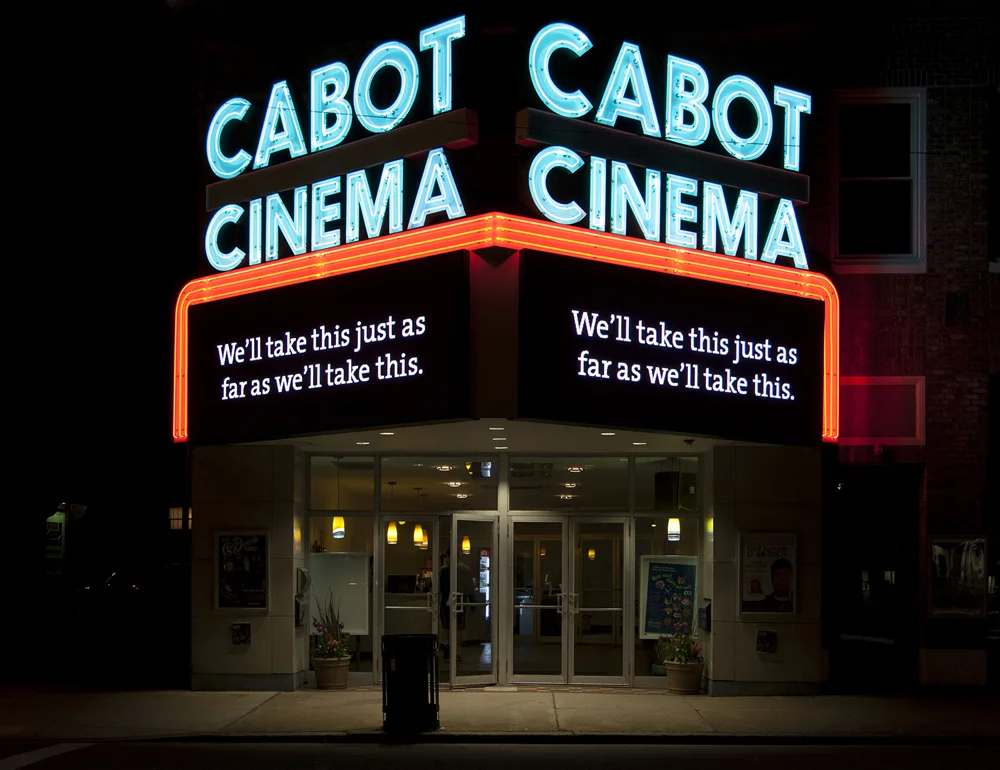
Lost and found on the road
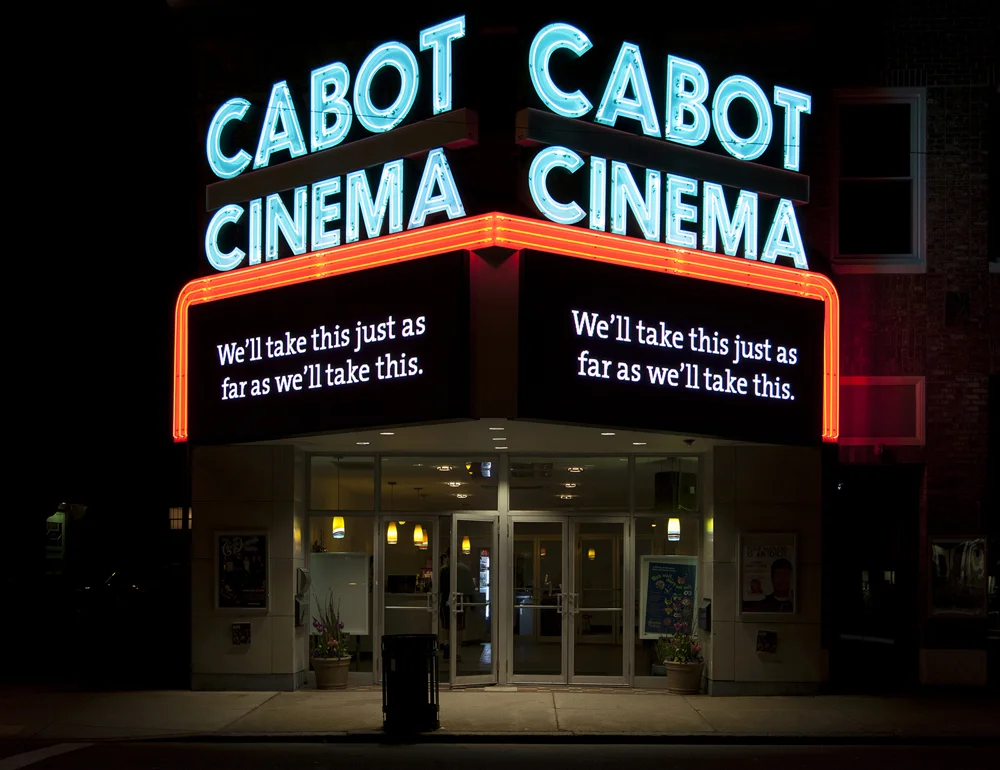
"Untitled II Beverly MA 2016'' (digital print) from “Victoria Crayhon’s show "It Says We're Not Real.'' an exhibition of an ongoing body of photographs and video entitled "Thoughts on Romance From the Road 2001-2017''. The show runs Feb. 10-April 8 at Cade Tompkins Projects, Providence.
See Ms. Ctayhon's video at: http://www.cadetompkins.com/artists/victoria-crayhon/
The gallery says:
“The images are a series of text interactions with historic and abandoned movie marquee and motel signs. As the artist traversed the roadways and interstates of New England, Michigan and other locales during long commutes and trips. These blank slates punctuated the path, causing her to recede into memory and ultimately display fragments of thoughts that might easily disappear but now exist purely as photographs.
“The messages can read as intensely personal “(In This Case the Closure Has Occurred Maybe’’), cautionary (“Approaching Dangerous Point’’) or darkly humorous “(Oh God I Love My Life’’), but all address the private self existing in public, as well as exposure to advertising media as entertainment while driving as its own unique form of existence and consumption within American culture. The proof of the performance in photographic evidence, however, is staged and stark; there are no vehicles, no passersby. Ed Ruscha’s intensely colorful paintings come to mind as a parallel of the meeting of the seemingly mundane: gas stations in the desert and flat purple plains overlaid with phrases and fragments that blur the conventions of language and art.
“Crayhon’s most recent work in the series further complicates the scenario and enriches the experience. This time she interacts with digital theater signs, transferring her message, filming the playback and photographing it simultaneously. Here, a more complete thought reaches a captive audience in the gallery; The world is not stagnant now, cars whiz and jazz from a nearby club sings in the background. ‘’

Charles Pinning: Winter humors in Newport

Another gray winter day in Newport before the construction of the Pell/Newport Bridge and the good Saturday morning cartoons and shows were over. Might as well grab the basketball and head down to the Ferguses.
The Ferguses lived two doors down and had a backboard mounted on their garage. I bounced my ball sullenly down the sidewalk, bounced it alongside their house, arrived at the cement apron in front of the garage and took a shot.
Bwong—off the rim, ran, grabbed it, hook shot from the corner…Swish! Backward shot off the backboard…miss…grabbed it, turnaround jumper…bwong…layup—Good!
Bounce-bounce-bounce-bounce….Cousy sets, shoots….It’s Good! Mrs. Fergus tapped on the kitchen window and smiled.
And on it went with the great Bob Cousy…Oscar Robertson…Bill Russell….More often than it should have, the ball bounced off the rim, hitting the broken cement spot and caromed sideways, triggering a lunge to the sidelines, a miracle save and then the hook…Nooo!!! But he was fouled!
After lunch I banged a tennis ball up against our garage door. It was uncanny how often, without trying, I could hit the raised strip in the middle where the two doors overlapped, the ball ricocheting into our hedge on one side, or into the neighbor’s driveway on the other.
Jayne, the “Mongoloid” who lived next door, watched me from her living room window, and every time the ball hit the center strip and went flying, she clapped. (“Mongoloid’’ was a termunfortunately used until recent decades because of the somewhat East Asian appearance of people we now identify as having Down syndrome.)
I let my wooden racquet drop straight down on the top edge of the head and it bounced back up. I grabbed it and did that a few times. Jayne clapped.
I went into the house and down into the cellar, where I played with the road racing set I’d gotten for Christmas a year ago. Bored after 10 minutes, I imagined shooting the BB gun at a target. The gun had been confiscated over the summer because I took a potshot at Piper Haynes, the dog next door. Piper piped and Mrs. Haynes, who was hanging clothes, caught me pulling the barrel in through the cellar window.
I went up to my room and handled my baseball trophies. I cruised into my older brother’s room and examined the top of his bureau and sniffed his bottle of Royall Lyme aftershave. I peered inside his top desk drawer. I grabbed a couple of his Mad Magazines and took them into my room where I lay down on my bed and read them. Afterwards, I returned the magazines to his room and put them precisely as they had been in the rack next to his bed.
I walked over to the window next to his desk and looked into the backyard. I turned to the bookshelf above his desk. I touched the spines of Animal Farm, House of Mirth and Bleak House.
On the top shelf of the bookcase, up near the ceiling, was a blue Maxwell House coffee can. Standing precariously on his swivel chair, I stepped up onto the desk and reached for it. Barely within my grasp, I pulled the can forward and it tumbled over. The plastic top popped off and I shrieked, instinctively dropping my head as a putrid, lumpy liquid poured over me.
My mother rushed in, followed by my brother.
“What have you done?” screamed my mother.
“Moron!” yelled my brother.
“What is all of this?” demanded my mother.
“It’s a pregnant rabbit I dissected in biology class,” said my brother.
“What? The smell!” cried my mother.
“It was in formaldehyde,” said my brother.
My mother rocketed into the far reaches of incredulity. “Why did you bring it home? Why did you have it up there?”
“What difference does it make? It belongs to me! It’s mine!” yelled my brother.
Yanking me by the arm, my mother dragged me into the bathroom. She turned on the shower. “Get undressed,” she said disgustedly.
“Teach you to snoop around my room, dorkoid!” shouted my brother.
Let me tell you, I looked like hell, I smelled like hell, but inside I was laughing and happy, but I didn’t dare show it. Finally—some excitement around this place!
Charles Pinning, an occasional contributor, is a novelist and essayist who lives in Providence.
Chris Powell: The binding arbitration disaster: How about electing municipal "contract arbiters'' to take fiscal responsibility?
With even Connecticut Gov. Dannel Malloy acknowledging that binding arbitration for municipal government employee union contracts may be a bit of a problem amid state government's worsening insolvency, maybe sensible change is coming to Connecticut. But what the governor has proposed is timid, little more than an invitation to the General Assembly to discuss the issue, which is the last thing that legislators want to do, lest they provoke the unions and all the government employees living in their districts.
The governor proposes only a change in the selection of supposedly neutral arbiters, who are picked by the arbiters already chosen by the management and union sides in contract disputes. Neutral arbiters are said to fear favoring one side or the other too much lest they not get chosen again and lose the arbitration work. So the governor proposes random selection for the neutral arbiters.
But this would leave the binding arbitration system in place, a system that removes most of a municipal budget from the ordinary democratic process. The governor's proposal is not likely to save any significant money for the public.
Elected officials want binding arbitration almost as much as government employee unions do because they don't want to have to be seen choosing between taxpayers and government employees. Elected officials want someone else -- those unelected arbiters -- to take responsibility for the big decisions that drive municipal taxes up or public services down every year. Elected officials want to be able to shrug and proclaim their helplessness to their constituents.
The real reform of binding arbitration would be to repeal it and restore to elected officials the authority to decide the compensation of municipal- government employees. But even Republican legislators would never dare to do that, since Republican town officials don't want responsibility any more thanDemocratic town officials do.
So another reform might be more instructive and almost as good: requiring each town to elect a contract arbiter at each municipal election -- to find just one person in every town willing to take political responsibility, and, really, to control a town's finances. Mayors, council members, and school board members could continue to hold their offices and pretend to be important, but in effect the town arbiter would decide how most of the town's money was spent.
Such a system would abruptly concentrate the public's attention on where most of its municipal tax money goes. There would be union candidates and taxpayer candidates for arbiter and, whoever won, the issue would be settled democratically.
If just one Republican legislator could introduce a bill to elect contract arbiters, the unions would explode in outrage at the idea of restoring democracy to municipal finance and the arbitration system would be exposed as the anti-democratic and cowardly racket it is.
The governor also has proposed a timid reform of another racket, the state's"prevailing wage" system of contracting for municipal construction projects. This system forces municipalities to hire contractors who pay above-market wages to their employees. The effect is to force municipalities to give their construction work to contractors whose employees are unionized.
The governor would raise the threshold at which "prevailing wage" work is required for municipal projects. The $100,000 threshold for remodeling work would rise to $500,000 and the $400,000 threshold for new construction would rise to $1 million.
The president of the Connecticut AFL-CIO, Lori Pelletier, denounces this as an attempt to balance budgets "on the backs of workers," which expresses the union attitude perfectly: that Connecticut's taxpayers aren't workers too.
Chris Powell is managing editor of the Journal Inquirer, in Manchester, Conn.
'To warm the frozen swamp'
The Wood-Pile
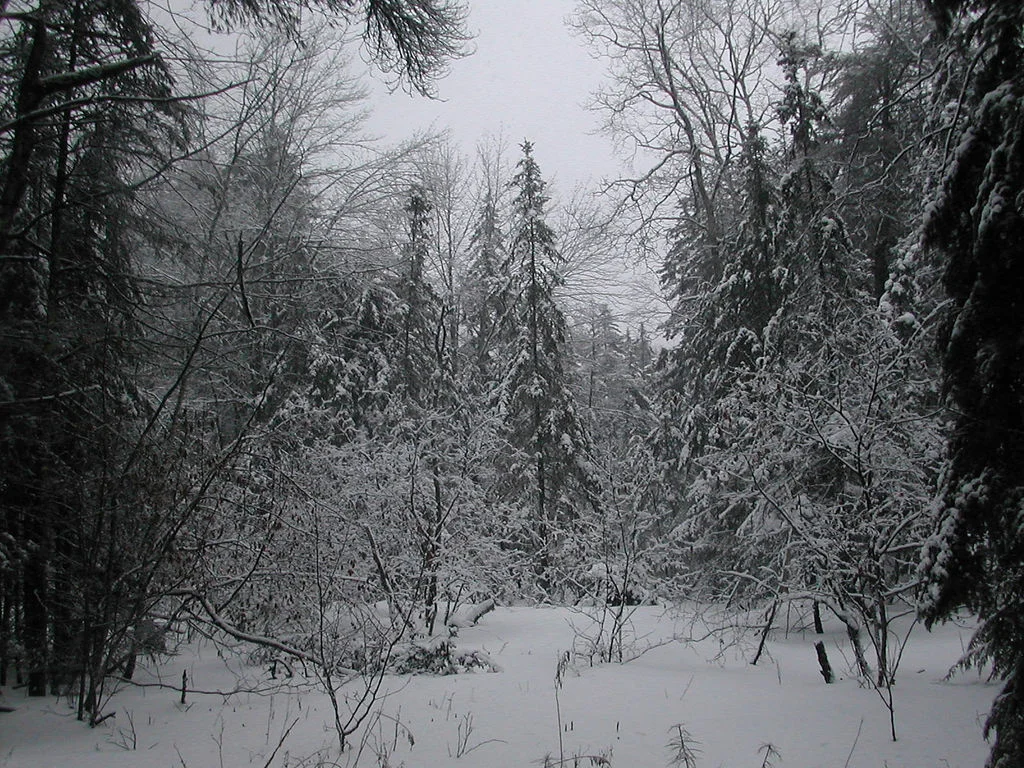
"Out walking in the frozen swamp one gray day,
I paused and said, 'I will turn back from here.
No, I will go on farther -- and we shall see.'
The hard snow held me, save where now and then
One foot went through. The view was all in lines
Straight up and down of tall slim trees
Too much alike to mark or name a place by
So as to say for certain I was here
Or somewhere else: I was just far from home.
A small bird flew before me. He was careful
To put a tree between us when he lighted,
And say no word to tell me who he was
Who was so foolish as to think what he thought.
He thought that I was after him for a feather --
The white one in his tail; like one who takes
Everything said as personal to himself.
One flight out sideways would have undeceived him.
And then there was a pile of wood for which
I forgot him and let his little fear
Carry him off the way I might have gone,
Without so much as wishing him good-night.
He went behind it to make his last stand.
It was a cord of maple, cut and split
And piled -- and measured, four by four by eight.
And not another like it could I see.
No runner tracks in this year's snow looped near it.
And it was older sure than this year's cutting,
Or even last year's or the year's before.
The wood was gray and the bark warping off it
And the pile somewhat sunken. Clematis
Had wound strings round and round it like a bundle.
What held it though on one side was a tree
Still growing, and on one a stake and prop,
These latter about to fall. I thought that only
Someone who lived in turning to fresh tasks
Could so forget his handiwork on which
He spent himself, the labor of his ax,
And leave it there far from a useful fireplace
To warm the frozen swamp as best it could
With the slow smokeless burning of decay.''
-- Robert Frost
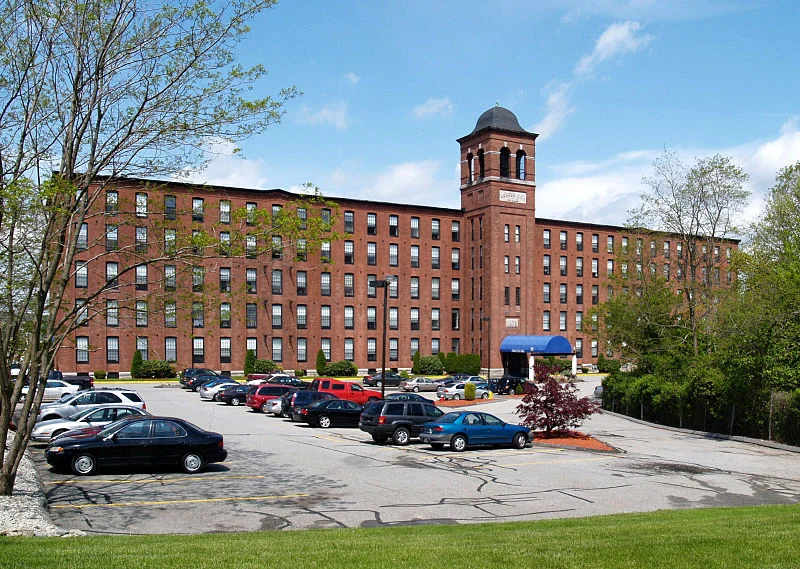
Hope on Mount Hope Bay
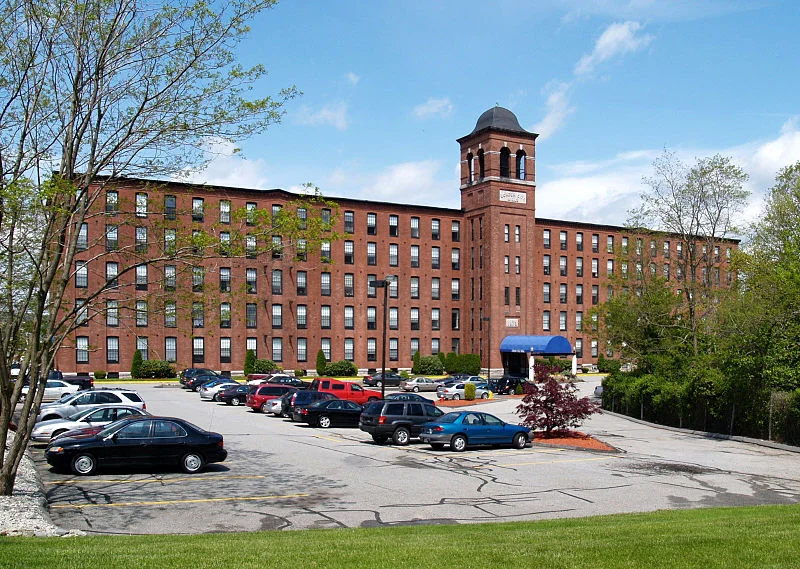
The Border City Mill in Fall River.
Adapted from an item in Robert Whitcomb's "Digital Diary,'' in GoLocal24.com
Amazon is already employing about 1,800 people in its new and gigantic fulfillment center in Fall River, Mass.
That’s a big boost to the long economically ailing ‘’Spindle City,’’ which was once the world's leading cotton-textile producer.
But folks should remember that simultaneously Amazon is killing many thousands of jobs at brick-and-mortar stores, many of which are closing because of Amazon, thus depriving their communities and states of much tax revenue and jobs and eroding their sense of community.
By the way, hilly Fall River’s setting on Mount Hope Bay is one of the most beautiful on the East Coast. And some gorgeous old granite and brick mills have survived the arsonists' efforts to enjoy the sexual pleasures of pyromania and/or the comforting piles of cash from insurance settlements.
Yes, romantic Fall River.

David Warsh: Trying to make sense of Trump's frenzy of actions

"The Plot Thickens (silver shade instant film), by Corey Escoto, in his show "A Routine Pattern of Troubllng Behavior,'' at Samson Gallery, Boston, through April 1.
The Carnegie Museum of Art observed: 'The two- and three-dimensional works of Corey Escoto meditate on the production and consumption of illusion, both in terms of what we accept as photographic truth and, more broadly, how we distinguish fact from fiction in an ever more manipulated, media-saturated world.''
SOMERVILLE, Mass.
The new president has been throwing up all kinds of ideas, orders and initiatives, presumably in hopes that some will find favor with Congress. How to understand what he’s doing? I read some careful newspaper stories, each very good, all slightly different. (WSJ: “Trump’s Week One Off Script”. WP: “Reality Check: Many of Trump’s early vows will probably never happen”. NYT: “Misfires, Crossed Wires, and a Satisfied Smile in the Oval Office”. FT: “A Whirlwind Week in the White House”.) The single most useful insight I came across was that of Politico’s Eliana Johnson, speaking on National Public Radio’s On Point:
“The way to think about this government is sort of like a coalition government, where you’ve got the populist nationalist president in the White House [who’s] going to agree with the Republican majority in Congress on some things, [as] he’s going to agree with Democrats in Congress on other things, but there isn’t a party in Congress that he aligns or sees eye-to-eye with on everything, that’s going to be able to ram through legislation. Same with his cabinet secretaries – they disagree with him on many, many things. I don’t think he nominated secretaries who are pushovers.’’
Of the bewildering array of first steps Trump proposed, none was more interesting to me than a foreign policy initiative when he was expected to call Vladimir Putin, Angela Merkel and Francois Hollande. What might he have said? For many years I’ve thought that Jack Matlock, the career Foreign Service officer who was George H.W. Bush man in Moscow, has understood the situation particularly well. He is the author of Autopsy on an Empire: The American Ambassador’s Account of the Collapse of the Soviet Union (Random House,1995) and Superpower Illusions: How Myths and False Ideologies Led America Astray – and How to Return to Reality (Yale, 2010). Matlock took to his blog to propose a four-paragraph communique for afterwards:
“The presidents agreed that there is no good reason to consider their countries enemies and there are compelling reasons for the United States and Russia to cooperate in solving common problems.
“The presidents recognize that a nuclear war would be catastrophic for humanity, must never be fought, and that their countries bear a special responsibility to cooperate to reduce the nuclear danger and prevent further proliferation.
“Regarding specific issues, they agree to begin, on an urgent basis, consultations with each other and with allies and neighbors regarding ways in which current confrontations could be replaced by cooperation.
“One question that will inevitably arise regards the continuation of U.S. sanctions on Russia. In [Matlock’s] view, these sanctions are now doing more harm than good, but [he] would hope that decisions regarding them would be made in concert with U.S. allies, who have been pressed by the United States to adopt them. Perhaps President Trump could state that he agrees that sanctions are incompatible with the sort of relationship he seeks with Russia, and he intends to explore ways to create conditions that make them unnecessary.’’
It is anybody’s guess which of those among of the frenzy of proposals emanating from the White House might eventually become the basis for blueprints for action. I can’t fault the method the president chose. Throwing much against the wall in hopes that something will stick is an approach to dire circumstances previously associated mainly with Franklin Delano Roosevelt. (Of course, then it was the nation’s circumstances, not the president’s, that were dire.) WSJ columnist Peggy Noonan and Joshua Green, writing in Bloomberg Businessweek, think that Trump is seeking to create a “workers’ party,” composed of “those who haven’t had a real wage increase in the last eighteen years.” I don’t think the populist nationalist in the White House is going to get very far with that.
David Warsh, a longtime financial journalist and economic historian, is proprietor of economicprincipals.com, where this first appeared.
More leaf-chomping on the way for this spring in New England
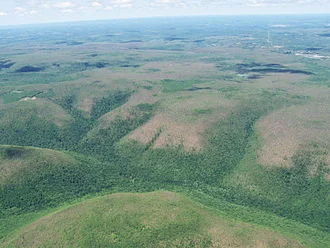
Hillsides in a gypsy-moth infestation.
Adapted from an item in Robert Whitcomb's "Digital Diary'' in GoLocal24.com
Scientists say that the gypsy moths will be back in force this spring to continue the devastation of the southern New England woods we saw last year. The ecological changes wrought by New England’s long drought are blamed. The Massachusetts Department of Conservation and Recreation reported:
“Recent drought conditions have limited the effectiveness of a soil-borne fungus, Entomophaga maimaiga, which has helped keep gypsy moth populations in check since the last large outbreak during the 1980s.”
I remember driving through vast swathes of virtually leafless trees early last summer around Worcester. In a way, the openness, combined with the ground-level greenery, was exhilarating -- until you considered it a bit more. I wonder how many trees would die if this infestation occurs more frequently, with, say, global warming.
Let's hope that conservation folks don't obey a public outcry to aerial-spray the hell out of these creatures, and in so doing kill many other creatures.