
Vox clamantis in deserto





Josh Fitzhugh: Let's pour some cooling reason, please, on the Trump immigration-order hysteria
I have discovered over a lifetime of living that in a general discussion of a heated topic it is best to let the firebrands speak first and when the emotion has died down, try to raise some sensible facts in a calm voice. That frequently helps resolve the discussion.
I think that we are at this same place in the uproar/hysteria/chaos over President Trump’s immigration orders of recent days.
So let’s reiterate some facts.
One. President Trump won the election. He did not receive a majority of the votes cast but he did receive what I will call an “electoral majority,” i.e., a majority of the votes in enough states to become president under our Constitution. (In my opinion some of the recent protests are less about his post-election policies and more about his victory at the polls.)
Two. It should not come as a surprise to anyone that Trump has moved to restrict immigration, at least temporarily. Controlling our borders was the centerpiece of his campaign. More particularly he said he wanted to tighten the “vetting process” for people entering the country legally from some countries, and to stop the influx of people into the country illegally. The vetting process is already quite rigorous, though made more difficult when refugees come from countries in chaos, like Syria.
Three. Legal immigration to this country (i.e., immigration with the permission of the United States) is at the highest level in 23 years. According to the Pew Research Center, we admitted 85,000 immigrants last fiscal year. Nearly half were Muslims. The Obama administration was on schedule to admit 110,000 people this fiscal year.
Four. Congress has given the president enormous discretion to determine who should be admitted to this country. In fact this is the very same discretion that President Obama cited as authority for not deporting the children of immigrants who came here illegally. The courts historically have been extremely reluctant to second-guess the president’s authority, although they have said that Congress could by law restrict it.
Five. Although Trump in the campaign talked of banning Muslim immigrants, the executive order he signed does not do that. It temporarily restricts immigration from seven, mostly Muslim countries that were already on an Obama watch list, and permanently bans immigration from Syria, another mostly Muslim country. Many mostly Muslim countries continue to send immigrants to America. To say, as the New York Times has repeatedly said in editorials, that the order “bans Muslims” is a flagrant misrepresentation that only incites religious intolerance.
Six. The Trump White House is still getting organized. Many officials have not been confirmed by the Congress and others have not been appointed. The executive order involving immigrants contained some mistakes (extending the ban to those with green cards, for example; not making exceptions for Iraqis who have materially assisted our troops is another) that reflect the inexperience of a new American administration. Time should cure this problem.
Seven. Those seeking entrance into the United States have no constitutional rights. They are not American citizens nor residents of this country. While it may be “un-American” to bar a foreigner based on their belief in a religion that is not contrary to our Constitution, it is not in violation of that Constitution nor, I believe, a violation of any of our laws.
Eight. While the president’s actions have certainly sent a big “unwelcome” sign over our borders, and have probably disrupted the plans of thousands if not tens of thousands of people across the globe, relatively few people were directly detained or sent home by the order, under a few hundred, I believe. Courts are sorting out some individual cases, as they should. Ironically, although Trump vowed to pursue “America First” in his inaugural, his family business is very international.
Nine. Many Americans believe that continuing the Obama immigration policies will increase terrorist attacks in our country. Some of our recent mass shootings were conducted by Muslim Americans who had been radicalized overseas. It is unclear whether restricting immigration will reduce the threat of domestic terrorism, and many diplomats overseas think that restricting immigration may in fact increase terrorism. A recent poll showed that 49 percent of Americans support Trump’s executive order.
Ten. The immigration situation across the globe is a mess, and is likely to get worse. Fighting and political unrest in the Middle East and North Africa have put millions of people on the move to try and save their families. Europe is at the breaking point in its efforts to accommodate refugees. Climate change and population growth are likely to make this trend worse over the coming century. The world needs to find a better way to handle the rising tide of refugees by addressing the problem at its source.
Now I’m sure that others could cite other facts that might lead to other conclusions, but for me these facts lead to this: The president is entitled to some time to carry out the promises of his winning campaign; that a pause in immigration policy is supported by at least half of all Americans; that the effectiveness of the Trump policies in reducing the threat of domestic terrorism is hard to determine; that the courts will protect the interests of those wrongly affected by American policies; and that Congress may if it wishes restrict the discretion of the President in this area.
One final thought, which is opinion, not fact. It is pretty clear to me that the world will not advance if countries pull back inside their borders. Young people in particular want an international world. At the same time, many Americans are nervous about this internationalism and the economic and social consequences that come with it, and their candidate won the White House. In the long run of American history this appears to be a time when the people want a reset of our foreign engagement before continuing the march toward a single, multicultural nation and world.
John (‘’Josh’’) H. Fitzhugh is a Vermont farmer, retired insurance executive, lawyer and former journalist. He served as chief counsel to two Vermont governors – Richard Snelling, a Republican, and Howard Dean, a Democrat.
Of pomposity and insecurity
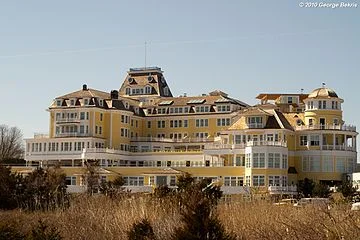
The Ocean House.
Excerpted from Robert Whitcomb's "Digital Diary'' column in GoLocal24.com
One of the more entertaining recent stories in New England was Richard C. Morais’s denunciation in the Dec. 20 Barron’s of the service at the pretentious Ocean House, in the Watch Hill section of Westerly. Mr. Morais approvingly quotes Penta Travels as calling it “America’s Most Overrated Hotel’’.
But first it should be noted that the $147 million rebuilding of the 19th Century resort hotel with the money and close direction of Wall Street mogul Charles (“Chuck’’) Royce (of Greenwich, Conn., natch) was done beautifully, albeit with furnishings with the sort of faux aristocratic/WASP imagery promoted by that brander extraordinaire Ralph Lauren (ne Lifshitz and born in the Bronx – a delightfully American life story). The hotel is heavy on model boats and Chinese vases. It employs some locals (in addition to its cheap labor from abroad) and is a major source of revenue to some local businesses.
Anyway, Mr. Morais and his wife had a generally unpleasant stay in what Travel + Leisure magazine in 2014 had called the No. 1 resort in the continental U.S.!
Mr. Morais’s tale of occasionally incompetent and arrogant service sounded pretty accurate to me, at least based on a couple of meals we had there (one of them blessedly paid for by somebody else). In any event, the pomposity of service at the hotel is likely to be best tolerated by the sort of insecure customers who, among other things, want to feign not having to worry about money in a joint pitched to the rich and the wanna-look rich. Some are the same sort of people who stay in the tacky but expensive hotels, and buy the branded made-in-Asia junk, on which the con man Donald Trump puts his name.
Mr. Morais wrote:
“That night in the formal dining room, as at the spa {which also involved bad service}, we were handed menus without prices, as if we were faint-hearted Victorian women who couldn’t possibly handle seeing how much things cost. Again I was irritated. Then our obsequious waitress demanded to know our dessert choice before we had even started the meal, somehow under the impression we were on a simple Italian pensione meal plan. Our dinner, when it came—local oysters, halibut—was tasty enough, at $293 with a modest half-bottle of wine.
“But each course was introduced by ludicrously long and pretentious descriptions. Worse still, my wife and I tried to have a serious discussion over dinner, but the waiters interrupted us every few minutes, asking if everything was to our satisfaction. After the fifth or sixth such request, my wife whispered that it felt as if we had to reassure them of their job security.’’ Reign of terror at the Ocean House? Staff fearful of being shipped back to Sri Lanka or Mexico or Slovenia?
If the rumors about Hillary and Bill Clinton buying a place in Watch Hill turn out to be true, maybe they can re-establish their frayed populist credentials by championing the rights of low-paid summer-resort workers. The Clintons have apparently stayed in the Ocean House and bought some books in Westerly’s Savoy Bookshop and Café on their visit after the election. One rumor had it that they were looking at real estate to buy.
I’m glad that Mr. Royce has pumped a lot of money into the Westerly area. And in his piece Mr. Morais sometime sounded rather pompously privileged himself. However, in the same piece, he did have nice words about the Castle Hill Inn, Newport – very expensive, but not in the stratosphere with the Ocean House.
xxx
Now that the most corrupt and sociopathic person ever to inhabit the White House is in charge, will there be a reaction against his gaudy sleaze, as there was in the ‘30s in reaction to the Gatsby-like excesses of the ‘20s? Will it again become fashionable again, even for the new rich, to show less exhibitionism, more selflessness and more low-key civic-mindedness? Probably not: America’s decline into civic decay, celebrity culture and willful ignorance seems unstoppable, lubricated by cable TV and “social’’ media, which turns out to be pretty anti-social.
Another big question, of course, is whether Mr. Trump’s protectionism will lead to the sort of trade war that helped intensify and lengthen the Great Depression after the Smoot-Hawley tariffs of 1930. It will be fun to watch a Congress run by the Republicans rubber-stamp the protectionism even though the GOP has long prided itself as backing free trade. In the end, the configurations of political power and the associated spoils will trump (or Trump) principle.
Some economists have estimated that Smoot-Hawley and retaliatory tariffs by America's trading partners helped reduce U.S. exports and imports by more than half during the Depression, helping to drive American unemployment to 25 percent by March 1933. History doesn’t repeat itself, but as Mr. Twain said, “there are rhythms’’ in it.
In partial defense of February
The most serious charge which can be brought against New England is not Puritanism, but February.... Spring is too far away to comfort even by anticipation, and winter long ago lost the charm of novelty. This is the very three a.m. of the calendar.
~- Joseph Wood Krutch
This is one of the once-renown essayist's most famous lines. But we don't entirely agree with him. The brighter mornings and the faster melting of ice and snow, compared to January, in this shortest month make February suitable for hope. A mild February day can produce a brief moment of ecstasy.
'Prayer Pilgrimage for Freedom' 60 years later
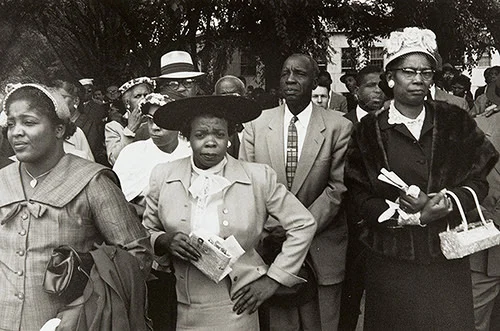
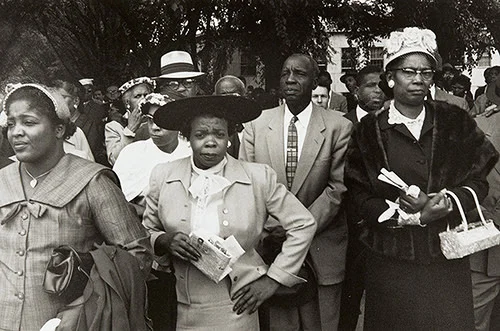
Untitled photo by Lee Friedlander in the show "Let Us March On: Lee Friedlander and the Prayer Pilgrimage for Freedom,'' at the Yale University Art Gallery, New Haven, through July 9.
The Yale University Art Gallery is celebrating the 60th anniversary of the Prayer Pilgrimage for Freedom with photographs by artist Lee Friedlander.
''Let Us March On'' celebrates the thousands of activists who united in front of the Lincoln Memorial on May 17, 1957, the third anniversary of the Supreme Court decision in Brown v. Board of Education, which officially banned racial segregation in schools. But such segregation continued well into the '60s and beyond.
Mr. Friedlander, only 22 at the time, took pictures of such prominent figures as Martin Luther King, Jr., Ella Baker, Harry Belafonte, Mahalia Jackson and Rosa Parks and many other demonstrators and participants.
''Let Us March On'' features high-quality gelatin prints and displays the frustration about racial injustice and demand for equality still present today. Addressing such issues as racial violence and inequality, among other topics, Mr. Friedlander's photos offer a remembrance of America's past and an inspiration for today.
James P. Freeman: Now it's U2 vs. the Trump regime
Suit and tie comes up to me
His face red
Like a rose on a thorn bush
Like all the colours of a royal flush
And he’s peeling off those dollar bills
— “Bullet the Blue Sky,” 1987
U2’s angry, angst-driven anthem was meant to be a stinging political commentary on President Ronald Reagan’s ‘80s foreign policy, and the band’s seminal work, The Joshua Tree, was, by extension, an explorative essay about Americana, with Nevada’s desert plain serving as its cinematic lyrical leitmotif.
But today, still infatuated with America as an idea, U2 has substituted Donald Trump for Ronald Reagan, and the inspiration for the band’s newly announced tour, commemorating the 30th anniversary of the album, is really an elaborate ruse of anti-Trumpism, not a trip through the wires of celebratory nostalgia.
Fans should be prepared.
The Joshua Tree Tour 2017 (stopping in Greater Boston at Gillette Stadium on June 25) seems steeped in sentimentalism — with the band even having re-created a photo based upon the iconic album cover — given the original recording’s massive popularity and youthful idealism. But guitarist The Edge, in a recent Rolling Stone interview, provides fair warning and the reasoning behind this surprise tour: “The election [happened] and suddenly the world changed … The Trump election. It’s like a pendulum has suddenly just taken a huge swing in the other direction.”
Meaning, evidently, the wrong direction.
He further explained that “things have kind of come full circle, if you want. That record was written in the mid-‘80s, during the Reagan-Thatcher era of British and U.S. politics. It was a period when there was a lot of unrest. Thatcher was in the throes of trying to put down the miners’ strike; there was all kinds of shenanigans going on in Central America. It feels like we’re right back there in a way.”
And The Edge added that while this tour is “not really about nostalgia,” the songs “have a new meaning and a new resonance today that they didn’t have three years ago, four years ago.” That was under President Obama’s America of “safe-spaces” and universal health care. (The band played at a pre-inaugural concert in Washington, D.C., eight years ago, heralding his election.) Trump’s America, by contrast, is now a dangerous netherworld, as U2 sees it.
Two U2 shows in 2016 offer a kinetic prelude to shows coming this spring.
Last fall, before the election, performances at the iHeartRadio Music Festival and Dreamforce, in Las Vegas and San Francisco, respectively, were infused with vitriolic rants about Trump and the kind of degenerated America one should expect under his leadership.
During the song “Desire” at the iHeart show, with a video backdrop of Trump speaking, Bono asks those in attendance, “Are you ready to gamble the American Dream?” And if they were to vote for Trump they would, he admonished, lose “everything.”
James P. Freeman, an occasional contributor, is a writer and in financial services. This piece first ran in The New Boston Post.
Robert Whitcomb: The rise and fall of the New England-born HoJo's empire
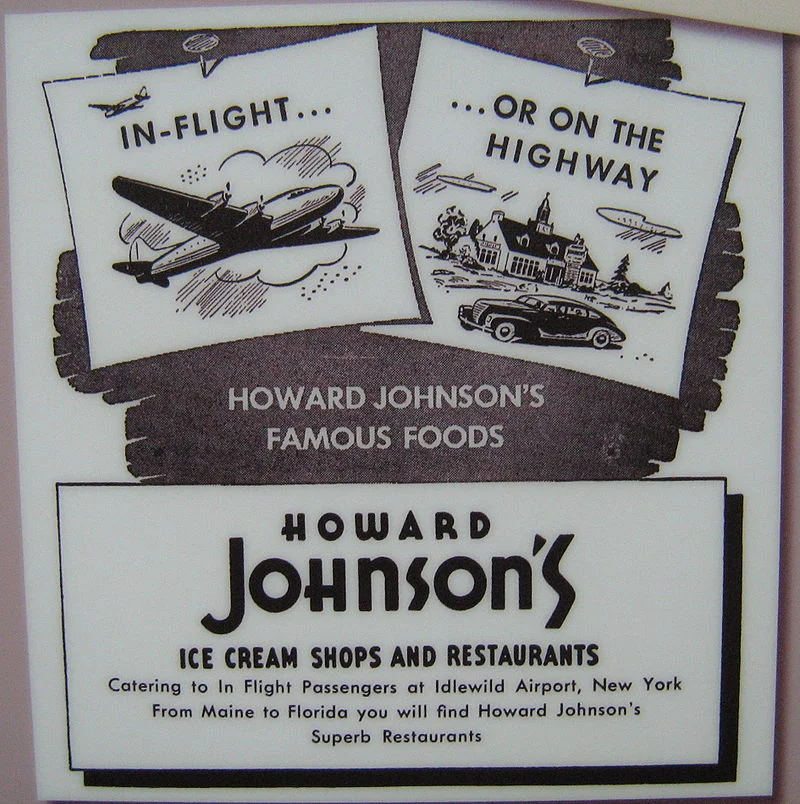
After Howard Johnson got into (over-expanded?) national catering in addition to its famous orange-roofed restaurants and ice-cream shops. Later, it became a major hotel chain. Somehow "Idlewild'' sounds more romantic than John F. Kennedy International Airport.
Flavors of Mid-Century
A History of Howard Johnson’s
How a Massachusetts Soda Fountain Became an American Icon
By Anthony Mitchell Sammarco
(American Palate, 157 pp., $19.99)
The rise and fall of the Howard Johnson Company says a lot about American society and business from the 1920s on.
It was quite a ride, some of which I was familiar with before reading Mr. Sammarco’s chaotic and seemingly unedited history of the famous chain of restaurants and, later, motels, too. Howard Deering Johnson started his company in Wollaston, a section of Quincy, Mass., close to my hometown, Cohasset. And the Howard Johnson Company bought a rival ice-cream parlor chain, Dutchland Farms (with windmills – high kitsch!), owned by friends of my father, in the late ‘30s. As the shoe companies in the area folded, the locals felt proud about having another local enterprise grow into a national powerhouse.
Mr. Sammarco’s book is rife with repetitions, confusion (there’s lots of quoted stuff but you often don’t know who’s being quoted) and almost nonstop breathless copy about the company’s “delicious foods and ice cream’’ (ice cream perhaps not considered a food?), including ‘’clams so fresh and delicious that they were called ‘Tendersweet’ clams.’’ Then there such mysteries as the chain’s “ceramic broiled steaks, chops, chicken and lobster.’’
There also many side trips with extraneous information that has little or, in some cases, nothing to do with the main history. And yet, the monomaniacal Mr. Johnson and the company he created are so interesting that you keep reading Mr. Sammarco’s boyishly enthusiastic ramblings. And the many old pictures are delightful, if randomly placed. And, praise be to God, there’s an index!
Mr. Sammarco got the main point right about the long success of “The Wonderful World of 28 Flavors’’ and its importance in American business history: “Standardization of quality, preparation and portion control ensured uniformity throughout the orange-roof restaurant chain.’’ People like Ray Kroc, of McDonald’s, said they learned a lot from Howard Johnson.
Even as the company went national, the emphasis on ice cream (always a huge favorite in New England) and such regional specialties as fried clams and Yankee pot roast, and, at many HoJo restaurants, pseudo-Colonial Revival architecture, reminded many around America of the company’s regional roots. Fried clams, that very New England heart-attack enabler, may have been the chain’s most famous food after ice cream.
I remember well the heyday of HoJo’s, in the ‘50s and ‘60s, when the restaurants, with their famous “28 Flavors’’ signs were all over America. Almost all of them were expertly situated and promoted, on or near major roads and with strong signage. It wasn’t an exciting place to go (except for small children drawn to the ice cream), but it was comfortingly predictable for travelers, weary or otherwise.
Mr. Johnson came to understand early on that the automobile would profoundly change Americans’ dining and lodging habits.
He started out by buying a Wollaston drugstore in 1925 and, recognizing the profit potential from New Englanders’ love of ice cream, experimented with many new flavors, all using more butterfat than most ice cream makers did. They were hits with patrons of the store’s soda fountain. The desire to pay off the debts from his late father’s cigar business helped drive his work ethic.
He responded to the popularity of his “28 Flavors’’ of ice cream by expanding his operation to summer ice cream stands along streets at the region’s urban beaches as the number of people with cars to get there was rapidly increasing.
Then, in 1929, he opened his first real full-service restaurant, in downtown Quincy. Eugene O’Neill gave him a boost: The censors in Boston (remember ‘’banned in Boston’’?) prohibited his play Strange Interlude from being shown in the city. So it was moved to the Quincy Theater, right across the street from Mr. Johnson’s new establishment, which thrived from the business from the playgoers, many of whom told their friends how good the food was (at least compared to the contemporary bland New England “cuisine’’ of the time).
The Depression hit Mr. Johnson’s new creation hard. But the workaholic came up with a scheme to expand anyway. In 1935, he arranged a franchise relationship with a friend/businessman at a busy (especially in the summer, of course) intersection in Orleans on Cape Cod.
Under this arrangement, the Howard Johnson Company would let a franchisee use the by now well-known Howard Johnson’s name, buy all (highly standardized) food and other supplies from a central HoJo’s commissary and adhere to Mr. Johnson’s “Bible’’ on how the final food preparation and table and counter services would be done.
Mr. Johnson insisted on uniformity: “When you get the same kind of {Howard Johnson’s} sundae in New York that you get in Florida, you are more likely to buy one in Maine,’’ he said.
While franchises were not unknown at the time, it was Howard Johnson who established it in the restaurant business, along with aspects of what would come to be called “fast food’’ – stuff to take out, as well as brisk counter service, albeit not nearly as fast as in today’s computerized fast-food establishments.
After tough times during World War II because of rationing, Mr. Johnson’s empire grew rapidly into hundreds of company-owned restaurants and franchises. And starting in the mid-‘50s, the company got into the “motor lodge’’ (AKA motel) business.
Perhaps no businessman understood the business opportunities associated with Americans’ love affair with (and mandatory reliance on) driving as well as did Howard Johnson. As the Interstate Highway System got going in the late ‘50s, the company’s growth accelerated. As Time magazine said in 1960:
“The travel-weary U.S. motorist has been conditioned to think of food—and a chance to let the kids out of the car—when he spots a roof of bright orange tile along the highway. This ‘landmark for hungry Americans’ is the trademark of Howard Deering Johnson, a onetime cigar salesman who has become a part of Americana (teenagers call his places "HoJos") by catering to the common denominator of U.S. taste and haste.’’
Mr. Sammarco writes that the chain “served a traveling public with fine food.’’ I’d call it “reliable’’ food.
When the company went public, in 1961, Mr. Sammarco writes, “it consisted of 605 Howard Johnson’s restaurants (265 operated by the company and 340 by licensees {franchisees}, 10 Red Coach Grill {more upscale} company-owned restaurants and 88 Howard Johnson’s Motor Lodges, all of them franchisees.’’
By 1975, the empire included more than 1,000 owned and franchised restaurants, over 500 motor lodges, vending and turnpike operations and a massive manufacturing and distribution system.
The orange roofs and blue shutters of the chain, along with the predictable and safe food, seemed to have become a permanent fixture of the American road.
The ‘50s and ‘60s were the heyday of the American nuclear family. The extended families of earlier generations – lots of uncles, aunts and cousins living close by – were in steep decline but illegitimacy was not yet in ascendency and intact families, with a married mother and father, and often a lot of kids, dominated domestic life in times that were becoming increasingly prosperous.
Thusthe “family restaurant’’ approach taken by Howard Johnson (who was married four times!) was in a fertile field. Take the kids to HoJo’s! No unpleasant surprises there.
But things started to get a bit strange in patches, too. The company, in the Mad Men period of the early ‘60s, hired two French chefs – Pierre Franey and Jacques Pepin – to help develop new meals, and, also wandering far from its roots, got Dior to design new uniforms for HoJo waitresses! Were these fire bells in the night that the company was losing focus?
By 1975, the empire included more than 1,000 owned and franchised restaurants, over 500 motor lodges, vending and turnpike operations and a massive manufacturing and distribution system, including frozen food.
Clouds were gathering. New competitors, most famously McDonald’s and Burger King, were pressing to dominate the downscale side of the restaurant business. And while more affluent folks still tended to want a somewhat leisurely sit-down meal, especially in the evening, many other people wanted more speed -- both takeout and in-house service --and lower prices. I suspect that’s in part because growing work pressures, shrinking inflation-adjusted average incomes and the influx of many women into the workforce meant that there was less time and less income for more traditional restaurant meals for many Americans. And the richer folks found HoJo’s boring: It was too standardized.
You also have to wonder whether the expansion of the company into the motel business seriously weakened the company’s focus and undermined its brand identification amongst the public even as so many competing restaurant chains were entering the market.
Meanwhile, quality was slipping. Howard D. Johnson retired as president in 1959, with his son, taking over. Because of his fear of debt, the elder Mr. Johnson had tended to keep too tight a lid on certain expenses, especially the number of employees and their pay. So many of his establishments were understaffed, causing slow service, and things got worse under his son.
Even before his retirement as president, the elder Mr. Johnson started to spend less time making spot visits to his restaurants to check on the quality of the food and service, which gradually declined in his later years, even as he spent more time in places like Manhattan’s Stork Club. (That may have pleased his employees: Mr. Johnson was a large and fierce-looking man.)
His smooth and preppy son, Howard B. Johnson, was also obsessed with cutting costs, and spent too little time checking on quality and keeping up with demographic and other changes in American life that would help or hurt a restaurant chain. Rather than working out of Wollaston, the official headquarters, he operated from an office in Manhattan. He was not an operations guy like his father.
Mr. Sammarco usefully quotes Brian Miller, writing in the Journal of Hospitality & Tourism Education:
“The fall of the Howard Johnson’s brand {in the ‘70s} was faster than it took to build. When the reins of the company were passed down from father to son, the son appeared to quickly lose control over the direction of the company. Without the persona of his father inhis corner, the younger Johnson was leading a company that lacked a vision.’’ Well, that’s not quite right. The younger Mr. Johnson had quite a few successful years at the helm but he did lack a unified longterm vision.
That HoJo’s had become a public company also probably undermined its long-term prospects. The younger Johnson wanted to keep the stock price as high as possible but this meant avoiding needed but costly improvements and innovations. Given the choice between working for a closely held company (assuming that the owner/owners were halfway civilized) and apublicly held one, I’d choose the former any time: The former is more likely to take the long view and reinvest.
Thus the company’s profits and revenues started to slide in the ‘70s, and in 1979, Howard B. Johnson sold the company to Imperial Group Ltd., which in 1985 sold it to Marriott. Various financial permutations and combinations led to rapid shrinkage over the next couple of decades, and as of this writing there is only one Howard Johnson’s restaurant left, in Lake George, New York.
There may never again be a chain of “family restaurants’’ quite like HoJo’s in our much multicultural stew of a country, but that one was created, and provided decent service to all, and joy to some, especially children, is edifying and a soothing memory of mid-century Americana.
Robert Whitcomb is editor of newenglanddiary.com, a columnist for GoLocal24.com, former finance editor of the International Herald Tribune and former editorial-page editor of The Providence Journal.
Avert your gaze

"Hiding Place (Man in a Hovel)'' (oil on panel), by Craig Hood, in the show "Momentum: Works by the University's Art and Art History Department Faculty,'' at the Museum of Art at the University of New Hampshire, in Durham.
James Dempsey: Scofield Thayer, 'The Dial' and the Modernist revolution


Scofield Thayer
Scholars disagree on when that many-headed phenomenon we call Modernism really took hold. Some quote Virginia Woolf’s famous line, ''On or about December 1910 human character changed.'' Others point to 1922, a Modernist annus mirabilis in which both The Waste Land and Ulysses were published. Others dig back into the 19th Century.
Trying to pin down a movement, or rather, movements as messy and self-contradictory as was Modernism is probably pointless. But there is some value in charting the progress of Modernism through the opening decades of the 20th Century, a century whose cultural landscape it helped heave open.
This year marks the 100th anniversary of a flurry of events, some titanic, some seemingly negligible, some public, some taking place behind the scenes, that constituted or were responses to the “modern” to which artists and writers were reacting and would forever alter our sense of human reality.
The U.S. entered the Great War and so made its presence felt on the world stage, and Russia writhed in the throes of its two revolutions. Poet and war-hero Siegfried Sassoon’s anti-war “A Soldier’s Declaration’’ was read in the British Parliament. E.E. Cummings, like many other young Americans, volunteered in a French ambulance brigade, an experience that he would use in The Enormous Room, a Modernist classic. The Little Review, a daring avant-garde magazine, moved from Chicago to New York City.
Most notably, perhaps, T.S. Eliot published his first collection of poems, Prufrock and Other Observations, shocking, or bemusing, readers with his description of an evening that was “anaesthetized’’. Less notably, Scofield Thayer moved to New York to begin a career in publishing. In little more than a decade, he would drift back into anonymity, but in the intervening years he would transfuse Modernism into the cultural bloodstream of America.
Thayer launched his own magazine in 1920. It was a reincarnation of The Dial, a financially lame and literarily stodgy journal of politics and book reviews that had once been a bulwark of culture in the Midwest, and before that an outlet for the cheery thoughts of Ralph Waldo Emerson and the Transcendentalists.
Few expected him to succeed. He was, after all, a rich boy from a Massachusetts factory town, Worcester, who had come to New York to indulge his dilettantism and put a dent in his sizable inheritance. He had published poetry and helped edit magazines during his school years at Milton Academy and Harvard, but that was just the extent of his experience. His business partner, James Sibley Watson, also the scion of a wealthy family, was similarly untried.
Indeed, many seemed eager to see the magazine fail. “All Thayer has is money,” sneered the short-story writer and novelist Sherwood Anderson. “A pink thread of juvenility runs through it,” wrote Conrad Aiken. T.S. Eliot, though a friend of Thayer’s, was also dismissive. “It is very dull -- just an imitation of The Atlantic Monthly with a few atrocious drawings reproduced,” he wrote. The drawings, all of burlesque characters, were by E.E. Cummings, seven of whose poems were also included in the issue.
And yet for all the private carping, writers and artists clamored to get their work into the pages of the journal. Aiken was published regularly. Eliot and Pound served as foreign correspondents, and would each go on to win the coveted Dial Award of $2,000 (about $24,000 today), as would Anderson.
Thayer and Watson bought the magazine in 1919 and turned it into a showcase for what they believed was the best visual art and literature of their time.
They succeeded to the extent that the Contents pages of the magazine from that period reads today like a Who’s Who of the literary greats of the 20th Century. Eliot, Pound, Cummings, Marianne Moore, William Carlos Williams, Virginia Woolf, Hart Crane, D.H. Lawrence, Thomas Mann and Maxim Gork -- all published their work in The Dial. Artists whose work was chosen for reproduction included Picasso, Matisse, Chagall, Demuth, LaChaise, Burchfield, Marin, Schiele and many more.
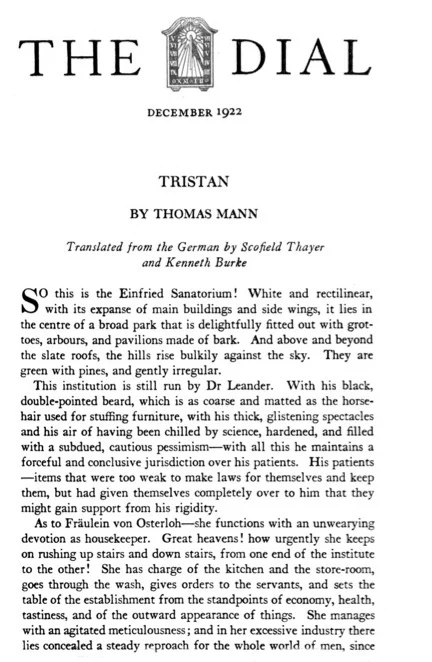
The magazine saw the first American appearance (usually the first ever appearance) of works that have become touchstones of 20th Century literature—Ezra Pound’s The Cantos and Hugh Selwyn Mauberley; Eliot’s The Waste Land and The Hollow Men; W.B. Yeats’s The Second Coming; E.E. Cummings’s Buffalo Bill; D.H Lawrence’s The Prussian Officer; Thomas Mann’s Death in Venice. Thayer’s and Watson’s writers -- as well as the editors they hired, including Gilbert Seldes, Alyse Gregory, Kenneth Burke and Marianne Moore--were truly prescient.
Most of the art reproduced came from Thayer’s own collection, which he built up in a frantic three-year period when he was in France, Germany and Austria, mostly in Vienna, where he was a patient of Sigmund Freud for two years. This stunning collection is at the Metropolitan Museum of Art. An exhibit of highlights from it, Obsession: Nudes by Schiele, Picasso and Klimt from the Scofield Thayer Collection, will open in the fall of 2018 at the Metropolitan Museum.
Scholars have come to understand the crucial role played by magazines in creating and distributing what has become known as “Modernism,” which was not so much a manifesto as an axis of complex responses to the perceived thrust of modernity.
Of those magazines, The Dial was the most influential. Certainly, there were more radical publications, such as Blast and The Little Review, but these journals were hampered by shortages of funds or of continuity. Blast, for instance, put out by Pound and Wyndham Lewis, had just two issues. The Dial had the luxury of being able to lose money. This, together with the almost religious devotion that Thayer had to visual art and literature, ensured its longevity.
Thayer wrote, “If a magazine isn't to be simply a waste of good white paper it ought to print, with some regularity, either such work as would otherwise have to wait years for publication, or such as would not be acceptable elsewhere.”
But the lifespan of little magazines, as these journals came to be known, depended upon their being able to steer clear of such organizations as the New York Society for the Suppression of Vice, which had the power to charge publishers with obscenity. In 1921, for instance, The Little Review was found guilty of obscenity in publishing the “Nautical” section from Ulysses, which has a masturbation scene, which resulted in the novel being essentially banned in the U.S. It was then also a crime to use the mails to distribute obscenity, and the loss of the ability to distribute to subscribers was a de facto death sentence for any magazine. In any event, The Dial, under the steady hands of Thayer and Watson, lasted through the decade—from January 1920 to June, 1929. The sheer longevity of the journal gave it an unequaled influence.
Thayer suffered from schizophrenia. Shortly after the middle of the decade, when he was just 37, Thayer suffered a breakdown that took him out of public life. He spent time in various hospitals and institutions and was eventually declared “an insane person.” As time went by, Thayer and his achievement faded into history. He died in 1982 at 92, having outlived most of his friends and contemporaries, all but forgotten.
The Dial didn’t last long without Thayer, and the last issue was brought out in June 1929, at the end of the decade it had come to define. The magazine’s mission had been to bring the best of contemporary arts and letters, including the avant-garde and the experimental, into the mainstream, and it succeeded to such a degree that it more or less put itself out of business. By the time that it closed its doors at 152 West 13th St., in Greenwich Village, the work it had championed--much of which had been earlier ridiculed--had created a new normal. Its poets were showing up in anthologies and its visual artists work was now to be found in galleries and museums. That same year saw the founding of the Museum of Modern Art.
James Dempsey is the author of The Tortured Life of Scofield Thayer (2014) and is currently at work on the exhibition catalog for the Metropolitan Museum of Art’s fall 2018 show on Thayer’s collection, in New York. He is also Consulting Producer on the film Make It New: Scofield Thayer, The Dial, and Modernism. While researching Thayer, he unearthed a previously unpublished poem of one of Thayer’s friends, E.E. Cummings. Dempsey has written several books (fiction and nonfiction) and numerous articles for both academic and general audiences. An award-winning journalist (Associated Press and United Press International), he is an instructor in the Humanities and Arts Department at Worcester Polytechnic Institute, where he teaches writing and literature. Dempsey is at work on a book about the late Stanley J. Kunitz, United States Poet Laureate and Pulitzer Prize winner.
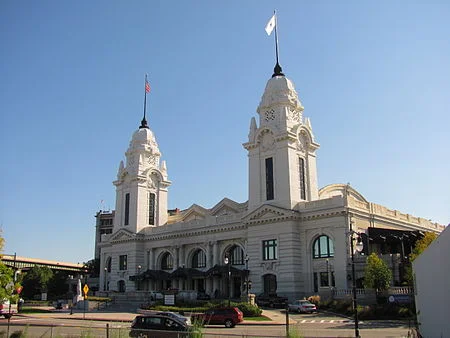
Look for a better owner of Worcester's Union Station
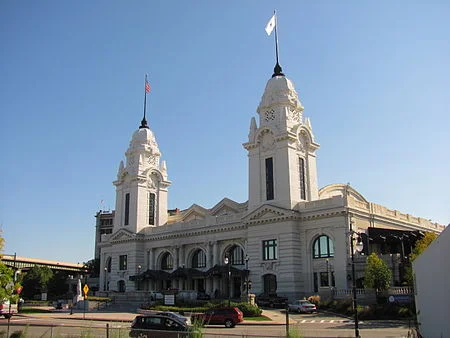
Worcester’s glorious Union Station should become increasingly important as more and more people seek to use mass transit. But it might be much better run if owned either by a private entity or by some new public-private entity, such as Amtrak, and not by its current owner, the Worcester Redevelopment Authority. At least the grossly underfunded Amtrak, which has never been more patronized than now, knows the transportation business. And the Northeast Corridor is Amtrak's big money maker.
Certainly the size and location of Worcester and the station’s size and beauty could make it into the nexus of interior southern New England. Consider such splendid company-owned venues for the public as Madison Square Garden.
Out of season

To see snowdrops blooming in January, as they have been doing near our house on a south-facing slope for the past couple of weeks is both heartening and vaguely unsettling.
Yet again, Beth Israel, Lahey trying to merge
From the Cambridge Management Group (cmg625.com) Web site.
For the fourth time, Beth Israel Deaconess Medical Center and Lahey Health say that they plan to merge.
The partnership would create a new parent corporation running the combined systems, of which Boston-based Beth Israel Deaconess Medical Center and Burlington, Mass.-based Lahey Hospital & Medical Center are the flagships. Under current plans, Kevin Tabb, M.D., the current CEO of Beth Israel Deaconess Medical Center, would head the combined system.
Boston Business Journal reported:
“The hospitals are also still discussing how this move would impact New England Baptist {Hospital} and — both of which are part of Beth Israel Deaconess Center’s larger entity CareGroup. New England Baptist announced in 2014 that it would join a clinical partnership with BIDMC, and officials said they would be having discussions with both hospitals to see how they would fit in to a new entity.
“Each hospital would also maintain its existing medical school association — Lahey with Tufts Medical School and BIDMC with Harvard Medical School.
“The deal would combine Beth Israel’s presence in Boston and the South Shore with locations in Burlington, Gloucester, Beverly and Winchester. A merger would also combine behavioral health expertise at Lahey with research and educational expertise from the BIDMC.”
To read more, please hit this link.
2 N.E. healthcare leaders warn of effects of ACA repeal

Adapted from an entry on the Cambridge Management Group (cmg625.com) Web site:
The Republicans’ promise to repeal the Affordable Care Act not only threatens to deprive millions of people of their health insurance; it could drive many hospitals deep into debt and destroy innovative programs created by the ACA aimed at improving patient care, two New England healthcare leaders say.
Timothy Ferris, M.D., an internist and medical director of the Mass General Physicians Organization, told FierceHealthcare that he worries that the “progress we’ve made over the past five years would be threatened.”
He said that includes programs through the Accountable Care Organization (ACO) at Massachusetts General Hospital, including experiments with video consultations and home hospitalization.
Dennis Keefe, head of Care New England, in Rhode Island, told NPR that he is concerned about the future for Integra, an ACO that includes primary- care physicians, specialists, urgent-care and after-hour providers, clinics, laboratories and inpatient facilities.
Hospitals and healthcare systems that have spent the last six years trying to create new value-based, patient-centered models as part of the ACA. And so 120 organizations sent a letter to President Trump and Vice President Pence urging them to not roll back progress they have made.
To read more, please hit this link.
'Try getting a plumber on Sunday'
Excerpted from Robert Whitcomb's Digital Diary column in GoLocal25.com.
Rhode Island Gov. Gina Raimondo, supported by some other state leaders, wants to let all Rhode Island students regardless of income attend any of the state’s three public colleges tuition-free for two years. This is a well-meaning initiative but I doubt that it would have much effect on the state’s economy and/or lead to particularly better lives for the graduates.
The cost of the program would be $30 million when it’s fully implemented. The money might be better spent on boosting low-cost or free (to the students, though not the taxpayers) vocational education for such skilled and necessary trades as nurses, electricians, utility linemen, pipe-fitters, sheet-metal workers, stone masons, welders, plumbers and certain factory jobs, which increasingly involve robotics.
These provide much more job security and higher incomes than most college graduates can expect to get, especially as automation and offshoring keeps gutting many previously well-paying job sectors, including such white-collar professions as law and accounting.
Starting about 30 years ago, politicians started saying that pretty mucheveryone should go to college, despite the fact that for many, perhaps most young people, a college education can be worthless in terms of what they can do for a living after getting their degrees.
(I went to college myself, but as a future editor and writer on current affairs had, in a sense, a vocational education myself by majoring in history and taking courses in such topics as Latin, which helped me better understand English. But very, very few people can look forward to careers in paid journalism, whose business model has been blown to smithereens by the Internet.)
There wouldn’t be family means testing for the tuition-free plan, though that would seem fairer. I guess the idea is that by making the program available to all, it would get maximum political support. It recalls how Social Security, since it was created in the 1930s, has been available to all – from pauper to billionaire – as one way to ensure that it wouldn’t be revoked. Good politics.
Anyway, remember Woody Allen's line "Not only is God dead but try getting a plumber on Sunday.''
Yankee humor and marketing
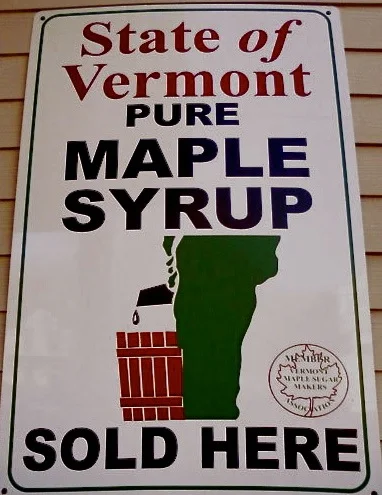
By the way, in the past couple of weeks, the maple-tree sap has often been running in northern New England as if it's been March.

Architecture as 'symbol of cultural values and history'

From the show "Scenes From Late Capitalism,'' by Nathan Heuer, at the Brookline (Mass.) Art Center, Feb. 3-March 10.
The gallery writes:
"Heuer's work is largely concerned with the role of architecture in society as a symbol of cultural values and history, using watercolor and graphite to create both small- and large-scale works. ''
Chris Powell: Responsible parents needed much more than social workers
MANCHESTER, Conn.
Connecticut Voices for Children, which clamors for state government to spend a lot more money remediating the consequences of child neglect and abuse without ever contemplating their causes, has proposed raising state taxes by $3 billion per year.
"A cuts-only approach," the organization said the other week, "may offer a short-term solution to the budget deficit, but it does so at a significant cost to the long-term economic and social structure of the state."
What about the cost to the state's long-term economic and social structure resulting from the removal of another $3 billion from the private economy, a tax increase of about 18 percent? Connecticut Voices for Children has no more concern about that cost than it has about state government's subsidizing childbearing outside marriage.
How much money could state government save if, instead of social workers, children had parents prepared to support them? Why don't children have such parents? Connecticut Voices for Children would be far more valuable to Connecticut and children alike if it looked into those questions rather than muse about throwing a lot more money at remediation, therebyv accepting neglect and abuse.
Also missing the point is Jamie Whitman of Stonington, who, writing in The Day of New London, angrily reports that the state Department of DevelopmentalServices is planning to cut in half the services provided to his mentally disabled cousin. Whitman predicts that his cousin will end up in hospital emergency rooms more often and cost more anyway.
Whitman writes: "The message the state is sending is that people who are developmentally disabled are expendable." Yes, but state government's message here is actually an old one, a message thatWhitman and others advocating for the innocent needy are only beginning to notice.
State government has been sending this message for decades with collective bargaining for state and municipal government employees, binding arbitration of their union contracts, and defined benefits for their pensions, laws that have turned the ever-rising expenses of government employees into "fixed costs," costs beyond control by the ordinary democratic process.
By contrast, as a matter of law the costs of care for the innocent needy are merely discretionary. There are no binding arbitration and contracts for them. For as a matter of law everything in state government is subordinate to the compensation of government's own employees. Down to its last dollar, as a matter of law state government will throw the helpless into the street to keep its employees happy.
Such priorities are disgraceful. But the advocates of the innocent needy do not yet seem to realize that "to govern is to choose." If advocates of the innocent needy want a different outcome, they will have to persuade elected officials to confront the special interest that consumes the bulk of government spending. But those who consider complaining about these arrangements must beware.
Forstarters, the president of the state AFL-CIO, Lori Pelletier, whose organizationis dominated by the government employee unions, will accuse anyone who puts theinnocent needy first of having "hatred" for government employees.
Assert that the innocent needy should take precedence and Pelletier's followers will accuse you of "conservative ideology" and of betraying the journalistic ideal of comforting the afflicted and afflicting the comfortable -- as if government employees in Connecticut are generally the afflicted and not the comfortable.
Of course, being employed by government is no crime, but neither does it make anyone a liberal or particularly virtuous. No, being employed by government makes one only an expense to be considered impartially against government's other expenses. Doing so can seem revolutionary only in a state dominated by special interests.
Chris Powell is managing editor of the Journal Inquirer, in Manchester, Conn.

Agri-tourism divides bucolic town

The Eliasons' house across from Sakonnet Vineyard.
By FRANK CARINI, for ecoRI News
LITTLE COMPTON, R.I.
Neighbors across Watson Reservoir from Sakonnet Vineyard, in this bucolic town in southeastern Rhode Island were long used to an occasional solo performer or a small acoustic band playing the works of Simon and Garfunkel, if they even noticed the music at all. But wedding DJs playing Nicki Minaj late into the night is hard to miss.
“It used to be a guy playing a keyboard on the grass,” Burchard Avenue resident Natalie Eliason said. “Now there’s a concert stage and music blaring until 10 and 11 at night. You can’t put a fence around noise and light.”
The Alex and Ani Summer Concert Series began in 2015 with 13 Thursday night shows. The vineyard refers to the area where bands perform as a pergola. Neighbors, like Eliason, call it a stage. Since the vineyard was bought by Dionysus Acquisition LLC and Equity of Sakonnet Vineyard LLC in 2012, concerned residents claim that both the frequency and noise levels of events such as concerts and weddings have increased considerably.
Eliason said the vineyard “went crazy” with events in summer 2015. Neighbors claim that summer the West Main Road operation hosted 29 weddings and 28 concerts, including the Thursday night series. In 2016, the number of concerts remained the same, but neighbors said the number of weddings dropped to nine.
After buying the property in late 2012, Carolyn Rafaelian, the founder and chief executive officer of Alex and Ani, changed the name to Carolyn's Sakonnet Vineyard. She also began advertising a vineyard concert series, including on an Interstate 195 billboard.
The October 2016 edition of Rhode Island Monthly noted that Rafaelian “ushered the winery’s transformation into more of an entertainment venue, where its seasonal concerts and Sunday jazz series are as big of a draw as the varietals.”
The vineyard’s added entertainment and the noise and traffic it has caused forced Eliason and her husband, Brian, to hire a lawyer, Christopher D’Ovidio.
“There are days I can’t work in my garden because the music is so loud,” said Brian Eliason, who has lived at his Burchard Avenue home for nearly two decades. “I’d get a headache. Under previous owners you wouldn’t even know there was music. It wasn’t the commercial enterprise it is now. It became the Cape Cod Melody Tent overnight.”
Founded in 1975, the vineyard sits on 162 acres, 30 of which are used to grow the grapes used in the operation’s winemaking.
ecoRI News spoke with the Eliasons and three other concerned residents in early January at the home of Daune Peckham and husband George Purmont on West Main Road, a few miles down the street from Carolyn's Sakonnet Vineyard.
This group of residents and others in town are concerned that past and proposed entertainment activities at the vineyard violate the property’s deed to development rights regarding the protection and preservation of agricultural lands.
In 2008, the U.S. Department of Agriculture, the Rhode Island Agricultural Land Preservation Commission and the Little Compton Agricultural Conservancy Trust bought the development rights to 94 acres of vineyard land for $2.25 million.
Both vineyard neighbors and local residents are concerned that there is no pre-set limit to attendance, claiming that some concerts have drawn nearly 2,000 attendees — about half the year-round population of Little Compton. They mentioned the summer tour buses that enter and exit the property.
They’re also concerned about the current use of deeded land for parking, and the potential for that protected land to be paved over.
Longtime Haffenreffer Lane resident Larry Anderson said current vineyard operations are less about agricultural activities and more about commercial music events.
Anderson, who lives on the other side of town from Carolyn's Sakonnet Vineyard and isn’t impacted by the increased intensity of events being held there, is concerned about the precedent that could be set if the vineyard is allowed to host “non-agricultural uses that are arguably prohibited,” such as weddings and regularly scheduled concerts. He said if such activities become the vineyard norm, it would increase the likelihood that other agricultural properties in rural Little Compton could be developed in a similar fashion.
He said scheduled summer concerts on Thursdays and Sundays and seasonal weddings are vastly different than selling local produce and honey from a small stand, or even hosting an annual festival, such as the popular Little Compton Gratitude Festival.
“The vineyard explicitly promotes the Alex and Ani brand,” said Anderson, a past president of the Sakonnet Preservation Association. “They’re transforming a working vineyard into an entertainment center, concert and wedding venue that sells Alex and Ani merchandise. Wine has become secondary.”
According to Little Compton zoning ordinances, “Agricultural uses including the growing, processing, value added production, displays, education, promotion and sales of agricultural products including, but not limited to wineries.”
Agri-tourism on the rise
The issue of accessory uses on farms and agricultural lands is being hotly debated in many Rhode Island communities, and at the Statehouse. In fact, accessory farm uses is a growing trend nationwide.
Farming in Rhode Island, like just about anywhere else on the planet, is hard. It’s not an easy way to make a living, especially for small- and medium-sized operations competing against the handful of multinationals that control the global food supply.
A few bad seasons or prolonged drought can shutter a local farm. To help diversify an operation’s revenue stream, a farmer, as one example, could open a small roadside fruit and vegetable stand. During the next few seasons, the farm stand’s popularity grows, a small, permanent structure is built, and a light lunch menu is incorporated.
Over time, both traffic and noise generated by this accessory use increase. Parking is added and signs posted. Neighbors complain. Public hearings are held, and legal action taken. The farmer eventually decides to sell the land to a developer.
Since the 1940s, Rhode Island has lost more than 80 percent of its farmland to development, according to the state Department of Environmental Management.
In 2014, the General Assembly amended Rhode Island’s Right to Farm Act to include mixed uses of farms and farmlands, including such events as tours, petting zoos, hayrides and other “special events.” There is no mention of weddings.
Agricultural tourism is a commercial enterprise at a working farm, typically designed to generate supplemental income. Agritourism can include a farm stand, U-pick operations, a farmers market, farm stays, tours and classes, corn mazes and pumpkin patches, festivals, Christmas tree sales, weddings, farm-to-table dinners and barn dances, depending on state laws and local ordinances.
Rhode Island municipalities generally address proposed accessory farm uses on a case-by-case basis, because of the high number of variables, from concerns about public-safety and environmental impacts to the type of add-on use being proposed.
These complexities, uncertainty in the approval process, lack of enforcement, and outdated, cumbersome and vague ordinances are conspiring to divide communities and create red tape.
In the past few years the Rhode Island General Assembly has held committee hearings regarding the issue of enhanced farm operations, including a House panel that discussed whether to add weddings to the group of acceptable activities that can happen on designated farmland under the Right to Farm Act. The bill didn’t pass.
Another bill that failed to get approval sought to eliminate a municipality’s right to place restrictions on such events as weddings and concerts. Local ordinances and bylaws supersede the Right to Farm Act.
This past summer, a Washington County (R.I.) Superior Court judge ruled against a property owner who was holding weddings in violation of Exeter ordinances, as the town had argued.
The Portsmouth Town Council recently amended zoning ordinances to allow wedding receptions and other non-agricultural uses on farms, such as festivals and concerts, with a special-use permit granted by the zoning board. The change came after Greenvale Vineyards had filed a lawsuit to continue holding wedding receptions on its 73-acre farm overlooking the Sakonnet River.
Little Compton resident Carol Lynn Trocki, a Rhode Island Land Trust Council board member and a self-employed conservation biologist, told ecoRI News late last year that mixing agriculture uses with non-agricultural events on farmland can end up pitting corporate interests against community interests.
“There are plenty of weak zoning ordinances on the books,” she said. “Little Compton is scrambling to improve its ordinances so it can better control what’s happening in town. We’re too reactionary. Instead of always being on the defensive and feeling threatened by development, we need to determine what we want and be proactive in defining it.”
Trocki said Rhode Island’s cities and towns need to decide what they want their communities to look like now and 50-100 years into the future. She noted that the state’s more rural communities need to enact well-crafted ordinances if they want to protect their agricultural look and fell.
“Sakonnet Vineyard scaled up its events, built a bandstand and then lawyered up,” said Trocki, noting the difficulty volunteer town boards and commissions face when they go up against a “room full of 400-dollar-an-hour lawyers.”
Hired guns
In its fight against the Eliasons and their supporters, Carolyn's Sakonnet Vineyard is being represented by Adler Pollock & Sheehan, the same firm that is representing the Chicago-based corporation attempting to build a fossil-fuel power plant in Burrillville, R.I.
Purmont, a concerned West Main Road neighbor of the vineyard’s expanding operations, said few from Carolyn's Sakonnet Vineyard speak at local meetings or to agitated neighbors, just hired guns.
“Corporate pressure is their only form of communication,” he said.
The Eliasons said the vineyard’s attorneys show up at meetings with their own stenographer. “It’s been a show of force since day one,” Brian said. “It’s a money-making machine that could ruin the look and feel of this town."
He noted that this isn’t an anti-agriculture argument, saying "we’re against the bastardization of agriculture."
The Eliasons’ attorney, D’Ovidio, says the town concluded and the vineyard conceded in 1992 that concerts and weddings weren’t permitted. A Nov. 13, 2016 letter from Little Compton's zoning official, George Medeiros, to the Town Council president regarding vineyard activities verified that claim, stating “weddings and concerts are not accessories to uses to, and required for, the operation of the principal use and therefore are not allowed.”
The vineyard’s owners disagree. The matter is likely headed to court.
The Eliasons, however, aren’t fighting Carolyn Rafaelian alone. About 100 Little Compton residents, both year-round and part-timers from out of state, have joined the resistance, donating time and/or money to the cause. The group has so far spent about $60,000, according to Brian Eliason.
Opponents of the event intensification at the vineyard said they want their local farms and farmers to be successful. Noise generated by farm machinery is not their concern.
“We’re not trying to shut down farming. Farming is what we want,” said Anderson, who has a conservation easement on 15 acres (held by The Nature Conservancy) of his 20-acre Haffenreffer Lane property. “This isn’t about a bunch of cranky neighbors. Public interests are at stake. There’s a big difference between a 160-acre vineyard holding weddings and concerts and a farm selling heirloom tomatoes at the end of a driveway. We all could be hosting weddings and concerts.”
Frank Carini is editor of ecoRI News.
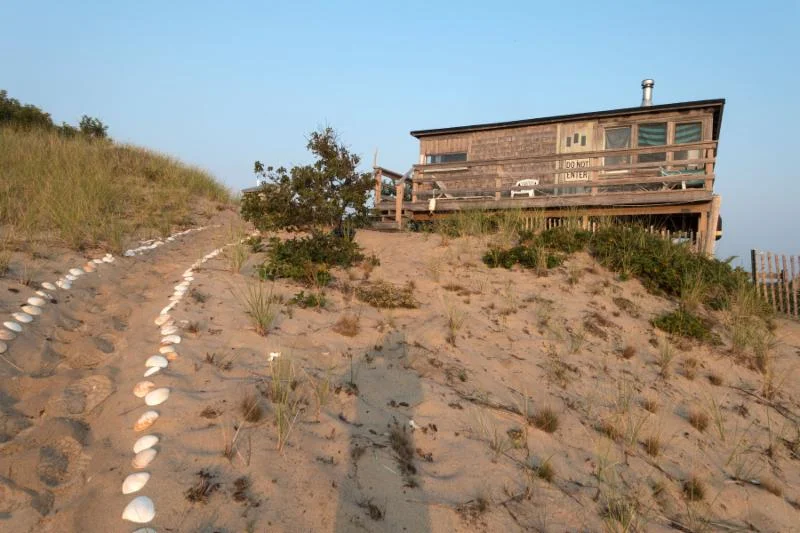
Rent it before it washes away
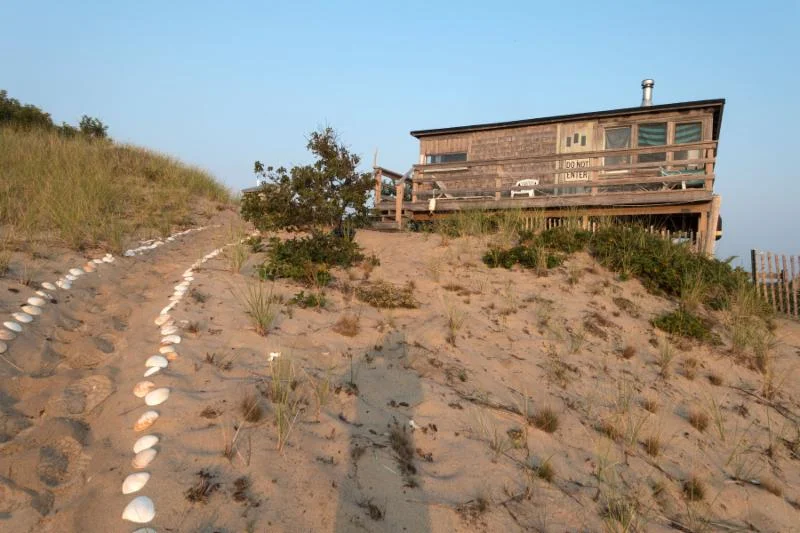
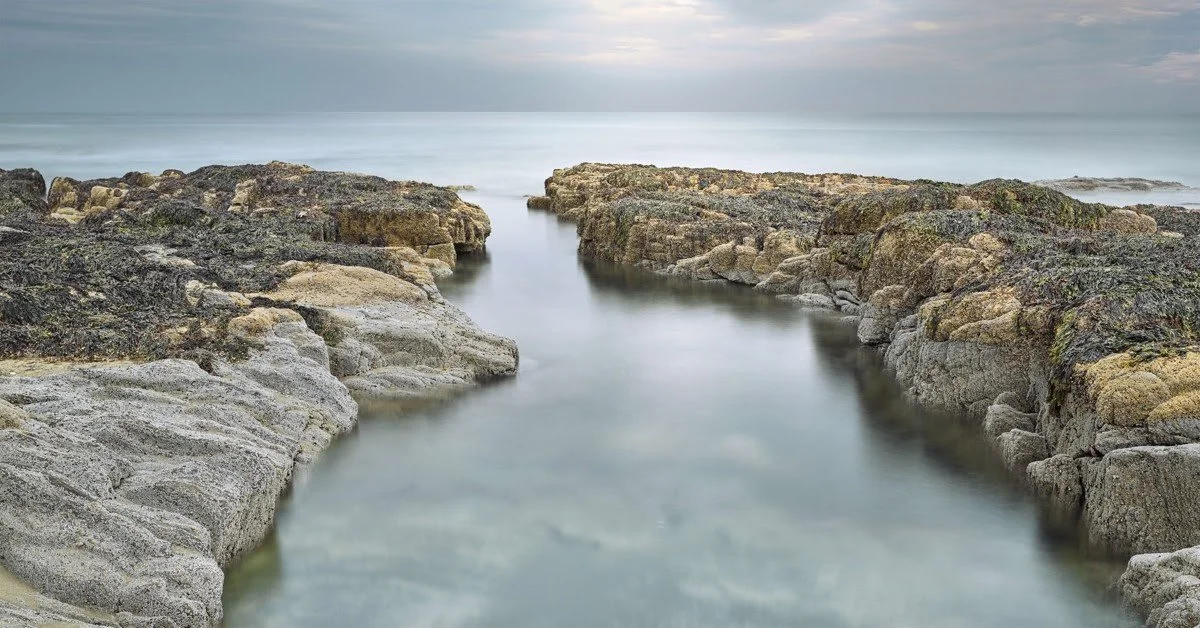
"Wells Dune Shack (Provincetown)'' (archival digital photo), by Jane Paradise, in her show "Dune Shacks of Provincetown,'' at Galatea Fine Art, Boston, March 1-March 29. Do you prefer sandy coasts or rocky ones?

The incoherent crowd

"Quick Takes'' (photo montage, oil and resin on panel), by Sherry Karver, in her show at Lanoue Fine Arts, Boston, through Feb. 25.