
Vox clamantis in deserto



Llewellyn King: Showmanship is not statesmanship
It is a generally good thing for politicians to honor their campaign promises. In that, President Donald Trump is acting in an exemplary way.
But does he have to do it so fast?
In a campaign ideas and ideology dominate, details languish. But once office is won, especially the highest office in the land, there is time to contemplate not just the journey but the best route.
There is a vast amount of know-how and knowledge to be tapped that might, on consideration, temper the ideas of the campaign.
For example, the president, before commanding the hiring of 5,000 more U.S. Customs and Border Protection agents, might have learned how difficult it is to recruit and train these men and women. He might have taken note that there are 1,200 vacancies along the border right now, despite strenuous recruiting efforts.
His early action in pulling the United States out of the Trans-Pacific Partnership (TPP) — a trade deal that was negotiated between 12 Asia-Pacific nations who represent more than 40 percent of the global economy — was done in haste, which might set world history off in a direction that the nation and the world will rue.
One of Trump’s campaign promises, if not the theme of his campaign, was that the United States would be led by the world’s best negotiator, its top dealmaker. Why would he tear up a deal before he had taken time to improve it? There is no art in trashing a deal.
Why would he willingly relinquish a leadership role in global trade to China, which he has called out time and again?
On the face of it, Trump will now have to direct the U.S. Trade Representative to negotiate separate deals with the TPP signatories, possibly taking years. China has proposed the Free Trade Area of the Asia Pacific and the Regional Comprehensive Economic Partnership, stepping right in where the United States has stepped out. Does Trump want to be known as the president who lost Asia? History is cruel; its mistakes devastating.
Would Trump prefer 28 bilateral trade deals with Europe when he could have 27 plus one, Britain? Europe is our largest trading partner, a relationship worthy of tender loving care, but Trump has encouraged its breakup.
Trump loves to make a grand entrance. He showed that with his stately ride in the company of his wife, Melania, down an escalator in Trump Tower on Fifth Avenue in New York City before announcing his candidacy on June 16, 2015. It was dramatic: the quintessential Trump, showman and grandstander.
His entrance into Washington has been louder and splashier — almost as though it is a finale, not an opening. The city is reeling, the world is agog and the Republicans — to say nothing of the president’s Cabinet nominees — are in the dark about his policies; where his head is at?
The president may not have had as many people at his inauguration as he had wished, but his actions have turned him into a show of shows. Even as the Ringling Bros. and Barnum & Bailey Circus goes out of business, Donald Trump is its temporary replacement: The Greatest Show on Earth. But this big top stands for four years, and no performance lasts that long.
Entrances and showmanship are not statesmanship. Trump needs to begin to show that he can stay the course beyond a grand entrance; he needs to be seen to negotiate for the United States, not just to be the great treaty abrogator.
Trump made more than 650 promises on the campaign trail. Some he can keep, particularly when they have no more depth than reversing his predecessor’s executive actions.
Having failed to prove the theory that former President Obama was born in Kenya, he seems determined to expunge as much of Obama’s legacy as he can get his hands on.
The big promises, like creating 25 million jobs, boosting the growth rate to between 4 percent and 5 percent and balancing the budget, may require the great dealmaker to do some deals with the country’s expectations.
Grand entrances can lead to ignoble exits.
Llewellyn King is executive producer and host of White House Chronicle, on PBS.

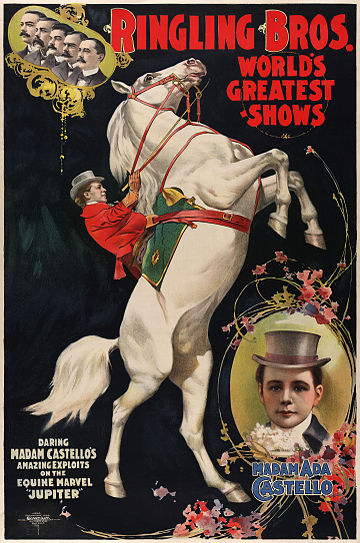
Ringling Bros. at the old Boston Garden
Excepted from Robert Whitcomb's "Digital Diary'' in GoLocal24.com
I felt a pang the other day when reading that Ringling Bros. and Barnum & Bailey Circus would close after its current season ends after 146 years.
The writing has probably been on the wall for some time. Increasingly, people, and especially kids, have sought entertainment on screens and not, well, in real-life performances. And coercing animals into cleverly designed but silly acts has become increasingly unpopular among many groups.
The most popular animals at the circus have usually been the elephants. Ringling Brothers stopped using them last year, which accelerated the decline in attendance that has been underway for years.
Feld Entertainment, which owns the circus, retired its elephants to its elephant conservation center in Florida last year. As for its still-working animals – lions, tigers, kangeroos, llamas, alpaca, donkeys and camels -- the company says they will go to good homes. I’m sure that the Humane Society will monitor these transfers.
My parents took all five of their children at various times to Ringling’s “The Greatest Show on Earth’’ several years in a row at gritty old Boston Garden. My strongest memories of these events is the smell of the manure, the ominous, near-hysterical music (like the track from a Fellini movie) and the chameleons, sold in Chinese restaurant takeout boxes. They were often dead by the time we got home.
It may a good thing that Ringling Bros. is closing. But, as with zoos, the undignified and for a long time brutal (those whips!) display of circus animals also raised the public’s affection for such charismatic animals and thus has helped boost campaigns to save them. The biggest threats to wild animals are the destruction of countryside because of human overpopulation, global warming and the hideous trade in ivory and other animal parts, centered in China. Indeed, the Chinese may still succeed in exterminating the African elephant.
Late last year, China’s Communist dictatorship announced that it would ban all ivory trade and processing by the end of this year. Very, very late in the game. Meanwhile, the trade in other the parts of other endangered animals, such as tigers, continues virtually unabated in that country. Much of it is based on ridiculous but long-held ideas that parts of some animals have aphrodisiac qualities for humans.
Maybe they'll leave the light on for you

"Rooms for Rent'' (mixed media on wall-mounted construction), by Joe Landry, in his show "You Are Here, '' at the Bromfield Gallery, Boston, Feb. 1-26.
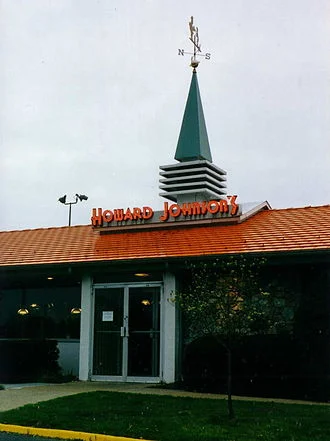
Robert Whitcomb: New England-born HoJo's and the rise of roadside family restaurant chains
Flavors of Mid-Century
A History of Howard Johnson’s
How a Massachusetts Soda Fountain Became an American Icon
By Anthony Mitchell Sammarco
(American Palate, 157 pp., $19.99)
The rise and fall of the Howard Johnson Company says a lot about American society and business from the 1920s on.
It was quite a ride, some of which I was familiar with before reading Mr. Sammarco’s chaotic and seemingly unedited history of the famous chain of restaurants and, later, motels, too. Howard Deering Johnson started his company in Wollaston, a section of Quincy, Mass., close to my hometown, Cohasset. And the Howard Johnson Company bought a rival ice-cream parlor chain, Dutchland Farms (with windmills – high kitsch!), owned by friends of my father, in the late ‘30s. As the shoe companies in the area folded, the locals felt proud about having another local enterprise grow into a national powerhouse.
Mr. Sammarco’s book is rife with repetitions, confusion (there’s lots of quoted stuff but you often don’t know who’s being quoted) andalmost nonstop breathless copy about the company’s “delicious foods and ice cream’’ (ice cream perhaps not considered a food?), including ‘’clams so fresh and delicious that they were called ‘Tendersweet’ clams.’’ Then there such mysteries as the chain’s “ceramic broiled steaks, chops, chicken and lobster.’’
There also many side trips with extraneous information that has little or, in some cases, nothing to do with the main history. And yet, the monomaniacal Mr. Johnson and the company he created are so interesting that you keep reading Mr. Sammarco’s boyishly enthusiastic ramblings. And the many old pictures are delightful, if randomly placed. And, praise be to God, there’s an index!
Mr. Sammarco got the main point right about the long success of “The Wonderful World of 28 Flavors’’ and its importance in American business history: “Standardization of quality, preparation and portion control ensured uniformity throughout the orange-roof restaurant chain.’’ People like Ray Kroc, of McDonald’s, said they learned a lot from Howard Johnson.
Even as the company went national, the emphasis on ice cream (always a huge favorite in New England) and such regional specialties as fried clams and Yankee pot roast, and, at many HoJo restaurants, pseudo-Colonial Revival architecture, reminded many around America of the company’s regional roots. Fried clams, that very New England heart-attack enabler, may have been the chain’s most famous food after ice cream.
I remember well the heyday of HoJo’s, in the ‘50s and ‘60s, when the restaurants, with their famous “28 Flavors’’ signs were all over America. Almost all of them were expertly situated and promoted, on or near major roads and with strong signage. It wasn’t an exciting place to go (except for small children drawn to the ice cream), but it was comfortingly predictable for travelers, weary or otherwise.
Mr. Johnson came to understand early on that the automobile would profoundly change Americans’ dining and lodging habits.
He started out by buying a Wollaston drugstore in 1925 and, recognizing the profit potential from New Englanders’ love of ice cream, experimented with many new flavors, all using more butterfat than most ice cream makers did. They were hits with patrons of the store’s soda fountain. The desire to pay off the debts from his late father’s cigar business helped drive his work ethic.
He responded to the popularity of his “28 Flavors’’ of ice cream by expanding his operation to summer ice cream stands along streets at the region’s urban beaches as the number of people with cars to get there was rapidly increasing.
Then, in 1929, he opened his first real full-service restaurant, in downtown Quincy. Eugene O’Neill gave him a boost: The censors in Boston (remember ‘’banned in Boston’’?) prohibited his play Strange Interlude from being shown in the city. So it was moved to the Quincy Theater, right across the street from Mr. Johnson’s new establishment, which thrived from thebusiness from the playgoers, many of whom told their friends how good the food was (at least compared to the contemporary bland New England “cuisine’’ of the time).
The Depression hit Mr. Johnson’s new creation hard. But the workaholic came up with a scheme to expand anyway. In 1935, he arranged a franchise relationship with a friend/businessman at a busy (especially in the summer, of course) intersection in Orleans on Cape Cod.
Under this arrangement, the Howard Johnson Company would let a franchisee use the by now well-known Howard Johnson’s name, buy all (highly standardized) food and other supplies from a central HoJo’s commissary and adhere to Mr. Johnson’s “Bible’’ on how the final food preparation and table and counter services would be done.
Mr. Johnson insisted on uniformity: “When you get the same kind of {Howard Johnson’s} sundae in New York that you get in Florida, you are more likely to buy one in Maine,’’ he said.
While franchises were not unknown at the time, it was Howard Johnson who established it in the restaurant business, along with aspects of what would come to be called “fast food’’ – stuff to take out, as well as brisk counter service, albeit not nearly as fast as in today’s computerized fast-food establishments.
After tough times during World War II because of rationing, Mr. Johnson’s empire grew rapidly into hundreds of company-owned restaurants and franchises. And starting in the mid-‘50s, the company got into the “motor lodge’’ (AKA motel) business.
Perhaps no businessman understood the business opportunities associated with Americans’ love affair with (andmandatory reliance on) driving as well as did Howard Johnson. As the Interstate Highway System got going in the late ‘50s, the company’s growth accelerated. As Time magazine said in 1960:
“The travel-weary U.S. motorist has been conditioned to think of food—and a chance to let the kids out of the car—when he spots a roof of bright orange tile along the highway. This ‘landmark for hungry Americans’ is the trademark of Howard Deering Johnson, a onetime cigar salesman who has become a part of Americana (teenagers call his places "HoJos") by catering to the common denominator of U.S. taste and haste.’’
Mr. Sammarco writes that the chain “served a traveling public with fine food.’’ I’d call it “reliable’’ food.
When the company went public, in 1961, Mr. Sammarco writes, “it consisted of 605 Howard Johnson’s restaurants (265 operated by the company and 340 by licensees {franchisees}, 10 Red Coach Grill {more upscale} company-owned restaurants and 88 Howard Johnson’s Motor Lodges, all of them franchisees.’’
By 1975, the empire included more than 1,000 owned and franchised restaurants, over 500 motor lodges, vending and turnpike operations and a massive manufacturing and distribution system.
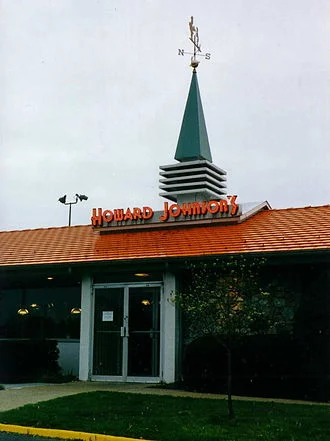
The orange roofs and blue shutters of the chain, along with the predictable and safe food, seemed to have become a permanent fixture of the American road.
The ‘50s and ‘60s were the heyday of the American nuclear family. The extended families of earlier generations – lots of uncles, aunts and cousins living close by – were in steep decline but illegitimacy was not yet in ascendency and intact families, with a married mother and father, and often a lot of kids, dominated domestic life in times that were becoming increasingly prosperous.
Thusthe “family restaurant’’ approach taken by Howard Johnson (who was married four times!) was in a fertile field. Take the kids to HoJo’s! No unpleasant surprises there.
But things started to get a bit strange in patches, too. The company, in the Mad Men period of the early ‘60s, hired two French chefs – Pierre Franey and Jacques Pepin – to help develop new meals, and, also wandering far from its roots, got Dior to design new uniforms for HoJo waitresses! Were these fire bells in the night that the company was losing focus?
By 1975, the empire included more than 1,000 owned and franchised restaurants, over 500 motor lodges, vending and turnpike operations and a massive manufacturing and distribution system, including frozen food.
Clouds were gathering. New competitors, most famously McDonald’s and Burger King, were pressing to dominate the downscale side of the restaurant business. And while more affluent folks still tended to want a somewhat leisurely sit-down meal, especially in the evening, many other people wanted more speed -- both takeout and in-house service --and lower prices. I suspect that’s in part because growing work pressures, shrinking inflation-adjusted average incomes and the influx of many women into the workforce meant that there was less time and less income for more traditional restaurant meals for many Americans. And the richer folks found HoJo’s boring: It was too standardized.
You also have to wonderwhether the expansion of the company into the motel business seriously weakened the company’s focusand undermined its brand identification amongst the public even as so many competing restaurant chains were entering the market.
Meanwhile, quality was slipping. Howard D. Johnson retired as president in 1959, with his son, taking over. Because of his fear of debt, the elder Mr. Johnson had tended to keep too tight a lid on certain expenses, especially the number of employees and their pay. So many of his establishments were understaffed, causing slow service, and things got worse under his son.
Even before his retirement as president, the elder Mr. Johnson started to spend less time making spot visits to his restaurants to check on the quality of the food and service, which gradually declined in his later years, even as he spent more time in places like Manhattan’s Stork Club. (That may have pleased his employees: Mr. Johnson was a large and fierce-looking man.)
His smooth and preppy son, Howard B. Johnson, was also obsessed with cutting costs, and spent too little time checking on quality and keeping up with demographic and other changes in American life that would help or hurt a restaurant chain. Rather than working out of Wollaston, the official headquarters, he operated from an office in Manhattan. He was not an operations guy like his father.
Mr. Sammarco usefully quotes Brian Miller, writing in the Journal of Hospitality & Tourism Education:
“The fall of the Howard Johnson’s brand {in the ‘70s} was faster than it took to build. When the reins of the company were passed down from father to son, the son appeared to quickly lose control over the direction of the company. Without the persona of his father inhis corner, the younger Johnson was leading a company that lacked a vision.’’ Well, that’s not quite right. The younger Mr. Johnson had quite a few successful years at the helm but he did lack a unified longterm vision.
That HoJo’s had become a public company also probably undermined its long-term prospects. The younger Johnson wanted to keep the stock price as high as possible but this meant avoiding needed but costly improvements and innovations. Given the choice between working for a closely held company (assuming that the owner/owners were halfway civilized) and apublicly held one, I’d choose the former any time: The former is more likely to take the long view and reinvest.
Thus the company’s profits and revenues started to slide in the ‘70s, and in 1979, Howard B. Johnson sold the company to Imperial Group Ltd., which in 1985 sold it to Marriott. Various financial permutations and combinations led to rapid shrinkage over the next couple of decades, and as of this writing there is only one Howard Johnson’s restaurant left, in Lake George, New York.
There may never again be a chain of “family restaurants’’ quite like HoJo’s in our much multicultural stew of a country, but that one was created, and provided decent service to all, and joy to some, especially children, is edifying and a soothing memory of mid-century Americana.
Robert Whitcomb is editor of newenglanddiary.com, a columnist for GoLocal24.com, former finance editor of the International Herald Tribune and former editorial-page editor of the International Herald Tribune
Stop the theft from stone walls
By TIM FAULKNER for ecoRI News
Via ecori.org
PROVIDENCE
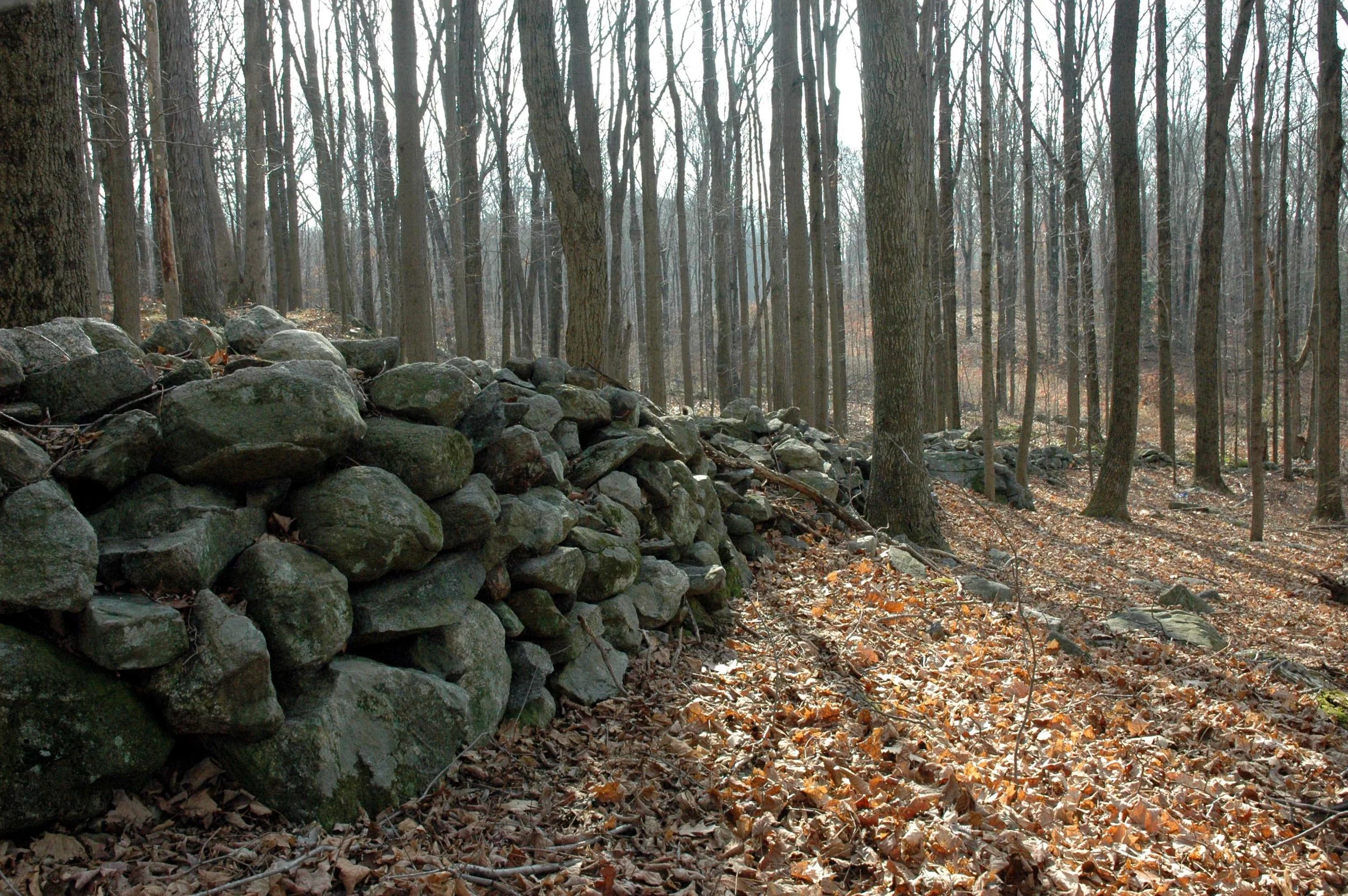
Preserved open space in Rhode Island needs additional protections, because poachers steal rocks from stone walls and nearby residents cut down trees to improve their views.
Currently, there is no deterrent or penalty for intentionally damaging or building on land protected from development. If caught, the thief or vandal simply has to pay a portion of the value of the damaged or stolen items, such as the timber value of a cut tree.
Rupert Friday, director of the Rhode Island Land Trust Council, testified at the Rhode Island General Assembly on Jan. 18 in favor of a bill that would make such offenses a civil violation.
“The current penalties are little more than a hand slap,” Friday said. “The current penalty if you steal a stone wall and you get caught and convicted is you have to put the stone wall back. It’s pretty lucrative if you don’t get caught.”
Meg Kerr, senior director of policy for the Audubon Society of Rhode Island, said such legislation would help protect 9,500 acres of open space and wildlife habitat that Audubon owns and manages. Kerr said it’s common for landowners living near protected coastal areas to cut down trees on protected land to improve their views of the water.
“This legislation will provide a greater deterrence and keep people from blatantly damaging our communities’ open space and our significant investment to protect these special place,” Kerr said in testimony before the House Judiciary Committee.
The bill was held for further study and will likely have another hearing on Jan. 24. It's the third year in a row that the bill has been introduced. Last year, the bill passed in the House but stalled in the Senate.
The bill is modeled after a bill passed in Connecticut in 2006 that was intended to address the same problems faced by land trusts, municipalities, the state, environmental groups, and other owners and managers of open space.
In the legislation, open space is defined as any park, forest, wildlife management area, refuge, preserve, sanctuary or green area owned by one of those entities. Damage, called encroachment, is defined as intentionally erecting structures, roads, driveways or trails. It includes destroying or moving walls, cutting trees and vegetation, removing boundary markers, installing lawns or utilities, and storing vehicles, materials and debris.
The civil fine for a violation could amount to five times the cost of the damage up to $5,000.
The bill is sponsored by Rep. Cale Keable (D.-Burrillville).

Of time, place and health

This just in from the Dedee Shattuck Gallery, in Westport, Mass., about the show “where lines meet,’’ which runs to Feb. 19. The gallery describes the show, in part:
“’where lines meet’ is a photographic installation to create a space for contemplation, conversation, and community. This project addresses artist Heather Hobler's ongoing investigation into well being.
‘“where lines meet’ is an installation of medium format film photographs of the same vista facing south over Buzzards Bay, the view from Heather's home. The project began innocently as snapshots meant to record time, but quickly built into a reflective rhythmic ritual of getting back to life and art after the artist’s battle with cancer. Beyond the beauty of each photograph, the collection intrigues and soothes with the dynamic and subtle power of both its consistency and comparison. It was in the collecting of the images that it became obvious to Heather this was a continuation and distillation of her art and her life.’’
An all-season resident

-- Photo by THOMAS HOOK
The White-Breasted Nuthatch, this one in that giant aviary known as Southbury, Conn., is another tough species that stays in New England year round. Very unfashionable: It winters where it summers.
Kevin Morrell: The ancient Greeks had 'post-truth politics' and a Trump-like demagogue
Following Donald Trump’s inauguration as U.S. president the world is anticipating a new, and potentially radically different, era for the U.S. The inauguration also prompts questions about this new style of politics. Trump’s surge to leading the most powerful nation in the world was fueled by a rhetoric we associate with a new term: ‘’post-truth’’. The Oxford Dictionary named ‘’post-truth’’ its word of the year in 2016, and defined it as “circumstances in which objective facts are less influential in shaping public opinion than appeals to emotion and personal belief”.
Brexit’s and Trump's success were new lows for many of us, particularly in higher education, precisely because facts came a distant second to populist appeals.
But, as a number of people have identified, post-truth didn’t begin with Trump.
A reference point for the two campaigns that 2016 will be remembered for has been the propagandism of the 1930s, and two wickedly cynical pieces of advice: Repeat lies often enough until they are accepted as true, or remember, if you are going to lie, tell a big lie.
But almost a century earlier, in the 1850s, there were far dirtier U.S. election campaigns when an anti-immigration party, The Know Nothings (aka the American Party), thrived on pretending to be ignorant of their own party’s activities.
Further back still, before U.S. independence, the satirist John Arbuthnot wrote: “Falsehood flies, and the truth comes limping after it, so that when Men come to be undeceived, it is too late… like a physician who has found out an infallible medicine after the patient is dead.” The title of his 1712 essay? “The Art of Political Lying’’.
And way, way before Arbuthnot, in 350 BC, Aristotle’s Constitution of Athens describes the demagogue Cleon in a way Trump critics might recognize: “The cause of the corruption of the democracy by his wild undertakings.”
A closer look at Cleon invites several parallels with how critics see Trump. Cleon inherited his wealth from his father in the form of a tannery - a leather factory: certainly the Athenian equivalent of blue-collar.
He rose to power in 430 B.C., during a desperate time for Athens: It was at war with Sparta and was devastated by plague. Plutarch describes him as someone who “catered to the pleasure of the Athenians” with a combination of “mad vanity”, “versatile buffoonery” and “disgusting boldness.”
Cleon had a distinctive and shocking communication style, one Athenians had never seen before. While speaking, he would hitch his cloak up and slap his thighs, running and yelling at the crowds.
Aristotle says that he was “the first to use unseemly shouting and coarse abuse”. Aside from this radically new communication style, Cleon’s populism was based on attacking two enemies.
First, though rich himself, he was an anti-establishment figure, pursuing a “relentless persecution of the upper classes”.
Second, he was a flag-waving xenophobe, antagonistic towards Athens's rival and (partly thanks to Cleon) bitter enemy Sparta, as well as to the city of Mytilene, who wanted independence from Athens.
The Athenian general and historian Thucydides even records a speech when Cleon expresses admiration for Mytilene’s “unassailable” walls.
Parallels don’t end there. A later Athenian writer, Lucian, suggested that Cleon profited from exploiting his office, as some warn Trump is set to do, and that he was “venal to excess” (as Trump detractors suggest).
He was boastful, once bragging that he could win a war against some Spartans by himself. He was thin-skinned and censorious, as well as a litigious bully.
Cleon tried, unsuccessfully, to have the satirist Aristophanes prosecuted for writing The Babylonians, which he considered a treasonous play -- in the process turning Aristophanes into a life-long enemy.
He accused Athenian generals of incompetence and, in establishment-bashing mode tried, unsuccessfully, to prosecute one of them, Laches.
Cleon was held responsible for the eventual exile of another, Thucydides, who, as well as being a general, is sometimes described as the founder of history.
Indeed Thucydides’s contribution was to found a tradition of historians as being concerned with facts and the truth.
Throughout this period Cleon was the biggest obstacle to normal relations with Sparta and within a year of his death a peace treaty was agreed.
History was certainly not kind to Cleon, and perhaps Trump will not be showered in praise either.
In Cleon’s case this was no surprise, perhaps, given that he exiled the most eminent Athenian historian and tried to silence the most eminent Athenian satirist.
Nowadays Cleon is most well-known through Aristophanes’s play, The Knights (far ruder than Saturday Night Live).
This has an unusually small cast because it is essentially a relentless assault on the character Paphlagon, who is obviously based on Cleon: “the leather-seller” with a “gaping arse”, “a perfect glutton for beans” who loudly “farts and snores”, an “arrant rogue” and “mud-stirrer” with a “pig’s education” and the “stink of leather” -- “this villain, this villain, this villain! I cannot say the word too often, for he is a villain a thousand times a day”.
Cleon may well have had a front-row seat for The Knights, where he would have seen Aristophanes playing Paphlagon/Cleon, presumably because no-one else dared to.
Characters in these plays were masked, but no prop-maker dared make a mask resembling Cleon.
We might imagine Cleon later reviewing The Knights as: “A totally one-sided, biased show -- overrated! The theatre must always be a safe and special place. Apologize!”
What matters is that Aristophanes’s contemporaries awarded The Knights first prize at the Lenaia festival (something like Athens’s Cannes Festival).
Cleon’s brand of post-truth politics flourished because when life is extremely hard, facts are not as novel or distracting as sensationalism.
Some Athenians were won over by the novel spectacle of yelling, coarse abuse and thigh-slapping - and distracted by diversionary ranting against Sparta.
Critics of Brexit and Trump might say that voters were won over by bus-sized gimmicks or tweet-sized slogans - where both camps painted "enemy" over an anonymous other.
2016 was a bad year, in which millions were desperate for change, but perhaps what we saw was an age-old spectacle. Populism and appeals to emotion always work on some people. When times are bad enough they work on enough people.
One consolation for Trump's opponents and Remainers (those who want the U.K. to stay in the European Union) is that the Athenians kept Cleon partly in check using existing governance mechanisms -- the courts.
They can also take comfort that contemporary culture remembers Cleon through the eyes of his bitter enemy Aristophanes. Cleon’s era was horrific yet it also became a golden age for satire and saw the birth of the discipline of history.
The worst fears for the Trump presidency are bleak, but civilization survived Cleon. Shortly after his death we saw another kind of Athenian golden age - with Socrates, Plato and Aristotle laying down the basis for Western philosophy and civilization.
They taught the importance of skepticism and scrutiny, and of virtue. They placed the ultimate premium on the search for knowledge and truth.
Aristotle gave us all the tools we need to see through a Cleon.
Kevin Morrell is a professor of strategy at Warwick Business School, in Britain. He researches rhetoric in politics.
Standing by a vile president is 'morally treasonable'
"To announce that there must be no criticism of the President, or that we are to stand by the President, right or wrong, is not only unpatriotic and servile, but is morally treasonable to the American public. Nothing but the truth should be spoken about him or any one else."
-- Theodore Roosevelt, in The Kansas City Star, May 7, 1918

Bring on the hardy kiwi

From Robert Whitcomb's "Digital Diary'' column in GoLocal24.com.
The Boston Globe ran a fascinating article on Jan. 9 (“The hardy kiwi: scourge or savior for farmers?’’) about afruit, called a “hardy kiwi,’’ related to the famous fuzzy kiwi you can find in supermarkets. The hardy kiwi has a smooth skin and is smaller than its fuzzy cousin. It’s also delicious and, reports The Globe, has “twice the vitamin C of an orange, twice the dietary fiber of an apple and as much potassium as a banana.’’
But of particular interest here is that is hardy enough to grow very well even in most of New England. It could become quite a cash crop.
The trouble is that some people, such as at the Audubon Society, see the plant, which is a fast-growing vine, as an invasive species that would strangle some woodlands as has kudzu, which has been moving north with global warming. So there’s a campaign underway to add hardy kiwi to the state’s prohibited plant list. Of course, you could say that all plant and animal species (especially people!) are originally invasive. Life spreads around, whether we like it or not
Trying to ban the plant would be a mistake. For one thing, there’s little evidence that that it would take over a lot of woodland. Foes point to hardy kiwi’s proliferation in a section of Lenox, Mass., but that’s because the plants there are basically remnants of those used ornamentally at the big Gilded Age estates in the Berkshires a century ago after they were brought in from Japan. There’s no indication that they’ve been spreading willy-nilly across New England inthe past century!
Finally, the hardy kiwi offers the opportunity for New England to have another – and very healthy – product, like cranberries and blueberries. Now, another invasive species – bittersweet – is quite another thing. It spreads very fast and doesn’t produce anything you can eat.
xxx
And New England’s hardy kiwi may not have to be so hardy in coming years. Climate scientists at the University of Massachusetts at Amherst’s Northeast Climate Science Center predict that New England’s temperatures will rise by an average of 3.6 degrees Fahrenheit above pre-industrial levels by 2025 – a faster rise than in most places. Scientists cite New England’s position in the prevailing westerly winds, the region’s latitude and dramatically warming temperatures in the Gulf of Maine as among the reasons.
This is another wake-up call to reduce carbon emissions and to prepare coastal regions for higher sea levels and thus disastrous flooding. One good step would be ending at least the current version of the National Flood Insurance Program (NFIP), which subsidizes irresponsible building, mostly by affluent people, on beaches (and some flood-prone inland places).
Lloyd’s, the giant London-based insurance market, has called on the federal government to stop providing these subsidies to homeowners and businesses to build in coastal areas exposed to risks related to climate change.
And Lloyd’s says that NFIP subsidy regime is financially unsustainable. The program is now in the red by more than $24 billion, largely because of such coastal flood disasters as Hurricane Katrina, in 2005, and Superstorm Sandy, in 2012. It will probably get worse.

Border greenery

"ENT-e, 2014'' (robotic installation, video and art intervention, by Gabriela Munguia, in the group show "Last Frontier,'' at the Cantor Art Gallery, at the College of the Holy Cross, Worcester, through April 14.
The show presents some work of contemporary Latin American artists from what the gallery calls "a diverse array of perspectives and geographies.'' The idea is to explore the border/frontier as a "dividing line'' between nations and ''the dissolution of borders through globalization, borders as an experience of 'us' vs. 'them' and the blurring lines between virtual and natural spaces.''
New England is lucky that its border with a foreign nation -- stable, prosperous Canada -- is so much less fraught that the United States's border with Mexico.
An excuse for inaction?
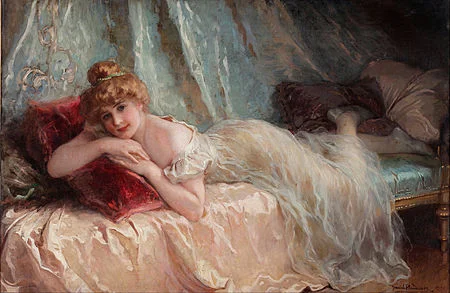
"Idle Woman, by Daniel Hernández Morillo
"Winter is a time of promise because there is so little to do, or because you can now and then permit yourself the luxury of thinking so."
-- Stanley Crawford
Don Pesci: GOP tide might even be rising over Connecticut
It’s always possible for politicians to learn from current events, mend their ways and move on. Owing to the failure of questionable progressive policies, national Democrats this election year kept the House and the Senate and won the presidency.
Republican gains have brought to a full stop a serious progressive movement that began when Barack Obama assumed office in 2009. Flush with success – Democrats that year captured both houses of Congress and the presidency – Mr. Obama ran a progressive plank above shark-infested waters and invited Democrats to take a stroll. They did. Eight years later, Democrats have 12 fewer governorships, 13 fewer Senate seats and 69 fewer seats in the House.
The losses cut deep and will be long remembered. During Mr. Obama’s two terms, according to MarketWatch Democrats lost more than 1,000 seats at the state and national level, leaving Republicans in control of 4,170 state legislative seats. The GOP holds 33 governorships and in 25 states controls both the governorship and two houses of the state legislature, whereas Democrats hold five. Clearly, the Democratic political trek from the heights to the depths is the most dramatic rejection of a nascent progressive movement in living memory.
In Connecticut as well, the progressive political arc now bends downward. In 2011, Connecticut Democrats seized the governorship for the first time in two decades, displacing two Republican governors and Lowell Weicker, whose political affections, even when he represented Republicans in the U.S. Senate, put him firmly in the Democratic Party camp. Mr. Weicker’s liberal American for Democratic Action (ADA) rating during his last year in the Senate was higher than that of U.S. Senator Chris Dodd’s, and the income tax he draped around the state’s neck like a hangman’s noose stood him in good stead with Democrats.
Ripping a page from Mr. Obama’s campaign book, Gov. Dannel Malloy simply refused to do political business with Republicans, and the Democrats in due course passed two budgets freighted with massive tax hikes, the first the largest and the second the second largest tax hikes in Connecticut history -- with predictable results.
In the most recent election, Republicans evened the numbers in the state Senate and made substantial gains in the House. “For the first time in 125 years,” one reporter noted, “Democrats and Republicans are tied in the state Senate. With a shift of just four votes on the House of Representatives side, the Democratic majority could lose control of issues due to their 79 to 72 advantage – the narrowest margin in more than 50 years.”
The numbers cited – “first time in 125 years… narrowest margin in more than 50 years” -- point to historic, even momentous Republican gains. The power shift in the General Assembly – and, Republicans hope, in the upcoming gubernatorial race in the next two years -- will be momentous if Republicans are able to seize the moment and turn it to their political advantage, by no means a foregone conclusion.
And if Republicans and moderate Democrats working, one hopes, hand in glove to make permanent life-saving, long-term adjustments in Connecticut’s economic and social policy, are unsuccessful -- beaten back by progressives in the General Assembly who want to increase taxes to support an already too expensive unionized public employee sector -- what then? Chris Powell, managing editor of the Journal Inquirer, in Manchester, put it very bluntly in a recent column, Connecticut has wasted 40 years enriching its government class: “Since enactment of its state income tax in 1991 Connecticut has been declining steadily, and despite that tax increase and the others, state government is broke. Now Connecticut has nothing to do but strive desperately to subordinate the government class and unfix its ‘fixed costs’ -- or die.”
Mr. Powell is right. At stake in the next budget is not the welfare of a party, unions or a progressive ideology -- but the welfare of the state. Connecticut’s “fixed costs,” the untouchable expenditures written into budgets that cannot be adjusted, crowds out and marginalizes the government’s disposable revenue, and the bulk of the state’s fixed costs are tied to pension and salary agreements between state employee unions and a government that a) has been overgenerous to unions in the past, and b) retreats behind the curtain of “fixed costs” whenever anyone suggests permanent spending reductions, the only way Connecticut may lift itself up from permanent deficits and frequent cuts in services to the deserving poor.
Moreover, even the most progressive Connecticut governor since Wilber Cross knows in his bones that further tax increases will plunge the state into a “fixed tailspin” from which it is not likely to recover.
The next budget offered by Mr. Malloy to the General Assembly will fix Connecticut’s fate well beyond the next elections. Now is the time – perhaps the last opportunity – for all good men and women to come to the aid of their state.
Don Pesci is a Vernon, Conn.-based political writer.
At UMass-Dartmouth, images of the refugee crisis

From the promotion of the show "Artists Respond to the Refugee Crisis,'' at the Galleries of the University of Massachusetts at Dartmouth, through Jan. 29.
Featuring the work of Gohar Dashti in conjunction with Mehdi Ghadyanloo, Pantea Karimi, and Jodi Stevens
"Stateless'' brings together the work of four artists who reflect on the recent refugee crisis and issues of human displacement and migration.

James P. Freeman: Friedman's partly conservative look at adapting to accelerating change

Gentle reader, if the feverish pace of change in technology, globalization and climate change both fascinates and frightens you, read Thomas Friedman’s new book, Thank You for Being Late. His forensic examination and farsighted explanation of the acceleration of everything is an exercise in expeditionary learning and his prescription for adapting to this new world disorder should also appeal to conservatives.
Friedman, a New York Times columnist, is perceived to be as progressive as the paper he writes for. But that assessment doesn’t apply here. As he described it last year, he belongs to the party of “nonpartisan extremism” and his political alignment is “to the far left and the far right at the same time.”
Thank You for Being Late (Farrar, Straus & Giroux), currently ranks number 10 on the New York Times Combined Print and E-Book Nonfiction List and, published last fall, essentially is an epilogue to Alvin Toffler’s 1970 best-seller sensation, Future Shock (a book about feeling overwhelmed by change). Toffler’s assessment 47 years ago, was, basically, he wrote, “first approximations of the new realities.” So is Friedman’s for a world dominated by cyberspace.
The central argument of Friedman’s book is that technology (due to “Moore’s Law” — whereby computing power has been doubling every two years for the last 50 years), globalization (the “Market”) and climate change (“Mother Nature”) have all collided and now constitute the “age of acceleration.” These three accelerations “are impacting one another” and, at the same time, are “transforming almost every aspect of modern life.”
Friedman believes that the collision occurred roughly 20 years ago, 2007, with technological advancements in computing power (processing chips, software, storage chips, networking, and sensors) that formed a new platform. This platform “suffused a new set of capabilities to connect, collaborate and create throughout every aspect of life, commerce, and government.” These capabilities are smarter, faster, smaller, cheaper and more efficient. It is not coincidental, therefore, that that year saw the advent of the first iPhone, symbolic of this massive transformation.
The challenge posed by these exponential rates of change is our ability to absorb and adapt to them. “Many of us,” Friedman writes, “cannot keep pace anymore.” Eric Teller, head of Google’s X research and development lab, said, “[T]hat is causing us cultural angst.” And Teller warns that “our societal structures are failing to keep pace with the rate of change.”
Our fragile customs, traditions and mores are certainly being pressured in this all-digital, frenetic — if not homogenized — globalized environment. But Friedman is concerned that government itself has not kept up. The process of government — its lawmaking and structural components — should live in parallel with, and not be an impediment to, this age of accelerating change, he advises.
Former House Speaker Newt Gingrich, a sort of conservative futurist, nearly a decade ago understood that government is not forward-thinking. In his book Winning the Future, he observed that “We live in a world defined by the speed, convenience, and efficiency of the 21st century, but with a government bureaucracy invented in the 19th century.”
This may partially explain the phenomenon of the presidency of Donald Trump and many Americans’ presumed desire to radically reform government. Trump may have tapped into the belief that today’s government is not only not operationally progressive but too philosophically progressive — that it is out of sync both with technological advances and with the will of the people.
But what will attract cautious conservatives who wish to retain American ideals within a constitutional republic in an era of trans-global bits and bytes that have no allegiance to American values? They face this while addressing this troubling fact, in Friedman’s words : “That we are creating vast new ungoverned spaces — free from rules, laws, and the FBI, let alone God — is indisputable’’.
Amidst the columnist’s 461 pages of analytics and anecdotes he understands that “geo-politics has to be reimagined in the age of accelerations, just like everything else.” He also realizes that we must “reimagine our domestic politics too.” Much of his list of 18 ideas should appeal to conservatives (which includes support for free-trade agreements, tightening border security, reforming bankruptcy laws and review of the Dodd-Frank financial regulations), despite his constant clamoring for immediate action on climate disruption. (In the 1970s, some in the news media warned of a coming ice age.)
Conservatives should also be elated with this novel nugget: “Today we need to reverse the centralization of power that we’ve seen over the past century in favor of decentralization. The national government has grown so big bureaucratically that it is way too slow to keep up with change in the pace of change.” Today, a centralized government is inefficient and out of step with the maddening drive towards efficiency and push for better performance.
Still, Friedman is bullish on the future. He is indeed optimistic that a better world will be made by, and we can adapt to, these accelerations. He sees local government starting to embrace these concepts.
Thank You for Being Late does not delve into the psychological ramifications about the effects of such rapid change on individuals and societies that Future Shock does; nor does it capture the sense of dislocation being experienced today. But it is just as compelling.
And there is exquisite irony in the timing of this new effort. Toffler died last year just months prior to the publication of Friedman’s captivating book. He nonetheless would have agreed with Friedman’s conclusion about these new realities. “I hope that it is clear by now that every day going forward we’re going to be asked to dance in a hurricane.”
James P. Freeman, an occasional contributor, is a writer who also works in financial services. This piece first ran in The New Boston Post.
The big wind of the next two days

"Northeast Wind'' (acrylic and watercolor on raised panel), by Tamara Gonda, at Alpers Fine Art, Andover, Mass.
Winter resident

-- Photo by THOMAS HOOK
A Black-Capped Chickadee in Southbury, Conn. Chickadees are probably the bird most associated with winter in New England. You can hear them chirping on the coldest days. By the way, will global warming lead semi-tropical birds to stay in our region through the winter? We think of the flock of gray parrots that for years lived on a point in East Providence, on Narragansett Bay.

John O. Harney: NEEP sees regional growth and then massive uncertainty
The New England Economic Partnership (NEEP) explored "What’s Ahead After This Historic Election?" at the group's outlook conference held Jan. 17 at the Federal Reserve Bank of Boston, right across the street from South Station.
Their general conclusion: New England's economy will stay robust through 2017 and 2018 ... but then watch out! (And that's just economists—groups of scientists, multiculturalists, educators, philosophers and others would presumably voice similar cautions.)
Brandeis International Business School Senior Lecturer John Ballantine opened the NEEP proceedings by urging the crowd to reexamine its "confirmation bias," noting that the northern congressional district in Maine voted for Donald Trump and Clinton won New Hampshire by only about 2,700 votes.
NEEP's frequent national forecaster, Moody’s Analytics Chief Economist Mark Zandi, reassured the audience that the U.S. is in the midst of its second-longest economic expansion in history, including a record-setting seven consecutive months of job growth, record-low layoffs and nearly full employment. It would take a lot to derail that in 2017, he said.
The conference theme—Trump's election—is another story. Zandi was in London on election night and went to bed expecting a Clinton victory, only to take a call from his daughter in the U.S., who was crying over the results. He said he wouldn’t read too much into the post-election reaction in financial markets. Investors are responding to pledges of lower taxes, less regulation and deficit-financed government spending on the military, infrastructure improvements and other items, he said. But “there’s a boatload of uncertainty” here.
Tweets browbeating specific companies have made businesses anxious, Zandi said. And while U.S. policy since World War II has been to embrace the world, the Trump administration would use tariffs and other sticks with countries it sees as cheating. Zandi conceded that China and Mexico would probably retaliate, touching off a trade war. In addition, tough immigration standards will constrain growth in the U.S. labor force. We actually need more immigration, skilled and unskilled, he said. He added that immigrants tend to be more entrepreneurial, so immigration is the best way to increase productivity. Zandi suggested if you're in the recession-prediction business, look out for the end of Trump’s term, when some of the worst disruption (not in the current fashionable sense) will kick in.
Ross Gittell, chancellor of the Community College System of New Hampshire and NEEP vice president, noted that the New England economy has tracked the U.S. economy and should see strong growth in 2017 and 2018. But he too worried about uncertainty in the outer years of forecast.
New Hampshire posted the lowest unemployment rate in the U.S., at 2.5%, and Massachusetts the third lowest rate in the U.S., at 3.3%. (South Dakota, at 2.7 percent, was the second-lowest.) The New England average was 5% in 2015, down from a regional peak of 8.7% in 2010, and NEEP projected that it would fall to 3.7% in 2018. That's when things may go south, in part, because all that employment constrains room for more growth and, in part, because the Trump risks begin to kick in at that point. Among those risks, Trump's anti immigration stands would deal big blows to New England's already-vulnerable labor pool and the region'shigher-education sector, which relies so much on foreign talent.
Different states may meet different fates. For example, Trump could offer perverse pluses in Connecticut: tax cuts for the rich and more submarines for a defense buildup. Massachusetts could also benefit from the Pentagon spending, but could be hurt by changes to the Affordable Care Act (so-called Obamacare) as well as immigration policy.
Massachusetts also has net inflow of domestic and international Millennials, said Alan Clayton-Matthews, associate professor of public policy at Northeastern University. An audience member asked why people in their 20s are migrating to Massachusetts, but people in their 30s are migrating out. Panelists didn’t seem to know. Bird suggested that New Hampshire is the opposite, losing people in their 20s who return in their 30s for a perceived quality of life.
Ryan Wallace, project director at the Maine Center for Business and Economic Research at the University of Southern Maine, noted that Maine employment won’t return to pre-recession peaks until 2018. The oldest state in the nation by median age, Maine is among the few states where deaths outpace births. But since 2010, Maine's population has grown by 4,200—almost all through international migration. The state had been famous for welcoming Somalis to Lewiston and other cities. But more recently, Maine stories focus on cutting safety nets. On a different front, Maine’s governor has threatened cuts to the state workforce.
Independent economist Jeff Carr gave the Vermont forecast. “I don’t think there’s been a time where we’ve been more uncertain about where we’re going,” Carr said. He agreed that 2019 and 2020 will be the danger years. Among other risks, Vermont—like Maine and Rhode Island—gets a high percentage of funds from the Feds, led by Medicaid.
Every New Hampshire industry is hiring, except government, partly because a declining school-aged population means less demand for teachers, according to Greg Bird, economist with the New Hampshire Center for Public Policy Studies. Bird also noted a serious divide between counties tied to Greater Boston and more rural counties, which are treading water, or evenstill in recession. New Hampshire—like Maine and Vermont—hasn’t seen labor force growth from 2012 to 2015. Bird said the state's prosperity is not sustainable because of its demography and already Granite State businesses are having trouble finding people to hire.
Rhode Island had the highest unemployment rate in New England in November at 5.3%. But that's a far cry from the 9.1% it hit in November 2013. Edinaldo Tebaldi, associate professor of economics at Bryant University, noted that Gov. Gina Raimondo’s economic development emphasis includes attracting jobs from GE and Johnson & Johnson and proposing free tuition at the Ocean State's public higher- education institutions.
Patrick Flaherty, assistant director of research and information at the Connecticut Department of Labor, said employment is hitting record highs in Connecticut, though the state has recovered less than three-quarters of jobs lost in the recession. Healthcare has been a key employer in Connecticut, but is currently restructuring with hospital mergers. Also, the number of school-age children is projected to keep shrinking, while the 65-and-over age groups, especially 85 and over, keeps growing. Also a Trump tax policy that favors high-income individuals could help Connecticut's affluent population, as could the defense buildup: Connecticut is still the fourth largest state in aerospace employment … and a major producer of submarines.
Song for Europe
In addition to regional economic forecasts, NEEP counts as part of its mission providing indepth discussions on key issues. This time around, some of that focused on the economic and political crises facing Europe—not unrelated to the Trump reflections.
Jeffry Frieden, professor of government at Harvard University, explained how confidence in government has collapsed and support for the European Union has plummeted. And the economy has been suffering a long time; for some, it may be not a lost decade, but a lost generation. In addition, poor Spanish are more likely to share values with poor Germans than with well-off Spanish. And, said Friedan, if the NEEP crowd thinks New England’s demography is threatening, the labor force constraints in Europe are even tighter.
John O. Harney is executive editor of the New England Board of Higher Education, on whose Web site this essay first ran.
Back to a crust of bread
‘’The simplicity of winter has a deep moral. The return of Nature, after such a career of splendor and prodigality, to habits so simple and austere, is not lost either upon the head or the heart. It is the philosopher coming back from the banquet and the wine to a cup of water and a crust of bread.’’
-- John Burroughs, "The Snow-Walkers," 1866