
Vox clamantis in deserto
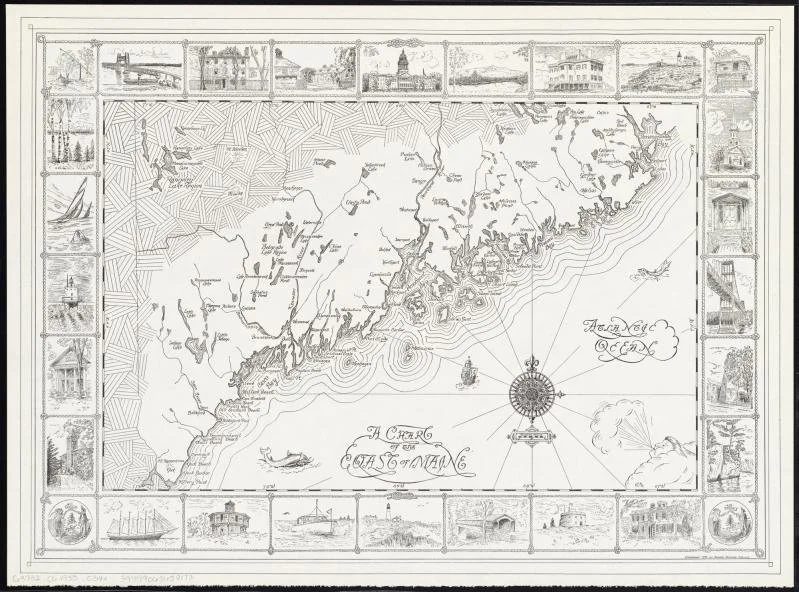
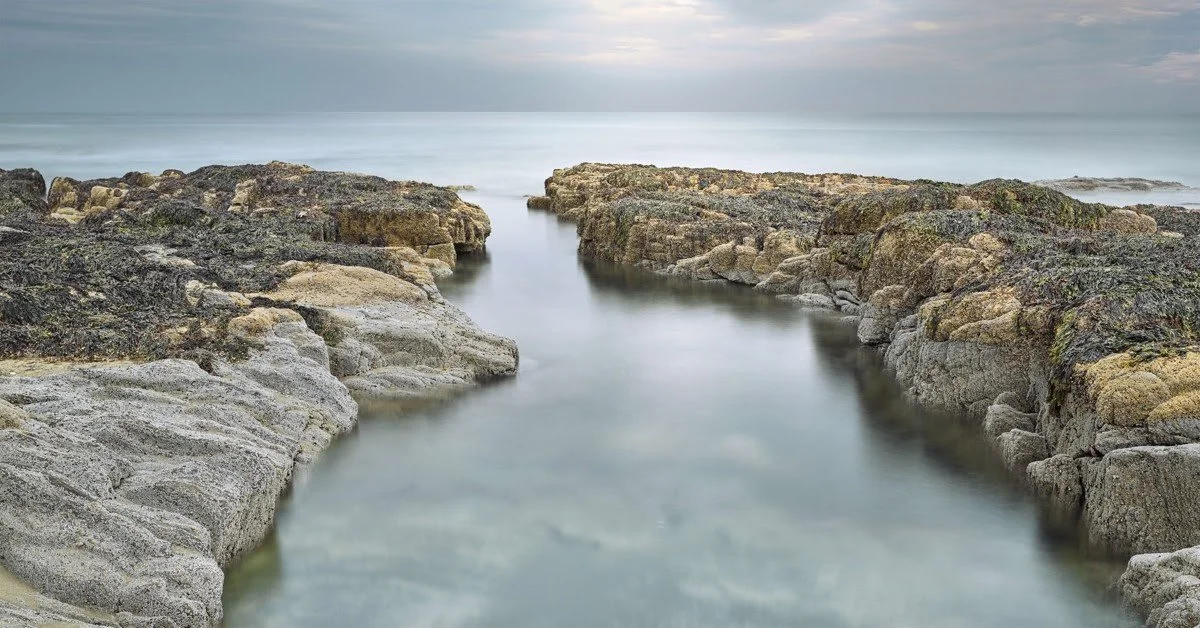


Pack your Prozac
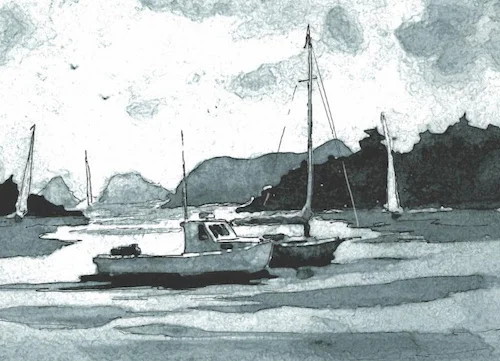
"Deer Isle (Maine)'' (polymer intaglio) by James B. Myette (member of Providence Art Club.
For all the Downeast beauty, the frequent grayness of the Maine coast because of its infamous fog can make it a profoundly dispiriting place.
Robert Whitcomb: What to do with those islands near Europe
On a business trip to London in the ‘80s, I saw a billboard for an airline at Heathrow Airport that proclaimed “Best Route to Europe’’. I asked a cabbie: “Aren’t we in Europe?’’ He answered: “No, Sir, we’re in England’’.
Whenever I visit Britain, I never feel I am in “Europe,’’ but rather in something closer to the U.S. or Canada. It isn’t just the language; it’s in the manner of the people and the look of the place. London reminds me of Boston (Mass.), Nottingham of Worcester (Mass.).
On June 23, British subjects will vote on whether the United Kingdom (England, Scotland, Wales and Northern Ireland) should quit the European Union (the exit called the “Brexit’’). There would be pitfalls (for a while) in doing so but advantages too.
The pitfalls: Harder for British people to get jobs on the Continent, less flexibility for big U.K. companies in doing deals with Continental companies and snags in coordinating sometransnational anti-terrorism security measures with E.U. members.
Still, while Brexit would hurt the U.K. economy for several years it would strengthen it for the long term.
It would give the U.K. more control over its own affairs, thus letting it better maintain its best qualities, especially its love of liberty; its quirky individualism; its entrepreneurialism; the strength and stability of its institutions, including its glorious Common Law, the astonishingly adaptable language that England gave the world and that 1.5 billion people speak now, and its special relationship with America.
For all their flaws, no nations have benefited the world as much as have the United Kingdom and its offspring the United States. The U.K.’s cultural/political/economic characteristics made that possible. Further absorption into the homogenizing, bureaucratizing and centralizing European Union, mostly run by unelected, if highly professional and well-meaning, administrators, threatens to dilute these strengths.
The late historian Robert Conquest wrote: “within the West, it is above all the English-speaking community which has …pioneered and maintained the middle way between anarchy and despotism.’’
Brexit would probably encourage the U.K. to tighten ties with its most important offspring – America -- with which it shares so many values -- and with the 53-nation Commonwealth of Nations, formerly the British Commonwealth, to help offset negative economic effects of Brexit.
I used to live in France and am a fan of the European Union – for the Continent. For all its regulations, bureaucracy and social engineering, the E.U. has, all in all, helped make the Continent more prosperous and humane and war in Western and Central Europe much less likely.
That the E.U. has made it much easier for citizens of E.U. countries to travel and work where they want within the Union has usually been a boon. But it also has made it easier for terrorists and other criminals to operate freely over a wide area, which has increasingly worried the British. Thank God for the Channel!
The biggest near-term threats to the E.U. come from the gangster Vladimir Putin’s aggression and from Islamic pathologies, which wreak terror attacks and refugee floods, but confronting them is mostly NATO ‘s job, not the E.U.’s. And the United Kingdom will remain in NATO, whether or not it leaves the E.U.
Meanwhile, for all the talk of the glories of “multiculturalism,’’ the fact is that Western culture has brought more prosperity and human rights to the world than any other. No wonder almost all refugees want to flee to the West. We need to do everything possible to boost the broader Western World through, for example, such projects as the Transatlantic Trade and Investment Partnership – a huge free-trade area in the mutual self-interest of the European Union, the U.K. (Brexit or not) and the U.S.
But in such cooperation, let’s not dilute the best idiosyncratic elements of Western Civilization’s parts. The U.K., in the long run, would do better as a friendly partner of the E.U. than as a member. Its history, its enduring psychic separation from Europe, its curious blend of insularity and worldliness (much of the latter stemming from the British Empire experience) has served itself and the world well.
Robert Whitcomb (rwhitcomb51@gmail.com) is overseer of newenglanddiary.com and former finance editor of the International Herald Tribune.
Sam Pizzigati: The affluent are the big tax cheaters
Via OtherWords.org
The folks working for the federal government can do some incredible things.
Over at NASA, for instance, they’re now putting the finishing touches on the new James Webb Space Telescope — an instrument TheWashington Post says will be powerful enough “to capture the heat signature of a bumblebee on the moon.”
Amazing. We can now spot a bug in space.
So why can’t we spot people who cheat on their taxes right here in the US of A?
A great many people, the IRS says in a new report, are stiffing Uncle Sam. Our federal “tax gap” — the disconnect between what taxpayers owe and what they eventually pay — is now averaging $406 billion a year.
(Photo: Timothy Winner / Flickr)
That eye-opening figure comes from the 17 percent of taxpayers who misreport their income and underpay their taxes.
The other side of the coin is that 83 percent of Americans are paying their taxes, in full and on time. If you make a typical American income, you almost definitely fall within this 83 percent.
Actually, you don’t have much choice. All wage and salary income — the overwhelming bulk of the income average Americans receive — gets automatically reported to the IRS and faces automatic withholding from your paycheck.
Under this system, notes the new study, only 1 percent of overall paycheck income goes under- or unreported.
But some Americans — the nation’s most affluent — don’t make their money from wages and salaries. They get the bulk of their income instead from business profits, rents, and the money they make buying and selling assets.
Most of this income doesn’t get automatically reported, so few of these dollars ever face any withholding at all.
That wouldn’t matter all that much if the IRS had plenty of agents out in the field doing in-depth audits. But the IRS has been losing staff. The tax agency had 50,400 full-time-equivalent enforcement staff available in 2010. The 2016 figure: only 38,800.
With fewer watchdogs on the job, almost a fifth of individual tax due on capital gains and “partnership” income is going uncollected. An even higher share of rents, royalties, and “proprietor” income — nearly two-thirds — is escaping taxes.
How much of this tax cheating involves big-time business people and how much involves mom-and-pop business operators? The IRS doesn’t say. The agency doesn’t break down the new tax evasion data by taxpayer income class.
But eight years ago, economists Andrew Johns and Joel Slemrod went through earlier IRS raw data and did just that.
Americans who make between $500,000 and $1 million a year, these two researchers found, misreport their income at triple the rate of taxpayers making between $30,000 and $50,000, and well over double the rate of taxpayers making $50,000 to $100,000.
One key point to keep in mind here: We’re not talking about loopholes in the tax code when we talk about the “tax gap.” Loopholes let the deep-pocket set legally sidestep what otherwise would be a significantly higher tax bill. The IRS tax gap numbers only apply to outright illegal tax cheating.
The rich engaging in this cheating do get nabbed sometimes. This May, for example, a federal judge found that Texas tycoon Sam Wyly engaged in “deceptive and fraudulent actions” to avoid taxes on over $1 billion of his assets.
But the Sam Wylys remain outliers. Most high-income tax cheats don’t get caught. And that won’t change until Congress starts subjecting the incomes of the awesomely affluent to the same reporting and withholding standards that apply to the incomes of average Americans.
Sam Pizzigati, an Institute for Policy Studies associate fellow, co-edits Inequality.org, where an earlier version of this piece appeared. His latest book is The Rich Don’t Always Win: The Forgotten Triumph over Plutocracy that Created the American Middle Class, 1900-1970. Distributed by OtherWords.org.
Expert on international corruption speaks June 7 at PCFR; expert on world shipping June 22
June 5, 2016
To members and friends of the Providence Committee on Foreign Relations (thepcfr.org; pcfremail@gmail.com).
Please see query about June 22 dinner below.
Our next meeting comes on Tuesday, June 7, with Michael Soussan, author and former U.N. whistleblower.
He will talk about global corruption as the driving force behind the rise in extremism and instability in the world today.
Mr. Soussan, formerly at CNN and the UN and the NYU Center for Global Affairs, has commented on international Affairs for CNN, The BBC, NPR, The New York Time, The Wall Street Journal, The New Republic, among others. He is the author of Backstabbing for Beginners: My Crash Course In International Affairs, soon to be a movie starring Ben Kingsley, Theo James and Catherine Bisset.
As usual, the dinner will be at the Hope Club, 6 Benevolent St., Providence. Drinks start at about 6, dinner by 7, then the talk and a Q&A and the evening ends by 9. We will make all possible efforts short of physical violence (psychic violence is allowed) to ensure that the talk ends with plenty of time left for questions and get people out by 9.
Please let us know whether you will join us June 7 by replying to pcfremail@gmail.com.
Thanks very much to those who have already let us know!
The Hope Club needs good estimates no later than the day before a PCFR dinner.
Dues and dinner cost information may be found at: thepcfr.org. Other membership information may be found there, too. (A member asked if (the modest) dues and dinner fees for this nonprofit educational and civic membership organization are deductible for business purposes. In some cases. Ask your tax adviser.)
Our last speaker of the season will be Evan Matthews, a key thought leader at the North Atlantic Ports Association and director of the Port of Davisville. He will talk to us on Wednesday, June 22, on changes in world shipping, including the widening of the Panama Canal and other changes of huge interest to New England ports, especially Quonset/Davisville. Since this will be in some part about Narragansett Bay, it’s a good summery topic to end the season with.
We’d greatly appreciate knowing soon about how many people will come to the June 22 dinner.
We’ll be sending a list of some new-season speakers in the next few weeks. Topics will probably includethe role of Germany in the E.U.; the mess in Brazil; Central Europe facing right-wing populism and an aggressive Russia; Mongolia; the Zika virus; ocean fishing, the Silk Road Project; Japan and God knows what other topics current history might throw at us.
Suggestions are appreciated.
We look forward to seeing you.
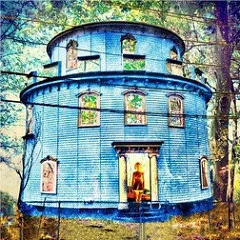
Realty check
Work by Deb Hickey in the show "Exploring a Sense of Place,'' now through June 25 at Brickbottom Artists Association, Somerville, Mass.
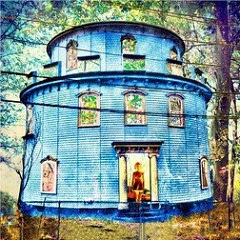
Work by Deb Hickey in the show "Exploring a Sense of Place,'' now through June 25 at Brickbottom Artists Association, Somerville, Mass.
Beginning and ending faster and faster
“And so with the sunshine and the great bursts of leaves growing on the trees, just as things grow in fast movies, I had that familiar conviction that life was beginning over again with the summer.”
F. Scott Fitzgerald, near the start of The Great Gatsby
Chris Powell: Let suburbanites vote in cities
With Connecticut’s state tax revenue declining, those who consider themselves big thinkers have been advocating more regionalism, as if having towns share a dog warden will save them much as long as their municipal employee union contracts remain subject to binding arbitration and thus exempt from serious economies. In fact, advocacy of regionalism long has been just a cowardly evasion of Connecticut's most expensive policy failures.
In any case try to find someone who will argue for more regionalism in the context of recent developments in Hartford. The city is beyond insolvent, with the new mayor, Luke Bronin, having to slash its budget and seek concessions from the city employee unions. Meanwhile the minor-league baseball stadium the city last year decided to build is now not only 20 percent over budget but also months late in completion. The entire home season of the baseball team seems likely to be lost.
Of course, few observers are surprised by this, competence not being expected from city government. Asked last week about the troubles of the Hartford stadium, even Gov. Dan Malloy remarked that he had not been enthusiastic about it. But the governor could have killed it with a word before it got started. He could have declared that if Hartford, while its school system and police protection were collapsing, really thought that it could afford $50 million to build a minor-league baseball stadium, the state administration, which covers half the city's budget, would reduce financial assistance to the city by whatever amount the city appropriated for the stadium.
Instead the governor, a Democrat, was silent, reluctant to alienate the city's Democratic organization, and now Hartford is out at least $60 million, and instead of a stadium and minor-league baseball the city more likely can look forward to years of expensive litigation with the developer.
Meanwhile The Hartford Courant disclosed last week that even as the city's school administration was closing schools and eliminating services to economize, it was also paying $61,000 for having sent 33 school employees to a conference in Miami, where the school system got an award, which might as well have been for obliviousness.
Such scandals are typical of Connecticut's cities and they happen because the cities long ago lost their independent, self-sufficient, politically engaged middle class employed in the private sector, becoming dominated instead by the government and welfare classes, dominated by takers rather than producers.
As a result people who are self-sufficient or aspire to self-sufficiency and aspire to get their children away from the pathology of government-created poverty relocate to the suburbs, where people who pay more in taxes than they receive in income drawn from taxes want nothing to do with regionalism, insofar as regionalism means fluff like overpriced stadiums and Florida junkets.
Though this situation offers suburbanites an escape, it is hideous all the same, since it lets Hartford, Bridgeport, New Haven, and Connecticut's smaller cities remain corrupt and exploited dependencies, free of political pressure or incentive to change.
So the regionalism that Connecticut needs should recognize that the state pays too much for its cities for them to function mainly as generators of poverty and patronage. The regionalism that Connecticut needs should enfranchise suburban residents to vote in city government elections and referendums, since suburban residents are already paying half of city government expense.
Connecticut's cities do not have a big enough private sector to bring city government under control, to make it pursue the public interest. But if city elections were actually regional elections, city officials might behave more responsibly -- might not even think of spending money on stadiums and trips to Florida.
Chris Powell is managing editor of the Journal Inquirer, in Manchester, Conn.
Baby birds and humanity
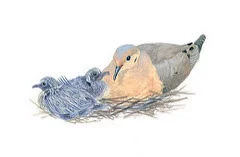
“Mourning dove, ‘’ by Julie Zickefoose, in her show “Baby Birds: An Artist Looks into the Nest,’’ at Mass Audubon, Lincoln, Mass., through Sept. 18.
The gallery notes say: “Being in nature and viewing the world around us gives humanity a deeper insight towards ourselves and how we fit into the universe. Artist Julie Zickefoose acknowledges this connection and focuses on baby birds, from eggs throughout their lives in her current exhibition…. Ms. Zickefoose, who is an author, artist and naturalist in addition to being a wildlife rehabilitator, feels a strong connection to nature and feels it is important to show this passion through artwork. Not only are these images based on birds she had seen in nature, but also some in which she felt an even stronger connection to: orphaned baby birds who Julie nursed back to health until they were ready to survive on their own within their natural habitat.’’
Always better than one?
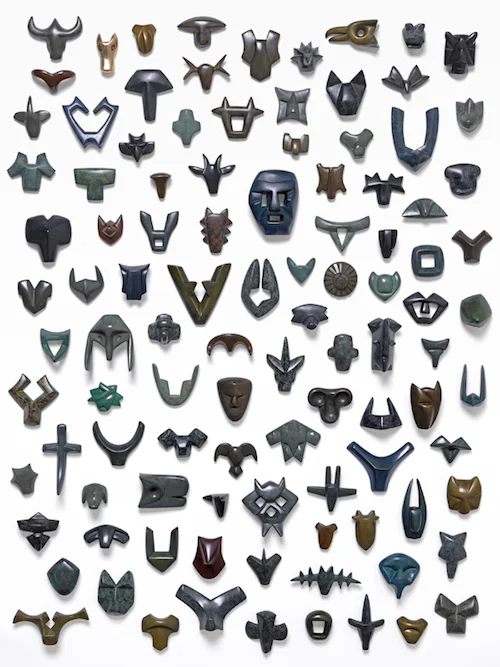
"100 Heads'' ( bronze), by Peter DeCamp Haines, in his show "Mostly Heads,'' at Boston Sculptors Gallery, June 8-July 17.
The gallery says the heads in the show comprise a new subset in Mr. Haines's "Archaeology of the Subconscious''.
'All things were glad'
“Spring flew swiftly by, and summer came; and if the village had been beautiful at first, it was now in the full glow and luxuriance of its richness. The great trees, which had looked shrunken and bare in the earlier months, had now burst into strong life and health; and stretching forth their green arms over the thirsty ground, converted open and naked spots into choice nooks, where was a deep and pleasant shade from which to look upon the wide prospect, steeped in sunshine, which lay stretched out beyond. The earth had donned her mantle of brightest green; and shed her richest perfumes abroad. It was the prime and vigour of the year; all things were glad and flourishing.”
-- Charles Dickens, from Oliver Twist.
Summers on Boston harbor and one in the newsroom
Ah, those usually boring summer jobs. From the time I was 13 to when I was 16 I had a series of the usual jobs --- mowing lawns, cutting shrubs, delivering papers vis bicycle, briefly busboying. But when I turned 16 I started working at a company on the Boston waterfront called Mills Transfer Co., which picked up stuff brought in by ship to the Port of Boston and trucked it around the Northeast.
Mostly what I did was utter tedium – filing multicolored bills of lading and, a bit better, making some deliveries around Boston. Occasional excitement was provided when the IBM punch-card machines malfunctioned, exploding those “do not fold or mutilate’’ cards all over the floor.
But the floor where I worked had a superb view of Boston Harbor and Logan Airport, and it was fun to be sent down to the loading dock to talk with the truckers. Best was that docked nearby by a lunch boat that my office mates (all of whom were full-time employees; I was the only summer worker) took a couple of times a summer around the inner part of Boston Harbor. The wind was soothing on those hot days, albeit often smelly. Boston Harbor was far more polluted than it is now.
Much of the waterfront then was still decrepit. Boston’s redevelopment took a while to get to the waterfront, and arson seemed to be the most common method of removing the eyesores of crumbling old building and collapsing piers. Still , there was a certain romance to it.
So through the hot and humid days of July and August I would trudge from South Station, where the bus from Cohasset, where I lived in the summer (I lived at school in Connecticut most of the rest of the year) stopped, to Mills Transfer, walking over the foul Fort Point Channel. At 5 p.m., I reversed the trip, noting that upon entering August, the light became noticeably dimmer. And then came the tedious traffic jams on the Southeast Expressway that often maderest of the trip home take more than an hour.
Still the boredom involved led me to become a loyal newspaper reader: There was nothing else to do.
So as the summer of 1969 approached and I was looking for a new kind of summer job, I lucked out when an AA friend of my mother, a natty sports columnist called Joe Purcell, helped get me a job as an “editorial assistant’’ (i.e., "copy boy'') at the Boston Record American, a Hearst tabloid heavy on murders and “The Daily Number.’’
The Record was in a beautiful granite building on Winthrop Square in downtown Boston. But other than the executive offices, the facility was not air-conditioned . The filthy newsroom was stifling. There were jars of salt tablets around to try to ward off collapse and a couple of weak fans.
I helped by cutting the teletype paper before handing wire-service copy to rewritemen (there was only one lady journalist in the room), made “books’’ – 2 carbon sheets sandwiched with three sheets of paper for writing stories, was given money by editors to give to the bookies in the composing room and was sent on rather pleasant errands around Boston. It was always cooler on the streets than in the newsroom. (The composing room and press room must have been close to 100 degrees.) For instance, I had to pick up stuff at the Boston Stock Exchange and the Associated Press.
It was the summer of “Woodstock’’ (which of course didn’t happen in Woodstock but rather in Bethel, N.Y.), the moon landing and Ted Kennedy’s Chappaquiddick scandal. The Record being only about an inch above a scandal sheet, the last story drew the most attention in the newsroom in the Capital of the Kennedys. I heard many salacious remarks, but don’t remember details all these years later.
-- Robert Whitcomb
Llewellyn King: The pernicious effects of polling on the body politic
Warning: the political news you are consuming may be synthetic, manufactured in a corporation and served up breathlessly by the media. Like many synthetic substances, it could be bad for your health.
I refer, of course, to the epidemic of polling. Polls have become a political narcotic. There is an appetite for them that knows no bounds. If you do not like or trust one poll, take another.
This, in turn, reflects a time when the science of polling faces challenges. Polling had become fearsomely accurate, but recently it has encountered two bugaboos: Changing demographics and changing telephone usage. These things have cleft polling in two: polls that are conducted through telephone interviews and those that are conducted electronically.
The evidence is that the old way remains more accurate, but it is bedeviled with fewer land lines and more people who do not want to be interviewed, or may not be comfortable speaking English.
It is, I am told, cheaper to poll electronically, but the bugs are not all out of the system and wide discrepancies in results are showing up. Hence, a poll that shows Hillary Clinton beating Donald Trump in the general election is followed by another equally reputable poll that shows Trump defeating Hillary.
The pollsters I have known are a canny lot, and I have no doubt they will get on top of these problems. The most egg that has landed on the face of the polling industry was in getting the last British election so wrong. That fiasco is informing the doubt surrounding polls on whether or not Britain should leave the European Union. They are struggling with a close call and public distrust of polling.
In the United States, polling has gotten the presidential primaries more or less right. But the putative contest between Clinton and Trump has wide swings in polling results; so wide that the pollsters themselves are having difficulty asking the right questions and managing the results.
Not since 1945, when it started seriously, has polling seemed so challenged as in this presidential contest.
But unreliable or not, the debate is fashioned by the polls. Talk radio, talk television and the newspapers are nourished by the latest polls, which pass as news.
For me the argument is not whether the polls are accurate, but rather the damage they do to the system. They are — and I am assuming that the pollsters will regain their former omnipotence — an impediment to the political process.
A poll is a snapshot that morphs into a narrative. A second in time becomes a reality, and candidacies are extinguished before they can catch fire.
Commentators extrapolate a grain of truth into a mountain of fact.
Polling has reached a point where not only is it part of the democratic process, but it also distorts that process, picking winners and losers before the electorate has assimilated the facts.
The news media has fallen onto the habit of taking this synthetic news — a suspect commodity for which the great news organizations pay — as the real thing. A poll gets the same weight as the ballot, thus affecting the ballot.
I believe that polls do reveal a truth, but a truth of one brief moment in time. The trouble is that revelation becomes the revealed truth, and the future gets tethered to that moment. Normal evolution in political thinking is hampered by this synthetic truth.
In hiring pollsters, news organizations are unwittingly setting up what is the equivalent of a posed photograph: a photograph that will be reprinted hundreds of thousands, if not millions, of times until it has become a kind of truth and its dubious genesis is forgotten.
Politicians are swayed by polls, fitting their policies to synthetic truths that have been certified as the will of the people: erroneous certifications, as it happens.
Llewellyn King is the host and executive producer of White House Chronicle, on PBS, and a longtime publisher, columnist and international business consultant. This piece first ran on Inside Sources.
Or your office during an earthquake

"Pond With Flash'' (watercolor), by Milo Winter, at ArtProv Gallery, Providence, June 8-July 22.
William Morgan: Touring the treasures of a cold campus
Spring in northern New England is a sometime thing. It does not usually come until May, if at all, and it doesn’t stay very long. (There's a bit of Yankee humor: "Spring around here is short. Last year, we played baseball that afternoon''.) A recent visit to Maine reminded me that we were still very much in what the late Noel Perrin, my favorite Dartmouth professor, called one of New England's six seasons: "Unlocking''. Except for a few brave daffodils, there were no flowers to be seen and few leaves on the trees.
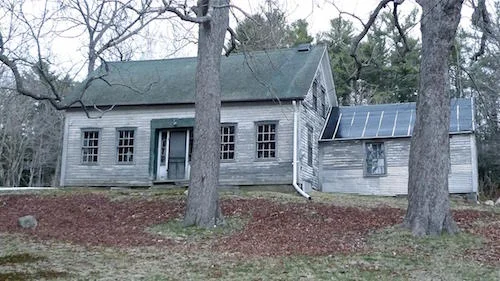
Waiting for spring: House neat Wiscasset, Maine.
My wife and I walked around Bowdoin College during this period of grayness. Where, we wondered, were the crowds of prospective Polar Bears touring the campus on their spring break? Our own son had seen the Brunswick school in the flush of summer. Would an introduction in November or March have chilled his ardor for Bowdoin? What about students from Virginia or California showing up expecting Maine to look as it appears in online college promotional material?
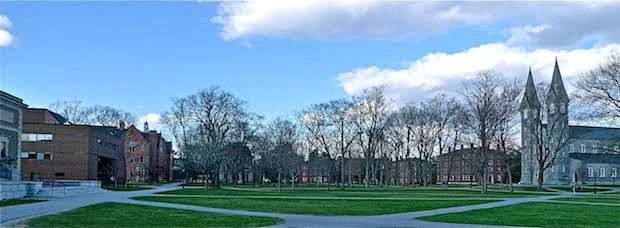
Main Green at Bowdoin College, looking north.
Yet, we found something strangely appealing about Bowdoin at this time of year–a kind of astringency, a stark honesty defined by barebones trees. There was a sense of what it means to live in Maine year round, or to have attended Bowdoin, say, back in the 1820s, along with Longfellow and Hawthorne, when Brunswick was far away and pretty isolated from the world.
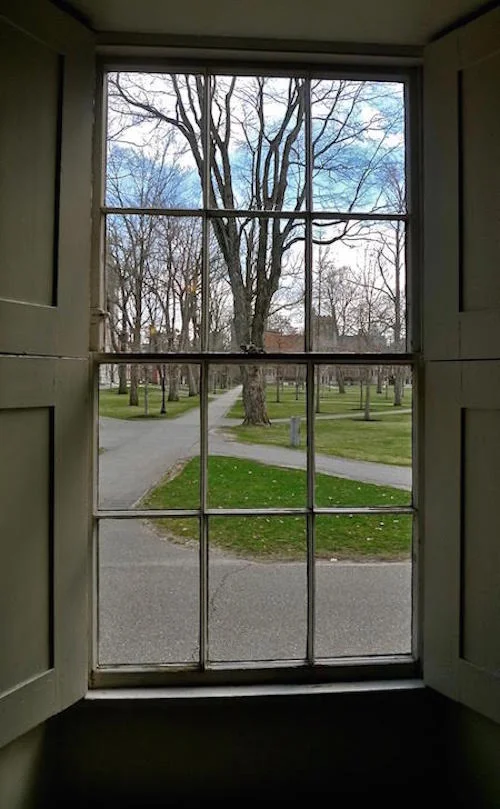
View of the green from Massachusetts Hall (1802),Bowdoin's oldest building.
Minus the leafed-out of shrubbery and flowering trees, it is a lot easier to appreciate the astounding collection of notable 19th Century and early 20th Century architecture that forms the center of the Bowdoin campus.

Charles McKim, of McKim, Mead & White, was the most famous American architect to build at Bowdoin. The Walker Art Museum (1894) is a perfect Renaissance revival jewel. The Western canon of painters, sculptors and architects whose names are carved on the façade might now be seen as a group of dead white men, but it was a typical homage found on Beaux-Arts civic buildings
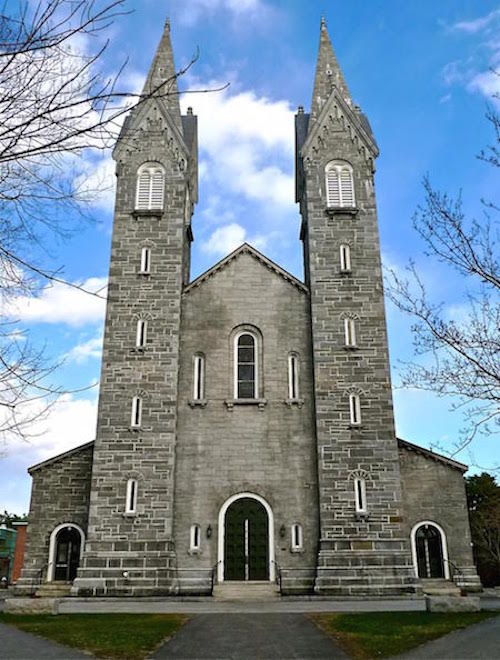
Richard Upjohn was another giant of American architecture, best known for his Gothic revival churches, such as Trinity Church on Wall Street in New York. Upjohn, however, employed his beloved English Gothic only for Episcopalians. So the Bowdoin Chapel, 1844-55, was built in a severe German Romanesque for the Maine Congregationalists–a commanding if stern house of worship.
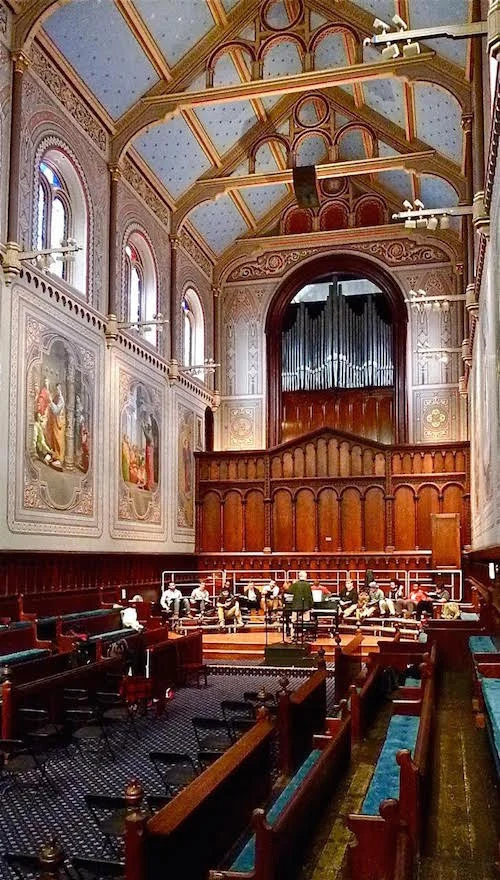
The tall and narrow chapel, with its large murals and painted ceiling, is an unexpected change from the starkness of unadorned white interiors of the typical New England meetinghouse.

Although not as famous as either Upjohn or McKim, Boston architect Henry Vaughan was a major designer of churches and colleges. Like Upjohn, he championed English Gothic. Here, Searles Science Hall of 1894 is an early example of a Jacobean-inspired collegiate building in America.
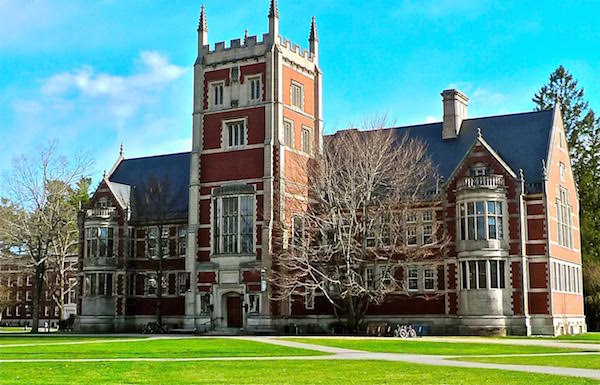
Echoes of Oxford and Cambridge, where Vaughan worked before emigrating to America, inform his Hubbard Library (1903). Soon, the lawn would be home to Frisbee games.
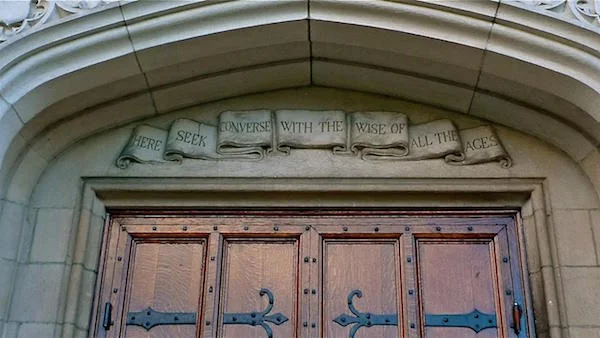
Above the entrance to Hubbard Library is this flowing banner carved with the admonition: Here Seek Converse With The Wise Of All Ages. Would such a motto be welcome in today's politically correct academy?
William Morgan is a longtime architectural historian and essayist. His books include Monadnock Summer: The Architectural Legacy of Dublin, New Hampshire and A Simpler Way of Life: Old Farmhouses of New York and New England
.
Still, rejoice
It was a splendid summer morning and it seemed as if nothing could go wrong.
-- John Cheever
Of course, plenty went wrong in the life of the great short-story writer and novelist Cheever, who grew up on Boston's South Shore. But he almost always found reasons for hope and redemption. The last line of his novel Falconer is "Rejoice''.
Jill Richardson: Blaming the poor for being poor
Via OtherWords.org
If you’re poor, many Americans think, it’s your own fault. It’s a sign of your own moral failing.
I don’t personally believe that, but the idea has roots in our culture going back centuries.
In The Wealth of Nations, the foundational work of modern capitalism, Adam Smith extolled the virtues of working hard and being thrifty with money. That wasn’t just the way to get rich, he reasoned — it was morally righteous.
Sociologist Max Weber took the idea further in describing what he called the Protestant work ethic.
To Puritans who believed that one was either predestined for heaven or for hell, Weber wrote, working hard and accumulating wealth was a sign of God’s blessing. Those who got rich, the Puritans thought, must have been chosen by God for heaven; those who were poor were damned.
Even major American philanthropists have subscribed to this idea.
John D. Rockefeller, a religious Baptist, thought that his vast wealth was evidence from God of his righteousness. Fortunately, he took this as a sign that he should use his money for good. He gave it to universities and medical research centers, and his descendants used it for great art museums, national parks, and more.
But Rockefeller also believed that the poor were often deserving of their fate. If they’d just worked harder, or budgeted their money wisely, then they wouldn’t be poor.
Plenty of Americans agree. Sadly, that’s often not the case.
The first factor determining one’s wealth as an adult is an accident of birth. If you’re born to wealthy parents, you’ll go to better schools and get better health care. Your odds of success as an adult are higher.
If, on other hand, you’re born to poor parents who must work multiple jobs instead of staying home to care for you — or who can’t afford healthy food, medical care, or a house in a good school district — your chances of earning your way into the middle class as an adult plummet.
In fact, if your parents’ income is in the bottom 20 percent, there’s you’ll be stuck in that low-income bracket for your entire life. Thanks to racism, that figure rises to 50 percent for black people born into poverty.
Indeed, racial disparities crop up even at the bottom of the ladder.
Due to historic racism and discrimination, data from the Economic Policy Institute shows, low-income white families tend to be wealthier than black families making the same income. Furthermore, whites are more likely to have friends and family who can help them out of a financial bind.
Finally, thanks to decades of discriminatory housing and lending practices, black families are more likely to live in poorer neighborhoods. That impacts the quality of the schools they attend, among many other things.
So why can’t a hardworking family get ahead? For one thing, it’s expensive to be poor.
Try finding an affordable place to live. You need to have enough cash on hand to pay a deposit. Many apartments require you to prove your income is 2.5 times the cost of the rent.
Public-assistance programs only help the most destitute, and often don’t provide enough even then.
For the disabled, the situation is worse. In theory, Social Security provides for those with disabilities. In reality, getting approved for disability payments is costly (in both medical and legal fees) and difficult. Once you get approved, disability payments are low, condemning you to poverty for life.
In short, there are many reasons why poor Americans are poor. It doesn’t help that our society thinks it’s their own fault.
Jill Richardson, an OtherWords.org columnist, is the author of Recipe for America: Why Our Food System Is Broken and What We Can Do to Fix It.

'For what they are'
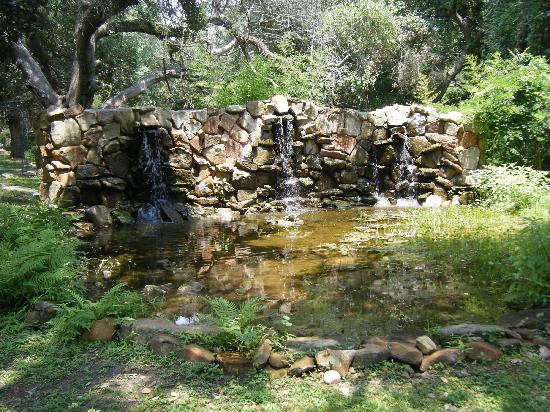
By June our brook's run out of song and speed.
Sought for much after that, it will be found
Either to have gone groping underground
(And taken with it all the Hyla breed
That shouted in the mist a month ago,
Like ghost of sleigh-bells in a ghost of snow) --
Or flourished and come up in jewel-weed,
Weak foliage that is blown upon and bent
Even against the way its waters went.
Its bed is left a faded paper sheet
Of dead leaves stuck together by the heat --
A brook to no one but who remember long.
This as it will be seen is other far
Than with brooks taken otherwhere in song.
We love the things we love for what they are.
Robert Frost, ''Hyla Brook''
Inscrutable sculpture
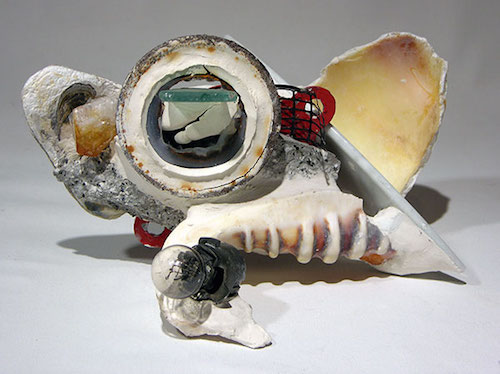
“Pique with Citrine’’ (stone, shell, ceramic, metal, glass, plastic, paper clay), by Leslie Linda Brown, in her show "More Holes,'' at Kingston Gallery, Boston through May 29.
The gallery says that the title of exhibition refers to" the porous, eroded forms of the art; as the artist says, 'These works are half created and half destroyed.' Like unearthed, archaeological treasures, a key part of each sculpture's strength lies in its inscrutability. Ms. Brown's art possesses a wild elegance, where symmetry angles towards complexity at every turn, so that it is impossible to summarize the sculptures from a single point of view. The works comment on the current state of our environment, on the vital force of human connection, and on the potency of materiality in advancing emotional expression.''
Whew!