
Vox clamantis in deserto






Altitude sickness
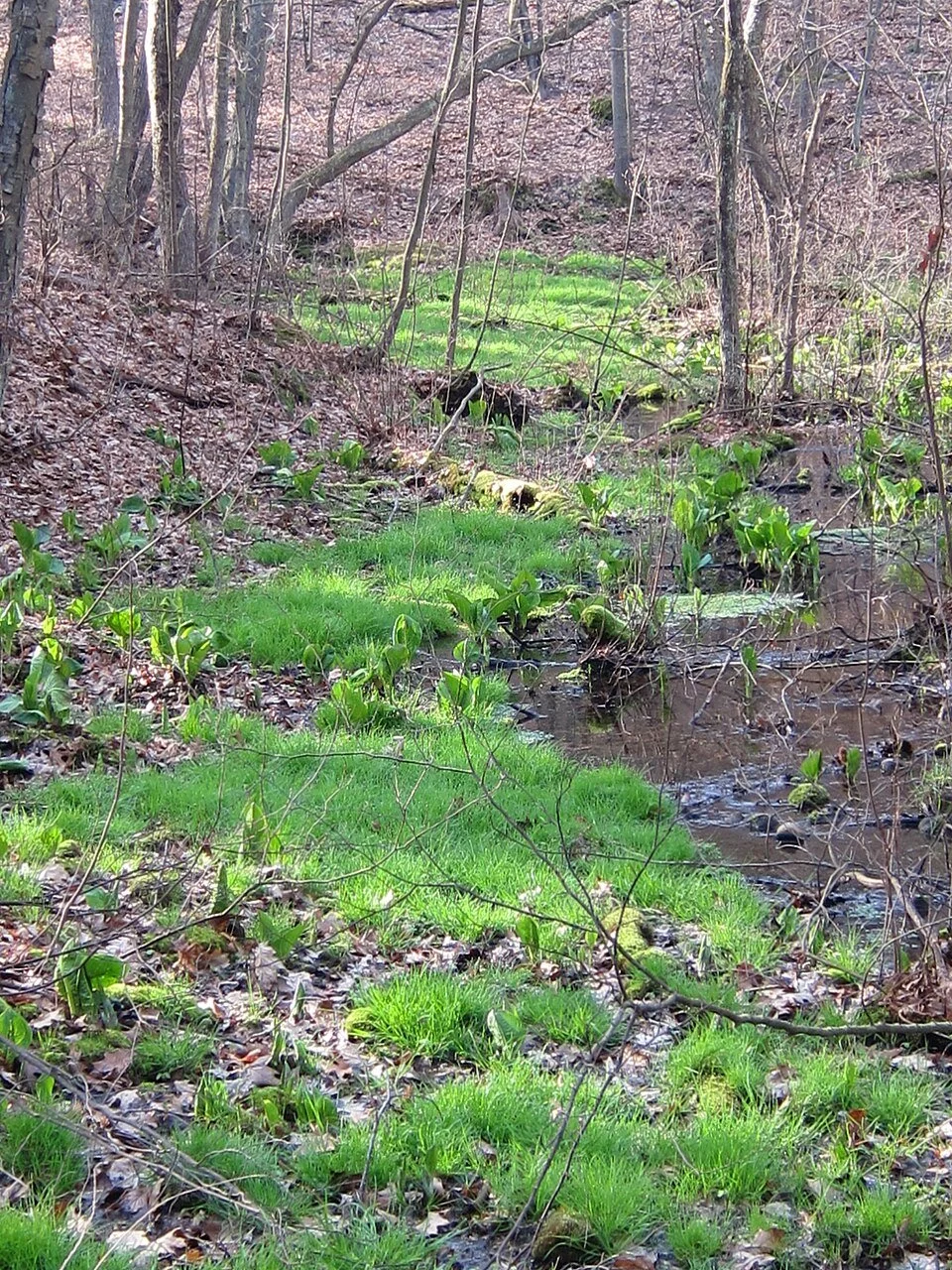
"Elevation'' (acryllic on canvas), by Diane Novetsky, in her show 'EARTHSHIFTER,'' at Galatea Fine Art, Boston, through Feb. 28. She says the name of the show refers to "the materiality of paint as well as the way I manipulate space on a two-dimensional surface...{as well as} my focus on the land, skies and waters of our dynamic yet fragile planet Earth.''

"Elevation'' (acryllic on canvas), by Diane Novetsky, in her show 'EARTHSHIFTER,'' at Galatea Fine Art, Boston, through Feb. 28. She says the name of the show refers to "the materiality of paint as well as the way I manipulate space on a two-dimensional surface...{as well as} my focus on the land, skies and waters of our dynamic yet fragile planet Earth.''
Llewellyn King: The sustaining knock on the door
For some Americans today, tomorrow and the day after, on and on, a knock on the door is the high point of a lonely life. They are the old, infirm and shut-in; and they are a growing part of our aging society. Even though many of them have children and grandchildren, if you live alone and you are old, you know what it is to be all by yourself and lonely.
I think of them as the Alone Generation: people who suffer the privations of age and the dark place of loneliness.
The daily knock on the door comes from a volunteer for Meals on Wheels, and means a meal and little companionship. It is a public-private partnership that works: food for needy people.
That knock on the door comes a million times a day as Meals on Wheels volunteers fan out in their communities to deliver food. Some drive great distances in rural areas, some around their own neighborhoods.
The meals are tailored for the elderly, and often for diabetics. Sometimes they are delivered hot and ready to eat. Sometimes they need to be heated in a conventional or microwave oven. Sometimes they reflect regional tastes. All the meals are manna to the recipients.
According to Ellie Hollander, CEO of Meals on Wheels America, based in Arlington, Va., the average recipient is 75 years old or older, is usually a woman, takes at least six medications a day, suffers some physical impairment, and wants to live independently.
About a third of the organization’s funding comes from the federal government, and the other two-thirds comes from state and local governments and charities. There is a lot of volunteer labor.
Hollander says the money spent on keeping people at home is a national bargain: It keeps them out of expensive nursing homes, hospitals and other pricey warehousing.
You do not have to plunge into the statistics about aging – but Pennsylvania alone has over 2 million seniors, according to the Bipartisan Policy Center. Instead, just go to any rundown area of any town or city and you can see them asking grocery store employees about the price of everything, pulling wads of coupons out of their wallets before they hand over their money at the checkout, and struggling to carry their purchases.
My town in Rhode Island has an area called Arctic, which is home to a lot of old people. Their needs are palpable. I see them on the streets, in the drugstores and the grocery store. Some are bent over, nearly double. Others can walk only with canes and walkers. They stand in the cold without shelter, as they will this week, waiting for a bus that comes infrequently. Shopping is a burden without a car, and taxis are expensive. So my neighbors do things the hard way, the only way.
My neighbors are not derelicts. They have worked all their lives, many not in pensionable jobs. They live on Social Security and balance their spending between shelter, food, medicines, utilities and clothing. For them, and many millions of aged Americans, it is about staying alive.
There are studies and committees on the aging; the White House talks about it, Congress ruminates and appropriates a sliver of money. But the horrible truth is millions of old people, probably already undernourished and sick, choose daily between food and heat, food and medicine, food and rent or even clothes.
Retirement communities, assisted living centers, sunshine enclaves in Arizona, Florida and Nevada, are only part of the story of aging. Mostly age comes stealthily, creeping up on people in the communities where they have put down their roots.
I look at poor, old people everywhere and wonder what they were like when young; when they were full of love and joy and hope. I wonder how they make it now, staving off starving or freezing, or living with aching loneliness.
It is worth thinking about this when politicians attack “entitlements” and imply that those in need are there by choice.
The well-off avert their eyes and blame the old for not being better with money in their youth. Unfortunately, many never made enough money to save.
These winter days, as the snow piles up in much of America, fewer people will get that sustaining knock on the door.
Llewellyn King (lking@kingpublishing.com) is a long-time publisher, columnist and international business consultant. This first ran on InsideSources.com

Chris Powell: Of Flint, Hartford and a stadium

With the city’s water system contaminated by lead, this was the headline last week on a news story from Flint, Mich.: "Mothers of Flint Very Frightened for Their Kids."
The story lacked even one reference to the fathers of Flint, presumably because there are few if any fathers there, the city of 100,000 being, like so many other U.S. cities, more or less a concentration camp for the poor, hapless and fatherless.
As a result since 2011 Flint has been operating in administrative receivership by Michigan state government. The city was also in state receivership from 2002 to 2004 but it did little lasting good.
The catastrophe resulted from the current state receiver’s decision to save money by switching the city’s water supply from the metropolitan Detroit system to the Flint River, whose water leached lead from the city water system’s old pipes. As signs of trouble grew, Flint lacked the competent political class needed to take care of itself or evoke the concern of state officials.
So now many children in Flint are at risk of irreversible lead poisoning, a national scandal.
But Flint’s circumstances, political incompetence arising from comprehensive and perpetual poverty, are common in many cities, including cities in Connecticut, as indicated by the latest incompetence in Hartford, the $10 million cost overrun in the minor-league baseball stadium the city is building to steal New Britain’s team.
Nearly everyone outside Hartford knew that the lack of minor-league baseball was not among the city’s problems and that city government would botch the project. For like Flint, Hartford lacks the independent and engaged middle class necessary to make government work in the public interest. Instead, most ofHartford’s politically involved people are members of the government and welfareclasses -- the dependent classes.
While some Hartford residents have complained about the decision to build the stadium and the cost overrun, there are not enough to make a difference politically.
Hartford’s new mayor, Luke Bronin, who had nothing to do with the stadium decision, has made what he says is the best settlement available for the cost overrun. The city will split the expense with the minor-league team and the mayor will pursue more financial aid from the state and federal governments to compensate for the city’s unplanned extra contribution.
Thus Bronin, until recently an aide to Gov. Dan Malloy, inadvertently has exposed the dodge that his former boss hid behind when Hartford began contemplating the stadium -- a statement that state government would not help fund it.
But like Connecticut’s other impoverished cities, Hartford long has drawn half its budget from state government reimbursement, far more than most municipal governments get, and thus for many years whenever Hartford has wasted money, half the waste has been state government money.
With the stadium Hartford already has wasted a lot of state money, and if Mayor Bronin obtains more aid from the state and federal governments to reimburse the cost overrun, the city will be wasting still more.
The disaster might have been prevented if, instead of purporting to be indifferent to Hartford’s stadium plan, the governor had candidly acknowledged the city’s disproportionate financial dependence on state government, declared the stadium a luxury, and announced that every dollar the city spent on the stadium would be matched by a reduction in state aid to the city.
That instantly would have scuttled the stadium and brought much-needed clarity to Connecticut’s dysfunctional political economy. Instead, exploding the governor’s pose of neutrality, state government now will be subsidizing not only Hartford’s theft of New Britain’s team but still more ofHartford city government’s incompetence, thus giving all municipalities more incentive for their own incompetence.
Chris Powell is managing editor of the Journal Inquirer, in Manchester, Conn.

Pending a no-school announcement
"Winter came down to our home one night
Quietly pirouetting in on silvery-toed slippers of snow,
And we, we were children once again."
-- Bill Morgan Jr.
Chris Powell: Paying criminal prof $60,400 to go away
What was more or less a triumph of public administration was announced last week at Central Connecticut State University in New Britain, which obtained the resignation of an English professor, Ravi Shankar, who had amassed a long criminal record and even had received a promotion while serving a jail sentence, though the university said it had not known that he was locked up at the time.
Even so, the university declined to fire Shankar, uncertain if the professors union’s contract allowed it. Noting that the professor's crimes occurred off campus, the union and a local state representative who is a union tool argued that they had nothing to do with his job and that criminality is irrelevant to employment in public education.
But after getting away with making a scandal, Shankar was arrested again, this time accused of expensive shoplifting, prompting the university to suspend him without pay last August. Last week's resolution: Central has paid Shankar $60,400 to resign and he can never work again in the state university system.
Of course, few criminals working in the private sector get severance pay like that, but since public administration in Connecticut long has been practically against the law, the university system probably achieved the best possible outcome for the public.
If Shankar had not been bought off this way, he might have sued for wrongful dismissal and, given the political composition of the state Supreme Court, in a few years he might have won a decision that no government employee can be fired for anything less than mass murder and that he was owed millions of dollars in retroactive pay and lawyer costs.
While such a decision would have established formal precedent that criminality doesn't matter to employment by government in Connecticut, people who pay attention might have figured this out already from the newspapers.
xxx
SURPRISE! ALL TEACHERS ARE GREAT: Releasing the first summary of teacher evaluations in local school systems, the state Education Department reports that 99 percent of Connecticut's teachers have won the top two ratings, "exemplary" and "proficient," with only 1 percent rated "developing" or "below standard." So either schools have the best class of employees of any industry in Connecticut or the evaluation system functions only as political cover for school administrators, school boards and teacher unions.
Since individual teacher evaluations are exempt from the state's freedom-of-information law lest schools ever operate in the public interest rather than their own interest, there is no way for the public to verify any evaluation or to evaluate the administrators who do the evaluating. Besides, if evaluation summaries keep getting published, any administrator who rates a teacher "below standard" will risk getting questioned about his failure to replace him.
Just as there's no sense in asking the barber if you need a haircut, there's no sense in asking school administrators if they are maintaining high standards with their teaching staffs. What else are they going to say? The law requires the evaluations of all other government employees in the state to be public. So either open the teacher evaluation process to full disclosure and let students and their parents participate in it, or stop wasting time and money on the charade.
xxx
WHERE GUNFIRE IS NORMAL: Residents of East Windsor and Willington are alarmed that the state police propose locating a weapons training range in their towns. The townspeople fear that the noise of pistol and rifle fire will be disruptive and diminish property values and ruin the character of their towns. They don't know how lucky they are. The new range could go in Hartford, Bridgeport, or New Haven and the gunfire might not even be noticed.
Chris Powell is managing editor of the Journal Inquirer, in Manchester, Conn.
Josh Fitzhugh: In Cuba, old U.S. cars as metaphor





Editor’s note: Insurance executive, lawyer, farmer, Vermont maple-syrup mogul and former editor and reporter John H. (Josh) Fitzhugh, sent us this piece the other day. By the way, New Englanders should be aware of the very long social, cultural and economic ties between Cuba and our region. The old Boston-based United Fruit Co. is just one example, not to mention the many New England firms that made candy, booze, molasses and brown and white sugar from Cuban sugar cane, some of it grown on farms with New England-based owners. And yes, the slave trade. My paternal grandparents and parents went down there a couple of times to enjoy the raffish activities under assorted pre-Castro dictators/gangsters.
-- Robert Whitcomb
xxx
I traveled with my daughter, Eliza, on a Dartmouth College-led tour thinking that I should “time travel” to see what Havana and the island were like now before tourism and American business interests transformed it.
I needn’t have rushed. While change is certainly underfoot in Cuba, I left the island after a week with the conviction that the tangled relationship between the U.S. and Cuba will take decades to sort out absent some leadership change as dramatic as occurred a half century ago.
First, a bit about the trip. As required by the rules of the U.S. embargo of Cuba, the trip was organized as a people-to-people exchange to enhance “contact with the Cuban people, support civil society, or promote the Cuban people’s independence from Cuban authorities.”
Dartmouth’s method for accomplishing these goals was to have us accompanied by a professor of Spanish; to organize numerous lectures by Cuban authorities; to visit various art and music venues; to eat predominately at small private restaurants called paladars; and to permit us to pepper our good-spirited and intelligent Cuban guide, Abell, with constant questions regarding the deficiencies of the vaunted Revolution. Over the course of the week we toured old and new Havana; Hemingway’s residence, Finca La Vigia; the towns of Cienfuegos and Trinidad; and places in between. To say that we were exhausted by the time we left would be an understatement.
We also all learned a lot, and by that I mean that we all struggled on a daily basis to reconcile our growing understanding of Cuba with opinions as to how American (or Cuban) policy should change to better the lives of the people of both nations. Now that may sound kind of arrogant (who are we to assume such responsibility?) but it was the truth. As an American you can’t travel in Cuba without feeling some responsibility for the ways things are, including the country’s turn toward socialism. And President Obama’s initiative to press for closer contacts with Cuba have given these thoughts greater immediacy.
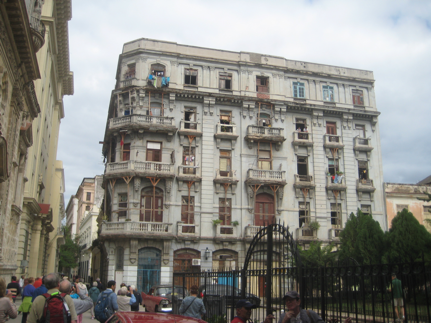
Now as to some observations. It would appear that over the past 50 years, Cuba has made great strides in health care and education (provided free of charge to the population) but at a cost of economic stagnation and tremendous deterioration of its physical structures. The government is quick to lay the blame for the latter on the embargo but in my opinion it has less to do with that than with the socialist mentality that has discouraged enterprise and private investment of any kind.
A good example is the deterioration that has occurred in old Havana, the location of many beautiful European style structures. Before the Revolution, according to a tour member who had been there, Havana’s old structures, mainly of cement and stone, were in pretty good repair. Today, one in ten is missing a roof; one in five have no windows. Three a day collapse, we were told. The reason? While families are permitted to live in the structures, they are not responsible for their upkeep, which is the government’s responsibility, and whether by design or lack of funds, it has not done so. The picture above is a good example of this decline.
Today, the only structures in old Havana in good repair are tourist spots (such as government-owned hotels) or small paladars snd small hostels, owned by families which under current rules can tap into and keep some of the profits from the burgeoning tourist trade. Even major government centers, like the Museum of the Revolution, are shabby and decrepit. The Capitol building, designed to look like Washington’s, has been closed for three years (although that may tell more about Cuba’s one-party rule than its finances, frankly.)
Faced with the loss of its sugar daddy, the Soviet Union, Cuba in the mid-‘90s first went through a horrendous economic decline (they call it the “special period”) and then began to pull itself back with help from Chavez’s Venezuela and an increasing reliance on tourism. Today, China and Vietnam seem to have replaced Venezuela as major trading partners but tourism continues to grow, and with it major economic issues.
In short there now appear to be two economies in Cuba: the tourist economy, where taxi drivers, restaurant operators, hoteliers, tour operators, artists and musicians prosper; and the rest of the economy, which suffers along at $20 a month in government wages plus whatever black market income one can find. This income disparity is worsened by those lucky enough to have relatives overseas who send back “remittances,” and most of these are Cuban whites from formerly middle- and upper-middle-class families in Havana.
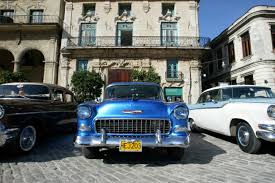
An example of this disparity was manifest in a dinner we had with some young artists. The young Afro-Cuban at our table has an art degree and has had some moderate success selling his work, mainly to tourists. He now supports his brother a dentist who is on the state payroll. Another example was a young man whose father was ambassador to Paris in the ‘70s. Trilingual in Spanish, French and English, he worked in a restaurant until three years ago, when he began driving his family’s original 1955 Chevy as a taxi in Havana because his income prospects were better.
The lack of investment is also apparent in the country. Cuba nationalized the hated sugar plantations and mills, but after a disastrous attempt to maximize sugar production in the 90s, has now cut back on sugar production in an effort to diversify agriculture and reduce food imports. Despite efforts to privatize small farms and urban gardens, however, a tremendous amount of land remains fallow, land that to my eye was probably cultivated before the Revolution. Coupled with the ongoing demographic flow from country to city and the lack of any environment for foreign investment, I don’t see much prospect for agricultural growth and believe Cuba’s goal of producing 70 percent of its own food a pipe dream.
In general we found the Cuban people well behaved, good humored and (as best as one can generalize such things) happy. They are proud of their independence and tolerant of their leaders. They seem willing to recognize mistakes and move on. While constantly reminded by their government that Uncle Sam is evil and untrustworthy, and that the socialist ideals of the Revolution should be venerated and followed, my sense is that most Cubans love American culture and take an attitude toward their government that “this too shall pass.” Many have become very adept at managing their immediate environment to try to benefit themselves and their families.
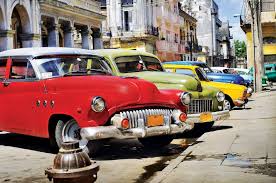
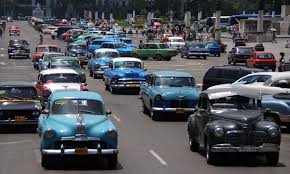
The prevalence of old Chevys, Fords, and Cadillacs is a kind of metaphor for this attitude, I think. Keeping these vehicles going is of course a necessity due to the U.S. embargo and a real testament to the mechanical ingenuity of Cubans, but since they are so obviously a symbol of America, and of Cuba before the Revolution, they also bespeak(to me at least) a kind of protest with the way things are and a hope as to what may eventually return. So is the practice of using the dollar sign ($) to denote an item’s cost in pesos.
Like a divorced couple, Cuba and America have much history to remember and to forget, but will forever be linked in some fashion by their proximity to one another.

'Afternoon in February'
Image by Lydia Davison Whitcomb

"The day is ending,
The night is descending;
The marsh is frozen,
The river dead.
Through clouds like ashes
The red sun flashes
On village windows
That glimmer red."
- ' Henry Wadsworth Longfellow

Tim Faulkner: Back when farming was sustainable
What can today's farmers learn from tenant farming in 1790 New England? Farmers Emily Liss and McKayla Hoffman explain from Coggeshall Farm in Bristol, R.I. Video taken Jan. 23, 2015
Via ecoRI News (ecori.org)
BRISTOL, R.I.
Farming in 1790 is a zero-trash dream. There’s no plastic, cardboard or toxic chemicals. Grit is swept into the fireplace. The few crumbs of food that aren't eaten are tossed out a window with the dishwater, where a wild turkey waits to peck at the morsels. Nearly everything is made and used on-site.
This practice of sustainable living is happening at Coggeshall Farm Museum, on Colt Drive, — a working tenant farm that adheres to the late 18th-Century New England standard of living. Farmers, depicted as “living history interpreters,” practice organic agriculture and resiliency, with the tools, crops, livestock and even clothing from the Federalist Era.
Even on a wintry day, when the fields are idle, the 48-acre farm is vibrant. Lambs are born. Cows are fed. In the farmhouse, the hearth is roaring. Cast-iron pots hang over the flames: one for soup, one for hot water, another for candle making.
The soup is made with chicken, leeks, potatoes, carrots and dill — all ingredients from the farm. A Dutch oven is covered in embers to make bread. This spring, the farm will grow grain for the flour.
It’s farming without tractors, running water and refrigeration. Yet, there is a cheese press, a spinning wheel, a root cellar and hearth ovens.
“Small farms are diversified and extremely resilient,” Coggeshall's executive director, Cindy Elder, said.
Coggeshall Farm and farmhouse date back to the mid-to-late 1700s. It was preserved for public use in 1921 and established as a nonprofit in 1973. The farm and museum are open to the public throughout the year for tours, events and workshops.
Here’s a brief look at tenant farming in the Federalist Era:
Owning land
Wealthy local families leased the property to tenant farmers, who paid rent with their farm products. Excess food and goods were sold to save money, in hopes of eventually buying land of their own. Land ownership, for men at least, came with certain rights and privileges, such as voting.
Family values
Like any farm, labor was critical and big families were the best source of workers. Generations of a family often lived together and shared the work.
“Families tended to stick together, because you can’t run a farm with three or four people,” said Emily Liss, one of Coggeshall's full-time farmers. “Back then, kids were your money, kids were your labor force.”
Although work was assigned by gender, such as the women doing the cooking and laundry, running a farm typically relied on whomever was healthy and able.
“All is fair in love, war and farming,” said Liss, who has worked on organic farms in Massachusetts and New York. “The tougher things get, the more equal genders are.”
Resilient animals
Farm animals are versatile. Gulf Coast sheep are low-maintenance and ideal to withstand the elements, while providing wool, meat and field-mowing services. The American milking Devon cow, which was a fixture of East Coast farms at the time, were popular for their meat, milk and labor.
Many of these species are now endangered or threatened, including four varieties of chickens common during the era. Coggeshall Farm is part of a nationwide effort to preserve and propagate these breeds.
Era drawbacks
“Not everything from the past should be glorified, but we learned from their lessons,” Elder said.
The colonists drove out Native Americans, the original stewards of southern New England, upset the ecosystem and exploited natural resources.
Trees became scarce thanks to clear-cutting for farmland. So, firewood was one staple typically not from the farm. Most of the firewood and lumber for this area was collected from forested areas several miles away in Fall River, Mass.
Slavery was big business after the Revolutionary War, and Bristol was one of the main ports in trafficking human beings. Although slaves weren’t common to tenant farmers, the slave trade was fundamentally an accepted institution during the mid-to-late 1700s and treatment of black citizens was abhorrent.
Tim Faulkner is a member of the staff of ecoRI News.
A plaintive and musical no-school announcement
See this bizarre and very musical no-school announcement by the headmaster of Moses Brown School, in Providence.
All that glisters is not gold

"Worn scale at McNulty's Tea & Coffee Co., Inc., established 1895''.
-- Photo by Anders Corr (2016)
Don Pesci: Mother Aetna's unhappy children
VERNON, Conn.
In Mario Puzo’s novel The Godfather, Michael Corleone, plotting to kill a crooked cop, says to his brother Sonny, “It's not personal, Sonny. It's strictly business.”
Ya’ gotta do what ya’gotta do.
If Aetna CEO Mark Bertolini does move Mother Aetna’s home office from Hartford, Conn., to Louisville, Kentucky’s largest city, he can also plead it’s only business. General Electric (GE) recently announced it was moving from Fairfield, Conn., to Boston – just business, nothing personal… please try to understand.
"We've done the analysis," Mr. Bertolini said five years ago, "and, quite frankly, Connecticut falls very, very low on the list as an environment to locate employees …in large part because of the tax structure, the cost of living, which is now approaching, all in, the cost of locating an employee in New York City.”
Such “hits,” to borrow the Mafia term, are not generally shouted from the rooftops. The possibility of dramatic uprootings are conveyed by subtle body language, a frown here, a warning word there, and threats so understated it would take a raw-nerved politician weeks to decode them.
GE CEO Jeff Immelt turned all this on its head. He was shouting from the rooftops just before he shook the dust of Connecticut from his feet and headed to Massachusetts, formerly “Taxachusetts.” Mr. Immelt’s message to Gov. Dannel Malloy and Connecticut’s Democratic-dominated General Assembly was an iron-fisted, unambiguous BANG: Get control of spending, particularly pension obligations; stop taxing the engines of prosperity; and repeal your new Unitary Tax, which will drive large multi-state businesses from Connecticut. When political decision-makers in Connecticut showed themselves hostile to such pleadings, GE decided to leave town – nothing personal.
After GE’s “hit,” Mr. Malloy sniffed, “You win some, you lose some.” Speaker of the House Brendan Sharkey and President Pro Tem of the Senate Martin Looney, having taunted Mr. Immelt as a tax-scofflaw, were not convinced the company had pulled up stakes in Connecticut for reasons given by Mr. Immelt.
It was left to Red Jahncke, president and CEO of The Townsend Group, to point out what ought to have been obvious all along: that the reasons GE decided to leave Connecticut, lucidly stated by Mr. Immelt in his many public rooftop proclamations, and the reasons that GE chose Boston {for its strengths as a high-technology and education center} as its future nesting place were, necessarily, not the same.
How many CEOs of companies in Connecticut and elsewhere were watching Connecticut’s instructive-destructive melodrama from the wings? Was Mr. Bertolini, perhaps, among them? We are back to subtlety. Does the the Kentucky-Bertolini romance portend yet another Immelt-like rupture in Connecticut?
Maybe, thought Senate leader Len Fasano, a Republican Savonarola indelicately bringing up the matter of papal immorality: “Aetna, I believe, is under the same impression that Connecticut is not going to fix its problems. They clearly said, 'We are clearly committed to Louisville, Kentucky.' Then when politics came into play, they said, 'Well, for now, we're in Hartford.' Clearly, they're leaving the state. I would suggest they've already done some clearing out of the state already. This just speaks to a Democratic majority who wants to put blinders on, who doesn't want to see the facts because it doesn't fit their narrative, and want to continue with the status quo. We are in deep trouble in this state. ... We've gotta fix this.”
The possibility of further business flight was dangling like a Damoclean sword over the head of Governor Malloy as he mounted the rostrum to deliver his second State of the State address before Connecticut’s General Assembly. The ladies and gents in the audience were all ears, and when Mr. Malloy proposed that the short session should be devoted strictly to budgetary matters – eschewing the pet projects that legislators often tuck into end-of-session implementer bills to enhance their re-election possibilities – he received the most raucous applause of the afternoon.
It was a fine and timely suggestion. Serious reforms that return any of the three branches of government to their pristine purposes as define in constitutions and statutes will hasten the state’s renewal and give tax-whipped Connecticut citizens fresh reason to believe that politicians generally stand for something more solid and lasting than their re-election campaigns.
Don Pesci (donpesci@att.net) is a writer who lives in Vernon, Conn.

It only looks dead

"Within'' (pastel), by Shirley Koller, in her show "The Wounded Tree Series: Trees in Landscapes,'' at the Providence Art Club, through Feb. 12.
It has always struck us how much of a tree can look dead but yet it keeps on growing.

Voters hiding from the world

The insularity of that minority (i.e., “the base’’) of the electorate that tends to dominate presidential campaigns’ first innings explains much of the current nasty race, especially on the Republican side.
These people seek to protect themselves from the anxiety of hearing a viewpoint they might not like by holing up in echo chambers in which the same fact-thin opinions are repeatedly shouted day after day. The epicenter is the oratorical masturbation known as political talk radio.
You’d think that listeners would get bored and occasionally want to hear something different, but that would make them uncomfortable. Talk radio does not encourage curiosity or research. The point is to soothe listeners by reinforcing their well-entrenched prejudices and satisfy their desirefor simple solutions to their problems – and clear villains.
The majority of talk-radio fans are middle- and lower-middle class white people aggrieved by their downward socio-economic mobility and upset about changing social mores as seen, for example, in gay marriage, and the changing ethnic and religious mix of America. That’s understandable.
But their refusal to listen to all sides in order to become better informed citizens also suggests a disinclination to make the changes, be it training for new work skills or bringing disorderly personal lives under control, necessary to address these tougher times for many Americans. Too many of them are both angry and passive.
That makes them prey to such demagogues as Donald Trump and Ted Cruz. Mr. Trump may be an especially fitting candidate for our times: People who avoid reading and obtain most of their “news’’ from TV and talk radio like him the most.
No wonder (relatively) scandal-free people of great executive and policymaking accomplishment who would have been very plausible presidential candidates in the past – say former New York Republican Gov. George Pataki and former Democratic Sen. Jim Webb -- don’t have a prayer. And such competent chief executives as Ohio Gov. John Kasich, former Florida Gov. Jeb Bush and former Maryland Gov. Martin O’Malley haven’t gotten much traction either.
And it’s hard to see Hillary Clinton, despite her long CV, intelligence, ambition and persistence, as a person of great executive and policymaking success. Bernie Sanders, for his part, is an eccentric fringe high-tax candidate in a nation whose citizens hate taxes. His only executive experience has been as mayor of Burlington, Vt.: pop: 42,000.
(A possible spanner in the works of a Hillary Clinton marchto theDemocratic nomination: indictment stemming from her “top-secret’’ home-server e-mails.)
You’d think that voters would want the nation’s chief executive to be or have been a successful elected executive of a government body. And no, running a business is not the same as running a government body.
Globalization and technology, both of which will continue to eat away at the American middle class, require a panorama of responses, including reducing our plutocracy’s ever-increasing power, more job training and rebuilding the nation’s decayed physical infrastructure to create jobs and make the nation more internationally competitive.
Cheapening labor and technology-based automation, which so far have mostly destroyed the jobs of blue-color workers, are now eating away even at what had been well-paying upper-middle-class jobs. Andsenior business execs show little desire to share more of their gargantuan compensation with underlings.
The candidates generally avoid presenting and emphasizing programmatic details because details don’t do well on TV and talk radio. And so many journalists have been laid off that the surviving ones almost entirely focus on the easiest and more marketable stuff in the campaigns - - the daily insults, faux pas and hour-by-hour opinion polls -– the horse race.
Apparently that’s fine with the people who hide in the silos of talk radio.
Once the candidates of the two major parties are chosen, perhaps more substance will appear as the candidates reach for support from moderate and independent voters. We can hope they’ll then explain with considerabledetail and precision what they’d do and, as important, how they’d do it.
Meanwhile, most of the electorate, the large majority of whom only bother to vote in November, can look into the mirror to see who is most to blame for our predicament.
Robert Whitcomb (rwhitcomb51@gmail) oversees newenglanddiary.com, is a partner at Cambridge Management Group (cmg625.com), a former Providence Journal editorial-page editor and a former International Herald Tribune finance editor,

Morning in Little Compton.
How coldly burns our sun! One would say its rays of light are shards of snow, one imagines the sun lives upon a snow crested peak on this day.....
All photos by Lydia Davison Whitcomb









“It is growing cold. Winter is putting footsteps in the meadow. What whiteness boasts that sun that comes into this wood! One would say milk-colored maidens are dancing on the petals of orchids. How coldly burns our sun! One would say its rays of light are shards of snow, one imagines the sun lives upon a snow crested peak on this day. One would say she is a woman who wears a gown of winter frost that blinds the eyes. Helplessness has weakened me. Wandering has wearied my legs.”
― Roman Payne
PCFR dinner on Hydro-Quebec, Trudeau, etc.
Feb. 2, 2016
To members and friends of the Providence Committee on Foreign Relations (thepcfr.org; pcfremail@gmail.com). (We update the Web site frequently with news and commentary. Information on how to join the PCFR is on the site, too.)
Speaking to us next, at our Tuesday, Feb. 16, dinner meeting, will be David Alward, the former premier of New Brunswick and now the consul general of Canada to New England.
He’ll talk about the implications of the recent change in Ottawa under new (rock star?) Prime Minister Justin Trudeau, international security issues, such big trade matters as New England’s purchase of more hydro-electric power from Canada, the U.S.-Canada border and the idea of a common market encompassing Canada, the U.S. and Europe.
When you rush a cataract operation

Song's for Anthony Caesar (charcoal on paper), at the Kingston Gallery, Boston, in show "Phantasmal Espionage Feb. 3-28.

Too cold to be naked

"The trees down the boulevard stand naked in thought,
Their abundant summery wordage silenced, caught
In the grim undertow; naked the trees confront
Implacable winter's long, cross-questioning brunt."
D.H. Lawrence, "Winter in the Boulevard''
Josh Hoxie: No fun for resort workers
via otherwords.org

People with working-class jobs in U.S. beach towns and ski resorts are getting pushed away by exorbitant housing costs.
Think back to your favorite vacation. Wouldn’t it be delightful if that trip never ended?
Imagine moving to that fantastic destination town, finding a job and a house, and living the dream. Even if you had to wait tables or stock store shelves, who needs a desk job when you live in paradise?
That’s how many of us view the lives of the working class in beach towns or mountain resorts — an endless vacation.
If only. Barbara Ehrenreich popped that bubble in her book This Land Is Their Land.
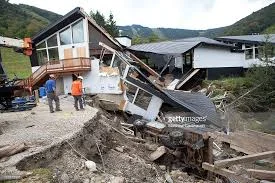
As destination towns get more popular, she explains, more people flock to them. That creates more jobs, but it also causes housing prices to spike, making it nearly impossible for ordinary workers to find a place to live. This scenario is playing out in just about every town in America that people like to visit.
I grew up on sunny Cape Cod, a Massachusetts peninsula known to vacationers as a quaint getaway with sandy beaches and bountiful seafood. What it’s not known for is affordable housing or high-wage, year-round jobs. This leaves businesses scrambling to find enough workers during the year’s busy months and workers struggling to find housing they can afford.
Or take the case of Vail, Colo.. Low-wage workers, who can’t begin to pay the skyrocketing rents around the expensive ski resort, are being forced to move farther and farther away from their jobs, as The New York Times recently reported.
In short, the Cape Cods and Vails of America are turning into hollow versions of their former selves. They’re losing the culture, vibrancy and authenticity that comes from real people living there — not just second home owners commuting in from the cities on weekends and holidays.
Addressing this problem is going to take action on two fronts: raising wages and cutting housing costs. These problems are felt in nearly every burg and burrow across the country. But destination towns have one key advantage — a steady flow of tourist revenue.
The only problem is it’s going into very few hands.
Ski resorts are an excellent example. While some mom and pop resorts are barely getting by, mega-resorts like the one at Vail are profitable enough to pay their executives seven- figure salaries. Yet most of the folks who keep the resorts running — many of whom, like ski patrollers and instructors, do dangerous work — toil for sub-poverty wages.
Now, though, many of these workers are organizing to raise their wages through labor unions and collective bargaining. Ski instructors at Beaver Creek, a resort owned by Vail, recently won collective-bargaining rights, as did ski patrollers at Telluride. These inspiring efforts offer a glimpse at a solution for what ails America’s many hollow paradises.
Reducing housing costs is harder. Wealthy urbanites have more cash to drop on second homes than local workers have to buy their sole residences. That drives up the cost for everyone.
Yet innovative solutions like community land trusts are gaining popularity. These trusts take land out of pricy real estate markets and often enforce year-round residency requirements. That creates a way for communities from Lake Champlain, Vt., shared by Upstate New York and Vermont to theSan Juan Islands in Washington State to ensure housing for low- and moderate-income families.
Vacation towns aren’t immune to the inequality that’s been festering in this country for decades. But if they can invest in a more equitable future for their workers, then maybe living there really will be a little more like paradise.
Josh Hoxie is the director of the Project on Opportunity and Taxation at the Institute for Policy Studies. IPS-dc.org
.
Doodling toward home

"By the Sea'' (mural), by Ben Jundanian, at New Art Center, Newton, Mass., through Feb. 27, created for Uber Boston, 2015.
In this project, Mr. Jundanian "engages with the aesthetics and iconography of maps to create an expansive and highly developed doodle....The piece's bustling roadways, bike paths, railroads and waterways converge on a point in the center of the wall, an indicator of home.''
One thinks of T.S. Eliot's line from his poem "East Coker,'': "In my end is my beginning.''