A_map_of_New_England,_being_the_first_that_ever_was_here_cut_..._places_(2675732378).jpg

Vox clamantis in deserto

Commentary Robert Whitcomb Commentary Robert Whitcomb

Jim Stergios: Time to stop Boston mega-project mania

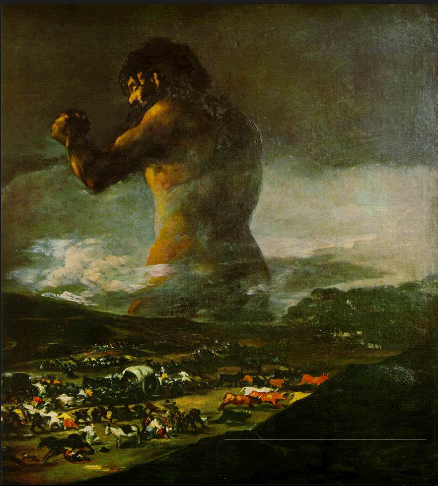
  Goya Giant I

One of Goya's Titan paintings.

BOSTON

Last year it was a billion-dollar expansion of the Boston Convention and Exhibition Center, with an embedded $110 million giveaway to a hotel developer. This year it was the recently abandoned Boston 2024 Olympic bid. Now we’re talking about digging a tunnel to connect North and South Stations. Boston has a mega-malady, and it is a love affair with mega-projects.

Modern-day Massachusetts is acquiring a variant of French political sophistication, whereby Boston (Paris) is the showpiece and the rest of the state (France) is relegated to flyover status. Here are three quick facts to waken us from our dangerous flirtation with economic development in the grand continental style. The MBTA — buried under nearly $9 billion in debt and interest, and with a maintenance backlog of more than $7 billion — should focus on avoiding a replay of last winter’s horror story. A new tunnel does not make the MBTA’s list of top priorities.

Often lost in the heated discussions of particular parcels is the bigger question of what kind of a city we want to be. Cost realism has in the past reined in Boston’s appetite for megaprojects. In essence, that is what happened when the governor and legislative leaders commissioned a third-party evaluation of the Boston 2024 effort.

Former Gov. Michael Dukakis argues that the North-South Rail Link should be buildable for $2 billion, not the estimate of $8 billion. It should cost less, but it will cost more. We just learned that the Green Line extension is $1 billion over budget. No one has forgotten that the Big Dig was supposed to cost $2.8 billion, but ultimately broke the $15 billion sound barrier.

Cost estimates aren’t the only problem. Project benefits are routinely oversold. Exhibit A: The unrealistic pictures painted by convention center feasibility studies are legendary. The BCEC is doing between 30 and 40 percent of the business it was projected to do. Exhibit B: The Greenbush commuter rail line. Instead of, as projected, taking eight passengers off highways for each one lured from the MBTA’s South Shore commuter boat service, nearly half the current customers previously took the ferry. When those who rode other commuter rail lines are added in, more than 60 percent of Greenbush riders were already using public transit.

Rather than Boston’s mega-project megalomania, we need to return to a good old American sense of fair play. When Gov. Charlie Baker pulled the plug on the proposed BCEC expansion, he created an opportunity to do just that. Each year, tourism-related taxes generate tens of millions of dollars to underwrite the Massachusetts Convention Center Authority. Between now and 2034, these taxes will provide the MCCA with $30 million more annually than it needs to operate. After 2034, when the bonds sold to pay for the construction of the BCEC are paid off, that amount will more than double.

Anyone who has spent time in Massachusetts cities outside Boston knows that they have significant infrastructure needs, including roadways, retail spines, bridges, and sidewalks. For years the Big Dig left these cities starved of investment; it takes no sophistication to understand that the litany of Boston mega-project proposals would continue that trend.

Cost estimates aren’t the only problem.Project benefitsare routinely oversold. Infrastructure upgrades will not, by themselves, refashion the futures of Massachusetts’ cities. But together with reforms to public schools, policing, and economic policies, state investment can go a long way toward making them more attractive places to live and work. In fact, creating an infrastructure fund for these cities to leverage needed reforms would prove a powerful urban revitalization strategy.

Greater Boston needs its fair share of infrastructure investments — and right now MBTA upgrades are what can do the region the most good. State government must keep in mind, however, that more than half of the state’s population is outside Route 128. Forgoing an $8 billion Boston mega-project would allow infrastructure upgrades across Massachusetts.

Jim Stergios is executive director of the Pioneer Institute, a Boston­-based think tank. This piece originated in The Boston Globe.

Read More
Commentary Robert Whitcomb Commentary Robert Whitcomb

Samantha L. Presser: Uncertain future of transnational companies

From its initial introduction in the 1970s to the present, the idea of Corporate Social Responsibility (CSR) has not been popular in the business community.In an interview in 1970 with The New York Times Magazine, famed economist Milton Friedman famously remarked that a corporation “has one and only one social responsibility — to use its resources and engage in activities designed to increase its profits so long as it stays within the rules of the game, which is to say, engages in open and free competition without deception or fraud.”

The author, a graduate of Brown University and Cornell Law School, successfully practiced corporate law in Manhattan until August 2013, when she left to pursue an accelerated master's degree in nonprofit management at the New School. She received the degree in May. A corporation is legally defined as that “which occupies the time, attention, and labor of men for the purpose of a livelihood or profit.” [1]Therefore, it is logical that tensions exist now and in the past when arguments arose that a corporation had in fact dual (and oftentimes conflicting) purposes: (1) generating profits for its shareholders and (2) a social responsibility to its stakeholders. Stakeholders are those who affected by a corporation’s business activities, including the general public, labor, the environment, and even local competing businesses.[2]

From its initial introduction in the 1970s to the present, the idea of Corporate Social Responsibility (CSR) has not been popular in the business community.[3] In an interview in 1970 with The New York Times Magazine, famed economist Milton Friedman famously remarked that a corporation “has one and only one social responsibility — to use its resources and engage in activities designed to increase its profits so long as it stays within the rules of the game, which is to say, engages in open and free competition without deception or fraud.”[4]

During the late 1990s, third party global organizations, including The World Bank, NAFTA, and The United Nations, decided to implement laws making it easier for domestic companies to expand in size and wealth. Creation of the global organizations such as The General Agreement on Tariffs and Free Trade (GATT) encouraged unrestricted free flow of goods, services, and capital between nations that in turn led to the creation of transnational corporations.[5] Today, many transnational corporations (TNCs) earn more money per year than some nations’ gross domestic product (GDP) and employ more foreign workers than population entire countries.[6]

This rapid globalization led to an “inexorable integration of markets, nation states, and technologies to a degree never witnessed before...enabling individuals, corporations, and nation states to reach around the world farther, faster, deeper, and cheaper than before, the spread of free-market capitalism to virtually every country around the world.[7]

Before the 1990s, corporations on such a global scale did not exist. They were restricted to their borders, meaning that they were severely limited in the ways they could do business, both financially and legally. They could not outsource their labor or their contracts therefore operating costs were always expensive, they were limited in what materials they could use given their location in the world, and they were subject to scrutiny by their state government given their small size and the fact that all of their operations took place in one place.[8]

Incorporation in one place makes it very easy to regulate, scrutinize, and if necessary, prosecute under federal and state law because jurisdiction is easy to determine-it is simply the state of incorporation. After the massive and oftentimes unregulated expansion abroad, however, corporations had many foreign subsidiaries in under developed nations and an untapped labor force that was desperate for work with no knowledge or conceptual understanding of the western ideas of “minimum wage,” “workers rights,” or “human rights.”

To date, TNCs control around 16% of the entire world’s productive assets and employ over 73 million global citizens around the world.[9] The financial power of one TNC is often greater than the annual GDP of some nations. Moreover, each of the twenty wealthiest TNCs earns annual profits that alone exceed the wealth of the eighty poorest countries in the world together. The market value of the top ranking TNCs is in the billions of dollars. For example, Currently, Apple Inc., a United States based TNC is the wealthiest and largest TNC in the world, is listed on the global price indices at $725 billion and 40% of the wealth controlled by TNCs is from those incorporated in the United States.[10]

Most historians agree that the creation of the modern “state” began in 1648 when the Peace of Westphalia ended The Thirty Years War in Europe.[11] This signified the end of the ancient world during which vast territories were ruled by a pope or an emperor, formally dissolved the Holy Roman Empire, and began the current period, in which hundreds of independent rulers control individual territories, each with its own fixed boundary, culture, system of government, economic system, and religion. [12]

The modern “state” has four essential components: (1) a permanent population; (2) fixed borders that it has the right to defend against other states; (3) an autonomous government with independent ruling authority; and (4) the capacity to enter into enter into agreements and treaties with other states autonomously. After World War II, a fifth component, different than the first four in that it is a not a right but an obligation to further the principles and practices of human rights and different also in that it contradicts the principles of self-rule, is now considered a component of statehood.[13]

Every state who is a party to the Universal Declaration on Human Rights agreed, that in today’s global society, accepted limits on sovereignty was worth receiving the privileges gained in becoming a member of the United Nations and the protections and rights associated with that membership.[14]

Most TNCs, despite their global power, massive, wealth, and employment of many hundreds of thousands of workers across the world, have continued to operate under an idea that they are not officially “states” and are not governed by the same laws and regulations that dictate the behaviors of states, specifically the law of nations.[15] Arguments continue between states, third party global governance organizations, European courts, federal courts, and business organizations about how to regulate both the labor practices and overall general practices of TNCs under international law given the now highly complicated foreign subsidiaries and subcontracting networks many of the parent companies employ and the jurisdictional complications that arise. Attempts made at regulation by third party global governance organizations have little to no effect because these global governance organizations often do not have the power to sanction.

Even though The Supreme Court ruled years ago that, for purposes of civil and criminal liability, a corporation should be viewed the same as an individual, United States based TNCs, compared to those based in Europe and Asia, have on the whole been more egregious offenders of labor rights violations abroad[16] Moreover, United States based parent companies now understand that CSR-related public relations based initiatives do attract financial capital but instead of investing money in their own foreign operations, many United States based TNCs instead invest small sums of money in philanthropic based initiatives having nothing to do with their own business endeavors, and then publicize them to the American people as “CSR policies.” This “bait and switch” is a common tactic employed by many United States based TNCs who want to benefit from proven reputational gains associated with CSR but do not want to invest actual dollars into changing their business practices.[17] CSR and charity are two very different topics.

For years, TNCs have take a “reactive” approach to dealing with human rights violations in their labor operations abroad, meaning that once an injury happens, a representative from the parent company steps in. This approach is cheaper, does not address the cause of the injury, fix the problem, does not address the stakeholders affected by the source of the injury or deal with protecting them at all. A reactive approach is concerned only with preserving the reputation of the corporation by silencing the injured party (which involves the signing of a nondisclosure agreement (NDA), paying for his medical care by giving him the lowest dollar amount possible, or, if he is he is dead, paying his family a small sum of money in corporation for their silence.[18]

The opposite of a reactive approach is a preventative approach whereby corporations spend more money before workers begin working on factory equipment, invest in a training program to teach workers how to use it, make sure that workers are treated well and that safe conditions are maintained, pay workers’ a living wage, and maintain a certain standard of care in the hopes that these factors will result in a more productive work force in the long run.[19]   After the reforms of the Industrial Revolution, domestic corporations are now legally mandated to act preventatively when it comes to the safety of their workers. However, without government oversight and given free reign, the notion of spending money to protect what was seen by corporations what was seen by many as an unlimited and unskilled resource made no business sense.

When TNCs were in their growth phase, investing money to build safer factories and implementing more stricter and protective working conditions would have halted production and therefore decreased profit. Therefore, from a strictly business sense, by not investing in protective measures, the correct decision was to simply continue to replace injured workers with more workers and continue to move along at a rapid pace. Businesses don’t engage in social responsibility without either fear that their actions are illegal or knowledge that their efforts will lead to an increase in profits.

Most foreign subsidiaries are in developing nations. TNCs made an excellent strategic move when it placed its outside operations in these locations as it often found cheap raw materials and a vast population desperate for work. Developing nations lack financial capital, often have a weak governance structure, have little or no access to the outside world via the internet and the media, and have a large population that is unskilled and needs work.[20] A TNC provides a promise of work, a guarantee of some infrastructure, and immediate flush of financial capital if it can buy large amounts of natural resources in a short amount of time (even if the prices are below market value.)   Even if working conditions are prohibitive, there are no other options for thousands of unskilled workers and moreover, there is no access to outside media to even understand western concepts like “workers rights,” “union,” or “minimum wage.”

By securing a developing nation’s raw materials, employing its entire population, and being the only guarantee that its nation will continue to receive financial capital in the future, TNCs often buy not only a state’s population and raw materials but many times buy its sovereignty. Thus, the largest and wealthiest TNCs are now throwbacks to ancient Greece and Rome.   Large and wealthy rulers control their subjects from an ocean away with little idea of what is going on and without really caring about anything but production at the end of the day.   Very often, workers do not know whom they are working for or what they are doing. As TNCs continue to expand, parent companies are further isolated from any incidents that take place abroad. The largest TNCs today of contracts and subsidiaries working on so many projects that it is more complicated that a Gordian Knot.

For years, corporate attorneys rightfully felt secure that even if a connection was established between wrongful conduct of a foreign subsidiary and a parent company, no federal court could possibly hold a parent company in the United States accountable for a human rights violation of their employee an ocean away. It turns out, however, that federal courts were willing to make that connection.

In 1980 an imaginative legal team realized that a statute not used since 1789, the Alien Tort Statute (ATS), could be used as a means to circumvent the jurisdictional challenge of pleading a foreign plaintiff’s claim in federal court.[21] Although this case did not deal with corporate liability, it did survive a motion to dismiss in federal court putting corporate defendants on notice that a legitimate [22]avenue existed for foreign plaintiffs to sue them in federal court for torts committed abroad.

Despite an initial worry that there would be a floodgate of litigation, ATS litigation merely trickled for years. Only 81 cases were filed between 1980 and 2004 due to a combination of terrified foreign plaintiffs with little resources, powerful defendants, and a heightened pleading standard and an often defendant friendly-court.[23]

The next case of significance was not until 2004. In Sosa v. Alvarez-Machain, the Court held that federal courts [can] hear claims in a very limited category defined by the law of nations and recognized at common law.”[24] Many scholars criticized Sosa, believing that it creating additional causes of action under the ATS not originally intended by the Framers. This is in fact the opposite of what the Court intended to do.   In fact, the Court was attempting to limit the use of the ATS by stating that that the Framers meant it was only to be used as a vehicle to keep international peace and that they intended courts to allow it only to used in the same spirit.[25]

Moreover, by specifically notating the causes of actions that the Court will hear under the ATS, it sent a clear message to all circuit courts of the narrow purview of its use. Only cases in which the foreign plaintiff suffered international human rights violation(s) by a corporation and had minimum contacts with the United States would survive a motion to dismiss at the pleadings stage.[26]

In 1996, two groups of Nigerians plaintiffs brought a lawsuit in the Second Circuit against The Royal Dutch Company and its subsidiary, Shell Petroleum, alleging that many of them were tortured and executed by the Nigerian military at the command of the Shell Company. In 2007, one group of plaintiffs settled with The Royal Dutch Company for $15.5 million.[27]

In 2007, The Supreme Court granted certiorari to rule on the issue of “whether corporations are immune from tort liability for violations of the law of nations…or if corporations may be sued in the same manner as any other private party defendant under the ATS.”[28]  The Court accepted the case to give clarity to the circuit courts where a clear divide had started in the hearing of foreign plaintiffs’ claims against TNCs for torts committed abroad.

After hearing oral argument from both sides, the Court demurred on the question originally argued and amongst themselves, came up with new legal issues for the two sides to argue. The issue of corporate liability was off the table. Both parties were now asked to argue the case on the issues of whether claims under the ATS are legally valid if they are brought for violations of the law of nations occurring outside the United States and if TNCs can be liable? The Court also addressed the issue as to whether TNCs could be liable on a theory of extraterritoriality.[29] Once again, both sides had to prepare and argue before the Court. When the defendant won, it was not the verdict that was important any longer so much as the process by which it was attained.

When the case of Kiobel v. Royal Dutch Petroleum Co.[30] was accepted for cert on the issue of whether TNCs could be held liable as a matter of law, this holding would have been one of the most significant in the modern era. If TNCs were exempt from international law and controlled the world’s wealth and resources, one can only imagine all of the “worst case” scenarios. Of course, this didn’t happen because the Court realized, better late than never, what they were doing, and so they did the best thing they could thing of other than not accepting the case to begin with-arguing the case on finite points of law in an attempt not to cause any further damage.

The biggest issue in Kiobel is the one not addressed directly, that of corporate liability. Instead of dismissing plaintiffs’ claims on that issue, the Court dismissed them first because of jurisdictional problems, stating that the facts did not overcome the rebuttal presumption of extraterritoriality and then further concluding and then concluding that TNCs are subject to the law of nations (or international law.) Thus, if anything, the opinion is favorable to foreign plaintiffs in that it affirmatively states the Court’s belief that TNCs should be regulated by international law and moreover, that plaintiffs’ claims failed simply because of jurisdictional issues and not because they lacked merit.

In a concurring opinion, Justice Samuel Alito touches on the original issue meant to be addressed, corporate liability, logically stating“[c]orporations are often present in many countries, and it would reach too far to say that mere corporate presence suffices for extraterritorial ATS liability.”[31] Justice Alito reaffirms the basic premise in civil procedure that any first year law student knows that in order to overcome the rebuttal presumption of extraterritoriality (e.g. since the plaintiff lives abroad and the act occurred abroad) the plaintiff must demonstrate that the corporate defendant has more than just a mere “corporate presence” in the forum state and that the corporate defendant’s behavior “touches and concerns” the forum state.

Not surprisingly, Kiobel did not resolve the circuit split or curtail ATS litigation.   It provided no bright line rule to circuit courts to determine if a TNC’s behavior either “touched and concerned” the United States or if they had more than a “mere corporate presence” in the United States nor did it provide a list of factors to determine if a plaintiff’s case had sufficient strength to overcome the rebuttable presumption of extraterritoriality. Thus, each case brought before a circuit judge is a matter of first impression requiring no further legal justification.[32]

The Supreme Court’s recent ruling in 2014, overturning the Ninth Circuit’s holding that the Argentinian subsidiary Daimler Mercedes Benz Argentina, “collaborated with state security forces to kidnap, detain, torture and kill certain” employees of Daimler’s Argentinean subsidiary is more troubling than Kiobel in that Daimler is an exclusive importer and distributor in the United States and had several facilities in California, its California contacts could be imputed to Daimler itself and thus clear basis for jurisdiction.[33] The Supreme Court, however, in overturning the Ninth Circuit, found simply having “sizable” sales in a forum is not sufficient to justify the exercise of general jurisdiction, which can only be found if a corporation’s contacts with the state are “so continuous and systematic as to render it essentially at home in” that state.[34] It seems, therefore, that although The Supreme Court reserves the power to hold TNCs liable for their conduct, it is often times not willing to allow federal courts to exercise it.

Although it is still somewhat unclear if an TNC is subject to “the law of nations” most judges in the United States operate under the presumption that domestic corporations are subject to the law and so TNCs are treated the same until a direct ruling from The Supreme Court states otherwise. Since the rapid expansion of TNCs, there have been some positive changes exhibited in their behavior but they have been slow and in most cases reactive.   In many cases, TNCs act only when there are immediate threats that the media will disclose unfair labor practices, human rights violations, or other questionable business practices. There is no longer any legal question as to whether The Supreme Court will hear the claims of a foreign plaintiff in court. Only questions of fact remain as to each specific case but there remains doubt as to the willingness of the current Supreme Court to exercise their authority to prosecute corporate defendants.

Despite uncertainty over whether or not they will be prosecuted, there will be a time in the near future or in years from now that the public will demand TNCs be accountable to stakeholder interests.   TNCs were created in a time of relaxed trade regulations, reduced oversight, and in a time that did not hold businesses accountable for their actions. Priorities have shifted drastically now.   After the 2008 global recession, there is little tolerance now for the exploitation of the very rich at the expense of the very poor, the environment or the world at large. It is only a matter of time before third party auditing of offshore factories, implementation of minimum wage and hour laws abroad, and other regulatory standards are no longer voluntary but required as they are in the United States. TNCs were allowed to grow enormously wealthy and expand quickly but every smart businessperson knows the time to implement a new business model in order to continue to exist. There is a way to reconcile shareholder and stakeholder interests. Those TNCs who invest money now to achieve that balance will be those that succeed in the end game. Those who continue to operate as if business continues to be about the bottom line will not last long in the new world order.  As Benjamin Disraeli said, “In a progressive country…change is inevitable.” [1] See Goddard v. Chaffee, 2 Allen (Mass.) 305, 79 Am. Dec. 796; Sterne v. State, 20 Ala. 46) (1861).

[2] A company’s stakeholders are individuals or groups who are directly impacted by the business’ operations and decisions and can be either potentially benefitted or harmed by the decisions the business makes. See Carlson, J.R., Carlson D.S., & Ferguson M. (2011); See alsoDeceptive Impression Management: Does Deception Pay in Established Workplace Relationships?Journal of Business Ethics, 100(3), 497-514 (2010).

[3] See Thomas McInerney, “Putting Regulation Before Responsibility Towards Binding Norms of Corporate Social Responsibility”, 40 cornell int’l lj. 171, 172 (2007) (For purposes of this article, CSR is simply defined as “a variety of initiatives corporations should participate in from voluntary codes of conduct to programs whereby companies can undergo external audits to verify the adequacy of their practices in a variety of areas of social concern.”)

[4] See Milton Friedman, "The Social Responsibility of Business is to Increase its Profits", The New York Times Magazine, (Sept. 13, 1970.)

[5] See Danailov, Sylvia,“The Accountability of Non-State Actors for Human Rights Violations: the Special Case of Transnational Corporations,” (Geneva, October 1998) (citing studies to show the enormous wealth and power of TNCs today).

[6] See Id. at 45.

[7] See generally Dadgelen, Osman & Recep Yucel,“Globalization of Markets, Marketing Ethics and Social Responsibility,” International Journal of Tech Engineering, 10(5), (2010).

[8] See generally Dadgelen, Osman & Recep Yucel,“Globalization of Markets, Marketing Ethics and Social Responsibility,” International Journal of Tech Engineering, 10(5), (2010).

[9] See Danailov, Sylvia, “The Accountability of Non-State Actors for Human Rights Violations: the Special Case of Transnational Corporations,” (Geneva, October 1998) (citing studies to show the enormous wealth and power of TNCs today).

[10] “Market value” is the share price times the number of shares outstanding. Listed companies do not include investment companies, mutual funds, or other investment vehicles.

Definition provided by The World Bank,

http://data.worldbank.org/indicator/CM.M KT.LCAP.CD/countries

[11] See Danailov infra at 45.

[12] See Id at 45.

[13] See generally U.N. Charter (1945) (Art. 45 (“right to self defense”); Art. 52; and Art. 55 (right to enter into treaties with member nations); Art. 74 (“it is the policy of the UN “to respect the territories” and geographic borders of member states.”).

[14] See generally Art. 1 (The Purposes of the UN are…[T]o develop friendly relations among nations based on respect for the principle of equal rights and self-determination of peoples and to take other appropriate measures to strengthen universal peace…and to be a center for harmonizing the actions of nations in the attainment of these ends.”).

[15] See Danailov infra at 44-47(discussing the various “soft law” international laws that attempt to regulate the behavior of TNCs to date.)

[16] See generally Pembina Consolidated Silver Mining Co. v. Pennsylvania, 125 U.S. 181 (1888) (holding the Fourteenth Amendment, forbidding a State to deny persons equal protection under the law, applies to private corporations as well as to individuals, public agencies, and the government); See also Trustees of Dartmouth College v. Woodward, 17 U.S. 518 (1819) (holding corporations may contract with other parties and sue or be sued in court in the same way as natural persons or unincorporated associations of persons.)

[17] See generally John M. Conley & Cynthia A. Williams, Engage, Embed, & Embellish: Theory versus Practice in the Corporate Social Responsibility Movement”, 31 J. Corp. 1,1-2 (2005).

[18] See Kolk, A. 2003, “Trends in Sustainability Reporting by the Fortune Global 250”, Business Strategy and the Environment, 12:270-291 (2003).

[19] See Id at 47.

[20] See Hough, Phillip A., “A Race to the Bottom? Globalization, Labor Repression, and Development by Dispossession in Latin America’s Banana Industry,” Global Labor Journal, Vol.3, No.2 (2012).

[21] The Alien Tort Statute (ATS), 28 U.S.C. § 1350, enacted as part of the Judiciary Act of 1789 and originally intended by the Framers was created to assure foreign governments that the U.S., as a fledgling nation, was partially to prevent and provide remedies for breach of customary international law concerning diplomats and merchants.

[22] See Filártiga v. Peña-Irala, 630 F.2d 876, 878 (2d Cir. 1980) (holding that deliberate torture under color of law violated the law of nations and ruled that the ATS provided subject matter jurisdiction over a human rights claim brought by Paraguayan citizens against a Paraguayan police official for torts occurring abroad).

[23] See Jason Jarvis, A New Paradigm for the Alien Tort Statute Under Extraterritoriality and the Universality Principle, pepperdine law review 30(4) 676-78 (2003).

[24] 542 U.S. 692 (2002).

[25] See Jason Jarvis, A New Paradigm for the Alien Tort Statute Under Extraterritoriality and the Universality Principle, pepperdine law review 30(4) 676-78 (2003) (Legal critics argue that the Court took liberties in interpreting “what the framers” meant in Sosa. However, when examining the history behind The ATS, this argument fails. The Framers created The ATS, primarily, to give aliens the power to sue other aliens in federal court and in doing so, conferred specific jurisdiction over torts brought by an alien in violation of the law of nations. The Founders believed at the time the ATS was drafted that the three principle violations of the law of nations were (1) violation of safe passage, (2) infringement of the right of ambassadors, and (3) piracy-but this was not meant to be an exclusive or finite list and further, these were considered torts by the framers.

[26] 542 U.S. 692 (2002)(holding that the present day “law of nations” would extend to torts that were “specific, universal, and obligatory.”)

[27] See Wiwa v. Royal Dutch Petroleum Co., 226 F. 3d 88, Ct. of Appeals, 2nd Circuit (2000).

[28] See Kiobel v. Royal Dutch Petroleum Co., 621 F.3d 111 (2d Cir. 2010), cert. granted,

132 S. Ct. 472 (Oct. 17, 2011) (No. 10-1491).

[29] See Id. at 14.

[30] Kiobel v. Royal Dutch Petroleum Co., 621 F.3d 111 (2d Cir. 2010), cert. granted,

132 S. Ct. 472 (Oct. 17, 2011) (No. 10-1491).

[31] See Kiobel. V Royal Petroleum Co., 133 S. Ct. 1659, 1669 (2013) (J. Alito, concurring.)

[32] See Id. at 14.

[33] See Daimler AG v. Bauman et al., 134 S. Ct. 746 (2014.)

[34] See Id.

Read More
Commentary Robert Whitcomb Commentary Robert Whitcomb

Poultry department

  Reed


"Rooster and Turkey (after d'Hondecoeter),'' by SHELLY REED, in the show "Tiger in the Living Room,'' at  the Wheaton College Gallery, Norton, Mass., Oct. 23-Dec. 16.


Ms. Reed recontextualizes imagery gleaned from art-historical sources, typically combining elements from the work of such artists as Alexandre-Francois Desportes (1661-1743), Jean-Baptiste Oudry (1686-1755), Melchior d’Hondecoeter (1636-1695), and the horse paintings of George Stubbs.

Read More
Commentary Robert Whitcomb Commentary Robert Whitcomb

Llewellyn King: In search of the real Elizabeth Warren


I went to Boston last week in pursuit of the real Elizabeth Warren. You see, I don’t think that the whole story of Warren comes across on television, where she can seem overstated, too passionate about everyday things to be taken seriously.

Like others, I've wondered why the progressives are so enamored of the Massachusetts senator. Suffolk University (in Boston), mostly known for its authoritative polls, gave her platform as part of an ongoing series of public events in conjunction with The Boston Globe. But whether the dearest hopes of the progressives will be fulfilled, or whether the senior senator from Massachusetts has reached her political apogee is unclear.

What I did find is that Warren has star power. She is a natural at the podium, and revels in it. At least she did at Suffolk,  where the cognoscenti came out to roar their affirmation every time that she threw them some red meat, which she did often.

Here's a sampling:

On student loans: “The U.S. government is charging too much interest on student loans. It shouldn’t be making money on the backs of students.”

On the U.S. Senate: “It was rigged and is rigged [by lobbyists and money in politics]. The wind only blows in one direction in Washington ... to make sure that the rich have power and remain in power.”

Warren's questioner, Globe political reporter Joshua Miller, led her through the predictable obstacle course of whether she was angling to be the vice-presidential candidate if Joe Biden runs and becomes the Democratic nominee. She waffled this question, as one expected, admitting to long talks about policy with Biden and declaring herself prepared to talk policy with anyone. She said  the subject of the vice presidency might have come up.

Short answer, in my interpretation: She would join the ticket in a heartbeat. This is not only for reasons of ambition -- of which she has demonstrated plenty, from her odyssey through law schools, until she found a perch at Harvard as a full professor -- but also age.

Warren is 66  and although her demeanor and appearance are of a much younger woman, the math is awkward. There are those in the Democratic Party who say  that she needs a full term in the Senate to get some legislative experience and to fulfill the commitment of her first elected office. But eight years from now, she'll probably be judged as too old to run for president.

Clearly, Warren didn't fancy the punishment and probable futility of a run against Hillary Clinton. But the vice presidency might suit her extraordinarily well, given Biden’s age of 72.

Warren has stage presence; she fills a room. She is funny, notwithstanding that you can be too witty in nation politics, as with failed presidential aspirants Morris Udall and Bob Dole. She reminds me of those relentlessly upbeat mothers, who were always on-call to fix things in the children’s books of my youth.

Although Warren comes from a working-class background, years of success at the best schools has left her with patina of someone from the comfortable classes -- someone for whom things work out in life. She counters this by stressing the plight of the middle class, the decline in real wages and her passion for fast food and beer -- light beer, of course.

Warren's father was janitor in Oklahoma who suffered from heart disease and her mother worked for the Sears catalog. The young Elizabeth did her bit for the family income by waitressing.

However, it's hard to imagine her at home at a union fish fry. My feeling is  that she'd be more comfortable -- the life of the party, in fact -- at a yacht club.

Progressives yearn for Warren and she speaks to their issues: lack of Wall Street regulation, and federal medical-research dollars, and the need for gun control, student-loan reform, equal pay for equal work, and government contracting reform.

She is  a classic, untrammeled liberal who is less dour than Bernie Sanders, and less extreme. So it's no wonder that so  many  Democrats long for her to occupy the presidency or the vice presidency.

All in all, I'd like to go to a party where she is the host: the kind where they serve more than light beer.

Llewellyn King (lking@kingpublishing.com) is executive producer and host of White House Chronicle, on PBS. 

Co-host and General Manager,

"White House Chronicle" on PBS

Read More
Commentary Robert Whitcomb Commentary Robert Whitcomb

Reframing the commonplace

  pexa

"The Lucent Parlor Installation,'' by Aaron Pexa, at Cade Tompkins Projects, Providence, Sept. 11-Oct. 31.

The gallery says:

"Aaron Pexa is an American artist and architect whose work manifests curiosity and a sense of bewilderment through projection, optics, and appropriated antique objects. His multimedia works and video fracture and reframe everyday environments through the creation of artifacts, sleight of hand actions, and experimental operations.''

Will Cade Tompkins soon make this space available as a romantic restaurant?

Read More
Commentary Robert Whitcomb Commentary Robert Whitcomb

Stop wasting food in Mass.: Donate it

By EcoRI News staff

The Harvard Law and Policy Clinic recently posted three legal facts sheets regarding food donation in Massachusetts. The topics included date labeling, tax incentives and liability protections.

Date labeling. Date labels are the dates on food packaging that are accompanied by such phrases as “use by,” “best before,” “sell by” and “enjoy by.” Date labels can lead to food waste because they are misleading to consumers and result in safe food being needlessly thrown away. Furthermore, date labels impact food donation in Massachusetts, because state law sets additional conditions on the sale or donation of any food once the labeled date has passed.

Currently, there is no federal law regulating date labels. Since federal law is so limited, states have broad discretion to regulate date labels. As a result, inconsistent labeling laws exist nationwide. What has been consistent, however, is food manufacturers’ practice of basing these dates on optimal food quality and freshness, not on food safety. Despite this fact, many consumers continue to believe that date labels are related to food safety. However, no link has been shown between eating food after its labeled date and food-borne illness.

Despite the evidence that date labels are unrelated to food safety, Massachusetts — along with 19 other states and the District of Columbia — sets additional conditions on the sale or donation of any food once the labeled date has passed, making it more difficult to donate food to those in need. Much of this food ends up buried or incinerated.

Tax incentives. Federal tax incentives provide important financial motivation to make food donation more cost effective and economically beneficial. These tax incentives have been extraordinarily successful in motivating food donation. After federal tax incentives for food donations were temporarily expanded to cover more businesses in 2005, food donations across the country rose by 137 percent.

While in some states federal tax incentives may be augmented by state tax incentives, Massachusetts has no such state-level policy.

Liability protections. Businesses and nonprofits that provide or receive donated food are generally well protected by laws designed to provide immunity from liability related to such donations. The federal Bill Emerson Good Samaritan Food Donation Act provides liability protection for food donors; the Massachusetts Good Samaritan law provides additional liability protection to businesses.

Federal law and Massachusetts state law provide ample liability protections for food donors, so long as the donated food is in compliance with state safety and labeling rules, and it’s donated in good faith and without the donor acting with gross negligence, recklessness or intentional misconduct.

Read More
Commentary Robert Whitcomb Commentary Robert Whitcomb

Bristol Rotary's campaign to address autism

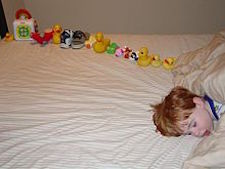
autism A young  autistic boy who has arranged his toys in a row.

Here’s a project that reminds me of why I like American local civic organizations so much. The French writer Alexis de Tocqueville touted these groups back in the 1830s and he was quite right to do so: They represent some of the best national characteristics of Americans -- compassion, generosity, neighborliness, energy and ingenuity.

Anyway, The Autism Project and the Bristol Rotary {Club} Charities Foundation have announced the opening of a new center to serve individuals, their families and healthcare professionals. Autism, of course, has been increasingly in the news as healthcare providers, researchers, news media and the general public have become more and more aware of how widespread it is and of the need to address it much more comprehensively.

There are an estimated 2,000 families in the East Bay (defined for this purpose as the towns of Barrington, Warren and Bristol) with people with autism spectrum disorder.

The Autism Project – East Bay Support Center will open Sept. 14. The primary location will be the Highlander Charter School, on Route 136 in Warren, but training and individual meetings with parent resource specialists can be scheduled at Mt. Hope High School, in Bristol, and the East Bay Chamber of Commerce, in Warren.

Before this there has been no center to serve this population in the East Bay; people had to travel to the west side of Narragansett Bay. But the hard-working and civic-minded people at the Bristol Rotary Club rolled up their sleeves to help meet this need.

Bruce Cox, president of Bristol Rotary Charities Foundation, said:

“Supporting this project is important to us and to other Rotary Clubs in the East Bay. We created an advisory council of community leaders committed to bringing support and resources to the project, and to reflect the community’s commitment to its citizens in need.’’

This is the sort of effort that helps keep America together.

For more information, please contact Joanne G. Quinn of The Autism Project at (401) 500-3146 or jquinn5@lifespan.org.

Read More
Commentary Robert Whitcomb Commentary Robert Whitcomb

Llewellyn King: In desperate search of sartorial dignity

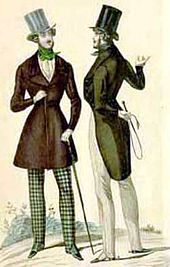
Dandys  


Robert Whitcomb afterword at end.

Men’s hats bit the dust in the time of Jack Kennedy. Oh, sure, there are baseball caps and various ersatz chapeaux to keep the top of a man cool or warm. But they aren’t grand symbols of taste on the head: boaters, derbies, fedoras, homburgs, panamas, trilbies and — forgotten glory — silk top hats.

More recently, the bell has tolled for the necktie — that useless but delightful fashion option for men. Who ever complimented a man on his unadorned neck?

I blame Hollywood and the whole state of California for suppressing fashion by promoting the idea that casual dressing is superior. The Golden State has upended the decent order of all things sartorial for men; reduced us to looking like bums in shapeless clothes emblazoned with the manufacturer’s name.

What became of the well-fitting — bespoke, if possible — suit or blazer, craftily cut to minimize bulge around the waist and maximize size at the shoulder? What of the fine shirt in linen, poplin, French twill, silk or even broadcloth? What has replaced the sense of social perfection of a man showing his cuffs in a double-breasted Melton blazer?

This decline in the male wardrobe I’ve borne with fortitude. But I believe that wardrobe disassembling has hit its nadir: men wearing suits without socks. Enough, enough, enough!

A senior executive of a California company, of course, showed up sans socks for a taping of my television program. I’ll give the man his due: he wore a decent suit, a passable shirt and a power tie. His feet supported quality loafers. But why no socks? Does anyone admire the male ankle? Is it a thing of beauty? Have I missed out on the charm of this lovely body part?

That horror wasn’t an isolated event: Recently, I dined at a French restaurant in Boston with a distinguished citizen — an ambassador plenipotentiary to a European country, no less — who wasn’t wearing socks. Does the State Department know? Is there a protocol for ambassadorial dress? Can down-dressers be rebuked? Is this matter addressed in Hillary Clinton’s copious emails?

We should be told in the president’s Saturday broadcast whether the nation is going to be allowed to go down the sartorial drain.

I’ve been checking out Chinese dignitaries. Every last one of them, as far as I can determine, wears socks. Even Russian President Vladimir Putin transgresses international standards of statesmanship only from the waist up. Shoes and socks prevail for this improbable Tarzan.

The passion to be casual is causing actual hardship. Nobody knows what to wear at important events. Some years ago, I participated in a U.S.-Japan business forum in Hawaii. The U.S. delegation head decided that polo shirts would be appropriate attire for men. But his dress decision didn’t reach the Japanese delegates, and they all wore suits. After lunch, though, the Japanese went casual and the Americans donned suits. Mutual red faces.

Does anyone really think a partner or associate in a big law firm feels good with his tummy rolls accentuated by a knit shirt advertising a crocodile? For women, this casual thing is a refined cruelty. You work like hell: law school, junior legal slave, and finally — hosanna — partner. Time for a fabulous Chanel suit, patent leather-toed slingbacks and heaps of pearls.

Not so fast. The managers have decreed it’s time to go casual, to bring out the jeans. The law-school look for work.

We have to make America look as if it cares again. Therefore, I won’t vote for any presidential aspirant who, if male, doesn’t wear a tie or plunges his feet into loafers without socks; or who, if female, wears flats and eschews leg and foot coverage. I’m saving my vote for a sartorially principled candidate.

Llewellyn King (lking@kingpublishing.com), an occasional contributor to New England Diary, is executive producer and host of White House Chronicle on PBS. He wrote this for InsideSources.com.

xxx

Afterword from Robert Whitcomb, New England Diary overseer:

I have generally found that I get better service while traveling wearing a jacket and tie than without. (It’s also often helpful to wear pants.) The sartorial dignity tends to elicit more respect.

But there are times when being relatively formal can cause you trouble.

Two incidents come to mind:

In May 1974 I took the ferry from Ostend, Belgium, to Folkstone, England. I wore a summer suit and a tie. I was the only one so attired of the hundreds on the boat. It was the tail end of the Hippie age and most of the other passengers wore T-shirts, cut-off jeans and so on. It looked like Woodstock-sur-le-mer.

So I stood out. For my pains, I was asked upon entry in England to enter a stuffy room in the immigration center in Folkstone, where I was interrogated for an hour on where I planned to go in England and whom I would be seeing. I had to provide numerous phone numbers and addresses connected with my itinerary before my release.

Clearly they thought that someone of such traditional appearance had to be up to no good. Perhaps I was a spy or an international business con man? (If only that had been the case,  I wouldn't have worried so much about the cost of that trip to Europe, which was mostly to see old friends on the Continent and in England.)

The next incident came in the fall of 2001, soon after 9/11. I was returning from Athens via Amsterdam to Boston, again wearing a suit and tie. Everyone else was a slob, of varying degrees, and some young men look liked the popular vision of Islamic terrorists. I look like, I’m afraid to admit, (almost a parody of?) a WASP – dishwater-blond hair, thin and so on.

Anyway, because I looked like I was covering up something nefarious by wearing business clothes, and/or because political correctness directed them to make me an example of how they did not unfairly single out the scruffy or the ethnically or religiously suspicious-looking, I was interrogated at great length by two inspectors about where I was going.

Finally, I asked them, politely: “Why the grilling?’’ One of the inspectors responded with no explanation and a slight smile: “You can’t be too careful about people going to Boston.’’

That is of course from where two of the planes used by the 9/11 terrorists took off on their flights to mass murder.

But everyone else was going to Boston too. My old-fashioned conventional appearance elicited the inquiry, either out of real suspiciousness or to make a display of their lack of bigotry in front of a couple of hundred other passengers.


Read More
Commentary Robert Whitcomb Commentary Robert Whitcomb

Where light is a Maine event

"The Summit at Dusk,''  by ROY PERKINSON, in his show "The Poetry of Light: New Work by Roy Perkinson,'' at Fountain Street Fine Art, Framingham, Mass., Sept. 10-Oct. 4.

The summit here is that of Cadillac Mountain, in Acadia National Park, Maine.

Read More
Commentary Robert Whitcomb Commentary Robert Whitcomb

Chris Powell: Stop manufacturing poverty

MANCHESTER, Conn.

Connecticut's impoverishment continues, as was recognized the other day by Hartford's school system, which decided to offer free breakfast and lunch to all students because more than half of them qualify as impoverished, the federal government will pay for it all, and keeping track of who qualifies and who doesn't is no longer worth the trouble.

It was the right decision -- somebody has to feed the kids, and some schools in Connecticut are already providing not only free breakfast and lunch but dinner as well. Indeed, some schools also are providing medical and dental services to their students, and good for them, since, again, somebody has to.

But this stuff raises urgent questions the rest of government is ignoring: Where are all this poverty and child neglect coming from and how can they be reversed? Why do so many kids today have poor parents or none at all?

How can it be a problem of a lousy economy? The federal and state administrations are both controlled by the "party of the people" and say the economy is great. (Of course that also means poverty no longer can be blamed on anyone named Bush or Reagan.) So what is it exactly and what can be done about it?

Eighty years ago during the Depression the journalist Upton Sinclair ran for governor of California on a platform called End Poverty in California. As Sinclair was a socialist who became a Democrat only to help his candidacy (the technique was not invented by Bernie Sanders), his platform was nationalization of industry, a progressive state income tax, and old-age pensions. Connecticut and the country already have progressive income taxes and the country already has a good Social Security system. As for nationalization, this is not the week to argue for having the entity that runs the state Motor Vehicles Department run everything else as well.

So what should a campaign to end poverty in Connecticut do?

Probably it should inquire into why most poverty in Connecticut is a matter of fatherless families, why 40 percent of the kids being born in the state are being born outside marriage, and why the fatherlessness rate in the cities approaches 90 percent.

Most social science in recent years confirms the huge correlation between childbearing outside marriage and poverty, so ending poverty in Connecticut would begin with understanding what causes this phenomenon and induces people to have kids before gaining a committed spouse and the education and training necessary to earn an income sufficient to support a family. After all, the fatherlessness phenomenon is relatively recent. People began behaving this way in such large numbers only in the last four decades or so, a period corresponding with the vast increase in government financial support for people behaving this way -- cash, food credit cards, medical insurance, housing vouchers, and such.

Of course financial assistance from the government is necessary for people who have encountered unavoidable problems. But what about avoidable problems? What about poverty that is self-inflicted and facilitated by the availability of government assistance for what is really antisocial behavior? Why does government fail to distinguish between such situations?

Government will always get less of what it taxes and more of what it subsidizes. So to end poverty in Connecticut, first government must stop manufacturing it.

Until government stops manufacturing poverty, schools that are providing free meals may not be able to do much more for impoverished students than to have the teachers take the kids home with them at night.

As for why government hasn't realized all this, Sinclair explained it: "It is difficult to get a man to understand something when his salary depends upon his not understanding it." If poverty was ever ended in Connecticut, half of government would be out of business.

Chris Powell is managing editor of the Journal Inquirer.

Read More
Commentary Robert Whitcomb Commentary Robert Whitcomb

Archiving print on paper

Artist Paul Rousso in front of one of his multimedia creations in his show through Sept. 27 at Lanoue Gallery, Boston.

Mr. Rousso has had a fine time using fragments of American commercial and popular culture.

In one of his artist's statements, he wrote:

"That which brought us out of the Dark Ages, the printed word, which also began with the Bible on Gutenberg’s press, is definitely in its final death knell. After hundreds of years of the printed word, ink on paper, is on it’s way out.

"Soon there will be no new magazines, no newspapers, no new books, everyone will have their reader, I-pad etc., to which they can download whatever they want, whenever they want, where ever they are. The last paper and ink to go away will likely be our paper currency. Perhaps the audience for my work is only just being born.''

Yes, the shift to digital will continue but as Anne Mangen and other scientific researchers have found, our understanding and retention of text is considerably higher when we read it on paper than on a screen. Life on a screen is already taking a big bite out of developed thought.

-- Robert Whitcomb

Read More
Commentary Robert Whitcomb Commentary Robert Whitcomb

A highly possessive property

-- Photo by John R. MacArthur

The practice of putting one's name on a commercial building is, of course,  nothing new, although Donald Trump may have taken it to new levels of narcissism. But the use of the possessive is, as on this building in Woodstock, Vt., a bit unusual.

Read More
Commentary Robert Whitcomb Commentary Robert Whitcomb

Al DeCiccio: A new look at the purposes of education

BOSTON I was able to hear Stanley Fish speak at the annual meeting of the Association of American Colleges and Universities in January 2004. Fish, a literary critic, had become dean of arts and sciences at the University of Illinois at Chicago (UIC)—a position he has now vacated. Fish has published widely, usually upholding the ideals of our nation’s colleges and universities in his writing. His stated aims for educators were that: educators should do their job (and only their job) well; that educators should not attempt to do the jobs of others for which they are not qualified; and that educators should not let others do their job.

Here’s a provocative passage from Fish:

"You can reasonably set out to put your students in possession of a set of materials and equip them with a set of skills (interpretive, computational, laboratory, archival), and even perhaps (although this one is really iffy) install in them the same love of the subject that inspires your pedagogical efforts. You won’t always succeed in accomplishing these things—even with the best of intentions and lesson plans, there will always be inattentive or distracted students, frequently absent students, unprepared students and on-another-planet students—but at least you will have a fighting chance given the fact that you’ve got them locked in a room with you for a few hours every week for four months.

"You have little chance, however (and that’s entirely a matter of serendipity), of determining what they will make of what you have offered them once the room is unlocked for the last time and they escape first into the space of someone else’s obsession and then into the space of the wide world.

"And you have no chance at all (short of discipleship that is itself suspect and dangerous) of determining what their behavior and values will be in those aspects of their lives that are not, in the strict sense of the word, academic. You might just make them into good researchers. You can’t make them into good people, and you shouldn’t try.''

Unless he is being playfully ironic, which is possible, I think Fish has it wrong, because I think these are the aims of education: that educators should assist students in waking eager from dreams to return to the conversations of their classes, clinicals and internships; that educators should encourage their students to share their social and cognitive gifts in those classes, clinicals and internships; that in those classes, clinicals and internships, educators should model for students how to have respect for the other; and that in those classes, clinicals and internships, educators should prepare students for transformative action.

What I want to emphasize is that educators can nurture what John Henry Newman described as “good members of society” through their teaching and the courses they develop, thereby preparing a generation of people who can help to mend a broken, post-9/11 world.

Such development can occur only if colleges and universities hold mature conversations, informed and robust dialogues that will lead to an abundance of ideas, strategies and solutions for repairing our globe. I believe in the abundance of talents or gifts that reside in our students and that we will all enjoy the fruits of that abundance on the campuses and in the communities we will all enter, refusing to acquiesce to the illusion that a scarcity of ideas, vision, ideals and character is the inevitable condition of human existence.

Engaging faculty and students

These mature conversations that educators orchestrate in their classrooms will be the preparation their students will need to engage in the public debates about the important questions of the day. How do we prepare students and faculty to hold these mature conversations? I have spent hours with the faculty members asking the following eight questions—questions that, when addressed with students, I think will be crucial to initiating these conversations in higher education institutions These questions are based on the work of Russell J. Quaglia, who has founded centers on student aspirations:

  1. How do I create a culture of belonging in my classroom?
  2. How do I try to be a role model in my classroom?
  3. How do I inspire accomplishment in my classroom?
  4. How do I build excitement in my classroom?
  5. How do I promote curiosity and creativity in my classroom?
  6. How do I promote adventure and risk taking in my classroom?
  7. How do I prepare those in my classroom for leadership?
  8. How do I prepare those in my classroom for taking responsible actions?

Attempting to answer questions like these will certainly help the faculty prepare students of character who may enter, with confidence and conviction, the various discourse communities to which they will be invited in their lifetimes.

Fish out of water?

To be fair, Fish may have a point in asking educators to do best what they have been prepared to do: teach, research, create, produce and disseminate. Sometimes, when educators allow their political ideologies and social programs to take precedence in their classrooms, they risk losing their hold on teaching the content for which they are credentialed and risk dismissing the educational needs of their students. Fish may also be following a tradition in offering his own perspective to the so-called culture of suspicion to which 19th-century thinkers such as Marx, Freud and Nietzsche contributed. In such a culture, the idea of character formation cannot thrive and will not be accepted.

Fish’s critique of character-building efforts by educators becomes less biting when one recognizes that his own theories about making meaning of texts are predicated upon a notion—social constructionism—which advances collaborative learning (i.e., dialogue among peers leading to understanding) as its pedagogical practice. In some ways, Fish wants it both ways. Fish asks faculty to nurture the intellectual life, in a community of knowledgeable peers, ultimately, teasing tender minds into thought—what he attempted to do at UIC after his tenure on the faculty at Duke. Fish surely must recognize that passionate engagement is the hallmark of the college or university. It is this passionate engagement which leads thinkers (Fish’s knowledgeable peers as well as those who wish to become known as knowledgeable peers—their students) through conversation toward community and the quest for truth and, ultimately, against that narrow perspective which curtails conversation and debate.

Roughly 2000 years ago, Quintilian recognized the importance of three disciplines—grammar, or the study of texts; rhetoric, or the production of texts; and logic, or the critical thinking ability to discern and to formulate a rational qualitative or quantitative argument—as he tried to assemble good men to carry on the ideals of Roman culture in his Institutes of Oratory. Today, in colleges and universities, we may return to these ideas and Quintilain’s trivium, even as we acknowledge new literacies brought about by technological advances, new genre studies that prepare young men and women for the public discourses that await them, debates about the environment, stem-cell research, human reproductive health and so forth.

General education and core curricula, at colleges and universities address the“greater expectations” advanced by the Association of American Colleges and Universities by preparing students for living in and contributing to a world in which individuality—human dignity, individual rights, personal choice—is more and more interconnected with global systems of commerce and telecommunications.

At colleges and universities, the curriculum can initiate this process by using reading, oral and written communication, critical and analytical reasoning, and reflection to explore the interaction among individuals and the various communities within which personal identity is cultivated. And they might advance these skills in multicontextual teaching and learning communities, both inside and outside the classroom. Educators have always accepted a responsibility to manifest hope and love in their teaching. These virtues, embodied by the professor and passed on to be embraced by the student, will help to heal our broken world.

Can education create from the outset conditions for students and faculty to engage in mature conversations about values and beliefs, maturity and self-understanding? Can it lend itself to being collaborative, multicontextual and transformative?

The engaged classroom within the “rooted” campus

National Urban Alliance President Eric Cooper points out that America practices a pedagogy of despair, particularly for persons of color and for lots of others too. Scholar Lisa Delpit writes, “When one ‘we’ gets to determine standards of learning for all ‘wes,’ then some ‘wes’ are in trouble!” Such a debilitating stance is very much like the oppressive banking approach to education that Brazilian educator Paolo Freire described and denounced almost 40 years ago: Its process involves “P”rofessors, with a capital P, depositing information into “s”tudents, with a lower case s, and withdrawing from the students the dividends of their deposits in exams and papers.

Fortunately, Cooper also advocates a pedagogy of hope, a problem-posing pedagogy in which learners become teachers and teachers become learners—face to face and virtually in educative communities of which the classroom is but one to which everyone contributes and in which everyone participates. By practicing such a pedagogy, argues Freire, people “develop their power to perceive critically the way they exist in the world with which and in which they find themselves; they come to see the world not as a static reality, but as a reality in process, in transformation.” Surely, it will take transformative thinking to show us all how to use our abundant talents to confront the racial, social, political, ideological and cognitive challenges of our post-9/11 world.

It should now seem abundantly apparent that a college rooted in mature conversations is a community in which those in it see how much everyone has to offer to it. In such a rooted environment, educators will neither be isolated nor sullen nor downtrodden, seeking sustenance elsewhere—at professional meetings, away from their campuses, away from the persons they should be bringing inside their disciplinary circles and teaching their particular habits of mind. The current practice for encouraging faculty to revitalize themselves is to send them away to professional meetings or to provide them sabbatical leaves of absence. And these are fine and necessary benefits to provide the faculty. But a complementary course of action might be to offer faculty strategies to fashion a sustaining community through transdisciplinary programming that aims at extending to all the academy’s constituencies an opportunity to be contemplative and then to take action that will effect positive societal change.

Parker Palmer, founder of the Center for Courage & Renewal, in Seattle, has noted that when we allow ourselves to be brought down by a perceived scarcity of resources, the end result will be isolation. As Palmer asserts, if we can be buoyed by the abundance that results from the sharing of resources, then the happier result is hope. The rooted academy is that place where people share—through dialogue, conversation and engagement—what gifts they have and are willing to receive these gifts, adding to what they already possess cognitively and socially, constructing a hopeful future.

Al DeCiccio is vice president for academic affairs at Labouré College, in Boston. This piece is based on a talk he prepared for the opening of the 2015-2016 academic year and was first published  on the Web site of the New England Board of Higher Education (nebhe.org).

Read More
Commentary Robert Whitcomb Commentary Robert Whitcomb

Mike Rispoli: Creating new local constituencies for news

There’s a crisis in journalism. Rapidly changing consumer habits have slashed demand for the print editions of newspapers and magazines, squeezed advertising dollars, and made thousands of media jobs vanish.

The news industry’s downturn has created another crisis: People across the country are finding it harder to get the information they need to participate in society and be engaged members of their communities.

The public loses the most when local news coverage disappears. According to the latestcensus from the American Society of Newspaper Editors, newsroom employment dropped by more than 10 percent in 2014 alone. And over the last 10 years, the number of newsroom jobs has plummeted 39 percent.

Each of those lost jobs means one fewer journalist representing the public interest and holding the powerful accountable.

There’s often a real distance between journalists and the communities they’re supposed to serve. To make local reporting more viable and vibrant, it needs to consider perspectives from outside the news industry. That’s why Free Press started News Voices. Our new project will connect newsrooms and communities and build a collaborative network of people invested in local journalism.

There’s no better place to experiment on ways to create this network than New Jersey, one of the most underserved states when it comes to local media coverage.

When Free Press surveyed Garden State residents about their local media, many noted that they craved more coverage of their communities. A significant share of the state’s 565 municipalities lacks a locally rooted news outlet. Many of the outlets that do exist ignore residents’ concerns.

Almost all survey respondents remarked on how the location of New Jersey — sandwiched as it is between the huge media markets of Philadelphia and New York City — means that important local issues often fail to get sufficient coverage.

“The past two decades have seen local newspapers bought out and either closed down, absorbed, or just hanging on with little local coverage,” said a survey respondent from Rumson, a New Jersey suburb. These papers are “merely a shadow of the past when each municipality was well covered.”

This isn’t an indictment of the media in New Jersey. Every U.S. newsroom is under pressure to do more with less, and delivering that extra load in a 24-hour news cycle can come at the expense of quality public-service journalism. Another loss: the capacity to cultivate the sources journalists need to cover vital local stories.

Local journalism is at its best when it’s community-driven. The News Voices project is about listening to what New Jersey residents have to say about their information needs — and bringing journalists to the table to hear those voices. By teaming up with reporters, members of the public can advocate for the kind of reliable, credible, and timely information they require.

We aim to create something that doesn’t yet exist: a constituency for the news. And by that I mean a constituency that not only consumes the news but also advocates for its future.

Mike Rispoli is the press freedom campaign director for Free Press (FreePress.net). This piece originated at OtherWords.org.

Read More
Commentary Robert Whitcomb Commentary Robert Whitcomb

Seeing ourselves in a mushroom

Peterson  

"Skinny White'' (HD C-print), by DAN PETERSON, in the show "Multiple Perspectives,'' at Adelson Galleries, Boston, Sept. 12-Oct. 11.

Mr. Peterson like to express abstract ideas through organic shapes like those of the mushrooms he finds in the Berkshires.

As the gallery notes say:

"These small organisms that inhabit the forest floor are hardly visible among the dense timbers and leaves, yet when spotted, they pop with rebellious hues.  The artist finds the most beautiful specimens along his daily walks, then isolates, photographs, and enhances them to a human-scale – allowing viewers to admire their microscopic intricacies.  The artist feels that we are connected to these beautiful organic shapes, and cannot help but see ourselves in their forms.''

Read More
Commentary Robert Whitcomb Commentary Robert Whitcomb

Chris Powell: Too late to stop the bad Iran deal

Connecticut isn't convulsed as Washington is over President Obama's nuclear inspections agreement with Iran. All members of the state's congressional delegation, all Democrats, have endorsed the agreement except Sen. Richard Blumenthal, who hasn't decided yet, and they wouldn't be supporting it if their constituents were furious about it. Nevertheless, last week U.S. Rep. John B. Larson (D-1st District), held a forum in his district with a State Department official who helped negotiate the agreement, Chris Backemeyer, the department's deputy coordinator for sanctions policy. Backemeyer answered critical questions from a well-informed crowd of about 80 people who, if not entirely convinced, hurled no tomatoes and appreciated that their concerns were taken seriously. Ready to keep taking punches, Backemeyer and Larson met afterward with several journalists.

While Iran may delay by a few weeks the access of international inspectors to any new suspected nuclear development sites, Backemeyer and Larson said radiation leaves enough traces that any cheating at such sites will be caught quickly.

They added that the release of $150 billion in frozen Iranian assets won't be as big a bonanza to Iran's international terrorism and subversion as many fear, since Iran will need to reserve much of the money to manage its international trade.

But Iran already is said to be within a few months of capability to build nuclear bombs, and if the country is determined to get them, the agreement and inspections won't delay it much. If Iran is found to be cheating, presumably the nations that were enforcing economic sanctions against Iran will reimpose them, but Iran will have regained its frozen assets and put them to use for terror and subversion, particularly against the United States and its ally Israel.

This seems to be what most distresses Americans about the agreement with Iran -- that it is not a peace treaty but actually will help Iran continue its de-facto wars against fellow members of the United Nations. Thus it is silly to believe that Iran really wants to comply with the agreement or that it will comply with it for long.

The world should have continued blockading Iran economically without exchanging sanctions for an agreement about nuclear weapons, as the blockade was causing great political discontent among Iranians and weakening their government, a fascist theocracy led by a fuhrer who claims to be implementing the will of God. Continuing the economic blockade would have been more likely to change Iran's behavior and perhaps even its regime than the agreement is likely to prevent Iran from making nuclear weapons.

But it's too late now and nothing would be gained by Congress's rejection of the agreement. President Obama induced this country's allies to put great effort into negotiating the agreement and they will not humiliate themselves in front of their own people and the world by reversing their position now because the president did not first build a consensus in Congress for his policy.

Without proof of Iran's violating the agreement, any attempt by the United States to reimpose sanctions on Iran would not have enough international support to be effective. Instead of isolating Iran, the United States would be isolating itself and breaking up the alliance against Iran, such as it is. There would be neither an economic blockade nor nuclear inspections.

The agreement with Iran is largely appeasement. But appeasement is increasingly the attitude in Europe, and while polls say Americans oppose the agreement, they are not likely to support another military adventure in the Middle East, the adventures in Afghanistan and Iraq having turned out so badly.

There's not much left for the United States to do here but regroup its allies to contain Iran, starting by giving Israel, Jordan, and Saudi Arabia what they need to defend themselves.

Chris Powell is managing editor of the Journal Inquirer, in Manchester, Conn.


Read More
Commentary Robert Whitcomb Commentary Robert Whitcomb

Thomas M. Paine: Save Boston Children's Hospital's healing garden

  garden

The Prouty Garden, at Boston Children's Hospital.

-- photo by Thomas M. Paine

For almost 60 years Boston Children’s Hospital considered the acclaimed Prouty Garden an integral part of its mission. The garden’s donor, longtime hospital trustee Olive Higgins Prouty, who had lost two young daughters, had the word of then-President William Wolbach that the garden she was endowing in 1956 would  remain forever.  That commitment is about to end unless the board quickly rethinks its plan to demolish the garden in a proposed $1.2 billion project to overhaul the hospital’s neonatal intensive-care unit and replace 82 semi-private rooms with single rooms with showers and clothing storage.

From its creation, Prouty Garden has been a sanctuary of healing where children confined for long periods can brighten their stays and hasten their recovery with daily visits to smell the flowers, discover the hidden statues, or see themselves reflected in the fountain pool. The expansive lawns, majestic dawn redwood, shrubs and perennial borders have provided respite for countless distraught families, visitors and overworked hospital personnel. Many children have spent their last moments on earth in the peace of Prouty Garden. It is where President John F. Kennedy came to grieve after the loss of his newborn son, Patrick Bouvier Kennedy. Originally designed by the famed Olmsted Brothers firm, Prouty Garden is “one of the most successful hospital gardens in the country,” according to healing-gardens authority Clare Cooper Marcus.

Prouty Garden advocates maintain that, frustrated with delay and wary of ballooning costs, the board has rejected some 17 plans that would preserve Prouty Garden. All 17 apparently had “fatal flaws.” The chosen plan was the only one considered that sacrifices Prouty Garden. Such decisions are never easy, and precisely what factors informed the decision process are not public. The board apparently, and no doubt reluctantly, concluded that Prouty Garden is not an inviolable part of the hospital’s mission but rather a temporary, expendable amenity.

To compensate for the loss, the selected design includes other landscaping. The renderings available online show a ground-level courtyard crisscrossed by walkways separated by raised planters of bamboos underplanted with groundcover. There are pocket parks in upper floors of the 11-story building, and a green roof. But does that settle the matter?

The fragmented greenspace in the preferred plan cannot compare with the expansive 23,000-square-foot Prouty Garden, with its spacious lawn under open skies, on firm ground, away from busy walkways, where kids can roam and families can find solitude. Even the largest green space in the design, the proposed outdoor courtyard, offers none of that immersive power, and the small pocket gardens on the upper levels can do even less. A green roof would hardly offer calm and security, let alone be planted with large trees or be visible from a hospital window. As to where families  would go to grieve alone, or terminally ill children  would spend their last moments, the proposed spaces are no substitute for Prouty Garden.

Board members have rightly emphasized the needs of the children over the needs of the hospital. But have they adequately considered how the garden itself serves children’s needs?  Environmental psychologist Roger Ulrich demonstrates that experiencing nature in a hospital garden even for five minutes can speed healing significantly, that hospital gardens are especially effective for calming stressed patients, family members, and staff, and that patient exposure to nature reduces health-care costs.[i]

But scientific facts don’t tell the whole story. The personal testimonials posted at saveprouty.org offer compelling evidence of the difference that Prouty Garden has made. Shelley Senai tells what happened after her daughter Juniper was born with protruding bowels: “All told, we spent 101 days living at your hospital during the summer of 2013 and I can’t think of a day that we didn’t spend in the garden, unless it was raining….We met other parents there and got a feel for the community that was happening in this big hospital around us.” Caitlyn O’Hara, a lifelong cystic fibrosis patient who has relied on Prouty Garden for three decades and is waiting for a lung transplant, says pocket gardens and roof gardens do not compare: “A manufactured rooftop garden, no matter how lovely, cannot replace the magic of the natural world.”

More than 11,000 patients, families, staff, donors and community members have signed a change.org petition to preserve Prouty Garden. While they recognize the need for the proposed new hospital facilities, they argue that the garden, which is no less essential to its patients, patient families, nurses,  physicians and other medical personnel, can and should be saved. Prouty Garden advocates are raising funds to press their case in ways that the board cannot ignore.

In New York City, trustees of the Frick Collection, a private art museum, recently decided to rethink expansion plans that would have eliminated the museum’s beloved garden for needed building space. If people were up in arms about the loss of a museum garden, how much more compelling and deep are the feelings evoked by the imminent loss of a hospital garden for sick and ill children.

I urge the hospital administration to declare a moratorium and go back to the drawing board. Surely, talented architects can produce a plan that avoids substantially altering the outdoor space that has been indispensable for the past six decades. Prouty Garden, which was intended to last forever, is about to be lost forever, unless the board changes course.

Thomas M. Paine, a landscape architect, is the author of Cities with Heart, about the importance of public open space. In 1976, he designed a corner of the Prouty Garden when he was an associate at Shurcliff, Merrill & Footit. He was a patient at the hospital in 1952.

Read More
Commentary Robert Whitcomb Commentary Robert Whitcomb

A summer place

starboardlight  


This is a lovely documentary by Nick Fitzhugh about a lost family summer place in Chatham, on Cape Cod.

It will be broadcast again on Rhode Island PBS, at 8 p.m. Sept. 24.

The film will evoke much nostalgia  in many New Englanders.

Read More
Commentary Robert Whitcomb Commentary Robert Whitcomb

David Warsh: Global economy zigs, macro-economics zags

“A small cloud, no bigger than a man’s hand…” 

The prophet Elijah’s most famous forecast (I Kings 18:44) – the sudden storm, deduced from inconspicuous change, that ended a three-year drought – became a cliché in business journalism in the 1970s, as one industry after another was overtaken by rapid change that it hadn’t anticipated.

There were no such metaphors in economics – an outgrowth of the conviction summed up by Alfred Marshall’s motto, Natura non facit saltum – Nature makes no leaps. For economists educated in marginalism and the differential calculus, it was an entirely natural way of thinking of the world.

Thus the news from China barely made a dent in the U.S.  in 1976. The Cultural Revolution was said to be winding down. Zhou Enlai died in February; an earthquake in Tangshan in July killed as many as 650,000 people; Mao Zedong died in September. The Mandate of Heaven, an ancient governing concept in Chinese civilization, had, it was said, perhaps been lost. Americans were preoccupied with recovery from a recession, a presidential election, the bicentennial celebration of their Declaration of Independence;, Europeans with their record-breaking hot summer.

Barely two years later, the Communique of the Third Plenum of the Eleventh Central Committee announced a plan to “shift the emphasis of our party’s work and the attention of the people of the whole country to socialist modernization.” People’s material lives must be improved, it declared; bureaucratic self-indulgence would not be tolerated. A “new Long March” would make China “a great modern socialist power” by the end of the twentieth century.

Six months later a highly promising  Republic of China (Taiwanese) army captain named Justin Zhengyi Lin slipped out of his uniform on the island of Quemoy in the middle of the night and swam a mile to the mainland port of Xiamin. Reunification was both inevitable and desirable, Lin had concluded and, as one of Taiwan’s most celebrated young citizens, he wanted to express his conviction as dramatically as possible, leaving behind a large family whom he loved.

It took the mainland authorities a little while to assess his motives – was he a double-agent? He wasn’t. By 1980, calling himself Yifu Lin (“Persistent man on a long journey”), he was studying political economy at Beijing University. Assigned to translate that spring for visiting Nobel laureate Theodore Schultz, Lin impressed the visitor.

By 1982, on a scholarship arranged by Schultz and approved by the authorities in Beijing, he was pursuing a Ph.D. at the University of Chicago. And 25  years after that, Yifu Lin became chief economist of the World Bank, the highest-ranking Chinese citizen yet to serve in that body. (All this is to be found in Evan Osnos’s excellent Age of Ambition: Chasing Fortune, Truth, and Faith in the New China, (Farrar, Straus, and Giroux, 2014.).

Lin was one of the very first movers in the epochal events that followed the third Plenum in December 1978. Millions followed, high and low, in accordance with Deng Xiaoping’s mantra, “Let some people get rich first.” By the end of the 20th Century, China was on the verge of becoming the second largest economy in the world. Average annual growth of 10 percent for 20 years had lifted half a billion people out of poverty and changed the lives of countless others around the world.

Entry of China into the world trading system was only one of those once-small clouds to have swiftly grown into all-encompassing developments in the ’90s and ’00s. The advent of the computer was another; financial deregulation after Mayday 1975 was a third. These are the changes we are concerned with here. Still others – gender convergence, for example – have only just begun to have their impact gauged.

Meanwhile, the cutting-edge economic theorists who had recently transformed macroeconomic policy-making by incorporating more psychologically-realistic agents in their models embarked on a new program. Again taking their cue from Robert Lucas, whose influential essay “Understanding Business Cycles” appeared in 1977, these “new classicals” would seek to devise a more satisfying explanation of the pattern of boom and bust that had characterized market economies for centuries.

Since the 1950s, business cycles had been understood mainly in Keynesian terms:  small models of loosely-described aggregates, consumption, investment, government spending, inflation and unemployment. These did well enough for short-term forecasting. They had moderated in the years since World War II, of course – economists now spoke of expansion and contractions, or recessions, instead of periods of prosperity and depression. But whatever their sources, alternating bouts of unacceptable levels of inflation and unemployment had become the central problem of economics.

Once economists had accepted the “rational expectations” postulate of forward looking, partially informed economic actors – and taken seriously Lucas’s critique of models that didn’t allow the actors they depict to take account of policy-makers’ intentions – those Keynesian models were useless for evaluating monetary and fiscal policies. Only process-oriented (“dynamic”) models based on the new mathematized understanding of general equilibrium would do.

Over the next 25  years, one candidate for the task seemed to succeed more than any other.  The theory of “real business cycles” produced reformulations sufficiently surprising that its enthusiasts routinely described it as “a scientific revolution.” These developments culminated in the award of Nobel Prize, in 2004, to Fynn Kydland, of the University of California at Santa Barbara, and Edward Prescott, then of the University of Minnesota. Within a decade, RBC theory was widely, but not universally, judged to have been discredited by the crisis of 2008.

This is the story of the 30-year boom, told against the backdrop of the development of “real business cycle” theory.  The  tools used to construct RBC theory were, in due course, employed to build models of other, quite different theories. The class to which they all belonged came to be described for the ambitions that all had in common – they were dynamic stochastic general equilibrium (DSGE) models.  Today the field is simply “modern macro.”

The tale of the 3-0-year boom is not the usual one about Margaret Thatcher and Ronald Reagan, though the British prime minister and the American president are certainly part of it.  It’s a long story, having to do mostly with how the Practicals of the world got far ahead of its economic theorists. I am going to barely sketch it here. Once again, I reluctantly split in half on the Web what in a better world would be an integral chapter. But it is an important story, critical to understanding what happens next.

.                                       The Three Worlds

Let’s begin by returning to the realm of growth theory, meaning the history of the division of labor. A new chapter in global specialization and interdependence is clearly what the China story is about.

Readers of "Adam Smith, Theorist, '' the fourth episode in this serial, will remember the argument.  Smith’s Wealth of Nations contained not one but three “thinking caps,” or paradigms, as we call them now, There was price theory, as represented by the metaphor of the Invisible Hand; growth theory, conveyed by Smith’s disquisition on the pin factory; and monetary theory, symbolized by the metaphor of “Daedalean wings.”

Economists became preoccupied with price theory and left specialization and money to others.  Monetary theory remained inside the tent of economics, though in a junior place, with much of its work done by central banking practitioners; growth theory operated at the fringes of the tent, or , more commonly, outside of economics altogether: Charles Babbage, John Rae, Friedrich List, most famously Karl Marx, and his 20th Century epigone Joseph Schumpeter. John Stuart Mill smoothly effected the separation of specialization out of economics when he wrote, in 1848, in Principles of Political Economy:

"In so far as the economical condition of nations turns upon the state of physical knowledge, it is a subject for the physical sciences, and the arts found on them. But in so far as the causes are moral or psychological, dependent on institutions and social relations, or on the principles of human nature, their investigation belongs not to the physical but to moral and social science, and is the object of what is called Political Economy.''

For the next  80 years, as Germany and Japan industrialized, they learned economics from the British, French, Austrians and Scandinavians; economics learned measurement from the Germans.  The European powers raced to establish imperial dominion over portions of the Earth not previously claimed. What today we call “development economics” was mostly handled by students of Karl Marx. They took power in Russia, in 1917.

Then came the Great Depression.  John Maynard Keynes, though he had as a young man worked on Indian currency problems, was thoroughly Eurocentric.  Schumpeter, Hayek and Irving Fisher were hardly less so.  H.W. Arndt, of Oxford University, later summarized James Meade’s overview of “business activity” for the 1938 World Economic Survey of the League of Nations this way:

"Developments in the United States, Western Europe, and Japan, were covered in some detail in twenty-six pages; the “primary producing countries” (Australia, Canada, New Zealand, Argentina, Brazil, Chile; Hungary, Rumania, Yugoslavia) rated one paragraph and a table; the Balkans, the Dutch East Indies, one sentence each; South America, one paragraph; all the rest, including all of Asia (except Japan), Africa, and the USSR, were completely ignored.''

With the end of World War II approaching, U.S. President Franklin Roosevelt insisted that the European nations must give up their colonies. Decolonization eventually happened, by fits and starts. The climactic Chinese Revolution in 1949 accomplished the rest: the division of the world into three great blocs of nation-states – the so-called First World (the industrial market economies), a Second World (the communist nations), and a Third World of new countries in Africa and Asia, known as “less developed countries,” or LDCs.

These were the circumstances that obtained after 1945.  For the communist nations there would be central planning, a discipline known in the Soviet Union as mathematical cybernetics; for the Third World, development economics. Economists in the West would pursue the  “Keynesian Revolution. In the story I’ve been telling in this serial, that was only the beginning of “the New Economics.”

.                              Solow – Establishing the Trend

From the outset, Keynesian economists had been preoccupied with preventing the recurrence of massive, involuntary unemployment. Gradually it grew apparent that the industrial economies, the U.S. economy in particular, were more robust and stable than had been expected. By the early 1950s, the new National Income and Product Accounts made it clear that the U.S.  economy was growing more swiftly than others. How to account for national growth rates became one of the outstanding problems.

It fell to Robert Solow, of MIT, to sort out the issue.  He had inherited a pair of models constructed by two older Keynesians, one by Roy Harrod, from 1939; the other by Evsey Domar, from 1946.  Both depicted growth as a very fragile process, prone to runaway booms and interrupted by long depressions. That didn’t seem to be the case with the U.S.  economy in the post-war world.

A gifted craftsman in the new techniques of mathematical model-building, Solow solved the problem through the simple expedient of permitting substitution. In place of the fixed capital/output ratios of the earlier models, he adopted an equation known as a production function, one that allowed for substitution between capital and labor. He illustrated the relationship with a simple graph, relating changes in capital intensity to the savings rate. The model was sleek and simple and old-fashioned; just population growth, capital formation and productivity growth. It had little in common with the attempts to relate consumption and investment and government expenditure that dominated the Keynesian agenda of the ’50s.

The next year Solow tested it empirically, using U.S.  GNP data for the period 1909-1949. After he estimated the production function by which workers in factories turned capital investment in machinery into output, he found that he had only explained about 15 percent of the reported growth of output for those years.  Something like 85 percent of growth had to be imputed to the broad concept of technical progress.

This was “the Residual”—the portion of increased GDP unexplained by capital accumulation and population growth.  There now began a series of efforts to refine measurement, mostly through the then-new concept of human capital, meaning investment in education. None of this altered the basic finding very much at all.  New technology, including improvements in organization and the like, account for 60 or 70 percent of growth. .

Solow experimented with various improvements.  Gradually he returned to macroeconomics and, in particular, the Phillips Curve. For more than a decade, growth seemed to be a settled topic.  By the time that Solow received the Nobel Prize for his work, though, in 1987, Paul Romer, 32, had brought interest in growth back to a boil.

.                               Romer – opening things up

Romer had been, like Lucas, a University of Chicago undergraduate. Like Lucas, he had gone away to graduate school, before returning to Chicago to complete his graduate work: Lucas to the University of California at Berkeley, where he had studied history for a term with David Landes; Romer, to MIT where, after two years, he passed his economics field exams. After a year auditing courses at Queens University in Kingston, Ontario, while his wife completed her medical training, Romer returned to Chicago and wrote a dissertation supervised by José Scheinkman and Lucas.When he went on the job market in 1982, Solow and others sought to persuade him to return to MIT. He took a job teaching at the University of Rochester instead.

Romer’s dissertation appeared in 1986 as “Increasing Returns and Long Run Growth.” He had used the Arrow framework of contingent states, embedded in a model developed by Tjalling Koopmans and David Cass, to produce a dynamic account of the growth process.  It was close in spirit to the Solow model, but because consumption was decentralized.  Instead of being treated as a given, the savings rate thus became a matter of choice for actors within the model.  This meant that all manner of policies could influence the outcome.  The effect was electric: economists love to manipulate policy levers. Suddenly growth theory was booming again.

Tucked away in Rochester, Romer discovered a problem. He had set out to depict profit-seeking investment in research and development.  But there was no reason to undertake it in his model; the math he had employed wouldn’t let him do it: Every new bright  idea was instantly copied away before it could earn a return, through the magic of uncompensated “spillovers.” (I do a better job of telling this somewhat complicated story in Knowledge and the Wealth of Nations: A Story of Economic Discovery (Norton, 2006)).

So Romer turned to a bag of tools designed sixty years before to capture just such situations, the convention known as  monopolistic competition. He wrote temporary monopolists into his model – holders of trademarks, patents, copyrights, and, most of all, the slowly-wasting secrets we call know-how. Now he had an economy in which there was plenty of reason to invest in new products and new knowledge about how to make more.

But no longer did his model exhibit the kind of perfect competition associated with price system as governed by the Invisible Hand.  Now someone would have to make some rules governing  intellectual property. This was apostasy, at least in the Chicago tradition.  Then in January 1988, the University of Chicago hired him back as a full professor.

.                              Lucas – emphasizing education

When Romer returned to Chicago from MIT to write his dissertation in 1980, it didn’t take a genius to recognize that vast changes were occurring on the global stage.  Japan as Number One, by Ezra Vogel, was on best-seller lists. The economies of Singapore, Hong Kong, Taiwan and Korea were the “East Asian miracles,” The OPEC nations were spending heavily on infrastructure – and arms. Milton and Rose Friedman, who in their highly successful PBS television series Free to Choose had discussed Hong Kong, were invited to lecture in Beijing.  Paul Samuelson’s introductory text, which in its first edition, in 1948, mentioned the underdeveloped world precisely twice, and then only in passing, in its 1980 edition dwelt on the topic “from the front flyleaf to its chapter 5, ‘Income and Living Standards,’ to many of its last hundred pages,” as noted by H.W. Arndt in Economic Development: The History of an Idea.

Nevertheless, there was considerable excitement when Robert Lucas delivered his Marshall lectures at Cambridge, in 1984 and chose as his topic “The Mechanics of Economic Development.”  Lucas was already recognized in many quarters as the leading macroeconomist of the day; but the University of Cambridge, was not one of them. For 150 years the ancient English university had been the world capital of economics, but by now had been pretty decisively displaced by Cambridge, Mass., and Chicago. It was expected that Lucas would talk about rational expectations and monetary theory.

Instead, he asked to speak about growth.  It was a new field for him, he explained, but  he didn’t want to spend the second half of his career defending what he had done in the first. He didn’t say that recently, Edward Prescott, the friend and collaborator with whom Lucas had laboriously operationalized Arrow’s apparatus of contingent states, recently had begun a new program of research. Lucas had used the new tools of dynamic programming to put  the topic of money at the top of the profession’s docket. Now Prescott was using the same methods in an attempt to take it off again. Lucas decided to spar with Romer instead. The younger man’s work hadn’t been published yet, but the members of the Chicago department had been arguing among themselves about its significance for two years.

By assigning so great a role to “technology” as a source of growth, both Solow and Romer necessarily were assigning too small a role to alternative possibilities, Lucas argued.

"We say that Japan is technologically more advanced than China, or that Korea is undergoing unusually rapid technical change, and such statements seem to mean something (and I think they do). But they cannot mean that “the stock of useful knowledge” (in Simon Kuznets’s terminology) is higher in Japan or China, or that it is growing more rapidly in Korea than elsewhere. 'Human knowledge' is just human, not Japanese or Chinese or Korean. I think when we talk this way about differences in technology across countries, we are not talking about knowledge in general, but about the knowledge of particular people, or perhaps particular subcultures of people…. We want a formalism that leads us to think about individual decisions to acquire knowledge, and about the consequences for productivity. The body of theory that does this is called the theory of human capital….''

Already Romer was moving in the opposite direction, assigning still more importance to the economics of new goods and services. The formalism he was working on would lead economists to think about IBM, Microsoft, Google, Toyota, Samsung, and the Chinese Academy of Sciences. The excitement would spread. Economists studied Korean chaebol vs Japanese zaibatsu as engines of growth; the significance of banks; patents vs. prizes; the origins of the Industrial Revolution; the impact of various “general-purpose technologies” (steam, electricity, computers, the germ theory and public health); and, perhaps above all, the importance of trade.  The world was changing and economics was changing with it.

But the sparring with Lucas didn’t last for very long. After 18  months Romer quit his appointment at Chicago and in 1989 moved to California, where his physician wife enjoyed better employment opportunities. He spent a year at the Center for Advanced Studies in the Behavioral Sciences, at Stanford, taught for six years at the University of California at Berkeley, for 11  more at the Graduate School of Business at Stanford, where he won its distinguished teaching award prize in 1999, but he all but stopped publishing economic research. He founded a publishing company, quit Stanford to run it, sold it, and with the proceeds started a foundation to pursue the founding of  “charter cities” in empty spaces in developing nations, loosely based on the concept of charter schools. After two last-minute failures to launch, in Madagascar and Honduras, he is still looking for his first opening.

Romer returned to academia in 2010 as a professor at New York University’s Stern School of Business.  In January of this year he

launched an attack ondescribed at as Lucas’s tendency to “mathiness,” an accusation of bad faith which he has since refined in a series of blog posts. He may yet find ways to frame the issues better, but so far Romer’s campaign has mainly elicited curiosity.

.                               Prescott – maybe money doesn’t matter after all

Let’s go back to that Lucas essay, “Understanding Business Cycles,” in 1977. In the turbulence surrounding everything else Lucas was involved in — the success in reframing monetary theory, the new doctrine of policy ineffectiveness, the beginnings of “new growth theory – it  was easy to overlook what happened next.

Before Keynes, Lucas wrote, business cycles had been regarded as one of the main mysteries in all of economics; and incorporating cyclical fluctuations into general equilibrium theory, in which, in principle,they shouldn’t exist, one of its greatest challenges.  The Keynesian Revolution had redirected the effort to, as Lucas put it, “an apparently simpler question of the determination of output at a point in time, taking history as given.” Meanwhile, Keynesian macro had enjoyed the fruits of a second revolution (which, Lucas? said, owed more to the Dutch econometrician Jan Tinbergen than to Keynes)  in the level of precision and explicitness with which theories were formulated. Business-cycle theory had stagnated all the while.

"The economically literate public has had some forty years to become comfortable with two related ideas: that market economies are inherently subject to violent fluctuations which can only be eliminated by flexible and forceful government responses; and that economists are in possession of scientifically-tested knowledge enabling them to determine, at any time, what these responses should be.''

Never mind that public skepticism about economists’ pretensions had grown sharply in the 1970s. By now, Lucas said, the profession itself had doubts about the validity of the second proposition: it was ready to re-examine the first. The alternative possibility – the view that Lucas shared with Milton Friedman – was  that the economy was inherently fairly stable and that clumsy government policies undertaken to offset private-sector instability had been the root cause of the cycles over the years. Lucas wanted to put competing hypotheses to a test. But how?

Little noticed was the phrase with which Lucas had defined business cycles as “movements about trend in gross national product in any country…” This was a very different definition from that of the Business Cycle Dating Committee of the National Bureau of Economic Research. The NBER approach is a kind of statistical “thick description” that has evolved over nearly a century of comparing each new recession or expansions to the others. This agnostic index-building was condemned in 1947 as “measurement without theory” by the Cowles Commission, but it has endured, highly valued by those who believe that each bust probably is best understood in terms of the previous boom.

If not from the NBER, where to get a trend from which to discover the cycles to be explained?

In 1982, Edward Prescott, Lucas’s former collaborator, proposed a different way to build an apparatus with which to perform the tests that Lucas wanted.  With Fynn Kydland, his former student, he would take their trend from the neoclassical growth model – the Solow model, in the high-tech general equilibrium version fashioned by David Cass and Tjalling Koopmans.  They would derive their business cycles from that, using US quarterly data for the period 1950-1979. With his CMU colleague Robert Hodrick, Prescott produced a filter to remove the trend in order to leave the residual data – the cycles. With Kydland, he built a model that seemed to fit. Unemployment in the NBER version became “fluctuations in hours allocated to market activity that are too  large to be accounted for by changing marginal pructivities of labor as reflected in real wages.”

It turned out they didn’t need an unsteady hand on the money supply to explain the half-dozen post-war recessions Prescott and Kydland had identified, or even any  shock.  A constant series of small shocks would do.  Prescott called them “technology shocks.” He and Kydland  put investment dynamics at the heart of their model.  They called it Time to Build and Aggregate Fluctuations. The following year, inReal Business Cycles, John Long and Charles Plosser argued that money tends to simply track these ”variations in the real opportunities of the private economy,” rather than causing them. Economists since David Hume, including Friedman and Lucas, considered that money somehow played a vital role in business fluctuations.  Prescott’s argument was, on many levels, a surprising one.

This is no place to go into the intricacies of the new classical view of business cycles In the circles where high macroeconomic theory is done, RBC theory was the straw that stirred the drink after 1982, prompting myriad alternative systems to be created and propounded, gradually forcing the transition to the methodological style known as decentralized stochastic general equilibrium models.

Fortunately,Michel De Vroey, a professor of economics at the University of Louvain, has tracked the debates between the New Keynesians and New Classicals over the years, patiently and dispassionately. His book, A History of Economics: From Keynes to Lucas and Beyond (Cambridge, 2015), promises to be a landmark event in circles extending far beyond the history of thought into the controversies surrounding economics in the present day.  For an edifying foretaste, see "What Can Civil Society Expect from Academic Macroeconomics?''

Debates there were, though they remained recondite for the most part. Real Business Cycle Theory met resistance every step of the way from those who considered themselves practical, practicing macroeconomists. Lawrence Summers, of Harvard University, led the way in 1986 with "Some Skeptical Observations on Real Business Cycle History''.  N. Gregory Mankiw, also of Harvard University, in "Real Business Cycles: A New Keynesian Perspective,'' pointed out the irony that the theory appeared just as Federal Reserve chairman Paul Volcker demonstrated how powerful an effect monetary policy could have on prices, employment and output. Maurice Obstfeld and Kenneth Rogoff observed,  “A theory of business cycles that has nothing to say about the Great Depression is like a theory of earthquakes that explains only small tremors.”

But remember, this was the period that had been dubbed “the Great Moderation,”  In 2004, when the Nobel Prize was awarded to Prescott and Kydland, “for their contributions to dynamic macroeconomics: the time consistency of economic policy and the driving forces behind business cycles,” small tremors had been the rule for more than 60 years.

And so it was here that matters stood in 1982 – small clouds of discussion, in Cambridge, in Chicago, in Minneapolis-St. Paul, none bigger than a circle of a few academic economists – when the 25-year boom began.

.                                                              xxx

- See more at: http://www.economicprincipals.com/#sthash.1rfV3r2P.dpuf

David Warsh is proprietor of economicprincipals.com and a long-time economic historian and financial journalist.

Read More
Commentary Robert Whitcomb Commentary Robert Whitcomb

Those deans of women

Deans of Women and the Feminist Movement, by Kelly C. Sartorius, Palgrave MacMillan Press (Historical Studies in Education) St. Martin’s Press, 2014. Remember when every coeducational college or university had a “Dean of Women”? It was a powerful and influential position, at least for the “coeds” under her charge (and it was always “her”). The dean of women was expected to provide guidance, protection and support for “coeds,” when women were a minority among undergraduates. How things have changed.

The position no longer really exists and perhaps with reason. Now that the majority of undergraduate students are women, unplanned pregnancy no longer is as big an impediment for women to completing college, marriage is less an expectation, and women have many more educational and professional opportunities than previously, one might consider the position of “Dean of Women” an anachronism, an historical artifact no longer needed.

Indeed, women are now university presidents, academic deans and widely integrated into post-secondary education at all levels. But not so long ago, that was far from the case.

Until the 1970s, a dean of women was one of the very few professional roles for women in administration in post-secondary education, indeed in nearly all aspects of higher education. To get there and make any sort of difference in the lives of her charges, she had to be fierce. And foresighted.

As Kelly C. Sartorius writes in Deans of Women and the Feminist Movement, this (woman’s) position sometimes challenged itself and its charges. Until the feminist movement began on coeducational college campuses in the 1970s, female college students had, in many respects, only deans of women to shelter and protect them, to act in loco parentis, and if they were lucky, help them become strong individuals.

While some of these deans provided career counseling aimed at making their charges able to support themselves financially, should the often-anticipated “Mrs.” degree not materialize, much of their work was directed at caretaking and maintenance of female college students. But there were deans of women who looked out rather than in, and this is where Sartorius focuses her book.

By taking a close look at the life and career of a very activist dean of women at Kansas State University, Emily Taylor, the author presents the case that this “women’s profession” foreshadowed, indeed shaped, contemporary circumstances in higher education for women. It’s an interesting perspective. Could a dean of women who was something of an early if unspoken feminist—along with her dean colleagues at other colleges and universities—prepare, even shape themselves, their institutions and their students for the enormous social and political changes, feminism and changing expectations of and for women in particular, that many now take for granted?

Kelly Sartorius is herself a good example of the influence of those activist deans of women such as Emily Taylor—women who worked within the establishment toward and with the deep and broad social changes that started only four decades ago. While working as a university administrator (in development), Sartorius earned a doctorate in history; this book is based on her dissertation.

The book itself is a nice combination of well-researched, thoughtful historical perspective, and interesting reading. (For example, how did public universities and their female students shape antiwar activism, racial issues and radical feminism?) More importantly, it is documentation of how the then-few professional women in higher education accommodated or, as Sartorius argues, enabled changes in higher education that expanded the personal, social and professional development of young women in college.

Times have changed. It remains important to be aware of how much that is the case and how it happened. This book is a good reminder.

Reviewed by Jane Sjogren O’Neil, an educator, economist and consultant. This piece originated on the Web site of the New England Board of Higher Education (nebhe.org).

Read More