Vox clamantis in deserto
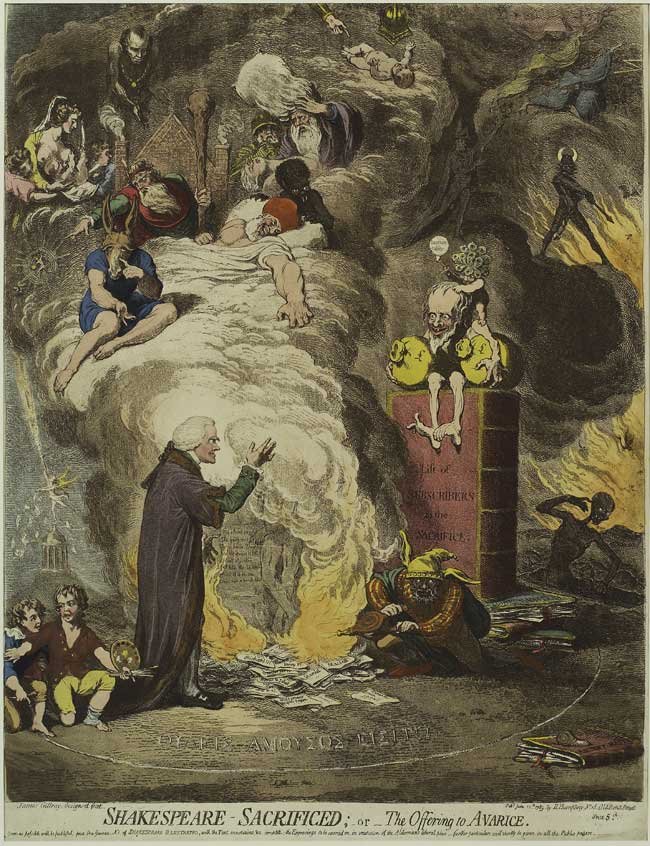






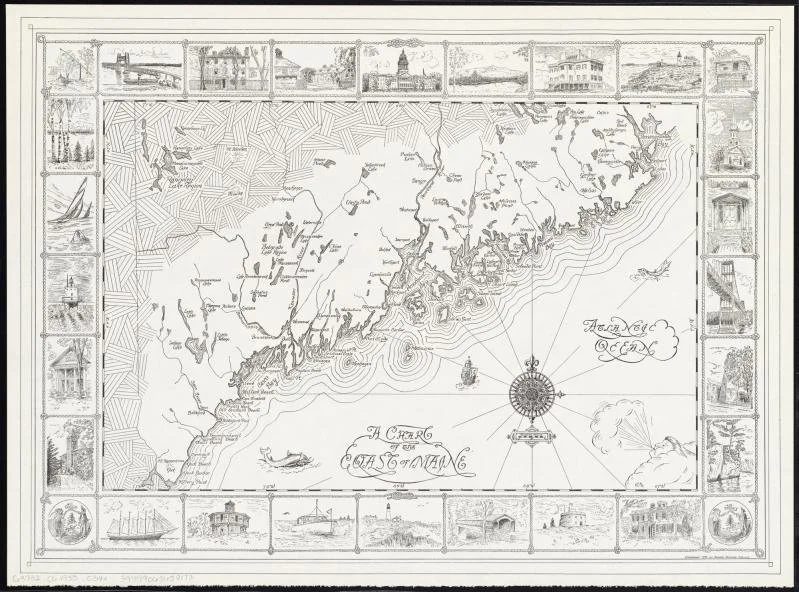


Grand old kitsch
 "Independence'' (archival pigment print), by NANCY GRACE HORTON, in her ''Slyly Fractured'' show at the Trustman Art Gallery, at Simmons College, Boston, Sept. 2-Oct. 1.
Few people combine patriotic fervor with kitsch as relentlessly as do Americans.
Robert Whitcomb: In the Amazon jungle

Amazon is an impressive if rather creepy company, with its style set by its cold, “data-driven’’ founder/CEO, Jeff Bezos. An Aug. 15 New York Times piece, “Inside Amazon,’’ laid out the travails of the monopolistic and Darwinian enterprise’s white-collar workforce. Their issues have gotten more attention than the much worse Dickensian conditions of the blue-collar employees in its warehouses and the company’s relentless accumulation, like the also Orwellian Google’s, of our personal information. Amazonianism’s causes?
One is in the mirror. Americans have grown addicted to buying stuff online -- of course, the cheaper the better. They seem to want to avoid face-to-face interactions in stores -- and community engagement in general -- and Amazon’s power ensures that they’ll get low prices, at least for now (see below), even as their local stores close because of such online competition.
The preference for communicating via screens rather than person-to-person is especially common among the young, who grew up in the Internet Age. Human-resource managers have told me that young job applicants often don’t look them in the eye because in-person encounters make them anxious.
The disappearance of many well-paying jobs, and static (or worse) compensation except for top executives and investors, have encouraged consumers to seek out cheaper stuff than a few decades ago. But – irony of ironies! – Amazon and other high-tech automators have helped destroy good U.S. jobs in their “data-driven’’ mania to take full advantage of the international low-wage, cheap-goods machine.
Physical-store chains such as CVS and Home Depot are doing their bit to kill jobs --- by, for instance, installing automatic checkouts. I try to boycott stores with these machines because I know that each means the loss of another entry-level or second job for someone who needs it. This makes me feel better for a few minutes.
If Amazon’s workplace brutalities offend some consumers, they could resume shopping in their own communities and thus help employ some of their neighbors. Most won’t.
And look to Washington, where ideology and campaign contributions ensure that the Justice Department’s Antitrust Division doesn’t go after such monopolies as Amazon and Google. Until about 1980, Republican and Democratic administrations actually enforced laws against monopoly. The long disinclination to do so will hit consumers hard when Amazon, which has been undercutting other retailers to gain maximum market share, killing many brick-and-mortar competitors, suddenly jacks up prices big time.
Also consider the collapse of the private-sector union movement. If there were unions at Amazon, the Third World work environment would quickly go away. Gilded Age working conditions helped spawn the union movement in the first place. Now, management’s utter dominance has employees ready to put up with anything to keep their jobs.
Meanwhile, the “Big Data’’ revolution is turning workers into organic robots, soon to be replaced by real, inorganic robots. When every move of workers is measured for maximum productivity and profit potential, as at Amazon, kindly treatment of employees pretty much disappears. Employees are mere data points.
This process started with assembly-line and other blue-collar workers. The generally affluent types who read, say, The New York Times didn’t care that much. But turning employees into metrics is now heading rapidly up the food chain. Physicians, lawyers, tech engineers, middle managers and journalists (monitored for the number of Internet clicks their work gets) are being measured daily by senior executives who see their employees as entirely fungible and disposable.
And don’t expect the executive suite to share the riches from this speed-up with lower-level employees. The tendency for more and more of the wealth of companies to be shared by fewer and fewer people continues apace. We’re on a selfishness wave.
Amazon has created a fascinating machine for distributing goods. (Its delivery drones are next -- maybe equipped with surveillance gear?) Mike Daisey, writing in The Guardian (“Amazon’s brutal work culture will stay: bottom lines matter more than people,’’ Aug. 22), quoted comedian Louis C.K. as saying about such enterprises that “everything’s amazing and nobody’s happy’’ . Well, some are.
Anyway, most Americans seem to adore Amazon, which will repay them good and hard.
xxx
Lovely dim late-summer light today, and leaves are falling off the plane trees from sheer exhaustion.
Robert Whitcomb (rwhitcomb51@gmail.com) is a Providence-based editor and writer, a partner at Cambridge Management Group (cmg625.com) and a Fellow of the Pell Center, in Newport, He used to be the editorial-page editor of The Providence Journal, the finance editor of the International Herald Tribune and an editor at The Wall Street Journal, among other jobs.
Dark and windy city

"Unquiet City XXA'' (pigment print on canvas) in the "Boston Through the Eyes of Robert Hesse Collection'' at the Patricia Ladd Carega Gallery, Center Sandwich, N.H.
I must admit that I have always found Boston unfriendly, class-ridden, too ethnically and religiously tribal and too windy. This picture reminds me of the chilling scenes outside my father's office on Federal Street in downtown Boston more than 50 years ago, when he worked for a long-dead Boston company called the United Shoe Machinery Corp. in a stepped, gold-topped Art Deco skyscraper put up right before the Depression. That slump lasted, off and on, into the '50s in Boston, at least in some ways. The Brink's Robbery was a nice distraction.
Poor John Cheever, the novelist and short-story writer who grew up just south of what we headline writers used to call "The Hub,'' used to get so depressed and anxious when he returned to Boston that he'd get drunk and sometimes be found like a bum sleeping on a bench in Boston Common.
Of course, he did have various "issues,'' as they say. But growing up in the downcast environment of Greater Boston was one of them.
The city is a lot spiffier now than it was a few decades ago, but no friendlier.
I'll take Manhattan., or even Brooklyn.
-- Robert Whitcomb
Fleeing the Islamic world
Think of the many millions who would flee if they could the brutalities of parts of Islamic society, which trap them in bigotry, cruelty, corruption, poverty and ignorance. But just look at how many thousands are fleeing, despite the perils involved. Review current migration and refugee maps. The migrations are almost entirely to the West, because the West is indeed best.
Chuck Collins: Our 'oligarchy with unlimited political bribery'

Is America’s political system controlled by a small financial elite? One former president thinks so.
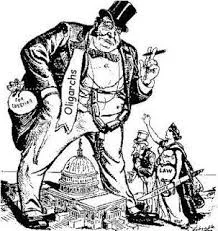
Almost 40 years after he was elected, former President Jimmy Carter commented recently that our political system is now “an oligarchy with unlimited political bribery.” He may be right.
For the last three decades, wealth has concentrated in fewer and fewer hands. Just how few? As of 2013, the wealthiest 3 percent of households in the United States held more than half of all private wealth.
All that concentrated wealth translates into concentrated political muscle — including the power to influence elections.
As of this summer, over half of all donations to Republican super PACs came from just 130 wealthy families and their businesses. Democratic candidates had a wider base of small contributors, but also plenty of big-money donors of their own.

We’re now living through the billionaire primary. Six months before a single vote is cast in New Hampshire, the field of candidates is being selected and winnowed by billionaire donors.
Indeed, it seems like a presidential hopeful must have at least one billionaire backer — and ideally several — to be considered a credible candidate. Roofing billionaire Diane Hendricks gave $5 million to the Scott Walker campaign. Houston billionaire Toby Neugebauer gave a $10 million boost to Ted Cruz. Oracle CEO and billionaire Larry Ellison gave $3 million to Marco Rubio.
This political-patronage system effectively disenfranchises ordinary voters.
Since the Supreme Court’s Citizens United decision opened the floodgates for unlimited political sending, the pace of contributions has only escalated. Super PACs have already raised $258 million for this election cycle — more than 16 times the total from this point in the 2012 race.
Unfortunately, this is just the tip of iceberg.
The wealthy are major contributors to a vast array of other lobbying groups masquerading as tax-exempt social welfare organizations. The Koch brothers alone have vowed to give and raise nearly $1 billion for these kinds of groups and related work by think tanks and universities during this electoral cycle.
These organizations don’t have to disclose the identity of their donors, even as they increasingly influence our elections.
The Federal Election Commission has effectively thrown up its hands in attempting to regulate this secret money. As a result, untold additional millions will flow through these tax-exempt corporations, providing the super-wealthy with another avenue to influence the outcome of state and federal elections.
This isn’t just a new Gilded Age. As Campaign Finance Institute President Michael Malbin says, this may even be a new “Platinum Age.”
What can we do?
Encouraging movements are forming in response to the corruption of our electoral system. So far, 70 former members of Congress have come together to form the bipartisan ReFormers Caucus to press for campaign finance reform. And a new group, 99Rise, has launched a campaign to expose and eliminate secret money from our campaign finance system.
Carter laments that the present system of campaign finance “violates the essence of what made America a great country in its political system.”
A century ago, Louis Brandeis expressed similar fears for our fragile experiment in self-governance. “We must make our choice,” the future Supreme Court justice said. “We may have democracy, or we may have wealth concentrated in the hands of a few, but we can’t have both.”
We must make our choice: democracy or rule by the rich?
Chuck Collins is a senior scholar at the Institute for Policy Studies (IPS-dc.org) and the co-author, with Bill Gates Sr., of Wealth and Our Commonwealth: Why America Should Tax Accumulated Fortunes. This originated on OtherWords.org.
We're all stereotypes

"Stephen, Coach/Educator'' (silver gelatin print), by KEVIN J. BRIGGS, in the show "Stereotypes: A Conscious Look at Race, Faith, Gender and Sexual Orientation,'' at Gallery Seven, in Maynard, Mass., through Sept. 26.
Mr. Briggs says that as an African-American, he had a few episodes in his life that left him with an acute realization that he was sometimes not seen as a distinct individual but as a stereotype.
Chris Powell: Well-run states shouldn't need to bribe to keep firms
Back in June the leaders of the Democratic majority in the Connecticut General Assembly, having just passed another huge tax increase, including substantial business taxes, scoffed at complaints by major businesses, including General Electric, whose headquarters is in Fairfield. GE threatened to leave the state.
Senate President Martin Looney, D-New Haven, said GE was just using the tax increases as an excuse for layoffs it already planned. House Speaker Brendan Sharkey, D-Hamden, agreed, adding that GE was "fear mongering" and that tax policy couldn't be inducing the company to move. They noted that GE probably wasn't paying much in state corporation income taxes at the moment, but that was misleading. For GE's resentment seems to have been triggered by the state's change to a system of "unitary taxation," by which corporation earnings attributed to transactions out of state would be taxed here too.
Governor Malloy didn't scoff as his party's legislative leaders did. The governor took the business complaints seriously and persuaded the legislature to reconvene in special session to reduce and delay the tax increases. While this wasn't much, the governor long has been offering tax breaks and grants to induce businesses to locate or stay in the state, so he knew intimately that other states are doing the same thing and that most big businesses today have little loyalty to anything beyond money.
The other businesses that complained about the tax increases may have been mollified but not GE. There lately have been reports that the company is negotiating its relocation with Georgia and New York and that the Malloy administration is assembling a counter-offer. If GE pays little in state taxes now, it soon may pay even less.
GE most benefits the state economically not through corporate income taxes but through its huge employment, about 5,700 people here, and through the income, property, and sales taxes they pay. That would be a lot of jobs to lose.
But paying GE to stay would have its own costs. State government would be seen to have yielded to a major extortion and the other big companies that complained about "unitary taxation" and an ill-conceived tax on data processing would be tempted to try their own. Indeed, GE's extortion likely was encouraged by the extortion paid by state government last year to United Technologies Corp. for little more than the company's promise to keep its employment here steady while it expands elsewhere.
Smaller businesses, which don't have the same leverage, would be further demoralized by the unfairness of paying GE to stay, since, in effect, everybody else in Connecticut would be having his taxes increased just to keep GE and its employees happy.
This really isn't "economic development." Since it just shifts burdens from one set of businesses to another set, it's more like political patronage and corporate welfare, and it should stop.
For if Connecticut cannot attract and sustain business by virtue of its basic characteristics -- labor force skills, transportation and technological infrastructure, favorable taxation, efficiency of government, and general living conditions -- the state should work on those characteristics before it pays extortion. Surely those characteristics need much improvement.
For starters, if state government ever could regain control over government employee costs and stop its welfare system from perpetuating poverty through child neglect and abuse, it could easily forgo all revenue from big companies that might try extortion.
Imagine being able to tell GE and the world that Connecticut is so well-managed and attractive that it doesn't need to pay extortion. Of course, that would require alienating the government employee unions and welfare recipients, child abusers and their coddlers. But there may be a reason why no states are bidding for them.
Chris Powell is managing editor of the Journal Inquirer, in Manchester, Conn.
Charles Pinning: The fungibility of fun and funds

(Photo by CHARLES PINNING)
Hay bales on a Little Compton, R.I., farm
One languorous August afternoon, my friend Peter Lapin phoned to tell me that a farmer near where he lived in Middletown, R.I., would pay us $120 apiece for a week of loading hay. My parents had been on my case for laying around all summer, so I agreed.
“Good luck,” scoffed my older brother, busy patching a ding on his surfboard. “Get ready to suffa. And on the way, watch out for the cow pies!”
“Yeah-yeah, blah-blah,” I responded.
“Gerbil,” he deadpanned. “Why do you think a stud like me is a lifeguard instead of working on Old MacDonald’s Farm? You’ll find out.”
Equipped with iron hooks and work gloves that were too big for us, we traipsed behind a lumbering stake body truck, wrestling bales of hay up onto the bed as it belched stinking black exhaust.
All week the sun blazed in a cloudless sky and the humidity soared. It was backbreaking work for two 13-year-old boys whose bodies hadn’t really developed yet. Our legs got scraped up and the inside of our forearms were scratched and welted. We were drenched in sweat, hair matted, eyes stinging, hay dust filtering down into our cut-offs.
At night, I spread Noxzema on my red cheeks and shoulders, doused my welts with witch hazel and swabbed my scrapes with clear merthiolate. After dinner I fell into bed, senseless and sore.
But come Friday afternoon, it was all over — the fields were clear, the hay was in the barn, and the farmer paid us $120 in cash, each.
“Hey,” said Peter, “Let’s go to the beach!”
We bicycled over to Easton’s Beach, threw down our bikes and raced across the hard sand into the water.
Heaven! The waves were good, the cool water balm to my scorched flesh. After bodysurfing a couple, I suddenly panicked. I jammed my hand into the pocket where I’d folded my money and it was gone. All $120 was gone!
I twisted hopelessly, searching the surface then staggered out of the water and flopped face down on the sand. I couldn’t say anything to Peter, who’d had the good sense to shove his money into a shoe. He would laugh, called me stupid, make me feel worse than I already did. When we bicycled home in our separate directions, tears streamed down my face.
I hid in my room until my mother came knocking.
“Clean up and come down for dinner. We’re celebrating with your favorite!”
“I’m not hungry,” I said in a low voice.
“What?”
“Nothing!” I shot back.
On the table was spaghetti and shrimp in a cream sauce.
“We’re really proud of you,” my father said. “You stuck it out on the hottest week all summer. Real bull-work under tough conditions. Congratulations.”
“Any plans for the money, sweetheart?” asked my mother.
“Just enjoy it, son,” said my father. “You’ve earned it. Have a good time with it. Why not take Anna out to a movie. I’m sure she’d like that.”
Anna was my next-door neighbor who’d moved in only a year ago. I would’ve loved to have taken her to a movie. She was the nicest girl I’d ever met, actually.
After dinner I went up to my room and curling into a ball, cried myself to sleep.
In the morning, I woke up to the horror that it hadn’t been a dream. I stayed in my room all day, doing my summer reading. I finally came down for dinner and was bumping my shoulder up against a doorway when my brother came whooping into the house.
“Dig it, gerbils: another big day for the stud!”
Strutting into the living room, he twirled once around. “Guess what the good news is?” he asked.
“You saved someone’s life!” said my mother expectantly.
“You decided to get a haircut,” said my father.
“Well, gerbil, what about you?”, he asked me.
“I have no idea, stud. You’re getting married.”
“Studs don’t get married, gerbil. I found a hundred bucks on the beach! No lie! Life is good!”
Charles Pinning is a Providence novelist.
Where it's Arbor Day everyday; Kennedy on Chappy
 “Path, Arnold Arboretum” (photo), by RUSSELL duPONT, in the show "Artists in the Arboretum,'' at the Arnold Arboretum of Harvard University, 125 Arborway, Boston, Sept. 17-Oct. 18.
Arboretums can be magical. We just toured the exquisite and unexpected Mytoi Japanese Garden on Chappaquiddick Island, part of Martha's Vineyard. Very, very soothing. Everything was perfect except that otters had eaten all the gold fish in the lily-padded pond.
Then we took on the ugly, as we traced the routes that the late Sen. Edward Kennedy took in his drinking, driving and other activities on the night of July 18, 1969 that resulted in the death of Mary Jo Kopechne when Mr. Kennedy drove a car off a bridge into the water.
None of excuses/explanations he gave were plausible but local authorities were in the pocket of the Kennedys so he avoided a vehicular-manslaughter charge and proceeded with his political career. But the accident may well have prevented him from becoming president.
-- Robert Whitcomb
Yankee hills
 "Mountain Ridge'' ( watercolor and charcoal), by SALLIE WOLF, at Patricia Ladd Carega Gallery, Center Sandwich, N.H.
I find that after years of driving through the low mountains west-northwest of Concord, N.H., this is the most accurate image of that semi-wild countryside.
--- Robert Whitcomb
Anders Corr/Kyoko Sato: Dreamy scapes of oil paint
 “Summer Winds” (oil on canvas, 1984), by RYOICHI MIURA. Courtesy of Kamakura Shirts Collection, Kanagawa, Japan.
A boy sits on a miniscule tatami (a mat) on the second floor of a miniature house, gazing at the Pacific Ocean. A kitten sleeps on a pillow. Sounds of waves and wind chimes wash over a bicycle and tobacco box obscured by shadow on the ground floor. It’s a summer day in Japan.
The self-taught painter Ryoichi Miura (b. Japan 1956-) dreamed, in black and white, the scene painted in “Summer Winds”. He met us last week at the Harvard Club of New York City and over a summertime special of chilled avocado soup recounted his inspiration for the painting. “I wanted to color the scene. It was so unique to me because I had never seen a monochrome dream”. He just closed the show “Summer: Gallery and Invited Artists” (July 28-Aug. 15) at the Prince Street Gallery in New York.
A dreamy, deformé style epitomizes Ryoichi’s paintings. His signature and contemporary aesthetic is rooted in Garo, a monthly manga (comics) magazine (Seirindo, Japan, 1964-2002). “A big brother of my friend showed me the issue of July 1968 when I visited their home. I saw Ernest Hemingway’s The Killers, a comic {book} by Maki Sasaki. I was totally shocked and I could not move at all!”
Miura immediately asked his mother to subscribe to the magazine. When the bookstore hand-delivered his first issue, as was the norm in the 1960s, Miura jumped from the bathtub and ran dripping, merely covered by a towel, to receive it from the delivery man.
Ryoichi became an artist from that point. He drew his first manga, and brought it to school. His teacher read it aloud in the classroom. He still feels pride that everyone in the classroom, including his teacher, admired the art. Miura painted his first oil painting when he was 13, and has painted ever since. One of his earliest paintings still hangs in the principal’s room of his junior high school, Miura proudly recounts, 46 years later. Miura is now 59.
The earliest influence from manga is delightfully visible in his current art. Illustrations in his children’s book, Kids in N.Y. (Kaiseisha, Japan, 2003), are eerily angled, imbalanced, falling. “New York City is always moving. I wanted to express its movement and speed of the city.”
Miura is the Edward Hopper (American, 1882-1967) of his moment in New York City. Like Hopper, Miura’s paintings are lonely, urban, stark, transitory, estranged, anxious and tightly cropped. Yet Miura is hotter, faster, and more emotional.
Miura, above all, wants to communicate emotion. “I see a scene that gives me an emotional response,” he said. “I want the viewers of my paintings to feel this moment of emotion, the color, the movement.” His medium is important to his message. “I can express it [emotion, color, and movement] only because I am using oil, not camera.” Only with oil and the texture of paint, for example, does he believe that he could paint the smile of a woman, what became his favorite painting, in vermillion red. He says he will never be able to paint such a piece again, and has refused to sell it to buyers.
Ms. Tamiko Sadasue purchased “Summer Winds” in 2013 at the Prince Street Gallery because it symbolizes old Japan – a simpler time after World War II when she was a young girl and Japan had a dream. The painting hangs in Kanagawa Japan at the head office of her company, Kamakura Shirts, as a symbol of Japan’s dream of a prosperous future linked to a simpler, Hopperesque past.
While other artists chase new media, Miura sees value in the classical medium of oil. “I need to wait for 2 weeks for drying, always takes long, need to make tremendous efforts to finish a work. That is valuable for me, especially because we are living in such a convenient world,” says Miura. “I have many more objects and themes I want to paint. Through my paintings, I would like to show my own worlds with my own colors and textures to the people.“
Miura’s dream of painting color into the black and white, proceeds apace with the speed of New York City.
Anders Corr, Ph.D., founded Corr Analytics in 2013. Ms. Kyoko Sato is a curator in New York City.
Llewellyn King: 'Project ghosts' leave engineers demoralized
We need more engineers. Go forth and study engineering for the future of the nation. Math and engineering are the keys to maintaining our place in the world and keeping the Chinese, and a few others, at bay. That is the urging of our political class, whether they are appointed public officials or elected politicians; or whether they are members of the thinking and writing class. Taken collectively, they might be called “the exhortationists.”
But there is a problem: We do not treat engineers very nicely — at least not those who are federal employees or contractors. The very politicians who lead in exhorting our young to become engineers are those who treat engineers as disposable workers.
The government starts many projects and finishes few. A change of administration, a shortage of money, or some other excuse and the government shelves the project.
The impact on engineers is devastating. They have often relocated their families to the site of the project and — wham! — it is canceled.
It is not only that this rough treatment has a huge impact on families – and engineers are not that well-paid (median income is $80,000, and petroleum engineers are the highest-paid) – but also the psychological damage is considerable.
Engineering a new project is exciting but also demanding. Men and women throw themselves into what is a giant creative undertaking, eating up years of lives, demanding the most extreme effort. It is shattering when there is a sudden political decision to cancel a project.
To look at a bridge or a locomotive and say, “I built that,” “I made a difference,” is much of the engineer’s reward. Marc Goldsmith, a fourth-generation engineer, who has worked on 16 projects in nuclear power that have been canceled, says that many engineers get so frustrated they leave the profession and go into law or finance, and never face a logarithm again. He says the government treats highly educated engineers like day laborers: expendable.
Goldsmith, a former president of the American Society of Mechanical Engineers, says the heartbreak of a canceled project to the engineers is terrible and destructive of the can-do engineering culture.
The hundreds of engineers involved in a big engineering project do not do their job just for the money, but for the satisfaction that they solved a problem and made a thing that worked, whether it was a mega-passenger aircraft, a spindly skyscraper or a flood-control gate.
We now live in a world of project ghosts, where public policy (politics) has said “go,” and has said later, with the same passion, “abandon.”
Clarence L. “Kelly” Johnson, the genius founder of the Lockheed secret division of engineers, dubbed Skunk Works, in Burbank, Calif., told me before he died in 1990 that some of the starts-and-stops and abrupt cancellations of military projects made him sick. The Skunk Works, which brought us such legends as the U-2 and the SR-71, to name a few, was also instructed by the government to eradicate any trace of other projects that were far along. “Not only were they canceled, but they had to be expunged,” he told me.
Nuclear has been especially hard hit by government policy perfidy. In today’s shame roster, Yucca Mountain, the nuclear waste repository and the pride of thousands of engineers, was abandoned by the incoming Obama administration in a deal with Harry Reid, the Democratic senator from Nevada and Senate majority leader. Good-bye to $15 billion in taxpayer money; good-bye to a nuclear waste option; and goodbye to all that intricate engineering inside a mountain.
Now the administration is taking its policy sledgehammer to another engineering project: one it supported until it didn’t support it anymore. It is trying to end the program to build a plant to blend surplus weapons-grade plutonium with uranium and burn it up in reactors as uranium oxide, or MOX, as it is known.
The contractor – a consortium of Chicago Bridge & Iron Co, and Areva, the French firm – says the plant is 67-percent complete and employs 300 engineers, out of a total workforce of some 1,800, at the Department of Energy site near Aiken, S.C. Now this big engineering project, which is another way of dealing with nuclear waste, is in the government’s sights.
Llewellyn King (lking@kingpublishing.com) is executive producer and host of White House Chronicle, on PBS. This oroiginated on InsideSources.com.
Chris Powell: Declining civic engagement imperils community hospitals
Having decided that it can't sustain itself financially, Eastern Connecticut Health Network, operator of Manchester Memorial and Rockville General hospitals, continues to try to find a buyer. The latest bidder is Prospect Medical Holdings, Tenet Healthcare Corp. having withdrawn last year when state government imposed onerous conditions on its bid.
ECHN President Peter Karl says the company has to cut expenses by 15 to 20 percent, and the communities it serves have an interest in knowing how this would be accomplished, especially since one option would be to close Rockville.
Two recent public hearings called by ECHN and Prospect provided little useful information. While Prospect said it planned to keep nearly all ECHN employees, honor union contracts, and maintain Rockville, it would not respond to the Journal Inquirer's {of Manchester, Conn.} questions about how it might exact savings from ECHN's operations.
Maybe some hints will be obtained from Prospect by the state attorney general's office and health department, which will supervise the sale of ECHN and have asked Prospect for answers on about 50 issues.
Even so, Prospect is not likely to offer any long-term guarantees. Its plans will be good only until they change, and medicine is changing fast, in part because of government's increasing interventions, largely matters of shifting and concealing costs.
Part of that cost shifting and concealment will be the annual property tax revenue Manchester and Vernon expect to receive upon conversion of ECHN's hospitals from nonprofit to profit-making status, revenue estimated at $4.4 million. That windfall will be generated by increasing hospital charges to insurers and patients, reducing compensation to hospital employees, or exacting efficiencies in hospital operations, efficiencies that Prospect declines to identify.
Since towns never reduce property taxes and since most of their spending goes to unionized town employees who by contract receive salary and benefit increases every year, this cost shifting will transfer money from hospital patients and maybe hospital employees to town employees, cost shifting that will be essentially a tax on illness. Not one person in a thousand will be able to figure it out and instead the blame will fall falsely on medical insurers.
Every business operation can be more efficient. For example, it's not clear why ECHN's top executives should continue to be so highly paid while the company operates at such a loss. Having already negotiated two sales agreements, first with Tenet and now with Prospect, ECHN's management must have pretty good ideas of where cuts could be made, just as Prospect's management does, having bid for a money-losing company.
But even if state government pries some of these ideas out of Prospect and they cause controversy, what is the alternative to the sale of ECHN? Maintaining the hospitals as nonprofit, locally focused operations and deciding on and implementing the necessary efficiencies on the basis of community interest and participation would be possible only with much civic engagement, and that no longer seems available.
ECHN's board of trustees long has been compromised by self-dealing and conflicts of interest, some of its members receiving large payments from the company, and the company's 232 corporators -- the company's ultimate authority -- members of the communities served by ECHN, have been indifferent to this and to the board's long failure to get expenses under control. Indeed, last month when the corporators approved the sale of the company to Prospect, 27 percent of them didn't even vote. Why have they been purporting to serve as corporators?
As civic engagement declines, only profit will be left to run hospitals and all sorts of other things that once were run in pursuit of the public interest. It will be a very different world.
Chris Powell is managing editor of the Journal Inquirer, in Manchester, Conn.
Trump does some truth-telling
I must admit that sometimes the great huckster Donald Trump can do some healthy truth-telling. That's a major reason why he seems to be hanging on to such strong support. For instance, he has been the only GOP presidential candidate to note that all the presidential candidates are whores to various degrees to economic interest groups -- that the current system is utterly corrupt. The Koch Brothers summon the GOP candidates and give them marching orders. Hillary Clinton answers to Wall Street.
Yessir, Boss!
He also noted accurately that Canada's popular single-payer health-insurance system (which even the current conservative regime up there does not try to dislodge) works very well -- much, much better than the U.S. joke of a mercenary and chaotic healthcare "system.''
He also reminds people that illegal aliens are, indeed, here illegally, eschewing such ridiculous euphemisms as "undocumented residents.''
-- Robert Whitcomb
Universalist if not universal

"Universalist Church (in Gloucester)" (watercolor over graphite on cream wove paper, 1926), by EDWARD HOPPER, at Princeton University Art Museum.
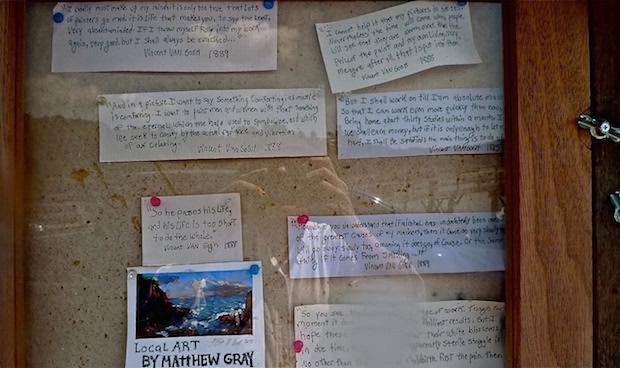
Van Gogh's angst on a Maine bulletin board
Anything for attention

"Glitter Girls'' (oil and mixed media on campus), by HILARY TAIT NOROD, at Liquid Art House, Boston.
Nitrogen pollution threatens Cape Cod
HARWICH, Mass. The Massachusetts Department of Environmental Protection (DEP) has scheduled a public meeting for Aug. 26 to seek comment on a draft document identifying the need to reduce nitrogen pollution in the Cape Cod coastal waters of Allen, Saquatucket and Wychmere harbors and in the Herring River.
The public meeting will be held at 3 p.m. in Town Hall, 732 Main St.
The restoration plan for this estuary system, formulated by DEP and the University of Massachusetts at Dartmouth School for Marine Science and Technology (SMAST), is proposed as part of theMassachusetts Estuaries Project, intended to improve estuarine water quality in 70 embayments along the southeastern Massachusetts coastline.
This coastal water body system is currently impaired because of excess nutrients, mainly nitrogen, according to a SMAST study. Nitrogen is the primary cause of eutrophication, which can lead to:
Loss of eelgrass beds, which are critical habitats for fish and macro-invertebrates such as sea worms, snails and crabs.
Undesirable increases in macro algae, which are much less beneficial than eelgrass.
Periodic extreme decreases in dissolved oxygen concentrations that threaten aquatic life.
Reduced diversity in sea-bottom-dwelling species such as worms and clams.
Periodic algae blooms.
Steady population growth and increased development, particularly during the past several decades in southeastern Massachusetts, has led to an overabundance of nitrogen in Cape Cod harbors, bays and estuaries, according to the study. The primary controllable source of nitrogen is wastewater discharged from septic systems, stormwater runoff, leaching lawn fertilizers and discharges from agricultural land uses. Atmospheric deposition also contributes varying quantities of nitrogen.
At the public meeting, DEP staff will present a draft total maximum daily load (TMDL) for limiting nitrogen to the amounts that the water bodies can absorb without violating water-quality standards and impairing uses such as fishing and recreational activities. The plan calls for reducing watershed sources of nitrogen by up to 80 percent. Most of the reductions will be from better treatment and handling of wastewater, but nitrogen from stormwater and fertilizer use should also be controlled wherever possible.
This effort included three years of chemical, physical and biological studies within the Herring River and Allen, Saquatucket and Wychmere harbors. Another component was the use of a dynamic water-quality model to determine the present sources of nitrogen and the loading rates, the nitrogen concentrations in the embayment, the nitrogen concentrations that will result in the restoration and protection of the embayment, and the target nitrogen loading rates that will achieve those protective concentrations.
This watershed modeling and TMDL analysis will serve as a planning tool for communities to implement new comprehensive wastewater management strategies in order to improve estuarine water quality, according to the DEP.
The Herring River Estuary Restoration Project also recently received a $1 million state grant to help restore the estuarine habitat in the area.
The public comment period for this draft document ends Sept. 30 at 5 p.m. Written comments can be submitted to: Barbara Kickham, Department of Environmental Protection, Division of Watershed Management, 8 New Bond St., Worcester, MA 01606. Electronic format comments should be sent to barbara.kickham@state.ma.us.
All Lovecraft, all the time

"Tentacles" (digital print illustration), by JOHN COULTHART, in the "Ars Necronomica'' show, Aug. 20-Sept. 4 at the Providence Art Club. "Ars Necronomica'' features work by artists from near and far inspired by the life and work of horror writer H. P. Lovecraft.
I must admit that I find most of Lovecraft irritating and do not understand the enthusiasm for his (to me) tedious fantasizing. Why can't Providence celebrate another literary figure connected with Providence? I nominate S.J. Perelman.
--- Robert Whitcomb
Not tonight: I have a mask on