
Vox clamantis in deserto







And forgotten

"Gone'' (photo), by REBECCA SKINNER, at Galatea Fine Art's (Boston) "New England Collective V,'' Aug. 1-30.
We used to "break into '' old houses like this (actually, you could usually just walk in via the door) , some, I suppose, abandoned during the Depression and never reoccupied. Their smell of mildew and dead animals was notably unpleasant but the yellowed copies of magazines and newspapers from the '30s were intriguing, raising my interest in the history of what was then only the half-completed and very bloody 20th Century.
--- Robert Whitcomb
Still trying to appease Putin
Russian dictator Vladimir Putin continues to send Russian troops, intelligence operatives and heavy weaponry into the eastern Ukraine to try to take it over. It's not proving quite as easy as his theft of Crimea from Ukraine, a sovereign nation, but he is patient.
The West has responded to this brazen aggression by doing virtually nothing, Meanwhile, the Germans remain profoundly cynical and corrupt as they try to work out more business and other deals with this thug. This recalls the Hitler-Stalin pact, although of course the main players are nowhere that evil!
In any case, we'll pay for this appeasement.
Our Woody Allen neighborhood
Woody Allen is making a movie in our neighborhood, in Providence, this week, and some streets are blocked off. There are an astonishingly large number of vehicles associated with the shooting, including about a dozen very large trucks and RV's. You can see that making feature movies requires one hell of a lot of infrastructure. The neighbors are torn between irritation about the inconvenience and pleasure that this celeb is making a big movie in this leafy neighborhood. (What viewers will actually see will be quiet and intimate, I'm pretty sure. Woody Allen doesn't exactly make spectacles.)
Providence is an appropriate place, culturally, for Allen to make a film. Rhode Islanders tend to be cynical and pessimistic, yet many of their surroundings are beautiful. And it's not too far from his beloved Manhattan.
How weird it seems to me. I remember watching Allen as a standup comedian in the '60's, seeing him play the clarinet at Michael's Pub, in Manhattan, in the '70's, and viewing most of his movies, usually with great pleasure. What a work ethic to get through such a long and complicated life.
And now he's around the corner.
Hide and hide
 "Ramps'' (enamel, gesso and watercolor on Stratmore paper), by JAMIE WYETH, at Adelson Galleries Boston.
Llewellyn King: Give American dogs French rights!
You are embarking on reading something that is hopelessly one-sided, patently biased and completely partisan. It is plainly and simply a call for equality.
I want dogs in the United States to be accorded the same rights and privileges as they are in France.
I say that if you want to be born a pooch, do it in France. The French dog’s life is tres bonne.
You may think I am barking mad, but I have been studying pampered pouches for decades. In Britain, people have a screw loose about all animals. But in France, the dog is the overlord of all it surveys.
British dogs may get roast beef on Sunday, if they are lucky. Their French equals drag their owners to the patisserie whenever they feel the urge for an éclair or a napoleon. British dogs get a bath infrequently in the family tub. But French dogs go to a salon. Sadly, in America, we outsource the grooming to a chain; not the same as a salon for Fifi the Pomeranian or Jacques the wolfhound. But it is really at lunch and dinner when the French dog struts his or her superior situation: They go to fine restaurants with their owners, and sometimes –Mon Dieu! -- eat their meals on the same china.
In England the lucky few four-footers can go to the pub and, with the publican’s permission, enter the hallowed premises. After some unpleasantness with the same publican’s large mongrel, which always blocks the entrance, he or she will find a spot under the table and hope for a bit of overcooked banger.
It is quite amazing how many dogs will show up in a restaurant in France and, after a few snarls, how fast they will settle down to the serious work of begging for food, or waiting in the certain knowledge that if they have the power over their owners to be taken out to lunch or dinner, delicious victuals will be provided with a loving, “Bon appetit, mon petit chien!” Last month in Paris, I saw a happy dog sitting on a banquette in a fine restaurant.
Dogs in France also are conspicuous on public transportation. You see them on the trains, local and intercity, and the intercity airplanes. Some taxi drivers feel safer with a large German shepherd or Rottweiler on the front seat. I have always though that a dog is superior to plastic dividers and other security devices in these uncivil times.
The French indulge their dogs and owners to such an extent that they have special sanitation workers who ride motorcycles equipped with vacuum cleaners, so that the good citizens do not, well, step in it.
But in America, dogs are defendu, not allowed to darken the door. They are classified as a health hazard. You can get away with dining with your best friend outdoors at some establishments. But mostly, the dear creatures must endure confinement at home while we gorge.
My fellow Americans, can this go on? Can we allow the pampered poodles of France to lord it over good ole’ American coon hounds? Liberte, egalite, fraternite for the dogs of the U.S.A.!
Llewellyn King (lking@kingpublishing.com) is executive producer and host of “White House Chronicle,” on PBS.
.
A canine summer
 "Swimdogs'' (oil on canvas), by JAMIE WYETH at the Adelson Galleries Boston.
Wet, happy and often smelly dogs are among the most memorable creatures of summer in the New England countryside.
David Warsh: Nobel Prizes and macro vs. growth
BOSTON
It was about a year ago that Paul Krugman asked, “[W]hatever happened to New Growth Theory?” The headline of the item on the blog with which the Nobel laureate supplements his twice-weekly columns for The New York Times telegraphed his answer: The New Growth Fizzle. He wrote:
''For a while, in the late 1980s and early 1990s, theories of growth with endogenous technological change were widely heralded as the Next Big Thing in economics. Textbooks were restructured to put long-run growth up front, with business cycles (who cared about those anymore?) crammed into a chapter or two at the end. David Warsh wrote a book touting NGT as the most fundamental development since Adam Smith, casting Paul Romer as a heroic figure leading economics into a brave new world.
''And here we are, a couple of decades on, and the whole thing seems to have fizzled out. Romer has had a very interesting and productive life, but not at all the kind of role Warsh imagined. The reasons some countries grow more successfully than others remain fairly mysterious, with most discussions ending, as Robert Solow remarked long ago, in a “blaze of amateur sociology”. And whaddya know, business cycles turn out still to be important.''
Krugman’s post raised eyebrows in my circles because many insiders expected that a Nobel Prize for growth theory would be announced within a few weeks. A widely noticed Nobel symposium had been held in Stockholm in the summer of 2012, the usual (though not inevitable) prelude to a prize. Its proceedings had been broadcast on Swedish educational television. Romer, of New York University, had been the leadoff speaker; Peter Howitt, of Brown University, had been his discussant; Philippe Aghion, of Harvard University and the Institute for International Studies, the moderator of the symposium.
Knowing this, I let Krugman’s gibe pass unchallenged, even though it seemed flat-out wrong. These things were best left to the Swedes in private, I reasoned; let the elaborate theater of the prize remain intact.
Then came October, and a surprise of a slightly different sort. Rather than rousing one or more of the growth theorists, the early morning phone calls went to three economists to recognize their work on trend-spotting among asset prices and the difficulty thereof – Eugene Fama, Robert Shiller and Lars Hansen. Fama’s work had been done 50 years before; Shiller’s, 35. Two big new financial industries, index funds and hedge funds, had grown up to demonstrate that the claims of both were broadly right, in differing degrees. Hansen had illuminated their differences. So old and safe and well-prepared was the award that its merit couldn’t possibly be questioned.
What happened? It’s well known that, in addition to preparing each year’s prize, prize committees work ahead on a nomination or two or even three, assembling slates of nominees for future years in order to mull them over. Scraps of evidence have emerged since last fall that a campaign was mounted last summer within the Economic Sciences Section of the Academy, sufficient to stall the growth award and bring forward the asset-pricing prize – resistance to which Krugman may have been a party.
These things happen. The fantasy aspects of the Nobel Prize – the early-morning phone call out of the blue – have been successfully enough managed over the years as to distract from the “hastily-arranged” press conferences that inevitably follow, the champagne chilled and ready-to-hand. Laureates, in general, are only too happy to play along. Sometimes innocence may even be real. Simon Kuznets, on his way to visit Wassily Leontief in New York in 1971, told friends that he overheard heard only that “some guy with a Russian name” had won, before stepping into the high-rise elevator that would carry him to his friend’s apartment. It was, he said, the longest ride of his life.
As described on the Nobel website, the committee meets in February to choose preliminary candidates, consults experts in the matter during March and April, settles on a nomination in May, writes up an extensive report over the summer, and sends it in September to the Social Science class of the Royal Swedish Academy of Sciences – around seventy professors, most of them Scandinavians – where it is widely discussed. Thus by summer, the intent of the committee is known, if very closely held, by a fairly large fraternity of scientists. The 600-member Academy then votes in October.
There is nothing obvious about the path that the economics prize award should take; even within the Academy there are at least a couple (and probably more) different versions of what the Sveriges Riksbank Prize in Economic Sciences in Memory of Alfred Nobel, established in 1969, is all about. Wide-ranging and free-wheeling discussion among the well-informed is therefore crucial to its success; so is dependable confidentiality. Nominations and surrounding documentation are sealed for 50 years, so none of this has been revealed yet since the economics prize was established less than 50 years ago.
Over the years, however, scraps of information have leaked out about struggles that have taken place behind the scenes, in areas where sharp philosophical disagreements existed. For example, Gordon Tullock, of George Mason University, a lawyer and career diplomat with no formal training in economics, told me years ago that he woke in 1986 expecting to share the prize for public choice with James Buchanan. He didn’t. In her biography of game theorist John Nash, A Beautiful Mind, Sylvia Nasar reported that Ingemar Ståhl had sought to delay an award to Nash by moving up the prize prepared for Robert Lucas. He didn’t succeed, and Lucas was honored, as had been planned, the following year. (Harold Kuhn, the Princeton mathematician who tirelessly insured that Nash’s story would be told, died last week, at 88.)
Something of the sort may actually have happened in 2003: preparations were made in Minneapolis for a press conference for Edward Prescott, then of the University of Minnesota; the prize went instead to a pair of low-key econometricians, Clive Granger and Robert Engle, both of the University of California at San Diego. Prescott and Finn Kydland, of the University of California at Santa Barbara, were cited the following year, “for their contributions to dynamic macroeconomics: the time consistency of economic policy and the driving forces behind business cycles.” The latter award remains even more controversial today than it was then.
Indeed, Krugman’s own prize may have been moved up, amidst concern in Stockholm for the bourgeoning financial crisis of 2008. As late as that October it was believed, at least in Cambridge, Mass., that the committee recommended that a prize be given for measurement economics, citing Dale Jorgenson, of Harvard University; Erwin Diewert, of the University of British Columbia; and Robert Hall, of Stanford University. It would have been the first prize for empirical economics since the award to Richard Stone, in 1984, and only the third since Kuznets was recognized, in 1971. Instead the prize was to Krugman, by then working mainly as a columnist for The Times, “for his analysis of trade patterns and location of economic activity.”
No one seriously disputes that Krugman should have been recognized at some point for the consensus-changing work he did, beginning in the late 1970s, on monopolistic competition among giant corporations engaged in international trade, though a common view in the profession is that two others, Elhanan Helpman, of Harvard University, and Gene Grossman, of Princeton University, should have shared in the award. Committees over the years have been very conscious of the emphasis conferred by a solo award – only 22 of 45 economics prizes have been “singletons.”
The deferral of the measurement prize, if that is what happened, suggests there must have been considerable tumult behind the scenes. The gravity of the global financial crisis was very clear in Stockholm in September 2008. What happened in those few months won’t be known with any certainty for another forty-four years. But the effect of the award in October 2008 was to empower Krugman as a spokesman for the tradition of Keynesian macroeconomic analysis. He responded with alacrity and has employed his bully pulpit since.
So much, then for what is known and, mostly, not quite known, about the recent politics of the prize. What about the contest between macroeconomics and growth?
Macro is the dominant culture of economics – the center ring ever since Keynes published The General Theory of Employment, Interest and Employment, in 1936. It is a way of looking at the world, “an interpretation of events, an intellectual framework, and a clear argument for government intervention,” especially in the management of the business cycle, according to Olivier Blanchard, author of an authoritative text, Macroeconomics. There are many other fields in economics, but macro is the one that seeks to give an overall narrative and analytic account of expansion and recession, of capacity and utilization, of inflation and unemployment. Macro has had its ups and downs in the years since 1936. Today anyone who studies fluctuations is a macroeconomist; but not all macroeconomists acknowledge the centrality of Keynes.
In the 1950s and ’60s, a “neoclassical synthesis” merged Keynesian contributions with all that had gone before. New standards for formal models, plus national income and product accounts and measures of the flow of funds, produced various rules of thumb for managing modern industrial economies: Okun’s Law (output related to unemployment) and the Phillips Curve (inflation to unemployment); and so on. By the end of the 1960s, many economists thought of their field as mature.
In the ’70s came the “expectations revolution,” a series of high-tech developments (most of them anticipated by low-tech Milton Friedman), in which economists sought to build accounts of forward-looking people and firms into the macro scheme of things. The effectiveness of monetary policy was debated, until the Federal Reserve Board, under Paul Volcker, gave a powerful demonstration of its effectiveness. Reputation and credibility became issues; targets and new rules emerged.
Growth theory, on the other hand, has a less clear-cut provenance. There is no doubt that it began with Adam Smith, who, in the very first sentence of The Wealth of Nations, pronounced that the greatest improvement in the productive powers of humankind stemmed from the division of labor. Smith expounded for three chapters on the sources and limits of specialization, using a mass-production pin factory as his example, before dropping the topic in order to elucidate what economists today call “the price system.” Interest in the kind of technological change that the pin factory represented faded into the background.
Karl Marx was a growth theorist (remember “Asiatic,” “ancient,” “feudal,” “bourgeois” modes of production and all that?), but he came late to economics and never found his way into the official canon. So was Joseph Schumpeter, who came closer to giving a persuasive account in economic terms but still failed to leave much of a mark. In the ’50s, MIT’s Robert Solow, a leading macroeconomist, ingeniously showed that most of the forces generating gains in wealth (gross domestic product/per capita) were exogenous, that is, outside the standard macro model, unexplained by it as the tradition stood. Macro debates continued to flourish. By end of the ’70s, interest in growth once had again faded away in technical economics.
In the ’80s, excitement over growth was suddenly rekindled in economics by three key papers, of which Romer wrote two and Robert Lucas wrote one. Romer’s primary interest was in “endogenizing” technology; that is, showing why governments, universities, corporations and entrepreneurs engaged in research. Lucas was intrigued by stories from international trade: Asian trading nations such as Japan, Hong Kong, Taiwan, Korea and Singapore grew rich quickly while communist nations stagnated. Where did the growth “miracles” come from?
As usual, the arguments of both men were intricately related to other on-going debates in technical economics. Lucas, a University of Chicago professor, was at pains to preserve, for convenience’s sake, the assumption of perfect competition. Romer, educated at both Chicago and MIT and by then teaching at the University of Rochester, was intent on writing intellectual property into the act, employing the sixty-year-old convention of monopolistic competition. Pure competition “spillovers,” meaning, roughly, the gains you reap from watching your neighbors, animated the first models that Romer and Lucas produced. Romer’s second – and final – model depended on income streams that arose from new processes and new goods. The University of Chicago hired Romer; after a year, he moved to California where his wife had obtained a better job.
It seems clear that Romer won the debate. Aghion, then at MIT, and Howitt, then at the University of Western Ontario, quickly buttressed the case for viewing growth through the lens of monopolistic competition, but without producing the same clean convention as Romer’s “non-rival goods,” that is, know-how that can be possessed by more than one person at the same time. Helpman and Grossman obtained the same result.
Once it was established formally that privately appropriable knowledge was somehow involved in the process of growth – that ideas were economically important, as well as people and things – interest shifted quickly to the institutions and norms by which knowledge and the power to protect it were diffused. A shower of interesting new work ensued. The effects on growth of patterns of suffrage, political governance, education, tax policy, land and immigration policy, laws, banking, religion and geography came under economists’ lenses.
The Nobel symposium in 2012 made it clear just how sprawling the “new” literature of growth and development has become. Presenters included a galaxy of stars, nearly every one of them players in the Nobel nomination league. They ranged from experts on technology, schooling, health, credit, geography and political and legal institutions; to empirical economists; and policy evaluation specialists. So is it true, then, as Krugman asserted last summer, that “The reasons some countries grow more successfully than others remain fairly mysterious?” Only if you take the view from macro, and an extremely narrow view at that.
This is the sort of swirl that the Nobel program in economic sciences exists to rise above. It is true that Romer, 58, hasn’t made it easy for the Swedes. He stopped writing economics in the ’90s, started an online learning company, sold it, then quit economics altogether, leaving Stanford University’s Graduate School of Business and started a movement (which he announced in a TED talk) to create “charter cities” in less-developed countries around the world.
Charter cities? By analogy to charter schools, these city-scale enterprise zones would spring up on greenfield sites, their police and legal systems guaranteed by volunteer foreign governments: perhaps Norway, for example, or Canada. “Opt-in colonialism,” say the critics. After a couple of last-minute failures, in Madagascar and Honduras, Romer seems to be trying again, this time from the Urbanization Project at New York University’s Stern School of Business.
Second careers have become more common in recent years among economists whose early work has put them into the nomination for a Nobel Prize. Some intellects become bored by the chase. A. Michael Spence became a business school dean; Krugman took up journalism. Romer has become a reformer. But before he quit, he carefully dotted his i’s and crossed his t’s. He added growth to economics’ agenda, once and for all. Its integration into macroeconomics has barely begun.
David Warsh, a longtime financial journalist and an economic historian, is proprietor of economic principals.com.
German expressionist explosions

"Earth Fireworks'' (original 26-color serigraph), by JENNIFER BARTLETT, at Spaightwood Galleries Inc., in Upton, Mass.
Honey, I'm home

"What the Beekeeper Didn't Tell Us'' (lithographic monotype on panel), by BLAIR FOLTS in the show "Adventures in Printmaking: A Selection of Hand Pulled Prints,'' at the Patricia Ladd Carega Gallery, in Center Sandwich, N.H.
Healing a health system together
(I have been working with Cambridge Management Group. I found this project, involving health care in some old mill cities and smaller communities in north-central Massachusetts surrounded by some lovely countryside, particularly interesting.)
-- Robert Whitcomb
By Yvonne C. Acquafredda, MBA, and Lillian J. LeBlanc, MBA
Today’s healthcare organizations face increased pressure to deliver high-quality and cost-effective care. A key element in enabling them to do this is creating work environments that encourage teamwork on all levels, from board members to all employees.
The Great Place to Work Institute, which studies organizations around the globe, notes the importance of collaboration in the workplace. Great enterprises of all sizes structure their operations to encourage employee cooperation to achieve their organizations’ goals.
Fitchburg, Mass.-based Community Health Connections (CHC), a system of outpatient clinics providing medical, dental and behavioral-health services to thousands of mostly low-income residents in 20 communities, achieved an operational turnaround through a new focus on cross-functional cooperation and clearer and more consistent management.
This was accomplished in partnership with the healthcare-sector consultancy Cambridge Management Group (CMG) and the executive-search firm ZurickDavis (ZD).
CHC is a Federally Qualified Health Center (FQHC). With changing demographics and healthcare reform, such institutions play an increasingly important role in the U.S. healthcare sector. CHC’s experience has lessons for a wide range of healthcare and other organizations across America.
Established just 10 years ago, CHC grew rapidly as it responded to urgent needs to provide primary care in north-central Massachusetts. As patient volume increased, clinicians and administrators worked diligently to meet the demand. But CHC’s organizational structure and culture acted as barriers to examining and improving business processes even as clinical demands surged. By 2013, CHC found itself near receivership. As CHC board member Gregg Buckman put it, “the financial issues were staggering.” In addition, employee morale fell to an all-time low.
Would CHC collapse in the face of the demands being put on it?
Cambridge Management Group Transforms the Organization
Fortunately, CHC’s forward-thinking board recognized the broad range of issues facing the organization and contacted CMG to find ways to stop the losses and then stabilize, focus and grow the organization.
Crucial parts of the engagement that followed were to emphasize collaboration at all levels and to clarify the institution’s needs and goals.
CMG typically operates as a partner of management, providing guidance, expertise and best practices learned over the company’s three decades. As Lia Spiliotes, a CMG partner and senior adviser, explained: “We don’t do what you do; we help you do what you do better.”
However, due to the depth of the challenges at CHC, the board and CMG agreed that interim leadership was needed. Thus Ms. Spiliotes became interim CEO and her CMG colleague Kevin Ward interim CFO.
CMG brought its corporate philosophy of servant leadership to CHC, emphasizing executive approachability and openness without all the traditional boundaries of organizational hierarchy. For example, before CMG’s arrival, CHC executive offices were in an area of CHC headquarters removed from most employees and patients. The interim leadership team established its base in a former gift shop called “The Fishbowl,” in the middle of CHC’s main building. All employees were welcomed to come by.
Another example of this approach was that Ms. Spiliotes invited CHC billing people to meet with the interim leadership team, to give the latter perspective on CHC’s billing processes and present ideas for improvement.
In the initial meetings, all employees were quiet, seemingly afraid to speak up. But over time, as staffers observed, and regularly interacted with, the interim leaders, candid discussion helped to reveal several core operational challenges. One, identified by the billing team, was a communication breakdown between the clinical and billing departments, resulting in many claims being denied. Absent cross-functional teams, the communication changes needed to capture lost revenue would never have been identified.
Over the months of CMG’s leadership, through regular communication and increased collaboration, employees identified many administrative, financial and clinical concerns. Workable solutions were designed in response as the newly collaborative process led employees to feel more empowered, energized and invested in CHC’s success. ZurickDavis Leverages Collaboration for the CEO Search
As a new culture took hold, the CHC board turned considerable attention to recruiting a long-term leadership team. Sustaining CHC’s turnaround would require leaders with the same understanding of servant leadership that CMG brought, able to relate to employees at all levels and willing to invest the skills, time and energy needed to support organization-wide collaboration to achieve operational success.
So CHC’s board reached out to a trusted business partner, the executive-search firm ZurickDavis. CMG and ZD had been familiar with each other’s work for years.
In the spirit of collaboration, so much a hallmark of the CMG-ZD engagement, the latter’s staff invested considerable time to understand the needs of the organization, including requirements for new leadership. ZD went beyond standard job descriptions and the conventional executive-search process; it approached the engagement with few assumptions. It intensely interviewed several CHC board members and the interim leadership team, letting ZD come to fully understand the organization’s evolution and needs.
Armed with this information, ZD developed a profile of the ideal CEO to maintain CHC’s momentum. Through careful listening to the stakeholders, ZD recognized that certain qualities of character would be even more important than very job-specific skills. The new leader must be someone “committed to serve, unpretentious and genuine,” ZD found. He or she should possess a “naturally respectful, consultative, collaborative and accessible leadership style,” but also show “a willingness to lead decisively, to energize and inspire.”
ZD was a full partner throughout the process. According to ZurickDavis’s Ellen Mahoney, who worked closely in the search, steady openness and collaboration informed the whole process. “Everyone was transparent. We were a part of all meetings and fully utilized as a resource.”
Jeff Zegas, ZD’s chief executive officer, said that this level of cooperation and candor, especially in hiring a new leader, is crucial to any organization wishing to strengthen its culture and thus achieve and maintain operational success over the long term.
Building a Collaborative Organization: The ROI
Although CHC’s transformation is still a work in progress, outcomes show the positive impact of the CMG-ZD engagement. CHC achieved a positive fiscal 2013 cash flow (before depreciation) of nearly $190,000, compared with a negative $1.2 million for fiscal 2011. Eligibility denials involving erroneously entered insurance claims were reduced by almost 65%. And the organization enjoyed unprecedented public support for its $20 million project to build a new Fitchburg Family Health Center.
However, much still remains to be done. CHC’s board chair, Mary Giannetti, offers this advice to other organizations that need to effect profound change. “It takes commitment at all levels, but you don’t have to do it alone. Call in the experts and place trust in those you hire.” CMG co-founder Bob Harrington sums up the process at CHC: “Give employees some autonomy and expectation of accountability and you will motivate them to succeed.”
Yvonne Acquafredda has provided broad-based marketing and communications support to several companies in consumer services and healthcare. She has extensive experience in multi-site organizations. Ms. Acquafredda has a bachelor of science degree in communications from the University of Miami, a master of business administration degree from Northeastern University and a certificate in digital marketing from Rutgers University.
Lillian LeBlanc has more than 30 years of experience in the healthcare industry, assisting organizations with cultural transformation and boosting organizational effectiveness. She has worked with healthcare systems in Boston, Maine and South Florida. Ms LeBlanc holds a bachelor of science degree in economics, summa cum laude, from Boston State College and a master of business administration degree from the University of Massachusetts. She is a guest blogger for the Great Place to Work Institute, which produces Fortune’s annual list of 100 Best Places to Work For in America.
The Age of A/C
Overall, you'd have to say that air-conditioning has been a boon. For instance, the computer revolution almost certainly would not have happened without it : Those first big main frames needed massive A/C and even the desktops and laptops that followed still don't like heat. And it allowed the rise of the South to economic power by cooling its factories and offices enough to permit Teutonic levels of efficiency through the year. Some might not be all that happy with that rise, especially with its political effects. My Southern relatives, however, were happy that an extra couple of months of comfort and productivity had been added to their year. Still, A/C's absence did have some benefits. One was that the summer heat slowed you down and made you look at the world through a somewhat different optic, giving you a more rounded sense of life and the passage of the seasons. It spawned a certain kind of imaginative rumination. Another benefit was that the enforced slowness encouraged a leisurely friendliness, a back-porch socializing.
A heat wave made cold drinks more refreshing, swimming more refreshing and the cool break of a thunderstorm more exhilarating.
Except in urban slums, there were usually ways to avoid the worst of the heat. In my family, my brother and I, who lived on the very hot third floor, would move downstairs, to the first floor, or even the cellar, with sleeping bags, where it rarely got above 65. There we'd be lulled to sleep by the drug-drip-drip of the dehumidifier. Or we and our other siblings would sleep in the backyard, although that tended to get very uncomfortable soon -- first you'd be sweaty hot and then chilled before dawn. Meanwhile, fireflies produced brief amusement.
Few people had car air-conditioning until the '70s. You'd drive with the windows down, which, besides the cooling from the wind, had the benefit of blowing away the cigarette smoke.
New Englanders used to say that they didn't need A/C because it didn't stay hot enough long enough. (Such assertions are part of New Englanders' claims to be particularly tough and resilient when compared to people from other parts of the country. )
But when it is hot in New England it's hotter than most of Florida. The great New England heat wave of early August 1975 had temperatures up to 113. My wife and I were driving back to steamy Philadelphia from seeing friends in New Castle, N.H., at the time. The sides of the roads were lined with dead cars with steaming radiators. Luckily for us, we were in a VW bug -- air-cooled (though it was to believe that the air that day could cool anything). Like flat tires, steaming radiators are rare now. Tires and cars are better.
When we got back to Center City Philly we found a note in the apartment from someone who a few days before had been camping out there while we were away. It relayed a message from one of my sisters that my father had had a heart attack driving to work in Boston. (I know the car wasn't air-conditioned. ) He had the presence of mind to drive to the hospital, but died a couple of days after his arrival; at a rather young age, I had become the family patriarch.
I never heard again from the person camping out in our apartment; he was probably too mortified by the circumstances to contact us. But hello, John Whitfield (a former Wall Street Journal colleague who had decided to go to the University of Pennsylvania Law School) --- wherever you are on the road to Social Security.
I hope that central air conditioning is giving you a long, long life.
---Robert Whitcomb
Submerging our feelings

"Cenote Azul, #1'' (acrylic on linen), by ANNE LEONE, in the show "The Contemporary Figure,'' at the Dedee Shattuck Gallery, Westport, Mass., through July 27.
Arcadia along Amtrak

Photo by PAUL F.M. ZAHL
Marshland in Madison, Conn. , photographed the other day, as New England went into high summer. It's such scenes that make the Amtrak line along long stretches of the Connecticut coast so soothing to ride on.
Chris Powell: Infrastructure projects not enough to offset slob culture
MANCHESTER, Conn. Geographically New London is spectacular, with Long Island Sound on one side and the Thames River on the other, and a beautiful old train station downtown with passenger service north to Boston and south to New Haven, New York, and beyond. The city practically shouts of potential.
Geographically Waterbury is spectacular too, built on hills along the Naugatuck River with sweeping views, an expansive downtown green, and its own beautiful old train station, which, while now occupied by the city's newspaper, the Republican-American, remains the terminus for passenger service to New York and beyond. Potential is also Waterbury's middle name.
Unfortunately the other day both cities were not realizing any potential but just having their noses rubbed in gritty reality.
In New London, as reported by the city's newspaper, The Day, nine downtown residents complained to a City Council meeting about disgusting misbehavior in their neighborhood -- public drunkenness and drug use, panhandling, vomiting, and worse by vagrants, whom political correctness has euphemized as "the homeless." The residents said they were not just offended but fearful.
"It's very intimidating and frightening walking alone," one told the council. "I love this city. I think this city has incredible potential. But with this situation, who wants to come here?"
Crime by predatory young men has been a chronic problem in downtown New London, the most infamous incident being the murder of a pizza shop worker 3½ years ago by a wolf pack of six who, upon their apprehension, said they had set out to assault someone because they were bored.
At the council meeting a deputy police chief sympathized with the complaints but offered only the weak hope of increased police patrols if the department ever recovers from a personnel shortage.
Meanwhile Waterbury was learning from the Republican-American that the state Department of Economic and Community Development had just ranked the city as the most distressed municipality in Connecticut, displacing Hartford, which had spent years at the top of the list and dropped to No. 2. New Britain and Bridgeport ranked third and fourth, the rankings calculated from personal income, employment, education levels and property values.
The newspaper quoted local officials as saying that a municipality ranked distressed has the advantage of some preference for state government financial grants. Yet that preference has not done much for Hartford, which, as the state capital for 140 years, long has had another advantage, hosting what are now thousands of well-paid state government jobs only to fall steadily from being perhaps the richest city in the country to being among the poorest 10.
Geography gives Hartford, New Britain, and Bridgeport great potential too, but as things have turned out, such natural advantages are not decisive for quality of life. Indeed, natural advantages seem to mean less over time, as does a municipality's physical infrastructure, on which state government lately has concentrated, with new government buildings erected in Waterbury and Hartford, the bus highway being built between Hartford and New Britain, the Coast Guard museum being planned in New London, and such.
No, the decisive element of a municipality's infrastructure and potential is only what it always has been: the people who live there. Capable, self-sufficient people can accomplish much, but a half century of public policy in Connecticut purporting to raise people out of poverty has only driven them into it deeper and made them more dependent on government, policy that has correlated only with urban decline and the explosion of a demoralizing slob culture.
Much more than colleges relocated downtown, renovated theaters, convention centers and stadiums, Connecticut needs someone in authority to ask: What exactly has happened here and when is any of this stuff supposed to work?
Chris Powell is managing editor of the Journal Inquirer, in Manchester, Conn.
Story for 50 years hence
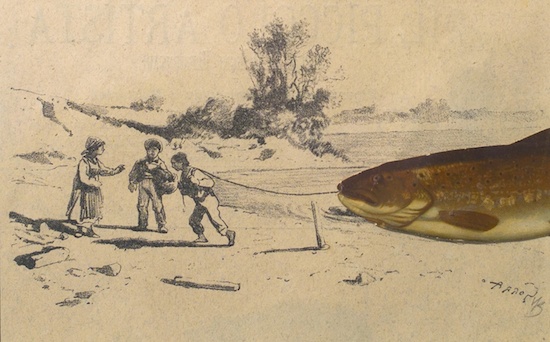
"Day's Catch'' (collage), by VARUJAN BOGHOSIAN, at Berta Walker Gallery, Provincetown.
The pastor and the pop star
See this piece about the Rev. Paul Zahl and pop star Burton Cummings
Robert Whitcomb: The Islamic State's soothing 'system'
The Islamic State being set up in parts of Iraq and Syria (still usually abbreviated in our press as ISIS, from the "Islamic State of Iraq and Syria'' -- now being given a simpler, more ambitious name) challenges the idea of the nation state as we in the West know it. The mostly young men who are the ISIS shock troops want to help swiftly impose the will of the ISIS on a swath of territory from Morocco to Pakistan in an extra-national empire that would justify its dictatorship by religion. Abu Bakr al-Baghdadi, the ISIS chief, would be its “caliph” — supreme leader.
In such utopian (or dystopian) schemes, ideology and theology are used to excuse what mostly ends up as just a power drive, often married to sadism and greed. The ISIS version of Islam promotes a totalitarian view of society in which all human activities are said to come under 7th century Koranic rules. It’s particularly attractive to frustrated and often psychopathic young men seeking the opportunity to dominate others while finding clarity amidst the unsettling ambiguities of life. One thinks of the Nazis and Bolsheviks. (If only the World Health Organization could address the problem of crazy people seizing power. Unfortunately, however, psychopaths run some U.N. member nations.)
Broad strains of Islamic culture encourage mercy, tolerance, charity, open-mindedness, hospitality and learning. But too often, violent and reactionary bigots have hijacked the name of Islam, as such people did, mostly in the past, Christianity. (Historian Bernard Lewis’s book What Went Wrong is a useful look at the Muslim world’s troubled encounter with modernity.)
The followers of ISIS and similar groups seek to address their economic, existential and even sexual anxieties and drives by embracing the kind of desert barbarism found in much of the Old Testament, albeit with modern devices. They seem desperate to avoid the stress associated with having to think and act for themselves. An all-encompassing “system” takes them by the hand.
Part of the problem is that, other than Turkey, Iran, Israel and Egypt, the Middle East lacks “real countries,” and thus the calming sense of national order and belonging that applies in, say, the United States and Europe. Iraq, Syria and so on are collections of tribes, some ethnically based, and religious groups (mostly Sunni and Shia) within borders drawn by European colonialists. (Yes, overcrowded “real country” Egypt is a mess.)
Sending back lots of U.S. troops won’t help. America cannot afford to occupy large swaths of the Mideast, where we’re generally not wanted anyway. Note, meanwhile, that ISIS has armed itself with large quantities of U.S. weapons and other equipment it seized when it took over much of western and northern Iraq. We left the stuff there for the “Iraqi government” (which mostly means Shiites) when we left at the end of the “American war” there. ...
From time to time, the United States may have to use drones and perhaps even commandos to attack “Islamic” criminal enterprises to save civilians from being massacred and to block attacks on the U.S. and our allies.
But in the long run, starving such groups of money may be the best strategy. This would include stepping up surveillance (sorry, National Security Agency foes) of international money transfers that benefit these criminals and cracking down on the Saudi, Qatari and other Persian Gulf Sunni individuals and groups that support these terrorists in the face of our too-mild complaints. After 9/11, the United States did a fine job in tracking terrorists’ money flows; we will have to ramp up again.
More generally, we can cut the cash that goes into the Mideast from oil and gas sales, much of which ends in the hands of dictators and terror groups (sometimes effectively one and the same). Places that depend on extractive industries (see Russia) tend to be more corrupt and dictatorial than those with diversified economies. Another reason to turn away from fossil fuels. The hope is to marginalize the Mideast until the passage of time, modern communication, humanitarian aid, wider travel and trade can moderate its worst aspects and encourage these tyrannies to become “normal countries.” To a point. We're in for a long struggle,
None of this is to say that the secular Western nation state is perfect. We’re commemorating this summer the opening of World War I, which drew in a Europe that in June 1914 seemed poised to climb yet further onto the broad sunlit uplands of progress. Part of the tragedy of young Serbian terrorist Gavrilo Princip’s assassination of the Archduke Franz Ferdinand, the heir to the Austro-Hungarian throne, was that the archduke was a reformer whose rise to the top would probably have meant a more democratic and humane central and eastern Europe. That mild empire, in any case, was generally better than what followed. Terrorism tends to beget more terrorism and worse tyranny. Things can get worse very quickly.
Robert Whitcomb (rwhitcomb51@gmail.com) is overseer of New England Diary, a former editorial-page editor of The Providence Journal and a former finance editor of the International Herald Tribune. He is a Fellow of the Pell Center for International Relations and Public Policy.
Richard J. August: Founders clearly meant individuals' gun rights
Robert Whitcomb once again displays his anti-gun bias when he “guesses that the Second Amendment was far more about state militias than individual possession” of firearms (“More mental hospitals, please”, June 7 Providence Journal column). To be sure, the intent of the framers of the Constitution, principally James Madison, has been the subject of numerous conflicting decisions by courts at all levels of the judicial system. However, the U.S. Supreme Court in the 2008 Heller decision clearly stated that the Second Amendment refers to the right of an individual citizen to own and carry a firearm. This, however, was not the only case in recent times that addressed this issue.
In a 1990 case involving the Fourth Amendment, Chief Justice William Rehnquist wrote for the majority in Verdugo-Urquidez that “the people” protected by the Second Amendment are “persons” and not a “well-regulated militia” as Mr. Whitcomb and other anti-gunners claim.
The Federalist Papers make clear that the Founders were wary –- some would say fearful -- of a large standing army that could be used by a tyrannical government. Hence, the Second Amendment reference to a militia involved a body of armed men at the state level that could counterbalance such a federal force. The militia in most of the states included all able-bodied males between certain ages who were required to turn out for a muster with a firearm suitable for military service and a specified amount of ammunition.
Madison made his position clear in “The Federalist Papers” number 46, where he referred to “a militia amounting to half a million men” The population of "free white males'' 16 and over in the United States in 1790 was about 808,000, out of total population of about 3.9 million.
The co-author of the Second Amendment, George Mason of Virginia, wrote “A well-regulated Militia, composed of Gentlemen, Freeholders and other Freemen was necessary to protect our ancient laws and liberty from the standing army....” In other words all able-bodied males made up the militia. Mason went on to describe the type of weapon, amount of ammunition and accoutrements that each militiaman was required to possess.
I am tired of people saying that “the militia” means the National Guard. The National Guard was created in 1903 –-more than a hundred years after the Constitution was written and ratified by the states.
I call Mr. Whitcomb’s attention to Section 22 of Article One of the Rhode Island Constitution, which reads, “The right of the people to keep and bear arms shall not be infringed”. How does he suggest one interpret that language?
The state Supreme Court wrestled with that matter and decided that “the people” referred to were indeed a militia. One wonders who the justices believe the Rhode Island Constitution refers to in its preamble, which begins, “The people of the State of Rhode Island and Providence Plantations...” Perhaps “the people” here are white, male landowners who were the only citizens allowed to vote when the document was written.
With respect to the title of Mr. Whitcomb’s piece, one wonders whether he is suggesting that the Ladd School {for the mentally disabled} and the former tuberculosis sanitarium at Zambarano State Hospital be reopened to house those who post whacky You Tube videos and disturbing messages and images on Facebook.
Richard J. August, of North Kingstown, R.I., is a cast member of the weekly radio gun talk show “Lock, Stock and Daria” on WHJJ.
Mr. Whitcomb responds: I'm not anti-gun; I even own a few guns (through inheritance). The dispute is over to what extent government can regulate their use, especially since the sort of guns available now did not exist in the Founders' day, to say the least.
From trash to treasure

Quilt in the "At Home in the Victorian Era'' show at the Saco Museum, in Saco, Maine. This sort of stuff used to be tossed out 60 years ago. My parents would leave Victorian furniture by the side of the road to be picked as trash. What idiots! Grandma Moses would not have approved.
Ready for an angry summer

"Behande Bulgarin'' (mixed media collage) by FRANZ WEST, in the Hall Collection, at the Williams College Museum of Art, Williamstown, Mass.