
Vox clamantis in deserto




Blame Russia for Russian aggression
By ROBERT WHITCOMB (rwhitcomb51@gmail.com)
Some denounce the United States for Russia’s reversion to brutal expansionism into its “Near Abroad” because we encouraged certain Central and Eastern European countries to join the North Atlantic Treaty Organization. The argument is that NATO’s expansion led “Holy Russia” to fear that it was being “encircled.” (A brief look at a map of Eurasia would suggest the imprecision of that word.)
In other words, it’s all our fault. If we had just kept the aforementioned victims of past Russian and Soviet expansionism out of the Western Alliance, Russia wouldn’t have, for example, attacked Georgia and Ukraine. If only everyone had looked into Vladimir Putin’s eyes and decided to trust him.
Really? Russia has had authoritarian or totalitarian expansionist regimes for hundreds of years, with only a few years’ break. How could we have necessarily done anything to end this tradition for all time after the collapse of the Soviet iteration of Russian imperialism? And should we blame Russia’s closest European neighbors for trying to protect themselves from being menaced again by their gigantic and traditionally aggressive neighbor to the east? Russia, an oriental despotism, is the author of current Russian imperialism.
Some of the Blame America rhetoric in the U.S. in the Ukraine crisis can be attributed to U.S. narcissism: the idea that everything that happens in the world is because of us. But Earth is a big, messy place with nations and cultures whose actions stem from deep history and habits that have little or nothing to do with big, self-absorbed, inward-looking America and its 5 percent of the world population. Americans' ignorance about the rest of the planet -- even about Canada! -- is staggering, especially for a "developed nation''.
And we tend to think that “personal diplomacy” and American enthusiasm and friendliness can persuade foreign leaders to be nice. Thus Franklin Roosevelt thought that he could handle “Joe Stalin” and George W. Bush could be pals with another dictator (albeit much milder) Vladimir Putin. They would, our leaders thought, be brought around by our goodwill (real or feigned).
But as a friend used to say when friends told him to “have a nice day”: “I have other plans.”
With the fall of the Soviet Empire, there was wishful thinking that the Russian Empire (of which the Soviet Empire was a version with more globalist aims) would not reappear. But Russian xenophobia, autocracy, anger and aggressiveness never went away.
Other than occupying Russia, as we did Japan and Western Germany after World War II, there wasn’t much we could do to make Russia overcome its worst impulses. (And Germany, and even Japan, had far more experience with parliamentary democracy than Russia had.) The empire ruled from the Kremlin is too big, too old, too culturally reactionary and too insular to be changed quickly into a peaceable and permanent democracy. (Yes, America is insular, too, but in different ways.)
There’s also that old American “can-do” impatience — the idea that every problem is amenable to a quick solution. For some reason, I well remember that two days after Hurricane Andrew blew through Dade County, Fla., in 1992, complaints rose to a chorus that President George H.W. Bush had not yet cleaned up most of the mess. How American!
And of course, we’re all in the centers of our own universes. Consider public speaking, which terrifies many people. We can bring to it extreme self-consciousness. But as a TV colleague once reminded me, most of the people in the audience are not fixated on you the speaker but on their own thoughts, such as on what to have for dinner that night. “And the only thing they might remember about you is the color of the tie you’re wearing.”
We Americans could use a little more fatalism about other countries.
***
James V. Wyman, a retired executive editor of The Providence Journal, was, except for his relentless devotion to getting good stories into the newspaper, the opposite of the hard-bitten newspaper editor portrayed in movies, usually barking out orders to terrified young reporters. Rather he was a kindly, thoughtful and soft-spoken (except for a booming laugh) gentleman with a capacious work ethic and powerful memory.
He died Friday at 90, another loss for the "legacy news media.''
***
My friend and former colleague George Borts died last weekend. He was a model professor — intellectually rigorous, kindly and accessible. As an economist at Brown University for 63 years (!) and as managing editor of the American Economic Review, he brought memorable scholarship and an often entertaining skepticism to his work. And he was a droll expert on the law of unintended consequences.
George wasn’t a cosseted citizen of an ivory tower. He did a lot of consulting for businesses, especially using his huge knowledge of, among other things, transportation and regulatory economics, and wrote widely for a general audience through frequent op-ed pieces. He was the sort of (unpretentious) “public intellectual” that we could use a lot more of.
***
I just read Philip K. Howard’s “The Rule of Nobody: Saving America From Dead Laws and Broken Government.” I urge all citizens to read this mortifying, entertaining and prescriptive book about how our extreme legalism and bureaucracy imperil our future. I’ll write more about the book in this space.
Robert Whitcomb (rwhitcomb51@gmail.com), a former editor of The Providence Journal's editorial pages, is a Providence-based writer and editor, former finance editor of the International Herald Tribune and a partner and senior adviser at Cambridge Management Group (cmg625.com), a consultancy for health systems, and a fellow of the Pell Center for International Relations and Public Policy.
member of.
'Beacons of hope'
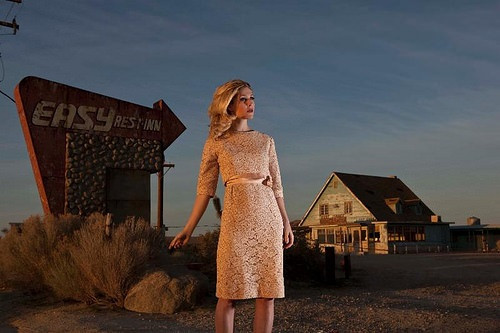
"Lori X, Lancaster, California,'' by B.J. & Richeille Formento, in the "Circumstance: American Beauty on Bruised Knees'' show at the Robert Klein Gallery at Ars Libri, in Boston.
Mr. Formento is the photographer and Ms. Formento, his wife, is the stylist in this show, meant to show the changing face of the American Dream through pictures of "women who became beacons of hope against the dark and slated backdrops of their lives.''
Black Mass at Harvard
Some students from Harvard's Extension School plan to hold a Satanic “Black Mass” in a pub at Harvard's Memorial Hall (named in honor of Harvard's Civil War dead) on May 12. Needless to say, the Roman Catholic Diocese of Boston is livid, especially because a consecrated host reportedly might be used.
Harvard's administration says in effect that it can't do anything about the plan.
Jumping into summer
 "No Strings Attached'' (oil on canvas), by CAROL O'MALIA, at the Art Complex Museum, in Duxbury, Mass.
George Borts, 1927-2014
George H. Borts, 86, a distinguished economist, writer and editor, died May 2 in Providence.
Professor Borts was born in New York City on Aug. 29, 1927, and educated at Columbia University, where he earned an undergraduate degree at 19 and worked on the student newspaper, The Spectator. He received both his master’s degree (1949) and Ph.D. (1953) from the University of Chicago, where he studied under Milton Friedman, the famed libertarian economist – an experience that profoundly influenced his thinking about economics and other aspects of society for the rest of his life.
Professor Borts spent 63 years at Brown University, where he joined the Department of Economics in 1950 at 23. During his long and distinguished career, he served as chairman of the Department of Economics at Brown and led its rise to prominence as one of the leading departments of economic teaching and research. He was also the managing editor of one of the economics profession’s pre-eminent journals, the American Economic Review, for more than 10 years.
His career gave him the opportunity for travel, research and other learning as a visiting professor/research fellow at Hokkaido University, the London School of Economics and the National Bureau of Economic Research. He retired last year as the George S. and Nancy B. Parker Professor Emeritus of Economics.
Professor Borts was an expert in international finance, industrial organization, regulation and transportation. His legacy as an economist includes not only his books and dozens of scholarly papers, but the many lives he touched as a colleague, teacher, friend and adviser. Over more than six decades at Brown, George Borts had instructed and mentored thousands of undergraduate and graduate students. He supervised dozens of senior theses and doctoral dissertations and until last year, he was teaching undergraduate courses on international finance and on the welfare state in America, as well as leading several independent studies on a variety of topics.
His intellectual curiosity and professional interests allowed him to analyze complicated issues without pre-judgment. He led discussions about political, economic and social issues in ways that were clear and engaging for undergraduate seminars and senior colleagues alike. Generations of Brown students, economics majors and non-majors alike, discovered the intellectual creativity of economics through his classes.
His interest in promoting excellence in education was also demonstrated by his leadership of Brown’s Phi Beta Kappa chapter for many years.
He gave frequent testimony before U.S. and Canadian regulatory agencies and commissions and served on many boards, including those of the Rhode Island School of Design, Dartmouth’s Amos Tuck School of Business, Rhode Island Blue Shield, Junior Achievement of Rhode Island and Temple Beth-El in Providence. And he advised political candidates of both parties on economic and tax policy and provided commentaries for The Providence Journal. In 1990-91 he was the editor of the Brown World Business Advisory.
The managing editor of that publication, who became The Providence Journal’s editorial-page editor, Robert Whitcomb, called Professor Borts a “joy to work with’’ over the two decades of their occasional projects together. “He combined intellectual rigor with great humor and congeniality, including when we didn’t agree on a specific issue. I particularly enjoyed his often amusing application of the law of unintended consequences to many societal situations at our numerous pleasant meals together.’’
Although he was a tireless advocate of the free market, he viewed political issues through an economic lens that was fair and open-minded. He valued greatly his relationships with both Keynesian and Monetarist economists. His closest personal relationships were with such prominent advocates of alternative points of view as Hyman Minsky, Phillip Taft, and Jerome Stein. Further evidence of this non-ideological approach was his pronounced belief in the need for immigration reform.
He is survived by Dolly, his wife of 65 years, three sons, three grandchildren and many friends and admirers around America and beyond.
More private seizures of public roads
rwhitcomb51@gmail.com
Much of Providence was paralyzed today by one of those promotions for a rich company that cities and towns get suckered into. Today's collection of races, called "Cox Providence Rhode Races'' after the media company, closes streets, hurts many local businesses and gets in the way of rescue vehicles so that a lot of people (presumably a lot of Cox "volunteers'') can run, or, more commonly, barely walk (because they're so out of shape) along many Providence streets.
Much of the city grinds to a halt in the process, with big macro-economic losses.
Like the giving away of public streets to rich private universities, which Providence has famously done, it's more erosion of the idea that public space is for the public, not for private interests, including corporate promotion.
A peak of realism and terror

A painting of Mt. Katahdin, Maine's greatest mountain, from photo-realist Richard Estes's "Realism'' show, opening May 22 at the Portland Museum of Art.
Looking at that gorgeous peak, I think of black flies and beer on a fishing trip to Baxter State Park 45 years ago. And, some years later, hiking Katahdin's scary "Knife Edge,'' with near-sheer cliffs on each side.
On a climbing trip to Katahdin about a decade ago, I noticed how variably physical fear can manifest itself. While I found walking along the "Knife Edge'' nearly terrifying (although every few minutes mitigated by clouds scudding in below us, thus helpfully making it impossible to see just how big the drop was) one of my companions, who had done extensive climbing in the Alps and other high mountains, seemed to display no anxiety.
And yet when the next day we rented a small plane (and its wisecracking Mainiac bush pilot) and flew over the gorgeous peak, our companion seemed terrified.
Coronary and traffic congestion
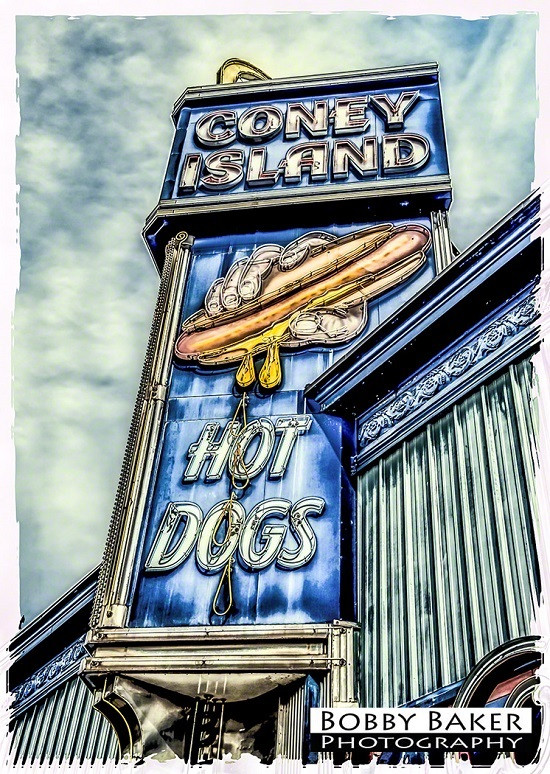
Photo copyright BOBBY BAKER, who travels New England in search of memorable shots.
This one, of a joint in gritty downtown Worcester, is very evocative to me. Friends and I used to stop there on road trips to Vermont and fill up on food that the American Heart Association would urge us all to avoid whenever possible. It is utter junk, but delicious. The confused and congested traffic circulation of downtown Worcester, "New England's Pittsburgh,'' was a frustration that was difficult to avoid but Coney Island made it considerably more tolerable.
From Worcester, we'd proceed northwest through assorted villages and mill towns, some of which looked little changed (except for the cars) from photos taken 100 years ago. If a year or more had elapsed since our last trip through the areas, we'd notice that some big wooden store or old stagecoach hotel on a common had burned down in the interval.
For those in peril on the sea

"Chapel on the Hill'' (oil on panel), by NAN HASS FELDMAN, at Fountain Street Fine Art, Framinghanm, Mass.
Dr. Pierson's 'Triple A' for health-care reform
One of my gigs is to help out at a consultancy called Cambridge Management Group, which advises hospitals and other health-care institutions as well as physician groups. I learn the thoughts of some very interesting people. One is nationally known health-care reformer Marc Pierson. Here's the chat/interview I put together the other day and that ran on Cambridge Management 's Web site, cmg625.com.
We chatted the other day with James Marcus (Marc) Pierson, M.D., a Cambridge Management Group senior adviser. Dr. Pierson -- an internist, emergency physician and past vice president of clinical information and quality for PeaceHealth St. Joseph Medical Center, in Bellingham, Wash. -- is a major health-care reformer. His leadership in helping to create an integrated and patient-centered health-care system for Whatcom County, Wash., has received national attention.
As a leader of the Pursuing Perfection program in the county, he helped develop the community-based, patient-centric Shared Care health-record system and participated at the board level in the Whatcom Alliance for Healthcare Advancement (WAHA). <a href="http://whatcomalliance.org/ ">WAHA</a> helped lead to the recently approved Washington State Health Care Innovation Plan, which has put the power of the state government behind the many ideas arising from Whatcom County’s whole-community and patient-informed perspectives.
He told us that “the county level is the smallest appropriate geographic base for creating a coordinated-care system.’’ Whatcom County was particularly attractive for such efforts because it has attracted a lot of civic-minded and collaboration-minded physicians who “didn’t move here for the money but, among other things, for the natural beauty.’’
Dr. Pierson said that creating an integrated-care model requires first observing how the chaotic traditional “system’’ was or was not working, then trying to understand it and then writing down observations and designing changes. It was crucial to understand the inter-actions of all of the parts of the health-care system, and, crucially, to use patients’ knowledge and opinions – those too-often-neglected elements of health-care reform – in changing the individuals and institutions that serve them.
He cited the “Triple A’’ approach: 1.) research and analyze the needs and desires of the patient population; 2.) understand (clinically and financially) the other parts of the system (doctors, nurses, hospitals, insurers, etc.; 3.) design together one integrated health-care community in which patients’ decisions play the most important part.
With that, he said, we can build a health-care system whose treatment and payment system addresses the ever-changing needs of the whole community. “The quality of the entire system suffers,’’ he said, “when the focus is more on the individual parts and loses sight of the whole community health system. Perfect parts do not make perfect or even good systems. It is the interactions between the parts that must be designed….’’ In any event, the improve-the-parts approach is unsustainable.
Further, Dr. Pierson said, we need to move away from the “extractive financing model’’ of American health care, in which much of the savings from improving a community’s health care leaves the community, making it unavailable for reinvestment. And he touted the idea of setting targets for spending on health within a whole community, citing the success of Jonkoping, Sweden, which set a target of 8.3 percent of the local economy for health care and has had very good outcomes.
He said that his experience in the mid-'80’s as an ER doctor trying to pull together in an ad hoc fashion a variety of specialists to treat a young man badly injured in a motorcycle accident helped get Dr. Pierson thinking about systems and coordination.
This line of focused community building would ultimately lead to his campaign for integrated, community-wide care. Along the way, he made it a point “not to ask anyone to do anything that was against their economic self-interest.’’ And he sought out the “most respected players’’ in the Whatcom health-care community to help him carry out this vision for the county. A very practical and behind-the-scenes reformer.
Given the widening income gap in the U.S., we wondered about whether only the rich would have the finest sort of individualized “concierge care’’. Somewhat to our surprise, Dr. Pierson was optimistic that the use of genomic information, personal medical devices and other advances would make “concierge care’’ available to everyone in the fullness of time, aided by the doctors, nurses, social workers and other health-care ‘’navigators’’ who will increasingly see a major part of their jobs as helping to guide patients to the information they need as well as through the system.
It’s all part of his vision to have all of us see “medicine as a part of health and well-being.’’ The whole community, he says, owns its health and well-being and we must design our futures in that context.
Relatively springlike

"Everything Is Relative,'' by MIMO GORDON RILEY, in her current show at the Providence Art Club.
For growers of flowers and vegetables this is a edgy time of year. On the one hand, you want to get the tomatoes, etc., in the ground, on the other, your fear a late frost. Even the more tropical parts of southern New England are vulnerable well into May. This gives a great excuse to put off the work and sleep late on weekends. Growing things is very satisfying but also very tiring, especially when the weeds get going and you can't afford yard crews of undocumented aliens.
By August, a lot of us are longing for the first frost, though that feeling doesn't last long.
You think of summer as a relaxing time but if you're growing things, there's always that pressure to get back to work, albeit outside and not in front of a computer screen. And it's politically correct to grow vegetables because that is seen as harkening back to principles of self-sufficiency, however basically bogus your ambitions in this mission may be since it's much more efficient and usually much cheaper just to buy the products of agribusiness at the supermarket. You can even get "organic'' produce there, if you believe that it actually is. (How can you really find out?)
's m
rwhitcomb51@gmail.com
cmg625.com
newenglanddiary.com
Gulf Stream feeling
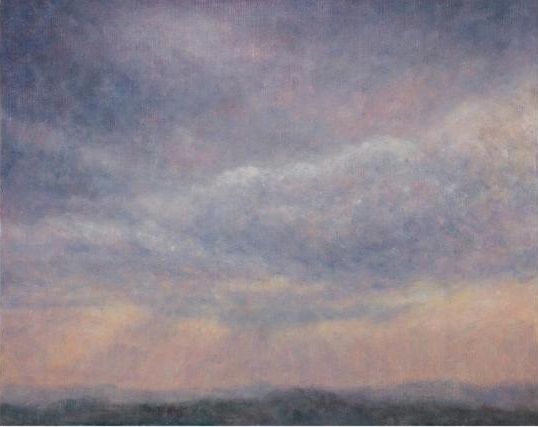
"Storm Lifting'' (oil on panel), by MARTHA STONE, in her show "Atmospheric Landscapes,'' at Galatea Fine Art, Boston, May 1-29.
April 29, 2o14
This morning had that pleasant wet feel that comes before a southeast rainstorm -- almost a breath of the tropics that reminds us of how close the Gulf Stream is.
A very agreeable effect until I realized that the basement might flood in the next couple of days.
And the wind and the rain might soon strip off the blossoms from the flowering trees, whose show is so brief.
rwhitcomb51@gmail.com
Architectural ruminations
 "Atlas View'' (mixed media on wood). by MAGGIE CARBERRY in her show "Urban Escape,'' May 1-29 at Galatea Fine Art, Boston.
She says that that images in her show ''represent a portion of my 'Daydream Dwellings project,' in which she is working to "re-imagine urban landscapes, one architectural detail at a time.''
Yankee magazine: More than B&B ads
The current issue of Yankee magazine is pretty damn good. particularly "The Throwbacks,'' about James and Sara Ackermann, a young couple working (about 18 hours a day) a Vermont dairy and maple-syrup farm. Yankee still manages in most issues to combine touristy, ad--revenue-gathering stuff and how-to material with rigorous reportage and very thoughtful ruminations about the region.
The article about the Ackermanns is about an old-fashioned work ethic (involving mind and body) squared, in a beautiful if demanding countryside.
The issue also has a silly but entertaining quote from the writer John Cheever, who grew up on the South Shore of Boston but spent most of his life in the New York City area:
"All literary men are Red Sox fans -- to be a Yankee fan in a literate society is to endanger your life.''
'I'd like to introduce her co-host'
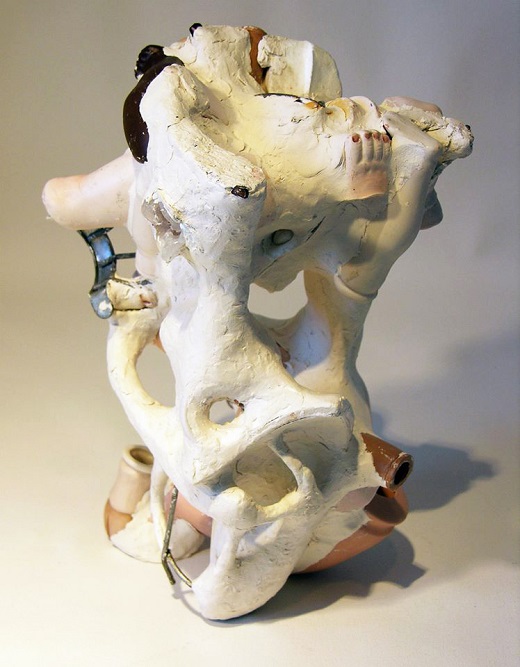
"Co-Host'' (ceramic, metal, plastic and paper clay), by LINDA LESLIE BROWN, in her show at the Kingston Gallery, Boston.
Nature is watching you
 "Green-Eyed Silence'' (digital print), by HARVEY GOLDMAN, in his "Apophenia'' show at Dedee Shattuck Gallery, Westport. Mass.
Apophenia is seeing patterns or connections in seemingly random or meaningless data.
What to do about capitalism in the 21st Century
By DAVID WARSH
BOSTON
"Economist Receives Rock Star Treatment": That was the recent headline on Jennifer Schuessler’s story in The New York Times. The facts bear her out. Thomas Piketty, 42, of the Paris School of Economics, seemed to be everywhere last week. Publication of his 685-page Capital in the Twenty-First Century had been moved up by two months, sales were soaring (46,000 copies so far), a triumphant tour of Washington (meeting with Treasury Secretary Jack Lew) and New York (appearing at the United Nations) has been completed. Encomiums were pouring in. “Pikettty has transformed our economic discourse,” wrote Paul Krugman in the current New York Review of Books. “We’ll never talk about wealth and inequality the way we used to.”
Not bad for an economist who traded an appointment at the Massachusetts Institute of Technology for a job as a researcher for the French government in 1996, when he was 25. “I did not find the work of US economists entirely convincing,” he writes in the introduction to Capital in the Twenty-First Century:
" I was only too aware that I knew nothing at all about the world’s economic problems. My thesis consisted of several relatively abstract mathematical theorems. Yet the profession liked my work. I quickly realized that there had been no significant effort to collect historical data on the dynamics of inequality since [Simon] Kuznets [in the 1950s and ’60s], yet the profession continued to churn out purely theoretical results without even knowing what facts needed to be explained.''
He went home to collect some of the missing facts.
Piketty wanted to teach at the Ecole des Hautes Etudes en Sciences Sociales, the elite institute whose faculty had included many of the foremost figures in the Annales school, including Lucien Febvre and Fernand Braudel – a group of scholars, most of them quantitative historians, that achieved enormous influence around the world publishing in the journal Annales. Economies, sociétés, civilisations (or Annales. Histoire, Sciences Sociales as it is called today).
Piketty got that job, along with time to do the research he wanted, first producing a book in 2001 on high incomes in France since 1901, then enlisting Anthony Atkinson, of Oxford University, in a similar investigation of Great Britain and several other countries. His friend and countryman Emmanuel Saez, of the University of California at Berkeley, produced similar data for the US. The World Top Incomes Database (WTID) is the result. Data on wealth, following the methods of Robert Lampman, of the University of Wisconsin, came next. Starting in 2003, Piketty began setting up the new Paris School of Economics; in 2006, he was named its first head. He resumed teaching and writing the next year.
Piketty’s thesis is set out succinctly on the first page of his introduction:
"When the rate of return on capital exceeds the rate of growth of output, as it did in the nineteenth century and seems quite likely to do again in the twenty-first, capitalism automatically generates arbitrary and unsustainable inequalities that radically undermine the meritocratic values on which democratic societies are based. There are ways nevertheless democracy can regain control over capitalism and ensure that the general interest takes precedence over private interests, while preserving economic openness and avoiding protectionist and nationalist reactions.''
What are those measures? Four chapters in the fourth section of the book draw a variety of policy lessons from the first three parts for a “social state:”
The right solution is a progressive annual tax on capital. This will make it possible to avoid an endless inegalitarian spiral while preserving competition and incentives for new instances of primitive accumulation.
Piketty says he’s left Paris only a few times on short trips since returning nearly 20 years ago. My hunch is that, after last week, it will be a long time before he takes another. He’s left behind a beautiful book, one that will receive a great deal of attention around the world in the years to come. He’s gone home to work on others.
xxx
Michael C. Janeway, a former editor of The Boston Globe, died last week. He was 73. It was he who, as managing editor, permitted Economic Principals to begin in 1983 as a column in the Sunday business pages. I have always been grateful to him, and to Lincoln Millstein, still very much alive, who led the blocking.
David Warsh is a long-time financial journalist and economic historian and proprietor of www.economicprincipals.com
Traumatized by speech and psycho-ceramics
By ROBERT WHITCOMB
‘Father Hoffman mixed personal opinion and church teaching in a way that offended everyone present, causing great harm,” said Prout School Principal David Carradini a couple of weeks ago. He was profusely apologizing for having the Rev. Rocky Hoffman, a host of Relevant Radio, a Catholic radio network, speak to the students of the Catholic high school, in South Kingstown, R.I. Father Hoffman, a member of the conservative Catholic society Opus Dei, spoke against homosexuality and divorce.
His views would have been considered standard Catholic fare only a few years ago, and are still held by many Catholics, and others.
Now, I’m not Catholic. Still, I salute the Church for much of its work, especially for the poor, and, yes, for the quality of Catholic schools. Anyway, we’re in a bad way in America if high-school students are to be prevented from hearing someone else’s views on morality. Where, exactly, is the “harm”? If these kids are seen as imperiled by listening to some priest, then how will they survive in the big, bad world? And how does Mr. Carradini know that the talk “offended everyone present”? (And so what if it actually did?)
Are our kids (and some of their complaining parents) really such lambkins that they can’t take the expression of strong opinions without collapsing in a heap? What’s there to apologize for, Mr. Carradini? Why doesn’t he just bring in some Catholic luminary with more “up-to-date” views as an offset? As they say, the cure for unsettling free speech is more free speech disputing it. And give all the kids debate lessons that nurture the capacity to understand and tolerate other views, including Father Hoffman’s traditionalist views.
Meanwhile, I’d suggest that if you don’t like Catholic beliefs, then don’t be a Catholic. Free will is an important part of the Church’s theology, at least for people from confirmation age on.
In other academic silliness, the student senate at the University of California at Santa Barbara (that cool, rich place) has passed a resolution requiring faculty to issue “trigger warnings.”
As Maria LaMagna reported in Bloomberg View: “Professors would write notes on their syllabi to alert students on which occasions a course’s material will be, say, sexually graphic. Students could then excuse themselves from class without being punished academically.”
Well, I think today’s college students are pretty familiar with sex, graphic or otherwise. They can handle such images. More to the point is that many courses that provide such material are devoid of academic rigor and a waste of time and money, sort of like Brown University’s long joked-about and nonexistent Prof. Josiah Carberry and his discipline of “psycho-ceramics”.
***
Northern Maine is poor, with lots of smokers and obesity, and yet their health-treatment outcomes metrics rank higher than much of the country (especially when compared with the South).
The reasons, summarized by Noam Levy in the Los Angeles Times, include:
•A strong safety net, which provides, among other benefits, more recommended screenings and medical treatments.
•An emphasis on preventive care, aided by Maine’s high number of primary-care physicians.
•Highly coordinated and data-driven care.
•Highly advanced data systems.
•Close collaboration between two competing hospital groups.
•A strong sense of civic obligation, including strong leadership by the public and private sectors.
The glue that keeps this all together is a vibrant sense of community, a sense missing in much of sprawling suburban America, with its subdivisions, gated communities and ever wider divisions of wealth. Mr. Levy quotes Dr. Jack Wennberg, founder of the Dartmouth Institute for Health Policy and Clinical Practice, as saying, “We used to joke that everyone gets along in northern New England because every hospital is separated by a mountain and the winters are long, so we’re happy to see someone.”
Or maybe Robert Frost’s related phrase will do: “Home is the place where, when you have to go there, They have to take you in.” New Englanders may not be the friendliest people in the nation, but, especially like Upper Midwesterners (who are friendlier), they have a strong sense of obligation, both in what their governments should do and what they should do individually.
***
The first words of T.S. Eliot’s poem “The Wasteland” are too often dragged out now. “April is the cruellest month ... ” (breeding tax bills out of ... ) Instead, how about the cheery first few lines, in Middle English, of the prologue of Chaucer’s “The Canterbury Tales”? We had to memorize the prologue’s first 18 lines in school and I’m glad we did, especially after this long winter.
Whan that Aprille
with his shoures soote,
The droghte of March
hath perced to the roote,
And bathed every veyne
in swich licóur
Of which vertú engendred
is the flour;
Or, more realistically, for New Englanders, Hemingway’s line from “A Moveable Feast”: “When the cold rains kept on and killed the spring, it was as though a young person died for no reason.”
Respond via rwhitcomb51@gmail.com
Chris Powell: Riding rails through Conn. ruins

"Appalachia'' (gelatin silver print), by MILTON ROGOVIN, at the Thompson Gallery, Weston, Mass.
By CHRIS POWELL
MANCHESTER, Conn.
Reading the governor's press releases, Connecticut might think that preservation of farmland and prevention of "suburban sprawl" are compelling issues. Riding the train from Greenwich to Hartford gives a contrary impression.
Thanks to Amtrak, such a trip is still possible for those who can deal with the bumps, shuttered washrooms, and clogged toilets. The train windows remain clear enough to reveal a stunning and almost unbroken panorama of economic collapse -- ruined and abandoned factories and commercial properties occupying what might be considered prime locations, adjacent to the railroad and highways and served by all utilities.
If there was really any money in agriculture in Connecticut, hundreds of large farms could fit on the abandoned property that is already cleared as well as inside the abandoned buildings that remain structurally sound. Of course the abandoned properties could be redeveloped as housing as well.
The ruin may be most striking in Bridgeport. While the call letters of the city's radio station, WICC, were chosen for "Industrial Capital of Connecticut," today the "I" would have to stand for "impoverished." New Haven, Meriden, and Hartford, once industrial powerhouses themselves, now consider it a triumph just to tear down a ruined building. Even fairly prosperous towns along the railroad, like Milford and Wallingford, have such embarrassing eyesores.
In any case "farmland preservation" -- government's paying farmers for the "development rights" to their property -- doesn't make agriculture profitable or even sustainable. It only lets farmers withdraw their equity from the land without having to sell it for housing, and thus makes suburban and rural towns even more residentially exclusive, restricts the housing market, and supports prices for those who have housing while driving up costs for those who don't.
Most advocates of "farmland preservation" care far less about sustaining agriculture than about keeping new people out. And while Connecticut's industrial decline is no secret, riding the rails through the core of that decline explodes the premises behind "farmland preservation" and complaints of "suburban sprawl."
The ride shows that Connecticut's problem is not preserving farms or stopping "sprawl"; instead the problem is urban rot. Since the infrastructure remains -- including the railroad, which, while creaky, is still more convenient than cars and buses for getting to New York, Boston, and Philadelphia -- what has made Connecticut's cities so unattractive to people who can afford to live elsewhere and pay taxes in support of government?
For starters are the schools, the worst in the state. But schools are only reflections of a community's population, and city populations are of course overwhelmingly poor and fatherless.
So the big policy question has to be: A half century into the "War on Poverty," with government now providing the poor with food, rent, heat, medical insurance, social workers, ever-longer unemployment compensation, disability stipends, and lately even cellphones, what is making and keeping people poor if not government itself? If the ruined factories along the rail line hint that the answer involves the loss of low-skilled, entry-level industrial jobs, couldn't government find similarly basic work for people to learn with in lieu of unearned welfare benefits? Thousands might be employed perpetually just cleaning up the trash along the rail line and the streets in every town.
Couldn't government enforce standards in school so that people emerged with enough skills to make their own way? Skilled people still might find good employment in any number of endeavors -- like modernizing the whole Northeast rail network. After all, "work, not welfare" used to be a populist and liberal objective. Right now the only consolation of riding the rails through the ruin of Connecticut may be that at least we still have the world's best imperial wars and public employee pension systems.
Chris Powell is managing editor of the Journal Inquirer, in Manchester, Conn.
Comment via rwhitcomb51@gmail.com