
Vox clamantis in deserto








Wind and tree

"The Fan Tree'' (oil on canvas), by CLIFFORD ADAMS BAYARD, in the "Three Vermont Impressionists'' show at the Bennington (Vt.) Museum through June 17.
At Tuckerman's Ravine
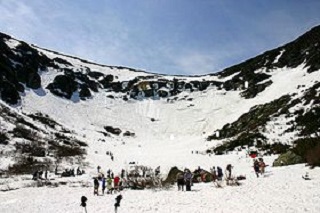
We seem to gravitate toward whatever season we're not in anymore. Thus hordes of skiers and climbers head for the glacial cirque known as Tuckerman's Ravine, on the southeast side of Mt. Washington. The howling winds blow up 60 feet of snow a year into the ravine from the upper part of the mountain, making the ravine skiable into June. On sunny days, the crowds are already congregating early in the morning to slide down its dangerously steep slopes.
Skiing in the wet, mild air of April on bouncy corn snow evokes a mellowness tinged with melancholy, and extreme sleepiness, at the end of the day. For full drug-like effects, you need to smell wood smoke from the nearest ski lodge.

Painting through pain

"Sometimes All That Is Left Is the Anvil,'' by JAMIE RIBISI-BRALEY, at Monkitree Gallery, Gardiner, Maine, through June 7.
The artist says she works through chronic pain from headaches.

Mrs. Pell's traditionalist exit
rwhitcomb51@gmail.com
Post-theology Easter
We were at old friends for Easter lunch today, most of it held outdoors overlooking greening woods and daffodils and other spring color explosions. If you stayed in the sun, it was warm. Some of the guests had been to church this morning and one of our kindly, generous, funny and alarmingly energetic hosts had even read a lesson from St. Paul then
We had lamb, which was delicious but that we'd never prepare on our own, because of animal-rights sensibilities and heart disease. But the beast was dead; too late to save it, and it was delicious.
Of the around 15 people there, I'll bet no one believed in the theology being celebrated. They believed, as Joan Didion put it, in "the sound of The Book of Common Prayer'' while tabling the miraculous events described in the New Testament.
rwhitcomb51@gmail.com
Easter color in New Hampshire
 "Little Flowers Under Moonlight,'' by WALASSE TING, in the "Abstract & Modernism'' show at the New Hampshire Antique Co-op, Milford, N.H., through Aug. 31.
Pulling on your eyes

"The Owl's Failure'' (acrylic, hand-painted collage on canvas), by IVA GUEORGUIVA, at her show at the Samson Gallery, Boston, through May 31.
Last week I heard David S
Wind-dried wood
I read an article the other day in The Providence Journal about a cotton-textile mill in West Warwick, R.I., called the Lippitt Mill. The charming old building is made out of wood.
There are wood structures in New England going back to the 17th Century. In few places in the world can such wooden structures last that long because of rot and insects. But New England's wind and cold winters preserve the wood, of which we still have a big supply. Another reason not to complain too much about our challenging climate.
xxx
The president of my college alma mater (Dartmouth) has given a fine speech about the need to stop the very small --- but all too loud -- members of that community who engage in bad, fraternity-idiot behavior. Because of stories going back to the '20s and '30s and the rise of Winter Carnival then, and later, the very funny if misleading ''Animal House'' stories allegedly based in part on hijinks in the Alpha Delta Phi House at Dartmouth, the college has developed a reputation for outrageous behavior by a few undergraduates.
The new president of Dartmouth, Philip Hanlon, was himself a member of A.D., before going on to Cal Tech for his doctorate and later serving as provost of the University of Michigan. So were my father and grandfather, two soft-spoken gentlemen who I never saw drunk. ( I'm a lifelong expert on alcoholism from the other side of my family.)
But writing as a member of a fairly demure fraternity myself back in the '60s, and watching closely what happens at other "elite colleges,'' I can say that Dartmouth gets a unfair share of the blame for bad behavior committed by a tiny percentage of male students.
Unfortunately, every institution has branding assets and deficits. Dartmouth long ago was branded as rowdy, even as, say, students at the University of Chicago (where an undergraduate recently died of alcohol poisoning) were branded as neurotic and hyper-intellectual.
It takes a lot of time and lot of money to change an image, however misleading it may be. Being a student at Dartmouth mostly means doing a lot of academic work (with no pre-exam reading periods in which to catch up unlike at most of its peer institutions) forced by its intense trimester system. But that's not nearly as good material for the news media as beer-pong tournaments.
Perhaps the college needs a Don Draper type from Madison Avenue to rebrand the place for the new international academic mass market.
A pier onto our memory

"Departure,'' by WENDY PRELLWITZ, at the Chandler Gallery, Cambridge, Mass., in its Direct/Indirect'' show of drawing on top of prints and printing on top of drawings through May 9.
Layers of reminders

"#14 Swimmers'' (painted wood sculpture), by MARK LITTLEHALES, at Ann Coleman Gallery, Wilmington, Vt.
I swim most mornings, usually early, It would seem to be boring going back and forth staring at the lane lines below. But repetitive motion in 84-degree water is remarkably soothing. The paradox of exercise is that up to a point, it gives you more energy than it subtracts. And you get into a kind of Zen state. I find the idea of sweating in a gym with a lot of other people (with whom you might have to talk) off-putting. Running is better in that you're outside, with plenty to look at, especially the changing seasons, getting vitamin D from the sun and so on. But the knees go. (I was quite a runner in school and so had a head start in the knee-destruction business.)
It's one of those mornings that reminds us of weather's energy in New England. Yesterday it was warm and tropically humid. This morning snow and ice lay on the ground, and I had to pour windshield-wiper fluid on car windows to speed my exit. Here we are, close to the Gulf Stream but wide open to the winds from Hudson's Bay.
But the buds and blossoms are still swelling, and out of the wind, the sun warms your face. The flowers seem to be thriving this morning; indeed the thin layer of snow may have protected them from being flash-frozen. And the layer of moisture can only help them once it warms up a bit.
But our little rescue dog from San Antonio, whose genes probably include those of Brittany spaniels (he has freckles), wanted his man-made coat back on, as a Manhattan dog would.
Meanwhile, in eastern Ukraine, the Russians continue their invasion, reminding us that dreams that dictators in Europe would no longer cross borders are dead, as if Putin hadn't already given plenty of warning that he would try to reestablish a variant of the Soviet empire that murdered so many people. But then, he has said the end of that empire was a "catastrophe''. And this former KGB counter-espionage officer himself has ensured that political foes' life expectancy is below the average.
Then there's the phenom of countries getting smaller. There's an outside chance that might happen in the United Kingdom. David Speedie, a Scottish native, gave a talk last Thursday at the Providence Committee on Foreign Relations speculating that there's about 45 percent chance that the Scots will vote to split off from the U.K. in a referendum later this year. He also suggested that Scotland would do very well economically by itself, in part because of North Sea oil and gas and f its growing tech sector. ("Silicon Glen'').
That seems unlikely to me, given the wealth creation based in the Home Counties around London. That wealth, I'd guess, would be less available to Scotland if it were independent and most Scots know that. Still, the romanticism of the Scots is feeding the independence movement, as is, of course, resentment about English arrogance, real and perceived. Romanticism is something I'm well aware of from my own crazy (and often drunk) Scottish relatives. They read too much Robert Burns and believed in many conspiracies. One curious one was that the Pope and Stalin were allies.
Still, when you enter Scotland, you pick up their sense of nationhood, which makes the expression "the Scottish nation'' plausible. I remember when there a bit of a sense of that when you'd enter Quebec, back in the '60s. You'd feel more that you were entering Quebec than entering Canada. Of course in those days it was as easy to drive into Quebec as it was to drive from New Hampshire across a Connecticut River bridge into Vermont.
With all the information technology we have these days, with all the ability to transport ourselves via electrons, in many ways we seem more constrained. A good side, I supposed, is that we are harshly denounced for engaging in such bad habits as smoking (which seems to be one of the few pleasures left to the unemployed poor, whatever the vast cost of cigarettes), drinking while driving and so on. But travel has gotten tougher and the very same information technology that permits such time wasters as Facebook threatens to eliminate most jobs, and a lot sooner than many might think.
Rich are 'at home in New England'
For a bit of escapism, look at a book called At Home in New England: Royal Barry Wills Architects 1925 to Present, by Richard Wills with Keith Orlesky.
It's an orgy of pictures of beautiful houses in our region. The only problem -- if this is a problem -- is the houses, as often is the case of such coffee-table books, are generally only obtainable for the top richest 1 percent, in our increasingly stratified society, which is starting to remind me of pre-revolutionary France.
"Royal'' indeed!
And 'so'?
One of the compensations of aging is being entertained by changing language. The accents of people in the movies and in own family who grew up in the 1910-1940 period sound a lot different than most American accents now. A lot of the regionalism has been washed out by mass media. My New England relatives sound less New Englandy, my Southern ones less Southern,. And then there are such quirks as the overuse of "like'' and, in the past decade or so, the tendency of people under 4o to begin many sentences with "So.''
As ice out approaches

"Squam Lake'' (N.H.) , by KATE CUTLER, at Patricia Ladd Carega Gallery, Center Sandwich, N.H.
James P. Freeman: A just appraisal of the '80s
By JAMES P. FREEMAN
“We’ve got no future, we’ve got no past
Here today, built to last…”
The Pet Shop Boys--“West End Girls”
A wit once said we live in an era of “re’s.” Today we regift, repurpose and reboot. But it is the wise who revisit. As did over 100 on a sweltering afternoon last summer on the campus green of Providence College for the 25th reunion of the Class of 1988.
While it was a celebration of silver tokens and conversation among graying scalps, it also afforded the opportunity to rediscover the Excellent Eighties and reflect upon contemporary culture.
The '80s still command little respect, as evident from the recent Radio Shack commercial mocking the era—its icons and gear—as obsolescent old-school relics. Indeed, Gen Xers (from 1965-1979, 80 million) are still overshadowed by Baby Boomers (1946-1964, 76 million) and their incessant self-indulgent generational ownership or a kind of “cultural hegemony.” The recent 50-year commemorations of the Beatles conquering America and the JFK assassination were given weighty television documentaries. By contrast, the seeming superficiality of the '80s are relegated to kitschy nostalgia programming on music channels.
But Daniel J. Boorstein, writing for Life Books in 1989, believed that the 80s saw “accelerating contrary movements home and abroad.” It was a decade of dichotomy that could live with cultural contradictions and synthesize the schizophrenia of silly and serious. The Brat Pack and Warsaw Pact. Tom Cruise and cruise missiles. Cher and Chernobyl.
Totally tubular!
As children, its members were born into the Space Age and Information Age of the '60s, the warp-speed mobility of man and data. By 1988, ET could phone home in analog and digital.
The formative years, however, were the 1970s, where disco and discontentment settled in amidst the thick stagnation. No wonder, then, that from this period emerged a pope, prime minister and president who would set the tone for the upcoming decade and prove to be towering 20th Century figures.
For students, Ronald Reagan was the central figure of the decade. The class of ’88 cast its first votes for president in 1984; it would mark the last time young Americans voted Republican in large numbers (with Reagan getting slightly under 60 percent of the vote.). The president’s stark good-vs.-evil persona paralleled the hot whites, midnight blacks and sharp edges of the Eighties. Gone were the browns, burnt oranges and soft shapes of the prior decade. It was a projection of power. Super powers and power suits.
It was Reagan who anticipated and advanced the shift of power from Washington to Wall Street. Gordon Gekko would become the most quotable financial icon only months after the then-largest point drop in the Dow Jones in 1987. By graduation, Yuppie finance figured conspicuously in literature with The Art of The Deal and Bonfire of the Vanities on non-fiction and fiction bestseller lists.
But as Wall Street was being erected in lower Manhattan a wall was about to be dismantled in the streets of Berlin. Reagan, often ridiculed as a warmonger, famously urged Mikhail Gorbachev to “tear down this wall” in June 1987 and lived to see the fall of the Berlin Wall in 1989, without so much a shot being fired. It would mark the end of a decade exquisitely, if not ironically, begun with shots on goal between the USA and USSR during the 1980 Winter Olympics.
The largest conflict proved to be between Iran and Iraq, a war that presaged future regional conflicts. In April of 1987, Iraqi Ambassador to the U.S. Nizar Hamdoon visited a political-science class at the college and warned of the greater effects of the war. One of the 20th Century’s longest conventional wars ended in August of 1988—the year the stealth bomber was unveiled -- with over 1.5 million dead.
For one class member, war would be at the center of a career. Michael P. Sullivan, former director of rule of law for the U.S. State Department, was awarded a personal achievement award by the national alumni association. He had visited many of the world’s hot spots: Bosnia-Herzegovina, Iraq and Afghanistan.
Awesome dude!
The '80s, however, were more than money and magniloquence. As the century waned, it weighed the contrasting philosophical musings of Jean Paul Sartre’s amoralism with John Paul II’s absolute morality. As the century’s longest serving pope, no other world figure would better articulate with a severe clarity the dignity and sanctity of life. Coupled with Britain’s Margaret Thatcher and Reagan’s leadership, the advancement of freedom globally was also moving fast.
As the only American college administered by the Dominican Friars, theology played a pivotal role in everyday life as did sports, particularly basketball in the spring of 1987--the Final Four. As juniors, they would seek pardon for the men they admired most: Rick Pitino, Billy Donovan and Ernie DiGregorio as the father, son and holy ghost.
Much is made of 80’s pop culture and Madonna’s Material World. Much had to do with the new technology allowing greater access in the distribution of content, particularly with music and movies--where forwarding the experience, in order to rewind it, became a newfound joy. This would be the first generation to embrace the individualism of Sony Walkman’s and rental VHS tapes, along with the communalism of Live Aid and Midnight Madness theatre showings, with equal enthusiasm.
MTV, the CD and synthesizer rescued a dying music industry. In 1982 there were no commercially released compact discs; by 1989 over 150 million were sold. By the end of the decade with VCRs blinking “12:00,” over “sixty percent of America fast-forward[ed],” according to Life Magazine. Dialogue and lyrics, as a consequence, would become more memorable.
In film, youthful indiscretion and accidental discovery played by effervescent capers and exultant crusaders defined the era. Unlike the '70s, characters wanted to live in the decade, not escape from it. Enter Ferris, Joel, Duckie and Rambo.
It was a time of Michaels… as in Jackson and Jordan.
But Michael J. Fox’s characters best personified the decade. A trilogy of films The Secret of My Success, Bright Lights, Big City, Casualties of War, saw dreamy optimism perish to jaded reality. Sequenced in 1987, 1988 and 1989, together they encapsulate the era from ambition (as a corporate buccaneer) to anxiety (as a writer) to asymmetry (as a warrior).
Then, in 1992, came the election of the first Baby Boomer president. And the '90s gave the world Clinton and Casual Fridays. Aspiration melted into angst. The world seemed safer, if not simpler, in a bi-polar globe, East and West.
The Class of ’88, in spite of it all, is remarkably composed. There were no existential crises, the kind embalmed by The Big Chill—there those Boomers go again... If anything, members reimagined a world before wardrobe malfunctions, Facebook creeping, derivatives and mobile apps. And 9/11.
A just appraisal of this period reveals that with the fun and frivolity there was substance and solicitude. Rubik’s Cubes and rubric conservatism. As Boorstein concludes, the “remembered record” for the' 80s will “also reassure us of the random vitality of Americans and of the human race.”
Wicked cool!
James P. Freeman is a former columnist with The Cape Cod Time.
Complication and opaqueness breed corruption
Respond by rwhitcomb51@gmail.com
“In its majestic equality, the law forbids rich and poor alike to sleep under bridges, beg in the streets and steal loaves of bread.’’
-- Anatole France
Ambrose Bierce famously defined politics as the "strife of interests masquerading as a contest of principles. The conduct of public affairs for private advantage.’’ There are people of principle in politics, but Bierce’s statement is a pretty good generalization. The Founding Fathers would have generally agreed with it.
The Supreme Court’s recent McCutcheon ruling, in which it struck down overall limits on campaign contributions by individual donors, is much less important than many have made it out to be. Yes, it’s true that yet more money will flow into the campaign cycle. And, yes, America’s oligarchs will continue to accumulate power, aided by the general public’s civic disengagement.
But money flows around campaign-finance laws as water flows around rocks in a river. I doubt if any limits have all that much effect. After all, look at the record since Watergate-era reform laws went into effect. There are so many monetary methods by which rich folks can influence politicians to help maintain or expand donors’ wealth and power. And as government has gotten bigger, there’s more and more reason to buy influence in it.
A couple of things, however, could level the playing field a little. One would be tougher (not more) laws mandating transparency in campaign gifts. If more voters could find out who’s giving what to whom, they’d be better able to make evidence-based decisions on Election Day. Back when I was a newspaper editor, I tried to find out who was funding an op-ed writer and/or the “public interest’’ group he/she was writing for and then note it at the bottom of their essays. Much of the time they turned out to be pushing an economic self-interest -- e.g., the climate-change deniers were paid by oil and coal companies, those fighting medical-malpractice reform were funded by trial lawyers’ associations. But all too often I gave up trying to find out. Deadlines!
Indeed, news organizations (most are understaffed) rarely try to discover the paymaster behind opinion pieces. And it can be very difficult to find out, though such organizations as Guide Star, FollowTheMoney.org and the Sunlight Foundation can sometimes help cut through the smoke from the smoke machines of economic royalists.
Another thing that could help reduce the prostitution in Washington is vastly simplifying the tax code, which has been endlessly complicated to please economic interest groups and do social engineering. The more complicated – and the perception it can be complicated even more – the tax code, the more donors are drawn to bribe members of Congress to manipulate it to the donors’ advantage.
Enacting a modified flat-tax system would dramatically reduce campaign corruption and free up vast amounts of time now spent to game the impenetrable code that Congress and the White House have given us over the decades. (Don’t blame the IRS – they’re just following orders.)
Likewise with other laws: The more complicated they’re made, the more campaign donors bribe elected officials to manipulate them and the regulations to enforce them. Complication favors corruption.
Finally, the majority of the public could, for a change, vote. Before that, they could study the issues, and find out who’s paying whom. But they probably won’t bother.
xxx
Let’s laud Rep. Tim Murphy (R.-Pa.), a clinical psychologist, for pushing what would probably be the biggest improvement ever in the federal government’s support for programs to address mental illness. It’s a complex measure but two elements stand out. One would put federal support behind court-ordered treatment of certain severely ill people (bi-polar disorder and schizophrenia victims particularly come to mind). Most states allow, in varying degrees, this sort of mandatory treatment, which is often the only thing that works.
The other thing is easing the disastrous federal law of 1996 that has made it almost impossible in many cases for family and other caregivers of mentally ill people to get actionable medical information on these sick people – and thus can make it almost impossible to treat them. Of course, this bleeds into the rest of the health-care system: Think of how many more overtly physical illnesses stem from mental illness.
xxx
How wonderful finally to be able to walk around outside without four layers of clothing, to see a few more patches of green grass, more crocuses and even daffodils every morning, albeit on south-facing slopes. As the writer Bill Bryson noted, New England’s beauty is undermined by the difficulty of strolling in it for several months of the year. I say that an old person for whom harsh weather becomes more inconvenient every year. Still, if winter weather slows the arrival of the Ebola virus, I’ll take it. Colder places are generally healthier places.
Robert Whitcomb is a New England-based writer, editor and business consultant.
Maple-tree rain
The maple trees are sprinkling those little red things on the sidewalks so you know that we're approaching high spring.
David Warsh: Jury-rigged parts of ACA might succeed
BOSTON
For all the political controversy surrounding the rollout of the Affordable Care Act, the remarkable thing is how few persons are affected by it. The first annual period of open enrollment ended last week; 7.1 million persons have signed up.
Never mind the political bickering about the composition of the group – it is inside-baseball stuff, at least until plans begin setting their 2015 rates, early next year. Never mind the more interesting question of why the implementation of the program was so badly botched. (Why are governments, at least in the U.s, so generally bad at buying information technology?)
Even at its flood, expectations are that as few as 25 million previously uninsured persons will take advantage of the act.
In contrast, more than 150 million Americans are covered by insurance purchased by employers. Another 49 million persons are enrolled in Medicare, because they are 65 and older.
In other words, the ACA controversy is about bringing the poor and the relatively powerless into the health-care system, partly out of considerations of fairness, partly in hopes of reducing the overall cost.
So why the ruckus? Republicans have feared from the beginning that the measure is a Trojan Horse, concealing plans for a single-payer system run by the federal government. And indeed, many early supporters of the Obama administration’s health care restructuring initiative were hoping for just that.
For instance, New York Times columnist Paul Krugman wrote last week that the ACA is “a Rube Goldberg device, a complicated way to do something inherently simple.” To extend Medicare-style insurance to the uninsured, he said, “the government could have simply sent a letter saying ‘Congratulations, you’re covered.’”
Instead, he noted, the ACA requires individuals and companies to go online or make a phone call and then make a complicated choice among options that depend on the presence or absence of subsidies. A lot of things could go wrong along the way, Krugman said.
More interesting to me is the camel’s nose that is the individual mandate. There is a big difference between giving citizens health care as a right and requiring them to buy it as a responsibility – and then subsidizing those who cannot afford the most basic plans.
The individual mandate was, you’ll remember, a major issue in the Democratic primaries in 2008. It had been the basis of Gov. Mitt Romney’s successful health-care reform in Massachusetts, three years earlier. In 2008 it was then- Sen. Hillary Clinton who proposed enacting an individual mandate, and then-Sen. Barack Obama who resisted the idea – until he won the nomination. Then he hired her advisers and took over her position.
Two years later, in 2010, the Democratic majorities in Congress passed the ACA. Citizens would have to show that they were insured, by their employer or by the government, or go to the exchanges to insure themselves.
The measure was eventually structured without a “public option” that would have allowed purchasers to simply buy into Medicare – a sop to the large and powerful private insurance companies that have grown up since World War II. It was then that Congress, reluctant to permit manufacturing companies to raise wages carefully regulated under wartime controls, instead doled out tax breaks to firms that offered workers health insurance.
Over the next 60 years, workers grew accustomed to generous company-sponsored health plans that seemed to cost them little, even though cash wages clearly were reduced somewhat as a result. And corporate benefit offices grew expert at negotiating with insurance companies, doctors and hospitals to keep costs down.
Here’s where the healt- care exchanges created by the ACA come in. From the beginning, there’s been a problem with the name. Massachusetts called its exchange “the Connector” (its organization, but not the name, became the model for the ACA). Jon Kingsdale, a high-level consultant who was its founding director, now prefers to call exchanges “marketplaces.”
An insurance exchange is “a virtual insurance store,” Kingsdale wrote in January in The New England Journal of Medicine. Like any retailer it must decide which products (qualified health plans) to offer, which suppliers (insurance carriers) to work with, how to market its wares, and how to help customers compare options and select a product.” It must seek to standardize plans so that they may be realistically compared, strive to keep administrative costs low, encourage competition, and endeavor to improve medical care. A tall order, considering the relatively small numbers of persons who will obtain their insurance through exchanges – at least at first.
But employers, no longer the powerful oligopolistic producers that they once were, have begun turning to private exchanges to relieve themselves of the expense of negotiating employee health plans – initially for their retirees. IBM Corp., DuPont Co. and Time Warner Inc. were among those that last year turned to a Utah-based Medicare supplemental coverage exchange to administer benefit plans for retired workers.
Through such private-public collaborations, state exchanges in time may garner as much power to negotiate with insurance carriers, hospitals and physicians as corporate benefit offices once enjoyed. Corporate health care plans, already shrinking, may eventually become much rarer – just as defined-benefit pension plan gave way to defined-contribution plans and 401(k) accounts in the 1990s.
At that point, individual decision-making under the individual mandate may become a potent force in the market place, just as it is in the automobile-insurance market. I have never covered the immensely complicated health-care industry. But I know enough economics to think that locating the decision about which insurance to purchase closer to the ultimate consumer could ultimately be a good thing. Bronze? Silver? Gold? Platinum? Faced with an overall budget constraint, persons ordinarily can be counted on to choose what’s best for them. The individual mandate and private-public marketplaces that now seem jury-rigged may in the end turn out to be the most important parts of the mechanism.
David Warsh is principal of www.economicprincipals.com, an economic historian and long-time financial journalist.
Chris Powell: Groucho was right about 'student athletes'
By CHRIS POWELL

MANCHESTER, Conn.

Having led the University of Connecticut men's basketball team to an improbable
national championship this week, point guard Shabazz Napier was defiant. "This
is what happens when you ban us," Napier growled, referring to the National
Collegiate Athletic Association's refusal to let the team participate in last
year's tournament because of academic deficiencies.

It's great for UConn fans that Napier and the other players who stayed with the
team may have taken it personally, but they had not been the target of the ban;
the university itself had been, for taking advantage of NCAA standards that were
weak to begin with.

Indeed, the academics of the two major college sports -- basketball and football
-- are increasingly "academic" themselves. The whole starting lineup of the team
the UConn men defeated for the championship, the University of Kentucky
Wildcats, is expected to quit school shortly to enter the National Basketball
Association draft, and all five are mere freshmen.

Many of the best college basketball and football players give interviews
signifying that they are challenged to assemble a simple grammatical sentence.
They're not in college for the book learning but to earn a chance to get
recruited for the professional leagues. Even the most NCAA-compliant colleges
structure the curriculums of their top athletes to go easy on their minds and
still surround them with tutors. For many of those who actually complete four
years, the most that can be expected is a degree in sociology.

This doesn't mean that the college players don't work. Most may work far harder
than most other students. It's just not academic work but rather physical and
character work resulting from enormous discipline -- and
for many it may prove more valuable than anything they could have learned in
class.

That may be the lesson of the UConn men's basketball program under Coach Jim
Calhoun and now Kevin Ollie. Few coaches graduated more players to professional
and personal success than Calhoun did, whether or not they left UConn with a
degree.

Are college athletes being cheated -- cheated out of education or the money they
help their colleges earn? If they are cheated out of education, it is a choice
they made before they got to college, for which they bear responsibility. If
sports beckon them too much, it is a mistake originating at home and in high
school.

As for being cheated out of money, there now is talk of unionizing college
athletes as if they were college employees. This will bump up against the NCAA's
tight restrictions on how players can be compensated -- restrictions that
increasingly seem meant not to protect players against the taint and temptations
of professionalization but rather to reserve all sports revenue for NCAA-member
colleges themselves.

For the colleges that are most successful in the most lucrative sports, the
concept of the student-athlete is increasingly a myth. Maybe it gives the public
some assurance about ideals in higher education, but no more so than it serves
higher education's economic objectives. So why bother trying to sustain the
myth?

Why not acknowledge that college basketball and football are the minor leagues
for the pros and let young men and women play in them without regard to their
academic standing -- even without being students? An age restriction on players
might accomplish as much as the pretense of academic restrictions.

That pretense is getting old. It was old in 1932 when
Groucho Marx portrayed a college president in "Horse Feathers" and scolded the
resentful faculty: "This college is a failure. The trouble is we're neglecting
football for education."

If the alternative to football and basketball is going to remain mere sociology,
Groucho was right.

Chris Powell is managing editor of the Journal Inquirer, in Manchester, Conn.