
Vox clamantis in deserto

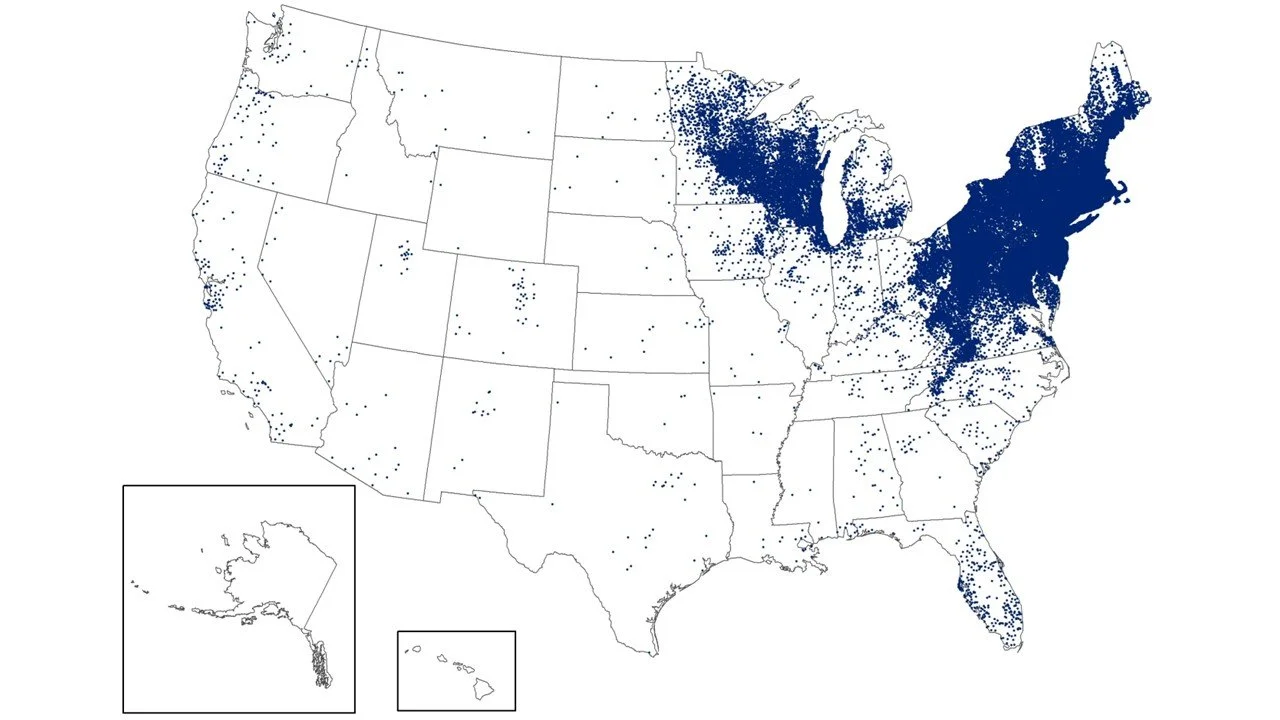
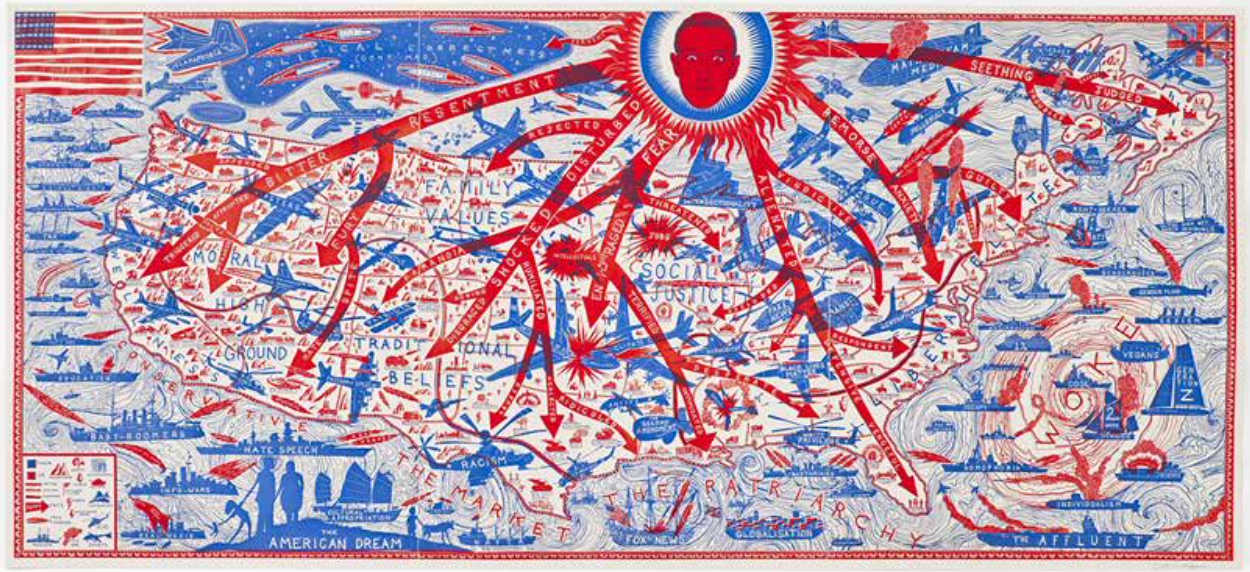


We'll stick with hate then
 "A Love Like This" (archival inkjet print), by CORINNE SPENCER, at Samson gallery, Boston, through August. She says "the artist forces the viewer to feel uncomfortable as she imposes bodily distress upon herself.''
Interesting business model.
Memento mori, et al.
 "Enduring Ephemera Series: Installation #2'' (detail, mixed media, plant/animal material, hair), by ERICA WESSMANN, in her "Memento'' show at Fountain Street Fine Art, Framingham, Mass., through March 30.
Prepare for industrial agriculture in maple-syrup business
The big story in The Boston Globe today is:
"Experiments at the University of Vermont’s Proctor Maple Research Center show that maple sap — the raw material that sugar makers boil into syrup — can be efficiently vacuumed from the decapitated trunks of saplings, sharply increasing syrup production. That’s a radical departure from the centuries-old practice of inserting a small tap a few feet above the base of a mature tree, relying on the force of gravity and internal pressure to draw off the sap.''
There's goes the romance of March-thaw maple-sugaring, albeit there will be a windfall for industrial agriculture in the North Country. The baby maples would be grown in tight rows, like corn or Christmas trees.
Respond via rwhitcomb51@gmail.com
On my mother's trail
"Satellite From the Afterlife (detail from acrylic on canvas), by DAVID KINSEY, in his show "In Loving Memory of My Mother, Kathy Wooden Kinsey,'' which presents "an epic trail'' of "moments of time that occur in one's life.'' The show will be at Bromfield Gallery, Boston, March 5-3o.
rwhitcomb51@gmail.com
Bourbon and burgers
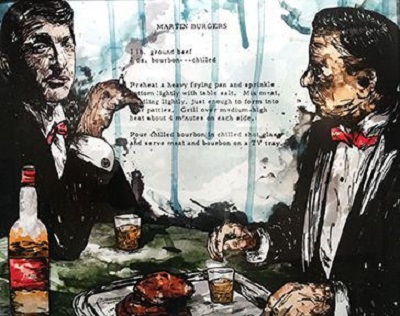 "Burgers,'' by DREW GUNDLACH, at Wedeman Gallery, Newton, Mass., through March 14.
Ukraine and the Sudetenland
March 2, 2014
Gray but at least not very cold morning. A little bit of drizzle. A couple of layers of rock salt and sand on the roads. Some of the ground around the trees unfrozen. Stored-up heat from yesterday's sunlight?
Lots of potholes on the roads. Will Providence's mayor, Angel Taveras, fill enough of them fast enough to avoid lethally damaging his run for governor? How many broken axles can he take?
Happy to hear that we won't get the snowstorm that had been promised for tonight and tomorrow. But heard little birdsong this morning. No bright sun to get the feathered bastards excited.
In some years, plenty of crocuses out by now in sunny spots. But on this year's tundra, we will have to wait, I would guess, until the end of next week. Perhaps the big rainstorm that some meteos see coming up the coast at the of end of this week will unfreeze the ground enough to speed things along.
Meanwhile, about five more degrees this morning and the worms will be wiggling in the compost bin.
Russian dictator and former KGB official Vlad Putin is doing to Ukraine what Hitler did to Czechoslovakia: Using the excuse of "rescuing'' his "compatriots'' (if that's what Russian-speaking Ukrainians are) to try to bring a whole democratic country to heel.
In Hitler's case, he used the bogus "plight'' of ethnic/linguistic Germans living in the Sudetenland strip of democratic Czechoslovakia as an excuse to take over that country after it was betrayed by France and Britain as then-isolationist America looked on.
Now we have further proof that Putin's occasionally murderous regime is also an imperialist and fascist one. We had plenty of proof already.
Will the European Union do anything? Has the Europeans' relentless military disarmament emboldened the Russian dictator to follow Hitler, Mussolini and Stalin and create a new empire, or rather reconstitute the Soviet one in the form of a fascist and xenophobic one?
As when the Russians invaded Hungary in 1956 (when Republican Eisenhower was U.S. president) and Czechoslovakia in 1968 (when Democrat and Vietnam-distracted Lyndon Johnson was president) to impose its will, so apparently it is doing now in Ukraine.
Of course, whatever the rhetoric, the West can do little in the short term to stop the Russians, though it would be nice to think that we could ship the Ukrainians some arms. But then, other than risk World War III, we could do little immediately in '56 and '68, despite the demands of conservative Republicans that we "roll back the Iron Curtain.''
But the Russian economy, whose only really successful part is oil and gas exports, is very vulnerable to long-term economic sanctions -- if the Europeans can summon up more courage and persistence that they have shown lately.
The first thing powerful thing we can do is to start freezing Russian assets in the U.S. (much of them produced from criminal activities anyway) and revoke the visas of Russian officials and businesspersons. Hit the Putin regime very hard in the pocketbook.
And let's hope that we not only take strong measures to thwart cyber-attacks on the Ukrainians, the Western Europeans and us during Russia's invasion of Ukraine but also go on the offensive to do everything possible to make Putin's invasion painful to his regime, which presides over what is in many ways a very fragile, if geographically vast, nation.
Of course, with Putin pal and Moscow resident Edward Snowden probably continuing to feed U.S. systems information to the Kremlin that will be more difficult than it would have been a couple of years ago. (Why oh why has Snowden, who took his information first to the Chinese communist dictatorship and then to the fascist one in the Kremlin been presented as some sort of a hero? )
But America, as an innovative and open society, has far more creativity than does the profoundly corrupt and paranoid Russia ruled by Putin. In the end, we can outsmart it.
respond via rwhitcomb51@gmail.
Our weather narcissism
By ROBERT WHITCOMB
Inevitably, some politicians and entertainers (e.g., Rush Limbaugh) are having great fun with the cold and snowy winter in the East and Midwest, saying that this shows that “global warming” is a fraud.
But they are extrapolating from immediate experience and anecdote, not science. I suspect that most of these people know better, but, hey, they’re in show biz.
Actually, January, for instance, which the news media lamented for its cold, snow and ice, has been rather severe in the eastern U.S. because of a huge dip in the jet stream that has brought cold (though not unprecedented cold) to the Upper Midwest and the Northeast while out West, including Alaska, it’s generally been very warm and dry for this time of year. Northeasterners and Midwesterners have endured temperatures 10, 15 or more degrees below normal; Alaska and California have been 10-15 degrees above. And the National Oceanic and Atmospheric Administration reports that January was, on a global basis, the fourth-warmest on record.
That the Northeast is so densely populated and that much of the national news media are based in New York and Washington mean that the idea that this winter is particularly bad has particularly strong currency. It recalls E.B. White’s funny 1954 essay “In the Eye of Edna,” in which he noted that the nation lost interest in Hurricane Edna after it moved beyond Boston’s radio and TV stations to wallop White’s comparatively remote Mid-Coast region of Maine.
Then there are such relatively new weather-news outlets as the Weather Channel and Accuweather. These commercial outlets will die if they fail to constantly dramatize such old weather phenomena as “The Polar Vortex” — a low-pressure area in upper latitudes that now is presented almost as a new and lethal threat to civilization. Weather events that would have seemed par for the course of a season a half century ago are now characterized as world-historical events.
Changes in the route of the jet stream from time to time bring cold air deep into the eastern part of the United States while the other side of the country becomes much warmer than usual as the jet stream brings in mild, Pacific air from the southwest. The jet stream’s position, of course, can vary widely but it can sometimes get stuck, meaning warm, “open” winters for us some years and cold ones in others. The general trend, though, is for milder winters. The trouble is that we confuse events in our areas that are part of weather’s natural variability with global climate change.
The confusion of one’s particular circumstances with the wider reality reminds me of the heartening rise in recent years of “evidence-based medicine” as opposed to the more traditional “expert-based medicine.” I am simplifying, but evidence-based medicine relies much less on individual physicians’ experience, values and judgment and much more on cold, hard data derived from rigorous collection and analysis of information from broad populations. As with medicine, so with climate, follow the data.
Anyway, New Englanders have suffered through another week of below-normal weather and are heartily sick of it. That the population is aging and that old people, in particular, find winters wearisome may reinforce the winter fatigue of younger people, too.
In some winters, snow drops and crocuses would be popping out of south-facing slopes about now. It looks as if we’ll have to wait a while for them this year. Still, a gradual change in the mix of morning bird song and that there’s bare ground around the base of trees where there was snow a week or two ago reminds us that the sun is getting stronger by the day: Some birds are coming north again and there’s more solar energy for the trees to absorb. And on one of our recent, and for this winter, rare mild days, I found the worms wiggling enthusiastically in our compost bin, whose contents seem to have been frozen solid a couple of days before. Worms: A reminder of the cycles of death and life.
***
The Feb. 23 New York Times business section story “Loss Leader on the Half Shell: A national binge on oysters is transforming an industry (and restaurants’ economics)” was heartening for a coastal New Englander. It implied that our estuary-rich region could benefit a lot from much expanded shellfish aquaculture. Unlike, say, casinos, which are a net subtraction from a region’s economy, or local businesses that recycle money that’s already here, aquaculture, because it has exportable physical products and brings people here from far away to buy them in our eateries as local specialties, increases our region’s wealth.
And the business, with its demands for clean water, prods us to keep our coastal environment cleaner.
Robert Whitcomb (rwhitcomb51@gmail.com), a former Providence Journal editorial-page editor, is a Providence-based writer and editor and the overseer of www.newenglanddiary.com. He is also a director of Cambridge Management Group (cmg625.com).
The NSA enlarges some fingerprints

"Black & White #3 (Chine-colle relief print), by BRYAN NASH GIILL, in his very wide ranging "The Process of Discovery'' show , at Heather Gaudio Fine Art, New Canaan, Conn., through March 22.
Birches and elms
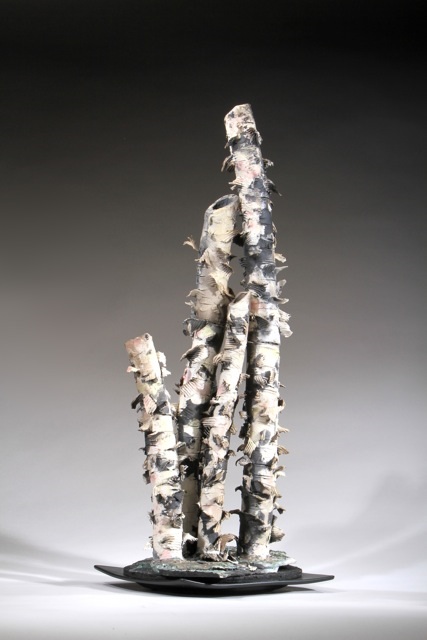
"Birch Trees #1,'' (raku ceramic), by NANCY CAHAN, at Alpers Fine Art, Andover, Mass.
Because of innumerable paintings, photos and such poems as Robert Frost's "Birches'', the birch tree is deeply associated with ideas about the New England countryside (and canoes), as are elms with the region's streets. But climate change might dramatically reduce the number of such trees, and confine them to New England's most northern sections.
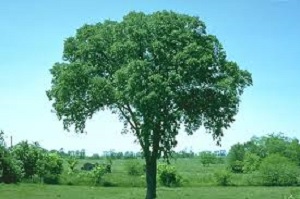
Meanwhile, recent botanical research has led to the development of fungal-disease-resistant American elms (see one below), which Dutch elm disease seemed to utterly doom only a couple of decades ago. We all look forward to the return of these graceful , hourglass-shaped trees to the commons and street sides of New England towns where they were so common 60 years ago. I'm sad I won't be around to see them as tall as I remember the trees, now long dead, as a boy.
I recall Memorial Day parades under the elms and think of their iconic position in New England whenever I hear the Eugene O'Neill play "Desire Under the Elms'' mentioned.
Slow-cooked art

"Standard and Microwave'' (assemblage), by CAROL McMAHON (photo credit: Stewart Clements), in the "Un-Mapping the Air'' show at 83 Spring venue, Watertown, Mass., through April 10.
Work-art balance
 Film still from "Balance Study, Heel Toe,'' by Jacob Tonski, at the University of Massachusetts at Lowell gallery through March 21. Mr. Tonski explores "dynamic balance through video, life-size objects and kinetic metaphors,'' says the gallery.
Conn. vs. Fla. may be equal contest
 By CHRIS POWELL
MANCHESTER, Conn.
With snowstorms seeming to arrive every few days, little room left for stacking
the snow, road-salt supplies nearly exhausted, state and municipal snow-removal
budgets in deficit, and the Connecticut General Assembly reconvening, many people in
Connecticut feel that they have had enough of the state.
It's little consolation to them that Connecticut may have the best snowplowing
operation in the country, with the state's major roads almost always kept
passable throughout even the heaviest snowstorms. For besides the extra snow,
Connecticut's economy and standard of living are still declining, which may be
the cause of most of the surliness here; the snow just makes people feel their
resentments more keenly.
As a result many of them look south enviously, especially to subtropical
Florida, to which many Connecticut residents already have fled, either
permanently or just for the winter. Indeed, when the University of Connecticut's
basketball teams play colleges in Florida, the crowd often seems to favor the
visitors.
But while it may be harder to appreciate Connecticut after shoveling snow or
falling on ice, Florida has its own climate disadvantages. In the late summer
and early fall Florida can be crossed by as many hurricanes as Connecticut suffers
snowstorms in the winter, and the resulting property damage in Florida is far
greater than that inflicted by snowstorms in Connecticut, just as
weather-related electricity outages in Florida can last longer.
Because of bad weather a few weeks ago it took three days and several flight
reschedulings for a recently retired couple from Connecticut to escape the state
by air for their new winter home in South Florida, one of those tightly
regulated condominium complexes that forbid admission to anyone under 55. The
couple had hardly begun breathing the state-income-tax-free air when a line of
thunderstorms stalled overhead for 24 hours and dumped 14 inches of rain on
them, flooding their new neighborhood, closing its roads, and incapacitating
sewer lines and toilets for a couple of days.
It wasn't a snowstorm; it was worse.
Not long after the couple got dried out and settled, some university researchers
reported that alligators, which which infest South Florida, not only swim stealthily
but also climb trees, in part for better surveillance of their prey.
Told of the study, the new arrivals from Connecticut refused to be
concerned. While they had not yet read their condo association's many rules,
they figured that, in addition to excluding people younger than 55, there was
probably one against alligators climbing trees on the property and eating the
residents.
They shouldn't count on it. Annoying as Connecticut's snow has been, at least it
also has gotten in the way of the state's own many predators, both those with
four legs and those with two. There's never much crime in bad weather.
* * *
Two executives of the Metropolitan Transit Authority came to Hartford last week
so Gov Dan Malloy could reprimand them in front of the television cameras about
the MTA's mismanagement of the Metro-North Commuter Railroad, whose many recent
disasters have impaired service from New Haven to Grand Central Station in New
York. The MTA executives duly promised improvements soon.
But while the governor got to look tough, he really didn't increase
Connecticut's leverage with the MTA, a New York state agency paid by Connecticut
to operate the state's rail lines into New York. To gain such leverage
Connecticut needs a plan, just as Metro-North needs a plan to improve rail
service.
Connecticut's plan might include demanding representation on the MTA's board,
the renegotiation of Connecticut's contract with the MTA, and a study of how
Connecticut could take over the management of its rail lines into New York.
Until Connecticut has a rail-service-improvement plan that goes beyond scolding
MTA officials on television, the MTA may assume that it can take its time about
improving service here.
Chris Powell is managing editor of the Journal Inquirer in Manchester, Conn.
Please respond to www.newenglanddiary.com via rwhitcomb51@gmail.com.
By CHRIS POWELL

MANCHESTER, Conn.

With snowstorms seeming to arrive every few days, little room left for stacking
the snow, road-salt supplies nearly exhausted, state and municipal snow-removal
budgets in deficit, and the Connecticut General Assembly reconvening, many people in
Connecticut feel that they have had enough of the state.

It's little consolation to them that Connecticut may have the best snowplowing
operation in the country, with the state's major roads almost always kept
passable throughout even the heaviest snowstorms. For besides the extra snow,
Connecticut's economy and standard of living are still declining, which may be
the cause of most of the surliness here; the snow just makes people feel their
resentments more keenly.

As a result many of them look south enviously, especially to subtropical
Florida, to which many Connecticut residents already have fled, either
permanently or just for the winter. Indeed, when the University of Connecticut's
basketball teams play colleges in Florida, the crowd often seems to favor the
visitors.

But while it may be harder to appreciate Connecticut after shoveling snow or
falling on ice, Florida has its own climate disadvantages. In the late summer
and  early fall Florida can be crossed by as many hurricanes as Connecticut suffers
snowstorms in the winter, and the resulting property damage in Florida is far
greater than that inflicted by snowstorms in Connecticut, just as
weather-related electricity outages in Florida can last longer.

Because of bad weather a few weeks ago it took three days and several flight
reschedulings for a recently retired couple from Connecticut to escape the state
by air for their new winter home in South Florida, one of those tightly
regulated condominium complexes that forbid admission to anyone under 55. The
couple had hardly begun breathing the state-income-tax-free air when a line of
thunderstorms stalled overhead for 24 hours and dumped 14 inches of rain on
them, flooding their new neighborhood, closing its roads, and incapacitating
sewer lines and toilets for a couple of days.

It wasn't a snowstorm; it was  worse.

Not long after the couple got dried out and settled, some university researchers
reported that alligators, which which infest South Florida, not only swim stealthily
but also climb trees, in part for better surveillance of their prey.

Told of the study, the new arrivals from Connecticut refused to be
concerned. While they had not yet read their condo association's many rules,
they figured that, in addition to excluding people younger than 55, there was
probably one against alligators climbing trees on the property and eating the
residents.

They shouldn't count on it. Annoying as Connecticut's snow has been, at least it
also has gotten in the way of the state's own many predators, both those with
four legs and those with two. There's never much crime in bad weather.

* * *

Two executives of the Metropolitan Transit Authority came to Hartford last week
so Gov Dan Malloy could reprimand them in front of the television cameras about
the MTA's mismanagement of the Metro-North Commuter Railroad, whose many recent
disasters have impaired service from New Haven to Grand Central Station in New
York. The MTA executives duly promised improvements soon.

But while the governor got to look tough, he really didn't increase
Connecticut's leverage with the MTA, a New York state agency paid by Connecticut
to operate the state's rail lines into New York. To gain such leverage
Connecticut needs a plan, just as Metro-North needs a plan to improve rail
service.

Connecticut's plan might include demanding representation on the MTA's board,
the renegotiation of Connecticut's contract with the MTA, and a study of how
Connecticut could take over the management of its rail lines into New York.

Until Connecticut has a rail-service-improvement plan that goes beyond scolding
MTA officials on television, the MTA may assume that it can take its time about
improving service here.

Chris Powell is managing editor of the Journal Inquirer in Manchester, Conn.

Please respond to www.newenglanddiary.com via rwhitcomb51@gmail.com.
White out wildlife

On Monhegan
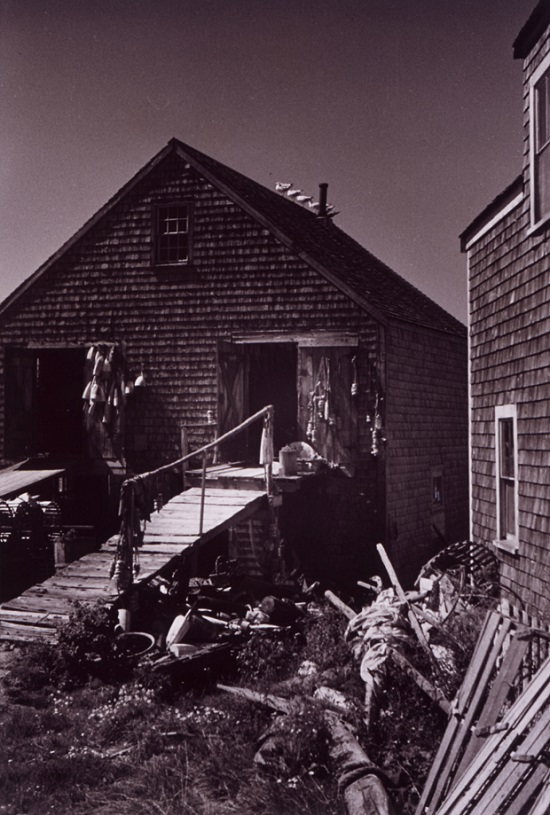
"Untitled'' (gelatin silver print, 1936), by GEORGE DANIELL, in the show " Picturing Monhegan Island,'' March 1--Aug. 3, at the Portland Museum of Art. (Picture is a gift of George Daniell and the Aucocisco Gallery, 2001.6.23 © George Daniell Archive, Dwayne and Gina DeJoy.)
The show showcases about 20 photos and drawings that Daniell created on the famous artists' haunt of  Monhegan Island, far off the coast of Maine, in the summer of 1936.
The stark beauty of the island, and the sadness of Depression-era America, come out in these beautiful pictures.
Philip K. Howard: Shipwrecked on ancient laws
By PHILIP K. HOWARD NEW YORK
A shipload of salt to deal with this year’s snow and ice on New Jersey’s roads has been detained in legal limbo in Providence Harbor, en route from Maine. The problem, detailed in the Feb. 19 New York Times, is that it’s illegal for a foreign-owned vessel to ship goods from one U.S. port to another. (There’s even a word for it, I learned. Domestic shipping is called "cabotage.")
Now, there’s nothing apparently wrong with the ship, which had just finished unloading its cargo in Maine and was available to take on the salt immediately. But an obscure 1920 law known as the Jones Act requires a U.S. ship, with a U.S. crew, on all domestic routes. There’s a cottage merchant marine industry and union that exists just because of this law.
In this era of free markets, one would think that protectionist laws from almost 100 years ago would have gone the way of the horse and buggy. But laws have remarkable staying power (as we saw two weeks ago with the continuation of New Deal-era farm subsidies). The same onerous process for enacting a law applies to repealing it, with one additional, almost insurmountable, hurdle: the law now is surrounded by an army of special interests who will do anything to defend it (think campaign money and ad hominem attacks on would-be reformers).
That’s why, in the strange culture of Washington, repealing laws is so rare as to be almost unthinkable. Getting rid of old laws violates the laws of legislative physics.
Laws pile up, year after year, like sediment in the harbor. Society, meanwhile, is increasingly paralyzed. The U.S. now ranks 20th in the world in ease of starting a business. This is because of thousands of laws like the Jones Act.
American democracy has a structural problem: There’s no political or legal imperative to clean the stables. The accumulation is so bad that, as I argue elsewhere, America should initiate a series of commissions, area by area, to recommend what are known as "recodifications" of law—new, simpler codes that reflect current national goals and priorities. Going forward, most regulatory programs should periodically "sunset," with an action-forcing mechanism (perhaps a constitutional amendment) that prevents Congress from simply re-enacting the same program in a midnight vote.
It’s impossible to run a government, much less balance public budgets, under the weight of a hundreds of laws and programs that are obsolete in whole or part. The weight grows heavier every year. It will break, sooner or later. Perhaps it’s time to start thinking about to fix it.
Philip K. Howard is a New York-based lawyer, civic leader and author. He is chairman of the legal and social-reform group Common Good and the author of , among other books, The Death of Common Sense and the upcoming The Rule of Nobody.
'Lame Deer' and 'culled' ones

"Lame Deer (Big Eagle)'' (oil on French linen), by ROBERT S. NEUMAN, in the "Robert S. Neuman: Lame Deer Series,'' at the Art Complex Museum, Duxbury, Mass., Feb. 23-May 18.
Soon there will be many fewer deer on Block Island, as a Connecticut firm is being brought in to "cull'' the herd, whose population, and that of the deer ticks that carry Lyme disease, have swollen. Brutal world.
Of factories, Florida and Alzheimer's
Many citizens wonder what to do with 19 acres of Providence land that have been made available for development by moving Route 195. What a huge opportunity!
The property is in the middle of New England’s second-largest city; alongside the East Coast’s “Main Street” — Route 95 — whose intersection with 195 created one of the East's big crossroads; next to internationally known academic institutions; spectacularly situated at the head of a great bay, and near a large hospital complex. And just down the road is Green Airport, which is being expanded to allow nonstop flights to the West Coast and Western Europe.
What to put on the property? Offices and academic facilities, especially those connected with medically related activities; design businesses (Rhode Island School of Design spinoffs?), restaurants, hotels and stores. But let’s not ignore manufacturing.
This would not be the “dark satanic mills” of yore, emitting thick pollutants into the air and water. Most American manufacturing is much, much cleaner these days. It also employs fewer people, as foreign factories and robotic systems here have taken over much of the work, though the factory workers we have are generally well paid. To make such high-end stuff as pharmaceuticals in plants on the 195 land is just common sense. Consider that the proximity of Routes 195 and 95 and Narragansett Bay’s ports makes shipping manufacturing materials into and finished products out of this part of Providence remarkably easy. And there’s lots of engineering expertise in the region.
And if you think that a factory can’t co-exist attractively with a thickly settled area, consider Genzyme’s plant in the Allston section of Boston.
But the area needs more and better mass transit to serve the neighborhood, whose warren of confusing streets could scare away car-based people. Eventually a couple of trolley lines (real ones, with rails) should run through the newly developed area to connect the old downtown, the medical complex to the south and College Hill. But let development be dense; sociological and other studies associate density with lower crime and higher urban energy. Planners for the land should keep out windswept parking lots.
All in all, the 195 land offers the biggest opportunity to raise the profile and thus the prosperity of Providence since the rivers were moved.
***
We just got back from Naples, Fla., where I worked and we saw relatives in one of the most demure parts of the peninsula. The overloaded airline system makes travel to and from the Sunshine State increasingly difficult. And the urbanization and suburbanization of much of Florida have tattered much of its semi-tropical beauty. Still, the warmth, the greenery and the ease of strolling compared with walking on New England’s icy streets, narrowed by inadequate snowplowing, made it seem paradisiacal. And the quiet was addictive; the sound of wind through the palms and the surf were the main background sounds as I typed in my brother-in-law’s office.
It brought back memories of a quiet, lush Florida from my childhood. I remember the smell of the orange groves, the roadside juice stands and the long stretches of unbuilt-on beach backed only with palmettos and dune grass. My first memory is of an old man throwing bread to pelicans on the beach in Siesta Key, near Sarasota. Later ones include discovering Key lime pie and stone crab, drinking from a coconut and enjoying the best roadside kitsch in America.
Parts of my family had been going to Florida for part of the winter since around World War I. Naturally they complained about its over-development. Of course, they helped start the problem. (However, they never took part in the sort of crazy land speculation immortalized in the Marx Brothers’ 1929 film “The Cocoanuts,” in which Groucho’s character keeps trying to unload swampland on unsuspecting investors. Not much has changed since then!)
When there’s something nice, we overuse it, which is what happened to Florida, especially after air-conditioning, interstate highways and jet travel made getting and staying there so much easier. The Florida that I briefly revisited the other week, just before its high season, evoked in me balmy nostalgia for a time before Florida became a mega-state.
***
Kudos to Cape Cod-based writer/editor/publisher Greg O’Brien, 64, who has been writing (as self-therapy) about Alzheimer’s disease since he was diagnosed with it, in 2009. One of his projects is his book “On Pluto: Inside the Mind of Alzheimer’s.” Then there’s my friend Berna Huebner, whose movie and book, “I Remember Better When I Paint,” describe how her mother, a successful Chicago-based painter, regained some of her skills and energy after she was persuaded to return to painting after Alzheimer’s seemed to doom her to a life of, by turns, agitation and depressed passivity. We’d better be looking for many routes for relief for dementia victims — and their families -- as the number of victims swells in the next two decades.
(In 2010, I wrote a magazine piece about this.)
Robert Whitcomb (rwhitcomb51@gmail.com), a former editor of The Providence Journal's Commentary pages, is a Providence-based writer and editor and the overseer of www.newenglanddiary.com. He is also a director of Cambridge Management Group (cmg625.com).
Cold moon over Maine
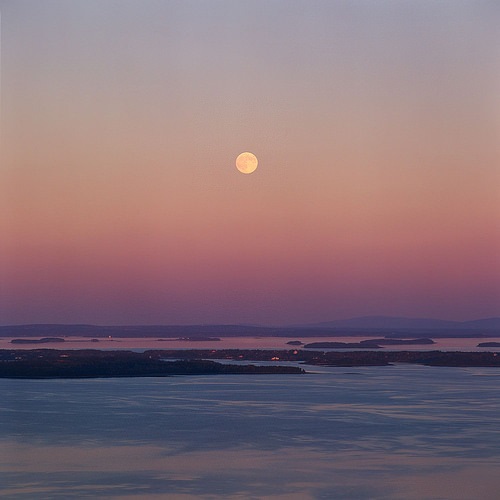
''Moonrise, Penobscot Bay'' (photo), by JIM NICKELSON, in his "Adventures in Celestial Mechanics'' show at Maine Media Gallery through March 1.
Have activities been even more difficult and frustrating to plan this winter than most? Or is it that life has become that much more complicated anyway, and a larger percentage of population is old and thus less able to deal with the seasonal mess?
Philip K. Howard: The perilous search for legal certainty
By PHILIP K. HOWARD
You will profit by reading philosopher Simon Critchley's recent reflection on Dr. Jacob Bronowski and the dangers of certainty. People who think they possess a final truth, driven compulsively towards their view of certainty, often cause evil, whether they're religious fanatics like Savonarola or, as Bronowski discusses, the officials who devised the Final Solution.
A responsible human must look life in the eye, open to the moral and factual uncertainties presented by many choices in human dealings. Critchley: "There is no God's eye view, Dr. Bronowski insisted, and the people who claim that there is and that they possess it are not just wrong, they are morally pernicious. Errors are inextricably bound up with pursuit of human knowledge, which requires not just mathematical calculation but insight, interpretation and a personal act of judgment for which we are responsible."
Applying this principle of human responsibility for moral choices has applications throughout the range of human endeavor. Let's look at law for a minute.
Legal certainty is accepted orthodoxy. Of course, law should be certain, we have been taught. Only then will people know what's expected of them, and not be fearful of arbitrary officials. In pursuit of certainty, laws have become ever more detailed. The new Volcker Rule regulating proprietary trading by banks is almost 1,000 pages long. The Affordable Care Act is almost 3,000 pages long. Nursing homes are typically regulated by 1,000 rules. In total, there are over 100 million words of binding federal law, and several billion words of state and local law.
Do all these detailed dictates achieve certainty? Of course not. Law is an unknowable jungle. Does all this law safeguard us against arbitrary officials? No, it's a legal minefield. No one can comply with it all. We're at the mercy of the state. Does all this detailed law make government a well-oiled, smoothly-running machine? HELP!! There's hardly any program, even the best of them, that doesn't waste vast resources in bureaucratic nonsense.
Public solvency is basically illegal in America. All this detailed law prevents the president, and any governor, from making the choices needed for fiscal responsibility.
Our obsessive quest for legal certainty has left our society, ironically, in a very uncertain state. The only cure is to abandon legal certainty and embrace human responsibility as the operating philosophy for most activities of government.
Canadian management theorist Brenda Zimmerman makes the distinction between activities that are "complicated"--like engineering, or rocket launches, or surgery--and activities that are "complex"--such as raising a child, or running a healthcare system. Complicated activities profit from detailed rules, checklists, and protocols. Complex activities require balance, and tradeoffs, and moral choices. Detailed rules cause failure.
Law can support a free society, I argue in my new book, The Rule of Nobody (due out in April), only when it abandons this obsessive quest for certainty. Law should instead set goals and principled boundaries, leaving room for humans to make practical and moral choices. Real people, not rules, make things happen. Automatic government is a false philosophy. Democracy is supposed to elect people to act on their vales, not to avoid them by mindlessly applying detailed rules. Of course people will sometimes abuse this trust. Look at the George Washington Bridge lane-closings. But officials there are paying the price. The worst system is one where things fail, and there's no one to hold accountable. That's what we have today: The Rule of Nobody, As Jacob Bronowski passionately explained, avoiding human responsibility is the root of much evil.
Philip K. Howard is a New York-based lawyer, civic leader and writer. He is chairman of Common Good, a nonprofit social- and legal-reform organization. Mr. Howard is the author of, among other books, The Death of Common Sense. For more of Mr. Howard's Daily posts, visit commongood.org/blog and follow him on Twitter: www.twitter.com/philipkhoward
To contact the overseer of New England Diary, please use rwhitcomb51@gmail.com