
Vox clamantis in deserto






Wooden wouldn't quit
 "Dove Street'' (oil on panel), by CHARLOTTE BREED HANDY, at the Providence Art Club.
The sadness and charm of an old neighborhood in an old New England city (in this case Providence). What is perhaps surprising is that so many of these old wooden houses have survived. The wind and the cold of our region have been very good preservatives.
Hitchcock on the Charles
 "Sinister, Cambridge, MA'' (archival digital image), by ED FRIEDMAN, in his show "STREETwHYS: A Personal View of Street Photography,'' at Galatea Fine Art, Boston, March 5-30.
A hard-won crop

"Shuckers'' (Homage to the Patricia Marie Series, 1976-2001, oil on canvas) by SALVATORE DEL DEO, at the Berta Walker Gallery, Provincetown, through March 8.
Tedious work but not nearly as unpleasant as being out on a cold wet clam flat and raking them up. No wonder they're so expensive.
Evoking a past gritty prosperity

"The Factory'' (watercolor), by STEPHEN H. HOLLAND, at the Art Complex Museum, in Duxbury, Mass., in the Duxbury Art Association's annual winter juried show.
But having a good time anyway
 "Faustian Darkness'' (photographic prints and found antique frames), by TODD GRAY, via Samson Gallery, Boston.
The granny pod in the backyard
(Please comment via rwhitcomb51@gmail.com)
Real-estate trends say a lot about America’s wider economy and society — about citizens’ ambitions and insecurities and their evolving sense of place in our hurly-burly nation. So I read with great interest the Jan. 26 New York Times stories “The Gadfly of Greenwich Real Estate: Amid dozens of unsold mega-mansions, a real estate agent sees a glut of greed” and “Big Is Back (and Don’t Forget the Extras).”
The stories reminded me of how much more showy house ownership is now among the rich and near-rich than, say, 50 years ago. What mix of insecurity, exhibitionism, “irrational exuberance,” love of place, healthy confidence and speculation in all this? (Reminder: A real-estate boom caused the Crash of 2008.)
Billionaire Warren Buffett, by the way, lives in a modest house in Omaha.
But what really caught my eye was a Times story that ran back on May 1, 2012 headlined, “In the Backyard, Grandma’s New Apartment.” It’s about a mini-house called the MEDCottage — a prefab 12-by-24-foot, one-floor “bedroom-bathroom-kitchenette unit that can be set up as a free-standing structure.”
Given the aging of the population, we might be seeing far more of these dwellings than McMansions in the next couple of decades. They’re a fine idea, letting old people retain a sense of independence (albeit partly bogus) while not encumbering them with the duty of taking care of a “real” house.
But it’s doubtful that many residents of these tiny houses will build the powerful memories associated with childhood homes. For one thing, their ability to remember is fading.
Some of mine might be too, but my recollections of the house “I grew up in” on a hill near Massachusetts Bay remain powerful. The smell of the cedar closet, the dusty heat of the third floor in summer, the freezing drafts in the west-facing rooms in the winter, the troubling sound of glasses being clinked downstairs. My parents owned the house for about 20 years but because a young person’s sense of time passing is much slower than an adult’s — more of that below — it seems to me that I spent half my 66 years there. A childhood home has a powerful personality, creating a haunting and lifelong sense of place.
But now, jettisoning most of our stuff and moving into something like the MEDCottage has a growing attraction. I wonder if the buyers of our modest house would mind if we bought a corner of the (albeit small) backyard and put one of these tiny dwellings there to move into. We like the neighborhood.
***
The demonstrations in Ukraine against dictatorial and (with his family) kleptocratic President Viktor Yanukovych, pal and/or lackey of Russia’s quasi-fascist dictator Vladimir Putin, recall that given honest information, most people would choose to live in Western-style liberal democracies. While such potentates as Putin strive to ever expand their power and to quash their opposition, most Ukrainians look west for hope. The thuggery of a Putin or the Taliban can only suppress for a time people’s drive to live in the sort of society whose fullest expression is in nations dominated by Western ideals.
That’s because those ideals when implemented, however incompletely, address the deepest desires of people for dignity, for protection from arbitrary, larcenous and violent rule and for self- and civic improvement. The brute force of authoritarian regimes cannot work forever to block these desires.
Most Ukrainians want to be part of “Europe” (which really means Western and Central Europe) and not an autocratic empire — even one run by fellow Slavs.
***
We’ve had a tough winter in the Northeast so far this year. The jet stream has been screwed up, bringing us extended deep freezes, and Out West, including Alaska, record warmth.
When you’re a kid, snowstorm predictions bring joy; you don’t worry about going outside without a hat, nor about your dog not wearing a coat. (We thought that dogs were impervious to the extremes of nature.) But as you age, the inconveniences of snow and ice look more daunting; indeed, new snow can seem a layer of death. You feel the cold more and (rightly) anthropomorphize the dog’s feelings.
Still, as I wrote in my blog during last Saturday’s morning-long “January thaw,” how adults process time helps get them through winter. We know far better than the young how fast the seasons come and go. A happy reminder comes when you have the habit of walking the dog early in the morning and sometime in the middle of January you start to really notice it getting brighter earlier. Rejoice! Rejoice! However, with the caution and empathy of age, you make sure that you’re wearing a hat and the dog a coat.
Robert Whitcomb (rwhitcomb51@gmail.com and www.newenglanddiary.com) is a Providence-based writer and editor and a former editor of The Providence Journal's Commentary pages.
Chris Powell: Past time to reopen mental hospitals
By CHRIS POWELL MANCHESTER, Conn.
Catastrophes of mental illness are everywhere these days, likely increased by the economy's collapse and social disintegration. While the federal government is too paralyzed by partisanship to do anything, Connecticut state government has decided to study mental illness in children, as required by a state law passed last year in response to the school massacre in Newtown.
The study, to be supervised by the state Department of Children and Families, is to develop a plan for improving children's access to treatment. But while it may be better than nothing, the DCF study is a dodge for delay.
For what is lacking in the treatment of the mentally ill is no mystery: the mental hospitals that were closed decades ago on the pretense that smaller community treatment facilities would handle sufferers more humanely. Of course, few such treatment facilities were established, nor can they be, since few people are willing to live near one.
The same laments are heard everywhere, as they were the other night on the CBS News program 60 Minutes. A state senator in Virginia told how he could not get his disturbed son admitted to a mental hospital within the six-hour limit given to police to hold someone believed to be mentally ill. So the young man was sent back home with his father and the next morning attacked him with a knife and then shot himself to death.
Also on the program a woman from Connecticut complained that her 8-year-old daughter spent 12 days in a hospital before being sent home only to be wracked three days later by more violent urges. Meanwhile the Associated Press reported that a young man charged with murdering his mother in Deep River in December spent years going through hospitalizations, doctor visits, medications, and treatment programs.
The young man's brother said, "He was in and out of that system for four years, and all we ended up with was a disaster." Of course much of the work of DCF itself involves coddling manifestly unstable and incompetent single parents whose children are always at risk, a policy of less than halfway institutionalization that often results in serious injury or death to innocent kids. The refrain across the country and in Connecticut is that "the system" failed mentally ill people who killed someone or themselves. The complaint is valid insofar as serious treatment was not available. But as with the perpetrator in Newtown, with the Connecticut case cited by 60 Minutes, and with the Deep River case, treatment was available on a sustained basis; it just didn't work, because treatment of mental illness is not simple arithmetic.
Rather treatment confronts an often complicated combination of chemical imbalance and emotional distress.. Sometimes it can be treated well enough with drugs and therapy and sometimes it can't.
Sometimes the best that can be done over the long term is to keep people secure, medicated, and away from dangerous objects, as was done when government maintained more mental hospitals. Connecticut probably could fill two or three such hospitals immediately just with the weekly overflow of mentally ill people in general-hospital emergency rooms.
So why aren't the mental hospitals being built? And why Connecticut's concentration on mental-illness treatment for children alone? The trouble is no less profound for disturbed adults and their families. It won't do to blame big, bad insurance companies for resisting coverage for institutionalization. Of course, insurance companies are no more eager to cover mental illness than government itself is; it is often fantastically expensive and perpetual without improvement.
But only government is big enough to handle the problem. Fortunately, if Connecticut is ready to rearrange its priorities it will have the resources, since treating the mentally ill is infinitely more compelling than state government projects already underway like busways, mouse factories, burrito restaurants, and raises and pensions for government employees.
Chris Powell is managing editor of the Journal Inquirer, in Manchester, Conn.
Some real and movie time with Pete Seeger
In the late spring of 1970, a group of about a dozen of us (I was along for the ride with a girlfriend of the time) spent a few hours with the mellow-voiced Peter Seeger at his 17-acre rustic homestead, in Beacon, N.Y., on a bluff overlooking the Hudson River. It had been a lush, warm spring, famous for anti-Vietnam War demonstrations. We had a cookout, at which Seeger was an affable host. He, of course, sang and played the five-string banjo, and a few others joined in making music.
Way down below on the river was a sloop that he owned that he was using in the early stages of leading a campaign to stop the likes of General Electric and other organizations from dumping toxins (some carcinogenic) into the river (which that day, despite its poisons, looked like 18th Century painting of the Rhine. Gorgeous!). It seems astonishing now to think of what we dumped into our public water, both as individuals and as institutions.
I generally disliked folk songs back then -- the lyrics seemed too sentimental and sometimes far too preachy and the tunes repetitive and clunky. I find them easier to take these days because I hear them as part of the broad flow of history. Or maybe I'm just getting hard of hearing....
Meanwhile, take a look at this segment of the very funny and sad movie The American Ruling Class. In it, Pete Seeger is walking, banjoing and singing down a road in what seems to be a very pastoral part of Greenwich, Conn., a capital of the sometimes rapacious capitalism that the old leftie hated. I think it's pretty funny, as is much of the movie, directed by John Kirby, produced by Libby Handros and with writer/editor Lewis Lapham as the master of ceremonies. He takes us to a lot of other celebrities commenting on American society in the years before the Great Crash of 2008.
Comment via rwhitcomb51@gmail.com
Fierce floral
 "Field of Flowers'', by GILL ROSS, at the Lexington (Mass.) Arts and Crafts Society.
Return to old reading

"Well Read'' (photo archival print mounted on board and overlaminated), by BOB HESSE, showing at Fountain Street Fine Art, Framingham, Mass.
I have had a little free time lately and have rediscovered the joys of reading musty old books left on the bedside tables of friends' houses and apartments, in book-sale rooms in libraries and even on the street. While I can still appreciate the likes of The Magic Mountain and many other long literary masterpieces (if reminded to do so), I confess that a well-wrought middle-brow novel (probably about "intelligent people'' with domestic conflicts in the suburbs or parts of Manhattan) with enough heft to get through a three-hour flight or part of a sleepless night will suffice.
As you get older, time circles back on you and you want to reread what you read in long summer weekends more than half a century before, interrupting your reading every few minutes to look at the puffy clouds in a blue sky and the lush greenery below your window while smelling the rich mixed aromas of lawn-mower gasoline and wet cut grass. From time to time, there's the shriek of a kid in the background, usually indicating happiness but sometimes a minor injury, usually inflicted by a sadistic child.At my rate, I'll be rereading the Doctor Doolittle series in no time, after returning to C.S. Forester's naval novels, set during the ever-popular (among readers of history and fiction) Napoleonic wars.
Meanwhile, our great throw-out of old, asthma-inducing paperbacks stashed in the cellar continues. No one will read any of them again.
Comment via rwhitcomb51@gmail.com
January thaw
Jan. 25, 2014 A windy, mild and sweetly melancholic day with scudding clouds from the southwest. Snow and ice are melting without man-made stimulants. Once again I'm rather surprised and pleased by how the light is brighter in late January than even just a couple of weeks before, and by the power of even the winter sun to quickly heat us in sheltered places. Our unheated but glassed-in sleeping porch, which faces the south, gets up to 75 even when it's 15 outside. We use the space to heat the adjoining bedroom by day.
We New Englanders could do a lot more with passive solar heating. It's not as if we're that far north; we're at the latitude of Portugal.
One nice thing about aging is that while the cold itself is harder to take, especially the windy chill of Northeast coastal cities, you're ever more aware of how fast time goes -- it will be spring very soon. And while it has seemed recently that we're living on Hudson's Bay, actually we're much closer to the Gulf Stream.
In New England, more than in most places, we have the weather to help mark off sections of our lives, as an aide-memoire, and that's handy. Now we have the predictable "January thaw,'' which, though this one will be very brief, reminds us that our weather won't really be paralyzed by the likes of "polar vortexes'' or other such Weather Channel monsters. By the way, California is having record heat and drought. And Alaska has been pretty warm for, well, Alaska.
Scientists differ on why the rise in temperatures associated with the "January thaw' ' tends to happen in late January rather than in early February, which would seem to make more sense. In any case, I'm more vulnerable to the sadness from lack of light than from the cold. And the light is moving in the right direction.
comment via rwhitcomb51@gmail.com
Face of New England

"Blue Granite" (mixed media on paper),'' by LUANNE W. WITKOWSKI, in her Exhibit "IV", at Kingston Gallery, Boston, through Feb. 2.
Tools of a brutal trade
 The University of Massachusetts at Dartmouth's gallery at 715 Purchase St., New Bedford, will present "The Harpoon Project and the Legacy of Lewis Temple'' on Jan. 29, at 6-8 p.m.
Mr. Temple was an African-American abolitionist and inventor. He invented the toggle harpoon in 1848 -- another way to torture whales but nice for the industry, which by that point was already in decline.
Panelists include Carl Cruz, of the New Bedford Historical Society, Michael Dyer, of the New Bedford Whaling Museum, Janine da Silva, of the New Bedford Whaling National Historical Park, and Linda Whyte Burrell, an artist. The panel will be moderated by Marc Levitt, of the "Action Speaks'', an NPR radio show based in Providence.
Blighted and bright college days
Robert Whitcomb (rwhitcomb51@gmail.com) is a Providence-based editor and writer.
The ultimate respect?

"Odalisque,'' by ELMYR de HORY (1974, oil on canvas), in the style of Henri Matisse. Collection of Mark Forgy. (Photo by Robert Fogt ) at the Michele and Donald D'Amour Museum of Fine Arts, in Springfield, Mass. through April 27. It's in the "Deceive: Fakes and Forgeries in the Art World'' show.
Most of us are fakers in some way, and we build upon the work of others, albeit not usually to the point of trying to perfectly replicate it to show off and/or make money. This brilliant show will test the perceptions of authenticity and, the museum says, show how technology is used to determine fraud.
David Warsh: WWI, the elites and the 2008 crash
By DAVID WARSH
BOSTON
A century after the outbreak of World War I, in 1914, and the memory of the wholly unexpected series of horrors to which it led, many commentators are feeling a little gloomy. Ordinarily I am persuaded by whatever sensible, knowledgeable, well-connected Martin Wolf has to say.
So I was surprised last week to find the chief economics columnist for the Financial Times arguing that our future is once again threatened by ignorant elites, just as it was in the years after 1914. This time, he wrote, the best and the brightest have been mismanaging the peace rather than bungling a war and its aftermath.
Wolf’s bill of particulars: First, the economic, financial, intellectual and political elites mostly misunderstood the consequences of headlong financial liberalization. Lulled by fantasies of self-stabilizing financial markets, they not only permitted but encouraged a huge and, for the financial sector, profitable bet on the expansion of debt. The policy making elite failed to appreciate the incentives at work and, above all, the risks of a systemic breakdown.
When it came, the fruits of that breakdown were disastrous on several dimensions: economies collapsed; unemployment jumped; and public debt exploded.
The policymaking elite was discredited by its failure to prevent disaster. The financial elite was discredited by needing to be rescued. The political elite was discredited by willingness to finance the rescue. The intellectual elite – the economists – was discredited by its failure to anticipate a crisis or agree on what to do after it had struck.
The rescue was necessary. But the belief that the powerful sacrificed taxpayers to the interests of the guilty is correct.
It seems to me that the history of the last 40 years is susceptible to a very different interpretation:
That the Cold War, which began with the partition of Europe after 1945 and the Communist Revolution in China in 1949, entered its last phase with the five-day meeting of the ruling committees of the Chinese Communist Party in December 1978, little more than two years after the death of Mao Zedong;
That the financial liberalization in the West, in the U.S. in particular, began just in time, in the Seventies, to facilitate the entry of China into the global market system, starting in 1979;
That markets in the Eighties in general coped very well with a vast expansion of world trade; and that the immediate aftermath of the Cold War saw remarkably little loss of life, except in the Balkans;
That experts in the Nineties navigated a series of crises in Mexico, in Asia, in Brazil and Argentina, preserving the international financial system and maintaining global growth;
That when the 25-year boom ended, in 2008, with the threat of a systemic breakdown of terrifying proportions, thanks to a global banking system that had evolved in ways that were little understood, central bankers correctly diagnosed the panic and Congress passed its test, appropriating funds necessary to preserve the banking system.
At least in the U.S., the necessary rescue probably cost the taxpayer little or nothing. The loans have been repaid. The severe losses – homes, jobs, earnings, careers, the fisc – stemmed from the deep recession, which otherwise could have been much worse. (The continuing crisis in the Eurozone is another matter. So is the Middle East.) True, by hampering the Fed’s ability to act, the Dodd-Frank Act probably makes it harder, not easier, to deal with the next crisis. But there is still time to deal with that.
I’d like to think that Wolf was simply writing for his audience, which consists almost entirely of those elites whom he castigates. There’s nothing wrong with leaning against the preferences of your readers. He cited weakening bonds of citizenship amid growing inequality and the constitutional disorder of the Eurozone as further evidence that elites are losing touch..
It seems to me more reasonable to fear that the rise of China and India to superpower status may cause increasing friction with their neighbors and with the West. The experience of World War I suggests that there may be something about coming into the club that wants a war. That was the case with Prussia’s becoming Germany, and Russia’s designs on the Ottoman Empire in the run-up to August, 1914. This time the problem of climate change may be enough to keep the lid on.
Some pretty serious trials lie ahead.
David Warsh, an economic historian and long-time financial journalist, is principal of www.economicprincipals.com.
The Winslow Homer Studio

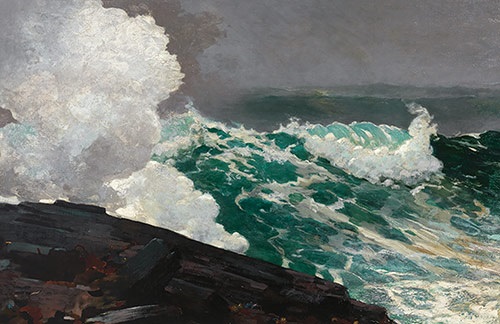
Winslow Homer's paintings have long been some of the most beloved art associated with New England. Thus many will want to visit the Winslow Homer Studio, at Prouts Neck, Maine. The studio, owned by the Portland Museum of Maine, is where the artist lived from 1883 until his death, in 1910. The museum says the studio is meant to "celebrate the artist's life, to encourage scholarship on Homer, and to educate audiences to appreciate the artistic heritage of Winslow Homer and Maine.''
Not that Homer is always that cheery. Many of his images show nature to be menacing, as in the painting "Northeaster'' below.
Blighted and bright college days
The dangers of afternoon naps
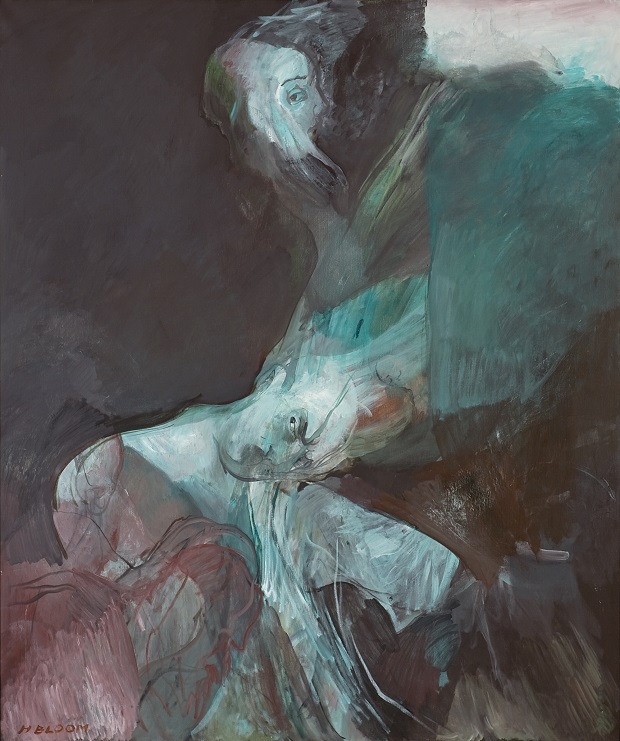
"Seance II,'' by HYMAN BLOOM,'' at the University of New Hampshire Museum of Art.
Survey map of surveillance
 "I See You'' (gouache/pencil marker on paper ), by BRENDA VAN DER BEEK, at Galatea Fine Art, Boston, in a Feb. 1-28 show.