

Llewellyn King: Murdoch profits richly by mining resentment, tribalism and sex

Rupert Murdoch.
Rupert Murdoch stands astride the Atlantic. He is the most successful newspaper publisher in the United Kingdom and the proprietor of Fox, the most successful cable news channel in the United States.
While he has many other spectacular holdings in the U.K., the United States, Australia and Asia, those are the two pillars on which the empire stands now that he has sold 21st Century Fox Entertainment to Disney.
I believe the two pillars are linked by what amounts to the Murdoch formula: find a chauvinistic, nationalistic vein and mine it.
Murdoch blew on the embers of resentment and stoked the fires of tribalism through The Sun, his big British moneymaker, and Fox News, his American gold mine.
He understood this social stratum, whether it was in working-class Britain or spread across what we now call the Red States in America. This audience felt ignored, put upon and unloved. Its traditional champions on the left — the unions, the Labor Party and the Democratic Party — had condescended to it, but not celebrated it.
Murdoch articulated its frustrations and gave them voice not where you would expect it on the left, but on the right.
A new and exceptional book by Irwin Stelzer, The Murdoch Method, lays out how Murdoch did this and how he holds his empire together. Stelzer should know. He has been a friend and consultant to Murdoch and his many enterprises for 35 years.
Stelzer, whom I have known for 45 years, is worthy of a book in his own right. When he met Murdoch, he had already achieved success enough for many a man. He founded National Economic Research Associates and sold it well. Then, after a stint with Rothschild in New York, he enjoyed running an energy program at Harvard. Then came Murdoch.
Stelzer worked so closely with Murdoch that a rival newspaper in London described him as “Murdoch’s man on earth.” And he was.
He was sometimes the go-between for British prime ministers and leading American figures, from Richard Nixon to Richard Cheney. Stelzer made Murdoch’s case to the mighty, and he crunched numbers. Money and the power of media made this world go around.
As the title suggests, Stelzer explains in his book how Murdoch manages so diverse a company as News Corp. and how he created and grew it from the newspapers he inherited from his formidable father, Sir Keith Murdoch, in out-of-the-way Adelaide, Australia.
What emerges is a portrait of man who thinks of himself as an outsider, a loner: a practitioner of a kind of minimalist management out to war against theestablishment and its elites.
Murdoch, both as a publisher and a businessman, has been incredibly courageous. He flipped The Sun from timid left to truculent right. He also stripped the brassieres off the models on Page 3. Chauvinism, sex and celebrity gossip was what Murdoch offered, and the public could not get enough. He also broke the British print unions in a near-military move to a secret printing site in Wapping, East London, in January 1986.
In America, Murdoch pretty well failed with newspapers he purchased in San Antonio, Boston and Chicago. He has not exactly succeeded with The New York Post, but he keeps it going as a personal indulgence. He is doing well with The Wall Street Journal. But Fox News is the jewel in his American crown.
Stelzer’s Murdoch and his method is one of a small executive staff: excellent executives who are very well paid and prepared to answer a call from their boss day and night. He let really gifted people, like Roger Ailes, of Fox, run their enterprises until there was a scandal and then, bang, the locks were changed, and settlements were paid. Murdoch is generous and ruthless.
Murdoch and Stelzer were in a way made for each other, although they did argue and sometimes Stelzer lost, only to find out just how wrong he was — as when he opposed the creation of the Fox Business Network.
Stelzer acknowledges he does not like everything Murdoch does; and he should not. Murdoch has treated the world as a playground where you make money by making damaging mischief — so you hire people like Sean Hannity and tolerate the inanity. Or you court the Clintons, but back Trump.
Stelzer has been on a wild ride and he takes you along in clear, readable prose.
On Twitter: @llewellynking2
Llewellyn King is executive producer and host of White House Chronicle, on PBS. He is based in Rhode Island and Washington, D.C.
David Warsh: 'It's the Computers, Stupid' and other essays
SOMERVILLE, MASS.
A fresh copy of The Age of the Applied Economist: The Transformation of Economics Since the 1970s (Duke, 2017) arrived in the mail the other day. Editors Roger Backhouse and Béatrice Cherrier note in their introduction that 10 of the last 12 winners of the John Bates Clark Medal were described as “applied” or “empirical” or doing work of “practical relevance.”
Make that 13. Parag Pathak, of the Massachusetts Institute of Technology, a market designer known for his work on the assignment of students in public schools, was recognized earlier this month. The Clark Medal is awarded annually by the American Economic Association to an economist under the age of 40, teaching in an American university, judged to have made the most significant contribution to economics
Backhouse, of the University of Birmingham, and Cherrier, of the Centre National de la Recherche Scientifique, are among today’s leading professional historians of economics. Their book is the annual supplement to the quarterly journal History of Political Economy (HOPE), which is also published by Duke University Press. The Age of the Applied Economist contains 11 essays on various topics, including “‘It’s Computers, Stupid’: The Spread of Computers and the Changing Roles of Theoretical and Applied Economics,” by the editors.
They trace the development of computers after World War II from mainframes running punch cards, in the 1950s and 1960s, to the advent of personal (or “micro”) computers and the Internet after 1981 (omitting the development of mini-computers in the 1960s and 1970s, which I suspect will turn out to have been significant to their story). They wisely note that “the evidence required to write a comprehensive history of the role of computing in economics is often hard to locate”. They urge their fellow historians nevertheless to pay careful attention to the significance of new computational tools for the discipline.
Still, they argue, the advent of powerful and easy-to-use computers is undoubtedly important, although by itself it is not sufficient to explain the turn toward applied economics that they document in the their conference volume. Beginning in the 1980s, they write, “some computationally very intensive techniques were marginalized, and computationally less-demanding approaches based on quasi-experiments became widely used in microeconomics.”
They mention the development of new databases and the emulation of methods of clinical testing in medical science. They cite the account in their conference volume, by Matthew Panhans, of Duke University, and John Singleton, of the University of Rochester, of a “credibility revolution.”
For all the brio of The Age of the Applied Economist, the book reads more like a prospectus for a research program than a persuasive account – which, of course, is the end that many of the forty-eight previous HOPE conferences have served. A good gloss on the subject is no substitute for shoe leather and sitzfleisch. Whether the age belongs to applied economists, or behavioral economists, or experimental economists, or even organizational economists, is far from settled.
The distinction between theoretical and empirical work seems overdrawn. Under a broad definition, a dozen Nobel prizes have been awarded for work in applied economics over the years, beginning with Simon Kuznets in 1971, including, most recently, Angus Deaton; but the first recognition of what will presumably be several awards for work in the “methods revolution” still lies ahead.
To reassure myself on this point, I took down from the shelf two classics of the recent history of economics: The World in the Model: How Economists Work and Think Cambridge, 2012), by Mary S. Morgan, of the London School of Economics, and How Economics Became a Mathematical Science (Duke, 2002), by E. Roy Weintraub, of Duke University.
Morgan develops an essentially philosophic argument though a series of closely examined case studies: David Ricardo’s groundbreaking “recipes,” more persuasive than syllogisms; Francis Ysidro Edgeworth’s diagrams; the caricatures of Max Weber (“ideal types”), W.S. Jevons (“calculating man”), and Frank Knight (“slot-machine man”); the thought experiments of Alfred Marshall; the analogical model of Walter Newlyn and Bill Phillips, a model run by water; the question-and-answer models of John Maynard Keynes and Paul Samuelson; the microscope-like simulations of Martin Shubik and Guy Orcutt; the “exemplary narratives” of game theory.
Weintraub, on the other hand, tells a series of stories, often quite personal: his economist father’s struggles with mathematics in an age of rapid change, and his own struggles, as a mathematician, with his father; and the relation of both to Hal Weintraub, brother to Sidney, uncle to Roy, a talented mathematician taken off by Hodgkin’s Disease at the age of 31. All this serves as a web in which to weave stories of Alfred Marshall and the development of the math-heavy Tripos final examination in economics at the University of Cambridge at the beginning of the 20th Century as a way of sorting out candidates; the influence of French Bourbaki scholarship on the further development of mathematical economics after 1945; and the spadework chapters that led to Weintraub’s 2012 book, with Till Düppe, of the Université du Québec à Montréal, Finding Equilibrium: Arrow, Debreu, McKenzie and the Problem of Scientific Credit (Princeton). In that book Weintraub’s doubts about mathematical austerity seem to give way to a tough-minded acceptance of one of the major tools – perhaps the major theoretical tool – of post-World War II technical economics.
These books are obviously not for those who are casually curious about what happened to economics in the twentieth century. But for anyone seeking to understand “the age of models,” or “the age of mathematical economics,” including practicing economists, they are landmarks. Establishing “the age of applied economics” will require a similar effort. The problem is that it isn’t easy to make a living as a historian of economics. Economics departments have ceased to teach the subject, much less require it of graduate students. And jobs involving the production of new knowledge of the field’s history are few and far between.
The miracle is that the community of the historians of social science continues to produce important books. We’ll just have to wait a little longer for a history of whatever age this is.
David Warsh is proprietor of economicprincipals.com, where this first ran.

David Haworth: Missing person report from the E.U.

BRUSSELS
To foreigners an oddity of U.S. diplomatic practice is the long gap between postings when replacing one envoy with another.
In contrast, most other foreign services put a premium on slipping the next Excellency into his or her predecessor’s place as soon as possible and the incomer’s name is known even before the valedictory cocktails are out of the way.
And there’s another thing debated locally when any American Embassy changeover takes place: Will the job be a State Department choice (career) or be the happy gift of an incoming president (political appointee)?
Frankly in most cases these two characteristics of State’s continuum don’t much matter, the hum of diplomacy continues anyway under a put-upon charge d’affaires.
But what about the post of the Representative of the United States of America to the European Union?
Highly regarded Anthony L. Gardner left that post just before Christmas 2016 – that is, well over a year ago – and has yet to be replaced.
This does not sit well with the European Union authorities, who deploy some 140 missions round the world.
The continued absence of a U.S. ambassador in the so-called “capital of Europe” is, therefore, not only a painful jab in E.U. officials’ pride but has serious practical consequences as well for a relationship in goods and services worth an annual $1.1 trillion.
What precisely does “America First” mean for the 28-member E.U.? Few, perhaps no one, can know with certainty.
Is the continuing failure to nominate an ambassador a calculated snub or just the normal vagaries of choice? To what extent does it represent America’s growing isolation – or “Exitismus” as it’s known in think tank circles?
One clearly irritated E.U. ambassador told me of the urgent need for a “valued interlocutor” from Washington D.C. – someone who carries the president’s authority to shape trans-Atlantic relations at a time when, arguably, they have never been worse or more volatile.
The E.U.’s proposal for a “digital tax” to raise more revenue from hi-tech corporations such as Google, Apple and Facebook has done nothing to improve Brussels-Washington relations. In the defense and security areas the Middle East continues to vex both sides. President Trump has made known he’s angry that some NATO members, most notably Germany, don’t pay their full dues to the alliance.
As the leading German weekly Die Zeit admits: “There is nothing to romanticize about the trans-Atlantic relationship but rather a lot to repair” and there’s little time.
On May 1, Trump will drop the temporary reprieve from tariffs on U.S. steel (25 percent) and aluminum (10 percent) but the E.U. wants a permanent exemption, according to the French and German leaders and European Commission president, Jean-Claude Juncker, who has said that that deadline is impossible to meet.
Some officials fear the steel-tariff issue could be the opening shot in a threatened trans-Atlantic trade war with retaliation targets Harley-Davidson, bourbon and Levi’s jeans among 200 other U.S. brands; more optimistic Europeans point out trade spats are nothing new, part of the weather.
Beyond dispute, however, is the need for an authoritative U.S. point man, an ambassador to the E.U., who can finesse political messages coming out of the White House.
The Trump presidency has disturbed most previous European assumptions about U.S. policy. Straightaway the new president dumped the pending Atlantic free trade agreement (TTIP), then he opted out of the Climate Change deal so carefully crafted in Paris.
European anxiety grew when one of Trump’s friends, Ted R. Malloch, was – apparently -- to head up the U.S. mission here. During a short visit last spring the former businessman/academic caused offence by claiming on TV the E.U.’s common currency, the euro, would fail, and moreover the E.U. had become anti-democratic and anti-American.
He also claimed the Trump administration “is no longer interested in the old form of European integration.”
Since then the Malloch prospect has faded – to be replaced by whom?
E.U. institutions, the Commission, the Council and the European Parliament, not to mention 28 chancelleries, are impatient to know. When the choice is finally made, it will be a defining moment in Atlantic relations.
Brussels-based David Haworth writes for Inside Sources, where this piece first appeared. A seasoned reporter on European subjects, he has worked for the International Herald Tribune, the Irish Independent, the Irish Daily Mail & The Observer.
Be fair to brick-and-mortar stores

From Robert Whitcomb's "Digital Diary,'' at GoLocal24.com
I hope that the U.S. Supreme Court reverses itself and decides that retailers on the Internet can be made to collect state and local sales taxes in states where they have no physical presence. If somebody in a state buys something at a physical store in that state and has to pay its sales tax, it’s only fair that someone residing in the same state pay sales tax in buying the same product online.
The problem goes back to a 1992 Supreme Court ruling that spurred Internet shopping. That ruling, Quill Corporation v. North Dakota, said that the U.S. Constitution bars states from collecting sales taxes from enterprises that don’t have a physical presence in a state. But in these surreal times, more and more of us don’t seem to have a physical presence anywhere.
Internet retailers complain that collecting the taxes will be too complicated. But in a world where, for instance, social-media companies can micro-target customers with great precision, I’m sure ways can be found to efficiently manage the tax collection.
It has long struck me as bad public policy that physical stores (whose owners pay local property taxes and otherwise contribute to the local economy and civic life) must collect sales taxes from local consumers patronizing these establishments while businesses living on computers far away don’t have to. Unfair advantage.
This inequity has deprived states of billions of dollars in tax revenue to pay for essential services and transportation and other physical infrastructure.
The art of combat veterans

Picture by artist and Vietnam War veteran C. David Thomas in the show "In War and After: The Art of Combat Veterans,'' at the Cultural Center at Rocky Neck, Gloucester, May 17-24 He says of this image: "It is one of about a dozen puzzle images I made around 2000. The images are from my childhood and a few from the Vietnam War. This piece is somewhat autobiographical with me on the left and my father on the right. ... He was in the Navy during World War II and I was in the Army in Vietnam.''
Mr. Thomas is the founder of the Indochina Arts Partnership.
Bill Betty: Mountain lions can adapt well to parts of the Northeast

Mountain lion.
This is a longer version, with links, of a previous article by Mr. Betty.
The mountain lion is the most widespread of any large terrestrial mammal in the Western Hemisphere.
Indigenous people called them cougars, pumas, shadow cats or ghost walkers. European settlers expanding into the interior of North America eliminated them from most of their former territory in the East centuries ago.
But in some parts of Canada they survived. Their descendants found in New Brunswick and Quebec today may be secretive, but they aren’t ghosts, cases of mistaken identity or figments of anyone’s imagination. Canadian scientists have identified them in multiple locations. DNA samples were tested. The evidence is irrefutable.
Cougars are highly efficient predators that are well adapted to life in densely settled regions such as California where millions of people live. Thousands of cougars live there to. This is also true in the Northeast along Maine’s mid-coast region, where many of the state’s citizens make their home. It’s also where most of Maine’s whitetail deer are concentrated. That’s one major reason why the Atlantic Coast is perfect habitat for cougars.
Cougars are long-distance colonizers. Over the past 70 years dispersing pumas have been making their way south from the eastern provinces following rivers and streams or taking the coastal route. All young males and perhaps 60 percent of females leave their natal ranges seeking to establish home ranges of their own.
Males can go more than 1,000 miles; females at least 800, although the average distances are much lower. Those in New Brunswick can easily reach southern New England.
It’s taken a long time for these animals to reoccupy the Northeast, almost as long as it’s taken in Nebraska, Iowa or Wisconsin, where cougars were eliminated in the past century. Examples of natural reproduction are limited. The arrival of more females from the north will increase the numbers of litters.
Persistent sightings of mothers and kittens across the Northeast are clues that recolonization is underway. Credible reports of family groups and a few confirmations suggest that natural reproduction is occurring at higher rates than officials are willing to admit.
The discovery of a female with a kitten in Monmouth, Maine, in September 2000 was an important finding. Keel Kemper, a biologist with the Maine Department of Inland Fisheries & Wildlife, made the track casts. Vermont had a similar incident. Legendary tracker Ralph Pomeroy encountered pumas in western Massachusetts from 1948-56, including evidence of a family group. Seventy years later his daughter sighted one. Provincial biologist Bruce Wright photographed tracks of a female and kittens in New Brunswick decades ago and recorded more than 450 reports of mountain lions in two provinces. In 1972, Wright estimated that 100 cougars were still present in the East.
Skeptics who think pumas are rare in the East believe cougars will eventually arrive from the West to reoccupy the region in, say, 30 years. Interventionists want to speed up the process by releasing Western lions in the Northeast. New York refused, and other states won’t accept this proposal either.
Advocates believe there is sufficient evidence to conclude that mountain lions are already recolonizing the region. Motorized reintroduction, however, is a distraction that threatens to delay cougar management in the region indefinitely. And stakeholders know it.
Long-term studies from 2001 to 2011 by Mark Gauthier and Sophie Bertrand in three National Parks confirmed the presence of several populations of cougars in New Brunswick and Quebec.
Because it’s currently impossible to distinguish the eastern cougar from the other North American subspecies based on DNA variation, Gauthier was unable to conclude whether these animals were remnants of a persisting eastern cougar population, escapees or dispersers from other North American populations. All three are possible.
Of the 19 positive identifications for pumas in Quebec and New Brunswick, 11 were North American haplotype and descend from a thousand generations of wild cougars in North America. Gauthier’s earlier estimate of the population in the study area was between 10 and 100 individual animals. The most recent one for Quebec alone was 15.
A casual examination of isolated findings outside the study areas, along with sighting report maps from Quebec, Nova Scotia, New Brunswick and Ontario, suggest many more cougars are found elsewhere in the provinces. Given the vastness of the provinces, the volume of physical evidence, and the passage of time, it’s likely that the number of cats in eastern Canada is much higher.
In nearby Ontario, for instance, more than 500 examples of evidence has been discovered, including two photographs of large black cats thought to be melanistic jaguars. More than 30 confirmations of pumas have been made.
Population estimates in Ontario range from 300 to 800 animals. All these pumas can’t be pets or dispersed males from western states. Some natural reproduction must be taking place.
DNA studies by Melanie Culver revealed that all the subspecies in North America (with one exception), including both the Florida panther and eastern cougar, are virtually indistinguishable. Many scientists accepted her landmark study. The U.S. Fish & Wildlife Service (USFW) does not.
The mission of the USFW is to conserve, protect and enhance fish, wildlife, plants and their habitats for the continuing benefit of the American people. That mission apparently no longer includes mountain lions in the Northeast, at least not native ones.
Federal biologists contend that the eastern cougar is a separate subspecies but believe it has been extinct for 80 years. In January, the USFW removed the eastern cougar from the Endangered Species List. Federal protections afforded cougars in the region — any native ones that might be still around or those with mixed ancestry — are gone. It’s up to the states to decide what to do with them now.
At least one state wildlife agency in southern New England believes residents can’t co-exist with mountain lions. It favors euthanizing them. Other states may follow their lead.
Having “nature’s perfect predator” around may be a good thing. A study published in 2016 by Prugh and Gilbert described the benefits of cougars in the East in places such as Connecticut, where deer herds are out of control. Researchers think the presence of mountain lions taking overpopulated whitetails will reduce vehicle/deer collisions in some areas and even save some lives.
In northern New England, the issues are different. Bad winters and 15,000 coyotes have drastically reduced the deer herd in Maine. Cougars kill plenty of deer, but they also kill coyotes. And they eat them. If pumas do that in Maine, it may benefit the state’s sport hunters.
Michael Keveny’s 2012 Clark University study showed that most of the habitat in Massachusetts is suitable for these charismatic killers, including suburbs less than 10 miles from Boston and much of Cape Cod. Maine’s coastal regions are similar. It’s along the Atlantic Seaboard, not in the Allagash wilderness, where catamounts will find what they need to survive; abundant prey, adequate edge habitat and cover.
According to Wally Jukubas, a Maine biologist, “The Mid-coast region accounts for the biggest chunk of mountain lion sightings. It’s not where you’d expect them ... that is where the people are.” The inland Maine mid-coast region still has plenty of deer, rabbits and turkey for prey.
At some point wildlife agencies in the East will be forced by circumstances to manage cougars. Maine is already one step ahead in the game. In 2014 it hired Nathan Webb, a native son, who spent the first 12 years of his career monitoring mountain lions, wolves and bears in Alberta, as its carnivore specialist.
Maine’s wildlife officials have other options besides benign neglect, which other jurisdictions appear to be following. Perhaps they’ll consider a hunting season in a few decades, when there is a sufficient number of cougars to sustain a harvest. Sport hunting has drawbacks, however, such as increased levels of infanticide, and will be opposed in some quarters.
Hunters will undoubtedly support that proposal, and the state will benefit from the revenue. In the meantime, state wildlife agencies need to give these predators adequate protection.
Agencies continue to favor the Black Hills of South Dakota as the place of origin for mountain lions in the Northeast — a thesis that has never received universal acceptance. Scientific research and evidence ranging from dead cougars to sightings by biologists point to someplace much closer as the likely source of our cougars.
If South Dakota isn’t the primary “source” for cougars in New England, where are they coming from? Florida has too few dispersing panthers to merit consideration. The only other place with an existing population that could supply the Northeast is Canada. And there is no longer any doubt that cougars are found there.
Time and space are factors. St. Stephens, New Brunswick, is 2,000 miles closer to us than South Dakota. Pumas could walk to Bangor, Maine, in a month or two. Quebec, which has its own cougar population, could make it in even less time. Dispersers from the north also wouldn’t have to cross six major rivers and numerous highways on a journey that would take young pumas from the Black Hills more than two years to complete.
Do we have thousands of mountain lions roaming the forests of New England? Probably not, but we don’t need thousands of breeding pairs to make a comeback. The USFW’s threshold is three groups of 50 individuals.
Alan Rabinowitz, chief science officer for Panthera, believes there is a “small population of mountain lions ... that are surviving in small numbers in wooded areas of the Northeast ... who are maintaining themselves and breeding.”
Mountain lions that established home ranges in Maine and other New England states after 1938 may be the descendants of dispersing eastern cougars that survived in remote areas in Ontario, Nova Scotia or other eastern provinces during the past century.
Canadian authorities aren’t certain which subspecies of cougar are found in the Maritimes and other eastern provinces. Eastern cougars are the obvious choice, but there are migrants and pets to consider. Animals with mixed ancestry have been identified.
Officially, the eastern cougar may be extinct in the United States, but the species is indisputably present in eastern Canada. If the ancestors of today’s big cats came from New Brunswick or Quebec, should they be considered an invasive species? Or close relatives of Maine cougars we should preserve and protect? That’s the real issue.
Bill Betty, a well-known mountain lion expert who has researched and written about the big cats for years, lives in Richmond, R.I.
Karen Gross: Ranking colleges by percentage of students who vote
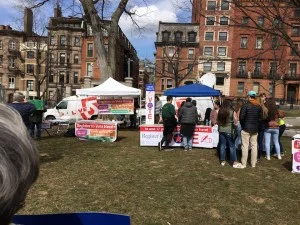
Registering young voters during the March for Our Lives in Boston on March 24.
From the New England Board of Higher Education (nebhe.org)
The recent March for Our Lives at hundreds of locations around the globe rattled my cage, particularly as I stood in the middle of hundreds of thousands of protesters in Washington, D.C. Had we finally found a way to increase activism, to get more and more people of all ages and stages involved in the well-being of their communities?
As I listened to the young speakers both over the loudspeakers and later on television, I wondered: Have the voices of high schoolers (and some even younger students) been ignited such that their fire will expand? These young people from Parkland, Fla., and beyond, seem capable of spreading their energy, their eloquence and their belief that “enough is enough” in terms of gun violence.
Here’s what worries me and I assume others: Can the efforts of these students to change gun laws to increase school safety be sustained?
Some movements falter; others have stickiness. As a product of the ‘60s, I experienced the rigor of our positions on civil rights and the Vietnam War and the need for women’s voices to be heard. We achieved some remarkable successes, though our work is still far from done.
All of this brings me to college campuses and my concerns about levels of student activism. Yes, there have been more protests in the past 24 months, spurred in part by efforts to eradicate sexual harassment and abuse. But are students actually engaging in the political process that other fundamental way: by exercising their right to vote?
Yes, many campuses have voter registration drives. Yes, there are personnel on some campuses to help students get absentee ballots. Yes, there are some young people running for office, particularly local officers. Yes, there seem to be more students interested in participating in politics.
But....
The percentage of college student voting, though rising in recent years, is below 50 percent. Data from the Jonathan M. Tisch College of Citizenship and Public Service, at Tufts University, tells a story of which we should not be proud if we believe that our democracy depends on citizens’ exercising their right to vote.
The percentage of white students who vote increased between 2012 and 2016, as did the percentage of Hispanic and Asian students; the percentage of black students decreased. But more important than the increases/decreases per se are the actual percentages of students’ voting in any given year. In 2016, 53 percent of white students, 50 percent of black students, 46 percent of Hispanic students and 31 percent of Asian students voted. Yipes.
Who votes?
Ponder these statistics: 53 percent of students in social sciences voted, compared with 44 percent of students in STEM disciplines. Students at public four-year institutions (50 percent) vote more frequently than students at community colleges (46 percent) and private four-year colleges (47 percent). Voting at women’s colleges and minority-serving institutions colleges exceeded percentages at Hispanic-serving institutions. Historically black colleges and universities (HBCUs) had the lowest percentage—a troubling statistic for many reasons.
Notably, the Tisch study does not include data for the percentage of voting by students at for-profit institutions.
Whether the data are complete and whether they fully capture all student voting (the data focus of the study is on presidential elections not other federal elections or state or local elections), we can still observe that there are differences in student voting rates at different colleges and universities.
What this means is that, if the data were actually available, we could compare and contrast colleges/universities on the basis of student voting rates. Indeed, students particularly interested in civic engagement and activism would be able to see which colleges/universities they were considering had very high voting rates and which had very low rates.
Now, we have many ways of rating and ranking colleges and universities. And there has been considerable debate about the quality of the existing measures used to compare one college/university to another. Assessment is a quagmire. For example, institutions with large endowments and higher admissions selectivity have higher rankings as calculated by US News than those with small endowments that also enroll high numbers of their applicants. Note that none of these are measures of educational quality unless one wants to say that big endowments and enrollment selectivity are surrogates for quality measures—assumptions I think are at once wrong and misguided.
Ratings (ostensibly different from rankings) are prepared by the U.S. Department of Education through the College Scorecard, and these data are also flawed on a myriad of levels. For starters, they look at retention and graduation rates based on first year-first time students, meaning that transfer students and their successes are not measured by the institutions that receive them or from which they departed. Odd, isn’t it?
We could wish for a day when all rankings/ratings are eliminated. But perhaps in the meantime, here’s one measure that could have meaning to a newly engaged youth population emboldened to make change and perhaps their parents and teachers: a comparison of voting rates among enrolled college/university students. I am not the first to reference the possibility of ratings based on voting rates (among other variables of civic engagement). But such ideas have not been embraced yet systematically.
For example, Northwestern University reportedly introduced voting during orientation in 2011, and voting by their enrolled students in presidential elections increased from 49 percent in 2012 to 64 percent in 2016. At East Tennessee State University, after concerted institutional and student efforts, voting in presidential elections by students increased to 47 percent from 39 percent. True, the numbers are still low but not as low as they were.
With the signs encouraging voting and political muscle at the March for Our Lives and the growing activism of high school students today, it seems that voting rates at colleges would matter to today’s K-12 students. If they had a choice of colleges—say among Harvard, Haverford, Hampton and University of Hawaii—how would they choose? Location? Price? Guidebook rankings? Programmatic offerings? Size? Reputation?
What if the voting rates among these colleges differed dramatically (a set of statistics we do not know at present across institutions)?
Local elections matter, too
If one were to create a ranking/rating system of value to students and their families, we would want to look at more than federal election voting levels. Local and state voting matter; these elections reflect how communities govern and function, and in some of these elections, there are votes that affect students and justice directly: school board elections and election of judges. The latter two elections affect how our schools function (and the dollars allocated to education) and how legal disputes, including those related to protests, permitting, free speech, civil rights and voting rights, are resolved. Election of state and federal representatives matters too because these individuals can serve on education and budget committees.
Keep in mind, too, that in some states, the outcomes of local and state elections are decided by a small number of votes, given low voter turnout.
And if one wants proof that a vote matters (an issue for some who see no value to voting), just remember Bush v. Gore, in 2000, and "hanging chads." Even if students are unaware of that electoral debacle given their ages, it is a part of history as to which much has been and should be read. For me, it is about more than politics; it is a story about our civic responsibility and how the right to have one’s vote count got trampled.
For college students, there is also the thorny issue of where they can, do and are allowed to vote and this problem should not be underestimated. And it cannot be dismissed by saying: Just vote; it does not matter where. That is not even true in presidential elections where a small number of votes can move the Electoral College one way or another.
Sadly, I have had experience with the difficulty students experience registering to vote in the town where they go to college, live, eat, study and work. I remember distinctly verbally sparring with the late and revered town clerk about the propriety of students registering to vote where they go to college. It was not pretty and was overheard by many. The counter-argument given: These students are not a part of our community; they are only here for a short period; they do not have the community interests are heart. State authorities had to be contacted.
Really? There are many people who move in and out of communities—who are not students. Even longstanding residents often do not vote; they use the schools; they work outside the locale. The students, on the other hand, are often engaged in the community, most especially those who work to help pay for their education; they perform internships in local businesses and or clinical rotations in local hospitals.
I wish I had known about the Supreme Court decision of Symm v. United States (1979), and, yes, I was a law professor for decades and clearly not cognizant of voting rights.
Improve voting rates
There are concrete steps colleges and outside organizations can take to improve voting by students on college campuses. There can be voting drives. There can be debates held on campus. There can be courses dealing with electoral outcomes and even “pop-up” courses for credit that focus on particular election issues that are timely and pressing. There can be messaging about the role of voting in a democracy and the fights in other nations for the right to vote. There can be campus readings; there can be campus speakers; there can be systematic voter registration drives.
As the demography of America’s students changes to include more “non-trads” (students over age 24) and minority students, the power of the vote is all the more important so that the voices of the many are heard. And there are efforts that could be instituted legally to ease voter registration and the location where voters can rightly vote. Misinformation is, unfortunately, often used to ban voting by students. The above-referenced town clerk was dispensing bad information in my view. Or let’s say, he discouraged local registration with such rigor that students were left discouraged from pressing forward.
A rating of “voting” percentages broadly defined speaks volumes about an institution. It bespeaks campus culture, campus involvement, campus priorities. It sends a message about how activism and political activity will be received and handled and supported. In today’s world, that’s a pretty good reflection of citizenship and the role of educational institutions in preparing the leaders of tomorrow. Surely voting percentages are more important than the size of a college’s endowment or other indicators we currently use to measure the quality of colleges.
Can you imagine students, parents and teachers saying: “Before we decide on the best schools to which to apply, let’s look at their voter rating.” It could happen. And it should happen.
Voting. What is more important to the success of our democratic processes and how important is it to teach our future leaders to take their social responsibility to vote seriously? Not much except perhaps their personal health, their mental well-being, their love of learning and their openness to change and problem-solving.
Karen Gross is senior counsel with Finn Partners, former president of Southern Vermont College and author of Breakaway Learners: Strategies for Post-Secondary Success with At-Risk Students.

Tim Faulkner: Localities stepping in to address ocean plastic crisis

Plastic pollution, especially in the ocean and along the coast, such as these plastic jugs found on the Portsmouth, R.I., shoreline, is a significant global problem.
Photo by Frank Carini of ecoRI News.
Via ecoRI News (ecori.org)
U.S. Sen. Sheldon Whitehouse’s Save Our Seas Act has big goals for addressing plastic in the oceans. The bipartisan bill that passed out of the Senate last year seeks to tackle marine debris and the ballooning problem of plastic waste by authorizing $10 million annually for cleanups of severe debris events in waters across the country. It also restarts federal research to determine the source of marine trash and the steps needed to prevent it.
What is already known is that much of the 8 million tons of plastic waste dumped in the world’s oceans each year happens outside the United States. In fact, five countries — China, Indonesia, the Philippines, Thailand and Vietnam — are responsible for 60 percent of the plastic garbage that makes it into our waters every year, according to the Ocean Conservancy.
That’s a problem, because most of those five countries receive plastic from U.S. recycling centers. The recycling industry, however, is lightly regulated, so it's hard to know the fate of the millions of bales of plastic recyclables shipped overseas annually.
The Save Our Seas Act addresses this problem by encouraging the president and the State Department to address the marine debris problem with these high-polluting nations. It also encourages international research into biodegradable plastics and establishes prevention strategies.
However, the likelihood of an environmental bill passing in the current Congress, much less President Trump endorsing it, is low. Trump wants to cut $1 billion from the National Oceanic and Atmospheric Administration (NOAA), which overseas the marine-debris program.
For now, much of the action on marine garbage is happening at state and local levels. Those steps include greater enforcement of recycling rules, bans on certain plastics, and improvement by product manufactures to make their packaging more environmentally friendly, reusable and include take-back programs for hard-to-recycle and bulky items.
At a recent Earth Day event in Middletown, R.I., aimed at drawing attention to the Save Our Seas Act, Johnathan Berard of the Rhode Island chapter of Clean Water Action said, “We cannot recycle our way out of this problem. We will only be able to solve it through policies that stop plastic pollution at its source.”
Recycling is necessary but is vulnerable to economic and market pressures, which cause revenues for waste prevention and education to fluctuate. There is little enforcement of rules, such as requirements in Rhode Island, Massachusetts and Connecticut that all business collect recyclables and offer collection for their customers. There is even less oversight of what happens to recyclables once they leave sorting centers and are shipped around the world. And with the exception of metals and glass, plastics eventually lose their durability and are down-cycled to trash.
Depending on the item, recycling rates hover between 20 percent and 30 percent nationally. Requiring a deposit on glass and plastic bottles, so-called “bottle bills,” boost the recycling rate to nearly 90 percent. But the political will for bottle bills is poor. For example, legislation is introduced in the Rhode Island General Assembly each year but rarely makes it out of committee.
The 2018 bill has yet to be scheduled a hearing. Massachusetts has had a successful 5-cent bottle-deposit program since 1983, but voters defeated a referendum in 2014 to expand the collection to include non-carbonate beverage bottles.
Take-back programs for bulky and hard-to-recycle items such as mattresses, paint cans and electronic waste have also made a difference, but expanding programs to other items like light bulbs, syringes and medications have stalled, as manufactures and retailers resist raising prices to fund collection or improvement of packaging.
This resistance puts the cost of waste management and recycling on consumers and local governments who pay for clean up and transportation. Budget limitations have led to the most cost-effective solution: bans. Prohibitions and fees on plastic bags, in particular, have proven effective at reducing land and marine debris. Dozens of communities in Massachusetts have banned plastic bags and a handful have enacted bans on polystyrene cups and to-go containers.
Seven Rhode Island communities have passed bag bans and more are considering them. Block Island even added a ban on balloons, and the “skip the straw” movement is growing among consumers and restaurants.
While bag bans and beach cleanups are helping clean southern New England, there is still the problem of global waste. Global plastic production is expected to double within 10 years and by 2050 there will be more plastic waste by weight in ocean waters than fish.
The Ocean Conservancy says a combination of education, waste collection and recycling infrastructure, and better managed and properly cited landfills are needed to tackle the plastic ocean debris epidemic.
“While we have made enormous progress cleaning up Narragansett Bay, the millions of tons of trash that are dumped into the oceans around the world can wind up on American shores and in the nets of Rhode Island fishermen,” Whitehouse said.
Tim Faulkner reports and writes for ecoRI News.
Don Pesci: Connecticut a national laughingstock
As Connecticut Gov. Dannel Malloy sets off into the sunset, The Wall Street Journal reviews, in as economical a manner as possible, the real state of the state of Connecticut, once the diamond in the crown of New England.
“The federal Bureau of Economic Analysis recently rolled out its annual report on personal income growth in the 50 states, and for 2017 the Nutmeg State came in a miserable 44th.” That’s the good news.
The paper refers to Governor Malloy as the “progressive paragon” and notes his “performance is even worse when you look at the details. The nearby chart shows that the state’s personal income grew at the slowest pace among all New England states, and not by a little. Governor Dannel Malloy’s eight-year experiment in public-union governance saw income grow by a meager 1.5% for the year, well below Vermont (2.1%). The state even trailed Maine (2.7%) and Rhode Island (2.4%), which are usually the New England laggards.”
In personal-income growth, Connecticut is the poor-boy of states. “Connecticut was 49th out of 50 states in 2012, 37th in 2013, 39th in 2014 and 2015, and 33rd in 2016. The consistently poor performance, especially relative to its regional neighbors, suggests that the causes are bad economic policies, not the business cycle or a downturn in a specific industry.”
And finally, the most progressive state in the Northeast has now become the most regressive state in the Northeast. “The fact that Connecticut, which is next to America’s financial capital, has grown so poorly amid an expansion that was especially good for financial assets is a damning indictment of its political leadership. It is a particular tragedy for the state’s poorest citizens who may not be able to flee to other states that aren’t run by and for government employees. Maybe we should call it the Regressive State.”
Among the 446 comments the editorial provoked, is one that suggests the more progressives learn, the less they know. “Dan, Dannel, Daniel just announced a bill from the still Democrat controlled legislature is making its way to the governor’s desk and he plans to sign it. That bill will grant tuition help to undocumented persons at Connecticut's state universities.”
These are not the kind of recommendations politicians generally want on their political resumes; though, of course, there will always be a feather bed somewhere – perhaps in progressive academia – for failed heroic progressive politicians. Malloy eventually may land on a soft surface, but it will take heroic efforts to effect changes in Connecticut that will return the state to its former glory.
More than a quarter century has passed since the father of Connecticut’s income tax, former Gov. Lowell Weicker, warned in his gubernatorial campaign that instituting and income tax in the midst of a recession would be like “pouring gas on a fire,” after which, once ensconced as governor, Weicker proceeded to pour gas on the fire. We have been living in the flames of an almost seamless unending recession ever since. As everyone who has not fled Connecticut for less punishing states elsewhere knows, Malloy called Weicker and raised him two tax increases, the first the largest and the second the second largest in state history. With the right policies in place, it would not have taken the state more than three decades to recover from its progressive governors and its progressive Democrat majority leaders in Connecticut’s General Assembly.
Since the Weicker bonfire, Republican gains in both the state House and Senate seem to suggest that a slim majority of Connecticut voters has come to appreciate Albert Einstein’s definition of insanity: doing the same thing over and over and expecting a different result. In the coming election, Republicans, now even in the Senate and seven seats away from Democrats in the House, will be running against Malloy’s ruinous policies. State Democrats will be running against President Donald Trump, or rather a highly exaggerated cartoon of Trump.
The progressive policies of Malloy and his co-conspirators in the General Assembly cannot rationally be defended, because any defense is answered by the realities mentioned in the editorial staring murderously at all Connecticut citizens.
Malloy’s response to Connecticut’s rapid downfall, directly related to the state’s hegemonic Democrat leadership and its lofty, feeling infused but reckless progressive policies, can best be illustrated by Mike Lawlor’s latest proposal. Connecticut’s Under Secretary for Criminal Justice Policy and Planning -- who as co-chairman, along with Supreme Court Justice Andrew McDonald, agitated effectively for the abolition of the death penalty and who set loose Frankie“The Razor” Resto on Meriden – has proposed the state should increase spending on prisoners’ meals, while the state slips sleepily into yet another multi-million dollar budget deficit.
A Republican member of the House Appropriations Committee, Rep. Melissa Ziobro, said of the latest Malloy-Lawlor venture into populist progressive politics, "Not only did he [Malloy] prioritize this money for criminals, he also eliminated money for seniors who are having meals for wheels deliveries.”
Lawlor has a ravenous appetite for wrong reforms. Connecticut’s new governor, Democrat or Republican, should eliminate his position, which is menacingly unnecessary. In fact, any prospective governor who promises -- "first thing I do when elected is to make Lawlor redundant" -- may pile up quite a few votes.
Don Pesci is a Vernon, Conn.-based columnist.
The muses are local

"Apollo and the Muses on Mount Helicon'' (1680), by Claude Lorrain.
"Where the heart is, there the muses, there the gods sojourn, and not in any geography of fame. Massachusetts, Connecticut River, and Boston Bay, you think paltry places, and the ear loves names of foreign and classic topography. But here we are; and, if we tarry a little, we may come to learn that here is best. See to it, only, that thyself is here;--and art and nature, hope and fate, friends, angels, and the Supreme Being, shall not absent from the chamber where thou sittest.''
-- Ralph Waldo Emerson
'North light in May'

Portland Head Light, Cape Elizabeth, Maine.
"Four miles out the tide curls in
like a beagle's ear
as we lunch together in the stiff suit of noon,
of north light in May.''
-- From "Poem,'' by Mira Fish
Pot in the air

From Robert Whitcomb's "Digital Diary, in GoLocal24.com
As Rhode Island, Massachusetts and some other states (if not the Feds) loosen laws against marijuana cultivation and use, pot smokers are becoming increasingly noxious neighbors in apartment and condo buildings. I have noticed the rich aroma of the stuff in some buildings and certainly on many sidewalks.
Reminder: Marijuana cultivation, sale and use are still prohibited under federal law, which presents considerable confusion in states that allow sale and use of the stuff anyway. The Feds have long looked the other way on this, fearing that the federal law is just too difficult to enforce, considering some states’ policies and that millions of people regularly smoke pot.
Non-pot smokers are being forced to inhale this psychotropic smoke, which, to say the least, is unhealthy. Of course, breathing second-hand tobacco smoke is bad for you, too, but it doesn’t affect your clarity of mind as marijuana smoke does. In some places, you can become involuntarily intoxicated.
Pot has become such a big business and tax-revenue supplier that, barring rigorous enforcement of federal laws still on the books, the problem of second-hand smoke can only get worse. And I laugh at the argument that states’ effective legalization of the weed primarily serves as a way to alleviate physical pain. Most people smoking pot just want to get mildly or very stoned for the pleasure of it, and there’s much profit and tax money to be made from the stuff.
To read an entertaining Boston Globe story on second-hand pot smoke, please hit this link.
Digitally 'sublime'

"Studio Window'' (digital painting), by Daniel Feldman, in his show "Specific Gravity,'' at Bromfield Gallery, Boston, through April 29. The gallery says Mr. Feldman's digital works "create a sublime sense of unfolding possibilities. ''
'Burlesque queen'
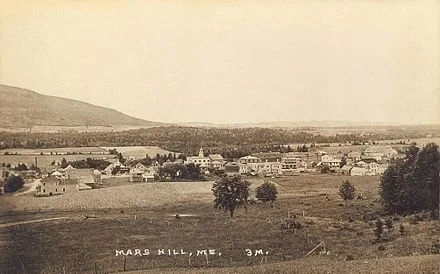
Mars Hill, in northern Maine, circa 1915.
‘’Where it stands in the wind
unpinning the plastic
it has worn all winter
"There is not one tree….
…and again like an old
burlesque queen, alone
in the potato fields
of Mars Hill, Maine.’’
-- From “House in Spring,’’ by Wesley McNair
The beauty of a Brutalist campus

Image from the show "A Visionary Campus: Paul Rudolph and UMass Dartmouth,'' at the CVPA Campus Gallery, University of Massachusetts at Dartmouth.
Through April 28, UMass Dartmouth’s College of Visual & Performing Arts Campus Gallery's show explores the unique mid-century modern campus, in southeastern Massachusetts, through photographs, drawings and 3-D models. Some critics consider this public university campus, designed by Paul Rudolph, an architectural gem. The lead curators, Anna M. Dempsey & Allison J. Cywin, along with their curatorial team of animators, graphic designers, artists and historians, situate the campus’s architectural aesthetics within the period’s cultural history and politics. Viera Levitt's photographs of Brutalist buildings and Michael Swartz’s spherical photographs of UMass Dartmouth LARTS building will also be featured.
Saving fancy private club while helping migratory birds
From Robert Whitcomb's "Digital Diary,'' in GoLocal24.com
It was pleasant to learn that the Nature Conservancy has paid $2 million for the development rights to about two-thirds (or 82 acres) of the exclusive Agawam Hunt’s grounds, in East Providence. The organization could also buy development rights, for $980,000, on the golf club’s remaining about 40 acres, The Providence Journal reported on April 16 (“Grounds for Optimism’’). The Conservancy cited the area’s importance for migratory birds, including waterfowl, near the urban core of metro Providence.
The purchase has helped pull the Agawan out of bankruptcy. I have noticed over the years that the Conservancy’s actions sometimes serve to protect land enjoyed by affluent people, often via its takeover of a lot of land next to rich people’s estates. The Agawam presents an interesting case.
Apparently as many as 101 houses could have been built on the Agawam land. Rhode Island has severe eviction and affordable-housing challenges in large part because there’s just not enough housing available. Among other things, more of those old mills should be renovated for residential use and the state urgently needs more multi-family houses. Time to bring back the triple-deckers?
Christopher Riely: New urgency to protect R.I. woodlands

From ecoRI News (ecori.org)
Those of us who care about and manage the region’s woodlands have often heard the statistic that Rhode Island is still heavily forested, with about 55 percent of the state still in woodland cover. Add to this the canopy that presents itself in Google Earth from 50,000 feet above our suburban and urban areas, and one would think that there’s plenty of woods to provide wildlife habitat, protect water quality, yield forest products such as firewood and lumber, filter the air and produce oxygen, and support outdoor recreation and tourism.
Despite that image, the ability of our woodlands to sustain our landscape and provide all those benefits is threatened by their continued loss and by fragmentation of the canopy. The rate at which the construction of roads, subdivisions and other human development continue to break up large, contiguous blocks of forest into an increasing number of smaller pieces is alarming. Fragmentation divides up the resource, and these islands of woodland provide limited benefits.
If you’re from an urban area, the woodlands beyond I-295 may seem endless, as they must have seemed to the colonists who arrived here in the 1600s. Yet, by 1800, much of our woodlands were gone, cleared for farms, cut for masts, lumber for houses and used as firewood. They’ve grown back, but now they’re being permanently lost to development, where the forest will not grow back.
We all see development happening, a cut here and a cut there. Death by a thousand cuts as the old saying goes. Commercial development in wooded areas, a proposed power plant in the middle of large conservation areas, and the latest threat: poorly sited renewable-energy projects that clear large swaths of woodlands.
As climate-change impacts progress, and sea levels rise, the retention of large, intact forested landscapes becomes increasingly important. The Executive Climate Change Coordinating Council has acknowledged this, noting the “critical role” of forest retention as a “key mitigation strategy” in its 2016 Rhode Island Greenhouse Gas Emissions Reduction Plan.
As the threats continue to mount, what can we do to protect this forested landscape? First, we must recognize its value and prioritize actions to prevent additional loss. Many decision-makers and Rhode Islanders agree that our woodlands are beneficial, and are good things to have around. But a lack of awareness as to the limits of this resource is a prescription for disaster.
The Rhode Island Woodland Partnership is a coalition of educators, scientists, policymakers, preservationists and business leaders. This partnership believes that preventing the loss and fragmentation of Rhode Island’s woodland is critical to protecting all of our other natural resources, such as clean drinking water, and the social and economic values they provide.
We encourage and promote the protection of the remaining forest cover in Rhode Island through the application of policies that discourage further forest fragmentation and encourage development patterns that conserve the landscape values of larger, unbroken tracts of land.
We implore community leaders at all levels to take actions to protect our remaining woodlands from loss and fragmentation caused by poorly planned and poorly sited development. Each of us should take a leadership role to make sure that no state or local policy results in and/or encourages the loss of woodland. state guide plans and town comprehensive plans have been developed and must be followed by state law.
There are actions that each of us can do to improve the health of our environment and protect our forests.
First and foremost, plant a tree. When an entire community takes on the responsibility to add to the existing canopy, forest health improves and the forest spreads.
We encourage the use and promotion of smart growth, which utilizes land-use techniques such as the transfer of development rights, conservation development, village zoning and low-impact development to accommodate economic growth while preserving forestland.
We support forestland conservation by encouraging state officials to include bond initiatives that are needed to assist local conservation efforts and meet state match requirements for federal programs to buy the development rights to forestland.
We support the Farm, Forest & Open Space Act, which applies current-use values as a tool to conserve forestland and prevent its conversion to more intensive land uses.
In every election cycle since 2004 nearly 65 percent of Rhode Island voters approved open space, recreational and agricultural bond referendums. This is a statistic that state officials should take to heart. Rhode Islanders love their special places, and protecting them is a fundamental responsibility that we all share.
Christopher Riely is the coordinator of the Rhode Island Woodland Partnership and the state coordinator of the Rhode Island chapter of the Forest Stewards Guild.
Sam Pizzigati: Greedy investors, not taxes, destroyed Toys "R" Us

A now closed Toys "R'' Us store in Waterbury, Conn.
From OtherWords.org
By the time that you read this, your favorite hangout as a kid may have gone kaput. Toys “R” Us, the iconic global retailer, recently announced its impending demise after over a six-decade run.
That sad news no doubt has many of us waxing nostalgic. All those aisles piled so high with games and action figures! For kids, a veritable miracle.
But this miracle, according to the economic orthodoxy that dominates our times, should never have happened.
Conservative pundits and politicians have been insisting for a generation now that entrepreneurs only start exciting new businesses when governments “back off.” So governments have backed off. At every level, they’ve deep-sixed regulations and cut taxes on rich people.
High taxes on high incomes, the reasoning goes, discourage entrepreneurship. No one with a great idea for a new business is going to start that business, conservatives argue, if Uncle Sam is just going to tax away the rewards.
The same goes for investors, they say. They’re not going to invest in “job-creating” enterprises if high taxes threaten to eat away at their potential earnings.
This conservative take on taxes totally muddies how our economy actually works. Case in point: the story of Charles Lazarus, the founder of Toys “R” Us.
Lazarus, a World War II veteran, noticed soon after the war that all his veteran friends were settling down and raising families. Products for kids, Lazarus figured, had a great future, and in 1948 the budding 25-year-old entrepreneur opened a storefront outlet for children’s furniture.
Lazarus soon added toys to his store’s selection and quickly saw their awesome sales potential. Parents, he realized, only buy a crib once. But they replace toys year after year. By 1957, Lazarus had opened his first toys-only store. By the mid-1960s, his one store had become a chain. Lazarus became a classic entrepreneurial success story.
All this success happened in an economic environment that bears little resemblance to ours. In America’s postwar years, high incomes faced high tax rates. Income over $200,000 for a single earner faced a 91 percent tax rate throughout the 1950s. In 1980, the year Ronald Reagan won the White House, America’s most affluent still faced a 70 percent top tax rate.
These high tax rates didn’t seem to undermine the entrepreneurial spirit of Charles Lazarus. He built his toy business right amid them. And Lazarus didn’t build that business out of the goodness of his heart, either. He saw himself as a businessman out to make a buck.
“If you’re going to be a success in life, you have to want it,” he would later tell Forbes. “I wanted it. I was poor. I wanted to be rich.”
But “rich” will always be relative. Yes, Lazarus did face high tax rates. But so did everyone else in his lofty income tax bracket. He remained, after taxes, rich by the standard of his day. He felt rewarded enough to exercise his entrepreneurial talents.
In the 1980s, America’s economic dynamics — and incentives — changed. By 1986, the tax rate on top-bracket income had sunk to 28 percent. America’s wealthiest now had opportunities to become wealthier than they had ever imagined. They rushed to seize those opportunities by any means necessary.
Those means eventually did Toys “R” us in. In 2005, private equity speculators bought the company and loaded it up with debt. Along the way, they extracted $470 million in fees. Last September, Toys “R” Us filed for bankruptcy. Now the company is closing its stores.
And Charles Lazarus? The 94-year-old died March 22, a week after the Toys “R” Us shutdown announcement.
Sam Pizzigati co-edits Inequality.org for the Institute for Policy Studies. His latest book, The Case for a Maximum Wage, will appear this spring.
Bravely on the river

"The Oxbow'' of the Connecticut River, by Thomas Cole (1836).
"It is a wonder that Norwood {based on Northampton, Mass.} was ever allowed to venture so near to the low grounds of the Connecticut {River}; for it was early settled, not far from thirty years after the Pilgrims' landing. How the temptation to build up the top of the highest hill was resisted, we know not.''
-- Henry Ward Beecher in his novel Norwood: Or, Village Life in New England (1868).
Domestic debris

"Homes Without Names: Kitchen Table" (acrylic on molded Tyvek, found fabric and mixed media), by Susan Emmerson, in her show "Now That We Have Only This,'' at Kingston Gallery, Boston May 2-27.