
Vox clamantis in deserto




‘New England’s Dark Day’; sue the bastards?
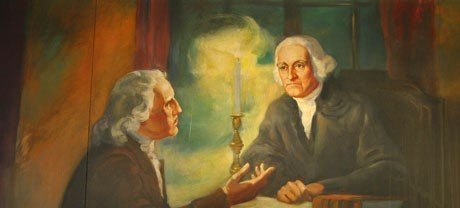
"Dark Day," a mural by Delos Palmer, depicts Connecticut Governor’s Councilor Abraham Davenport and Gov. Jonathan Trumbull on May 19, 1780, on what became known as “New England’s Dark Day.’’ The 1934 WPA mural is at Stamford’s Government Center.
On that day an unusual darkening of the daytime sky was observed over New England, caused by wildfires to the west. The darkness was so dense that candles were required from noon on.
Edited from a Wikipedia report:
“In Connecticut, a member of the Governor's council (renamed the Connecticut State Senate in 1818), Abraham Davenport, became most famous for his response to his colleagues' fears that it was the Day of Judgment:
“I am against adjournment. The day of judgment is either approaching, or it is not. If it is not, there is no cause for an adjournment; if it is, I choose to be found doing my duty. I wish therefore that candles may be brought.’’
OtherWords (slightly edited) article by Basev Sen
The 2026 heatwave is a global phenomenon, inflicting extreme temperatures on billions of people from the United States to Europe and South Asia.
Extreme heat is deadly. In Europe, an estimated 10,000 people have died from heat this summer, and the official count of a few dozen deaths in India and Pakistan is likely to be too low by several orders of magnitude, according to a recent scientific study.
Dozens of Americans died from heat over the Fourth of July weekend alone — a toll that’s still unacceptably high.
Meanwhile, much of the country has been blanketed in smoke from wildfires in Canada and Minnesota, triggered by the hot and dry conditions arising from the heatwaves. Like heat, wildfire smoke is also deadly. A similar wildfire smoke event in 2023 led to an estimated 33,000 premature deaths in the U.S. alone.
Scientists have found that all of these regional heatwaves were made likelier and more severe because of human-caused climate change, mainly attributable to burning fossil fuels.
Major oil and gas corporations have known for decades that their business model would cause disasters like these. Their response was to minimize or even hide their findings to keep the public in the dark about the risks — and pay front groups to deceive them.
This drive to preserve profits at the expense of humanity has understandably caused outrage. Eleven U.S. states, two tribes, and dozens of local governments are suing fossil fuel corporations for damages for the harm they’ve suffered from climate disasters.
State legislators have also joined the fray. New York and Vermont have passed “Climate Superfund” bills that require fossil-fuel corporations to pay for economic losses arising from extreme heat, wildfires, droughts, hurricanes, and flooding. Similar laws are being considered in Massachusetts, New Jersey, and Rhode Island.
The U.S. has experienced more than $200 billion in climate damages every year since 2016, and it’s only fair that fossil-fuel corporations pay for some of the damage caused by their reckless greed.
But instead of trying to make Big Oil pay up, some lawmakers in Congress are trying to do the opposite. Rep. Harriet Hageman (R-WY) and Sen. Ted Cruz (R-TX) have introduced House and Senate bills, respectively, that seek to dismiss ongoing climate damages lawsuits, shield Big Oil from similar future cases, pre-empt state Climate Superfund laws, and — most outrageously — block any state level regulation of greenhouse gases.
This is legislation expressly designed to protect a powerful, wealthy industry from having to face any accountability for harming the public. And when you follow the money, you can see why.
Rep. Hageman has received more than $23,000 in campaign money from the petroleum refining and marketing industry in this cycle, making it the second biggest industry (after sugar) backing her candidacy. She’s also received thousands more from other fossil fuel interests.
Also in this cycle alone, Sen. Cruz has gotten more than $129,000 in contributions from different segments of the oil and gas industry.
Effectively, these legislators — like too many others — were bought by a powerful industry to put their corporate interests over the health, and the very lives, of the broader public. This is naked corruption.
And if we want the kind of democracy we need and deserve, the rest of us shouldn’t tolerate it anymore.
Basav Sen directs the Climate Policy Program of the Institute for Policy Studies.

Jill Richardson: California fires show why we need publicly owned utilities

Satellite view of Kincade Fire smoke in northern California on Oct. 24
Via OtherWords.org
Hundreds of thousands of Californians have been fleeing raging wildfires, while millions sit in the dark. And for-profit utilities may be to blame.
Pacific Gas & Electric — a private, for-profit utility in the state — has admitted that its equipment likely caused 10 wildfires this year alone. To avoid further damage, the utility has been shutting off its customers’ power when weather conditions cause increased fire danger.
Will this lower the risk of wildfires? Maybe. It will also leave blacked out hospitals choosing whether to refrigerate their vaccines or keep their medical records online.
As Vox environmental reporter David Roberts put it, giving customers a choice between blackouts or fires is a failure.
A popular theory says that businesses must be “efficient” in order to survive in a competitive marketplace. By contrast, the government — without such market pressure — is naturally “inefficient.”
But even in the best cases, for-profit utilities with state-sanctioned monopolies are not functioning in a competitive marketplace. And unlike public utilities, which simply have to cover the costs of operating, privatized utilities must generate something else: profits.
How do they do this? By cutting costs — including employee salaries and benefits, customer services, and equipment upgrades. In the case of PG&E, it’s meant failing to upgrade and maintain their aging infrastructure.
It would be one thing if PG&E’s grid used all of the latest, most up-to-date technology. But that’s not the case. Instead of making their grid more resilient, now they simply shut it off when the weather gets bad — and it may still be causing fires.
And if customers don’t like that, too bad. It’s a monopoly.
Prices and service aren’t the only things at stake. We also need to get power from sources that are reliable, safe, and environmentally clean.
A corporation with a profit incentive, which needs to provide shareholders with growth each quarter, may not invest in that. Upgrading and maintaining infrastructure cuts into profits, giving them a reason to sacrifice safety and eco-friendliness to cut costs.
Imagine a circumstance in which most consumers and businesses get their power from clean, rooftop solar panels.
Sounds great, but there’s a big problem for for-profit utilities: After the initial manufacturing and installation, there’s no profit in people getting their power from the sun.
It’s clean, it’s technologically sound, and yet it’s not available to most people. As long as private, for-profit corporations provide our power, cleaner solutions like rooftop solar will remain out of reach to many.
But what if we had publicly owned utilities?
The wildfires — and the climate crisis that’s making them worse — are public problems. The reliability of our power grid is a public need.
When we privatize our utilities, we limit the solutions we can choose from to those that are profitable to a corporation. We risk situations like the one we are in now, in which the public is suffering the consequences of decisions a private entity made to maximize its own profits.
The public interest, not private profit, should be priority No. 1. If there’s a silver lining to this mess with PG&E, it’s that more people will demand that
Jill Richardson, a sociologist, is a columnist for OtherWords.org.