
Vox clamantis in deserto








Chris Powell: Economy of Southeastern Conn. is based on war(huge new EB sub contract!) and casinos
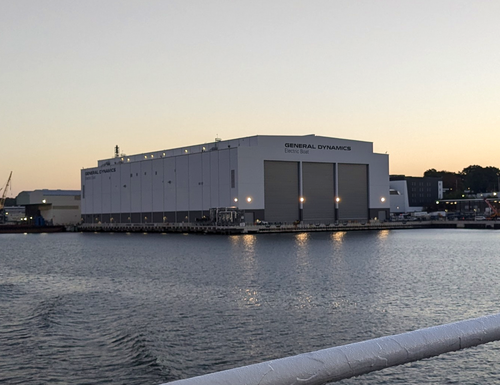
Part of the Electric Boat operation in Groton, Conn.
Fifty-six years ago Alfred M. Bingham of Salem, Conn., an elderly liberal lawyer and author with a national reputation whose father had been a U.S. senator from Connecticut in the 1920s, sought the Democratic nomination for Congress from eastern Connecticut. Bingham didn't get the nomination but unlike many candidates he tried to think seriously and say what he thought. The most notable thing he said was that he didn't think the people of eastern Connecticut were happy that massive instruments of death kept being built in and sailing out of New London Harbor.
Back then, liberals in Connecticut sometimes gave a second thought to their state's economic dependence on the war industry. Of course, without that industry the world might not have been saved from tyranny during the world wars, the Union might not have won the Civil War, and the American Revolution might have been lost. But maybe back then liberals, including Bingham, still remembered the remarkable lament President Dwight D. Eisenhower offered a few weeks after taking office in 1953. While Eisenhower was the foremost U.S. general of his time, he wouldn't glorify the military business.
"Every gun that is made, every warship launched, every rocket fired signifies, in the final sense, a theft from those who hunger and are not fed, those who are cold and are not clothed," Eisenhower said. "This world in arms is not spending money alone. It is spending the sweat of its laborers, the genius of its scientists, the hopes of its children."
Leaving office eight years later Eisenhower warned more famously about the "military-industrial complex," over which he had helped preside.
No second thoughts were expressed last week as Connecticut celebrated the U.S. Navy's new $77 billion contract with the Electric Boat division of General Dynamics to build nine attack submarines and five ballistic missile submarines by 2038, largely at EB's shipyards in Groton and Quonset Point, Rhode Island. Instead there were joy and even delirium, since the contract promises many years of prosperity and growth for southeastern Connecticut and redevelopment for its two impoverished cities, New London and Norwich.
Indeed, if Connecticut is not going to be chastened by such massive preparation for war, it at least should be chastened by what will have to be done, and fast, to get the submarines built here. EB has already hired 4,000 more employees so far this year and plans to hire another 12,000 by the end of next year. Where will they come from and where will they live?
Connecticut is notoriously deficient in housing, and together New London and Groton are reported to have increased their housing by only about 900 units in the last five years, an average of fewer than 200 per year. The new sub contract is being called a "signal" to housing developers about the opportunity awaiting them, but they don't need a signal. A signal is needed by 20 or so municipal governments in the area, and if their usual zoning procedures are followed, southeastern Connecticut may require five years just to produce another 900 units when thousands more may be needed next year.
So state government should take charge not just of zoning in southeastern Connecticut but also local transportation, with commuter buses and even trains and ferries.
The increasing aggressiveness of China, a ruthless totalitarian power, may justify the expansion and modernization of the U.S. submarine force and may fairly suppress concerns about the diversion of resources from human needs. But second thoughts still may be in order for eastern Connecticut. For the indefinite future life in the region will be based on war materiel and casino gambling.
Better than nothing, perhaps, but the best that could be done? What if peace and good sense ever break out?
In any case, will anyone in authority in overwhelmingly Democratic Connecticut who is celebrating the submarine contract thank the people who most made this future possible -- not just eastern Connecticut's U.S. representative, Joe Courtney, a Democrat, but also President Trump and congressional Republicans?
Chris Powell has written about Connecticut government and politics for many years (CPowell@cox.net).
Chris Powell: Why are Conn. and R.I. giving EB piles of money to do what it would do anyway?
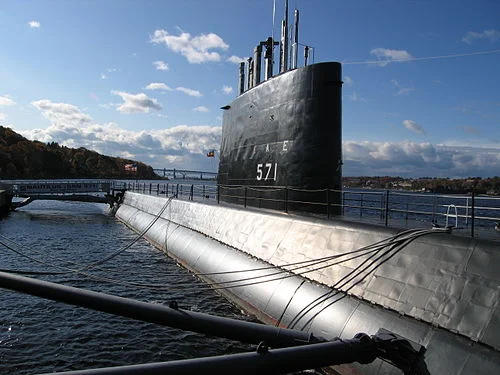
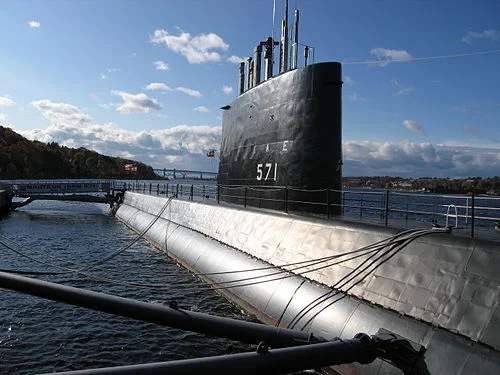
USS Nautilus moored in Groton at the Submarine Force Museum.
What was the necessity of Connecticut Gov. Dannel Malloy's award the other day of $80 million to the Electric Boat Division of General Dynamics in Groton? {Rhode Island is giving the very rich company $34 million in incentives to expand at Quonset Point.}
The governor said that in exchange for the money, the company will increase its local employment by 1,900 people over the next 16 years, a state subsidy of $42,000 per job. But the federal government already had given the company the extra submarine work that was requiring that expansion of its workforce.
That is, the Malloy administration is paying EB to do what it was doing anyway, and as a military contractor EB is already getting all its money from government.
So was the state's payment necessary to keep EB in Connecticut, to prevent the company from moving to another state? That seems improbable, given EB's huge facilities in southeastern Connecticut and Rhode Island. They would not easily be relocated. Further, any risk of relocation would not speak well of Connecticut's congressional delegation, whose agitation for more submarine construction is partly responsible for the extra work coming to EB. With the federal government spending billions more on submarines, EB probably would not have minded being required to stay put.
While the governor called the state's payment to EB a "partnership," it looks more like corporate welfare from an administration that senses that, with its constant increases in taxes and business regulations, it has crippled the state's economy and feels ever more vulnerable to extortion by major corporations.
And does the Navy really need the extra submarines? As long as military contracting is such big business in Connecticut, that issue will get no more serious inquiry from the state's political leaders than the war in Afghanistan, now in its 18th inconclusive year.
xxx
SUBVERTING THE CONSTITUTION: The General Assembly and Governor Malloy are moving to put Connecticut into the "national popular vote" system of determining the votes of the state's presidential electors and thus determining the election of the president. Under the proposal Connecticut's electors would be required to vote for the candidate who led the national presidential vote.
There are many problems with this plan, starting with its subversion of the Constitution by undoing the Electoral College without a constitutional amendment and it making a compact among states without the approval of Congress as required by the Constitution.
Advocates of the "national popular vote" system say it would ensure that every vote for president counts, but it wouldn't. For it would nullify the votes of states on the minority side and diminish the influence of Connecticut and other small states, whose electors now represent more voters than the national average. The proposed system would have canceled Connecticut's votes in the 2004 presidential election, when Democrat John Kerry carried the state but lost the national vote to Republican George W. Bush. Connecticut's advocates of the "national popular vote" system seem to think that this state can never be on the minority side nationally, but it has been.
And just how is the national popular vote to be officially counted and totaled? There are no such counts and totals. The secretaries of the 50 states count only their own state's votes and certify their electors
The Electoral College has its disadvantages but so does the "national popular vote" system. The proposal would allow political corruption in "sanctuary states," nullifiers of federal immigration law -- particularly California and New York -- to steal more than their allotted electoral votes and control presidential elections by facilitating voting by their millions of illegal immigrants.
Chris Powell is a columnist for the Journal Inquirer, in Manchester, Conn.