
Vox clamantis in deserto







Llewellyn King: Trump regime uses ICE as part of its assault on the rule of law; we are all imperiled
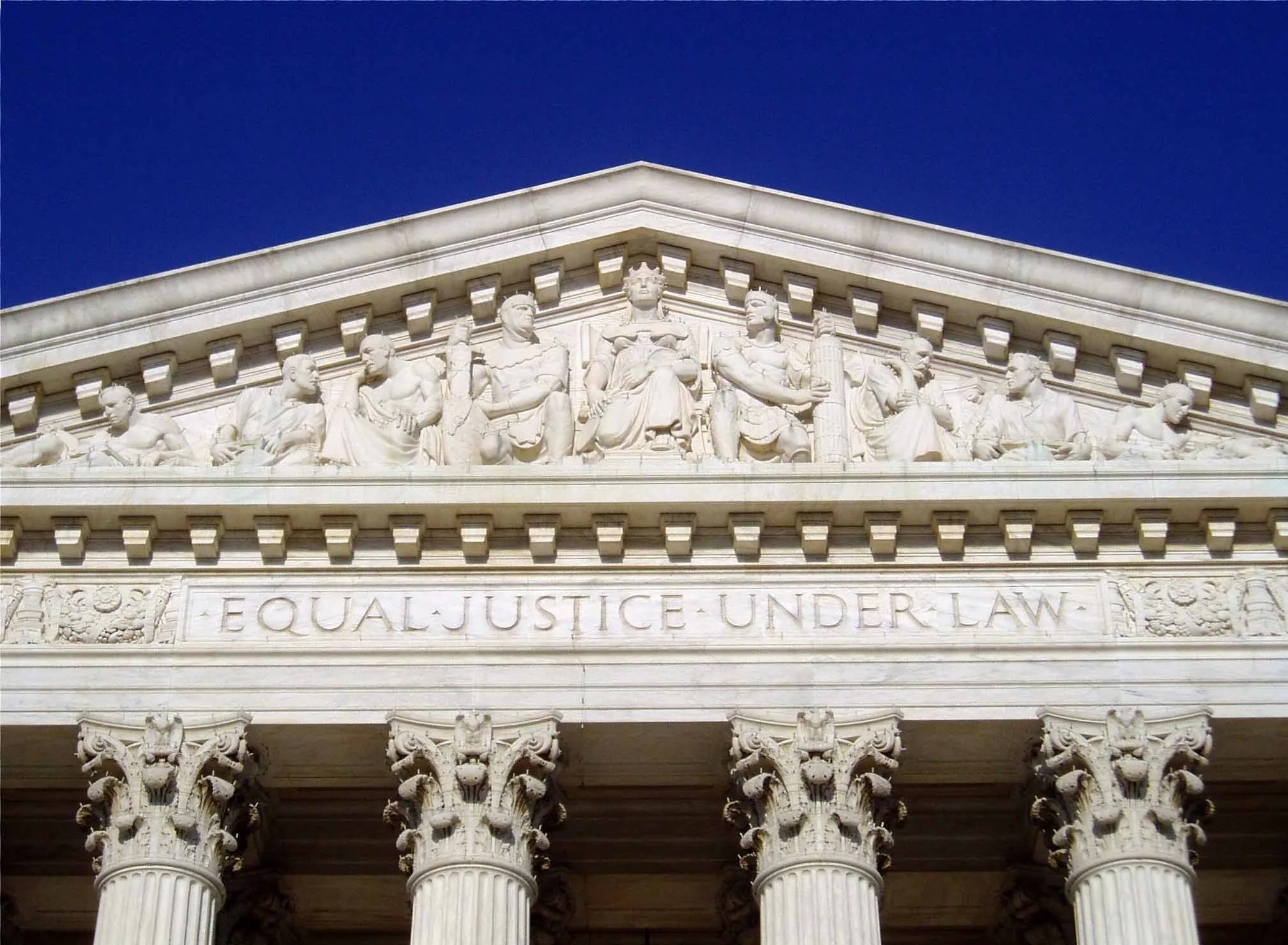
“Equal Justice Under Law,” by Robert Ingersoll Aitken, over the western façade of the U.S. Supreme Court Building.
—Photo byMattWade
WEST WARWICK, R.I.
The men you see in masks on your television savagely arresting people may not seem like your affair. But they are your affair and mine, and that of every other American.
U.S. Immigration and Customs Enforcement operates outside of the law. It doesn’t disclose charges, and no one arrested sees a court of law.
ICE agents are also the affair of the whole world, for while they are symbols of local terror, they are also symbols of America’s withdrawal from the one critical underpinning of civilization: the rule of law.
Without it, society isn’t much. No one is secure, even those who are in charge.
At another time, the victim may be the oppressor. When there is no law there is only fear. One day, the persecutor behind the mask may find himself persecuted by another man behind another mask.
Once power is wielded indiscriminately, it is free to serve many masters.
During a campaign by the government of Argentina to suppress left-wing political opponents, known as the Dirty War, from 1976 to 1983, a new way of settling personal disputes arose.
The police arrested so many and killed them secretly — between 10,000 and 30,000, and the victims became known as the “disappeared” — that soon murder became easier. If you didn’t like a rival or even a family member, you “disappeared” them — and that was that. No one would report such disappearances to the police for fear that it was the work of the police.
When I was in Argentina after the Dirty War, I was told about a man who didn’t like his mother-in-law and disappeared her. Lawlessness breeds lawlessness.
Currently, in areas of America where ICE is present, there is a common assumption that if someone suddenly goes missing, it means that ICE has detained them, and they are likely being sent to a detention center for deportation.
Mickey Spillane, the American crime writer, once said the only difference between the police and the criminals was that the police were employed by the government. We see that with ICE.
In 1215, at Runnymede, the nobles of England told King John to cut it out. They demanded an end to the arbitrary confiscation of property and his majesty’s habit of handing out sentences without trial.
Habeas corpus (“that you have the body”) dates in English law to before the Magna Carta, but it was codified there. The Napoleonic Code embraces many of the same elements as the Magna Carta, although Napoleon eschewed English common law when he revised French law into the code in 1804.
Now, about half of the world’s legal systems are based on the French code and half, including 49 U.S. states, are based on English common law. Louisiana has a hybrid of the two.
Nonetheless, it is a tenet of both systems that the individual will face trial and know his or her accusers, that the accused could be tried by his or her peers, and that the accused has rights.
Historically, the British relied heavily on the rule of law. In fact, law and its application became a mainstay of maintaining order in Britain and in the Empire. It was part of the concept of British exceptionalism.
The dignity and openness of trials were an important part of the colonial ethos. In Southern Rhodesia, before the country suffered a civil war and became Zimbabwe, I was a defendant for a minor dispute with a hotel over a bill. Even though I had settled the bill, I was ordered to appear before the native commissioner’s court in the remote area of the country where the hotel was situated.
The court was a room with a single table and chair. Everyone else sat on the floor. It was crowded with justice-seekers and defendants, all of them black.
Only the commissioner and I were colonials. I thought the process would be nothing more than a courtesy call, a wink and blink.
Finally, the great man with bushy, unkempt, white hair and a mustache called me to the table. He read the now-moot complaint and dressed me down in terms I have never been dressed down, before or after, ven by irate readers.
He said I was a disgrace to Britain, to my ancestry, to my family, and to my school. But, he said, I had especially let down the Empire. I was warned that if I ever faced him again for any reason, no matter how minor, I would get strict punishment.
It was really a rough way to treat a teenager, but it was part of the justice of the day that had to be seen as being even-handed and blind.
In Oliver Twist, Dickens wrote that “the law is an ass.” I think it is a beautiful beast, despite running afoul of it in colonial Africa. We need it back in the U.S. stable.
Llewellyn King is executive producer and host of White House Chronicle, on PBS, and an international energy consultant. His email address is llewellynking1@gmail.com, and he’s based in Rhode Island.