
Vox clamantis in deserto






Llewellyn King: Microgrids offer community solution to electricity challenge
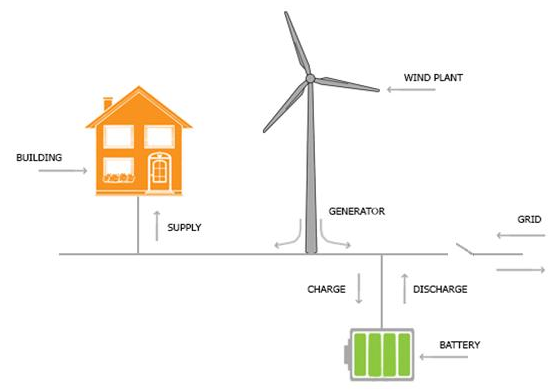
A typical scheme of a microgrid with renewable-energy resources in grid-connected mode.
—Graphic by Le Anh Dao
See this about microgrids in Massachusetts.And this. And in Rhode Island.
WEST WARWICK, R.I.
You may have heard of microgrids in passing, maybe at a town meeting or when the future of your electricity supply is under discussion. Mostly, they aren’t headliners like data centers.
But microgrids are becoming an important part of the future electric infrastructure. They provide a valve to release some of the pressure building for more electricity supply for data centers and transportation.
Burns & McDonnell, an architecture, engineering and construction firm, figures that by 2030, 50 percent of in-city deliveries will be made with electric vehicles of all types, and these will have to be charged daily.
There are about 700 microgrids operating in the United States, and over 7,000 are planned or under construction. While they got off to something of a slow start, they are now going full-speed ahead.
Originally, microgrids were seen as appropriate for military bases, college campuses, and other uses where there was a defense or social purpose, or in remote locations far from the grid.
Utilities were cool or actively hostile to them — although it can be argued that the first microgrid was established by Thomas Edison in Manhattan.
One utility executive said to me four years ago, “What is it about ‘micro’ that the promoters don’t understand?” Now utilities are beginning to embrace microgrids as part of the solution, not a raid on their customer base.
A microgrid, as explained by the futurist-entrepreneur Chase Weir, CEO of Distributed Sun and its spinoff truCurrent, is a way of bringing “kilowatt-hour liquidity” to the electric sector, smoothing out the periods when demand meets maximum capacity, often beginning as the sun sets.
It is a self-contained electric generation and localized distribution entity, using storage, renewables and, at times, traditional generation to create a grid that can operate either independently of the national grid or be connected to it. It is usually separated from but linked to a utility.
Oisin O’Brien, senior director of commercial solutions at truCurrrent, walked me through the dynamics of a microgrid that the company is building for a large food distribution company in Northern California.
Its assignment was to develop a charging station for 30 Daimler electric-tractor trailers used for food distribution. The challenge: To provide 2 megawatts of power for charging the Class 8 trucks during largely off-peak hours. Each truck has a 200-mile range on a single charge, and must be charged daily.
On this project, O’Brien explained, truCurrent is working closely with the local utility, PG&E. “We were able to harness the utility’s flexible service program,” he said.
The full power plant — which is awaiting permission to operate from PG&E — will team 800 kilowatts of solar power with battery storage to create a contained system.
Currently, solar collectors are being installed on the facility’s roof, but two dozen of the company’s trucks are already using the charging points in the parking lot. The 180 kilovolt (which equals 1,ooo volts) fast-chargers can fully recharge a truck in three to four hours.
This first-of-a-kind pilot is remarkable in that it has brought “speed to power,” going from contracting to charging in 13 months. It meets the food distribution company’s need for charging when they need to do so, brings resilient backup and load flexibility, and provides a price hedge at a time of record-high diesel prices.
“Our solutions are only becoming more valuable as cost, reliability and power availability worsens,” said Weir.
According to O’Brien, truCurrent has plans to deploy microgrids across the nation, utilizing a system of turnkey installations where the infrastructure is owned and operated by the local company or the community, but the planning, procurement and installation is provided by truCurrent.
“This project was driven by regulatory pressures in California, the company’s sustainability targets, and the increasing economic benefits with updated analysis, showing lower operating costs for electric fleets compared to diesel [pre-Iran war calculations],” O’Brien said.
The truCurrent project is for transportation usage, but there is a growing demand for microgrid deployment in suburbs, and even in apartment complexes.
It is an example of Weir’s vision for the electrical grid of the future which, in addition to liquidity and speed, must be designed for abundance and affordability.
The project “turned every challenge into an advantage for the developer, the customer, the utility and capital markets,” Weir said.
Shared prosperity with a microgrid: What’s not to like
Llewellyn King, a veteran international energy consultant, is executive producer and host of White House Chronicle, on PBS. His email is llewellynking1@gmail.com, and he’s based in Rhode Island.
Llewellyn King: The scary potential of cyberattacks on utilities make microgrids look better

In engineering there are credible and incredible failures. Nuclear-power plants were designed against what was believed to be a “maximum credible accident.” Then came Fukushima, incredible.
In early December, a report from the National Infrastructure Advisory Council (NIAC) raised the possibility that a huge electric failure, the result of a concerted cyberattack or other event, could knock out electric supply in large swathes of the country for an extended period, weeks even months. A failure with consequences which would have been beyond thinkable before the computer age.
The report, which comes from an advisory council whose mission is to inform the president, has a weight that a think-tank study, for example, would not have. Here, it is the voice of the energy establishment speaking.
I found in reading this report and talking to people in the industry and in academia, it is easy to predict the end of social order as we know it.
It is a painful mind game to try to think how long families could survive without electricity. First off, you would be hot or cold, every appliance in the home would not work. Even if you have a generator, in short order the fuel, natural gas or gasoline, would be gone. How much non-perishable food do you have? I suspect most families would be going hungry after a few days. I would. Cell phones would run down and stay down, and the networks would collapse.
We would be reduced to living like animals without the skills that are inherent to animals. In bad scenarios, families with guns would outlast families without – for a few days.
Survivalists would be proven right as they hung on, maybe for a few months, hunting for fresh food, hoping for clean water, and living off the non-perishable food they have stockpiled. Rumor would dominate as communications failed.
Electric utilities live in a world in which their realities are changing. Wildfires in California and Australia have pointed to a new liability for the companies: accidental ignition through falling lines, likely to get more serious as weather gets more aberrant and droughts become the normal in a time of climate change. That, together with cyberattack, puts them in a place of vulnerability they never anticipated.
Utilities are proud of their expertise – and justifiably so -- in responding to short-term outages, even major ones. They rush crews to the scene, and with military zeal get the lines up and the power flowing.
Then came Puerto Rico after hurricanes Irma and Maria, which gave an inkling of what happens when the grid fails: total devastation and maybe as many as 2,975 lives lost.
The NIAC report cites Puerto Rico and emphasizes cascading, blackouts as the grid begins to fail. As it is, utilities fend off daily cyberattacks, and every executive I have interviewed has emphasized that cyberattack is “what keeps me awake at night” – as Jacqueline Sargent, general manager and CEO of Austin Energy, told me recently.
The utility industry, often keen to be reassuring, was part of the preparation of the NIAC report. Scott Aaronson, point man in the industry’s trade organization the Edison Electric Institute, was involved in the report and has been raising the alarm in interviews since its release.
A new seriousness in the federal government, particularly in the Department of Homeland Security, the Department of Energy and the Pentagon, shows that the threat is real and credible. The White House has said nothing.
Changes not dictated by cyberattack defense, but which might aid it, are on the way. Small entities known as microgrids are cropping up. Think of the old utility model with central power stations as a city. The new one is a series of microgrids, more like villages, loosely connected and isolatable, and depending on local generation from solar and wind.
Also, the technology of defense against cyberattack is growing; There is a large cyber-defense industry. It is an escalating battle in which the defenses improve as the threat multiplies, a kind of cold war with weaponized computers.
In the new year, the invisible enemy will be engaged more than ever. But who knows what is enough? In the NIAC report, insiders have sounded the alarm about their own defenses. That is serious, credible.
On Twitter: @llewellynking2
Llewellyn King is executive producer and host of White House Chronicle, on PBS. He’s based in Rhode Island and Washington. D.C.
Watch the latest White House Chronicle:
The nation’s democracy crisis, with Joe Madison and Hedrick Smith
Set up 'microgrids'

A microgrid with renewable energy resources in grid-connected mode.
From Robert Whitcomb's "Digital Diary,'' in GoLocal24.com
With recent storms and widespread power failures in eastern New England reminding us of the fragility of our regional electricity grid, many experts are looking at creating more “microgrids.’’ Those are localized groups of electricity sources that normally operate connected to the traditional centralized electrical grid but can also be disconnected to "island mode" and function autonomously. Of course the storms are also leading many consumers to buy gas or diesel generators and/or to take the big step of installing their own green source of power – especially rooftop solar panels.
We’re unlikely to experience fewer storms in the future, and the tops of New England’s glorious big and heavily leafed (for six months a year) deciduous trees are thick over many electrical lines. I doubt if the public would be willing to pay to bury them all!