
Vox clamantis in deserto






Chris Powell: The case for vegetarianism is getting stronger
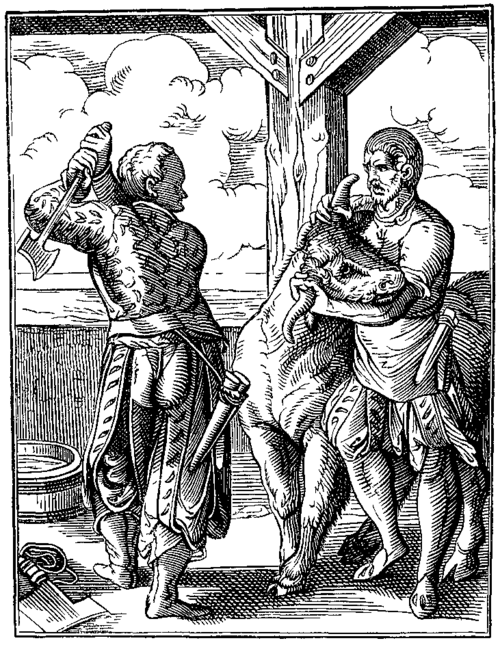
“The Butcher and his Servant’’ (1568), drawn and engraved by Jost Amman
MANCHESTER, Conn.
Wesleyan University, in Middletown, Conn., often rivals Yale University in New Haven for nutty political correctness, and that's how many people perceived its most recent news. A group of Wesleyan students, faculty members, and alumni has asked the university to erect a plaque outside the university's dining hall to memorialize all the animals killed for the food eaten inside.
Such a plaque would be a rebuke not just to meat eaters on campus but to the university itself, so it's hard to see how Wesleyan could erect it without also taking meat off the dining hall menu and formally converting the campus to vegetarianism. Once the plaque was erected, anything less would be hypocrisy.
Such a plaque also might make the university's priorities seem strange, what with poverty, homelessness, child neglect, and other human ills worsening throughout Connecticut, often within sight of the university.
Even so, the plaque concludes: “There will come a time when we will look back on this treatment of our fellow animals as indefensible. We will recognize that all animals feel, think, love, and strive to live -- even those who do not look or behave exactly as humans do -- and that their lives are as precious to them as ours are to us."
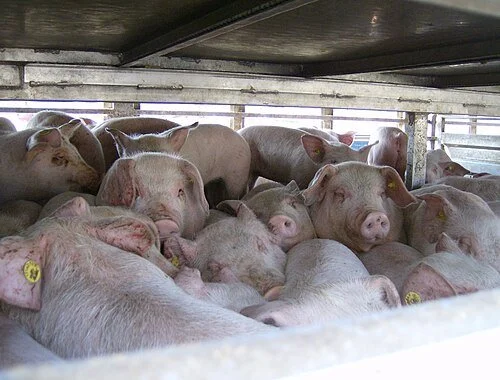
Pigs being transported to be slaughtered and eaten, much of the meat as bacon.
This is not so nutty, insofar as society has already conceded some of it in principle with laws against gratuitous cruelty to animals. But vegetarianism is up against all history, starting with animals themselves, many of which have no scruples against eating each other.
In Genesis the Bible conveys divine approval for eating meat: “And God said, Let us make man in our image, after our likeness: and let them have dominion over the fish of the sea, and over the fowl of the air, and over the cattle, and over all the Earth, and over every creeping thing that creepeth upon the Earth."
Indeed, without the meat industry many animal species and breeds, being raised primarily for food, might virtually disappear. Who would go through the trouble and expense of raising beef cattle just for the sake of biodiversity?
But guilt about eating meat is not peculiar to Wesleyan. There is much ethics-based vegetarianism in Hinduism, and some American Indian tribes offered prayers of thanks to honor the animals they hunted for food, though whether this was sincere respect or just rationalization for participating in the kill is arguable. Few people ordering hamburgers have to witness the prerequisite slaughtering and butchering of the animals that their meat comes from. Witnessing such spectacles in the stockyards and meat-packing factories can depress appetites.
Of course, vegetarianism does not automatically confer goodness. Taking a break from plotting mass murder in November 1941, Hitler assured his dinner companions, “The future belongs to us vegetarians."
It's still better that he lost the war.
But the case for vegetarianism, or at least for greater respect for animals, is getting stronger for new reasons.
Companion animals, particularly dogs and cats, long have been famous for their sometimes uncanny ability to communicate with and protect people. But in recent years home videos posted on the Internet have proven what had been mainly anecdotal -- the astounding intelligence and ability to communicate with humans possessed not just by dogs and cats but even by wild animals, farm animals, and birds as well.
Amelia Thomas, a journalist, animal scientist, and farmer in Canada, has detailed this in a fascinating new book, What Sheep Think About the Weather: How to Listen to What Animals Are Trying to Say.
“There's no us and them," Thomas says. “Rather, infinite varieties of us."

Chimpanzees are humans’ closest relatives.
Having worked a little with chimpanzees, some of whom have learned American sign language, Thomas quotes the primatologist Mary Lee Jensvold: “The more you appreciate what thinking beings they are, the more you also understand the depth of their suffering."
There are no chimps on the menu at Wesleyan, but if the vegetarian plaque is erected there, over time it may get harder to argue with.
Chris Powell has written about Connecticut government, politics and other topics for many years (CPowell@cox.net).