
Vox clamantis in deserto





Our first civil war
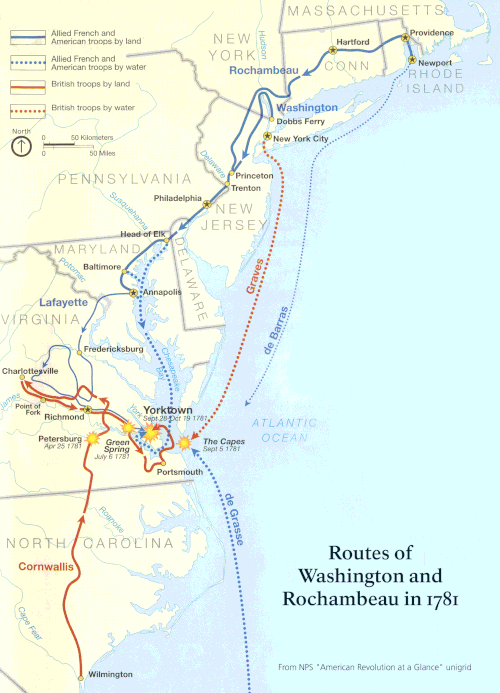
Map of the movements that led to the American (and French) defeat of the British at the Battle of Yorktown, the final major engagement of the American Revolutionary War, which was also a civil war.
Adapted from Robert Whitcomb’s “Digital Diary,’’ in GoLocal24.com
“How is it that the loudest yelps for liberty come from the drivers of slaves?”
-- English writer, scholar and philosopher Samuel Johnson (1709-1784) in 1775
I’ve been watching some of Ken Burns’s PBS series The American Revolution. I tire of the relentless violin music heard in his shows, but the very timely series does serve to undermine various popular myths of the Revolutionary War and, more broadly, The American Founding. It was far more than a noble desire for freedom from an empire, albeit one run by an elected parliament along with troubled, but not evil, king.
The British would have done well to follow the advice of the great Anglo-Irish politician and political philosopher Edmund Burke (1720-1797), who argued for conciliation between the British government and Americans who had felt that their traditional rights as British subjects were being violated by a far too dictatorial, rigid and aggressive government in London.
While Burke didn’t back giving American colonists representation in Parliament, at least partly because of the distance across the Atlantic, he did push for letting colonial legislatures set their colonies’ own taxes and many other policies. After all, he argued, the colonies had long experience of various degrees of autonomy, including considerable self-government.
Many Americans displayed great antipathy toward British-imposed taxes (but enacted, among other things to pay for protection from foreign powers such as the French). “No taxation without representation!’’
The Revolution was also about Americans’ greedy and brutal lust for seizing the tribal lands of Indians across the Appalachians – people whom the British mostly wanted to leave alone -- and an effort by the South to keep their partially slave-based system expanding.
Indeed, you could argue that the revolution was more about money than Enlightenment ideals of republican government.
And it was a bloody civil war between Loyalists for the British and those wanting their own country. There were ethical and other good and evil points on each side.
The Loyalists certainly thought they’d be better off governed under the relatively orderly British Empire than under the sometimes anarchic and rough people now calling themselves “Americans.’’
Lots of Loyalists fled, to Britain, the Maritime Provinces, Quebec and elsewhere, especially as Americans stole their property and in some cases threatened their lives. Some fled along the Maine Coast to points east enough that they thought they’d be safe. But the Treaty of Paris, in 1783, pushed the boundary further east than many had expected, and they found themselves stuck on the U.S. side of the border. At that point, many Loyalists were too tired to move again, and so they stayed put and became “Americans.’’ At least that’s what a Loyalist descendent living in Brunswick, Maine, told me!
The American Revolution helped lead to the very different French Revolution. You can read how and why they took such different courses by reading Hannah Arendt’s classic study On Revolution.
I suspect that a few of my New England ancestors (who were mostly around Boston and on Cape Cod) were Loyalists, but old documents suggest that most of them were “Patriots.’’ I love the old terminology of that war. I came across this from a family record:
“In 1775 John Butler is linked to Private Captain Joseph Palmer’s co. when they marched for 3 days {to where?}. Also with Captain Barrachia {!} Bassett’s co. dated January 13th 1776 a distance of 170 miles. Also on Captain Joseph Palmer’s co Col. Freeman’s regt. For service of 8 days on alarm {waiting for British troops to show up?} at Dartmouth and Falmouth in September 1778.’’
Would the world have been better off if the 13 colonies had remained part of the British Empire? Could they thus have been in better position to have encouraged Britain to adopt some of Americans’ better ideas/ideals (and, to quote Lincoln, “the better angels of our nature”) about government, the economy and other sectors, and society in general? These were ideas and ideals, some of them infused with a rhetorical egalitarianism, less common in Britain, and made manifest in the thoughts and actions of the often bickering Founders? Of course, there are far too many variables to know what would have happened. But playing “what if’’ is fun.
The only fairly sure bet is that slavery would have ended sooner here if London had remained in charge. The public opinion that slavery was evil was stronger in the United Kingdom than in what would become the United States, where part of the nation’s economy profited so much from it.
Meanwhile, one wonders how The Founders would have reacted to the current American regime of bottomless corruption and drive for tyranny, and that a plurality of those who bothered to vote backed a person with a 50-year record of private and public depravity. Of course, The Founders were always terrified that an extreme narcissist demagogue would take power in a lie-infested “populist’’ wave.
And now it’s happened.