Vox clamantis in deserto


Robert Whitcomb: John & Yoko in candids
Roger Farrington
From The Boston Guardian
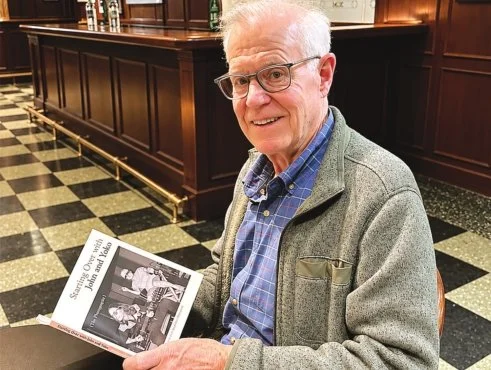
The tiny new book Starting Over with John and Yoko is a look at the last months, in 1980, of ex-Beatle John Lennon, shot to death on December 9 that year, about the social, technical and other aspects of pre-digital photography, and the ethics and anti-ethics of public relations.
The work, with text by Beatles scholar Kenneth Womack and photos by famed Boston photographer Roger Farrington, centers on the celebrity couple’s activities at a New York recording studio and outside The Dakota, the famous Upper West Side apartment building where the couple lived. Lennon, in collaboration with his wife, Yoko Ono, was recording what turned out to be his last album, Double Fantasy, sometimes erroneously called Double Fantasies, which was released on Nov. 17, 1980.
The duo had taken a five-year hiatus from recording starting in 1975 and rumors that they might be planning a return to production were constantly circulating. I remember those rumors, though I wasn’t a Beatles World obsessive. Anyway, on August 7, 1980, John Lennon and Yoko Ono walked into the Hit Factory to secretly begin work on a new album.
At the studio and outside The Dakota, Farrington, who was 27 at time, took some memorable candids of the couple, some of which are in this book, all the while having to deal with an irascible and sometimes crooked, or at least “colorful,’’ Boston-based press agent called Charles Cohen. He almost seemed like a guy in a ‘40’s Film Noir. Lennon himself was widely seen as arrogant and irascible but doesn’t seem that way in the book.
To say the least, Farrington was a surprise choice to visually record the couple in the studio. In 1980, he was performing a variety of jobs for owner Jack Sugrue at The Charles Playhouse, in Boston.
The book memorably evokes the times and places of that era, including the urban seediness of Boston and New York.
It reminded me of my experiences in school, developing film in darkrooms, especially the strong smell of the chemicals! Also later on my watching news photographers and photo editors I worked with at newspapers sometimes create memorable work in the face of big obstacles, some even dangerous. And then there was the challenge to editors to properly size and crop the images.
The book’s descriptions of what Farrington had to do to create those pictures act as a solid first lesson in the glories, disasters, unpredictability and occasional chaos of pre-digital professional/commercial photography and, so far as any photography goes, what goes into the decision of when to shoot a picture, whatever the gear. But when a photographer does get great pics, sometimes by accident, what an addition to the historical record!
Mr. Womack notes at the end of the book that Yoko’s Summer of 1980 anthology, which she compiled in 1983, “pointedly featured John in happier times, when the world was brighter {for some anyway} and the idea of making music again seemed a worthy cause for coming out of retirement. {Yoko’s} husband had been, as always, a visionary of the highest order, and the photos from that fate-filled summer redound with optimism and hope. Life is indeed what happens to you while you’re busy making other plans.’’
Robert Whitcomb is chairman of The Boston Guardian.