
Vox clamantis in deserto





Massport considers Hynes Convention Center for remote Logan terminal
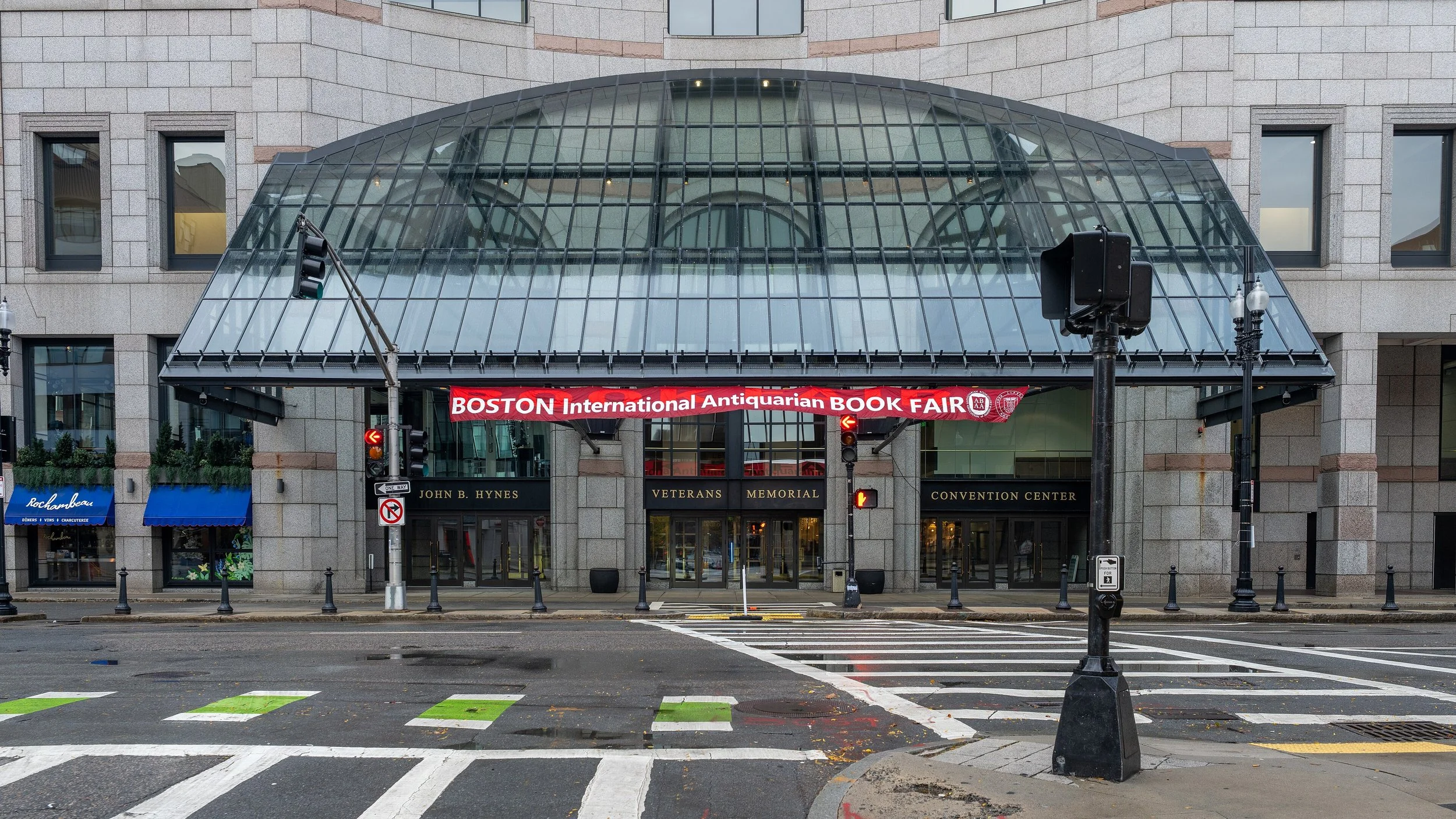
Boylston Street entrance to the Hynes Convention Center.
— Photo by ajay_suresh
(Robert Whitcomb, the editor of New England Diary, is chairman of The Boston Guardian.)
The Massachusetts Port Authority (Massport) is considering installing a remote Logan Airport terminal in the Hynes Convention Center where passengers could go through security and subsequently be bussed to the airport and dropped off after the checkpoint.
After the substantial success of a pilot remote terminal this summer in Framingham, the Boston Business Journal recently reported that Massport was in early talks with the Massachusetts Convention Center Authority (MCCA). So far, neighborhood representatives are excited about the possibility.
“I think it’s a great idea,” said State Rep. Jay Livingstone, who serves the Back Bay as well as Beacon Hill and the Fenway. “I think it will allow people visiting or living in Back Bay, the South End, to have easy access to [Logan]. Massport’s already proven that it’s been able to successfully do this in Framingham, and I think it would be a great amenity in the neighborhood and for the Hynes.”
Livingstone said he had discussed the idea with the MCCA, but that the authority hadn’t set a timetable yet. He said that MCCA executive director John Barros had already begun doing some basic community outreach. The Hynes is currently undergoing an extensive infrastructure renovation expected to last into 2029. Neighborhood leaders have been hopeful about that renovation, too, because of the benefits its conventions bring to Back Bay business and tourism. Meg Mainzer-Cohen, president of the Back Bay Association which represents businesses in the area, said the remote terminal would be yet another way to bring those benefits about more regularly.
“We would be very supportive of it,” Mainzer-Cohen said. “Anything that makes traveling to the airport from Back Bay will be welcome, and the simplification of having it as what sounds a seamless entry point at the Hynes would be, I think, a great benefit to the neighborhood.”
Serge Savard, chair of the resident group Neighborhood Association of the Back Bay (NABB), said in a phone call that it would also be a benefit to Back Bay residents to avoid a tedious Logan commute.
“To have easy access to Logan Airport without having to commute, to check in right there and be right there in the terminal in the secure area, as a commodity for our residents who are traveling quite a bit, I think it could be beneficial,” Savard said. “If it’s implemented well, and it doesn’t create chaos in the traffic around Mass. Ave in that section, we would be supportive. But it’s going to be really in the detail of the implementation, which we haven’t seen yet.”
Both Mainzer-Cohen and Livingstone said they expected the traffic impact of such a terminal to be minimal.
“I think that the same people right now who are entering by taking a shuttle bus, or public transportation, or Uber or vehicle would be [the people using the remote terminal],” Mainzer-Cohen said. “The traffic is there.”
An existing bus, the Logan Express, already runs from the Back Bay to Logan Airport. Massport has suggested using the Hynes’s large garage on Dalton Street as a potential site for the remote terminal busses to run from. The Logan Express stop in the Back Bay runs from that same street. Massport didn’t specify whether that shuttle would continue to run if the remote terminal was established.
“We are in the very early stages of evaluating the potential to expand the Remote Terminal program, and no decisions have been made,” a Massport spokesperson told The Boston Guardian in an email. “Because discussions are preliminary, we have not established potential bus routes or operational plans, and it’s too early to discuss any approvals or coordination that may be required. If the program moves forward, we would work closely with the appropriate partners throughout the planning process.”
Charles Chieppo: Special interests book Boston Convention Center
BOSTON
As more information comes in, two things become even clearer: Plans to expand the Boston Convention & Exhibition Center, or BCEC, are absurd, and the project is like a case study in special-interest politics.
Convention centers are supposed to bolster the local economy by attracting visitors who would otherwise spend their money elsewhere. The best measure of success is the number of hotel room-nights they generate. We’re told that the BCEC needs to expand because space limitations and lack of availability at the bursting-at-the-seams facility mean we’re losing out on room nights.
The 1997 feasibility study on which the decision to build the BCEC was based projected that it would generate 794,000 room nights annually. But we recently learned that the facility actually generated a paltry 264,669 room nights during the fiscal year that ended last June 30.
So much for bursting at the seams.
Look more closely and the numbers are even more devastating. Not only is the BCEC’s room-night generation one-third of what was projected, but the biggest building in New England actually generates more than one-third fewer hotel room nights than the much smaller Hynes Convention Center produced in 2000, before taxpayers spent $850 million to build the BCEC.
The BCEC is hardly alone. There was a little over 36 million square feet of exhibition space in the United States in 1989. By 2013, that number had nearly doubled to 71.1 million. But demand has remained flat at best, which is why Las Vegas, Orlando, Chicago and Atlanta are among the cities that recently competed expansions only to have the larger facility do the same amount or less business than before it was enlarged.
Yet despite dismal performance and a declining market, proponents maintain that we must expand the BCEC.
The Massachusetts Convention Center Authority wants expansion because it would grow an MCCA empire fueled by a $123 million operating budget, nearly half of which is supported by taxpayer subsidies, and keep $5 billion in hotel tax receipts flowing to the authority after the original BCEC construction bonds are paid off in 2034.
Another quasi-public authority, #massport, is pushing for expansion because it stands to reap a windfall as owner of the land next to the BCEC, on which a publicly subsidized headquarters hotel would be built. The Convention Center Authority is now appealing to the city of Boston for a tax break to build the hotel. They’ll need it; developers aren’t too keen on building hotels next to empty buildings.
Unions get their share too. The BCEC would expand using a project labor agreement, which means the nearly 84 percent of Massachusetts construction workers who choose not to join a union would be locked out of the $1 billion project.
Thankfully the Charles Baker administration has put the brakes on selling expansion bonds as it analyzes the issue.
BCEC expansion is like the perfect storm; all the usual suspects get a piece of the action — and taxpayers get the shaft. You can’t help but wonder whether its proponents even possess the capacity to feel shame.
Charles Chieppo (charlie@chieppostrategies.com) is principal of Chieppo Strategies LLC and a former vice chairman of the Massachusetts Convention Center Authority board of directors. This piece first ran in the Boston Herald.
Charles Chieppo
Chieppo Strategies LLC
(617) 548-7146
Fax: (781) 559-3106