
Vox clamantis in deserto







Llewellyn King: Check the Bible on citizenship and rights
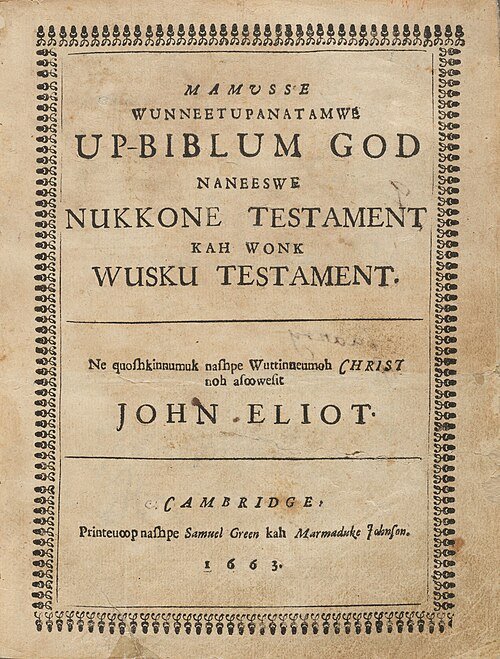
The Eliot Indian Bible was the first translation of the Christian Bible into an indigenous American language, as well as the first Bible published in British North America. It was prepared by English Puritan missionary to New England John Eliot by translating the Geneva Bible.
About 40 exist today out of the original 1,050 printed, with about 30 in New England (libraries and private collections) and about 10 in Europe.
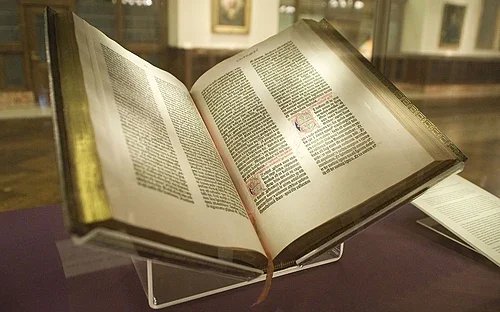
A Gutenberg Bible (1455) at the New York Public Library.
WEST WARWICK, R.I.
President Donald Trump claims that birthright citizenship isn’t that: a birthright. He wants the authority to revoke the citizenship of U.S.-born children of both immigrants here illegally and visitors here only temporarily.
The Supreme Court will hear arguments on birthright citizenship this spring. It will likely hand down a ruling by summer.
Before the justices decide, they may want to cast their eyes over the Acts of the Apostles in the Bible.
They will learn anew how inviolate birthright citizenship was to Paul when he entered Jerusalem. He had to invoke his Roman citizenship to save himself from flogging and torture.
On another occasion, Paul used his rights as a citizen to demand a trial.
Here is what befell Paul in Jerusalem in Acts 22:29:
22 The crowd listened to Paul until he said this. Then they raised their voices and shouted, “Rid the earth of him! He’s not fit to live!”
23 As they were shouting and throwing off their cloaks and flinging dust into the air, 24 the commander ordered that Paul be taken into the barracks. He directed that he be flogged and interrogated in order to find out why the people were shouting at him like this.
25 As they stretched him out to flog him, Paul said to the centurion standing there, “Is it legal for you to flog a Roman citizen who hasn’t even been found guilty?”
26 When the centurion heard this, he went to the commander and reported it. “What are you going to do?” he asked. “This man is a Roman citizen.”
27 The commander went to Paul and asked, “Tell me, are you a Roman citizen?”
“Yes, I am,” he answered.
28 Then the commander said, “I had to pay a lot of money for my citizenship.”
“But I was born a citizen,” Paul replied.
29 Those who were about to interrogate him withdrew immediately. The commander himself was alarmed when he realized that he had put Paul, a Roman citizen, in chains.
In the 1st Century A.D., Roman citizenship could be had by birth, purchased or granted by the emperor. But citizens who were born to their status had something of an edge over those, like the commander, who had bought their citizenship.
A Roman citizen enjoyed many rights, which are also contained in the U.S. Constitution but are being ignored by Immigration and Customs Enforcement agents who are sweeping up people — some have turned out to be citizens and some have been deported in error.
These are the rights of a Roman citizen in the 1st Century A.D.:
Immunity from flogging and torture. These could be used to extract confessions, but were forbidden to be used against citizens.
The right to a fair trial, which included the accused’s right to confront his accusers.
The right to appeal directly to the emperor.
Protection from degrading death, particularly crucifixion.
Protection from illegal imprisonment. A citizen couldn’t be jailed if he hadn’t been convicted.
Trump is seeking a Supreme Court ruling to uphold his executive order (14161), ending universal birthright citizenship. The lower courts have restricted the order, and the president has asked SCOTUS to set that aside.
The 14th Amendment grants birthright citizenship to any child born under the jurisdiction of the United States. But Trump’s executive order, according to the New York City Bar, “purports to limit birthright citizenship by alleging that a child born to undocumented parents is not ‘within the jurisdiction of the United States.’
“It thereby posits that birthright citizenship does not extend to any child born in the United States to a mother who is unlawfully present or lawfully present on a temporary basis and a father who is neither a U.S. citizen nor a lawful permanent resident.”
If Trump prevails, the unfortunate children will be unable to get birth certificates, register for school, receive health care or any kind of public assistance. They must either seek citizenship from their parents’ country or, more likely, join the growing ranks of the world’s stateless people, punished for life for the crime of being born. Victims to be exploited down through the decades of their lives.
The United Nations estimates that there are more than 4 million stateless people in the world, but that is a gross undercount, considering the number of refugees across Africa and in Latin America. War and drought are adding to the numbers daily.
If the justices want another biblical example, they may turn to the Old Testament and its several warnings that the sins of the fathers will be visited on the children for generations. As Exodus 20:5 puts it, “visiting the iniquity of the fathers on the children and the children's children to the third and fourth generation.”
Those who support the Trump view may want to think about the iniquity they are promoting. No baby chooses where to be born, ever.
Llewellyn King is executive producer and host of White House Chronicle, on PBS, and an international energy-sector consultant. His email is llewellynking1@gmail.com ,and he’s based inRhode Island.
Llewellyn King: As America turns its back on the World, the world will turn its back on America
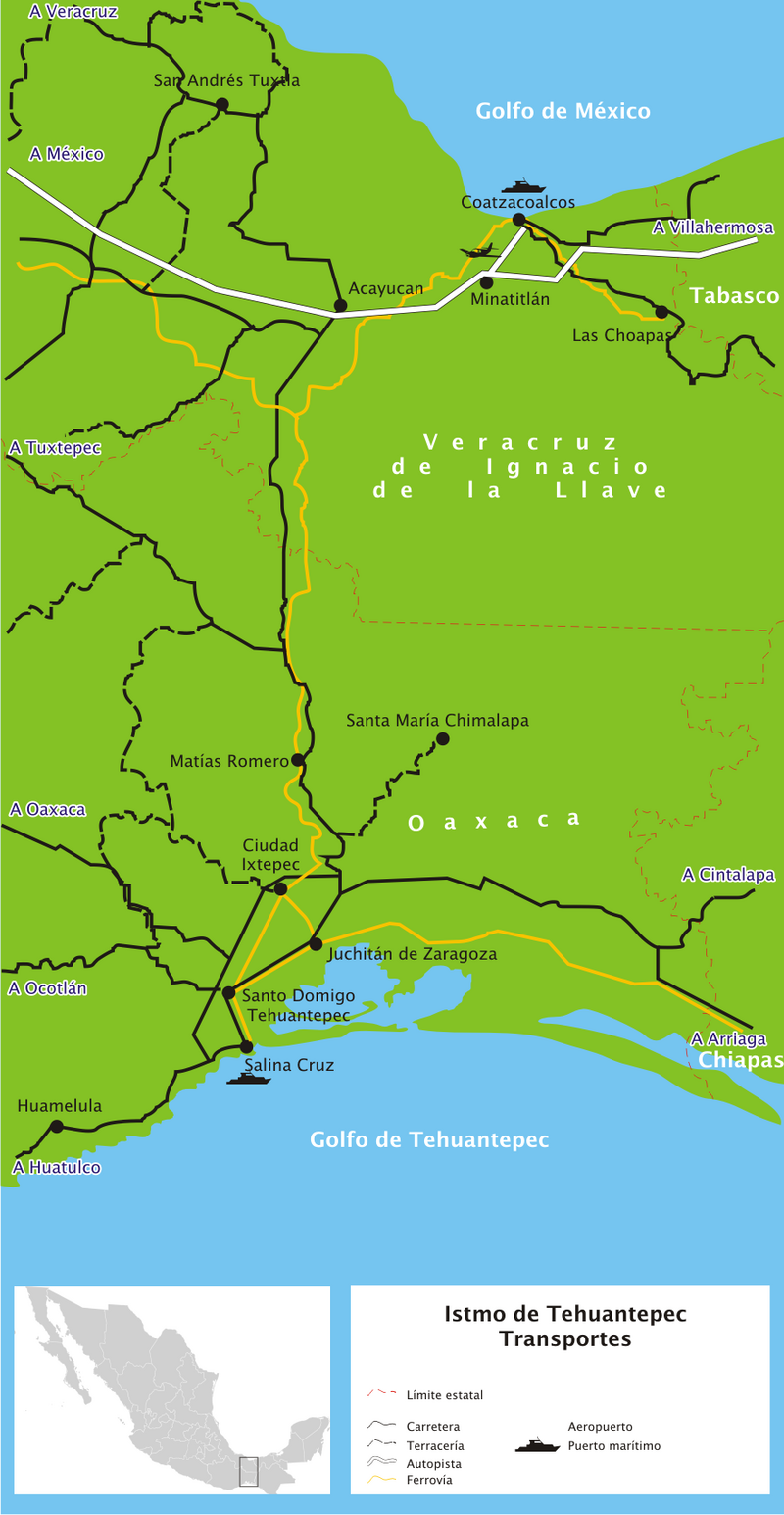
Project connecting the Pacific and Atlantic via a Mexican railway system called the Railway of the Isthmus of Tehuantepec. This will facilitate more Mexican trade with Europe and Asia, helping to reduce Mexico’s dependence on an increasingly unreliable United States.
WEST WARWICK, R.I.
America has your back. That has been the message of U.S. foreign policy to the world’s vulnerable since the end of World War II.
That sense that America is behind you was a message for Europe against the threat of the Soviet Union and has been the implicit message for all threatened by authoritarian expansionism.
From the sophisticated in Western Europe to the struggling masses worldwide, America has always been there to help. Its mission has been to serve and, in its serving, to promote the American brand — freedom, democracy, capitalism, human rights — and to keep America a revered and special place.
America was there to arbitrate an end to civil war, to rush in with aid after a natural disaster, to provide food during a famine and medical assistance during an infectious disease outbreak. America was there with an open heart and open hand.
If you want to look at this in a transactional way, which is the currency of today, we gave but we got back. The ledger is balanced. For example, we sent forth America’s food surplus to where it was needed, from Pakistan to Ethiopia, and we opened markets to our farmers.
The world’s needs established a symbiotic relationship in which we gained reverence and prestige, and our values were exported and sometimes adopted.
President Trump has characterized us as victims of a venal world that has pillaged our goodwill, stolen our manufacturing and exploited our market. The fact is that when Trump took office in January, the United States had the best-performing economy in the world, and its citizens enjoyed the products of the world at reasonable prices. Inflation was a problem, but it was beginning to come down — and it wasn’t as persistent as it had been in Britain, for example.
Trump has painted a picture of a world where our manufacturing was somehow shanghaied and carried in the depth of night to Asia.
In fact, American businesses, big and small, sought out Asian manufacturing to avail themselves of cheap but talented labor, low regulation and a union-free environment.
Businesses will always go where the economic ecosystem favors them. The ecosystem offshore was as irresistible to us as it was to a tranche of European manufacturing.
The move to Asia hollowed out the old manufacturing centers of the Midwest and New England, but unemployment has remained low. Some industries, including farming, food processing and manufacturing, suffer labor shortages.
We need manufacturing that supports national security. That includes chips, heavy electrical equipment and other essential infrastructure goods. It doesn’t include a lot of consumer goods, from clothing to toys.
Former California Sen. S.I. Hayakawa, a Republican and a semanticist, said you couldn’t come up with the correct answer if your input was wrong, “no matter how hard you think.” Trump’s thinking about the world seems to be input-challenged.
The world isn’t changing only in how Trump has ordained but in other fundamental ones. Manufacturing in just five years will be very different. Artificial intelligence will be on the factory floor, in the planning and sales offices, and it will boost productivity. However, it won’t add jobs and probably will subtract them.
Trump would like to build a Fortress America with all that will involve, including higher prices and uncompetitive factories. While not undermining our position as the benefactor to the world, a better approach might be to build up North America and welcome Canada and Mexico into an even closer relationship. Canada shares much of our culture, is rich in raw materials, and has been an exemplary neighbor. Mexico is a treasure trove of talent and labor.
Rather than threatening Canada and belittling Mexico, a possible future lies in a collaborative relationship with our neighbors.
Meanwhile, Canada is looking for markets to the East and the West. Mexico, which is building a coast-to-coast railway to compete with the Panama Canal, is staking much on its new trade deal with the European Union.
Trump has sundered old relationships and old views of what is America’s place in the world order. No longer does the world have America at its back.
This is a time of choice: The Ugly American or the Great Neighbor.
On X: @llewellynking2
Bluesky: @llewellynking.bsky.social
Subscribe to Llewellyn King's File on Substack
Llewellyn King is executive producer and host of White House Chronicle, on PBS. He’s based in Rhode Island.

Llewellyn King: Great newspaper editors I’ve known
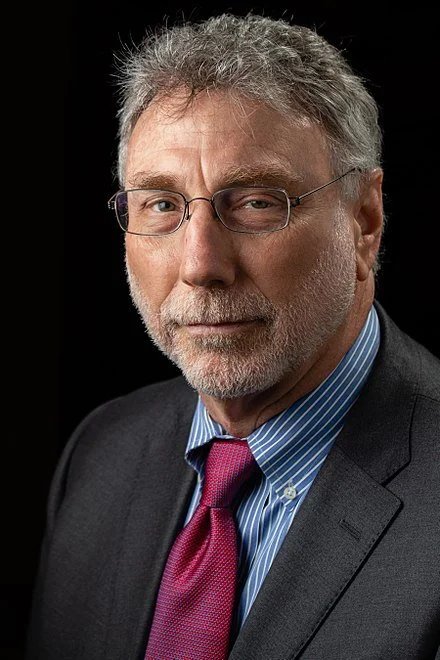
Martin Baron, who servved as head editor of The Miami Herald, The Boston Globe and The Washington Post. He lead The Globe’s investigation of sexual abuse of young people by Catholic priests, an investigation dramatized in the Academy Awards-winning movie Spotlight.
WEST WARWICK, R.I.
I am something of a connoisseur of editors. I have worked for them, alongside them, and have hated and admired them.
So I was ecstatic when Adam Clayton Powell III, my cop-host on the TV show White House Chronicle, told me he contacted Martin “Marty” Baron, who has a place in the pantheon of great editors, and he agreed to come on the show.
We recorded a two-part series with Baron, which was a tour de force appearance. He talked about the excitement of being the editor of The Miami Herald when Elian Gonzalez was the big story; the years-long unveiling of sexual abuse in the Catholic Church in The Boston Globe when he was its editor; and his becoming executive editor of The Washington Post and its transition from being a family property to being owned by Jeff Bezos, then the world’s richest man.
As he did in his book, Collision of Power: Trump, Bezos, and The Washington Post, he discussed how Trump early on had the new Post team to dinner at the White House and endeavored to co-opt them into the Trump camp. Trump had, as Baron explained, picked on the wrong team.
Baron’s biggest achievement, I believe, was the investigation that exposed the Catholic Church. I was traveling frequently to Ireland at that time — a country, sadly, that had seen more than its share of clerical excess. The Globe’s revelations had an immediate impact there and around the world: Think of the thousands of boys and girls who won’t be abused as a result.
Every editor edits differently and leaves a different mark. I worked for a weekly newspaper editor in Zimbabwe, Costa Theo, who set much of the hot type and edited on the Linotype machine. He urged me to use what he called “informants” many years before Watergate ushered in the practice of talking about “sources” without naming them and relying on the integrity of the reporter to guarantee the existence of the sources.
Herbert Gunn, father of the poet Thom Gunn, edited various newspapers in London’s Fleet Street — when I knew him, it was The Sunday Dispatch. He sat in a commanding way on what was called the “backbench” at the end of the newsroom and edited what he thought needed his touch in green ink with a Parker 51. If you saw green ink, you jumped.
Gunn was a superb editor and, like Ben Bradlee at The Post, gave a theatrical performance as well. All I ever saw in green ink were cryptic notes like “15 minutes.” That meant, “I will see you in the pub in 15 minutes.” It was an assignment not an invitation.
Some editors are technicians and change the look of the papers they edit. John Denson, at The New York Herald Tribune, is credited with introducing horizontal layouts using Bodoni typefaces as the principal type of the newspaper. This became the standard for many U.S. newspapers, including The Washington Post.
A newspaper genius, David Laventhol, put the women’s page in The Post to flight. As the Style section’s first editor, he did it with typological aplomb and with the use of photos in a Life magazine way: big and bold.
Laventhol, who ended up as publisher of the Los Angeles Times and Newsday, came to The Post from The New York Herald Tribune, where he had risen to managing editor. He and I worked together briefly in 1963 and I remember him having a days-long battle with Marguerite Higgins, the famous foreign correspondent, over the use of the word “exotic.”
Of course, Laventhol was only able to create the revolutionary Style section because executive editor Bradlee gave him free rein.
Bradlee edited with leadership, while affecting a kind international jewel thief persona, as might be played by David Niven or Steve McQueen. His genius always was the big picture. He didn’t write headlines or change captions, but he did decide the big stories of the day.
One of those stories was about a break-in at an office and apartment complex called The Watergate. I had arranged a dinner date with a reporter at the rival Evening Star. She called me and said, “I am afraid I will be late. There has been some sort of break-in at The Watergate. But it can’t be important because the Post is sending Carl.”
At that time, Carl Bernstein wasn’t a star, just a young city-desk reporter. I don’t think my date that night stayed in journalism.
Baron, like Bradlee, had a nose for the big one — and he brought it home.
On Twitter: @llewellynking2
Llewellyn King is executive producer and host of White House Chronicle, on PBS. He’s based in Rhode Island and Washington, D.C.

Llewellyn King: AI’s assault on journalism and many other jobs will intensify

AI robot at Heinz Nixdorf Museum, in Paderborn, Austria
—- Photo by Sergei Magel/HNF
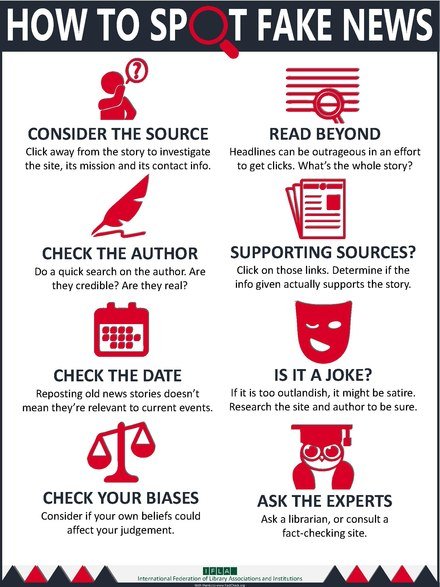
Infographic published by the International Federation of Library Associations and Institutions.
This article is based on remarks the author made to the Association of European Journalists annual congress in Vlore, Albania, last month.
I am a journalist. That means, as it was once explained to me by Dan Raviv, of CBS News, that I try to find out what is going on and tell people. I know no better description than that of the work.
To my mind, there are two kinds of news stories: day-to-day stories and those that stay with us for a long time.
My long-term story has been energy. I started covering it in 1970, and, all these years later, it is still the big story.
Now, that story for me has been joined by another story of huge consequence to all of us, as energy has been since the 1970s. That story is artificial intelligence.
Leon Trotsky is believed to have said, “You may not be interested in war, but war is interested in you.” I say, “You may not be interested in AI, but AI is interested in you.”
Just as the Arab oil embargo of October 1973 upended everything, AI is set to upend everything going forward.
The first impact on journalism will be to truth. With pervasive disinformation, especially emanating from Russia, establishing the veracity of what we read — documents we review, emails we receive — will be harder. The provenance of information will become more difficult to establish.
Then, it is likely that there will be structural changes to our craft. Much of the more routine work will be done by AI — such things as recording sports results and sifting through legal documents. And, if we aren’t careful, AI will be writing stories.
One of the many professors I have interviewed while reporting the AI story is Stuart Russell, at the University of California at Berkeley, who said the first impact will be on “language in and language out.” That means journalism and writing in general, law and lawyering, and education. The written word is vulnerable to being annexed by AI.
The biggest impact on society is going to be on service jobs. The only safe place for employment may be artisan jobs — carpenters, plumbers and electricians.
Already, fast-food chains are looking to eliminate order-takers and cashiers. People not needed, alas.
The AI industry — there is one, and it is growing exponentially —likes to look to automation and say, “But automation added jobs.”
Well, all the evidence is that AI will subtract jobs almost across the board. Think of all the people around the world who work in customer service. Most of that will be done in the future by AI.
When you call the bank, the insurance agency, or the department store, a polite non-person will be helping you. Probably, the help will be more efficient, but it will represent the elimination of all those human beings, often in other countries, who took your orders, checked on your account, helped you decide between options of service, and to whom you reported your problems or, as often, voiced your anger and disappointment.
The AI bot will cluck sympathetically and say something like, “I am sorry to hear that. I will help you if I can, but I must warn you that company policy doesn’t allow for refunds.”
On the upside, research — especially medical research — will be boosted as never before. One researcher told me a baby born today can expect to live to 120 — another big story.
As journalists, we are going to have to continue to find out what is going on and tell people. But we will also have to find new ways of watermarking the truth. Leica, for instance, has come out with a camera that it says can authenticate the place and time that a photo was taken.
We are going to have to find new outlets for our work where people will know that it was written and reported by a human being, one of us, not an algorithm.
Journalists are criticized constantly for our failings, for allegedly being left or right politically, for ignoring or overstating, but when war breaks out, we become heroes.
I salute those brave colleagues reporting from Gaza and Ukraine. They are doing the vital work of finding out what is going on and telling us. Seventeen have been killed in Ukraine and 34 in Gaza. They are the noble of our trade.
On Twitter: @llewellynking2
Llewellyn King is executive producer and host of White House Chronicle, on PBS. He’s based in Rhode Island and Washington, D.C.

Llewellyn King: Resilience is the key word now as utilities face increasing stresses

Regional transmission organizations in the continental U.S.
— Graphic by BlckAssn
WEST WARWICK
We all know that sinking feeling when the lights flicker and go out. If bad weather has been forecast, the utility has probably sent you advance warning that there could be outages. You should have a flashlight or two handy, fuel the car, charge your cell phone and other electronic devices, take a shower, and fill all the containers you can with water. If it is winter, put extra blankets on beds and pray that the power stays on.
Disaster struck mid-February in Texas. Uri, a freak and deadly winter storm, froze the state’s power grid. It lasted an unusually long time: five terrible days.
There was chaos in Texas, including more than 150 deaths. The suffering was severe. Paula Gold-Williams, president and CEO of San Antonio-based CPS Energy, told a recent United States Energy Association (USEA) press briefing on resilience that the deep freeze was an equal opportunity disabler: Every generating source was affected. “There were no villains,” she said.
Uri wasn’t just a Texas tragedy, but also a sharp warning to the electric utility industry across the country to look to their preparedness, and to take steps to mitigate damage from cyberattacks and aberrant, extreme weather.
This is known as resilience. It is the North Star of gas and electric utility companies. They all have resilience as their goal.
But it is an elusive one, hard to quantify and one that is, by its nature, always a moving target.
This industry-wide struggle to improve resilience comes at a time when three forces are colliding, all of them impacting the electric utilities: more extreme weather; sophisticated, malicious cyberattacks; and new demands for electricity.
On the latter rests the future of smart cities, electrified transportation, autonomous vehicles, delivery drones, and even electric air taxis. The coming automation of everything -- from robotic hospital beds to data mining -- assumes a steady and uninterrupted supply of electricity.
The modern world is electric and modern cataclysm is electric failure.
Richard Mroz, a past president of the New Jersey Board of Public Utilities, who had to deal with the havoc of Superstorm Sandy in 2012, said at the USEA press briefing, “All our expectations about our critical infrastructure, particularly our electric grid, have increased over time. We expect much more of it.”
Gold-Williams said extreme cold and extreme heat, as in Texas this year, put special pressures on the system. She said the future is a partnership with customers, and that they must understand that there are costs associated with upgrading the system and improving resilience. Currently, CPS Energy is implementing post-Uri changes, she said.
Joseph Fiksel, professor emeritus of systems engineering at Ohio State University, said at the USEA briefing that the U.S. electric system “performs at an extraordinary level of capacity” compared to other parts of the world. He said utilities must rethink how they design their systems to recognize the huge number of calamities around the world that have affected the industry.
A keen observer of the electric utility world, Morgan O’Brien, executive chairman of Anterix, a company that is helping utilities move to private broadband networks, believes communications are the vital link. He told me, “Resilience for utilities is the time in which and the means by which service is restored after ‘bad things’ happen, be they weather events of malicious meddling. Low-cost and ubiquitous sensors connected by wireless broadband technologies, are the instruments of resiliency for the modern grid. No network is so robust that failure is impossible, but a network enabled by broadband conductivity uses technology to measure the occurrence of damage and to speed the restoration of service.”
Neighborhood microgrids, fast and durable communications, diversity of generation, undergrounding critical lines, storage and cyber alertness are part of the resilience-seeking future.
As more is asked of electricity, resilience becomes a byword for keeping the fabric of the modern world intact. Or at least repairing it fast when it tears.
Llewellyn King is executive producer and host of White House Chronicle, on PBS. His email is llewellynking1@gmail.com and he’s based in Rhode Island and Washington,D.C.
--
Co-host and Producer
"White House Chronicle" on PBS
Mobile: (202) 441-2703
Website: whchronicle.com
Thanks!
Got it.
Done.
ReplyReply allForward