
Vox clamantis in deserto








Chris Powell: Conn. casinos are economic parasites that take money from the poorer and give to the richer

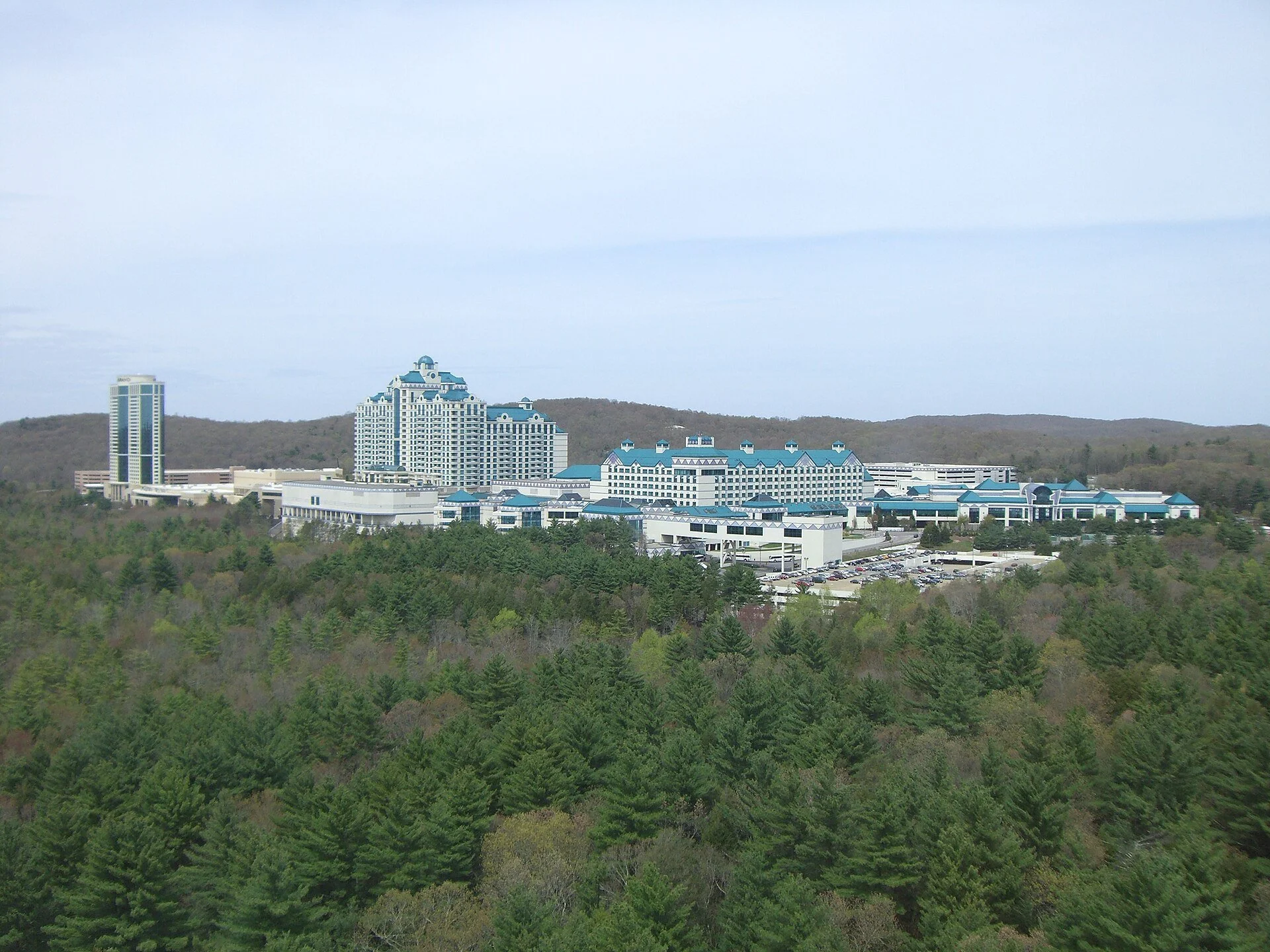
The Foxwoods casino complex, in Ledyard, Conn. The term “gaming” is used by casinos in place of “gambling’’ to make it sound more benign.
— Photo by Elfenbeinturm
MANCHESTER, Conn.
Back in the 1990s several rationales were offered when Connecticut approved its two Indian tribal casinos following enactment of the federal Indian Gaming Regulatory Act.
First was that since neighboring states had no casinos and did not seem to want any, Connecticut’s casinos might draw far more customers from out of state than from in state and thus collect more gambling tax revenue from them than from the state’s own residents.
Second was that the casinos, opened on tribal land in the relatively sparsely populated eastern part of the state, would boost the area economically.
And third was social justice. The casinos were portrayed as mechanisms of reparations for the mistreatment of the ancient Pequot and Mohegan people by the European culture that nearly destroyed them.
The third rationale was bogus. The last Pequots and Mohegans who had been mistreated by the Connecticut colony and its successor state died a century or more before Indian casino gambling was established. While members of Indian tribes in Western states were still suffering segregation and poverty, people of Indian descent in Connecticut had long been integrated into society and were living like everyone else.
But that didn’t matter, for the social-justice rationale corresponded with the advent of political correctness and gave people the impression that casinos were good if their owners were distant descendants of people who had been treated badly. Political correctness also gave the impression that anyone who objected to government's basing patronage on ethnicity was racist. This was intimidating and effective.
Now the first and second rationales for casino gambling in Connecticut have collapsed as well.
There are 20 other casinos in New England -- two in Maine, 13 in New Hampshire, three in Massachusetts, and two in Rhode Island. There are five in New York State. Connecticut’s two casinos increasingly draw their patrons from within the state’s own borders.
As a result, they have started taking more out of the state’s economy than they add to it. The two casinos still have thousands of employees, but they are sustained mainly by tens of thousands of customers who are Connecticut residents, people who, but for casino gambling in the state, might spend their entertainment money elsewhere in the state or at out-of-state casinos -- or even save it.
Casino gambling always has been a mechanism of taking money from the many and giving it to the few -- casino owners and their employees, with government skimming some in taxes. Connecticut got around that at the outset with its regional monopoly on casinos. But no more. Economically Connecticut’s casinos now redistribute money from the bottom to the top of the income scale in the state as most forms of gambling do -- and the other day the Hearst Connecticut newspapers calculated that the money being redistributed is in the many billions of dollars.
According to the Hearst report, legal gamblers in Connecticut have lost at least $56 billion since 1993, an amount that doesn’t include casino table games. Now that Connecticut has authorized Internet gambling -- from which the Indian casinos are paid a tribute for sharing their duopoly -- Hearst calculates that in the last five years gamblers in Connecticut have lost $922 million via FanDuel, Draft Kings, and Fanatics.
Since politics in Connecticut is so left-wing and sanctimonious, it might be expected to ask a few questions here, what with billions being transferred from the many to the few in an undertaking that produces so little value, and with gambling addiction exploding, destroying lives and families and causing ever-more bankruptcies.
But no questions are asked, perhaps because, as the Hearst report notes, state government’s total take from gambling -- from the state lottery, started in 1972, to the slot machine tax -- has reached $22 billion, and gambling revenue is now 2.5% of the state budget.
That much money for government seems able to salve most liberal consciences, no matter how it's obtained. It's now the only rationale for casino gambling in Connecticut.
Chris Powell has written about Connecticut government and politics for many years (CPowell@cox.net).

Chris Powell: With casinos now everywhere, who needs Indian casinos?

-- Photo by Ralf Roletschek
MANCHESTER, Conn.
Casino gambling could make an argument in Connecticut a few decades ago when itcould prey on more people from out of state than on the state's own residents. That is no longer the case, with casinos opening in neighboring states andthroughout the Northeast and with one soon to open in Massachusetts just overthe border in Springfield.
Indeed, the "interceptor" casino now being proposed by Connecticut's twocasino-operating Indian tribes would prey exclusively on the state's ownresidents, diverting some of them from heading north on Interstate 91 to thecasino planned by MGM Resorts.
With the "interceptor" casino the tribes would preserve the monopoly stategovernment has given them on casinos in Connecticut. The tribes would pay newgambling royalties to the state and millions in property taxes to East Windsor, whose town government is supportive and where the tribes have secured land alongthe highway.
The tribes say the "interceptor" casino will reduce the gambling revenueConnecticut loses to Springfield and preserve hundreds of jobs in the state. More likely the casino will create a few hundred jobs and relocate hundreds morefrom the two Indian casinos in southeastern Connecticut as gambling trafficturns north.
There are a couple of problems with this plan. The first is that the pathologies of the increased gambling will be borneentirely by Connecticut itself -- the addiction, the theft and theconcentration of wealth, its transfer from the public to the government and thetribes and the weakening of nearby businesses.
The second is that if casino gambling is to become pervasive, and not a specialthing in special places -- first Las Vegas, then Atlantic City, thensoutheastern Connecticut, then Indian reservations throughout the country, andsoon nearly everywhere -- why should Connecticut let any group monopolize it? That is, for casino purposes, who needs Indians anymore? (Really, who ever did?)
As New London Day columnist David Collins writes, last week the general counselof MGM Resorts, Uri Clinton, told a General Assembly committee that his companywill pay Massachusetts and Springfield far more for its casino rights thanConnecticut's Indian tribes are paying state government. That is, stategovernment continues to sell itself short for the benefit of the tribes.
The MGM Resorts executive also noted that if it really wants to compete withcasinos in other states, Connecticut is forfeiting its most lucrativeopportunity, which is not near the Massachusetts line but in Fairfield County, since a casino in Bridgeport, rejected years ago, might draw heavily from theNew York metropolitan area.
Indeed, instead of opening a mere "interceptor" casino near Massachusetts, whynot open a full-fledged casino, entertainment, and sports venue in thenorth-central part of the state?
After all, Connecticut just happens to have a bankrupt capital city whosedowntown is adjacent to both a big arena whose expensive renovations stategovernment can't afford and a new minor-league baseball stadium the city can'tafford. If such a venue could be competently operated, it might overshadow MGM'soperation in Springfield and push some of the burden of gambling's pathologiesback out of state.
Instead of increasing gambling, it would be far better for state government toeconomize by questioning the premises of its most expensive, mistaken, andfailing policies -- government labor contracting, welfare and child protection, and education. But that would require more political courage than Connecticut has musteredsince the Civil War. If it can't bring itself to stand up to a few rent-seekingIndians, state government will never stand up to anyone else.
Chris Powell is managing editor of the Journal Inquirer, in Manchester, Conn.