
Vox clamantis in deserto







Stephanie Lessing: How reliable are those ICE body cams?

A body camera designed for police use.
BOSTON
From The Conversation (except image above)
Stephanie Lessing is an adjunct professor of public policy at the University of Massachusetts at Boston.
She does not work for, consult, own shares in or receive funding from any company or organization that would benefit from this article, and has disclosed no relevant affiliations beyond their academic appointment.
Amid growing demands by Democrats to overhaul U.S. Immigration and Customs Enforcement after federal immigration officials killed two U.S. citizens in Minnesota, Secretary of Homeland Security Kristi Noem said in early February 2026 that agents in Minneapolis will be issued body-worn cameras.
But can body cameras on federal officials provide the transparency and accountability the public is demanding from agents with ICE and U.S. Customs and Border Protection?
As a public policy scholar, I have analyzed the existing body-worn camera policy for ICE agents. And I’ve compared this policy to dozens of other state and local body camera policies, in an effort to investigate the rationales for their use.
Whether ICE’s body camera policy can provide transparency and accountability depends, I believe, on the policy itself and the enforcement of that policy. ICE’s use of body cameras could improve the agency’s legitimacy in the eyes of the public.
But as I’ve seen with other police body camera policies, there’s a risk that camera footage may obscure actual events. It’s also possible that the strategic release of footage may undermine transparency.
Various body camera policies
Police body cameras were first used in the United States in 2012 by the Rialto Police Department in California. By 2020, their use had expanded to over 62% of local law enforcement agencies, covering 79% of local police officers nationwide.
That expansion was, in part, a response to growing criticism over stop-and-frisk tactics – in which police temporarily detain people for weapons searches when a crime is suspected – and police-involved shootings of people of color.
Body camera policies vary greatly between municipalities. Some policies make body cameras useful accountability tools, like those of Parker, Colorado, which uses cameras for evidence collection and ensuring officer adherence to policy rather than as surveillance technology.
Others, meanwhile, provide broad discretion for officers to choose when to activate their body cameras, such as Colorado Springs’ policy. Allowing officers to decide when to use their cameras can limit the availability of evidence.
I believe there are four crucial elements of a body camera policy that can ensure that ICE agents properly use the technology.
Activation requirements
Body camera quality has improved over the past decade. But the battery life of many models prevents continuous recording throughout a 10-hour shift.
Instead, law enforcement officials often manually activate their body cameras. Thus, to effectively promote accountability, a strong policy would require ICE agents to activate their body cameras before they interact with the public.
People attend a vigil for Alex Pretti, who was fatally shot by a federal immigration agent on Feb. 1, 2026, in Minneapolis. AP Photo/Ryan Murphy
A 2016 study found that, without mandatory camera-activation policies, officers often fail to activate their cameras.
The current ICE body-worn camera policy, issued in February 2025, lists enforcement activities that require recording. They include executing arrest warrants, frisks of individuals and “responding to public, unlawful/violent disturbances at ICE facilities.”
But the list does not include mandatory activation during vehicle pursuits or the transportation of people to detention facilities. Recording inside detention facilities is strictly prohibited by the policy.
Deactivation requirements
As proposed by the Police Executive Research Forum, a nonprofit that promotes policing professionalism, body cameras must continue to record until an encounter with a member of the public has concluded and agents have left the scene.
The current ICE body-worn camera policy states that agents “should only deactivate the BWC when the scene is secure as determined by the supervisor or team leader.”
While robust policies, such as that of the Chicago Police Department, require continued recording during the transportation of detained people, the ICE body camera policy does not. This creates the potential for critical moments to go unrecorded.
Facial recognition
Many body camera models come equipped with facial recognition technology. But many local police department policies prohibit its use due to privacy and surveillance concerns.
ICE uses facial recognition technology during immigration enforcement operations, but in 2020 lawmakers raised concerns that body camera facial recognition could dissuade citizens from protesting out of fear of retribution.
People gather outside Akron City Hall in Ohio on July 3, 2022, to protest after the release of body camera footage showed police fatally shooting Jayland Walker with several dozen rounds of bullets. Matthew Hatcher/AFP via Getty Images
As protests against ICE immigration enforcement continue, it’s known that the agency uses facial recognition technology on peaceful protesters and observers. Existing ICE policy prevents the use of facial recognition on “live BWC recordings,” meaning while the interaction is taking place. Facial recognition is permitted on body camera footage after the interaction has concluded.
In early February 2026, Democratic lawmakers introduced a measure that would prohibit the use of facial recognition by ICE and CBP agents. That ban would extend to facial recognition features on body cameras.
Policy compliance
Policy is only as strong as its enforcement.
Policymakers could consider strengthening submission forms for ICE use-of-force and civil rights violation complaints.
Thorough investigation of complaints and reviews of body camera footage could be handled by an external review board. The Office of the Inspector General, responsible for investigating allegations of excessive force by ICE agents, could also conduct reviews.
Body cameras will not deter violence committed by ICE agents unless policies clearly dictate their use. For body cameras to function as transparency and accountability tools, I believe wrongdoing would have to be swiftly and consistently penalized. This would highlight the consequences of noncompliance with body-worn camera policies.
Author
Adjunct Professor of Public Policy, UMass Boston
Disclosure statement
Stephanie Lessing does not work for, consult, own shares in or receive funding from any company or organization that would benefit from this article, and has disclosed no relevant affiliations beyond their academic appointment.
Partners
University of Massachusetts provides funding as a member of The Conversation US.
DOI
https://doi.org/10.64628/AAI.7egv5cakd
We believe in the free flow of information
Republish our articles for free, online or in print, under a Creative Commons license.
Republish this article
Chris Powell: Hartford mayor panders to the anti-ICE mob

MANCHESTER, Conn.
If the country is in big trouble, it's not just because the president pretends that he has authority to wage war wherever he wants. It's also because the country is full of people who are striving to obstruct immigration-law enforcement, full of people who hallucinate that the government is getting ready to kill them, and full of elected officials who pander to both groups.
Among those officials now is Hartford Mayor Arunan Arulampalam, who last week blamed the president and Immigration and Customs Enforcement for the conflict that occurred during a protest outside the federal building in Hartford, where ICE has an office.
Some protesters went behind the building and blocked the garage exit as two vehicles, presumably operated by ICE agents, were leaving. Video shows at least one protester in front of and leaning on an exiting car. Witnesses say someone, presumably an ICE agent, pepper-sprayed the blockaders and then the two cars made their way out by pushing through the mob, with a protester being knocked over but not injured.
The incident was the protesters' fault, not ICE's, just as the fatal incident in Minneapolis last week was caused by people who also set out to impede an enforcement operation.
At a press conference the day after the Hartford incident, Mayor Arulampalam called it "the direct result of the lawlessness and recklessness of the Trump administration." Oh, sure -- Trump and ICE made those protesters block the garage, and the ICE agents were wrong to try the clear the exit so they could do their work, though they are federal police officers just like FBI agents and impeding them is a federal felony.
With the mayor declaring that the work of the immigration agents is illegitimate, more criminal interference with ICE may be expected in Connecticut, at least until the FBI and local police make some arrests.
This doesn't mean that the fatal shooting of the protester by the ICE agent in Minneapolis was justified, though it may have been. It means that she and her friends were not just protesting peacefully but seeking confrontation and interfering, just like the protesters at the Hartford federal building garage.
This distinction was lost on the people who held other protests in Connecticut last weekend -- and lost on the journalists who interviewed them without posing critical questions.
A protester from Fairfield said, “It feels like it could happen to anyone now," though “it" doesn't seem to have happened to anyone not impeding or caught up in an ICE enforcement operation.
A protester from Stratford concurred, saying, “I don't know who among us is safe," though no one at her protest was attacked either.
Critical questions being out of fashion in journalism in Connecticut, no one seems to have asked the protesters just what, if anything, should be done about the illegal immigration that has overwhelmed the country. But questions should have been prompted by the signs the protesters carried, which called for ICE to be abolished or banished from Connecticut.
So should there be no immigration law enforcement?
That's the implication of the slogan on many other protest signs: “No human is illegal." But that's a straw man; no one has made such a silly claim. What's illegal is the presence in the country of people who have not been properly admitted after a background check. The sanctimony of this slogan seems to advocate a return to open borders.
ICE needs closer supervision and Congress should require it. As with regular police officers, agents making arrests should always be identified by badges and name tags and should not be masked. As with ordinary arrests, detainees should be promptly identified on public registers so press and public can keep track of them.
But as with regular police officers, ICE agents may be more sinned against than sinning, as they are sometimes assaulted by their desperate targets and protesters. People who impede them are insurrectionists as much as the January 6 rioters at the U.S. Capitol were.
Chris Powell has written about Connecticut government and politics for many years (CPowell@cox.net).
Llewellyn King: Trump regime uses ICE as part of its assault on the rule of law; we are all imperiled
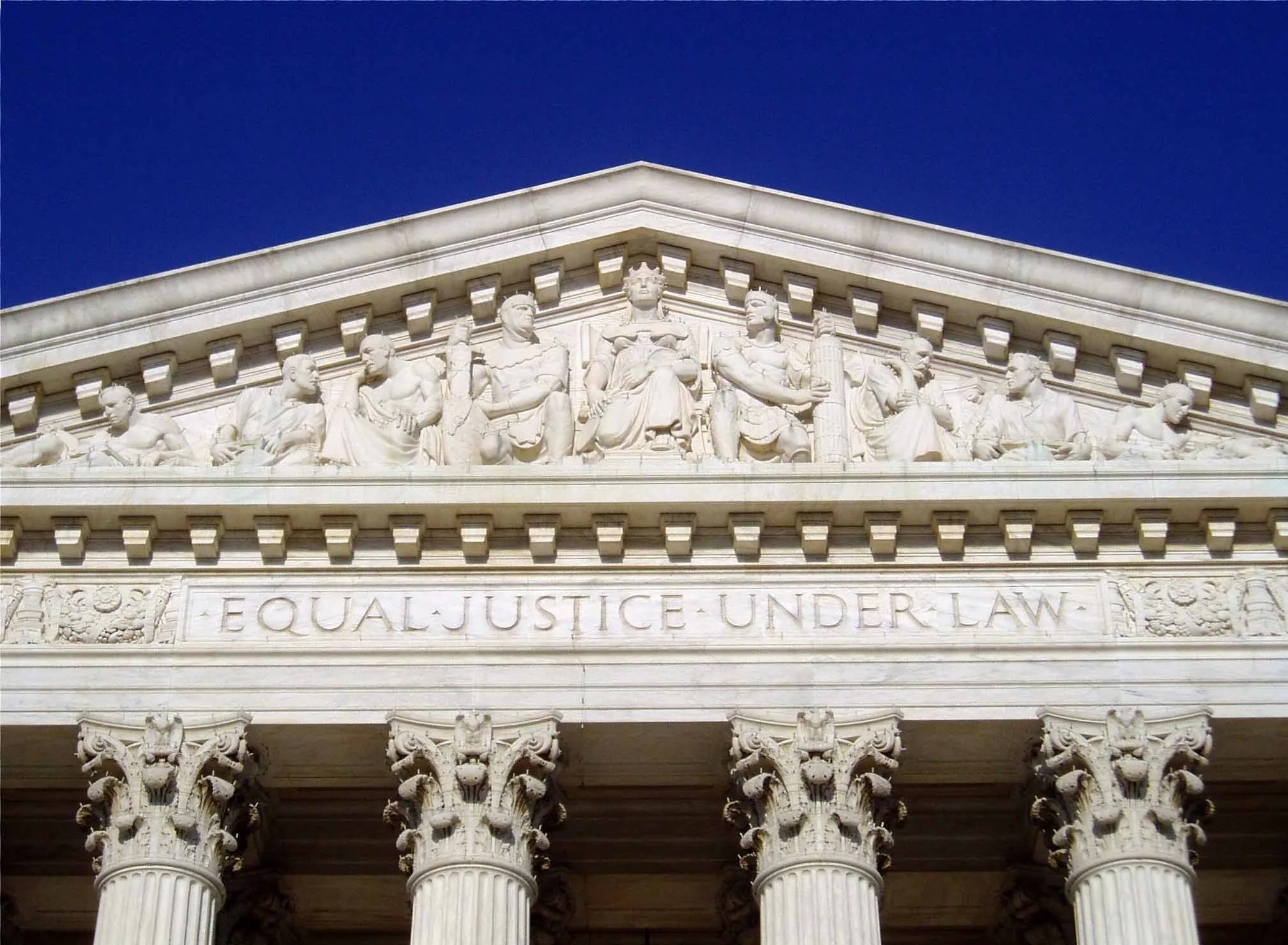
“Equal Justice Under Law,” by Robert Ingersoll Aitken, over the western façade of the U.S. Supreme Court Building.
—Photo byMattWade
WEST WARWICK, R.I.
The men you see in masks on your television savagely arresting people may not seem like your affair. But they are your affair and mine, and that of every other American.
U.S. Immigration and Customs Enforcement operates outside of the law. It doesn’t disclose charges, and no one arrested sees a court of law.
ICE agents are also the affair of the whole world, for while they are symbols of local terror, they are also symbols of America’s withdrawal from the one critical underpinning of civilization: the rule of law.
Without it, society isn’t much. No one is secure, even those who are in charge.
At another time, the victim may be the oppressor. When there is no law there is only fear. One day, the persecutor behind the mask may find himself persecuted by another man behind another mask.
Once power is wielded indiscriminately, it is free to serve many masters.
During a campaign by the government of Argentina to suppress left-wing political opponents, known as the Dirty War, from 1976 to 1983, a new way of settling personal disputes arose.
The police arrested so many and killed them secretly — between 10,000 and 30,000, and the victims became known as the “disappeared” — that soon murder became easier. If you didn’t like a rival or even a family member, you “disappeared” them — and that was that. No one would report such disappearances to the police for fear that it was the work of the police.
When I was in Argentina after the Dirty War, I was told about a man who didn’t like his mother-in-law and disappeared her. Lawlessness breeds lawlessness.
Currently, in areas of America where ICE is present, there is a common assumption that if someone suddenly goes missing, it means that ICE has detained them, and they are likely being sent to a detention center for deportation.
Mickey Spillane, the American crime writer, once said the only difference between the police and the criminals was that the police were employed by the government. We see that with ICE.
In 1215, at Runnymede, the nobles of England told King John to cut it out. They demanded an end to the arbitrary confiscation of property and his majesty’s habit of handing out sentences without trial.
Habeas corpus (“that you have the body”) dates in English law to before the Magna Carta, but it was codified there. The Napoleonic Code embraces many of the same elements as the Magna Carta, although Napoleon eschewed English common law when he revised French law into the code in 1804.
Now, about half of the world’s legal systems are based on the French code and half, including 49 U.S. states, are based on English common law. Louisiana has a hybrid of the two.
Nonetheless, it is a tenet of both systems that the individual will face trial and know his or her accusers, that the accused could be tried by his or her peers, and that the accused has rights.
Historically, the British relied heavily on the rule of law. In fact, law and its application became a mainstay of maintaining order in Britain and in the Empire. It was part of the concept of British exceptionalism.
The dignity and openness of trials were an important part of the colonial ethos. In Southern Rhodesia, before the country suffered a civil war and became Zimbabwe, I was a defendant for a minor dispute with a hotel over a bill. Even though I had settled the bill, I was ordered to appear before the native commissioner’s court in the remote area of the country where the hotel was situated.
The court was a room with a single table and chair. Everyone else sat on the floor. It was crowded with justice-seekers and defendants, all of them black.
Only the commissioner and I were colonials. I thought the process would be nothing more than a courtesy call, a wink and blink.
Finally, the great man with bushy, unkempt, white hair and a mustache called me to the table. He read the now-moot complaint and dressed me down in terms I have never been dressed down, before or after, ven by irate readers.
He said I was a disgrace to Britain, to my ancestry, to my family, and to my school. But, he said, I had especially let down the Empire. I was warned that if I ever faced him again for any reason, no matter how minor, I would get strict punishment.
It was really a rough way to treat a teenager, but it was part of the justice of the day that had to be seen as being even-handed and blind.
In Oliver Twist, Dickens wrote that “the law is an ass.” I think it is a beautiful beast, despite running afoul of it in colonial Africa. We need it back in the U.S. stable.
Llewellyn King is executive producer and host of White House Chronicle, on PBS, and an international energy consultant. His email address is llewellynking1@gmail.com, and he’s based in Rhode Island.
Llewellyn King: Trump gave us a year of fear: And 2026?
WEST WARWICK, R.I.
Of all the things that happened in 2025 — a year dominated by the presidency of Donald Trump — not the least is that great fear came to America.
It's reminiscent of the fear that African-Americans knew in the days of the lynch mob, or that Jews have felt from time to time, or that Hollywood felt during the blacklist of the 1940s and 1950s, or the fear that people of Japanese descent from the West Coast, who were mostly U.S. citizens, felt when they were rounded up and interred following the attack on Pearl Harbor.
For some, it is a low-grade fear of reprisals, financial ruin and humiliation. And for some, it is a fear of ruin by litigation. But for others, it is fear of faceless arrest, the jail cell and plastic handcuffs.
All of this has made us a nation in fear and removed our faith in our laws, our Constitution, and our plain decency.
This is a new kind of fear that is acute in places, such as immigrant communities, but more universal than in the past.
It isn't the fear of a foreign power or an alien ideology or a disease, but a fear generated domestically — generated by our own government. Fear in our workplaces, our schools, our movie studios, our newsrooms and our universities.
For the first time, this year we saw troops on the streets of cities when there was no civil unrest — as there was, for example, during the riots of 1968, which followed the assassination of Martin Luther King Jr.
We saw troops deployed in cities where they weren't wanted, opposed by the local government and local people. But those cities got the troops courtesy of an assertion by the president that troops can manage law enforcement better than the local police. Or was there some more sinister purpose?
For the first time, we saw arrests without charge or evidence, carried out by masked ICE agents, of people simply suspected of being here illegally.
Often the suspicion is no more than the color of the arrestee's skin, their dress and their demeanor. No crime needs to be proved by this army of the state, dressed to intimidate. To the ICE men and women, appearance is tantamount to conviction.
Nightly on television we watched agents drag away men, women and children without due process; they would been held and deported without charge, trial or having any avenue of appeal. Justice denied, nonoperational. Often deportees go to countries that are alien or different from their homelands.
Fear has come home.
Immigrants are frightened even if they are citizens. If you have olive-toned skin, you can be dragged and held incommunicado. No appeal, no trial, no court appearance, no access to help. Habeas corpus suspended.
Pinch yourself and ask: Is this the America we cherish for its freedom, its justice and its generosity of spirit?
The fear isn't confined to those who might be swept up in the mindless cruelty of ICE but extends throughout society. People with stature fear that if they speak out, if they do what at other times they might have seen as their civic duty, they will endanger themselves and their families. All the government has to do is to start an investigation or threaten one and the damage is done, the first level of punishment is delivered.
Investigations can target anything from how you filled out a mortgage application to whether you wrote something that may be viewed as objectionable, and the punishment begins.
Fear stalks the schools where teachers and professors can be punished for what they say or teach, and where the institutions of higher learning are subject to political scrutiny. Politics has become the law, capricious and savage.
There is fear in business, where so many companies rely on government loan guarantees or tax credits for their growth. There is fear that if they say anything that can be construed as disloyal, they will be punished.
Political opponents fear that their mortgage applications may be deemed to be irregular and they are to be censured or prosecuted. Political prosecution is now a government tool.
Others just fear that Trump will ridicule them in public with his schoolyard denigrations, particularly members of Congress. They fear they will be reprimanded and marked for defeat in the polls.
There is an awful completeness about the Trump rampage: his systematic ignoring of norms, shredding of the rights of the individual, destroying families and bringing about untold misery.
A question for all America: How is the spreading of fear — sometimes an acute fear and sometimes low-grade fear — throughout society beneficial and to whom?
We, the people, deserve to know.
X: @llewellynking2
Llewellyn King is executive producer and host of White House Chronicle, on PBS, and an international energy-sector consultant. He’s based in Rhode Island.
ICE rule on students would slam education and economy
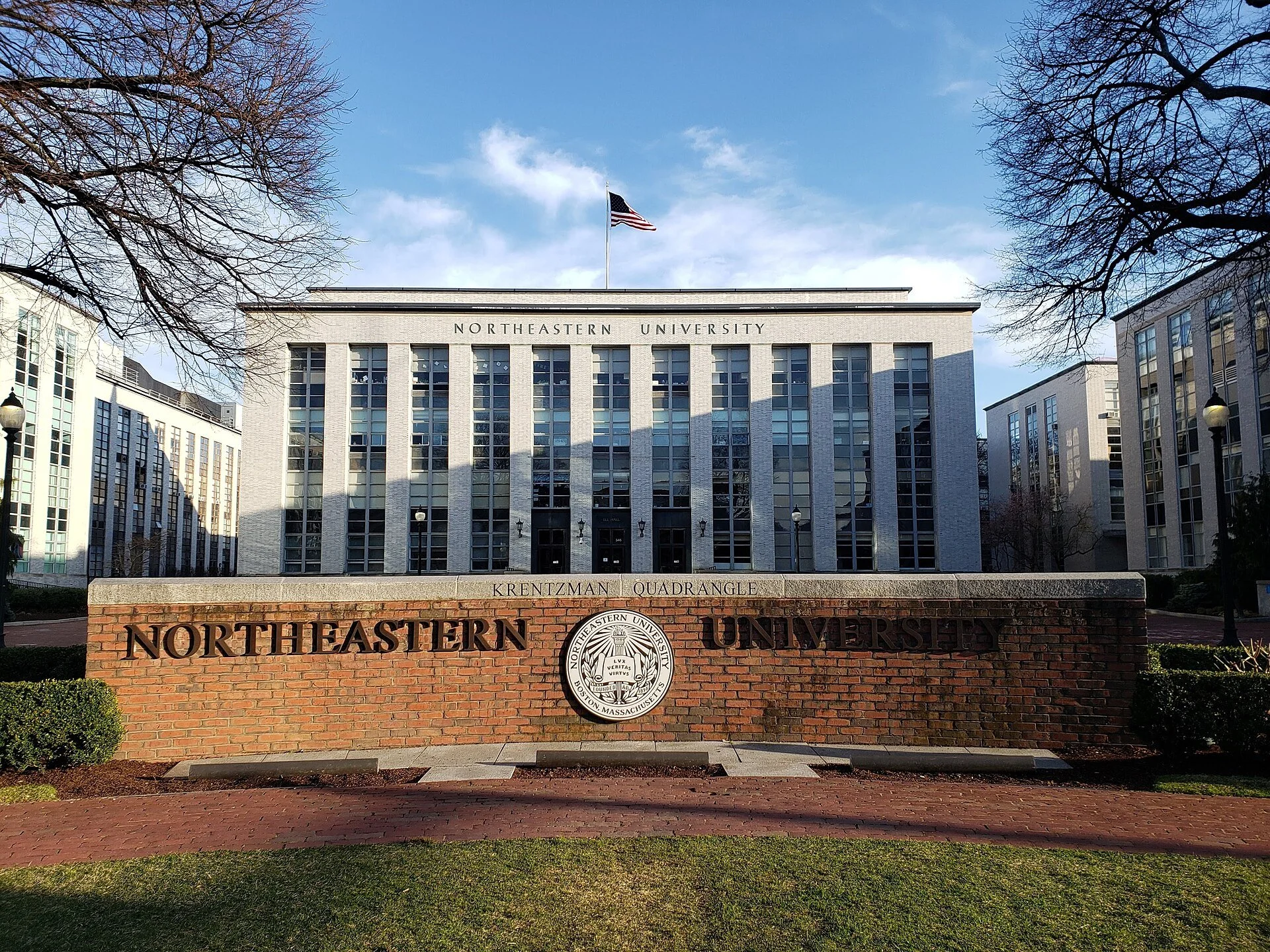
Northeastern University’s Ell Hall, on Huntington Avenue, Boston. Part of Northeastern success and contributions to the New England economy can be attributed to its drawing so many highly accomplished students from abroad.
Edited from a report by The New England Council
“The council has submitted comments on the proposed rule ‘Establishing a Fixed Time Period of Admission and an Extension of Stay Procedure for Nonimmigrant Academic Students, Exchange Visitors, and Representatives of Foreign Information Media.’
In its letter, the council expressed significant opposition to U.S. Immigration and Customs Enforcement’s (ICE) proposed rulemaking due to concerns that the rule would create unnecessary fear, confusion, and procedural roadblocks for international students, exchange visitors, and universities.
“The comment letter further noted that the rule will impede institutions of higher education in New England and across the United States from attracting and retaining the best and brightest minds to study and engage in research for issues and fields critical to our nation’s prosperity and well-being.
“In New England, international students have a significant positive economic impact, totaling $5.148 billion, and supporting 47,425 jobs during the 2023-2024 academic year. During that academic year, 115,086 international students were enrolled at higher educational institutions in the region.
“For more information on this issue or the Council’s Higher Education Committee, please contact Mariah Healy, director of federal affairs at mhealy@newenglandcouncil.com.’’
Chris Powell: Key Conn. Democrats keep pretending they aren’t obstructing ICE

MANCHESTER, Conn.
Some Connecticut Democrats keep doubling down in support of illegal immigration and obstruction of immigration-law enforcement even as they keep pretending they're not doing so.
The other week at the Legislative Office Building about 25 Democratic elected officials held a news conference that made a spectacle of their contradictions.
A week earlier state Rep. Corey Paris (D-Stamford) had issued a warning on social media that federal immigration agents were active in his district. He urged people to “remain vigilant, stay aware of our surroundings, and, above all, prioritize your safety," as well as to bring immigration-enforcement actions to the attention of groups that assist illegal immigrants.
Responding on social media, a conservative organization accused Paris of publicizing the “live location" of immigration agents and urged the Immigration and Customs Enforcement agency to “charge him."
ICE reposted the accusation, prompting, according to Paris, lots of anonymous threats against him. He denied disclosing the “live location" of immigration agents and putting any agents at risk.
Indeed, Paris had not posted that agents were, for example, working around the Stamford train station or a particular supermarket. But his district is a small place with defined borders, and citing it conveyed information useful to people seeking to remain in the country illegally, so Paris's intention was clear: to obstruct enforcement of immigration law.
At their news conference, Democratic elected officials, including Lt. Gov. Susan Bysiewicz and U.S. Sen. Richard Blumenthal, minimized that aspect of the controversy. They concentrated on the threats that Paris received, as if there is substantial political disagreement in Connecticut about the impropriety of such threats. (Even Republican state legislators felt obliged to deplore the threats against Paris while failing to deplore what he did.)
No, the substantial political disagreement is about illegal immigration.
“Corey did nothing wrong," Blumenthal insisted, and his colleagues at the news conference repeated this assertion.
All this came just days after Gov. Ned Lamont and state Atty. Gen. William Tong had proclaimed again that Connecticut is not a “sanctuary state" and does not interfere with immigration-law enforcement.
No one in journalism called the governor and the attorney general to ask why, if Connecticut is not a “sanctuary state," a state legislator had just acted as if it is one and if they approved of what he did.
Indeed, in calling their news conference the Democratic elected officials must have been confident that no one in the Capitol press corps would ever question them critically about illegal immigration.
No one asked the Democrats if, by saying Paris did “nothing wrong," they meant that trying to sabotage immigration-law enforcement is OK.
No one asked if they would feel justified in doing what Paris did if they knew that immigration agents were working in a particular area.
No one asked how the explosion in the country's illegal immigrant population in recent years is likely to affect congressional redistricting and which political party will benefit most from it.
No one asked if immigration-law violators who have not been accused or convicted of other offenses should be exempt from enforcement -- that is, if there should be another immigration amnesty.
No one asked if, for the country's protection, every foreigner should get ordinary vetting before being admitted.
And no one asked if, before publicizing immigration enforcement in his district, Paris should have determined whether the agents were going after criminals or just ordinary immigration law violators.
But almost simultaneously with the Democratic news conference,ICE announced that in a recent four-day operation in Connecticut it had arrested 65 people, 29 of whom “had been convicted or charged in the United States with serious crimes, including kidnapping, assault, drug offenses, weapons violations, and sex crimes." Others, ICE said, had criminal records in their native countries.
“Connectiut is a sanctuary no more," ICE said, implying that there would be more enforcement in the state.
How much more enforcement will be required in Connecticut before critical questions are put to public officials who deplore it?
Chris Powell has written about Connecticut government and politics for many years (CPowell@cox.net).

Rachel Hodes: What 'abolish ICE' really means

Via OtherWords.org
To most of America, “abolish ICE” is a cry of the far left. Even Americans who dislike Trump’s attacks on undocumented immigrants wouldn’t necessarily tell you that ICE should be abolished; that seems far too radical. ICE stands for the U.S. Immigration and Customs Enforcement agency.
They’re forgetting that ICE is actually pretty new. It was only created in 2003, replacing the Immigration and Naturalization Service (the same agency responsible for the internment of Japanese-Americans in the 1940s).
Since its creation, ICE’s budget has almost doubled, and its activity has expanded to triple the number of agents it employs. This expansion is shocking — and unwarranted. All evidence suggests that immigrants are far from the national security threat the Trump administration claims they are. Regardless of status, they’re more law-abiding than native-born citizens.
And time and time again, immigration has been shown to have a net-positive effect on the U.S. economy, from growing tax receipts to increasing wages for native-born residents. In fact, undocumented immigrants typically pay more of their income in taxes than your average millionaire.
More noteworthy than the economics, however, is that the individuals targeted by ICE are people — and all people are entitled to basic conditions of safety and for themselves and their families.
When the majority of these immigrants are fleeing violence with roots in U.S. intervention in Central America, the moral responsibility to offer safe haven becomes even more pressing. When government agencies neglect this responsibility, we all lose some of our humanity.
What calls to abolish ICE actually do is beg the question: Why do we need an immigration system dedicated solely to terrorizing immigrant communities?
Threats of ICE raids prevent undocumented people from going to work or sending their kids to school. Those in detention are denied access to basic hygienic products, subjected to severe overcrowding, and experience all manner of abuse. Several children have died.
We spend about $7 billion a year on ICE. What would happen if we instead invested those funds in resettling asylum-seekers, or hiring more staff to process asylum applications? What if families fleeing violence in Honduras or Guatemala had to wait only a few weeks to find out if they could immigrate legally, as opposed to the current average of almost two years?
The U.S. carried out over a quarter million deportations last year. The $7 billion that funded these actions
could have been used instead to resettle at least that many refugees (over 11 times what the U.S. accepted last year). It could also almost triple the funding of the government office that naturalizes around 700,000 new citizens each year.
Which is more radical: Investing in communities that strengthen our country and honoring basic human decency? Or continuing to fund an agency that’s literally caused the death of children?
As a concerned Jewish American, I believe none of us are safe until we’re all safe. We should be focusing our resources on welcoming new immigrants and helping them access the rights of citizenship — not subjecting them to detention and deportation.
A better world, for immigrants and for everyone, is within our reach. ICE just isn’t a part of it.
Rachel Hodes is a Next Leader at the Institute for Policy Studies.
Robert Kim Bingham Sr.: Herewith a simple path to legal immigration status for millions
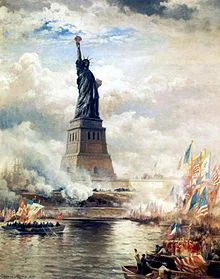
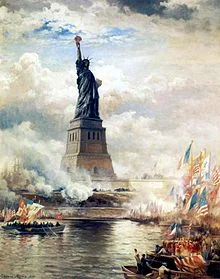
"Unveiling of the Statue of Liberty Enlightening the World'' (1886) by Edward Moran. Oil on canvas. The J. Clarence Davies Collection, Museum of the City of New York.
NEW LONDON, Conn.
As a retired Immigration and Customs Enforcement (ICE) lawyer, I have often asked myself "What should the federal government do about the 11 million undocumented immigrants in America?"
The simple answer is to revive a dormant law.
While serving in the general counsel's offices of the Immigration and Naturalization Service (INS) and ICE for 37 years, I observed many long-time undocumented immigrants facing removal proceedings. They were ineligible for relief from deportation under section 249(a) of the Immigration and Nationality Act (Act) because they had entered the United States after Jan. 1, 1972. Otherwise, they would have been eligible to apply for the benefit of lawful permanent residence status under section 249(a).
In fairness to those who have set down deep roots in America, I urge Congress to enact a bill updating 249's outdated entry requirement from Jan. 1, 1972, to Jan. 1, 2005. This would constitute a major, but fair, breakthrough immigration solution that could benefit thousands of persons who have resided here continuously for more than a decade, including many DACA {Deferred Action for Childhood Arrivals} recipients, and who wish to apply for lawful permanent residence.
By changing the eligibility date, long-time foreign-born residents who possess good moral character would have a path to legal status. The section's existing legal bars would still block from legal status "inadmissible criminals, procurers, and other immoral persons, subversives, violators of the narcotic laws or smugglers of aliens."
Every applicant would continue to bear the burden of proof to establish eligibility. Once the USCIS or immigration court granted lawful permanent residence, the applicant would typically wait five years thereafter to apply for naturalization, or three years if married to a U.S. citizen.
This update of the section would amount to a simple statutory fix with enormous consequences that could be supported even by Republicans who can appreciate that a party hero, Ronald Reagan, was the last president to update section 249(a), on Nov. 6, 1986.
Experienced immigration practitioners have expressed solid support for this immigration solution.
"It would be the easiest solution, of course," said Rita Provatas, a member of the Immigration Lawyers Association (AILA). "(Its) beauty is the statute's simplicity."
In its March 14, 2017, editorial, The {New London, Conn.} Day said it "likes the suggestion of Robert Kim Bingham Sr., a veteran attorney with ICE."
These are but a couple of the many voices from various political persuasions that have expressed support for the proposal.
Given that a significant number of the "11 million" group, who have lived here continuously for over a decade could qualify to become lawful permanent residents under section 249(a), if updated accordingly, the time for Congress to move up the entry date to Jan. 1, 2005 is now.
Robert Kim Bingham Sr. , who lives in the New London area, retired after working 37 years as an ICE lawyer. He can be reached at rbingham03@snet.net. Thank you to Chris Powell, of the (Manchester, Conn., Journal Inquirer, for notifying New England Diary about this essay.
Llewellyn King: My friend's 'Third Way' to deal with illegal immigrants
I wonder daily, really, what life is like on the other side of the windowpane that separates the legal resident from the illegal.
I wonder if the skinny, young Chinese woman working in the restaurant is legal. I have noticed her because she works so hard: She is there when it opens and when it closes.
The restaurant is family-owned, so I wonder if she is there legally — a link in “chain migration” — or illegally, in a kind of servitude. The chain is forged when a legal family sponsors other family members, who can then come here preferentially, welcome and free.
If she came here otherwise, say on a tourist or student visa, and did not return to her home country, then she is in danger of a knock on the door, handcuffs and the horror of deportation. And if she is arrested for a crime, no matter what, she is closer to the door.
I also wonder about the Mexican family that detailed my old car so well in the July heat. Cash work without a paper trail tells part of their story. Did they walk across the border from Mexico together or separately? The women speak English, but not the men. Were they a family before or after coming here? Are some of them here legally; will children lose their fathers, wives their husbands, if there are deportations?
Meeting agents from Immigration and Customs Enforcement (ICE), wearing black windcheaters with “POLICE” on top of “ICE” emblazoned in white on the backs, must be a heart-stopping experience. These are federal enforcement agents, police, not paper-pushers. This is rough stuff, not community policing.
I listen to tales of deportations: families torn apart, and people sent to countries where they were born but had never resided. I wonder if these people are yearning for U.S. citizenship and the ability to vote. Mostly, I think they are yearning just to live here in peace, free from the fear of a knock on the door from ICE agents.
Mark Jason, a friend who lives in Malibu, Calif., has devised a way to deal with illegal immigrants that eschews the brutality of deportations and the emotional hostility that amnesty for them provokes in some Americans. He calls it the “Third Way” and for six years, he has been promoting it with his own money.
Like many good ideas, Jason’s plan is very simple: He wants to create a 10-year, renewable “Special Work Permit” with an additional dimension: Holders need to earn the permit by complying with our laws and paying a 5-percent tax on their wages, and their employers will also pay a 5-percent tax.
Taxes collected from these permits would amount to $167 billion in 10 years, according to Jason’s think tank, the Immigrant Tax Group. “Payments could be facilitated by cell phone and computer technology, and the immigrants gain their freedom with certain rights and can assimilate more easily,” Jason said.
“These payments would be used to provide hospitals, schools, policing and prisons in the local communities where the immigrants live. This third way is a win-win that can be implemented simply,” said Jason, who is a retired budget analyst for California’s university system and a former IRS agent.
If I am right about the status of the young Chinese woman and the Mexican family, they could all live the American dream, working without the fear of a knock on the door: the knell that sounds for all who live in fear of the state and its agents, who have terrified down through the centuries.
Llewellyn King (llewellyn1@gmail.com), a frequent New England Diary contributor, is a veteran publisher, editor, columnist and international business consultant. He is host and executive producer of White House Chronicle (whchronicle.com), on PBS. He is a native of Zimbabwe (once called Southern Rhodesia) who (legally) emigrated to the United States via England. He is based in Rhode Island and Washington, D.C.
Also on the Web site, you can watch episodes of "White House Chronicle" which airs nationwide on PBS and public, educational and government (PEG) access stations, and the commercial AMG Television Network; and worldwide on Voice of America Television and Radio. A list of stations is on the site.
An audio version of White House Chronicle airs weekends on SiriusXM Radio's popular POTUS (Politics of the United States), Channel 124 at these times: Saturdays at 8:30 a.m. and 5:30 p.m. ET; Sundays at 1:30 a.m. and 4:30 p.m. ET.