
Vox clamantis in deserto







Robert Whitcomb: The very profitable outrage eco-system
PROVIDENCE
Charlie Kirk, like his Great Gilded Leader Trump, found that demagoguery can be very lucrative, especially as the educational level continues to slide in the U.S. The very able organizer was making a nice pile as co-founder and CEO of the far-right, marketed-to-young-people Turning Point USA. That was before Tyler Robinson, 22, like Mr. Kirk a son of affluent Republican parents, allegedly shot the 31-year-old to death. Making such gruesome attacks easier is that America is awash in guns, to no small degree because of Republican antipathy to any gun control. (Robinson’s gun was apparently his grandfather’s.) In the past few decades, the National Rifle Association, the gun industry and the Republican Party have essentially merged.
Of course, America has always been heavily armed, but it has reached astronomical levels, with 400 million guns now; of course plenty of people don’t own any.
(I myself inherited from my father an 80-year-old 12-gauge shotgun and a .22 rifle; a late 19th Century shotgun (too dangerous to use!) from my maternal grandfather’s Upstate New York farm, and a revolver that my paternal grandfather carried on the train between Brockton and Boston as he was ferrying cash and checks for a shoe company. All since have been dispersed elsewhere. But we still have the Civil War rifle from Kentucky that my wife inherited. Kentucky was a Border State, and so we don’t know whether it was used by a Confederate or Union soldier, or just for hunting wild animals, or neighbors the owner didn’t like. The Bluegrass State, like many former Slave States, has always been a pretty violent place.)
In any event, it’s been noted that both Mr. Kirk and Robinson came from the same toxic digital/podcast/cable-TV/YouTube ecosystem, in which violent threats abound.
Mr. Kirk’s shows, rife with bigotry, brought him an estimated net worth of $12 million at his death. His salary for running his right-wing machine was $407,000 back in 2021, the last year for which his pay was reported. But then, he was a charismatic leader to his pumped-up followers, most of them young and overwhelmingly white, and few of whom were interested in researching, let alone challenging, his assertions. We seem to be heading into a post-literate society. Mr. Kirk was aided by many Americans’ staggering willful ignorance about the history of their own country.
Never let the facts get in the way of a story if that brings in more revenue! Just ask the remarkably cynical and amoral Rupert Murdoch, of Fox News, and Mark Zuckerberg, of Facebook, who have made BILLIONS from the lies-and-outrage industry.
The charismatic provocateur Kirk had famously said he didn’t like the word “empathy,’’ preferring the word “sympathy,’’ though in his vitriolic remarks he often showed little of either, though obviously he could be warm and charming when needed.
Here are the standard definitions of two kinds of empathy:
Cognitive empathy: The mental ability to understand another person's perspective, thoughts, and feelings without necessarily feeling them yourself.
Emotional empathy: When you “feel” another person's emotions. What they are experiencing emotionally has an impact on your emotional state.
Here’s one of self-proclaimed Christian Mr. Kirk’s not untypical remarks:
“Joe Biden is a bumbling, dementia-filled Alzheimer's, corrupt tyrant who should honestly be put in prison and/or given the death penalty for his crimes against America.”
Here’s a bunch of other interesting remarks by Mr. Kirk.
Of course, it will get worse.
Last Wednesday Britain’s Channel 4 ran a long fact-checking show on Trump’s lies so far in his current regime. But they’d need a helluva lot more time to play them all.
Robert Whitcomb is editor of New England Diary.
Charlie Kirk’s campaign to ‘de-woke’ colleges and some deeper history
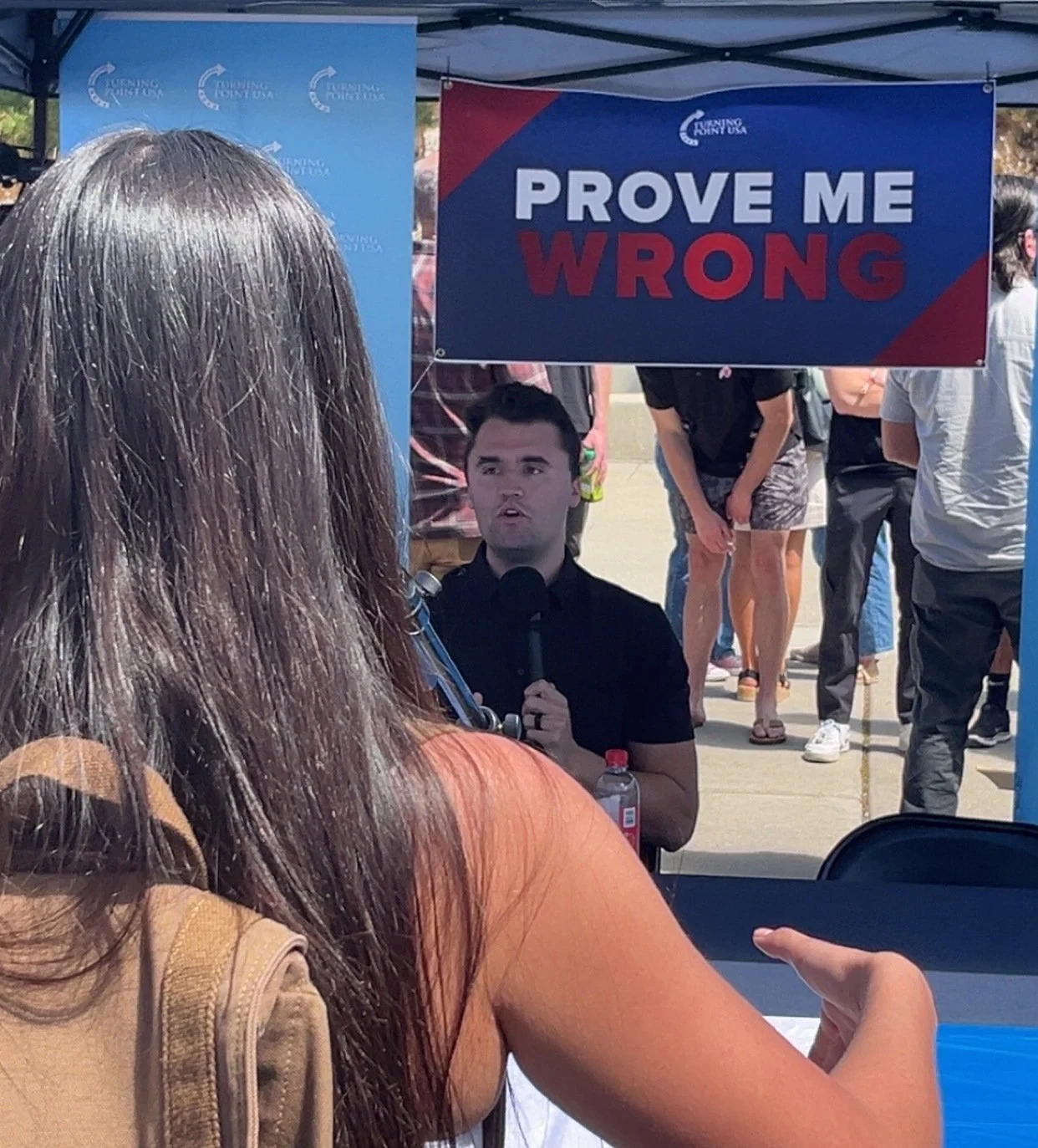
Charlie Kirk at a college event in 2024.
From The Conversation Web site (not including picture above)
Conservative activist Charlie Kirk was assassinated on Sept. 10, 2025, at the start of a college campus tour that centered on Kirk discussing politics – and education – with students.
A large part of Kirk’s political activism centered on what education should look like. Amy Lieberman, The Conversation’s education editor, spoke with Daniel Ruggles, a scholar at Brandeis University, in Waltham, Mass., of conservative youth activism, to better understand the beliefs about education that influenced Kirk and the connection he tried to make with young people.
What is most important to understand about Charlie Kirk’s views on education?
Charlie Kirk’s education philosophy was founded upon the idea of not being on the left. One of the problems with that approach is that it’s harder to explain your ideas and values in a positive way instead of just being “anti” left.
Conservatives, well before Kirk’s time, have been trying to reclaim education from liberals whom they view as valuing equity and belonging instead of timeless values of order and traditional values in society. This philosophy overall focuses on reclaiming education from liberals.
There is a lot of alignment with Kirk’s education philosophy and the Make America Great Again movement, but his approach predates Donald Trump’s rise. It is focused on returning to what conservatives call Western and “traditional” values. This means rolling back the clock to an idealized time when men and women had set gender roles in society and life was more harmonious and wholesome. At its best, this education philosophy can be valuable – teaching what society views as virtuous behavior, ethics and tradition – but it can also prioritize tradition and privilege over justice and equity.
This philosophy also has to do with not feeling a need to apologize for one’s identity. A big divide between liberals and conservatives is how they explain disadvantage. Conservatives like Kirk believe they should not have to apologize for their identities, and other people’s identities should not be a reason for special treatment.
This philosophy is not so much about making education more effective as much as it is about not being “woke.”
De-woking the classroom is usually the overall goal. This involves ridding the classroom of what is known as grievance politics – meaning someone believes they have been marginalized because of their identity, race, gender or sexuality.
How far back can you trace this educational philosophy?
The 1960s had an explosion of progressive activism amid the New Left and antiwar movements as young adults realized that they could now demand certain rights. At the same time, there were a lot of young conservatives on campuses who felt fine with the way things were or who were concerned about some of the more radical ideas promoted by the New Left.
Universities became more inclusive in the 1960s, too. Generally, there were not any gender studies programs at American universities until the 1960s and 1970s, nor were there any race and ethnicity programs. Some conservatives pushed back on the emergence of these programs, saying that if there is an African American studies department, they want to see a conservative studies department, too.
After the 1960s, conservative education fights died down. Conservatives still wanted their voices heard on campus, but their merit-only based education philosophy seemed less relevant when left-wing campus protests had declined significantly.
How did Charlie Kirk capitalize on the conservative feelings regarding education?
Kirk founded his political nonprofit, Turning Point USA, in 2012. Kirk didn’t originally support Trump, but he became friends with Donald Trump Jr., and eventually became close with the president. Like Trump, Kirk saw academia as the source of a plethora of problems in American society. His goal was to make college campuses more friendly to conservative students by making conservative ideas like free market economics and traditional gender roles more popular.
There was a lot of foundation laying over time for Kirk’s conservative education philosophy. Hamas’s Oct. 7, 2023, attack in Israel, as well as the subsequent war in Gaza and Palestinian rights protests in the U.S., offered a moment for conservatives like Kirk to brand progressives at schools as this huge threat.
What was Kirk’s tour focused on accomplishing?
Kirk and others in the conservative youth movement want their followers to have a close relationship with them. This helps conservatives influence government and society, using college campuses to recruit young adults as conservative voters and activists, making the university appear less progressive in the process. Let’s say progressive college kids have Bernie Sanders or Che Guevara posters hanging in their dorm rooms.
Conservatives such as Kirk have built an all-encompassing, alternative world for young conservatives to become involved in, where they have proximity to political and thought leaders, including Kirk. Turning Point has used flashy slogans, signs and bumper stickers to help make conservatism cool on campus.
Kirk’s tour had just begun, but he had planned to make stops at universities in Colorado, Utah, Minnesota, Montana and New Hampshire (at Dartmouth College) and other states. It was important that Kirk himself was in the room with young people, and that they could ask him questions and talk with him. He was considered approachable in a way that most politicians would not be.
Conservatives have used this strategy for a long time. My own research shows how college students would write to conservative leaders such as Ronald Reagan and William F. Buckley Jr. in the 1960s and 1970s and these figures would write back. This kind of proximity between leaders and young supporters isn’t seen on the left. The goal is to cultivate a conservative movement community. Many of those conservative college students later worked for the government. Kirk’s tour was about continuing that kind of direct relationship between conservative leaders and young people.
Conservatives have a pipeline – meaning, let’s say you’re in high school and you discover conservative ideas by watching Charlie Kirk on YouTube. In college, you can go to Turning Point events and meet conservative leaders. After you graduate, you can even get a job with a conservative group through websites like ConservativeJobs.com. The point of the pipeline is to always give young conservatives a next step to becoming more involved in politics. While not everyone follows this pipeline, it helps the conservative movement cultivate new generations of talent. I think Kirk had a lot he was trying to accomplish, including building up a reservoir of young talent through Turning Point.
How is Turning Point distinct from the Republican Party and MAGA?
Turning Point isn’t the same as the Republican Party, but it’s helping to push the party further to the right. Turning Point has alienated other members of the conservative movement in certain ways. In 2018, the conservative youth group Young America’s Foundation accused Turning Point of taking over the conservative youth movement and crowding out other groups.
Turning Point’s total revenue has grown considerably in the last few years, topping US$85 million in 2024 – that matters because money and attention help Turning Point push out other conservative voices.
Kirk and Trump agreed on a lot of policy issues. Kirk used Turning Point to define conservatism on his terms and to defend Trump. Education is the bulk of Turning Point’s work, a continuation of what has historically also been been the most important cultural issue on the right since the 1960s.