Boston: Where a parking space can cost more than a condo
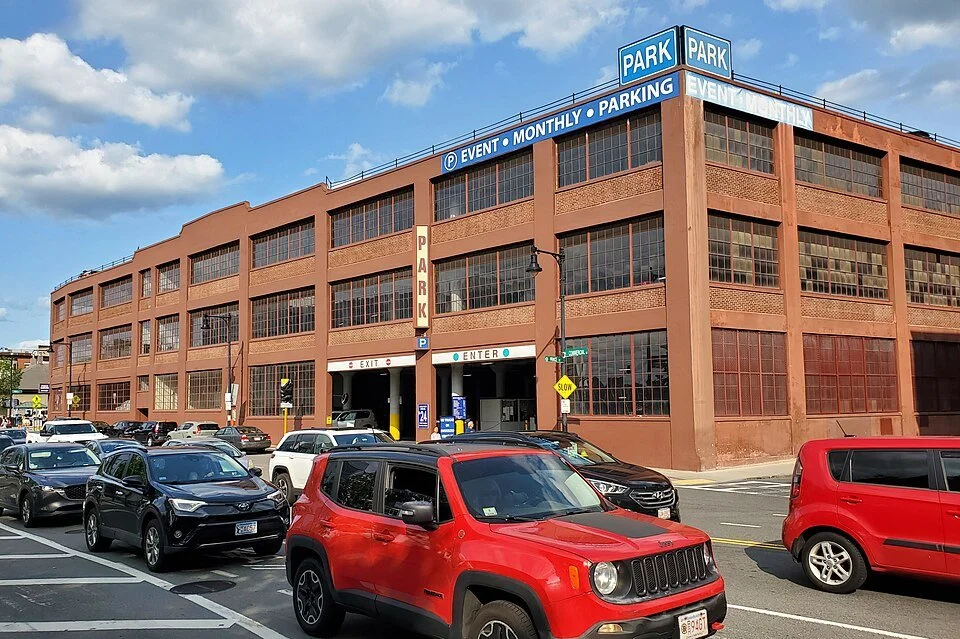
The North Terminal Garage, at 600 Commercial Street, in Boston’s North End. Built in 1925, it’s one of the few such surviving parking facilities from that era in the United States.
Slightly edited from article in The Boston Guardian.
Photo is from elsewhere.
(Robert Whitcomb, editor of New England Diary, is chairman of The Guardian.)
By Brandon Hill
Last year, a wave of headlines drew attention to the rising cost of permanent parking in Downtown Boston when a parking space at the Brimmer Street Garage was listed for $750,000. That price, the high end of luxury parking spaces, drew attention as an outlier, but what once felt extreme for parking pricing has increasingly become normalized.
Rene Rodriguez, senior vice president at the Cabot & Company real- estate firm and the agent who eventually sold the Brimmer Street spot for $600,000, says set a record at that garage.
Just hours before being interviewed for this story, Rodriguez closed on an off-market parking sale at 74 Commonwealth Avenue for $425,000. He said he’s been working in the market for 28 years and recent years have seen the market for deeded spaces in areas like Back Bay, Beacon Hill and the South End steadily tighten.
That recent sale, he said, reflects how many high-end parking deals now happen quietly without ever being publicly listed.
“The way those spaces normally work is the attendants in the garage keep a list of people who are interested in purchasing parking there, and when a seller says that they want to sell their space, they call the next person on the list,” Rodriguez said. “They’re not necessarily priced to market, and they’re not exposed to market forces.’’
It’s difficult to determine what might be considered a “market rate” for permanent parking for those in the market to buy. Two years ago, The Boston Guardian reported the sale of permanent spaces downtown ranging from $150,000 to $500,000 and that range remains broadly true, while it becomes more common for sales to creep up to and over that top end.
“Wilkes Passage Condominiums, in the South End, has a garage attached and you’re allowed to sell the spaces separate from the condominiums upstairs. However, they can only be sold to South End residents,” Rodriguez said. “Just seven or eight years ago, those spaces were trading for $50,000 to $80,000, and now the minimum purchase price is $150,000. It’s easy to sell, but those prices have gone up considerably.”
Many deeded spaces are sold with the purchase of a condo, so they can be hard to value, but Rodriguez said that’s often a deal-breaker on the sale of the property.
“In Beacon Hill, most of the houses do not have parking. You’re starting to find townhouses there priced from $10 million to $50 million and up, and at that point, people demand parking,” Rodriguez said. “It’s convenient, but at that point it’s also an investment because you could be sitting on a $15 million house and they’re going to pass it over because it doesn’t have parking.”
Still, he cautioned that these spaces are not easy investments. “You can’t finance them. You need to find cash buyers for them,” he said. “It has to have its own plot plan, a separate tax bill to be able to sell it.”
While the city had not returned a request for comment as of the date of this publication, Rodriguez said that city policies like the Downtown Parking Freeze have little to no effect on the sale prices of permanent parking spaces.
Under rules dating back to the 1970s and administered by the Air Pollution Control Commission, the freeze caps the number of off-street commercial parking spaces in the downtown area at 35,556, with 4,188 spaces available, as of July 17, 2025, that developers or property owners can allocate for new or expanded parking facilities. This reflects only a slight change from the 4,869 spaces available when The Boston Guardian reported this story in 2024.
Residential parking remains exempt from the commercial space cap, but anyone planning new shared or public commercial spaces downtown must navigate the permit process and the limited supply of “freeze bank spaces.”
“Freeze bank spaces" refer to a specific inventory of off-street parking spots held by a regulatory body—such as the City of Boston Air Pollution Control Commission— not currently in use but that can be allocated to developers or property owners for new or expanded parking projects.