Treasuring the Blackstone Valley
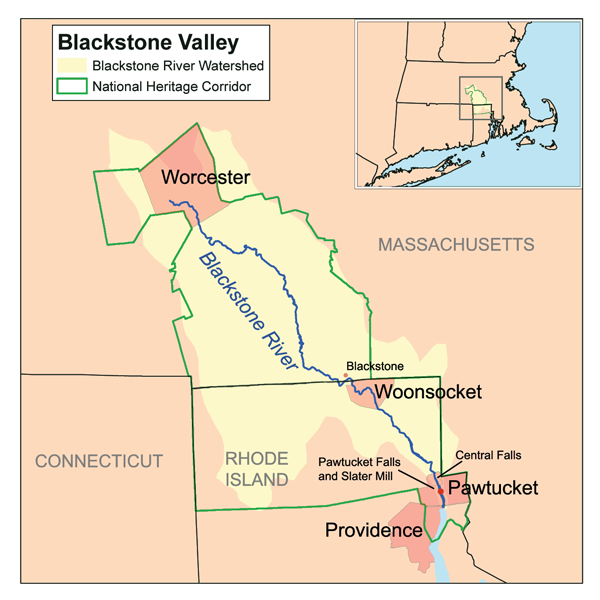
— Map by Karl Musser
From ecoRI News (except for map above
Members of some of the many nonprofits invested in the lower Blackstone River wish to respond to the article Hidden in Plain Sight: Neglect Along Lower Blackstone River and share a more optimistic view of the river and the incredible work that is ongoing. We’d like to clarify the record that partner organizations believe in coalition-building and are active, coordinated, and committed to making the Blackstone watershed a better place for us all to live, work, and play through our dedicated efforts around restoration, stewardship, and access of this Blackstone River. We recognize that our future depends on a healthy watershed – for recreation, tourism, economic development, and public safety.
There has been an incredible history of grassroots organizations in the Blackstone River Valley that have made great strides in cleaning and protecting the Blackstone River (just look up ZAP the Blackstone in 1972 – it wasn’t just a one-time effort; it still stands as the largest one-day clean up event in U.S. history, removing 10,000 tons of debris from the river), but due to low capacity from communities and organizations, those efforts were opportunistic instead of comprehensive. There was a need for a centralized group with sustained internal capacity to organize across the 475-square-mile watershed, encompassing a population of more than 1 million people along the river’s 48 miles – much like the Woonasquatucket River Watershed Council, Mystic River Collaborative, and many others have done so successfully in other regions.
The Blackstone Watershed Collaborative began in 2021 to serve as an umbrella organization to encompass the 100+ diverse existing partners already committed to protecting the river, including nonprofits, state agencies, tribes, and others that have been working tirelessly for decades to improve the health of our region. Capacity building, convening through our monthly, open public meetings, and supporting shared priority projects remain a central role that the Collaborative provides from Worcester to Pawtucket. (Need help on something related to improving our shared watershed’s resilience? Let us know – we respond to nearly a hundred technical assistance requests each year.)
While we might be pretty new, we interact with over a thousand people each year through fun events, informative webinars, direct community support, and more. We also partner together across existing groups that have worked for half a century and learn together – including the Blackstone River Watershed Association, established in 1969; Blackstone River Watershed Council/Friends of the Blackstone (1990); Blackstone River Coalition (2007); and Blackstone Valley Tourism Council (1985). We know, there are a lot of groups and it can be confusing – that’s why we recently created a new page explaining each Blackstone group’s mission and what they do.
The article noted that it would have been helpful for the Collaborative to bring together partners and shape the National Heritage Corridor in the 1980’s – and it sure would have been, but it didn’t exist for another 40 years. However, we work closely with those organizers – including the subsequently formed Blackstone Heritage Corridor nonprofit – and are using our coordinating power to seek a Wild and Scenic Designation for the Blackstone River, which would similarly bring national attention and funding to the region to improve its natural and cultural resources. This is especially important when considering equitable access to those resources, which the Collaborative is working to improve, including through their paddling guide and free programming and Mish(Kittacuck)sepe Restored work to identify new or retrofitted access points.
The article states, “The Blackstone has a similar course [to the Woonasquatucket]; its southernmost cities, such as Pawtucket and Central Falls, mirror the demographics of Olneyville, while its northern watershed borders some of the most sparsely populated parts of southern New England.” However, the Blackstone has significant areas of environmental justice (EJ) populations, starting at its headwaters in Worcester, Mass. The 2020 Environmental Justice Populations Map shows EJ block groups including minority, income, and English isolation. It continues to run through pockets of EJ populations in Millbury, South Grafton, and Blackstone, Mass. In R.I., each community along the river includes some EJ populations. These communities across the watershed often lack capacity to work across jurisdictions – another role the Collaborative serves, to bring people together across boundaries.
Due to its steep nature, dropping approximately 438 feet in 48 miles, the Blackstone was a home of the Industrial Revolution – damming the river and using it for water power to run textile mills, using the river only for our own benefit, to the water’s detriment. According to the Blackstone River Valley National Historical Park, there were around 40 dams built on the Blackstone River, 22 of which remain – nearly one every two river miles. These dams create a barrier to fish migration, trap legacy contaminants such as heavy metals, create warm impoundments, and increase flood risks to adjacent communities. The Collaborative is working with numerous partners to study the river’s dams and create a plan to improve natural hydrology as well as outline ways to enhance recreational access to the river through their Mish(Kittacuck)sepe Restored project. The project also will identify priority areas to improve free, equitable public access as well as priority dams whose removal could benefit the local ecosystem, economy, and community resilience.
As another part of that project, we’re working with Horsley Witten Group to create the first study of the flow of the river and canal to better understand opportunities for river improvements in both flood and drought conditions. The Collaborative has met with each of the communities along the river’s mainstem to incorporate local plans and goals into this effort and has also reviewed dozens of historic documents to build from past efforts around restoration and stewardship in the Blackstone Valley. In fact, the Collaborative has taken on several large-scale complex projects to improve conditions for all watershed residents, including working with Central Massachusetts Regional Planning Commission to create a 9-element Watershed Based Plan to document existing watershed conditions, create water quality goals, and make a plan for implementation of projects (our first public meeting is coming up in March; stay tuned).
Near Pawtucket, where this article focuses, the Collaborative leads a Fish Passage Community Advisory Committee (CAC) to help migratory fish return to the Blackstone River for the first time in over 200 years – a goal that has been identified in local, regional, and federal plans for decades. We’re working alongside numerous partners including the Narragansett Indian Tribe, the Hassananmisco Nipmuc Band, the National Park Service, Rhode Island Department of Environmental Management (RIDEM), the City of Pawtucket, the Blackstone Watershed Council, Save The Bay, The Nature Conservancy, and many others. Building from our partners’ work over the past 30 years, the group has established plans and applied for more than $20 million in funding to create the first fish passage project on the main stem of the Blackstone River at Slater Mill and Main Street in Pawtucket.
Just upstream on the border of Central Falls, the CAC is working to explore alternatives to get fish through or around Elizabeth Webbing Dam. From there, the owners of Central Falls Dam, which is next in line and would be legally required under their federal energy license to construct passage for fish. Our goal is to allow these fish to access their ancestral breeding grounds at Valley Falls Marsh for the first time in centuries – supporting local tourism, ecology, recreational fishing, and indigenous connection.
To encourage community engagement and ensure transparency and collaboration are central to the project, the Collaborative has hosted a postcard writing campaign as well as three “fish parades.” We invite you to learn more and join us at our next fish parade with the Blackstone Valley Tourism Council on Saturday, May 16, where you’ll be able to kayak or join the Explorer riverboat to experience those spawning grounds yourself and hear more about this project. There’s nothing like seeing a river from the water to truly understand and appreciate it, which is why we work with partners to host a source-to-sea paddle each September to keep eyes on this invaluable resource we all share and identify ways to improve it – including a free public paddle starting from Pawtucket’s Festival Pier, ending in a free public celebration at Narragansett Brewing.
The Blackstone River is not an “inconvenient backyard.” It’s a beautiful recreational and ecological treasure that we need to all recognize and embrace in order to turn this river’s decades of abuse into a future of stewardship. For millennia, this river was a clean home to fish and wildlife and the original stewards of this river, including the Narragansett, Aquinnah, Wampanoag, and Nipmic tribes, who saw the river as a relative to be cared for, to be thankful for, and to honor for its incredible offerings. The Collaborative’s goal is to transparently work together through its numerous partners across the watershed to build a groundswell of support, love, and understanding of this often overlooked waterway and recognize its beauty. We hope you’ll join us in seeing the Blackstone River not as an inconvenience, but as an opportunity, and explore how you can steward and care for this dear relative that we all depend on.
This article was signed by the staff and board members of the Blackstone Watershed Collaborative and Blackstone River Watershed Council/Friends of the Blackstone.