Those quiet Quakers
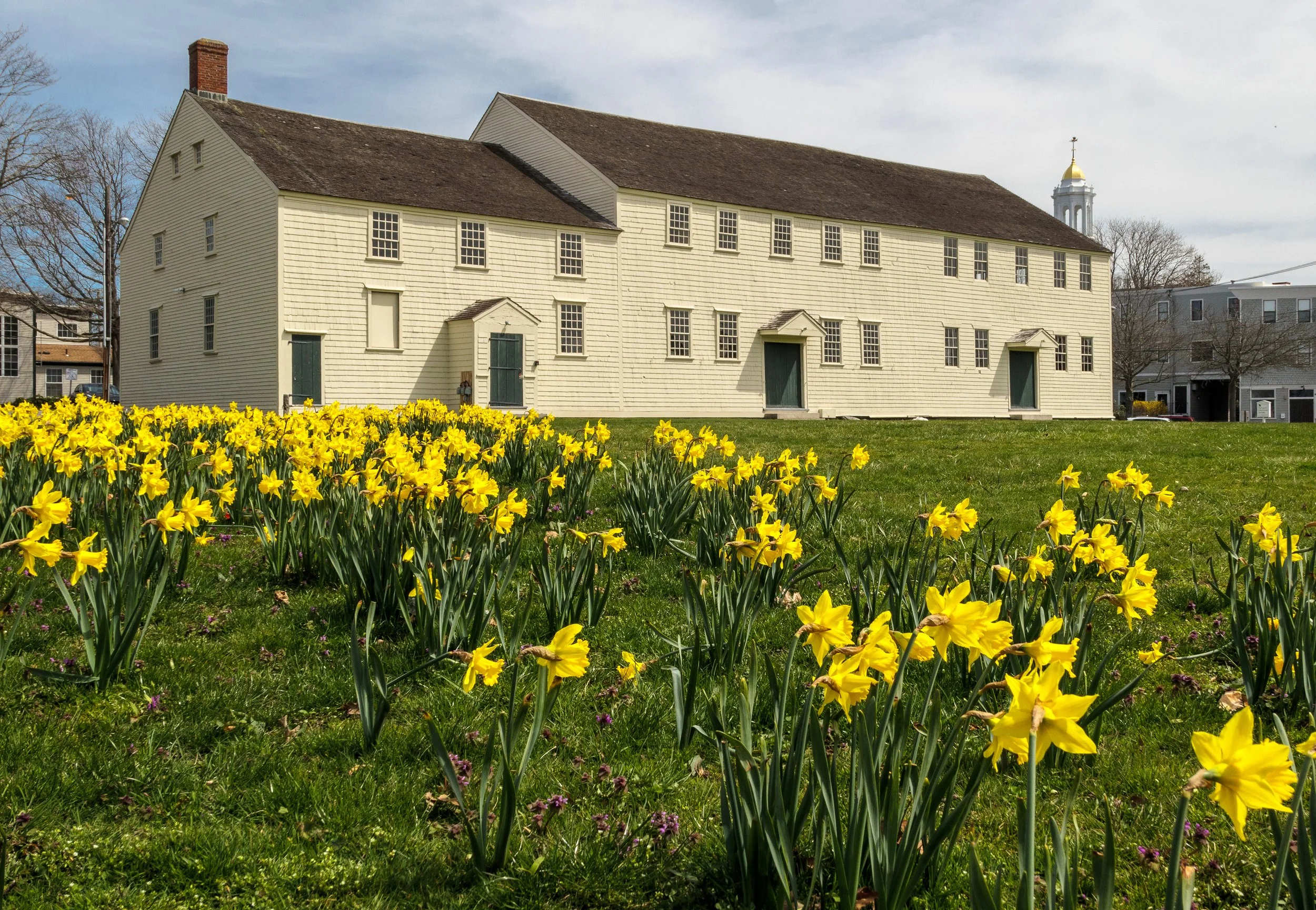
The Great Friends (Quaker) Meeting House, in Newport, R.I., built in 1699. It’s now a museum. Many Quakers fled the Massachusetts Bay Colony to seek refuge in Rhode Island,
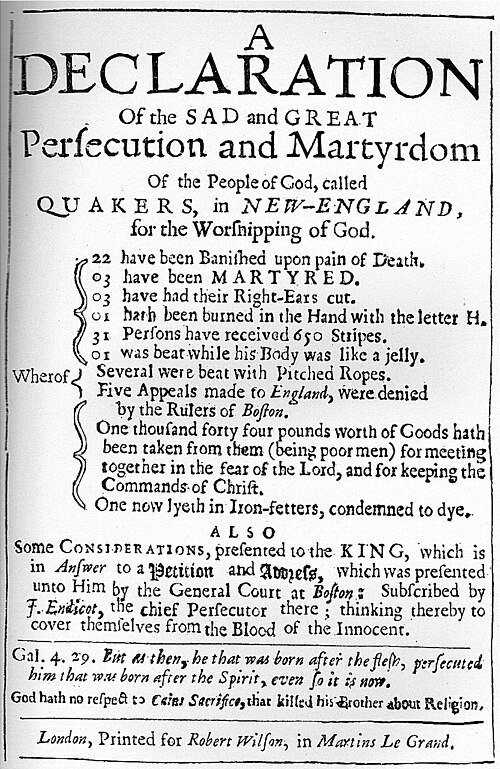
17th Century publication
Text from Robert Whitcomb’s “Digital Diary,’’ in golocal24.com.
While driving by the Friends (Quaker) Meeting House in West Falmouth, Mass., on Cape Cod, I always remember attending a memorial service there in 1992 for a great aunt, Gladys Tapley. Many of my Cape Cod ancestors were Quakers, having fled there in the late 1660’s from the Boston area to escape persecution by Puritans.
We had a French friend with us at the service, which, after being opened by a moderator, consisted of people standing up from time to time with reminiscences about this nice old lady, interspersed with stretches of silence. The moderator ended the event after a little less than an hour.
There was no mention of God or Jesus during the service. After the service, we repaired for drinks at an old family house. Our French friend Nicole, with a Catholic background, was bemused by the service, asking “Where is the religion?’’ and quipping that at our next such family event, “I will be the mourner.’’
Quakers believe in “the inner light,’’ meaning the personal awareness of something like a divine presence, without clergy or rigid reliance on scripture. And as with being an agnostic or atheist, Quakers accept the mysteriousness of life with courage, unlike, say, some “charismatic Christians” who, fearful above all of death and hell, seek assurances by trying to take the Bible’s admonitions literally, even though “The Good Book’’ is filled with contradictions and mistranslations.
Having been compelled in school to read the whole King James Bible, I’m often surprised at the ignorance, or eager self-delusion, of those who say they believe every word of it, and yet some don’t seem to even know that The Ten Commandants are a Jewish, not a Christian creation. But then some of these “Holy Rollers’’ are actively anti-Semitic. They’re also ripe suckers for corrupt and fascist politicians and evangelical con men, some of them rich TV performers, seeking to separate their naïve followers, many of them poor, from their money.
It takes a bit of courage to directly face the inscrutability of existence, with its pleasures, pains and confusions. Some lack such courage, while claiming that they know the designs of their version of God. It’s their way of dealing with existential anxiety.
Then there are the declining “mainstream Protestants’’ – Methodists, Congregationalists, Episcopalians, etc. -- many of whom lack the faith of their ancestors and may accept that the universe and any divine direction are unknowable but still occasionally go to church out of habit or because they like, say, the hymns and/or the beautiful language of the liturgy. When I was around 12 I asked my father whether he believed the theology (which is basically Catholic) presented at the Episcopal church we attended. “Well, I like a lot of the music,’’ he responded.
The mainstream Protestant denominations have a hard time competing with the intense show biz of some evangelical sects, concentrated in the South and Midwest. The mainstreamers are too calm, cerebral and skeptical to be good recruiters. Still, you can call them “cultural Christians.’’