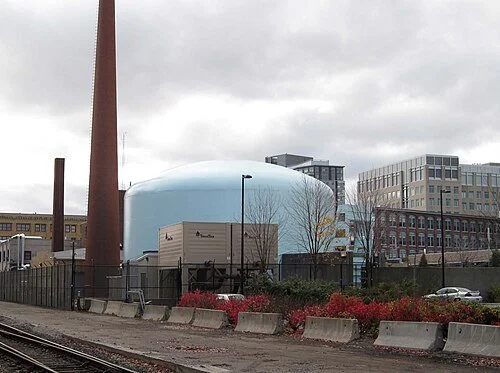
The MIT Nuclear Research Reactor (MITR), in Cambridge, Mass., is the fourth-oldest operating reactor in the country.
The first iteration of the reactor, MITR-I, operated from 1958 to 1974. The reactor was then upgraded to a new design, MITR-II.
There are plans to convert the reactor to use low-enriched uranium by 2027 instead of high-enriched uranium to mitigate the international proliferation risk.
WEST WARWICK, R.I.
The Trump administration last week announced and appeared to crow over an agreement with Saudi Arabia to help the kingdom not only to build nuclear-power plants, but also to enrich the uranium fuel. The plan has become a bit murkier since Trumps wants to make Saudi diplomatic recognition of Israel part of the deal.
There is no reason for the Saudis to enrich uranium. There are plenty of willing suppliers of enriched uranium and more are coming online.
Besides, it has always seemed curious that Saudi Arabia, with its huge fossil reserves and its abundant, reliable sunshine, should want to stress its industrial infrastructure with a nuclear-power program when it clearly doesn’t need it.
We are at war with Iran not because of nuclear power, but because it refuses to abandon its enrichment ambitions.
Enrichment raises the potency of uranium fuel by increasing the amount of the fissile isotope Uranium-235.
Today’s generation of light water reactors — the workhorses that provide about 20 percent of U.S. electricity — use uranium that has been enriched by 3 percent to 5 percent. The uranium for the new small modular reactors will be enriched by about 20 percent
.
Weapons-grade enrichment is generally considered to be uranium that has been enriched by over 90 percent. But Ernie Moniz, who was secretary of energy in the Biden administration and is a nuclear physicist, told a conference organized by the Earthshot Foundation on June 8 that “You can make a pretty good bomb” with 60 percent- enriched uranium, a reference to the Iranian stockpile that we are trying to destroy.
I have been covering nuclear power – and by extension nuclear proliferation — for over 50 years. For most of that time, Saudi Arabia has hankered for nuclear power and enrichment. The question is why.
When I began my coverage, there was great fear of nuclear proliferation — that more counties would get nuclear weapons. Those who have, in that time, are Pakistan and North Korea. China acquired a weapon in 1964.
Israel has never declared itself nuclear-armed, but the arms control community believes it has a weapon and that the United States helped it get one years ago.
The original nuclear weapons nations, the United States, Russia, Britain and France, held the technology close and were loath to see any country step in that direction.
But making civilian nuclear power available to the world has been a plank of U.S. foreign policy since President Eisenhower launched the “Atoms for Peace” program in 1953.
One of the beneficiaries of that program was Iran. In fact, before the Iranian Revolution of 1979, American companies, led by Bechtel, the giant engineering firm, were set to build reactors across Iran.
America’s global nuclear policy was, de facto, nuclear civilian power, yes, nuclear enrichment, no. It was pretty sensible and has worked well. Now it is set aside.
The U.S.-Saudi Arabia deal comes at a time when many nations would like to start down the weapons path. The wars in Ukraine and Iran are a stark inducement to go nuclear.
If Ukraine hadn’t given up its nuclear weapons, would Russia have invaded? Almost certainly not. If Iran had a proven bomb, would Israel and the United States have attacked? I think not.
Nonetheless, every nuclear weapon is a threat to world security. The danger isn’t only that desperate or ambitious countries will use them aggressively, but also that the danger of accidental detonation is ever-present.
The United States and the Soviet Union were so concerned about this that they shared safety technology. For example, when we developed an insensitive TNT for the trigger of a nuclear device, we shared this with the Russians. Neither side wanted a thermonuclear war triggered by someone dropping a weapon off a forklift.
Secretary of State Marco Rubio would seem to be so busy that he hasn’t had time to read up on the history of proliferation.
Rubio, declared about the U.S.-Saudi Arabia deal, “Suffice it to say that any agreement that we are going to make with any country in the world on civil nuclear is going to be one that will have safeguards in place to ensure that it can’t be turned into a weapons program.”
Rubio might want to take a few minutes to ponder these three things: How it is that we came to be at war with Iran, how Iran started with civilian power and went on to weapons, and how safeguards were bypassed.
Saudi Arabia’s neighbors in that volatile region will soon be at Rubio’s door looking for nuclear power -- and enrichment. First up, expect Turkey, then Egypt.
If Congress approves Rubio’s deal, then a nuclear-arms race in the Middle East is more or less assured. Is there a worse place to have that happen?
Llewellyn King, an international energy-sector consultant and commentator, is executive producer and host of White House Chronicle, on PBS. His email is llewellynking1@gmail.com , and he’s based in Rhode Island.