William morgan: When the names of Railroads Really meant something
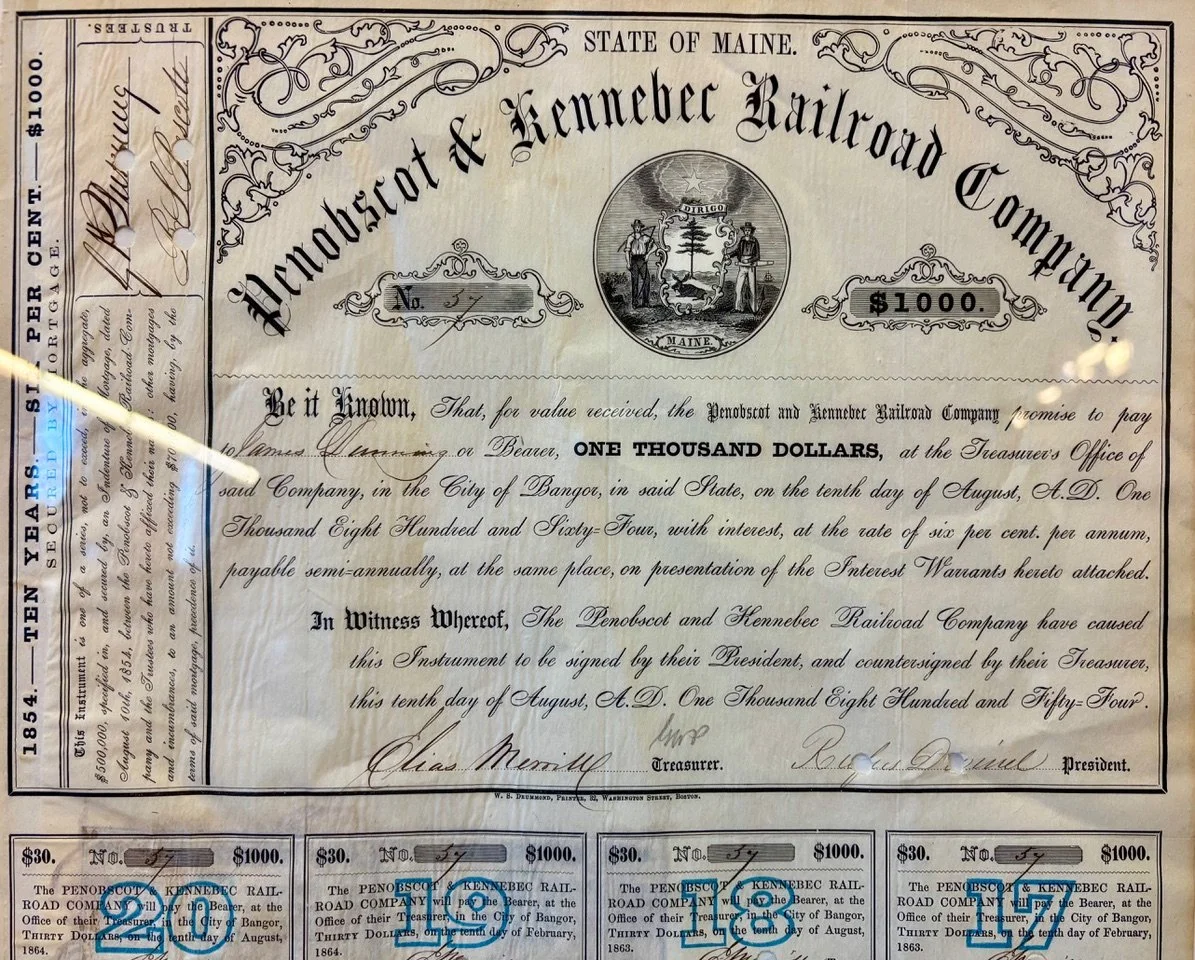
A framed initial stock offering of a mid-19 Century Maine railroad is for sale for $70 in a New Bedford antiques shop.
.
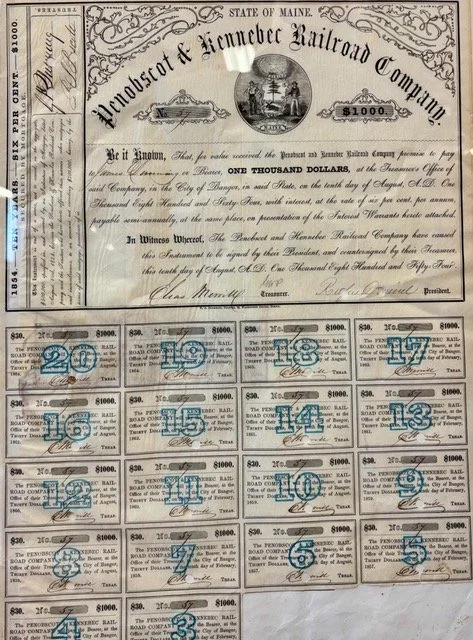
Chartered in 1845, the Bangor & Kennebec Railroad was capitalized at $1 million, with 10,000 shares valued at $100 a piece. The attached coupons allowed an investor to recoup $30, plus interest, twice a year at the railroad’s head office, in Bangor. Two coupons were redeemed from this certificate.
Typical of many railroads in America of the time, the Penobscot & Kennebec had a very short route of just 55 miles, connecting the mill town of Waterville on the Kennebec with Bangor, at the head of Penobscot Bay. Although the distance was short, the passenger and freight line was crucial to connecting eastern Maine timber and agricultural products to Portland, much faster and more dependably than by water. In 1862, the Penobscot & Kennebec was amalgamated with the Androscoggin & Kennebec, along with the Bangor & Piscataquis, into the Central Maine Railroad in 1862.
Along with the long-gone days of wood-burning locomotives, and handsome stock certificates that were works of art, the Penobscot & Kennebec recalls when railroads (and steamship lines and manufacturing companies) proclaimed their businesses with names that were both descriptive and romantic. Remember the major railroads, such as the Pennsylvania, the New York, New Haven & Hartford, and the Chesapeake & Ohio? Their history has been tarnished by forcing bland monikers on them–Conrail, Amtrak, and CSX. An anodyne corporate, computer-generated label is no match for the mantle of two mighty Maine rivers redolent of our Native American heritage.
William Morgan, a Providence-based writer, including of many books, went to camp in Maine in 1955, taking the Boston & Maine from North Station to Gardiner on the Kennebec River.