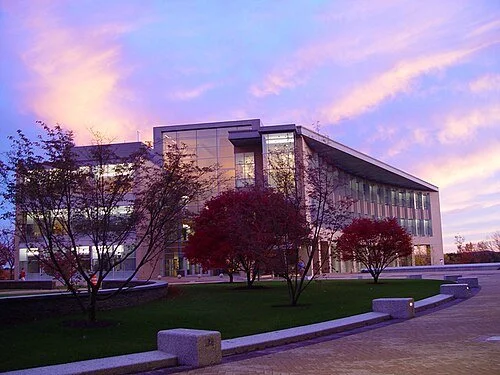
Milas Hall, at the Olin College of Engineering, in Needham, Mass.
WEST WARWICK, R.I.
I am a sucker for big engineering. I respond to it the same way other people respond to a great painting or a superbly sung opera.
You may be enthralled by a football game. But if one of those tall, skinny skyscrapers is going up in New York City, I am at the sidelines, watching with rapt attention.
I marvel at how the engineers keep those buildings standing, allowing for the sway in the wind and designing elevators that are fast enough to compensate for a long ride into the sky.
I get sentimental over nuclear-power plants, nearly lose it when looking at a great ocean liner such as the Queen Mary 2, and see the beauty and wonder of an aircraft carrier.
Yes, I like big iron, but I also love such small, intricate things as mechanical watches.
The simple universal joint in a car axle inspires me. How it solves a problem: One wheel turns faster than the other in a turn. That is clever stuff and routine.
I am more at odds with computer engineering. If I can’t see it, I don’t love it. I could see the engineering in a typewriter, but the engineering in the computer on which I am writing this is spooky science to me.
I love engineering because it moves the human project forward, improves our lot on earth and now points us to the distant sky, to the Moon and Mars and way beyond.
Poets – writers, my people — can talk about the spacious firmament, but engineers put us there. I am amazed at how airplanes leave the ground in defiance of logic.
When I was a private pilot and “rotated” at takeoff speed, I was always thrilled that the aircraft left the ground. I didn’t calculate it as a power-lift-equation. For me, it was the mystery of engineering — and life — in my hands.
I preferred to think of it as engineered magic and I, by moving the joystick back a few inches, could leave the ground and fulfill my desire, and that of humans for thousands of years, to fly.
The imagined future is with engineers, not poets.
Which gets me to this point: There aren’t enough engineers in Congress. It is a place dominated by lawyers and public-affairs professionals. It does seem to me that many of the challenges facing the nation are at heart engineering, not legal.
Engineers build and fix. Lawyers dispute, refute, argue, and settle. Compromise is in their DNA. Lawyers will struggle — as do journalists with whom they have an affinity -- to understand AI, data centers, space science, the electric grid, small modular nuclear reactors, carbon capture, sea level rise, and drone warfare.
When it comes to crafting law to deal with those and myriad other technical subjects, an engineering degree, it seems to me, would be more useful than many others.
There are no accurate tabulations yet of the professional backgrounds of the elected members of the brave new 120th Congress. But in the past, only 1-4 percent have had an engineering background.
The problem of balance in Congress has been with us for a long time. It is a logical progression to go from the courtroom to the legislature. It is less so to leave a construction site or a drafting computer for politics.
It is worth asking if we are getting the best of our talent in politics? I would say no, and no again.
Running for Congress is a horrible experience. You and your family, even your pet, will be vilified, denigrated, lied about, and held up to ridicule. You will be forced to raise a lot of money and to endure the pleadings of shafts of people.
Alas, the cream of the nation, including its imaginative engineers, stays away.
There is a talent deficit in Congress along with the fiscal one. What has just happened in the election hasn’t solved that challenge.
On X: @llewellynking2
Llewellyn King, an international energy-sector consultant and former publisher, is executive producer and host of White House Chronicle, on PBS. He’s based in Rhode Island.